• Skip to primary navigation
  • Skip to main content
  • Skip to primary sidebar

John August

  • Arlo Finch
  • Scriptnotes
  • Library
  • Store
  • About

John

Pilot School

April 13, 2009 Reading, Television

Pilot scripts for just about every TV show you can think of, [all in one place](http://sites.google.com/site/tvwriting/).

An absolute gold mine. If you’re thinking about writing TV, clear your schedule and start reading. (Thanks to [Jim Campolongo](http://www.imdb.com/name/nm2153286/) for the link.)

Speaking in Rancho Mirage

April 11, 2009 News

If you live in the Palm Springs area, you can join me Tuesday night for a lecture/screening thing at the [Rancho Mirage Public Library](http://www.ranchomiragelibrary.org/).

Tuesday, April 14
7:00pm – 8:30pm

I’ll be showing clips from my movies (and one that isn’t really mine), talking about the process, and answering questions.

[The event](http://www.ranchomiragelibrary.org/events/programs.aspx) is hosted by The Friends of the Rancho Mirage Public Library, in association with the Palm Springs International Film Society.

Should I write a straight-to-DVD knockoff?

March 27, 2009 Film Industry, Genres, QandA

questionmarkI have a friend who is high up in a production company that specializes in straight-to-DVD low-budget versions of blockbuster movies. As a joke I pitched him a few ideas. Well, he loved them and asked me to write up the scripts.

On the one hand, this could be a great step in the right direction for my career in writing. It would mean getting some real credits to my name. On the other hand, I am afraid I would be labeled as a hack for writing this type of knock-off movie.

So my question is: Which is better? Getting my foot in the door with a bad movie, or hold on to my integrity and look the gift horse in the mouth? Could a bad movie credit hurt your chances in the future?

— Rob
Wilmington, Delaware

James Cameron directed Piranha Part Two: The Spawning. Everyone starts somewhere.

Yes, sure, it would be great if your first paid writing job was a quality movie at a reputable studio, complete with WGA coverage. But don’t turn up your nose at actual paid writing for a company that makes movies. You probably don’t want to make schlock for a living, but you can learn a lot even while making less-than-awesome movies.

Do it. Make it as good as possible for the genre. Then use it as a foothold to reach higher.

Show your work, pt. 2

March 16, 2009 Follow Up, Geek Alert, Rant

geek alertFollowing up on [last night’s post](http://johnaugust.com/archives/2009/show-your-work), it occurs to me that designing and programming for the web also has an aspect of showing your work. Nearly every browser lets you “View Source,” showing how the page was constructed…up to a point.
For example, if you View Source on the new [Answer Finder](http://johnaugust.com/answers) I built, you can see the JavaScript (and jQuery) that drives the menu and shows/hides the various sections.

What you can’t see is the PHP on the server that generated those sections. In my case, this is a good thing, because the PHP is so awful and kludgy that I can’t explain or defend why it works.

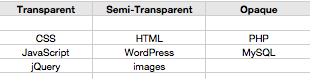
So to make that one page, I’m relying on a bunch of technologies with vastly different levels of transparency.

transparencyThe “transparent” technologies are available for anyone interested in looking. And that’s mostly good: Peeking beneath the hood is a great way to learn how a technology works. I often find myself opening the CSS for sites I like to see how they’re constructed. ((Keep in mind that you can learn bad habits this way.))

I’m classifying HTML as semi-transparent because so much of the HTML you see when you “View Source” for a site is generated by scripts running on the server, and it’s not automatically clear how or why. WordPress, for example, mixes in at least four parts (Header, Content, Footer and Sidebar) to make any given page. Someone familiar with WordPress might be able to deduce a basic structure, and figure out which parts were generated by The Loop. But in some cases it’s arbitrary. For example, the category links at the bottom of most pages on this site could be hard-coded or generated on the fly, and you wouldn’t be able to tell.

While you can find a lot of information about the images used on a site, including where they’re stored, you don’t necessarily know how they were generated. The chart above, for example, is a .png made from a snapshot of a Numbers document.

In the fully-opaque category are PHP and MySQL, who do most of the heavy lifting for the site but are completely insulated from the user.

Traditionally, programmers have been able to disappear behind the opacity of a compiler. Designers could hide behind the printing or manufacturing process. With the web, the process behind the product is much more visible.

(End of Geek Alert)
=====
The same thing is happening to movies. Not too long ago, a movie came into existence in popular culture just shortly before its release, when the first ads and trailers started running. I didn’t know anything about Die Hard before I saw a trailer. I saw The Blair Witch Project without any idea who made it or how.

Now, long before the marketing begins — before production even begins — details of projects spill across the internet for consumption and criticism. Scripts leak. Photographers sneak pictures of the set, or the costumes. The omission of a giant squid becomes the focal point of conversation for a movie that doesn’t yet exist.

For movies and television, I’m not sure we’re better off “showing the work” in advance.

I appreciate reading American Cinematographer to see how Robert Elswit lights There Will Be Blood, but I don’t read those articles before seeing the movie, lest I get too distracted by those details when I watch it. Likewise, I wish I didn’t know what I know about Terminator: Salvation or Dollhouse. It’s not insider knowledge, but rather the media reporting on the media.

This isn’t transparency, an invitation to come look inside. It’s forced exposure. It’s uncomfortable, and by nature we try to avoid uncomfortable things.

« Previous Page
Next Page »

Primary Sidebar

Newsletter

Inneresting Logo A Quote-Unquote Newsletter about Writing
Read Now

Explore

Projects

  • Aladdin (1)
  • Arlo Finch (27)
  • Big Fish (88)
  • Birdigo (2)
  • Charlie (39)
  • Charlie's Angels (16)
  • Chosen (2)
  • Corpse Bride (9)
  • Dead Projects (18)
  • Frankenweenie (10)
  • Go (29)
  • Karateka (4)
  • Monsterpocalypse (3)
  • One Hit Kill (6)
  • Ops (6)
  • Preacher (2)
  • Prince of Persia (13)
  • Shazam (6)
  • Snake People (6)
  • Tarzan (5)
  • The Nines (118)
  • The Remnants (12)
  • The Variant (22)

Apps

  • Bronson (14)
  • FDX Reader (11)
  • Fountain (32)
  • Highland (75)
  • Less IMDb (4)
  • Weekend Read (64)

Recommended Reading

  • First Person (87)
  • Geek Alert (151)
  • WGA (162)
  • Workspace (19)

Screenwriting Q&A

  • Adaptation (65)
  • Directors (90)
  • Education (49)
  • Film Industry (489)
  • Formatting (128)
  • Genres (89)
  • Glossary (6)
  • Pitches (29)
  • Producers (59)
  • Psych 101 (118)
  • Rights and Copyright (96)
  • So-Called Experts (47)
  • Story and Plot (170)
  • Television (165)
  • Treatments (21)
  • Words on the page (237)
  • Writing Process (177)

More screenwriting Q&A at screenwriting.io

© 2026 John August — All Rights Reserved.