• Skip to primary navigation
  • Skip to main content
  • Skip to primary sidebar

John August

  • Arlo Finch
  • Scriptnotes
  • Library
  • Store
  • About

John

The scorpion and the frog

April 9, 2012 Rant

Most versions of this parable run something like this:

> Unable to swim, a scorpion asks a frog to carry him across a rising river.

> The frog worries that the scorpion could sting him. The scorpion argues that if he stung the frog, the frog would sink and the scorpion would drown as well.

> Convinced, the frog agrees and lets the scorpion climb on his back. Halfway across the river, the scorpion does in fact sting the frog, dooming them both.

> “But why?” asks the frog.

> “It’s just my nature,” says the scorpion.

It’s a useful parable that illustrates several principles:

* Creatures can’t change their basic instincts, even for self-interest.

* It’s folly to think you’ll be the exception to the rule. (He’ll keep his word just this once.)

* Scorpions are dicks.

As parables go, it feels more inherently dramatic than most: trust! betrayal! poison! Compare that to another favorite: The tortoise may win the race, but his life was never in danger.

There’s nothing wrong with the scorpion and the frog. But as screenwriters, let’s stop having characters actually recite it. It’s been done before. [A lot.](http://www.enotes.com/topic/The_Scorpion_and_the_Frog) So now it feels like a hacky and desperate way to make villains seem cool by rationalizing their actions.

A friend writes:

> Really was digging the MAGIC CITY pilot until the mob boss dude asks Jeffery Dean Morgan, “Do you know the story of the scorpion and the frog?” to which, of course, JDM replies, “No, I don’t.” — and then the fucking mob boss proceeds to tell the entire fucking parable.

> Can a brother get a moratorium on that bitch or what?

Perhaps a brother can.
The pressure of PG-13

March 28, 2012 Film Industry, Genres

Rich Juzwiak looks at how PG-13 has become the [rating you want](http://gawker.com/5896566/the-reign-of-the-pg+13-rating-sanitized-safe-and-worth-shitloads-of-money):

> It’s simple math, really: Movies rated PG-13 make more money on average ($42 million per picture versus G’s $38.5 million, PG’s $37 million and R’s $15 million). Getting blessed with PG-13 ensures that the odds are ever in your favor. In this economy, who wants to gamble?

To some degree it’s a self-fulfilling prophecy: as studios make most of their blockbusters PG-13, most blockbusters will be PG-13.

While there are always notable exceptions (Safe House is a recent one), in most cases it doesn’t seem worth arguing anymore: if you’re making an expensive movie that could conceivably be less than an R, it probably *should* be PG-13 — and that comes at the scripting stage.

From personal experience, one of the worst things that can happen to your movie is to cut it down to a safer rating after you’ve shot it. It’s not just losing the F-words. It’s losing the moments that called for the F-words. If when writing the script you knew you could only say it once and in a non-sexual context, you would write scenes in a way that didn’t demand it.

Similarly, an R-rated action scene cut down to PG-13 feels neutered, while an action scene designed for PG-13 can plan for the absence of gore at the outset. People criticize the shaky-cam in The Hunger Games, but it was clearly a choice made from the beginning in order to show the feeling of violence without the bloodshed.

That worked out well for them.

Dialogue and dialog

March 26, 2012 Words

A few months ago, Stu Maschwitz and I were going back-and-forth about the syntax guide for [Fountain](http://fountain.io/syntax). I emailed him a correction:

> One search-and-replace: Dialog should be Dialogue. The Mac dialog box is an oddball. Happy to debate current and future usage, but every screenwriting text currently uses the “ue”.

We didn’t debate. We kept the “ue” on the end of dialogue.

But ever since I typed those sentences, I’ve been hyper-aware of this word in print and online. I think the trend is clear.

The “ue” is going away.

In ordinary newspapers and magazines, I’ve seen *dialog* used frequently.

> The goal is “a timely dialog,” said Lynne Greene, global president for the Clinique, Origins and Ojon brands at the Estée Lauder Companies in New York. [[NY Times](http://www.nytimes.com/2012/03/12/business/media/spotting-the-trends-before-they-break-out-advertising.html?_r=1&scp=1&sq=dialog&st=cse)]

> The hope is that they can run a two-track message operation, one that allows Obama to keep slightly above the fray even as the national dialog around his re-election effort becomes relentlessly negative. [[Time](http://swampland.time.com/2011/08/22/all-the-presidents-talking-heads/)]

Some dictionaries claim that *dialogue* is the British spelling, while *dialog* is American. But I’m pretty sure that’s wrong.

Rather, I think *dialog* came from its use in computers, specifically the Mac dialog box. As far as I can rememember, these little alert windows have never had a “ue” at the end. It’s not hard to imagine the designer/programmers leaving off the silent ending, either deliberately or inadvertently. *Dialog* fits nicely with *analog,* itself a tech-y term.

The “-logue” ending is clear sign that word has come through French from Greek (“logos” meaning word or thought). Here are a few others:

* monologue

* prologue

* epilogue

* travelogue

* catalog/catalogue

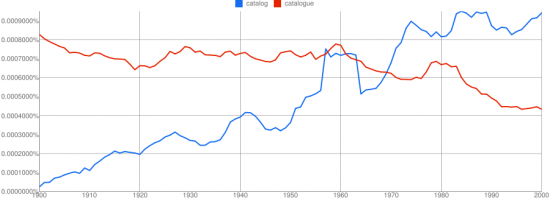
The last example feels like a good precendent, with the shortened version clearly taking over. This chart shows the use of *catalog* and *catalogue* in American books published in the 20th century:

usage chart

(Chart courtesy [Grammarist](http://grammarist.com/spelling/catalog-catalogue/).)

I think we’re approaching a similar crossing point with *dialog*. ((If you do the same Ngram comparison with dialog/dialogue, you get odd results that mostly show there were a lot of computer books published in the 1990s.))

Which one to use
—

For now, I’m sticking with *dialogue* for things related to screenwriting. Every book about the format uses the long version of the word, so there’s no urgency to switch.

Also, *dialogue* simply feels more literary. “Monolog” and “epilog” could be words, but they’re not currently in use, and look very wrong to me.

For computers, *dialog* seems like the right choice. (It’s almost always *dialog box* anyway.)

Breaking down Big Fish

March 25, 2012 Big Fish, Projects, So-Called Experts

A reader forwarded a link to this [structural analysis of Big Fish](http://thescriptlab.com/screenplay/five-plot-point-breakdowns/858-big-fish-2003), which attempts to break down my screenplay down into five plot points:

1. Inciting incident

2. Lock in

3. First culmination

4. Main culmination

5. Third act twist

It’s always strange seeing your work dissected by others, especially when they’re trying to fit a specific template with unfamiliar terminology. (I’ve never used or seen the term “first culmination.”)

In this case, I can’t disagree with the report’s overall accuracy — events in the script do happen on the pages listed — but I’m not convinced it’s a particularly helpful exercise.

What might be more useful is to compare what this report describes with what I actually intended when writing the screenplay.

> INCITING INCIDENT

> It’s been three years since Will Bloom (Billy Crudup) last spoke with his father Edward Bloom (Albert Finney), but he flies back home to see his dad, who is dying of cancer. Will enters his father’s bedroom and asks his dad to tell him the true version of the stories Edward has told all his life.

One could argue the inciting incident is really the fight at Will’s wedding, since that provides a point of focus for the conflict and sets up the central dramatic question: How can this father and son reconcile?

But as I pitched it and wrote it, I really did consider that first aborted bedside conversation as the inciting incident. The cancer diagnosis provides a ticking clock, and refines the question by adding urgency: Can this father and son reconcile in time?

> LOCK IN (End of Act One)

> In one of his stories, the young Edward (Ewan McGregor) leaves the small town of Ashton along with Karl the Giant; however, early on in their journey, they reach a crossroads: the longer, safer route and the shorter, more dangerous one.

Big Fish has two parallel stories: Edward in the past and Will in the present.

Edward leaving Ashton feels like the end of the first act (a character goes on a journey), but it doesn’t have much to do with the central dramatic question (father and son reconciliation). For example, if we omitted Spectre altogether, the Will-and-Edward plot line could be largely the same.

As I was writing it, I considered the witch’s eye a more significant moment. Young Edward learns how he is going to die, a detail that impacts both the storyline in the past (Edward no longer fears death) and the present (Edward is now dying).

> FIRST CULMINATION (Midpoint)

> [Edward works] at a circus for free under the condition that the ringmaster, Amos Calloway (Danny DeVito), will tell him one thing each month about his dream girl [Sandra Templeton].

I would agree that the focus of the middle of the movie is Sandra. I’m not sure which moment in the romance I’d single out as the most important, but the daffodils scene is a strong contender.

The movie is much more of a romance than Daniel Wallace’s novel, which didn’t have the circus, the war or most of the other obstacles on the path to true love. We spend a lot of time on Edward’s quest to find Sandra.

In the present day storyline, Will suspects his father has been cheating, and may have found proof. Both father and son have achieved goals — but they’re further apart than ever.

> MAIN CULMINATION (End of Act Two)

> Back in present day, Will is cleaning out his dad’s office and sees a document about Jenny from Specter. Thinking this is a woman in which his dad had an affair, Will drives to Specter and meets Jenny.

I always think of the end of the second act as “the worst of the worst,” the moment at which sucessful resolution seems absolutely impossible.

To me, that moment comes when Will learns his father has had a stroke. Jenny Hill has just told Will that his father has been faithful to his mother. Will would finally be able to have a conversation with his father about it — but because of the stroke, he can’t.

> THIRD ACT TWIST

> At the hospital, Edward […] wakes up, saying that this is how he dies but panics, unable to tell the story. Will then takes over his dad’s storytelling and begins telling an amazing fantastical story of how his father will die.

I agree that this is the crucial moment. Will has to create one of his father’s stories on the spot.

Also, I’d argue that this “how I go” moment shows how important the witch’s eye moment really was.

In early drafts of the script, Will didn’t tell the story directly to Edward, but rather told a similar story to Edward’s friends at the funeral. I’m eternally grateful to my smart producers for convincing me to try it at the bedside. That simple shift had a huge impact.

Does any of this matter?
—

Not really. I can’t even agree with myself which plot points should carry which labels, so it can’t be that important.

Far too often I see aspiring screenwriters struggling to make the great movies they see in their heads fit into proscribed templates. So I’m officially giving you permission to stop. Relax. You’ll be fine.

Theory is theory. Writing is real, and really hard sometimes.

It’s worth learning enough about dramatic theory so you can ask smart questions about your work — “How can I make things worse for my hero?” is always a good one — but you’re not required to answer every question or tick every checkbox.

And remember: If so-called experts really knew the secrets, they would be writing movies rather than selling books about writing movies.

« Previous Page
Next Page »

Primary Sidebar

Newsletter

Inneresting Logo A Quote-Unquote Newsletter about Writing
Read Now

Explore

Projects

  • Aladdin (1)
  • Arlo Finch (27)
  • Big Fish (88)
  • Birdigo (2)
  • Charlie (39)
  • Charlie's Angels (16)
  • Chosen (2)
  • Corpse Bride (9)
  • Dead Projects (18)
  • Frankenweenie (10)
  • Go (29)
  • Karateka (4)
  • Monsterpocalypse (3)
  • One Hit Kill (6)
  • Ops (6)
  • Preacher (2)
  • Prince of Persia (13)
  • Shazam (6)
  • Snake People (6)
  • Tarzan (5)
  • The Nines (118)
  • The Remnants (12)
  • The Variant (22)

Apps

  • Bronson (14)
  • FDX Reader (11)
  • Fountain (32)
  • Highland (75)
  • Less IMDb (4)
  • Weekend Read (64)

Recommended Reading

  • First Person (87)
  • Geek Alert (151)
  • WGA (162)
  • Workspace (19)

Screenwriting Q&A

  • Adaptation (65)
  • Directors (90)
  • Education (49)
  • Film Industry (489)
  • Formatting (128)
  • Genres (89)
  • Glossary (6)
  • Pitches (29)
  • Producers (59)
  • Psych 101 (118)
  • Rights and Copyright (96)
  • So-Called Experts (47)
  • Story and Plot (170)
  • Television (165)
  • Treatments (21)
  • Words on the page (237)
  • Writing Process (177)

More screenwriting Q&A at screenwriting.io

© 2026 John August — All Rights Reserved.