• Skip to primary navigation
  • Skip to main content
  • Skip to primary sidebar

John August

  • Arlo Finch
  • Scriptnotes
  • Library
  • Store
  • About

John

The second letter in R&D stands for development

January 17, 2013 Film Industry

Variety’s David S. Cohen returns from CES with a warning that studios need to invest in [research and development](http://www.variety.com/article/VR1118064759/):

>Exhibitors, and by extension the entire movie biz, have seen TV as their nemesis since the smallscreen ripped away a huge chunk of the moviegoing audience 60 years ago. Today that threat is more dire than ever, and business-as-usual from the majors and their parent companies isn’t going to cut it this time.

Cohen points to upcoming 4K TV screens — which trump the resolution of many movie projectors — as an example of how studios are risking the theatrical experience.

> Many years ago, the studios spent liberally on tech R&D; Fox spent a more than a million to try to get stereoscopic movies off the ground in Hollywood’s early decades, without success (which may be why the studio didn’t embrace 3D in the 1950s). In recent decades, aside from Sony, which was a technology company before it bought a studio, the Hollywood majors have seemed mostly content to let other companies take the lead in improving the movie experience. That worked well enough when the technology leaders (Kodak, Technicolor, Deluxe, Panavision, Christie and Barco) were basically in the movie business and movies had the advantage of a better capture and delivery medium — film.

But here’s the thing: while many movie studios are part of giant corporations, movie studios themselves aren’t manufacturers. They never made things the way Kodak and Panavision do.

Nor are movie studios in the exhibition industry, like IMAX or AMC. In fact, they’re [legally barred](http://en.wikipedia.org/wiki/United_States_v._Paramount_Pictures,_Inc.) from owning movie theater chains.

Movie studios make *movies*. Movies are intellectual property.

Cohen ultimately acknowledges this:

> The majors invest lots of money on R&D these days, but it’s mostly on developing intellectual property: script development.

They spend their R&D money on the thing they actually make. That’s pretty reasonable, really.

Studios love to make money from distributing movies theatrically. They also love to make money from home video — including on those fancy new TVs Cohen saw at CES.

When Cohen argues that the majors “need to invest in improvements to the movie platform, and soon,” it’s not at all clear what he wants. IMAX at every theater? Studios don’t own theaters. They can release more movies in IMAX, but by my tally, they’re already pushing it for every movie that makes sense.

Is there room for innovation theatrically? Sure. Love it or hate it, 48fps is a change, as was the resurgence of 3D. As with IMAX, the most the studios can be expected to do is produce and release movies in a new format and hope that moviegoers will embrace it.

Behind the scenes, the switch to digital delivery instead of film prints saved studios a lot of money. That’s not sexy, but research is often about spending money to save money.

Companies spend R&D money in the hope that the investment pays off down the road, and for studios, that mostly means paying screenwriters. I happen to think this is an awesome business plan.
So you’re applying for a job

January 17, 2013 Random Advice

Having sifted through many resumes over the years, I agree with [Brett Terpstra’s advice](http://brettterpstra.com/2013/01/16/thank-you-for-your-time-well-be-in-touch/):

  • Customize (or at least supplement) your resume. If you’re going to link to a web resume, it’s awesome if you make it a unique url tailored to the job you’re applying for.
  • Don’t list 10-year-old, deprecated technologies under your current skills. Your awards in COBOL programming are actually a turnoff when listed under skills instead of achievements.
  • Have a skills section. Your job as manager of a restaurant franchise location is less interesting to me than your current capabilities.
  • Put that skills section at the top. You know, before your extra-curricular activities.
  • Make your resume a well-formatted PDF, not a DOCX file.

That last one is apparently controversial, because many places require you to send in a Word file. But I personally dread when I see a .doc in an email, because I’m never sure how it’s going to open, or how it’s going to look — particularly on mobile. I don’t even have Word installed on my main machine, so every time I open one of these files, I get warnings from Pages or TextEdit.

Creating a custom URL for your resume is smart, and shows me you know what you’re doing. It will also tell you that I actually clicked through.

Big Fish announces Broadway plans

January 14, 2013 News

Today, we [officially announced](http://www.broadway.com/buzz/166623/big-fish-sets-fall-dates-at-broadways-neil-simon-theatre-kate-baldwin-bobby-steggert-and-more-join-cast/) more dates and details for the Big Fish musical.

For Broadway, Big Fish will begin performances September 5 at the Neil Simon Theatre. Opening night is set for October 6.

As [previously announced](http://johnaugust.com/2012/big-fish-in-chicago), we’re starting off with a five-week run in Chicago’s Oriental Theatre beginning April 2, with an official opening night on April 19. [Individual tickets](http://www.broadwayinchicago.com/shows_dyn.php?cmd=display_current&display_showtag=bigfish13) go on sale February 4th.

We also announced almost all of our cast today. Norbert Leo Butz, Kate Baldwin and Bobby Steggert play the central Bloom family, with a phenomenal group of actors surrounding them. I’m ridiculously happy with who we got, and everything they can bring to the show.

Obvious caveats: Long roads, many surprises and whatnot. As I said [last week](http://johnaugust.com/2013/sprints-marathons-and-migrations), writing a musical is a migration, not a sprint or a marathon. But I’m very excited for our next two stops on the trek.

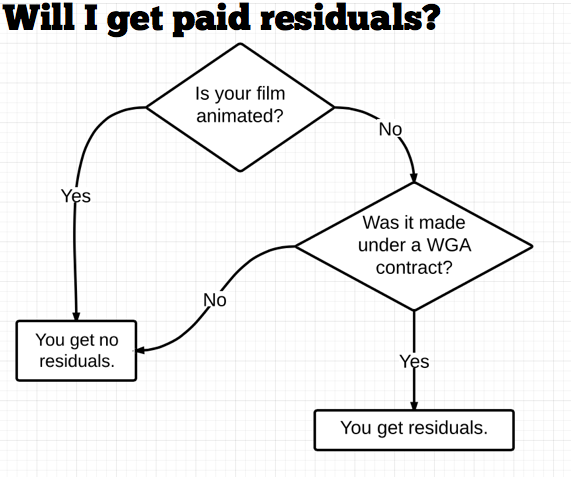
Do I get residuals? A flowchart

January 11, 2013 Follow Up

Jeff Drew (@jeffdrew) asks: “Animated movies don’t pay residuals like live-actn movies” Is there a WGA table, flowchart or infographic?

I couldn’t find one, so I made one:

residuals flowchart

btw, [Lucidchart](https://www.lucidchart.com/) is handy.

**UPDATE:** The official Twitter feed of the Animation Guild took offense at my flowchart, so I’ve amended it with the “Will I get paid residuals?” headline and changed the “no residuals” box to read “You get no residuals.”

As Steven Kaplan of the Animation Guild [tweets](https://twitter.com/AnimGuild):

> You are incorrect. Animation writers are @IATSE members and do get residuals. The IA residuals flows to our health plan.

> “Mailbox” residuals @IATSE members do not get. Ask a WGA writer what they pay for the WGA health plan though.

Of course, “mailbox” residuals are exactly what screenwriters mean when they talk about residuals. Big green envelopes. Actual money in your name that you can use to pay your rent.

I pointed out that residuals on a big studio movie can be worth hundreds of thousands of dollars to the writer. His reply:

> Indeed. Not saying its not lucrative, just pointing out the reason why IA residuals go toward the health plan.

> The IA residual component, calculated much differently than the WGA one, is an essential funding source for our health plan

So on an animated movie covered by The Animation Guild (not all are), residuals contribute to the health plan.

Ultimately, our disagreement is over “gets,” so let’s go back to Jeff Drew.

Jeff will **get** residual checks if he writes a successful live-action movie under the WGA’s jurisdiction. The same script, produced as an animated feature, will not **get** Jeff residuals money he can spend.

« Previous Page
Next Page »

Primary Sidebar

Newsletter

Inneresting Logo A Quote-Unquote Newsletter about Writing
Read Now

Explore

Projects

  • Aladdin (1)
  • Arlo Finch (27)
  • Big Fish (88)
  • Birdigo (2)
  • Charlie (39)
  • Charlie's Angels (16)
  • Chosen (2)
  • Corpse Bride (9)
  • Dead Projects (18)
  • Frankenweenie (10)
  • Go (29)
  • Karateka (4)
  • Monsterpocalypse (3)
  • One Hit Kill (6)
  • Ops (6)
  • Preacher (2)
  • Prince of Persia (13)
  • Shazam (6)
  • Snake People (6)
  • Tarzan (5)
  • The Nines (118)
  • The Remnants (12)
  • The Variant (22)

Apps

  • Bronson (14)
  • FDX Reader (11)
  • Fountain (32)
  • Highland (75)
  • Less IMDb (4)
  • Weekend Read (64)

Recommended Reading

  • First Person (87)
  • Geek Alert (151)
  • WGA (162)
  • Workspace (19)

Screenwriting Q&A

  • Adaptation (65)
  • Directors (90)
  • Education (49)
  • Film Industry (489)
  • Formatting (128)
  • Genres (89)
  • Glossary (6)
  • Pitches (29)
  • Producers (59)
  • Psych 101 (118)
  • Rights and Copyright (96)
  • So-Called Experts (47)
  • Story and Plot (170)
  • Television (165)
  • Treatments (21)
  • Words on the page (237)
  • Writing Process (177)

More screenwriting Q&A at screenwriting.io

© 2026 John August — All Rights Reserved.