• Skip to primary navigation
  • Skip to main content
  • Skip to primary sidebar

John August

  • Arlo Finch
  • Scriptnotes
  • Library
  • Store
  • About

John

Subtitling for screenwriters

February 21, 2013 First Person

Emmanuel Denizot works as a translator in Paris, subtitling US and UK films and TV series for release in France. Some of the films he’s worked on include [Puccini for Beginners](http://www.imdb.com/title/tt0492481/), [Project Nim](http://www.imdb.com/title/tt1814836/?ref_=sr_1), [Keep the Lights On](http://www.imdb.com/title/tt2011953/?ref_=sr_1), [Queer as Folk](http://www.imdb.com/title/tt0262985/?ref_=sr_1) and [The Daily Show with Jon Stewart Global Edition](http://en.wikipedia.org/wiki/The_Daily_Show).

Since subtitlers are often the final writers on our movies, I asked Denizot to give an introduction to subtitling for screenwriters.

—

first personEmmanuel DenizotAs a teenager growing up in France, I fell in love with both cinema and the English language. I used to videotape subtitled versions of British and American classics broadcast very late at night. Everything else on television was dubbed — the dialogue replaced.

At the time, I couldn’t have agreed more with Gena Rowlands when she said, “I like subtitles. Sometimes I wish all movies had subtitles.”

It used to be very difficult to find theatres showing subtitled films in France, but they’ve become much more popular. Today, most Parisian cinemas show subtitled films, and it’s almost a challenge to find dubbed versions of foreign films in the city.

Getting the words right
—–

In this day of technology, when subtitles are all the rage and anyone can have a go at amateur subtitling, it’s easy to overlook how complex it is to subtitle a feature film. It takes rigorous, creative professionals to provide quality subtitles.

The subtitling process goes as follows:

1. **Time-cueing**. This involves creating the captions (in English) along with time-codes. This part is fairly straightforward, but you need to respect shot changes and other constraints.

2. **Translation.** This is my job.

3. **Simulation.** The subtitles are checked in the lab with a proofreader and the client. In the event of a theatrical release, the distributor will pick their own translator, whereas in the video world it is most often the subtitling company which will subcontract a subtitler and handle the job.

Translating a film is just a long series of solutions to be found and traps to be avoided.

As a French speaker, I work from English into my mother tongue. This is a basic rule. A subtitler needs to have great ability in writing dialogue in his own language. He will also have extensive knowledge of the language he’s translating from with all cultural aspects that go with it.

As with any kind of written work, research is paramount and the Internet does wonders, but I also like to have a range of specialists I can contact. This job takes us from politics to sports and through all sorts of fields in no time at all.

Obviously, we are provided with the image, but also with a spotted list which provides explanations of puns, special intents in dialogue, etc. This detailed list is common for Hollywood films, but unfortunately, it is very unusual for indie films, in which case we are just provided with a simple dialogue list.

What you meant to say
—-

In the business, we say a good subtitling is the one you won’t notice.

We don’t want people to feel like they’re reading. They should be enjoying the work of a director and actors based on a screenplay. The subtitling must be such that they can forget that they had to put their glasses on to read the captions.

I like to watch the film a couple of times first to really get into it, and then watch French films in the same spirit so I can sort of work on the language side. What kind of register will I be using for these characters and this particular film? Sometimes the process is completely natural if it’s a modern film which resembles my own sort of speech patterns, and other times it is a totally different world or era.

In subtitling, you’re going from spoken to written language that will still need to read as dialogue. What’s more, the number of characters per line you are able to use is very limited.

Our goal is to express as much as we can in the fewest, shortest words possible. It’s a bit like crosswords: you’ve got a definition but you can only have one word for it. It can be quite frustrating sometimes, but also very satisfying when you find just the right phrase after trying so many different ways to express the same idea.

Subtitling a comedy, for instance, is always tricky as it is so culturally charged. What will provoke laughter in America might not in France or Canada. I remember subtitling a screwball comedy once which had a running gag on the misunderstanding of Kant & the c-word. I first thought it would be impossible to render puns based on pronunciation. And I was so happy and relieved when I came up with funny lines in the end using the name Kant. Very often, you will get your ideas whenever you’re away from your desk so it’s good to always be able to take notes at any time, just like any type of writer.

We often have less than three weeks to subtitle a film and time is paramount to come up with the best solutions. The good news is I work with subtitling software, so captions show up directly on the film. This makes it much easier to write and rewrite so that it’s readable. Rules are strict, but fiddling around is part of the job. The end result needs to be fluid and faithful to the original version, but also feel lively and natural.

For cultural reasons, French Canadian distributors get their own list of subtitles. Two French versions will be recorded: one in Quebec, one in France.

In other words
—–

Dubbing is a completely separate process from subtitling, which may seem strange. After all, you’re still translating into a language.

Dialogue for dubbing needs to fit the mouths, so to speak, of the original version. This is very far away from the constraints that the subtitler has to deal with. There is no way the subtitles could be used for dubbing purposes, and you can’t use the dub for subtitling either: the dialogue would be much too long for the captions. Therefore, a film will have two sets of new dialogue, one for the subtitled version, one for the dubbed.

In the end, many subtitlers are happier talking about their work as adaptation rather than translation. You’re creating a version of the work that hopefully reflects the original intent, but meets the needs of the audience and medium.

—

You can see more of Denizot’s credits on his [website](http://www.emmanueldenizot.webs.com).

For more information about subtitling as a profession, visit the British [Subtitlers’ Association](http://www.subtitlers.org.uk/ajax.php?modulo=paginas&accion=sitio_ver&idpaginas=3) or [L’Association des Traducteurs / Adaptateurs de l’Audiovisuel](http://www.traducteurs-av.org).
Type on the radio

February 5, 2013 News

I spoke with KPCC’s Alex Cohen about Courier Prime last week. You can hear it [online now](http://www.scpr.org/programs/take-two/2013/02/01/30332/frankenweenie-screenwriter-hopes-to-make-courier-p/).

Considering I do a weekly podcast, I got off to a surprisingly amateurish start. When the interviewer says, “Welcome,” you have a range of appropriate responses. None of them should include parroting back “welcome.”

Introducing Courier Prime

January 28, 2013 Apps, News

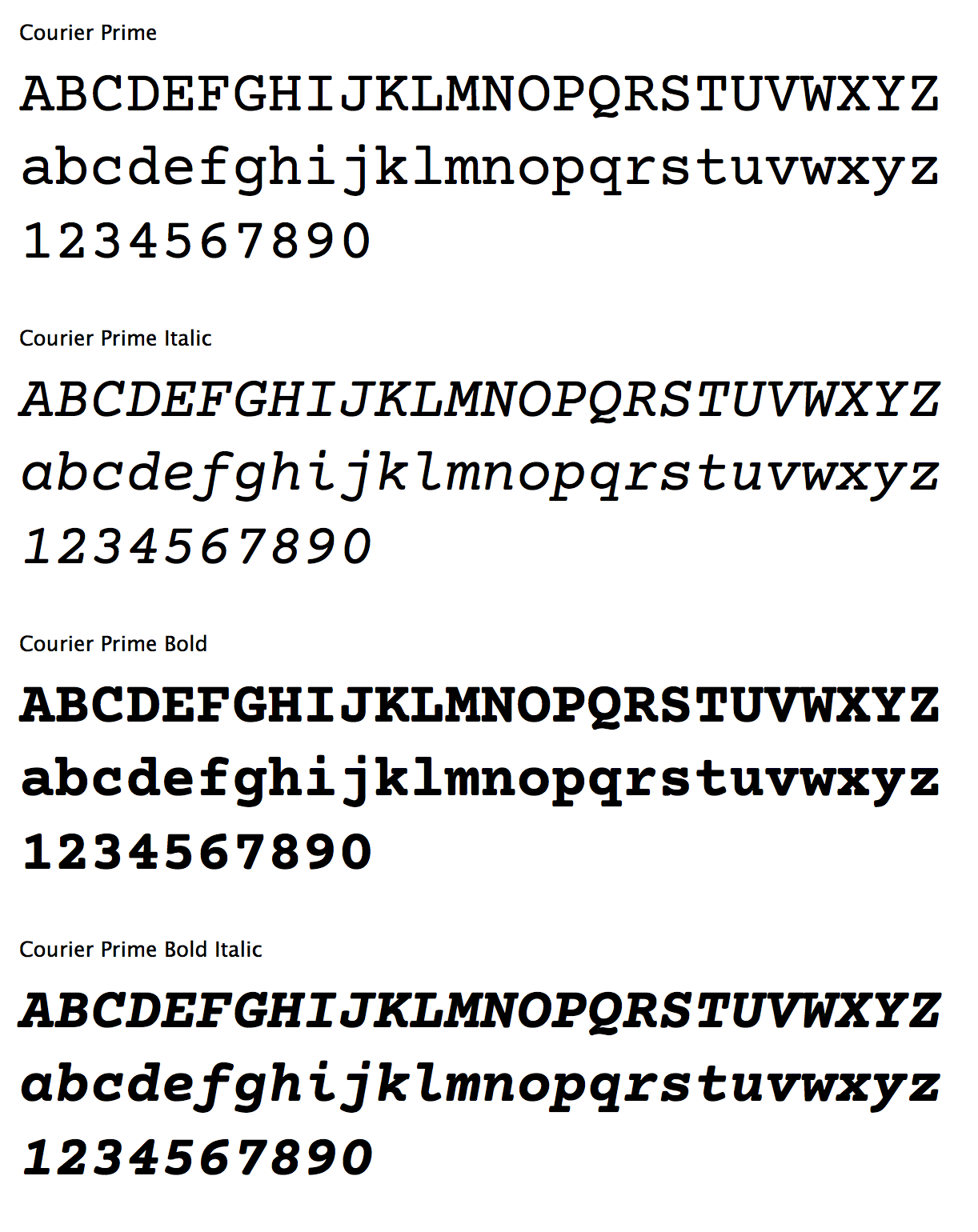
Today, we’re introducing a new typeface designed for screenwriters. It’s called Courier Prime.

It’s Courier, just better:

courier chart

It’s free, and available at [Quote-Unquote Apps](http://quoteunquoteapps.com/courierprime/).

How we got here
—-

Novels were once written by hand. So were plays and poems and speeches. As readers, we don’t see the original scrawl because they’ve been typeset along the way, transformed into something easier to read.

Screenwriting began in the era of typewriters, and it’s always been served raw. What the screenwriter pulls out of the typewriter isn’t a manuscript to be sent to the publisher — it’s the final product.

Over the years, the tools have changed, with the advent of computers and printers and PDFs. But we still expect scripts to look like they came out of a typewriter.

Specifically, we want screenplays to be twelve-point Courier.

The Courier typeface was designed in 1955 by Howard “Bud” Kettler for IBM. It’s classified as a monospaced slab serif, with each character taking up the same space and constructed with even stroke widths. IBM deliberately chose not to seek any copyright, trademark, or design patent protection on Courier, which is why it’s royalty free. It was the standard typeface on IBM’s best-selling Selectric II typewriter, and soon became the default typeface in Hollywood.

By standardizing around one typeface set at a specific size, we can take advantage of some rules-of-thumb.

For example, one page of screenplay (roughly, sometimes) equals one minute of screen time. More importantly, producers can be assured that a 119-page draft really is shorter than a 140-page draft. Unlike college freshmen, screenwriters can’t fiddle with the font to change the page count.

The biggest problem with Courier is that it often reveals its low-res heritage. Designed for an era of steel hitting ribbon, Courier can look blobby, particularly at higher resolutions.

But it doesn’t have to.

It’s Courier, just better.
—–

In July 2012, I asked type designer Alan Dague-Greene to come up with a new typeface that matched the metrics of Courier — thus protecting line breaks and page counts — while addressing some of its weak spots.

I wanted a font that could be substituted letter-for-letter with Courier Final Draft, but look better, both on-screen and printed. I wanted a bolder bold and real italics, not just slanted glyphs.

Alan rose to the challenge, creating a typeface that is unmistakably Courier, but subtly improved in ways you wouldn’t necessarily notice at first. Here’s a primer.

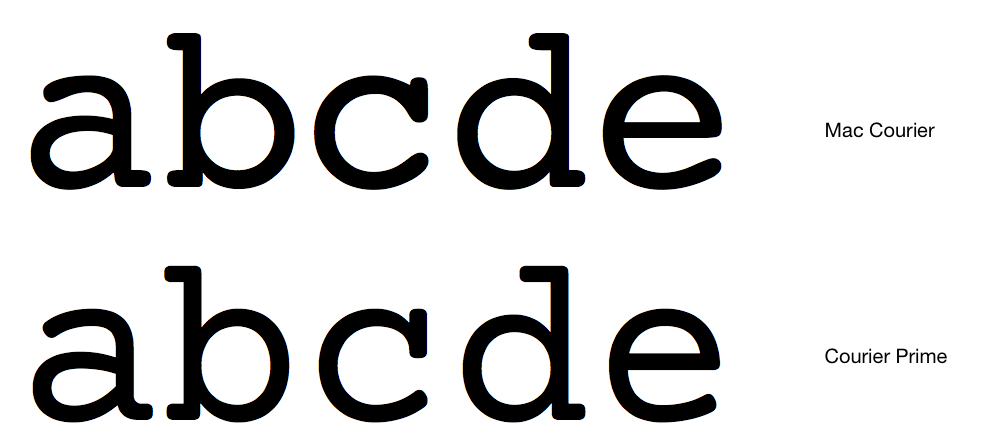
abcde comparison

The serifs are crisper and less rounded. They’re also less blobby where the serif connects — particularly in the lower-case c.

Look at the spaces inside the b and d. They’ve been opened up slightly, and the surrounding stroke tapered.

Still, you might occasionally wonder if you’re looking at regular Courier or Courier Prime. The quickest giveaway is the lowercase y, which loses its “foot” in Courier Prime.

y comparison

We ultimately went through 25 builds for Courier Prime.

With each new version, I’d prepare three sample screenplay pages — the same text but in three different fonts (standard Mac Courier, Courier Final Draft, and Courier Prime). The samples were given codenames (e.g. Fish, Dog, Bird) then shown to Actual Screenwriters, who voted on their favorite, not knowing which was which.

The early results were Not Good.

Screenwriters consistently preferred standard Mac Courier to our custom face. But we soon realized why: the standard Mac Courier is fairly heavy. Screenplays have a lot of white space, which makes thin Couriers look even thinner. As we gradually nudged up the stroke weight, we found the Goldilocks spot which was just right.

I want to thank all the screenwriters who participated in both the voting and the beta tests, and of course Alan Dague-Greene and Ryan Nelson for all their work getting the typeface out the door.

Courier Prime is [available today](http://quoteunquoteapps.com/courierprime/), free, for Mac and Windows. It’s released under a very liberal license so developers can use it for iOS and Android apps. We hope screenwriters get a lot of use out of it.

The hyenas got a raw deal

January 25, 2013 Story and Plot

Cezary Jan Strusiewicz makes some good points about villains who are actually right, including [The Lion King’s hyenas](http://www.cracked.com/article_18417_9-famous-movie-villains-who-were-right-all-along.html):

> They want something to eat. That’s their problem, and it’s only a problem because Mufasa banished them from the Pride Land and forced them to live in an elephant graveyard, which is no place to raise a child, hyena or otherwise. We never know why they were banished to the Pride Slums, leaving us to assume Mufasa’s unedited explaination of the Circle of Life went something like this:

MUFASA

Everything you see exists together, in a delicate balance. As king, you need to understand that balance, and respect all the creatures-- from the crawling ant to the leaping antelope.

SIMBA

But Dad, don’t we eat the antelope?

MUFASA

Yes, Simba, but let me explain. When we die, our bodies become grass. And the antelope eat the grass. And so we are all connected in the great Circle of Life.

SIMBA

Wow... Say, Dad, where do the hyenas fit into the great Circle of Life?

MUFASA

Ugh, the hyenas. No, f#@k those guys.

SIMBA

Yeah, that’s fair.

That said, I’ve seen hyenas in the wild, and they freak the bejeezus out of me. At first glance, you think “dog.” Then they start to move and nope, not dog.

Not. At. All.

« Previous Page
Next Page »

Primary Sidebar

Newsletter

Inneresting Logo A Quote-Unquote Newsletter about Writing
Read Now

Explore

Projects

  • Aladdin (1)
  • Arlo Finch (27)
  • Big Fish (88)
  • Birdigo (2)
  • Charlie (39)
  • Charlie's Angels (16)
  • Chosen (2)
  • Corpse Bride (9)
  • Dead Projects (18)
  • Frankenweenie (10)
  • Go (29)
  • Karateka (4)
  • Monsterpocalypse (3)
  • One Hit Kill (6)
  • Ops (6)
  • Preacher (2)
  • Prince of Persia (13)
  • Shazam (6)
  • Snake People (6)
  • Tarzan (5)
  • The Nines (118)
  • The Remnants (12)
  • The Variant (22)

Apps

  • Bronson (14)
  • FDX Reader (11)
  • Fountain (32)
  • Highland (75)
  • Less IMDb (4)
  • Weekend Read (64)

Recommended Reading

  • First Person (87)
  • Geek Alert (151)
  • WGA (162)
  • Workspace (19)

Screenwriting Q&A

  • Adaptation (65)
  • Directors (90)
  • Education (49)
  • Film Industry (489)
  • Formatting (128)
  • Genres (89)
  • Glossary (6)
  • Pitches (29)
  • Producers (59)
  • Psych 101 (118)
  • Rights and Copyright (96)
  • So-Called Experts (47)
  • Story and Plot (170)
  • Television (165)
  • Treatments (21)
  • Words on the page (237)
  • Writing Process (177)

More screenwriting Q&A at screenwriting.io

© 2026 John August — All Rights Reserved.