• Skip to primary navigation
  • Skip to main content
  • Skip to primary sidebar

John August

  • Arlo Finch
  • Scriptnotes
  • Library
  • Store
  • About

John

Writing comics in Fountain

March 6, 2013 Fountain

Fountain was originally designed as a screenplay format, but it actually works well for any text involving scenes and characters. Antony Johnston describes how he [uses it for comics](http://antonyjohnston.com/index.php/2013/03/06/fountainhead/):

> Turns out that, despite being designed for screenplay format, Fountain actually works pretty well for comics “out of the box” (note: there is no box) by using some of the built-in “forced format” syntax for underlines and emboldening.

To get you started, Johnston includes the templates he uses.

Fountain is flexible enough that you can also use it for stage plays and musicals. (We’re likely going to add a Lyrics element to the spec to help with the latter.) Ultimately, it’s up to individual apps to support specific templates, but the goal as always is to let writers create in any editor they love.
Secret and metaphors in Titan A.E. revealed

March 5, 2013 Projects

Reader Jeff writes:

> I would like to inquire about the movie you worked on, Titan AE. At the end, it’s insinuating the ship has the ability to restore all life on Earth based off of DNA on the ship. How would it go about doing this?

> Would terraforming the planet happen so fast that it would happen the next day? Or would it be like, “And on the fourth day, god created animals.” Also, would the animals first start as eggs? Or would they be born in test tubes, Jurassic Park style?

> Wouldn’t the Drudge keep trying to kill them? Surely their entire species wasn’t all on the one ship.

> Is this one big metaphor for the big, powerful bully beating up the smartest kid on the playground, because the bully knows that in the future, the smarter child will have a better life and will likely be the bully’s boss, but the bully hopes to prevent that by breaking the child’s spirit?

I’m going to be completely honest with you, Jeff: *I have no idea.*

The last time I saw Titan A.E. was almost 13 years ago when it came out. Thirteen years! Bill Clinton was the president. “The Real Slim Shady” was one of the top songs in the country. Ross and Rachel weren’t a couple on Friends. It was that long ago.

The premiere of Titan A.E. was at Staples Center in downtown LA. That’s an absolutely terrible place for a premiere by the way, because it’s way too big and doesn’t have a screen, which seems like prerequisite but whatever. Even that night, I was referring to the movie as “a friend from camp” because while I genuinely liked it, I had no ongoing relationship with it.

I had come in to do a quick dialogue polish, which became a bigger rewrite as it went through several directors’ hands. After I left, Joss Whedon took the writer reins — but I couldn’t honestly tell you what he wrote versus what I wrote versus what Ben Edlund wrote. It was a big lump of clay that everyone took turns pushing around. I was happy and surprised the final product was as good as it was. While it was box office failure, it’s gained a small cult following over the years.

In the end, I remember much more about the experience of writing the movie than I do about the movie itself. For example, I didn’t remember the name of the alien species until I read it in your question. (They’re actually called the Drej. That much came back.)

So while I’m always happy when someone says they like Titan A.E., I feel more honest saying “Me too!” rather than “Thanks.” It’s a movie with my name on it, but it’s nowhere near “my movie” the way Go or Big Fish or The Nines are.

Writing a scene in 11 steps

February 28, 2013 Follow Up

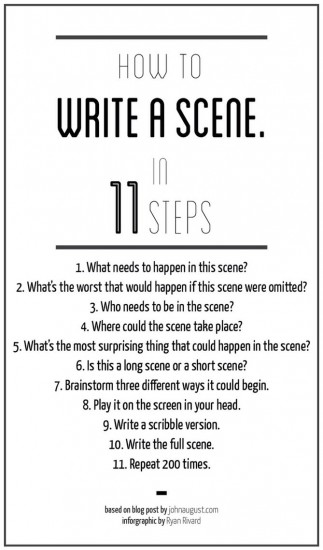
The infographic below, which hit the [front page of Reddit](http://www.reddit.com/r/movies/comments/19ehyv/for_fellow_aspiring_screenwriters_how_to_write_a/) tonight, comes from a 2007 post of mine titled [How to Write a Scene](http://johnaugust.com/2007/write-scene).

11 steps scene graphic

The graphic by Ryan Rivard is lovely and all, but the full post is probably more helpful. In particular, point five merits explanation:

> **5) Ask: What’s the most surprising thing that could happen in the scene?**

> Give yourself permission to step away from your outline and consider some wild possibilities. What if a car smashed through the wall? What if your hero choked and died? What if a young boy vomited up a finger?

> Most of your scenes won’t have one of these out-of-nowhere aspects. But your movie needs to have a few moments that are completely unexpected, so always ask yourself, could this be one of them?

Great scenes surprise both the reader and the writer.

And to clarify the last point (“Repeat 200 times”), I meant write 200 scenes. That is not an uncommon number for a feature.

Outlining scripts in Fountain

February 22, 2013 Fountain, Highland

Stu Maschwitz offers an overview of [outlining in Fountain](http://prolost.com/foutline):

> Organization and structure are such an important issues that I made sure Fountain had some provision for supporting them. Fountain’s Sections are invisible, hierarchical markers that you can use to demarcate the structural points of your story—or anything else you like. Synopses allow you to annotate a Section — or a Scene Heading — with non-printing descriptive text.

> You can add Sections and Synopses to your Fountain screenplay as you work, or as a part of rewriting. You can also begin the writing process with them. You can use them to denote scenes, sequences, act breaks, or whatever is helpful to your writing process.

Because they don’t print in the formatted script, [section and synopsis tags](http://fountain.io/syntax#section-sections) can help you structure the document in a way that makes sense for you as you’re writing. Rather than just a scene header like…

EXT. BEACH – DAY

…you can throw a meaningful label on it like…

##Giant crabs attack campers

EXT. BEACH – DAY

When we were drafting up the Fountain spec, I honestly didn’t pay much attention to these tags, because I didn’t think I’d use either much. But in writing my ABC pilot, I found them genuinely useful.

I used the top-level section mark (#) to denote act breaks, and the synopsis tag (=) to quickly jot out what was happening in upcoming scenes. That’s great for the end of the day, when you’re leaving some gas in the tank for tomorrow’s writing.

The = can also serve as a quick-and-dirty to-do list, such as:

INT. BEDROOM – DAY

= shorter. start on Asha

Several of the existing Fountain apps — and many of the upcoming ones — can do magic things with section and synopsis tags, formatting them differently or collecting them for an outline view. Together, they make it easier to jump through your script. Rather than looking for a page number or a location, you can skip right to the section or note you want.

« Previous Page
Next Page »

Primary Sidebar

Newsletter

Inneresting Logo A Quote-Unquote Newsletter about Writing
Read Now

Explore

Projects

  • Aladdin (1)
  • Arlo Finch (27)
  • Big Fish (88)
  • Birdigo (2)
  • Charlie (39)
  • Charlie's Angels (16)
  • Chosen (2)
  • Corpse Bride (9)
  • Dead Projects (18)
  • Frankenweenie (10)
  • Go (29)
  • Karateka (4)
  • Monsterpocalypse (3)
  • One Hit Kill (6)
  • Ops (6)
  • Preacher (2)
  • Prince of Persia (13)
  • Shazam (6)
  • Snake People (6)
  • Tarzan (5)
  • The Nines (118)
  • The Remnants (12)
  • The Variant (22)

Apps

  • Bronson (14)
  • FDX Reader (11)
  • Fountain (32)
  • Highland (75)
  • Less IMDb (4)
  • Weekend Read (64)

Recommended Reading

  • First Person (87)
  • Geek Alert (151)
  • WGA (162)
  • Workspace (19)

Screenwriting Q&A

  • Adaptation (65)
  • Directors (90)
  • Education (49)
  • Film Industry (489)
  • Formatting (128)
  • Genres (89)
  • Glossary (6)
  • Pitches (29)
  • Producers (59)
  • Psych 101 (118)
  • Rights and Copyright (96)
  • So-Called Experts (47)
  • Story and Plot (170)
  • Television (165)
  • Treatments (21)
  • Words on the page (237)
  • Writing Process (177)

More screenwriting Q&A at screenwriting.io

© 2026 John August — All Rights Reserved.