• Skip to primary navigation
  • Skip to main content
  • Skip to primary sidebar

John August

  • Arlo Finch
  • Scriptnotes
  • Library
  • Store
  • About

Archives for 2013

Writing a scene in 11 steps

February 28, 2013 Follow Up

The infographic below, which hit the [front page of Reddit](http://www.reddit.com/r/movies/comments/19ehyv/for_fellow_aspiring_screenwriters_how_to_write_a/) tonight, comes from a 2007 post of mine titled [How to Write a Scene](http://johnaugust.com/2007/write-scene).
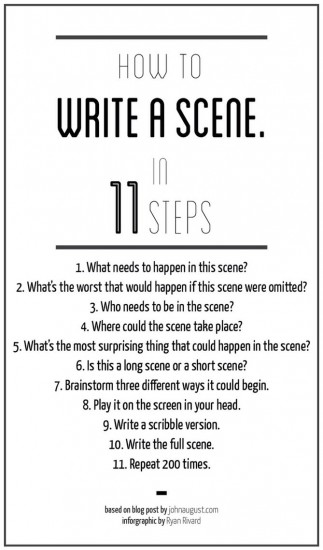
11 steps scene graphic

The graphic by Ryan Rivard is lovely and all, but the full post is probably more helpful. In particular, point five merits explanation:

> **5) Ask: What’s the most surprising thing that could happen in the scene?**

> Give yourself permission to step away from your outline and consider some wild possibilities. What if a car smashed through the wall? What if your hero choked and died? What if a young boy vomited up a finger?

> Most of your scenes won’t have one of these out-of-nowhere aspects. But your movie needs to have a few moments that are completely unexpected, so always ask yourself, could this be one of them?

Great scenes surprise both the reader and the writer.

And to clarify the last point (“Repeat 200 times”), I meant write 200 scenes. That is not an uncommon number for a feature.

Scriptnotes, Ep 78: The Germans have a word for it — Transcript

February 28, 2013 Scriptnotes Transcript

The original post for this episode can be found [here](http://johnaugust.com/2013/the-germans-have-a-word-for-it).

**John August:** Hello and welcome. My name is John August.

**Craig Mazin:** My name is Craig Mazin.

**John:** And this is Episode 78 of Scriptnotes, a podcast about screenwriting and things that are interesting to screenwriters. How are you, Craig?

**Craig:** I’m doing fine, John. How are you out there in my hometown?

**John:** Very well. I’m in New York City, and we are working on rehearsals for Big Fish. Today was actually our dialect day — like, we had an hour of dialect practice this morning. And we had an amazing woman named Kate who came in and talked us through the Alabama dialect and specifically the Alabama dialect of just outside Montgomery — so Wetumpka, and Prattville, and very specific things. It was fascinating and great. And stuff we didn’t really honestly have for the movie. And because we all need to be in the same place for this, it was tremendously helpful.

But one of the things I found especially interesting was — “interesting…”

**Craig:** [laughs]

**John:** Aline Brosh McKenna always makes fun of me for swallowing the T. And swallowing the T in a word like “interesting” is a very southern thing that I just happen to do.

**Craig:** Is that right? Because it’s also a drunk thing to do.

**John:** Yeah. I’m pretty much constantly drunk. So, that explains how it works.

**Craig:** [fake slurring] It’s pretty interesting.

**John:** It’s also a secret for talking like you’re from Alabama — just get a little bit hammered.

**Craig:** Interesting.

**John:** So, here was actually a really helpful exercise for anybody who wants to learn to talk in an Alabama sense: Stick out your tongue, you hold your tongue, and you talk for like 30 seconds with your tongue being held between your fingers. And then when you let go of your tongue your tongue will have relaxed and especially will have relaxed in the back part of your mouth, it will sort of be more open.

**Craig:** I’m doing it right now. I’m holding my tongue and talking.

**John:** Yeah. So, you talk to me for a little while. Tell me about your life.

**Craig:** Oh, it’s very good. You know, everything is going fine. Identity Thief is going to be number one again this weekend.

**John:** Is it? It’s amazing that in its third weekend it’s the number one movie in America.

**Craig:** Stolen Identity keeps hanging in there. And now when I release it, I’m like, oh yeah, my tongue is pretty relaxed there. It’s pretty interesting.

**John:** That’s pretty interesting. So, it’s a good secret that we learned today. But, yeah, stuff is going really well. It’s nice. I’m here in my little corporate apartment. I tweeted today that one of the strange things is that in this little corporate apartment they’ve rented for me I have four plates and four bowls and four cups. And so it’s become this weird game of resource management — like, how long can I go without having to actually wash the dishes?

**Craig:** Yeah. And I don’t know if you saw — I sent you a very useful link for like a $39 set of dinnerware.

**John:** Oh, how nice. Well maybe that’s what I’ll do.

**Craig:** Yeah, on Amazon.

**John:** So, Craig, today I thought we would talk about two main topics. First off there’s this class action against Fox regarding unpaid interns which is really interesting because that’s — interesting again! Now I’m going to say that word constantly — because so many people’s first exposure to working in Hollywood is that internship, so let’s talk about that.

And then you actually suggested a top. Craig suggested a topic!

**Craig:** I know. Well, because you shamed me last time, let’s face it.

**John:** Yes. So, rather than talking about shame, we would talk about jealousy today, which will be great. So, I’m looking forward to you leading us in that conversation.

**Craig:** I will. And first I just wanted to follow up on one of our topics from last week which was my little monologue on critics, and feelings, and all the rest of it. And I just wanted to thank everybody who sent emails, and tweets, and so forth. You’re all very kind and I thought it was a good thing that people sort of noted that there was a bit of honesty there that we don’t often hear from people in our business.

And I understand why. It’s not that Hollywood people are particularly interested in lying anymore than — or hiding things than people in any other industry. It’s just that this industry is an illusion business. The whole point of this business is that we present fiction as real. And so it’s understandable, I think, in our business that people don’t want to kind of bare their souls because suddenly it feels like we’re giving away — I don’t know — something.

But, for those of us who write screenplays, we don’t have to worry so much about that. So, I was very pleased. And I was also surprised no one brought up something that I was sure somebody would bring up, so I’ll bring it up. And that was, “Hey, you feel bad about these critics attacking you, but then you and John, you get these Three Page Challenge scripts and you read them, and sometimes you’re pretty harsh. And how do you reconcile that?”

And I want to make a distinction for those of you out there, no matter what level you are, and that is when you’re writing, the beautiful thing about writing is no matter what someone says about the pages, whether it’s a friend, or somebody you don’t know, or a colleague, or an employer, or an actor, you can change the pages. And sometimes you will, and sometimes you won’t. Sometimes you make them better. It’s important for us to take that criticism in the context of criticism of something that is still malleable, that can — and will — change frequently.

The issue about movies is different. That’s the movie. [laughs] That’s it. It ain’t changing. So, it’s harder.

You know, I’ve taken, I’ve sat through some pretty tough notes meetings, but in the back of my head I always think, “Okay, well, let’s see, maybe we can make it better.” A little different when it’s a movie.

**John:** Well, I think you’re drawing a distinction between constructive criticism and sort of just destructive criticism. Like constructive criticism is hopefully what we’re giving on these Three Page Challenge samples, is that people are sending in and saying, “Hey, what do you think of this?” And we can offer them, like, “Well this is not what’s working, but this is what might work.”

When a movie has come out, there’s nothing that’s going to change. It’s like talking about a book that’s already been published. It’s going to hurt more because there’s nothing you can really do about that. And in the case of a movie, I think a lot of times people focus on things that aren’t working in the movie which may really honestly have nothing to do with the screenplay that was written. And that’s frustrating.

I saw a lot of criticism about this last Die Hard saying like, “Oh, the script was terrible.” It’s like, well, how do you actually know the script was terrible?

**Craig:** Right.

**John:** I’ve actually talked to quite a few people who were involved with that movie, and I suspect the script was really pretty darn good. There were a lot of actors going into that movie. And if there had been a documentary about the making of that movie it probably would have been really fascinating, because it was not an easy, happy time for the people involved.

**Craig:** That’s right. There’s sort of a famous story that Pauline Kael at the height of her power as a critic left criticism and came out to Los Angeles to be a producer, I think. And she lasted about four months. And upon leaving said something like, “If this is how movies are made, I can’t do this.”

Well, yeah, this is how it’s made. This is how they’re made. And I always do chuckle whenever someone watches a movie and then says, “Well, the problem is the script.” Mm…you can’t say that, sorry. You didn’t read the script. You didn’t read the first script. You didn’t see what they told the writer before they even wrote the first draft. You just can’t say it. You just don’t know.

**John:** Yeah.

**Craig:** You know, but that aside, sometimes even when we get notes and we’re writing, sometimes the notes are destructive in the sense of “I hate this and I can’t tell you why I hate it.” Okay, but it can change. And maybe I’ll come back to you with something that works, for you.

But, yeah, a little different when it’s a movie. And somebody actually sent me a tweet — and I’ll send you the link — to a blog entry that he had written. And he’s one of many people who have a film criticism blog. And he doesn’t write for a periodical, but he just does his own film criticism.

And in his blog he pointed out something fascinating which was that he had seen quite a few movies, and had liked quite a few movies, but the ones that kind of got him ginned up to write were the ones he hated. And he had to stop and take stock of the fact that sometimes it’s just easier and more fun, and there’s more — frankly more libido — behind writing about things that you don’t like. That writing from a place of negativity and rejection is simply — it’s like running with the wind at your back. But, is it right?

Or, putting that aside, is it right that you should maybe put more time into that and invest more in that than you do writing about the movies you do like, and writing about why you like them. And it is harder to do that. So, I thought that was very interesting as well, and I’ll put a link up to that. I thought he did a good job of talking about that.

**John:** Nice. So, today I want to talk about this class action suit that was brought up against Fox. Originally it was brought up against Black Swan. And so it was called the Black Swan Suit. But I guess it’s been expanded to really talk about Fox overall, not just about Searchlight who made Black Swan, but overall Fox Corporation about the use of unpaid interns.

And this is a topic that is sort of evergreen in Hollywood because it’s very common for people to come to Hollywood, young people, people in college often — but not always young people — to work on a movie, or work on a TV show, or work with a studio. And they are doing so under the auspices that they are learning something. It’s an education opportunity, and therefore they are benefiting from the experience.

I know my very first internship was an unpaid internship. I was reading scripts for a company.

And this Fox suit is claiming that these people who were working for Black Swan, they were doing the work of paid people. They were not being paid and that is a problem. And that is a labor problem.

**Craig:** Yeah.

**John:** Which I think is fascinating because it brings up a whole bunch of issues on how movies are made, how the industry actually works, what is a paid job, what is educational, what should an inspiring writer who’s coming to Los Angeles to work in the film industry, what should he or she expect? What should he or she aim for? And so I thought we could talk… — We’re not lawyers. We’re not going to be able to talk about what the case law is going to come down to.

We can talk about what the reality is on the ground.

**Craig:** Well, and so right away the lawsuit runs into this little Hollywood quirk that, as you pointed out, it starts as the Black Swan lawsuit, and then it becomes a lawsuit against Fox. Well, why don’t you know who to even sue in the first place? Because, the way the business works is studios don’t make movies. They create companies that make movies.

So, no studio ever makes a movie. At the end of every movie you see, if you wait all the way to the end, you’ll see that this movie is copyright, and then some goofy name of a company that either includes the title of the movie. Like for instance Big Fish was maybe like Big Fish Productions, you know.

**John:** Yeah.

**Craig:** And they do this specifically to shield themselves from trouble. And you see this a lot. I mean, a lot of businesses do this. And the notion that you’re going to go past some fake company to get to the real company, the legal term is “Piercing the Veil.” So, they’re attempting to do that now because the point is there really aren’t any assets and there were limited assets at this little fake company that’s set up to do all of this work.

And, look, it’s not — when they make these little companies it’s not all just to pull the wool over someone’s eyes. It is a lot easier to manage the hiring of the hundreds of people that you need for a movie if you’re doing it all under the rubric of one film, one company. Otherwise Fox has thousands of people working for them at once, sometimes on two different things at once, and the accounting becomes a nightmare. So, I understand why they do it.

But that’s the first little bit of Hollywood weirdness. And then there’s this question of whether or not interns who are unpaid are actually being educated or are simply being slave labor. A good question! [laughs]

And, look, we weren’t there. However, I can tell you that in my time in this business, and I’m sure you can say the same, I have seen people doing things and then been told that they’re interns and are unpaid and thought to myself, “How did they get away with that?!”

**John:** Yeah.

**Craig:** Because this person is not learning anything. They’re just doing work.

**John:** And really the question becomes are they really doing — are we being hurt two ways in the fact that that kid isn’t getting paid, and the fact that a person who should be paid to do a job isn’t getting that paid job to do it? And so there are really two people who are sort of being hurt by this situation.

It comes down to the idea of a trainee. And is a trainee somebody who is working on a specific project with an educational goal? And a training program should have certain steps that you’re going through. There’s a way. There’s a hierarchy there. There should be achievable outcomes. You should be able to measure sort of where you’re at in the process of this. Versus if you are running around and doing work that a normal paid person could be doing, but you’re not getting paid for it, that’s going to tend to be a problem.

A lot of times in internships I’ve been involved with, they’d say, “We will only hire a college student.” So, you have to be in a film program, be it undergraduate or graduate. You can only work a certain number of hours. And it can only be for a certain number of weeks. They try to build things into it that sort of make it clear that this is a specific small time — small term, short term thing with an end date. Or you have to be getting academic credit for what you’re doing.

**Craig:** Right.

**John:** Those are ways to try to address it, but it doesn’t necessarily address like is that really the right kind of work for this person to be doing.

**Craig:** Right. And there are — this is one of those deals where you kind of have to judge based on the circumstances whether or not somebody is meeting the test for this or not. And from this article, so the Department of Labor governs are you actually being trained, and thus receiving some benefit which offsets the fact that you’re not being paid, or is this basically slavery?

And the factors that they list in this particular article, “Is the internship similar to training given in an educational environment? Is the work that the intern is doing to the intern’s benefit or to the company’s benefit?”

**John:** Yes.

**Craig:** And also, lastly, and most importantly, “Is this intern displacing a regular employee?”

So, the idea of the unpaid intern is you learn something. And the learning of it is clearly accruing to your benefit just as much as — at least as much if not more so than it’s accruing to the company’s benefit. And more importantly, you exist in addition to all the employees. If you were to be hit by a bus the next day, work would not be disrupted in any way, because people that need to be there are there and being paid. You are on top of that.

And so the argument from the plaintiffs here is actually none of those things happened. We weren’t in a program that would be similar to the kind you’d receive in an educational environment. None of this stuff was really accruing to our benefit at all. And, yeah, they would need to pay people to do this stuff if we weren’t there.

And if they can prove that that’s true then I think Fox or whoever is on the hook for this, whether it’s the production company or the studio, is going to have a problem.

**John:** So, this is the devil’s advocate perception from Fox. It’s from the same article. For example, says Fox, “Did Black Swan’s intern’s semester-end project give him unique insight into some aspect of movie production? Did the 500 Days of Summer internship who worked with the director’s assistant get something of value from that experience? What was the quality of the speakers at the corporate intern’s weekly lunches? Did the internships at Black Swan suffer from a lack of formal training program, or was their experience worthwhile regardless?”

And that comes back to sort of what my experience has been is that I was probably lucky, but the only unpaid internship I had was a reader position at Prelude Pictures, which I don’t think exists anymore. It was on the Paramount lot. And my responsibility was to read two scripts a week. I would write up coverage and take them in.

Now, I was doing grunt work, and that is sort of classically sort of grunt work, but because it was my very first crack at this I actually did really learn something by writing those up, handing those in. They would read it in front of me and they would give me a critique on my critique. They’d talk about sort of, “This is what you wrote. This is really good and helpful. This language isn’t clear. This isn’t the kind of stuff I need to hear on your analysis page.” And that was really good. It was actually very functionally similar to what I was doing in my script development class, but it was for a different sort of judge. And that was actually very helpful.

But I only stayed in that internship for about three months. And that was plenty. And that was enough time. And it was good and it was done.

Now, if I had already had that experience, you know, reading stuff before I was coming in, would that have been a good opportunity for me? Probably not really. I mean, all I would have gotten was a few more samples of coverage for applying for a paid job, which is what I ultimately got at TriStar as a reader.

But, it was useful for me at that time. And so one could argue that, well, is that intern who’s running to grab lunch for people, is he really learning something? Well, sometimes you are because sometimes you’re in that room when they’re talking about important stuff that’s about how movies are made. And you really are picking up stuff.

**Craig:** Yeah. And so it sort of comes down to the intention of the employer, because I do feel, frankly, that there are places where they just go, “Whoa, look at this goldmine of people that are desperate to be in Hollywood, so much so that they’re willing to come here and do the work of a PA. And where I would have to pay $600 a week, now I have to pay $0 a week and I can just put somebody in a Xerox room.”

Well, obviously you’re not going to learn anything Xeroxing unless you’re training to be a Xerox technician.

**John:** Although I would say once upon a time being in the Xeroxing or the mail room, it gave you access to physical scripts that were actually hard to come by other ways. And so it was the classic thing where like you print some extra scripts that you can actually read when you’d go home. And in the days before the internet that was actually kind of useful and meaningful. Like, you were actually seeing stuff.

That’s not now.

**Craig:** Yeah, the test isn’t that there’s a presence of meaningful benefit but rather a predominance, I guess, of meaningful benefit.

I mean, for instance, you can’t become — if you want to start from the ground up at a talent agency, you start in the mailroom, but you’re paid. I mean, they pay them. I assume they get minimum wage. I had an internship between my junior and senior year that was sponsored through the Television Academy. And their deal was, because they knew that people were applying from all over the United States, so if you got one of these internships they would give you a $600 a month stipend for the summer, which would cover basically the barest minimum rent and that’s about it.

So, it kind of worked out to being a free internship. But that very much was an educational program. It was — I mean, yes, I did some Xeroxing. Yes, I did some phone answering. But I also got access to things that frankly people who were working there didn’t have access to. You know, they let me go to the big network meetings where Barry Diller and Peter Chernin would get into fights. It was exciting. [laughs]

And I learned an enormous amount. And it was absolutely structured as an educational program. So, for sure, that passes the test. And I guess what this comes down to is, you know, I think a lot of people are going to look at the plaintiffs here and say, “You guys are never going to make it in Hollywood.” Everybody has to eat, eat, eat…a crow is the wrong word…a crow sandwich, but we’re trying to keep this one clean. Everyone has got to eat a bad sandwich to get ahead. And we all did this. “And I washed cars for five years,” blah, blah, blah.

But, you know, on a larger level, it would not be a bad thing for abuse to be eliminated here. I don’t like the idea that people are learning nothing for their free labor. It is exploitative.

**John:** Another of fairness that does come up here, and this isn’t part of the actual class action lawsuit, but it’s a problem with unpaid internships overall — honestly, even like legitimate ones that are sort of through an educational organization — is that you have to have means in order to be able to essentially work for free for a while.

And so if you come from a rich family you’re going to have the opportunity to not work that summer, and take an internship, versus flipping burgers at McDonalds. Or, you’ll be able to pay that college the one credit hour that it takes so that this company can hire you legitimately or use you legitimately as an intern.

So, unpaid internships, even when done with the best of intentions, would tend to favor richer people, or kids who come from the means that they can actually afford to not work other ways.

**Craig:** Great, great point.

**John:** So, in situations where possible you need to find, at least that Academy internship that you were talking about, or TV internship you were talking about — was there an opportunity for a kid who didn’t have the means to otherwise be able to support himself in Los Angeles for a summer could be here reasonably to do it?

**Craig:** Great point. Certainly when I got my internship I had no money and my parents had no money. I couldn’t afford a plane ticket. I drove. That was back in the days of $0.90 a gallon gas. And if they hadn’t offered me the $600 a month to be able to cover my minimum living expenses, I wouldn’t have been able to do it.

And so you look at a comparable person who is maybe living in Los Angeles, where there is no $600 a month, they need to, well, okay, they can live at home and maybe eat out of their mom’s fridge. But you’re absolutely correct. It is unfair to people who don’t have means. And I, as somebody who didn’t have them, that’s part of this that’s quite ugly. So, great point.

**John:** Let’s talk about sort of practical advice for aspiring writers who are maybe coming out here considering what they should do.

I can’t give a blanket statement saying one should never take a non-paid internship, because the reality is those are sometimes cases where you will learn something, where you’ll meet other people, who could employ you or give you recommendations, or I think just as importantly, you might meet other interns who are doing the same kind of stuff you’re trying to do, and you guys can work together. You can help each other out. That sort of lateral networking is really, really important.

But I think you have to be mindful of what are you really getting out of this? What are they getting out of it? The sort of cui bono, it’s always a good question to ask.

**Craig:** Mm-hmm.

**John:** Opportunities where you can shadow somebody are probably much more useful than opportunities for you to make copies or answer phones, or walk dogs. I mean, opportunities where you get to be around somebody who’s making decisions, you see what that life is actually like, are going to be more worthwhile for you.

Opportunities where you’re going to be able to take something that you did and come out of there with it are going to be more helpful. So, at least my coverage internship, that was a lot of hard work, but I had coverage samples I could show at the end of the day that this was my thing. And I also had persons who I could show the stuff I’d written to, and that was helpful, too. You don’t want to sort of shove written material and stuff to people too early, but once you build a relationship it’s fair to ask after a while, “Hey, could you read this little thing I wrote?” A lot of times they’ll say yes.

**Craig:** Yeah. And it’s also a great idea if you do take an unpaid internship to make it a requirement, and you actually do have a little leverage here because you’re not getting paid, that you receive a recommendation — good or bad — at the end of your time. Because, if it’s bad, fine, throw it out. But if it’s good, it’s valuable.

You certainly don’t want to leave having done a year of work that didn’t benefit you, AND you have nothing to show for it, AND no one is going to give you a recommendation. So what happened for a year? Nothing.

**John:** Yeah. The only time I’ve ever been an employer of interns, I’ve never had one as a writer, but in my last paid job as an assistant I brought in some interns from USC. And so I had three assistants who were reading for me, including one woman who ended up becoming — basically I got fired and I had two hours to train this intern to do my job and then never enter the building again.

**Craig:** That’s awesome.

**John:** It’s a very classically Hollywood story. I was indispensable and they needed to dispense of me, so they saidm “Train this intern to do your job.”

**Craig:** Great.

**John:** And she became one of my best friends because she had to keep calling, constantly, to sort of figure out “what do I do” and “these people are crazy.”

**Craig:** Always great to call the guy that just got fired to find out what to do.

**John:** Yes. But as people might guess, I’m a pretty nice guy, so I’m going to help you out.

**Craig:** So nice! So nice!

**John:** But, looking back, I would not have done the same things I did in terms of bringing in those interns. I don’t really think they got a lot out of it. I mean, they were reading some scripts for us, and so I guess, yes, they got some coverage samples. And I’m pretty nice guy, but I’m not sure it was worth their time to be driving out to Santa Monica to be doing this grunt work that I was having them do, and reading these honestly pretty terrible scripts that just needed to be covered for functional reasons, so that somebody would read these scripts.

**Craig:** Yeah, I guess our advice in the final analysis is don’t avoid internships but keep your wits about you. This town has a way of chewing up the weak. And if you walk in there pure as the undriven snow, you could be taken advantage of.

And, frankly, because I don’t know the details of this case all I can say is if the plaintiffs are correct, and if their allegations are shown to be true, I hope they do receive remuneration. And more importantly, hope that there is systematic change.

**John:** Yes.

**Craig:** And if it’s not true, well then good for Fox, and so it goes.

**John:** Either way I think it does shine a spotlight on sort of what our practices are and probably is already having some impact in how interns are brought into movies, at least movies of a certain size that are being done for a studio environment. Studios have to be thinking about, like, we don’t want to keep building up ammunition for this kind of situation.

**Craig:** Yeah. It’s one of those hard things about being a large employer. I mean, you know, I know it’s easy to go after the big, faceless multinational corporations, but sometimes you do get the feeling that they start with good intentions. Let’s do something nice for people. Let’s create a training program and then we can have good employees. And then five years later they get turned around and sued and they’re like, “Why did we even bother doing that? Let’s not do that anymore.”

I hope that’s not the result that they just say no more interns.

**John:** The one thing I do want to stand up for is most of the diversity training programs I’ve seen have been smart and excellent. So, if you get into one of those, go. Pack your bags and go. Because those tend to be really well-structured programs that have focus and have people coming in who are talking with you and you’re writing stuff that’s actually meaningful and people are reading it because they want to increase the diversity in the writing pool.

So, if you get into one of those, take it.

**Craig:** For sure. And there are a terrific number of examples of people who have not simply gone through it in an exercise of guilt-shucking by the corporations where they just move people in and out. People go through those programs and they work. And they have careers. And they succeed. And that’s the best test of all. So, good.

**John:** Cool. Let’s move on from this happiness and good feelings and thoughts to sometimes negative feelings and thoughts.

**Craig:** Yeah. And they do play. I wanted to talk about it because it’s Oscar weekend…

**John:** Oh, yeah.

**Craig:** Where the town is gripped by even more competitiveness and pettiness than it normally is, as Hollywood’s finest are ushered into an auditorium and pitted against each other. And there’s just metric tons of Schadenfreude and resentment and a few happy winners. And all of our efforts as artists and as entertainers are viewed through the lens of competition.

And this is, you know, I love talking about things that you and I have in common with the person who just sat down and bought Final Draft yesterday. Because there are certain commonalities among us all, and jealousy — professional jealousy — seems to be everywhere. As long as I’ve been in the business I’ve seen it around me.

I have my weaknesses. We certainly got an earful of it last week. I have never been a professionally jealous person. I don’t know why. [laughs] It just doesn’t, you know, I don’t — I’ve never been bothered — maybe because so many of my friends don’t do the writing that I do. They don’t work in comedy, so I’ve never felt like I was in direct competition.

But, I have met so many writers who I respect and have great admiration for who descend into discussions that I can only describe — and I’m trying to be charitable — as incredibly petty, and catty, and snipey. And who’s better than who…”I’m better than this one”…”this one stinks”…”that one makes too much money”…”this one is that.” “Fraud.” “Hack.” “Da-da-da-da-da…”

And you can find this sort of impulse even in a new writers group. A bunch of kids are taking a class at UCLA. They form a little writers group and they read their scripts and they read them to each other. And suddenly everyone’s eye is on the other person. And then, oh my god, god forbid that one guy sold his script, and everybody just goes into paroxysms of jealousy. And “how”…and “they shouldn’t have”…and “what did they do”…and “that’s what Hollywood is looking for”…and “that’s crap.” And so on and so forth.

What do you think?

**John:** When you suggested this topic I was trying to figure out what the difference was between envy and jealousy and so I had to actually look it up. And it turns out that jealousy is really about a fear of loss. Jealousy classically used to mean that it was a fear that you would lose something because somebody else gained something. It’s not just that you wanted something. It’s that you were worried that somebody was going to take something from you.

So, like the jealous husband is worried that that other man is going to steal his wife. That is a kind of jealousy.

**Craig:** Right.

**John:** Versus envy which is clearly like, “I want what that person has.” And so a lot of what I was ascribing to jealousy is really probably more classically envy. Is that I remember arriving to this town and I would flip through Entertainment Weekly and I would see all the things that Kevin Williamson was doing and I would just feel this envy.

And Kevin is a friend now, so I feel fine to confess that. I just felt envy. But in some ways that envy was constructive envy because I could sort of model like, “Well, if he can do it then I can do it.” And like he’s not magic. I’ve met him. He’s not magic. He’s very talented and he works really hard, but he’s not magic. And so that kind of envy was propellant in a way that was good. It helped to sort of outline a goal and a vision for sort of where I wanted to get to. That was the road that I saw myself walking.

Jealousy is the more poisonous of the two versions because jealousy is, “That because that person has succeeded I’m going to do — I will fail.” And that does definitely happen. And there’s less terrible versions of it. I said like I feel some jealousy that you got to make Identity Thief with Melissa, who is a friend of mine, so I thought you were taking this friend from me, you were taking this opportunity.

**Craig:** Well, because I did. I took her.

**John:** You did. You took her.

**Craig:** I took her. [laughs]

**John:** And so sometimes, I was flipping through the trades, and that’s why I don’t actually even read the trades anymore, but you will see somebody you know, or somebody you don’t really know but you recognize the name, got a project. And you’re like, “Ugh,” I feel this jealousy. And it’s not that I even would have time to have written that movie, but I see something and I’m like, “Oh, oh, that frustrates me that they got to do that and I didn’t get to do that.”

**Craig:** Yeah.

**John:** You don’t feel that at all? You don’t feel that professional jealousy?

**Craig:** Oddly no. And I think it’s in part because I just — I’ve never believed that Hollywood was a zero sum game. And it is true that sometimes I’ll see somebody get this wonderful gig and I’ll just think, “Oh wow, I wonder what it would be like for me to work on something like that.”

And certainly when I see my friends work on movies that get critical acclaim, which I never do, sometimes I think, “Oh, wow, I wonder — wouldn’t it be great if I had a moment like that?” I mean, I’m so happily cheerleading for John Gatins who is heading into the Oscars this weekend, because I’m kind of getting a vicarious thrill.

And I suppose that’s the happy sweet flipside of jealousy is vicarious joy. But, I’ve never thought, “Argh, it should have been me.” I almost feel like if it should have been me it would have been me, I guess. Maybe I’m just a Pollyanna about it all, but you know, it just never occurred to me that you getting something would make…

Or, like for instance, I remember when I saw The Hangover. And I’ve known Todd for years. And I had worked with him just for a couple of weeks when he did School for Scoundrels which, you know, just didn’t work out very well. It’s the one movie he has, I think, that just didn’t work out that well when all was said and done.

And I always feel a little bad about that one, you know, I was involved in the one that didn’t work out that well. And he was going on and he was making other movies. And then he made The Hangover and I went to go see it and just thought it was awesome. And it was doing so well and it’s exactly the kind of movie that I love, and I like writing.

And I called him up and was like, “That was awesome,” and I was so happy about it. And, I don’t know, I just didn’t think to go, “Argh! Dammit!” You know? Like because why? Why not just enjoy, I guess, enjoy good things.

I feel like, for instance, I always root for comedy. I root for it because I feel like if Ted makes $250 million, it just makes it easier for me to do the stuff I want to do. Not for one second do I look at the guys who wrote Ted and think, “Argh, why can’t I write Ted?” You know?

I just think, “Good, this is helping us all,” I guess.

**John:** It does seem strange that you are more Pollyannaish about this than I am. Or at least I’m feeling like I’m confessing sort of professional jealousy. There have been specific cases where I feel like I have a genuine universally acceptable reason for feeling some frustration.

Like, I’ve deliberately not watched the trailers for Pacific Rim, but then I went to see Mama last night, and it was the trailer that was in front of it, so like I had to sort of watch it giant on the big screen. And for people don’t know, I wrote this movie called Monsterpocalypse which is based on Monsterpocalypse, this great series of toys and games.

And it’s almost exactly the same movie. And my movie got stopped — Tim was supposed to direct it — my movie got stopped because Guillermo del Toro moved ahead with his. And it was, like, it’s exactly the same. I mean, literally, there’s invaders from another dimension or another world. They are these giant sort of insectoidy kind of things. You’re in these giant robot mech warrior things, and so I was trying not to pay attention to the details, but then I see like how they’re actually controlling the robots and it’s exactly the same.

Nobody copied anybody. But it’s the same thing. And because that movie exists, my movie can’t exist. And it is frustration.

**Craig:** Well, that’s not…that’s frustration and it’s regret, but I don’t think it’s jealousy per se. I don’t think it’s envy. I mean, I always think of this — this to me — here’s where jealousy and envy, and we’ll just use them interchangeably for a moment, this is where it goes wrong for you as a writer, for anyone I think. Is that you stop thinking about you and your writing and you start thinking about someone else and their writing.

**John:** Exactly.

**Craig:** You are not in a race with anybody else. You are on a track with no one. Get this, okay, they’re going to fire off a gun and you start running. And there are people in the stands and there’s no one to your left, and there’s no one to your right. That’s it. And your job is to run around the track and break through the tape in a certain amount of time.

**John:** Yes.

**Craig:** And you, on other days, other people will be running. And you may hear that somebody else at some time, first of all, no one will ever be the best there is. I don’t know who the best writer is. I know there are ton, maybe most, who are better than I am. And I’m happy and thrilled to know them, because I always feel like that’s how I can get better is just watching and learning.

But, we’re not actually in competition with anyone. And it’s a weird thing to say because sometimes circumstantially we are, to get a job for instance. There are times when we go in and we’re pitching our version and they’re pitching their version. And we’re trying to convince somebody to hire us.

Or, for instance, I remember when I was writing Identity Thief, Melissa McCarthy was entertaining a number of movies to do. And she got my script and a bunch of other scripts. And it felt like a competition. But had she not chosen our script and she had done a different one, I think I wouldn’t have felt jealous or envious about that other person. I just would have asked myself, “Okay, did I do my best? Did I try my hardest? Is this the one I wanted to write? Is that how I wanted to write it?” Yes, yes, yes. “Okay. She didn’t want to do it.”

And I guess that’s, more than anything, I think the lesson for writers at every level is you’re in a race by yourself. Sometimes you can’t win the race, because there is no way to win, you know.

**John:** But what you’re talking though, it’s getting back to sort of that fear of loss and that loss of version is you have built — I had built a version in my head of a universe in which I got to make my movie.

**Craig:** Right.

**John:** And that version — and the recognition that that version of the universe does not exist, and so again, it cannot exist. And so that is the frustration you feel. Underlining all of this, a point that you made, if you’re not focusing on your own work and what you’re actually doing, and if you’re paralyzed by thoughts about other people and the stuff that you can’t control at all, that’s a recipe for misery and disaster.

But I did have to take a little bit of a mourning period for, like, “Okay, this thing that I killed myself for, that I had a vision for what it’s going to be just isn’t going to be it.” And we talked about how Chosen didn’t happen at ABC, but that was a situation where I had gone in with a clear understanding of this is probably not going to happen in that most TV shows don’t happen.

So, I didn’t have that sense of — the floor didn’t fall out from underneath me when that didn’t get picked up because that’s just the way it’s naturally going to be.

**Craig:** Sure.

**John:** And I’d built, you know, we’ve talked before about eggs in baskets, but I had built that eggs in basket for that vision of that movie, and that’s why it was painful to lose it.

It’s not like a preoccupying thought. It’s backed away. But at the time it was incredibly frustrating. And so seeing this trailer in front of me, that feeling of jealousy did kick back in. And I would say jealousy rather than envy because it was specifically like, “Why did you get this life that I wanted? That you took this thing away from me, this opportunity I really liked.”

**Craig:** Mm-hmm. It happens.

**John:** But I haven’t been unproductive at all. It’s just the honest feeling.

**Craig:** Well, sure, but that pain, I think, in that moment is a good thing. I mean, again, it’s something that you loved and you poured yourself into. And somebody else in that jealous way, as opposed to envious way, took it.

**John:** Yeah.

**Craig:** And I think that’s totally fair. The envy is more of, “Why is that person doing well?” Or, and let’s face it, for guys like you and me who work in this business, so once you get to a certain place you’ve slipped the surly bonds of scale. And now you’re negotiating a fee.

“Well, that guy, what does that guy get? What does that get? What does he get for a draft? What does he get per week? Well, why am I not getting what he gets?”

All that stuff, blech, it’s like that’s such poisonous stuff and I see it all the time, you know. I talk to my agent, whenever we’re talking about deals and money and stuff, I’m actually very chill about all of it. I don’t really get worked up about what I’m getting paid. I let him get worked up about what I’m getting paid. That’s why I have an agent. I would be a very bad advocate for myself in a sense because I just get excited about what I get excited about.

But I do, sometimes I say, “Mike, do you have clients who are just really on you about the money thing, and about who gets what, and why don’t they get this, and why don’t they get that?” And he’s like, “You have no idea.”

And I think it’s probably, this is one area where I actually feel a little blessed, frankly, but my kind of goofy childish way of looking at it. Do you know writers who get really hung up on the whole money thing?

**John:** I do. Oh, you know exactly who I’m thinking about in your head. And, yes, there are people who do get obsessed with sort of the ranking, and sort of what’s A-list and what’s B-list. And how much are they getting for a draft? What is the order in which they went out to writers?

And there’s always going to be that sense, for me, and I think, again, it’s because we write different kinds of movies. And you’re in a comedy space in which you’re one of the top writers in comedy. Like one of the people who they go after for a comedy.

And I’m in different kinds of bubbles for things that people are going to go after me for. And, here’s what it is, whenever you talk about envy or jealousy, really you’re talking about self-doubt. And you’re starting to wonder like, “How do I fit in versus everybody else? Am I considered as good as everybody else?”

**Craig:** Right.

**John:** And the probably most dangerous thing is sort of the Salieri in Amadeus kind of problem, is where it’s entirely internally generated. There’s nobody telling Salieri, like, “Oh, you’re not as good as Mozart.” Salieri knows he’s not as good as Mozart and that’s what’s feeding his jealousy is that sense of like, “I will never be able to write something as well as Mozart did.”

**Craig:** Yeah.

**John:** I don’t have that, god bless me. But, I do sometimes have that sense of where everybody else is in relationship to things. That’s…it’s kind of natural. And when I do feel that feeling I will say, whenever I feel kind of any really strong feeling, and I’m aware that I feel that strong feeling, I will activate that little record button, and the little blinding red light inside, so I’ll at least remember what that feels like. Because that’s a useful thing for writing other stuff.

**Craig:** Yes.

**John:** And whenever I’m just being a horrible person, or I feel those awful moments, at least I can take those — at least that’s something I can put in my bag. I can use that. And that’s a useful thing for my writing for something else.

**Craig:** And I don’t know any writer that doesn’t love Amadeus specifically because it just hits us right in our softest spot. I don’t know any writer who doesn’t think on some level he’s Salieri. I’ve never met a single writer that thinks they’re Mozart.

Everybody has that knee-jerk envy of…if I have any envy of all it’s of a person that doesn’t exist. And that person is a writer who sits down at 8:30am sharp, is brilliant, writes brilliant material, has a wonderful lunch with her friends, comes back, writes some more wonderful material. Takes calls from Spielberg and so forth, and then goes to bed peacefully without a care because she’s brilliant. And in the morning she does it again. Frankly, she doesn’t know how she does it and it doesn’t matter, because it just comes out of her. It just pours out of her like the sun, like light pours out of the sun.

**John:** Yeah.

**Craig:** And here I am sweating away like a little Jewish curled up gnome, you know, trying to figure out why it’s not working. And my head hurts, and I’m tired, and am I any good?

But, the truth is those people don’t exist. Every time I meet somebody that I think is Amadeus, they’re Salieri. They think they’re Salieri. Callie Khouri, Scott Frank, John Lee Hancock. Any. They’re all this way. And that actually — that gives me some joy. It does.

**John:** When I first met Spielberg I was…he was the last person I was really intimidated to meet, because he’d made all these movies and I was so nervous. And he was thinking about directing Big Fish and so I was going in to meet him. And then I saw him on set and he was just working really hard. And I’m like, oh, that’s right, you’re just working really hard.

**Craig:** Right.

**John:** You’re not super human. You’re actually just working really hard and you have questions, and doubts and things you don’t get and things you don’t understand. And that humanizing was incredibly helpful to me because it let me know, like, well, if he has to work hard, I can work hard, and therefore I can do it. So, those are sometimes the good lessons you can take by sort of meeting your idols.

**Craig:** And he’s had bad days, too.

**John:** He has had some bad days, yes.

**Craig:** And he’s made mistakes. And we sometimes we create the enemy as a perfect opposition of our bar. So, we just run down an inventory of our shortcomings and our flaws as writers. And then we imagine that the people who are succeeding around us are just the opposite of all of that.

**John:** It’s because of the selection bias. We’re only seeing, if we’re reading news stories about them, we’re only seeing the hits. We’re only seeing the little blips of the successes.

**Craig:** Right.

**John:** Because no one sees like, you know, it’s never a news story when someone has to wait a week to get a phone call from somebody back. That’s never a story, so you’re only seeing those highlight moments and so you don’t get a sense of what their actual ordinary day/life is.

Or that they have a miserable home life and their dog hates them, so.

**Craig:** Yeah. I mean, we don’t see any of it. And, look, there are times when people just step out and do something amazing, and it seems effortless because it was effortless for them in that moment. And that’s amazing for them. And we don’t have it. And you can decide that that means you’re no good, or you can decide that those people just had one of those moments. And you might have one, too, or not ever. It just doesn’t matter, because you’re all you’ve got. So, don’t worry about the other people. Run your race. Be as happy as you can be in your shoes. They’re the only shoes you’ve got.

**John:** Yeah. My only bit of constructive criticism to take from this is I do think that envy to a limited degree can be helpful in the sense that it puts you in a direction. So, if you see somebody whose life you want, you can sort of figure out, “Well, what is that life? What are they doing?” And you’ll recognize how hard they’re working.

And that was hugely helpful for me with Kevin Williamson, who I had sort of read about in Entertainment Weekly, and then I finally met him — Go’s offices shared offices with him. And I saw how busy he was. And I was like, “Oh, okay, well I can do that life.” And so that’s incredibly helpful.

If you find yourself obsessing about people or their successes, then you need to stop. It’s when you are, rather than focusing on your own stuff you’re focusing on them, you have a problem. You need to not do that.

**Craig:** And don’t be the person who can’t feel good unless they tear down the people around them. Just don’t do it. You may not like — you may be a director who has what you believe are brilliant concepts for wonderful movies and you don’t want to be the guy who just goes on and on about how Michael Bay this and Shawn Levy that, or any director. Just don’t do it. It doesn’t matter; it’s not going to help you. Just be your own person.

**John:** Craig, do you remember, you probably saw the movie Sleep With Me a long time ago.

**Craig:** A long time ago, yeah.

**John:** A long time ago. But there’s a very nice moment in that movie where they’re throwing a party because somebody just sold a script, and it’s in that scene where Quentin Tarantino does this long monologue about Top Gun that’s sort of famous and you sort of see that excerpted on YouTube a lot.

But the context of that scene is really fascinating because it’s a party for somebody, but it’s also a lot of feeling of just jealousy and envy for, like, “This guy sold his script, and now he’s ahead of us.”

**Craig:** Yeah.

**John:** Don’t do that. No one is ahead.

**Craig:** Exactly. There is no ahead.

**John:** And so be happy for your friends. Be happy for your colleagues and your acquaintances because you, you know, you’ll get there in different time, but people get there in their own way. So, you feeling upset about that is not going to do anybody any good. Be happy for them.

**Craig:** Yeah. There’s a face some people make when they hear that you — I’ve seen it. I’ve watched it happen. I’ve watched somebody say to somebody, I’ll say congratulations, and there’s three of us, I say, “Congratulations,” and the person I’m saying it to says, “Oh, thank you.” And the third person says, “What? What happened?” And the person says, “Oh, I sold a script, and yeah, Spielberg is attached and they’re going to be making it. And it’s with Denzel Washington.”

And there’s a look on this other person’s face. They simply can’t hide their misery. And every time I see it I am surprised. And maybe I should stop being surprised, but I just think how — you’re so miserable about this person’s good fortune or success, however you want to character it, that you don’t even have the facility to hide it.

**John:** Yeah. I’m sure German has a word for it.

**Craig:** German has a word for it.

**John:** Well, Craig, that was a nice conversation about jealousy and envy. And I have a One Cool Thing, but do you have a One Cool Thing this week?

**Craig:** I’ve been literally on the drive over racking my brain. I mean, I tried John. I swear to god I tried.

**John:** All right, well, I’ll talk you through mine. Because I’m here in this corporate apartment and I’m away from my DVR so I don’t have all my normal shows. So, I was like, I’m going to watch Homeland. I’m going to watch all the stuff I keep meaning to watch. I have what I call my broken leg shows. I always have this theory that at some point I’ll break my leg and be laid up for a while.

**Craig:** [laughs]

**John:** And I’ll catch up on all the shows that I missed. But I decided, well, I kind of am on broken leg here because I don’t have my normal TV shows. And so I was like well how am I going to watch Homeland? And so I took the AppleTV that we had out in the gym and brought that with me. And the AppleTV is kind of great and I think it’s a little bit under sung because you can attach it to any TV, including a hotel TV like I have here, and all your shows are just there.

So, it was simple to buy a season of this. I can send videos from my iPad directly to it if I want to. It’s been just a great little friend. So, the AppleTV which is simple and cheap — and who knows if they’re ever going to come out with a giant flat screen, but the little box you can buy now and attach to your TV is great.

**Craig:** It is cool.

**John:** So, I’d recommend it.

**Craig:** There’s a very cool function on it that I use all the time when I’m writing with Todd and we’re in his office. You know, he’s got a flat screen TV in his office and he has an AppleTV connected to it. And you can do the AirPlay display mirroring. So, I’m on my computer, but what I’m typing is up on the TV. And it used to actually be a really annoying thing to do, like literally a year and a half ago that was annoying to do, with all the cables, or there was this product called McTiVia which I just didn’t think worked very well.

But the AppleTV makes it so easy. So, I love that part of it. So, if you write in collaboration with somebody, and you’re always like huddled around the screen while one person types, consider this as a very simple, simple solution.

And what is it, like $99 or something?

**John:** Yeah, super cheap. I suspect you probably see it in a lot of writer’s rooms now because it’s got to be a very easy way to get the writing assistant’s laptop shown for the whole crowd.

**Craig:** Oh, yeah. I mean, it’s so easy. Basically you have a WiFi router, you have your AppleTV. The AppleTV is connected to the same WiFi router that your computer is connected to an then, boop, it goes right on the TV, just like that.

**John:** Boop.

**Craig:** It makes that noise, too. Boop.

**John:** So nice.

**Craig:** Yeah. That’s my cool thing. That’s my One Cool Thing for the week, AppleTV. And, John, do you have one? No?! Hmmm.

**John:** Yeah, I’ll work on it.

**Craig:** Disappointing. Disappointing.

**John:** So, Craig, so we’re recording this before the Oscars but I want to wish our friend John Gatins all the luck. I want to wish everybody all the luck. I’m not rooting against anybody which is a lovely thing to say. I’m not even rooting against the others in the Animated Film category, because at this point I’m going to guess that Frankenweenie didn’t win. So, that if Frankenweenie did win it will sound like John didn’t even know he was going to win, but I kind of honestly don’t think we’re going to win.

**Craig:** I’m rooting for everyone, but I give a little extra bit of rooting for Halloweenie and for Flight. But, look, as they say, “You’re all winners.”

**John:** Aw. Just by being nominated, it was very nice. Anybody who got a movie made should deserve some sort of acknowledgment.

**Craig:** Absolutely. And a little extra special mention to Looper, which didn’t receive an Oscar nomination but…

**John:** Looper is great.

**Craig:** It got I think a BAFTA nomination, it got a Writers Guildy — what do we call it, the Waggy? It got a Waggy nom. So, good on Ryan, and just good for everybody. Hooray for Hollywood. Root for movies. Stay positive.

**John:** I agree. Craig, and stay, I don’t know, warm/cold, whatever the weather is in Los Angeles.

**Craig:** It is…actually warm/cold is a perfect description. I think it’s like 61 today.

**John:** Excellent. And have a great weekend. And I will talk to you next time.

**Craig:** See you next time. Bye.

**John:** Thanks, bye.

LINKS:

* [Alabama](http://www.dialectsarchive.com/alabama) on the International Dialects of English Archive
* The Craig-referenced blog post, [Critiquing Criticism: Personal Growth via The Hobbit](http://pgdejonge.wordpress.com/2013/02/19/critiquing-criticism-personal-growth-via-the-hobbit/)
* [Hollywood Interns: Fox Lawsuit Likely to Break Ground](http://www.hollywoodreporter.com/thr-esq/hollywood-interns-fox-lawsuit-break-422988)
* [Hollywood interns aren’t essential](http://johnaugust.com/2011/hollywood-interns-arent-essential)
* [AppleTV](http://www.apple.com/appletv/) with AirPlay
* OUTRO: Hot N Cold cover by [Los Colorados](http://www.youtube.com/watch?v=1upZz3a-7iM)

The Germans have a word for it

Episode - 78

Go to Archive

February 26, 2013 Film Industry, Scriptnotes, Transcribed

Craig and John take a look at the class-action suit over Hollywood’s unpaid interns, then discuss envy and jealousy and other unproductive emotions.

Hollywood interns aren’t essential, but internship has a long tradition in the industry. This lawsuit could change things dramatically — but will it change it for better or worse?

Envy is rampant among aspiring writers, but it never really goes away. It’s not altogether a bad thing — seeing what’s possible can give you a kickstart. But when it consumes too many brain cycles, it’s worth addressing.

LINKS:

* [Alabama](http://www.dialectsarchive.com/alabama) on the International Dialects of English Archive
* The Craig-referenced blog post, [Critiquing Criticism: Personal Growth via The Hobbit](http://pgdejonge.wordpress.com/2013/02/19/critiquing-criticism-personal-growth-via-the-hobbit/)
* [Hollywood Interns: Fox Lawsuit Likely to Break Ground](http://www.hollywoodreporter.com/thr-esq/hollywood-interns-fox-lawsuit-break-422988)
* [Hollywood interns aren’t essential](http://johnaugust.com/2011/hollywood-interns-arent-essential)
* [AppleTV](http://www.apple.com/appletv/) with AirPlay
* OUTRO: Hot N Cold cover by [Los Colorados](http://www.youtube.com/watch?v=1upZz3a-7iM)

You can download the episode here: [AAC](http://traffic.libsyn.com/scriptnotes/scriptnotes_ep_78.m4a).

**UPDATE** 2-28-13: The transcript of this episode can be found [here](http://johnaugust.com/2013/scriptnotes-ep-78-the-germans-have-a-word-for-it-transcript).

Scriptnotes, Ep 77: We’d Like to Make an Offer — Transcript

February 22, 2013 Scriptnotes Transcript

The original post for this episode can be found [here](http://johnaugust.com/2013/wed-like-to-make-an-offer).

**John August:** Hello and welcome. My name is John August.

**Craig Mazin:** My name is Craig Mazin.

**John:** And this is episode 77 of Scriptnotes, a podcast about screenwriting and things that are interesting to screenwriters.

Now, Craig, your voice is back, but your voice was gone for a few days, is that correct?

**Craig:** Yeah. I got a virus, so I wasn’t able to speak very well and I’m still pretty rundown and sluggish. So, if I sound sluggish it’s viral. It’s viral sluggishness.

**John:** So, I hope that a lot of people in your life have come up to you with suggestions for things you should do to get rid of this virus. Hopefully like really kind of impractical or sort of new-age things; I think that would go well with you, right?

**Craig:** Yeah. I’m the perfect person to come up to and recommend Echinacea because it gives me a chance to talk about how Echinacea has been proven to not work. Or things like zinc, which works sort of very minorly and in a tiny, tiny window, or other nonsense, none of which works.

**John:** Maybe a cleanse. Craig, maybe you need a cleanse?

**Craig:** [laughs] Yeah, you know, I feel dirty. I feel dirty. No, no cleanses for me. I’m a big believer in the immune system.

**John:** Ah, that’s a good one, yeah. And bolstering the immune system when the immune system needs to be bolstered, but there’s good ways to do that through vaccinations. But you’re not going to vaccinate against whatever this virus was, because who knows what this virus was.

**Craig:** It’s pretty much your standard rhinitis. Your typical upper respiratory tract infection. Nothing you can do about it accept suffer until it is gone.

**John:** All right. Well, let us not suffer anymore. Let’s get to our topics. Today I thought we’d talk about three things. First off is a new Vanity Fair article about the history of the spec market –the spec script market — which I thought was really good, so let’s talk about that.

Second, I want to talk about how you get ready for a pitch, if you’re going in to pitch something. What are those things you do in those last hours before you go in to pitch something.

And thirdly, I want to talk about your movie, Stolen Identity…

**Craig:** [laughs] Well played, sir.

**John:** Opened at $36.4 million this past weekend. We are recording this on Valentine’s Day, actually. So, Happy Valentine’s Day, Craig.

**Craig:** Happy Valentine’s to you. And if you wouldn’t mind, there’s just a couple of quick follow up things I wanted to mention before we roll into the spec stuff.

**John:** Go for it.

**Craig:** First, I owe a bit of a retraction / apology and then a nice little follow up on our Raiders thing. So, real quick, many podcasts ago I told a story about Kevin Smith at Comic-Con dressing down film critic Jeff Wells. And it turns out that I screwed up. That, in fact, the film critic that he dressed down was not Jeff Wells. It was a guy named Ron Wells. So, sorry Jeff. [laughs] That was my fault completely. And I apologize. Obviously a somewhat understandable mistake, the last name is the same, the first name is one syllable; not understandable in the sense that nobody likes to hear their name being called out and associated with a story that is all about how they screwed up and it’s not them.

So, Jeff Wells, I’m super sorry. Ron Wells, it was you all along.

So, that’s the retraction apology. And now a little follow up on Raiders. I got an email from Larry Kasdan. And here’s what it said. And it was for both of us, but he didn’t have your email, so he sent it just to me and then I forwarded it to you:

“Craig and John. Your podcast about Raiders blew my mind. Fantastic. The best analysis I’ve ever seen by a power of ten. I loved it and I learned a lot. Lawrence Kasdan.”

Now, how about that as a little feather in our cap?

**John:** Well, that’s fantastic. And for folks who really have no idea what we’re talking about, Lawrence Kasdan wrote Raiders of the Lost Ark. And so our podcast talking about it, apparently he listened to which is just weird, and meta, but great. So, hooray.

**Craig:** Pretty great. And, always nice to engage in an hour long discussion of a movie and then have the writer respond back and say, “Hey, you got it right.”

**John:** Aw.

**Craig:** Yeah. So, good for us. We win, again.

**John:** We do. Craig, it is weird to have you doing business on the podcast. It’s so — like you came with a prepared list of things you wanted to talk about. It’s just unusual.

**Craig:** It is unusual because, and I suppose people have picked up on this by now, my entire approach to podcasting is to be as ill-prepared as possible, almost really to be aggressively unprepared.

So, this time I came slightly prepared.

**John:** And you did ask Stuart to remind you about your note there.

**Craig:** Yeah. No one should be under the impression that I was really on the ball here. I was not.

**John:** I’m just saying, like if you were to go in that direction in the future, I would welcome it.

**Craig:** Oh, I see. This is a gentle suggestion that maybe I should actually…

**John:** There’s carrots. There’s sticks. There are many things. I can offer you carrot sticks, but it’s something that in the future as I get busier and busier with Big Fish, if you were to choose to do that, that’s just a thing that could happen.

**Craig:** I love that we’re having this discussion here on the podcast. And, you know what? You’re right. I’ve always been very careful to tell people when they compliment me on the podcast that you do all the work. That is correct. You pick the topics. You edit the show. You really do everything.

So, you’re right. I should step up and do more and maybe even come up with a thought about what we should talk about.

**John:** Every once in a while you do. I will give you credit for that. There have been times where I said, “Hey, we’re going to record a podcast.” You’ll say, “Let’s talk about this.” And we have talked about that.

**Craig:** Right. Those are far and few between. Probably of our 77 podcasts, maybe I’ve done that four times.

**John:** Well, today we’re going to talk about three good topics, and I think we’re going to have some good conversation on them, so let’s get started.

First off, this Vanity Fair article in the March 2013 issue is by Margaret Heidenry, I’m guessing, which I thought did a terrific job explaining sort of the history of spec scripts as a sales thing. I mean, screenwriters have always written scripts by themselves, and just defining terms, a spec script is technically any script that you’re writing just for yourself, that you’re not under contract to write it for somebody; you’re just writing it because you can just write a book. The same way novels are often written on spec.

But, what this article does is sort of track the history of when that began as a process of “I’m going to write this script and sell it to a studio,” which was a new thing, when it became really huge, which is the ’90s, and sort of what’s happened to it since then.

So, I strongly recommend everyone read it. But, I want to talk through some of the points because I thought they were really, really interesting.

The story, if I were to fault it for anything, it got a little bit heavy in the Schmucks with Underwoods references and the Sunset Boulevard of it all.

**Craig:** Yeah.

**John:** But the history stuff of it was really new to me, so I thought that was cool.

**Craig:** Yeah.

**John:** And we’ve talked on the podcast before about sort of the danger of this lottery mentality. I think a lot of people approach screenwriting as a career thinking, like, “Oh, I will write a script and I will sell that script and then I’ll have a million dollars. And then people will make my movie and I’ll be set.” And that’s not the way that most screenwriting works, particularly now. But it didn’t work back then that way, either.

So, this article starts back in the days of the studio contract writer system, which I guess we should really talk about because it’s such a different experience than what we have right now.

**Craig:** Yeah, so, in the old days writers were essentially employees of studios. They got buildings to work in called The Writer’s Building. And they were under contract the way that actors used to be under contract. And you would work for a studio. You wouldn’t work on a project; you’d work for a studio and the studio would assign you to projects and off you’d go. And you would earn your weekly salary.

And you would type up what they told you to type up. And, frankly, a lot of wonderful movies came out of that system, but also a lot of junk, too. I mean, let’s not get too rose-colored about the past. Barton Fink does a great job of sort of portraying the worst of the old studio system days where writers were cogs in machines being assigned to Wallace Beery wrestling pictures.

**John:** I was just at a meeting over at The Lot, which is the old Warner Hollywood, and they sent me to the wrong place. But they said, “Oh, you’re going to The Writers Building.” I just love that there’s still a building called The Writers Building.

**Craig:** That’s right. In fact we have Phil Hay, and Matt Manfredi, and Ted Griffin, and Alec Berg, and Dave Mandel all have their offices in that building, which I love.

**John:** Yeah.

**Craig:** But, you know, just as in professional sports, there was the emergence of free agency. At some point in — that studio system collapsed and writers became freelance and able to sell their wares wherever. And they weren’t tied down by these contracts.

And essentially the era of the entrepreneurial screenwriter began. And it began perhaps most in earnest with one script in particular, and that’s Butch Cassidy and the Sundance Kid.

**John:** Yeah. So, her article goes through, she thinks the first spec screenplay that would sort of count under our terms is the 1933 Preston Sturges’s script called The Power and the Glory, which sold to Fox for $17,000 back in 1933.

**Craig:** Right.

**John:** And that’s probably — that feels right. It was unusual for a writer at that time to just have the time and initiative to go off and write something for himself, but he did. And so that was the first thing that sold, and didn’t do very well, but Butch Cassidy has got to be what we think about for the first groundbreaking spec sale.

**Craig:** Yeah. Well, Butch Cassidy managed to do two things at once. It sold for a big huge amount of money and it was a big huge hit.

**John:** Yes. Those are good things.

**Craig:** And Hollywood is as susceptible to confirmation bias as anyone. They say, “Look, we spent a lot of money on a completely original screenplay and we got this big huge hit movie out of it. Maybe we should do this more?” And so began the heyday of the spec seller.

**John:** It wasn’t overnight. And it’s important to understand that William Goldman at that point had already written other scripts. He had had movies produced. But this was a thing he chose to do, just write for himself. He was at a point in his career that he could have gone and just pitched it to somebody, attached some actors, and set it up at a studio in a normal way. But he just decided to go off and write the script by himself and let his agent try to sell it.

And so it was a surprise that it sold for $400,000, which is a little over $2 million now. And that was unique, and wonderful, and great. And it was unusual at that time to come in with, like, “Here’s a fully developed script. We can make them make this movie and attach actors and succeed.”

What — I don’t know sort of the movies that have come directly before and after that, but my perception of Butch Cassidy is that it was so different that it might have been hard to pitch it.

**Craig:** Right.

**John:** And so that is a good argument even now for when you spec some things rather than pitch some things is if it’s going to be so hard to explain what your vision is for the movie in a pitch, sometimes a spec is a better place to spend your time.

**Craig:** That’s right. And even if people can understand the pitch, and want to buy the pitch, you are no longer able to work in isolation. You don’t get the opportunity to present your screenplay and say, “This is how I want it to be.” You are immediately involved in a collaboration. Sometimes that collaboration is rewarding and sometimes it’s not. Either way, it’s a collaboration.

William Goldman obviously thought to himself, “I would like to write the screenplay without anybody in my ear saying, ‘Don’t do that. Do this instead.'”

**John:** Yes. So, in the article they point to the 1988 Writers Guild strike as being the other major turning point for spec sales.

The 1988 strike was a five month strike, which is a very long time for screenwriters to be not working in their normal capacity. So, during that time a lot of people wrote spec scripts. They wrote scripts because they could. During that strike you could not work for the studios, but you could work for yourself.

And so the wonderful thing about being a writer is you can just write. And so many scripts were written during that time. And as the strike wore down and was resolved, those went onto the market.

It was also a time when the business was expanding. So, you had studios like Disney that were going and trying to make a lot more movies over the course of the year. I remember during the Katzenberg era, wasn’t it like he wanted to make 30 movies a year?

**Craig:** Well, you know, between all of their divisions — Miramax, Touchstone, Hollywood Pictures, and Walt Disney Pictures — one year they released more than a movie a week.

**John:** Yeah. Which is crazy now. We would never do that.

**Craig:** Crazy.

**John:** So, the business was expanding. You had a bunch of writers who had written stuff who could now sell that stuff. It was a really great time to be selling a spec script. And so suddenly you had — “common” makes it sound like everyone was doing it, but it was not unprecedented to sell your script for six figures, in the hundreds of thousands of dollars, or even seven figures.

The first million dollar sale, which is in the article but I also think I remember, that was Ticking Man, which is the Brain Helgeland and Manny Coto script, which still has never been made.

**Craig:** That’s right. That’s right. It was an interesting time because the reason the strike occurred in the first place was also in part the reason that the spec boom occurred. The strike in 1988 was in a weird way a redo of a failed two-week long squib of a strike in 1985.

The studios on their own had unilaterally decided that they were only going to pay one-fifth out on video residuals. And their argument in 1985 when they did this, or ’84 when they first started doing it, was that the video market, this VHS market, was very new and they needed a break on all the residuals because it was a new emerging market. It was a bunch of baloney.

But if you remember at the time, 1982/1983 was really when video was just starting to take off. The Betamax/VHS war had been settled. By the time 1988 rolled around it was quite clear that video was enormous. It was an industry all of a sudden. Renting videos and watching videos and buying videos — this was a huge part of the Hollywood system.

In fact, video was so lucrative for the companies that essentially the name of the game was make as much as possible and get it on video. So, the studios were incentivized by the market place, by the consumer, to create an enormous amount of product. The writers, angry about how they’d been screwed over in the early part of the ’80s decided to go on strike to undo the residuals formula that they detested.

They failed to do so, even after the longest strike the Writers Guild has ever endured. But what happened at the end of that strike was a confluence of the following things. Studios needed to make a lot of movies because video made almost all movies profitable on some absurd level. They were incredibly short on movies to make because nobody had been writing anything for a half a year. And writers had been writing stuff during that time for themselves that they were now willing to sell.

Talk about a seller’s marketplace. So, all of these writers went out with all of these scripts. The studios were desperate to make movies. And people started buying things. And, of course, this being Hollywood, when something sells for $500,000 every agent gets on the phone and says, “Okay, it’s the new deal, $500,000 now for a script like this.” And then it just goes up, and up, and up.

And at some point what ends up happening, like in any marketplace, whether it’s for visual art, art you hang on your wall, or whether it’s for tulips, you start to get into the realm of a bubble.

**John:** Yeah.

**Craig:** And that’s kind of what happened.

**John:** And this is the point where we move from history, like all that stuff that happened before we got here, to literally this is what Los Angeles and Hollywood was like when I got out of my car, sort of 1992. The business was expanding. Spec sales were happening. There wasn’t a lot of sort of common popular press about Hollywood, but there was Premiere Magazine. So, Premiere Magazine would write the articles about the big spec sales and like, “Oh, my, I want to be in screenwriting because the spec sales are happening.”

You’d see big articles about Joe Eszterhas selling a script for $3 million.

**Craig:** Right.

**John:** And, yes, it feeds that bubble. You know, like all bubbles, more people enter and it seems like it’s going to keep growing forever. What I think the article does a nice job is also pointing out a few of the unique factors that were happening right then.

First off, this was still a phone call and paper business, and so if you had a spec script going out you were literally making a bunch of copies, or the agency was making a bunch of copies, sticking them in envelopes, messengering them out to the studios. And agents were on the phone.

And that’s inefficient, but that inefficiency actually probably jacked up prices because no one had perfect information. You didn’t really know who was bidding on things. And so if the agent said, “I’ve got an offer,” it was very hard to check to see whether that was true or that wasn’t true. Even things like tracking boards were very new. There wasn’t a lot of ways to share information. So, you had to sort of take it on faith that, “This thing that I’m kind of into, that I would like to buy, well, I need to hurry and buy it right now because otherwise it’s going to become unavailable.”

**Craig:** Yeah. It’s a very simple human phenomenon: We want what other people want. Not always, but often. And I think for a lot of that period when you were an agent you would simply just lie and say, “I’ve got two studios. I’m not going to tell you who, but they’ve already put bids in, so you’re stupid if you’re not putting a bid in. And also, your boss is going to beat you over the head with this when it’s a hit at this other studio.”

I’m not a studio executive, but I hear something like that and I start to get sweaty because, what if it’s true? And, of course, nobody knows anything. And it might be right; that might be right. If two other people want it, maybe I should want it, too.

It was much easier to create hype back in the day. And it didn’t hurt that some of the big notable spec sales continued to work out. Lethal Weapon is a great example.

**John:** Absolutely. So, Lethal Weapon was a very big sale at its time, but that became a huge franchise. And so you look, and that was money very, very well spent.

**Craig:** Right.

**John:** And you had, in the article they cite Alan Gasmer who one year sold like 30 spec scripts, which was remarkable.

But friends of mine were in that pool of those spec scripts. I was in my first year of Stark at USC and this was the very early days of cell phones, so not very many people had cell phones at that point.

My friend Jen, we were at a night class, and my friend Jen, her cell phone rang, she ran out into the hallway, and it was sort of a big deal to run out of a classroom and to take a phone call. But she came back in and she said, “Al and Miles just sold their script for a million dollars.” And so, Al Gough and Miles Millar.

**Craig:** Wow.

**John:** And it was very, very exciting. And we applauded for them and she hung up the phone and we got back to…poor Mitchell Block who was teaching a class about how to get money from public television to do small documentaries.

**Craig:** [laughs] What a hard class to keep teaching after that news.

**John:** Exactly. But, I mean, that fever does continue. And I think “bubble” is a really nice way to describe it, because I remember the housing bubble that happened in Los Angeles where suddenly you would go to an open house on a Tuesday and there’d be five offers by the end of the day. And you’re putting in backup offers. That was really, really common at one point. And now it’s gone away. And the same thing happened with specs.

**Craig:** Yeah. This is general human nature but it’s exacerbated by this business which is such a chasey business. Everybody is always chasing things, you know. And so they get so excited whenever there’s this — nobody wants to feel like they’ve been left out of a party in Los Angeles. This is their biggest fear. Whereas my fear is having to actually go to a party.

**John:** Yes.

**Craig:** So, when the spec market was booming, it sort of fed in on itself. But with all things like this, eventually there is a correction as they say in the Wall Street Journal.

**John:** And that correction came partly because of overspending, but also because of other factors, just a change in times.

First off, most of the studios became bought by much bigger corporations. And so those corporations sometimes had deep pockets, but they were also very risk-adverse. They also had reasons to be using the material that they already owned, intellectual property that they already owned, or to gather up intellectual property that they could use and exploit.

So, it became much more reasonable for Disney to try to base things off of theme park rides, or for Fox to sort of look at what their publishing arm had and try to base off the books that they had. They wanted synergies. And that whole word synergy came about because these corporations were getting bigger, and bigger, and bigger, and looking for reasons to sort of justify why they were all under one big umbrella.

Second off, we talked about how paper and phone calls sort of helped inflate things, because information was hard to come by. But with PDFs they were just attached to an email, so they could zip out and everyone could have it at once. It was much easier to sort of leak things to other people just through email. And emails were just faster and quicker. And we didn’t have to wait on somebody calling back.

Like one of the most powerful plays an agent can have sometimes is just not calling somebody back and driving that paranoia. Email doesn’t do the same thing really.

**Craig:** No, it doesn’t. And then you also had the rise of the tracking boards online, which essentially eliminated the chicanery that would go on where you could essentially pump and dump a spec. People started talking to each other. Simple as that. The business had… — You know, it’s funny. It’s all sort of probably an antitrust violation, but one of the things that goes on at studios is they get very angry at any studio that breaks ranks and overspends on something.

When Jim Carrey got $20 million for Cable Guy, every other studio went bananas at — I think it was Sony that paid the $20 million — went bananas at them for basically resetting the pay scale for every A-list actor. They hadn’t just cost themselves $20 million. They’d cost everybody $20 million. And they do this with screenplays as well.

When you work in Hollywood, you have a quote. That’s what you get paid. And the way that business affairs departments work is, okay, if you got paid this and then your movie got made, then you get a little extra. And if your movie was a hit you get a little extra after that. They have all these little formulas. If anyone dares violate the formula and overpay somebody, everybody else goes bananas.

**John:** Yeah.

**Craig:** And so I think there is a natural tendency once the tools are in place for the studios to start talking to each other and saying, “Let’s not get suckered anymore, not by the writers, by the agencies.” The agency became the enemy here. CAA and William Morris and ICM and UTA and Endeavor were and continue to do everything they can to get as much money out of the studios as possible. And the studios, frankly, have gotten much better about talking to each other to prevent that.

**John:** Yeah. We talked about how the rise in spec sale prices came because of supply and demand. Essentially the studios had demand and then they would buy scripts because they had to fill a pipe. Those pipes became much smaller. They didn’t need as many scripts. And so as demand fell so did the prices for these things.

You know, first off, they’re just making fewer movies. Like that idea of, “Oh, we’re going to make a movie every weekend,” that went away because home video became less lucrative, less important. Movies themselves became more expensive, so we’re going to step up to the plate fewer times and bat at fewer things.

**Craig:** Right.

**John:** Plus, as these corporations grew, there were fewer buyers. There were fewer buyers because Warner Brothers takes over New Line, so you can’t — Warner doesn’t want to bid against New Line on a property.

**Craig:** They can’t.

**John:** As more labels get folded under each other they start having to negotiate who gets to buy something. So, if Fox 2000 doesn’t want to bid against Fox on a property, even if they might both want it, only one person is going to bid, so you can’t play them against each other.

**Craig:** That’s right. And there was this whole world of mini majors that existed with the Carolco and Orion and MGM and UA. And all these people just started disappearing and boiling down to five major buyers who were very corporate, who realized that marketing expenditures now were so enormous that it almost seemed that that department was the one to satisfy more than any other department. Specs were considered an inordinate risk.

The success of Batman in the late ’80s, I think, woke the whole town up to the notion of franchises that they were already sitting on that they should just exploit.

**John:** Yeah. Mm-hmm.

**Craig:** And then as things were sort of struggling and petering, the writers decided to go on strike again.

**John:** Yeah. That probably didn’t help. It was a rough time to do that. I think we should fast-forward to today because we talked I think two or three weeks ago about that spec sale report which showed sort of how many total spec scripts sold over the course of this last year, which I thought was really fascinating. And the numbers have trended up over the last three years. And there are more spec sales selling now than before.

They’re not nearly at the stratospheric prices that they used to be, but there are some that do sell. And often they’re selling for smaller figures to smaller places/labels that you may not necessarily have heard of. They’re happening in genres that are less expensive. So, it’s the horror and thriller ones are the ones that are selling. It’s not the giant action tent-poles.

It’s not Lethal Weapons that are selling. It’s smaller movies that they can make for a price that are selling specs, but they are still selling. They are still selling.

**Craig:** In general, yeah. I mean, there are some exceptions. All You Need Is Kill is a big huge action-adventure that sold for a lot. But, yeah, it does seem like a lot of the smaller genre movies are what they’re picking up.

**John:** Yeah. So, I want to sort of wrap this up by saying our sort of standard disclaimers that it’s interesting to think about and talk about spec sales because that’s often what people think about when they think about the life of a screenwriter is like, “Oh, you’re going off and writing a script and someone will buy the script and make that into a movie.” But that’s not the bread and butter of what most actual writers do.

And it’s not really necessarily the reason to write a spec script. Most spec scripts will never sell, but those good spec scripts will get those writers future work and future employment. Most of the things that are on the Black List won’t sell, and they won’t get made. But those good scripts on there will get those writers meetings and give those writers projects down the road to write and keep food on the table.

**Craig:** Precisely.

**John:** Cool. So, one of the things that a writer is going to be doing if he’s not selling a script is going out to pitch a project, and so I thought that would be our second topic today, because yesterday I had to pitch two different movies in the same day…

**Craig:** Eke.

**John:** …which was exhausting. Have you had to do that?

**Craig:** No! That sounds crazy. Why?

**John:** it’s just the way my schedule worked out. Because I’m heading off to New York to start some Big Fish stuff, so it was the only day where I could go in and meet on these two different projects. And it was tough. One of them was a phone pitch and one of them was in person.

But I want to talk a little bit about getting ready for a pitch, not the days of prep going up to it, but just like literally the couple hours ahead of time. Because one of the projects was the very first time I’d ever really pitched it, and so it was all sort of new and fresh, and it could be a little bit less formed because it was one of those pitches, like, is there even an idea here that we feel like could make a movie? It was a property that they owned the underlying rights and they weren’t sure if they wanted to make something out of it, but I thought there was something cool to make out of it.

The other one was based on a book, and so they’d already read the book, and I’d already pitched it other places so I definitely knew what the pitch was. But that was a pitch that I hadn’t done for four weeks. And so I had to refresh myself on it.

**Craig:** Got it.

**John:** So, I thought we’d talk about that.

What was the last thing you had to pitch, Craig?

**Craig:** Well, you mean to pitch to say get a job as opposed to pitching an original thing?

**John:** Either. And we can talk about what the difference is there.

**Craig:** Probably, well, it’s been a long time frankly. I mean, I was with a director the other day talking about rewriting a project that he’s attached to. So, I was sharing my thoughts and my opinions about how it should go, but that wasn’t really a formal pitch.

**John:** No. You’re sort of describing a take but it’s not “buy this.”

**Craig:** I think if I collect enough information together to sort of say, “Okay, yeah, I do want to do this, and here’s the story,” and he agrees, then I’ll go and pitch it probably to the studio. But it’s been awhile.

**John:** Yeah. I find every couple months I have to sort of dust off my sort of pitching brain and go in and do that. And I genuinely enjoy it. A few things that I found really helpful, and so I’ll talk first about this one project that I’d already pitched before, so I sort of had it worked out, but I had to sort of refresh myself on it.

If I’ve written something down, a lot of times I will write up sort of the pitch. And I’ll write it up sort of the way I would normally speak it. And that’s a document I will carry with me, but I’ll never really look at. So, for Chosen, I had to pitch the Chosen pilot to Josh, and then I had to pitch it to Fox, or 20th, and then 20th again, and then I had to pitch it to NBC and ABC. And so I had to pitch that thing a lot.

And, in that case I would only have a couple days off, but what I found to be really, really helpful is because I had this written document, in the couple hours before I would have a meeting I would go through and I would rewrite the document. And I found that actually just going through and rewriting and sort of putting it in my — the way I was thinking about it today, really helped it fit — it helped it come out of my mouth better when I was speaking it to a group because I had just written it, and so it felt real and it felt sort of alive in my head. I could sort of see it all again.

Just reading it didn’t do enough. Sometimes reading is sort of passive. Writing forced me to really engage with what the story was and what the points were. I could remember sort of like how I was getting from A, to B, to C, to D.

**Craig:** Right. Exactly. Yeah, you want to be able to inspire confidence. And part of what inspires confidence is sounding like you’re in control of your own story. Sounding like you’re in control of your story doesn’t mean you are; it just means you sound that way.

But it’s important to sound that way because the worst thing is to be in control of your story and sound like you’re not. Then you’re pitching yourself out of a gig that you deserve.

**John:** For this other property I pitched yesterday, I didn’t have a written pitch, but I had slides. So, I’d done slides and keynote on the iPad. And so because there were some very distinct visual images I needed to be able to show, I just brought in a little keynote presentation I did with it.

And it had been a couple weeks since I looked through it, so I went through and I sort of did the quick version of it just to myself going through the slides, and that helped me sort of put it all back together. Basically you’re just trying to recreate the best performance you have of what it is you’re doing.

And think of it like an audition. And I do definitely treat it like an audition. Even in that drive over as I’m headed there, I won’t listen to the radio. I won’t listen to a podcast. I will just speak the pitch. And I will start the pitch. And get the pitch rolling. If I can’t get my mouth to move right I will do those little vocal exercises I learned in college to, you know, just be able to speak, and speak clearly and intelligently.

I definitely find that the beginning of the pitch is crucial. And if the first few minutes are awkward you will never recover. You’re never going to get them back. So, you have to really think about, like, how are you going to introduce this property? How are you going to introduce this project? You can talk about: If there’s an anecdote, that’s great; if it’s something about the people who are in the room, that’s fantastic. With this book I could talk about…the producer had called me, we traded voice mails, and finally I just bought the book on my Kindle and I read it overnight and loved it.

And that’s not important in a weird way, but it just gets the ball rolling. It gets stuff started.

**Craig:** Well, it is important though because it shows that you care. I mean, we’ve talked about this before. It’s a weird thing to pitch something because you’re a salesperson. And when sales people come up to me, I’m annoyed and skeptical frankly, as I should be. Because we all know enough about sales — we’ve all seen Glengarry Glen Ross to know that there’s a lot of flimflam often involved.

But, if you care, and you are passionate about the material, then it’s not flimflam. Frankly, you are doing them a favor. You are giving them a chance to buy something that should be bought, because you’re going to do a really good job. And if you convey that and you get that across, it’s a very important thing. But it has to be true.

**John:** It has to be true. I mean, I think it’s a good idea to acknowledge someone else on your side, on your team who’s in the room with you. Just because if you’re going to be doing most of the talking, at least you’re sort of giving them a nod to say, like, this is an important person who’s here and there’s a reason why this person is in the room.

Then you’re going to talk about the things, you know, this is sort of Pitching 101, but you’re going to talk about what the story feels like. Sort of what the world of the story is and what kind of movie it is. You’re going to talk about the most important characters. If it’s based on an underlying property, you’re going to talk about what’s fantastic about the property, but also be honest about these are the challenges with this and this is where I think we can go in a better direction.

Because, they would hopefully have some exposure to what the underlying thing is. And they probably have some genuine concerns. So, if you head them off and sort of state their concerns, like you’re going to be worried about these three things, then they feel, “Oh, not only am I smart, but this writer is smart and understands what it is that I need to hear from him to get me past my basic objections.”

So, if you can start that way and then get into your actual, “This is how we open,” you’re going to be in a much better place.

**Craig:** Yeah. And the “This is how we open” is important because, you know, you pointed out it’s sometimes hard to begin a pitch. It’s such a formal, strange thing to do. And we’ve all seen parodies of it in movies about Hollywood. It seems so ridiculous.

You know, in The Player it’s, “Night. Chinese Lanterns.” It’s always so absurd sounding and kind of gross. But, what saves you is your first scene. Because the first scene of a movie is a similar difficult transition. People are in their seats, and they’re eating popcorn. It’s quiet. There’s a company logo. And then something happens. And that something is designed to be a wakeup and an introduction, whether it’s gentle or abrupt. That’s why it’s there. So, use that.

If you’re not pitching your first scene the way people would experience it in the theater, I think you’re pitching it wrong. You may spend three or four minutes pitching that first scene, and then eight minutes pitching the rest of the movie. That’s okay. But there’s an excitement about a first scene, a well-crafted introduction to a world, and a character, and a problem, and a situation that gets everybody in the front of their seat and makes them think, “Okay, that’s a sample of how this person is going to be in control of this story, hopefully.”

**John:** In my experience I’ve found that the degree to which it’s not quite clear when you started pitching is often very helpful. And so a lot of times you can start by talking about the character. And obviously you’re talking about your main character, and you can just sort of describe him. And we meet him and this is what’s happening. And because you’re often meeting your hero in the opening scene, that’s a nice way to transition into it. So, like you’ve gotten into it without the sudden like stop, and then like “Tracking through the Los Angeles hill sides.”

It makes it feel like you are starting your story with your hero if that is the right way to start your movie.

**Craig:** Right. Exactly.

**John:** Cool. So, that’s pitching.

And now I want to get to the third topic which is what I’m sort of most excited to talk about which is your movie, Stolen Identity, which opened so huge…

**Craig:** I think that’s great. [laughs] We should have called it that.

**John:** [laughs] Which opened so terrifically over this last weekend. And I got to see it at the ArcLight and loved it. I saw like a 5:30 show. It was pretty full.

And it’s always weird when you go to see a friend’s movie, in this case two friends’ movies, because I wanted it to be good for you, and I really wanted it to be good for Melissa. And Jason Bateman I know, but he’s fine. Whatever, Jason Bateman. But I wanted it to be good for both of you, and it was really good for both of you. I was very, very excited to see it.

**Craig:** Thank you. I had a weird week.

**John:** Yeah. I know you did. So, tell us about that.

**Craig:** Well, I will. So, we’ll start with the good news. The good news is the movie is a big success. And the audience that we set out to make the movie for showed up in droves. We’ve gotten great word of mouth. It had a terrific opening weekend, far beyond our expectations. Frankly, if it hadn’t been for the snow storm we could have made upward — nearly $40 million. So, it’s a lot of people buying tickets; a ton of people buying tickets for the movie.

And we’re still doing well. I mean, even on Tuesday, a Tuesday in February we made almost $3 million. So, that’s great. That is incredibly gratifying and it confirms what I suspected, because I watched the movie with test audiences long before the movie ever came out. So, I got to see audiences enjoy the movie and laugh all the way through and have a great time. Not everybody, but most of them.

And that’s why probably if you look back a couple of podcasts ago when we talk about Stolen Identity, or Identiweenie, as I like to call it.

**John:** I was also going with Identi-Thiefy.

**Craig:** Identi-Thiefy. When I was talking about Identi-Thiefy I was like, “Oh, and you know, I think the critics will like it.” Oh Craig. Oh stupid, stupid Craig.

So, my love affair with critics continues. Not big fans of mine. And this is the bad part of the week. And I want to talk about this in a way that perhaps people aren’t anticipating. Here’s what I don’t want to do: I am not going to discuss why the critics didn’t like it. Why so many of them seemed very, very angry about it. I’m not going to talk about Rex Reed. I’m not going to talk about the state of film criticism or try and explain any of it. I’m not going to do any of that. Not interested.

The critics will continue to do what they do. And I will continue to do what I do. And there’s nothing that either party is going to say to each other that’s going to change anything. So it goes. So it goes.

What I want to talk about is how terrible it all made me feel. And I want to talk about it because this is a podcast for screenwriters. And some of you out there are trying to be screenwriters and in success will have a movie in theaters. Some of you already are and have had movies in theaters. All of us who have movies in theaters, me more often than some, [laughs] but all of us will come face to face with bad reviews at some point or another. Or at all points.

And I am going to be very, very frank with all of you. It feels terrible. It was awful. I hated it because I think in part I love the movie, and I was proud of what I had done. I had watched it with people and I saw how Melissa and Jason had made people laugh, but also moved them to tears. And it was so great to watch. And then here come these reviews that basically say everybody stinks, especially this Mazin guy, how atrocious, how stupid, and illiterate, and so forth.

And for about three or four days I was kind of paralyzed in emotional anguish and misery. And I felt very, very stupid and very, very sad for myself. And rejected. And frankly just in pain. It really hurt. It hurt my feelings. Sometimes these phrases from childhood express our emotional states the best: My feelings were hurt.

And I wish that I could say to anybody out there that there’s a strategy to avoid this. There isn’t. In fact, I think this is what needs to happen: It is a sign that you care. Do not bargain this pain away. It may sound foolish, but the reason you’re in pain is because you care. The reason you’re in pain is because they’ve attacked you and your expression. And they’ve discounted it, and debased it, and frankly just made fun of it which is very much what goes on now in film criticism. There’s a mocking quality, all of it. You feel like a kid in the school yard who’s just been beaten up.

And good. That power that they have over us to some extent is real and will always be there. If you begin to close yourself off to being hurt, I fear that you begin to close yourself off from caring about what you’re doing. So, a good sign, I think, that I was in such terrible pain. But that’s not really to paint it with any kind of a brush. It stank. I’m just now kind of coming out of it.

I can’t even say that the big weekend sort of cured me of anything, because the truth is if you read terrible things about yourself and then lots of people go to see the movie and they send you all of these wonderful cards and things — cards? Sorry, what am I, in 1970? — emails and Facebook posts and so forth, we have a natural tendency to discount the positive and over-emphasize the negative because the negative feels more honest somehow or more real. That is an illusion.

I think that there is just as much dishonesty in negativity as there is in positivity. So, when it happens to you, or if it has happened to you, all I can say is, “Yup, that stinks.” And there is nothing we can do about it except to endure it, and then when it’s done let it go and then get back to work.

And I’ll tell you for me the tough part is I know it will happen again, and again, and again, because I think what I like and what I do, they don’t like. [laughs] And never will. And so this will happen again to me, and again and again. And I just have to find solace in the fact that the audiences do seem to like it. And they are who I make the movies for, for sure.

And so this pain goes along. There’s this phrase that Nietzsche popularized. I’m a big fan of Nietzsche, John. Have you ever read any Nietzsche?

**John:** [laughs] I’ve read some Nietzsche. It’s a little sad that you’re bring this up in the podcast, but yes I have.

**Craig:** Oh, why is it sad? [laughs]

**John:** It’s such a paragon of bleak times for me, yes.

**Craig:** Oh, it is? You mean when you read Nietzsche?

**John:** Yeah.

**Craig:** Oh, I’m sorry. Well, we’ll work you through your therapy after. But Nietzsche is my favorite of all philosophers, if you can even call him a philosopher. I think he’s sort of something more than that. But he spoke often of this concept of Amor Fati, which is the Latin phrase that means essentially “love your fate.”

And this is my fate. [laughs] I get it. I am not to be feted at fancy dinners. I will not get awards. I will not get Red Ripe Tomatoes. I will for many, many people always be looked at as a goof and a bad writer. But, I don’t believe I am one. And so I just have to accept it. That’s the way it is and that’s the way it’s going to continue to be. And so it goes. Amor Fati.

And here’s what he wrote. I just want to read one little thing that he wrote because this is sort of how I feel about it all. Nietzsche wrote, “I want to learn more and more to see as beautiful what is necessary in things; then I shall be one of those who make things beautiful. Amor fati: let that be my love henceforth! I do not want to wage war against what is ugly. I do not want to accuse; I do not even want to accuse those who accuse. Looking away shall be my only negation. And all in all and on the whole: some day I wish to be only a Yes-sayer.” And I love that.

And so I’m going to really try next time to — I’m going to try looking away. That shall be my only negation. So, next movie I have out, please remind me to look away.

**John:** Can I challenge some of your theses here?

**Craig:** Yes, of course.

**John:** Great. So, I’ll start with this last one, which I won’t challenge, but I will actually encourage. And Frankenweenie was the first movie that I did not read reviews. And the reviews were pretty good. So, it was kind of easy to not read the reviews because I’d say they were going to be good reviews, so that’s fantastic, and most people seemed to really like the movie. But I didn’t read them.

And because I didn’t read them I didn’t become obsessed with them. Because my experience has been even in times — exactly your point, that you will read ten glowing reviews and one negative review, and you will focus on the negative review. So, I decided, you know what, I’m not going to read any of them this time. On Frankenweenie I read none of them. And I would encourage that.

Second point. I would remind you of an earlier conversation we had where we discussed film criticism versus film reviewing.

**Craig:** Yeah.

**John:** And so film criticism is the actual study of film and what film is doing and what it means, what the trends in film are. Film reviewing is, “This is what opened at the movies this week.” And film reviewers are the people who had it out for you with long knives this last time.

**Craig:** Yes.

**John:** My third point is that I feel like some of the reasons why they had their long knives out for you is because you are the guy who wrote Hangover 2. And that if this exact same movie, if exactly the same print was shown on the screen, but that opening card had read Kristen some-last-name, and it was her first script sale, they would not have been anywhere nearly as harsh.

It’s because you were the guy who wrote the Hangover that I felt like, well…

**Craig:** Well, the Hangover and Scary Movie whatever.

**John:** Oh, yeah, and Scary Movie, yes, yes.

**Craig:** That is true, contextually I think there is — and it’s human, you know, but here I am, I’m trying to explain it away. I don’t want to do that. I’m willing to stipulate that they genuinely hated it.

**John:** Yes. And so I would stipulate that there were people who genuinely did not like the movie, but I would also argue that any reasons for singling you out for it in many cases was because you are that guy.

**Craig:** Yeah.

**John:** My next point, and I would offer as a counter example: Ben Affleck. Ben Affleck was a joke. Ben Affleck was a punch line. And Ben Affleck is now considered the best director. So, for you to say that this is your fate, and that you will always be perceived as this person, that’s absurd. And the fact that Ben Affleck…

**Craig:** Well, I know what you mean…

**John:** That like Ben Affleck can go from being the punch line and the guy who was dating J-Lo to acknowledged as a really good writer-director, I think, should be some evidence that you can arc.

**Craig:** Yes. You’re right. And really all I’m saying — I’m not saying that I am incapable of writing something that maybe one day critics will like, although that’s not certainly my goal. I guess what I’m saying is I have to be okay with the fact that it might not ever happen. That essentially I have to stop caring about it at all because the truth is it’s immaterial to what I do. It’s immaterial to what we all do, I think.

I don’t know any writer that thinks that writing towards critics is a good idea.

**John:** I would agree. I think we talked about as part of my New Year’s resolution is not counting chickens before they hatch. This is not counting your emotional chickens before they hatch. And it’s trying to divorce yourself from the expectation of like “I will be a better person if a lot of people like this thing I just made.” And that’s not the reality and that doesn’t last.

**Craig:** Yeah. Yeah. So, not counting the emotional chickens, precisely. And, you know, in a very real way I want to thank you. I’m so glad that you liked the movie, because I know that you are a very, very honest person. And that means, frankly, more to me than buckets of bloggers and their pun-based reviews. So, thank you.

And I’ve heard some great things from a lot of people actually. I feel bad in a sense, I feel goofy, and that’s why I needed to do this, frankly. I needed to be a little mawkish. But I also wanted to be honest because, look, in the end, what the hell else are we doing this for but to help each other? Not you and me helping each other, but to help our little community of people. And this is something that happens and it wrecks people, you know? It does. It really messes them up and it makes them sad. And I don’t like that. I don’t want any writer to be out there feeling as bad as I felt last week. It sucks.

And when I talk to writers, suddenly they have their stories and you start to realize, god, this isn’t cool. This isn’t healthy. We shouldn’t get quite so dark about it. But yet by the same token it’s kind of a sign that we care.

The only thing I can say about reviews that I know is wrong is when they say, “It was cynical” or “It was lazy.” No. If it were cynical or lazy, believe me, I would not have shed a single tear about the reviews.

**John:** Yeah. Now, Craig, I enjoyed so many things about it. And I don’t want to sort of spoil it for people who haven’t seen it by focusing on any one, although having directed a movie and having directed several things with Melissa, it’s so fascinating when you recognize an actor’s face so well that you recognize like, “Oh, that’s what Melissa looks like when she cries.” And so when she cries in the movie — not a huge spoiler, there’s some actual genuine tears in there — it was fantastic. And it was just so exciting to see like, “Oh, that’s Melissa. That’s what it looks like when she cries.”

But I also can’t watch a movie without some sort of producer brain kicking in, or someone who has been through the experience of making movies. And so I have one question for you which if you’ll indulge me.

**Craig:** Yes.

**John:** Which is a game I like to play called Guess the Reshoot.

**Craig:** [laughs] Go.

**John:** So, I’m guessing that when they go from St. Louis back to Denver there’s a car shot which was a reshoot which was done significantly after the fact. Because they shot the car, it’s daylight.

**Craig:** You mean that little car ride back to Denver?

**John:** Yes. It’s the one where she’s sleeping with her eyes open.

**Craig:** No. Not a reshoot.

**John:** That’s crazy. Because it looks like he’s in a wig. It just looks like it was shot seven months later.

**Craig:** You know what? I think something kooky happened with the green screen at some point. You know, these days… — Well, first of all, the movie did not have a large budget. I think it was maybe $33 million or something like that. Pretty tight schedule because Melissa has her show, Mike & Molly, and then literally the day after we wrapped on Identity Thief she flew to Boston to shoot The Heat which is coming out this summer, which also looks really, really good.

So, there was a tight schedule. And sometimes you’ll still shoot characters driving in cars in actual cars on little trailers which you pull around, but largely now they’ll kind of cheat and they’ll do a green screen thing. And then put plates in and so it looks like they’re driving but they’re not. And something seemed to go a little kablooey on a few of those. [laughs] I don’t know what else to say.

**John:** Sorry, it was a bad plate shot rather than a reshoot. It’s weird; I noticed first that his hair just looked bizarre in it, so I assumed he was wigged because his hair had changed for some other role. And I’ve been through that so many times, on Charlie’s Angels and on The Nines.

**Craig:** There was, I think, only two or three days of additional photography. And that wasn’t where it was. But it was elsewhere.

**John:** Okay. Then I have to single out, first off, Amanda Peet who is just a national treasure, and she’s so good in your movie playing, you know, what seems like a — it’s basically a reactive role. She’s sympathetic but she’s strong enough to say, “Well, this is not a good idea.” And yet she actually can bend to the fact that the plans change.

The scene with Melissa and Amanda at the kitchen is so good. [laughs] It’s so specific.

**Craig:** Yeah. And I have to give Amanda credit because when she came onboard, the idea of that scene was her suggestion. And I loved it. And so then I went and wrote it and then, you know, shot it. And Melissa, definitely the Bermuda Triangle is Melissa’s invention inside of that scene. But, yeah, big fan. Big fan of Amanda.

And, obviously, look, Melissa McCarthy is spectacular. And I love Jason, too. I think they’re both great. And it was — not to drag it back to mawkishness, but I was so angry about some of the stuff that was said about her. It just…ugh. I got very, very angry.

**John:** I got angry to hear the reports about it. But, again, I deliberately didn’t read it because I knew, “Don’t read things that you know are going to just piss you off.”

**Craig:** Yeah. Well, you’re smart.

**John:** Craig, over the course of this podcast have you come up with a One Cool Thing that you want to talk about?

**Craig:** I’ll bet I can figure one out by the time you finish your One Cool Thing.

**John:** Great. My One Cool Thing is something called Dungeon World, which sounds like it’s a fetish magazine, but it’s actually a role-playing game. It’s a new take on something that’s like Dungeons & Dragons. And it’s incredibly simplified and stripped down.

And so I had tweeted a few weeks ago about TSR which is now part of Wizards of the Coast, they had released all of their old modules as PDFs. And so I’ll have a link to that in the show notes. But this thing, Dungeon World, another reader had sent me the link to it. And it’s very, very cool. It’s a cool idea.

So, it takes all the sort of, the stuff of D&D and boils it down to a really, really simple system that doesn’t have turns or initiative. It’s all just talking. And it’s a very clever idea.

It’s a Kickstarter project that got funded, so it’s in this weird in between state where it’s sort of open source and sort of a physical product you can buy, but I’ll have a link to it. And if you’re at all curious about sort of what a reboot of Dungeons & Dragons would look like. It’s worth your time to check it out.

**Craig:** Well, while you were talking I did actually think of a possible Cool Thing. And, you know, I love Possible Cool Things. You do things that actually are currently cool, and I do things that might be cool if they ever happen. And you know I love science and I love medicine.

**John:** Please.

**Craig:** So, the Holy Grail — what do you think, John, if you ran a pharmaceutical company, what to you would be the Holy Grail medicine, to find, to discover, and bring to market?

**John:** A cure for cancer.

**Craig:** Exactly. And you would be right if companies were interested in saving lives, but they’re not. Remember, you are the CEO of a corporation with shareholders and they want money. Now, reevaluate your answer. What would be, you, money bags, what would be the drug you’d want to bring to market?

**John:** A sexual aid?

**Craig:** No. Although sexual aids definitely have sold well. If I were in charge of a pharmaceutical company and I did not care about saving lives, I only cared about my bottom line, I would want to bring an anti-obesity drug to market.

**John:** Oh yeah. I’m an idiot, of course, that’s exactly right.

**Craig:** Boom. Yeah, I mean, you would just make a killing, right?

**John:** And at times they have had anti-obesity drugs, but they’ve always done terrible things to you and they get pulled from the market.

**Craig:** That’s the thing. Here are the problems with anti-obesity drugs to date: A, they don’t work; or, B, they work but they’re addictive because they’re basically speed and they mess up your brain and your metabolism; or, C, they have terrible life impinging side effects like damage to your valves, the cardiac valves. All sorts of problems.

And it makes sense because if you try and pull on strings and gears inside the metabolism to move it one way, it seems like you’re affecting the body in a huge important way. It’s going to, perhaps throw other things out of stasis, and then you have a huge problem.

So, they keep trying and they keep trying. There is some glimmer of hope all of a sudden. You know how Viagra came to be discovered as a sexual aid?

**John:** It was as a side effect on another drug they were testing, right? It was a heart medicine I thought.

**Craig:** Yes, it was a heart medicine. I believe you’re exactly right. Same thing for what’s the Minoxidil…

**John:** Yeah, Propecia.

**Craig:** Yeah, the stuff that grows your hair. That also, I think, was for some sort of heart condition and they went, oh look, people are suddenly hairy.

**John:** I’m correcting myself already. So, Propecia is a different thing than Minoxidil, but Minoxidil, you’re right, was a heart thing.

**Craig:** Yeah, it was a heart thing. So, they call these off-label applications. You have a drug that does one thing, it’s intended to do one thing, it’s FDA-rated to do one thing, but then, “Oh off-label it also does this other thing. Maybe we should use it for that.”

Of all things, there is a drug that is used to treat canker sores. And what researchers have found is that this drug happens to be extraordinarily good at turning obese mice into normal weight mice. And apparently does so safely. That this drug is one of those drugs that’s been around forever. There’s a ton of research to back up its general safety to people. It doesn’t seem to do anything wrong. It just, at least in fat mice, makes them skinny.

**John:** Yeah.

**Craig:** So, soon they’ll be starting clinical trials on people. Now, at that point we’ll read about how their hands are falling off, or their hearts are exploding, but still, considering the enormous health implications out there for being extremely overweight or dangerously overweight, the idea that there might be a medicine for something like this, particularly for people who are just biologically inclined to gain weight like myself, it’s encouraging.

**John:** I agree.

**Craig:** Because, let’s face it, the whole eat less and exercise thing for 99 percent of people doesn’t seem to work.

**John:** It’s a very challenging chore.

**Craig:** So One Almost Cool Thing.

**John:** That’s a very cool thing. And if I were to be writing a spec TV pilot, for example, I would think of House of Cards but in the pharmaceutical industry and you have that drug. So, writers, go off and do that.

**Craig:** Come on guys. Go off and just kick us back 1 percent.

**John:** We’d like it.

Craig, thank you so much for a fun podcast. This is our last one that we will be recording in the Los Angeles region. I will be in New York and then Chicago doing Big Fish stuff, so I’ll have a different microphone so I’ll sound different, but it will still be fun.

**Craig:** Well, you know what? You’ll always be you.

**John:** I’ll always be me. I’ll always be me no matter what time zone I’m in.

**Craig:** Yes.

**John:** So, standard reminders: If you enjoyed the podcast, please subscribe to us in iTunes because that’s how we can actually know that you’re listening to it. While you’re there you could leave us a nice review, because we like those, and we actually do read those. And they’re lovely and they’re a great counter to the negative reviews of movies we’ve made.

**Craig:** Yeah, yeah. It would be nice to read a couple of good reviews for once. [laughs] Sure, why not? I’ve admitted I’m human.

**John:** Those are reviews we actually will read. People have continued to fill out the screenwriting survey, but I think we’re kind of done. So, thank you so much for all the people who contributed to that, we’re going to take that link down because we have like thousands of responses, which is great, and we’ve learned a lot about who our readers are and what we want to do.

And that is our show for the week.

**Craig:** And just remember we are Lawrence Kasdan approved.

**John:** We are. That’s nice.

**Craig:** See you next week.

**John:** Thanks bye.

**Craig:** Bye.

LINKS:

* [When the Spec Script was king](http://m.vanityfair.com/hollywood/2013/03/will-spec-script-screenwriters-rise-again) by Margaret Heidenry in Vanity Fair
* [Examples of early screenplay formats](http://www.screenplayology.com/content-sections/screenplay-style-use/1-1/)
* [Amor Fati](http://en.wikipedia.org/wiki/Amor_fati) on Wikipedia
* [Dungeon World RPG](http://www.dungeon-world.com)
* [Canker sore drug helps mice lose weight without diet, exercise](http://www.cnn.com/2013/02/10/health/mice-weight-loss-drug/index.html)
* OUTRO: [Roll a D6](http://www.youtube.com/watch?v=54VJWHL2K3I)

« Previous Page
Next Page »

Primary Sidebar

Newsletter

Inneresting Logo A Quote-Unquote Newsletter about Writing
Read Now

Explore

Projects

  • Aladdin (1)
  • Arlo Finch (27)
  • Big Fish (88)
  • Birdigo (2)
  • Charlie (39)
  • Charlie's Angels (16)
  • Chosen (2)
  • Corpse Bride (9)
  • Dead Projects (18)
  • Frankenweenie (10)
  • Go (29)
  • Karateka (4)
  • Monsterpocalypse (3)
  • One Hit Kill (6)
  • Ops (6)
  • Preacher (2)
  • Prince of Persia (13)
  • Shazam (6)
  • Snake People (6)
  • Tarzan (5)
  • The Nines (118)
  • The Remnants (12)
  • The Variant (22)

Apps

  • Bronson (14)
  • FDX Reader (11)
  • Fountain (32)
  • Highland (73)
  • Less IMDb (4)
  • Weekend Read (64)

Recommended Reading

  • First Person (87)
  • Geek Alert (151)
  • WGA (162)
  • Workspace (19)

Screenwriting Q&A

  • Adaptation (65)
  • Directors (90)
  • Education (49)
  • Film Industry (489)
  • Formatting (128)
  • Genres (89)
  • Glossary (6)
  • Pitches (29)
  • Producers (59)
  • Psych 101 (118)
  • Rights and Copyright (96)
  • So-Called Experts (47)
  • Story and Plot (170)
  • Television (165)
  • Treatments (21)
  • Words on the page (237)
  • Writing Process (177)

More screenwriting Q&A at screenwriting.io

© 2026 John August — All Rights Reserved.