• Skip to primary navigation
  • Skip to main content
  • Skip to primary sidebar

John August

  • Arlo Finch
  • Scriptnotes
  • Library
  • Store
  • About

Archives for 2009

Should I include a list of characters?

September 23, 2009 QandA, Words on the page

questionmarkFrom what I gather, it seems to be almost “bad form” to include a list of characters with your screenplay or at the beginning of it. At least it’s something. However, in dense scripts, wouldn’t such a list be helpful?

Seeing a movie on screen has the advantage of visual recognition in a sea of faces ( “Oh, that’s the Joe Pesci character,” “There’s the guy with the red hat again”, etc.), which obviously the written word can’t always convey, except if you go into background or descriptions every time the character shows up.

So is it okay to include a brief list of characters for a particularly complex and character-rich script?

— Liam
Paris, France

No. Never do this.

The Godfather screenplay doesn’t include a list of characters. Ditto for Lord of the Rings.

If your script is so convoluted that readers won’t be able to remember which characters are which, you need to fundamentally rethink it. A list of character names won’t help.

Yes, in some screenplays it can be tough to recall who’s who. Be nice to your readers. If you have a character who hasn’t shown up for fifty pages, it’s okay to throw a line in the scene description to remind us who he is:

The elevator doors open to reveal Marcel -- Tiff’s obnoxious boyfriend from the race track -- lighting two cigarettes. He hands one to the blonde gamine beside him, who we’ll call FAKE EDIE SEDGWICK.

When I’m reading a script that I’ll need to discuss later, one trick I’ve learned is to write down the major character names on the title page as I’m reading it, like this:

Todd – stockbroker
Brett – meth addict brother
Wallengate – Todd’s boss, narcoleptic

It’s a cheat sheet for myself, based on my reading, and helps me remember the geography of the plot when I meet with the writer. A prebaked character list wouldn’t help the same way.
Show your stats

September 23, 2009 Geek Alert

I’m working on a new incarnation of the site, so I checked Google Analytics to see which browsers readers are using. I’m happy to see IE declining, but surprised that iPhone (MobileSafari) isn’t higher.

Browser | Usage
——–| ——:
Firefox | 41%
Safari | 35%
IE | 18%
Chrome | 3%
MobileSafari | 1%

Out of curiosity, I checked how many of my Mac readers had upgraded to Snow Leopard:

Version | Usage
——–| ——:
10.4 (Tiger) | 12%
10.5 (Leopard) | 50%
10.6 (Snow Leopard) | 22%

Most Mac users have at least upgraded to Leopard. As far as screenwriting software, I haven’t noticed any problems with either Final Draft or Screenwriter under Snow Leopard, so if that’s a concern, it shouldn’t be.

Adobe Story, an early look

September 22, 2009 Screenwriting Software

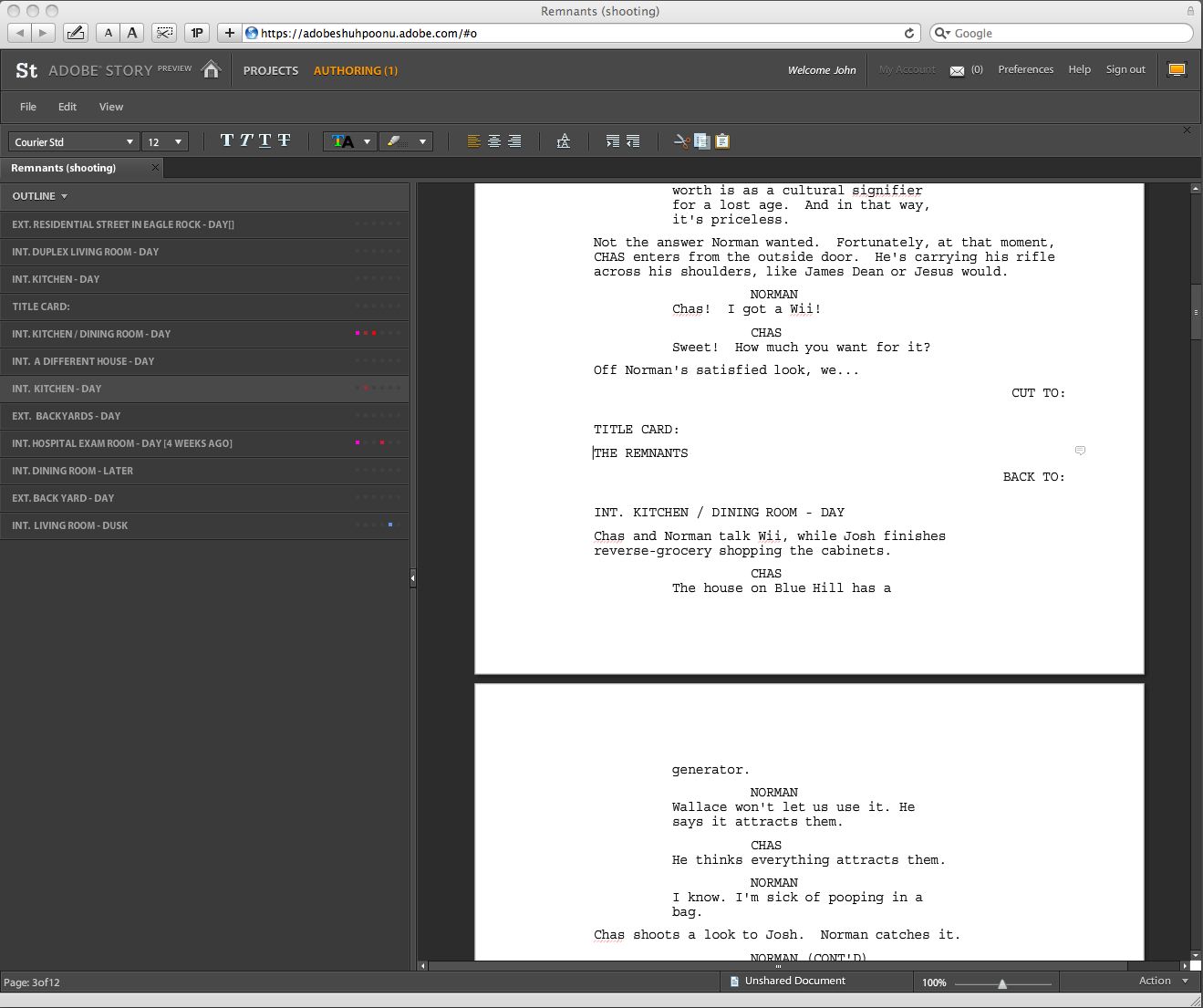
Reader Andrew [pointed me](http://twitter.com/abeeken/status/4170234549) to the preview version of [Adobe Story](https://www.adobe.com/products/creativesuite/cslive/story/), the new screenwriting application that’s designed to work with Adobe’s Creative Suite.

It’s Flash-based and runs in the browser (or via Air), but does a credible job duplicating most of what you’d expect from a traditional desktop application.

screenshot

Story is definitely a work-in-progress, so it’s not fair to compare it to the dominant players in the field. In its current form, it flubs some fundamentals like drag-and-drop and keeping blocks of dialogue together.

But while you wouldn’t use it for Actual Work yet, Story does some clever things that are worth calling out.

* Story tries to identify which characters are in a scene, and uses colored-coded dots to mark them in the outline.

* The highlighter is really a highlighter, changing the background of text.

* Full-screen looks good, with everything but the page itself nice and dark.

* Find and Replace is simply a toolbar in the same window.

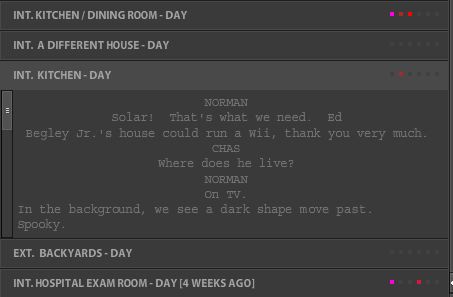
* Single-clicking a scene header in the outline expands it to a compressed, scrollable version of the scene, so you can check something without losing your place in the script. (Double-clicking a scene header jumps you to that scene.)

screenshot

I wish Story well. Competition is good, and a company like Adobe has the resources and experience to keep plugging at it. Yet I have a hard time envisioning it capturing a lot of ground.

Its text handling is strange, probably a result of its Flash origin. No doubt a lot of that can be remedied, but one of the consequences of platform-independence is that a web application is never going to act quite like a Windows one or a Mac one. With something as basic as text, I don’t want to have to consciously anticipate what’s going to happen if I try to select a word. Just work.

My other concerns are more philosophical. When the public preview of a screenwriting application lets dialogue spill across page breaks, I get nervous that its developers really don’t understand the format. Properly handling dialogue isn’t a feature; it’s a fundamental.

The preview version of Story does a good job importing and exporting. I didn’t test out the sharing and version-tracking features, but web-based software has a definite advantage here, and if Story is to make real inroads, it will probably be in this area. For writing teams, this can be very helpful.

I’ll be looking forward to seeing what Adobe does next with Story.

ADDED: Whenever I write about screenwriting software, the first questions are about what application I use. I alternate between Final Draft 8 and Screenwriter 6, with no strong preference between the two. I have also tried Celtx, Scrivener and Montage, but haven’t found them adequate for my work.

Principles of Hybrid Distribution

September 21, 2009 Indie, Projects, The Nines

I’ll be hosting a panel with [Film Independent](http://www.filmindependent.org/empower/index2009.php) in October focusing on the distribution challenges facing indie films, a topic I’ve [written about](http://johnaugust.com/archives/2008/nines-post-mortem) in the wake of The Nines.

A new [article by Peter Broderick](http://www.indiewire.com/article/declaration_of_independence_the_ten_principles_of_hybrid_distribution/pem) articulates a lot of the points I’ll try to make. Broderick calls it hybrid distribution, and while he offers ten points, I’d boil it down to three:

1. Don’t bank on selling it at a festival. Anticipate distributing it yourself.
2. Know your audience before rolling cameras.
3. Focus on getting people to see your movie, on whatever size screen makes sense.

As Broderick says:

> Today many filmmakers are as determined to retain “distribution control” as they are to maintain “creative control.” Distribution control is the power to determine the overall structure and sequence of distribution, select distribution partners, and divide up distribution rights.

Splitting distribution rights used to seem like a Bad Thing: “They only want the movie for DVD.” The truth is that many movies would be better off letting specialized companies handle specialized jobs.

Sony wanted The Nines for domestic home video, and brought in Newmarket to handle theatrical. If I’d really understood that at the start, I might have pushed our sales reps to draw up narrower contracts. As it is, I have no idea when the movie will show up on domestic cable, because it’s part of a much larger package of movies Sony represents.

> Grant each distribution partner only the specific rights they can handle well. For example, if a company is strong in retail DVD and digital, give them these rights, but do not also give them VOD if they have no experience with VOD.

Broderick doesn’t completely discount the Old Way.

If you have a movie that Fox Searchlight knows how to market, you’re in a much stronger position. When it works, traditional distributors have reach and power that can’t be matched, not only theatrically but far down the chain. Yes, you’ll have less control over certain aspects, and may not be able to sell DVDs from your website. But you’ll be able to sell them at Target, which may be the better home for them.

> The best distributors have resources, relationships, and expertise, which can be essential to a wide theatrical release. They may also have advantageous deals in place for VOD, DVD, and digital rights. If filmmakers do due diligence (by speaking with other filmmakers involved with the distributor they are considering) and are able to negotiate a fair deal, their best choice may be an all-rights deal. Higher budget, more mainstream features are better suited for an Old World approach.

If you’re thinking about making an indie, Broderick’s article is [worth a read](http://www.indiewire.com/article/declaration_of_independence_the_ten_principles_of_hybrid_distribution/pem).

« Previous Page
Next Page »

Primary Sidebar

Newsletter

Inneresting Logo A Quote-Unquote Newsletter about Writing
Read Now

Explore

Projects

  • Aladdin (1)
  • Arlo Finch (27)
  • Big Fish (88)
  • Birdigo (2)
  • Charlie (39)
  • Charlie's Angels (16)
  • Chosen (2)
  • Corpse Bride (9)
  • Dead Projects (18)
  • Frankenweenie (10)
  • Go (29)
  • Karateka (4)
  • Monsterpocalypse (3)
  • One Hit Kill (6)
  • Ops (6)
  • Preacher (2)
  • Prince of Persia (13)
  • Shazam (6)
  • Snake People (6)
  • Tarzan (5)
  • The Nines (118)
  • The Remnants (12)
  • The Variant (22)

Apps

  • Bronson (14)
  • FDX Reader (11)
  • Fountain (32)
  • Highland (73)
  • Less IMDb (4)
  • Weekend Read (64)

Recommended Reading

  • First Person (87)
  • Geek Alert (151)
  • WGA (162)
  • Workspace (19)

Screenwriting Q&A

  • Adaptation (65)
  • Directors (90)
  • Education (49)
  • Film Industry (489)
  • Formatting (128)
  • Genres (89)
  • Glossary (6)
  • Pitches (29)
  • Producers (59)
  • Psych 101 (118)
  • Rights and Copyright (96)
  • So-Called Experts (47)
  • Story and Plot (170)
  • Television (165)
  • Treatments (21)
  • Words on the page (237)
  • Writing Process (177)

More screenwriting Q&A at screenwriting.io

© 2026 John August — All Rights Reserved.