• Skip to primary navigation
  • Skip to main content
  • Skip to primary sidebar

John August

  • Arlo Finch
  • Scriptnotes
  • Library
  • Store
  • About

WGA

Script to greenlight panel

February 25, 2009 Film Industry, WGA

The WGA is hosting a [panel discussion](http://artfulwriter.com/?p=748) on studio feature development that should be worth checking out:

> Panelists include:

> * screenwriter Jonathan Hensleigh (Armageddon, The Punisher, The Rock)
> * JC Spink from BenderSpink management
> * development executive Navid McIlhargey (Sr. VP of Production at New Regency; previously of Silver Pictures)
> * producer Derek Dauchy (President of Davis Entertainment)
> * studio executive David Beaubaire (VP of Production at Paramount; previously studio executive of DreamWorks and Warner Brothers – he knows how each works)
> * and a Surprise Guest.

(No, I’m not the surprise guest.)

It’s hosted by the WGA Writers Education Committee, and open to WGA members in good standing (plus a guest).

Thursday, February 26, 7:30 p.m.
WGA Theater
135 S. Doheny Dr., Beverly Hills

You need to RSVP: (323) 782-4602.
More Remnants

January 21, 2009 Projects, Remnants, The Remnants, Web series, WGA

I was happy to get such a strong reaction since [posting](http://johnaugust.com/archives/2009/the-remnants-in-full) the pilot for The Remnants. Every few days, we get a surge of hits as new sites link to it. A fan even set up [Draft The Remnants](http://drafttheremnants.com) to get people to pledge their love.

For something that’s been sitting on a shelf for a year, it’s really gratifying.

Viewers had a lot of questions, so I’ll do my best to answer them here.

It’s actually not about zombies.
===

When I pitched the show, I described it as a cross between The Office and The Stand. Something Very Bad has happened, but we’re focusing on the survivors and their dysfunctional attempts to reestablish normalcy. Like Stephen King’s book, there are good people and some very bad people — but they’re not the living dead.

I completely understand why viewers might expect some shambling corpses. Mia claims that she’s “not one of them,” and former group member Stan apparently “went Jurassic Park.” The bad people, “them,” are truly scary — but also incredibly organized and sneaky. Think fascist.

Think V, not Z.

In the final scene, Mia and Josh both admit they don’t really understand what happened. That’s important.

MIA

I don’t know if the world got invaded, or if this is something we created ourselves...

JOSH

It’s nano-technology from the future.

MIA

Really.

JOSH

I have no idea.

The correct answer is an amalgam of all three.

How did you get that cast?
===

I knew Ben Falcone and Justine Bateman, so I wrote those parts with them in mind. Ze Frank is a friend of producer Matt Byrne, and I had a hunch he could act. So I wrote the part hoping he’d do it.

Robert Ulrich, who’s been my casting director on several projects, graciously agreed to help me find actors for Chas, Mia and Wallace. You’d think that given my credits, it would be easy to get people in to meet and/or audition, but several agencies simply refused to send their actors out for a web series. ((Props to William Morris and ICM for taking us seriously.)) I deliberately hired people with a writing or improv background, because I knew from shooting Part Two of The Nines that I’d need to let people veer far off the script in order to get the feel I wanted.

Because Justine is very active in SAG, she got us to test out their new web series agreement, which basically allows guild actors to work on experimental projects like this for less than scale. From cast to crew, everyone got about $120/day.

How long did you shoot? How much did it cost?
===

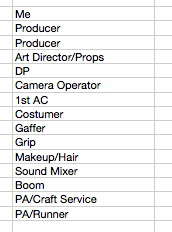
We shot three pretty easy days, with most departments getting a day to prep and a day to wrap. With six actors and a fair amount of improv, I didn’t want to feel rushed. We shot two cameras (the HVX-200) most of the time, generally gunning the same direction for a wide and a close-up.

remnants crewAll in, the show cost $25,003. Depending on your perspective, that’s either expensive for a web show or mind-blowingly cheap for television show. We paid for locations, permits and other details a scrappier web show would just ignore. And we had more crew. Some web shows are literally just the actors and a guy holding the camera. We had 15 people. We were more like an indie feature, but without trucks or trailers.

We could have done it cheaper. Of the $25,000, more than $17,000 went to pay people, and a lot of those folks probably would have worked for free. But I didn’t want to do anything I couldn’t replicate for a series of 10 episodes. You can’t ask someone to work for 25 days for the love of their craft.

I saw the pilot as an experiment not just in storytelling, but production. I wanted to it to be sustainable.

Why isn’t this a web series?
====

There are at least five answers, all of which are obstacles.

* **The lack of a major advertiser who wanted to sponsor it.** That was the original goal: to find a company that would promote the show as hard as we would promote their product. Pringles is sort of a placeholder. We could swap that out for almost anything: Coke, Ace Hardware, Duracell.

* **Actor availability.** Every actor in The Remnants works a lot. The writers’ strike was a major reason why so many great people were available. And no, I’m not wishing for an actors’ strike.

* **My schedule.** I don’t know when I could do it. I haven’t announced the post-Shazam projects I’m working on, but trust me, I’m really busy with features. Doing ten episodes of The Remnants would be three solid months of work.

* **The lack of a viable business model.** A series of ten similar webisodes wouldn’t cost that much (maybe $300K), but there’s still no model for how investors could get their money back. If I thought there was, I’d pay for it myself.

* **My ambitions.** I need to write another movie to direct. The more things I put in front of it, the longer it pushes off that goal.

All this said, I’ve been thinking a lot about The Remnants, and have mentally moved it from the “Impossible” to “Unlikely” box.

What happened at the Grand Canyon?
===

Something so awful it still gives me nightmares.

(That’s the answer I gave actresses when they asked that question in auditions.)


The Remnants from John August on Vimeo.

Cablevision and the infinite TiVo

January 12, 2009 Film Industry, Television, WGA

This morning, the Supreme Court asked the Justice Department to weigh in on a service Cablevision hopes to introduce. It’s an issue every screenwriter (or TV viewer) should be watching closely, because it could have a huge impact on the entertainment industry.

The case is called Cable News Network vs. CSC Holdings. The case made it to the Supreme Court after a U.S. Appeals court reversed a lower court’s decision. The case will probably end up back at the Supreme Court this fall.

The issue is deceptively straightforward: Cablevision wants to offer its customers a “remote storage digital video recorder.”

At first blush, this seems pretty unobjectionable. Under current U.S. law, it’s legal for a consumer to record television programs for later viewing. This is considered time-shifting, and was first made possible by the VCR. Conventional DVRs are high-tech cousins to VCRs, with a hard drive replacing the videotape. In the U.S., many cable and satellite companies provide boxes that include DVR functionality, generally for an additionally monthly fee.

Cablevision wants to offer DVR as a service instead of a device. Rather than recording 30 Rock on the box attached to your TV, the show will be recorded at Cablevision’s headquarters. Then, when you want to watch it, Cablevision will send the show to your television. If it works right, it should feel just like a normal DVR. Only without the cost of the DVR.

If Cablevision offers this service, I think it will be very successful. Less hardware means less things to break, and the service could presumably send a show to any TV in the house. (Some conventional DVRs can do that, but it’s often a hassle.) Plus, storage scales very well. Cablevision could offer a user much more recording space than a conventional DVR.

In fact, Cablevision could offer unlimited storage. And that’s where it gets dangerous.

Say Mary Jones sets her Cablevision RS-DVR to record 30 Rock. So does Bob Smith. Cablevision only needs to record it once. They can send the bits to Mary or Bob whenever one of them asks for it. ((Alternately, Cablevision could partition drives so that every customer has a certain number of gigabtytes (terabytes? petabytes?) of storage, and record each show in that partition just like a conventional DVR. But this is tremendously inefficient, and nearly impossible to audit.))

Given that Cablevision has more than four million customers, it’s a fair bet that at least one of their customers would be interested in any given show, so it makes sense for Cablevision to record and catalog every channel it distributes, 24/7/365.

Conventional DVRs only record what you ask them to record, with some modifiers, such as “new episodes of The Simpsons,” or “movies with Steven Seagal.” So for Cablevision’s service to work like a conventional DVR, it should only offer you programs you specifically chose to record. No fair waking up Friday and asking for last night’s The Office.

But wait. Cablevision is already recording every show. Why don’t they just offer a “Record Everything” option?

Once they offer you the choice to record everything, you suddenly have the ability to watch any show broadcast since you signed on to the service. This is transformative, a [Wayback Machine](http://archive.org) for television.

It would also destroy television as we know it.

Here’s where I put in my obligatory, “I’m no Luddite” disclaimer. I was the first person I know to have a DVR (the original ReplayTV), and consider myself highly familiar with the legal and less-legal options for watching video on computers and TV. As a consumer and geek, I would love to have a service like Cablevision’s. But I don’t think Cablevision should be allowed to do it their way.

Cablevision’s RS-DVR is back-door video-on-demand. They’re trying to offer the networks’ output to their customers on their own temrs, without paying any additional fees.

But it’s worse than that.

A service like Cablevision’s makes reruns absurd. Why would anyone watch a rerun of Desperate Housewives when it’s always been available for free on the RS-DVR? And it’s not just television shows that are affected. In a Cablevision universe, a feature film loses all its television value the first time it’s shown. Why would HBO want to show Slumdog Millionaire more than once, considering everyone who could ever want to see it would have it available for free in perpetuity via Cablevision?

For that matter, why buy a DVD, or spend $9.99 to buy a movie through iTunes when that same film is sitting on your (virtual) DVR?

Without reruns and ancillary markets (like DVDs and iTunes), there are no residuals, so that’s obviously a concern for writers.

But it’s worse than that.

*Without reruns and ancillary markets, there are no feature films and no scripted television.* Outside of lower-cost reality programming, it is simply not profitable to make a movie or TV show that can only be shown theatrically, or once on television. Very, very few movies are profitable in their theatrical release. Most make their money on video and television, which would largely be irrelevant with services like Cablevision’s. A movie studio could decide to never permit their films be shown on any station carried by Cablevision. For television, that’s not an option.

So what should happen?

The Supreme Court should rule that copyright holders (the studios, in this case) retain the right to profit from the distribution of their work for a given period of time. Yes, copyright law is frustrating, and corporations routinely abuse their authority through DMCA and endless extensions. Generally, the studios are the bad guys, so it’s hard to be on their side. But if they’re not getting paid, nobody’s getting paid. And if nobody’s getting paid, there is no industry.

The studios should then negotiate with Cablevision and all the other cable and satellite providers to roll out a system that calls this service what it really is: video-on-demand. A consumer should be able to watch (or record in their home) an episode when it’s first broadcast, or get it through VOD for a fee. That fee should be low, cheap enough to make it an appealing alternative to piracy.

And studios should continue to support Hulu, iTunes and all the other competing services. Television will change, and it will probably resemble something like what Cablevision is trying to do. But it needs to keep paying the people who make the shows, both corporations and individuals. Or there’s no television left.

Why is joining the WGA mandatory?

January 8, 2009 Film Industry, QandA, WGA

questionmarkWhy is it mandatory that you have to join the WGA when you sell a script? Why can’t you just go on about doing your own thing?

— Ethan Gentzsch

Because if it weren’t mandatory, studios would pressure writers not to join.

That seems like too simple of an answer, but it makes sense if you think it through. Let’s say a studio reads a script it wants to buy. The writer isn’t a member of the WGA. If the writer weren’t required to join the union, the studio could save a lot of money and hassle.

* It could pay less than minimums.
* It wouldn’t have to pay into the health plan.
* It wouldn’t have to pay into the pension plan.
* It wouldn’t have to pay residuals.
* It could decide which name would be listed for “written by.”

Given these advantages, a studio would certainly prefer if the writer weren’t WGA, and could make purchase of the script contingent on the writer agreeing not to join the WGA. ((I’m certain this is illegal under labor law, but we’re playing hypotheticals here.))

If it were optional, the studio would make sure you didn’t take that option. So making it mandatory protects incoming writers as much as established writers.

[Ted Elliott](http://www.imdb.com/name/nm0254645/) and [Craig Mazin](http://www.imdb.com/name/nm0563301/) are always the guys with the most thorough answers regarding anything involving entertainment guild law, so I won’t be surprised if they answer this same question better over at [Artful Writer](http://artfulwriter.com). But I’m here and handy, so I can least talk you through the exceptions.

There are some studios and production companies that are not signatories to the WGA. They can only hire non-WGA writers. I know some fledgling writers who’ve written entire scripts for $5,000 — which might be okay given their needs and goals. Likewise, feature animation is not typically covered by the guild, including the animated projects I’ve written (Titan A.E. and Corpse Bride). As a WGA writer, I’m allowed to work on them, but I don’t get any of the benefits of the guild, such as residuals.

While you can’t choose whether to join the WGA, a screenwriter can choose to effectively quit the guild by going fi-core. “Financial Core” status means you’re freed of most of the obligations of membership, but also lose your vote, and frankly the goodwill of many fellow writers. It’s very rare someone chooses to go fi-core, and usually involves hyphenates (writer-directors, writer-producers) who chafe against rules or decisions.

As far as “doing your own thing,” it’s important to understand that writers can choose to work completely outside the system. Many of the films at Sundance are written by writers with no connection to Hollywood or the WGA. The Guild has indie contracts that can offer some protections, but they’re optional. Likewise, international productions are largely outside the auspices of guilds and unions. But in my experience, when I meet international screenwriters they’re always wishing they could have an organization with the clout of the WGA. It’s very hard for a single screenwriter to achieve meaningful leverage with employers.

« Previous Page
Next Page »

Primary Sidebar

Newsletter

Inneresting Logo A Quote-Unquote Newsletter about Writing
Read Now

Explore

Projects

  • Aladdin (1)
  • Arlo Finch (27)
  • Big Fish (88)
  • Birdigo (2)
  • Charlie (39)
  • Charlie's Angels (16)
  • Chosen (2)
  • Corpse Bride (9)
  • Dead Projects (18)
  • Frankenweenie (10)
  • Go (29)
  • Karateka (4)
  • Monsterpocalypse (3)
  • One Hit Kill (6)
  • Ops (6)
  • Preacher (2)
  • Prince of Persia (13)
  • Shazam (6)
  • Snake People (6)
  • Tarzan (5)
  • The Nines (118)
  • The Remnants (12)
  • The Variant (22)

Apps

  • Bronson (14)
  • FDX Reader (11)
  • Fountain (32)
  • Highland (73)
  • Less IMDb (4)
  • Weekend Read (64)

Recommended Reading

  • First Person (87)
  • Geek Alert (151)
  • WGA (162)
  • Workspace (19)

Screenwriting Q&A

  • Adaptation (65)
  • Directors (90)
  • Education (49)
  • Film Industry (490)
  • Formatting (130)
  • Genres (89)
  • Glossary (6)
  • Pitches (29)
  • Producers (59)
  • Psych 101 (118)
  • Rights and Copyright (96)
  • So-Called Experts (47)
  • Story and Plot (170)
  • Television (165)
  • Treatments (21)
  • Words on the page (237)
  • Writing Process (177)

More screenwriting Q&A at screenwriting.io

© 2025 John August — All Rights Reserved.