• Skip to primary navigation
  • Skip to main content
  • Skip to primary sidebar

John August

  • Arlo Finch
  • Scriptnotes
  • Library
  • Store
  • About

Search Results for: outline

Scriptnotes, Ep 361: From Indie to Action Comedy — Transcript

August 7, 2018 Scriptnotes Transcript

The original post for this episode can be found here.

John August: Hello and welcome. My name is John August and this is Scriptnotes, a podcast about screenwriting and things that are interesting to screenwriters.

Craig is off on assignment this week but luckily we have not one but two people on deck to fill in. Susanna Fogel is a writer-producer whose credits include Life Partners, Chasing Life, and this new movie The Spy Who Dumped Me, which she also directed. Welcome Susanna.

Susanna Fogel: Hi, thanks for having me.

John: And also we have her writing partner on that film, David Iserson. His credits as a writer and producer include Graves, Mr. Robot, Mad Man, New Girl, Up All Night, and Saturday Night Live.

David Iserson: Hi.

John: David, welcome.

David: Thank you for having me. I’m a big fan of the show. So this is like – I can live in my fan boy fantasy of being on Scriptnotes.

John: Well, with the two of you here I want to talk about some film and TV stuff, because you’ve both worked in film and in television. I want to talk about action comedies. But mostly I want to get started by talking about how you guys came to write this movie together, because when I went to the screening last night I had assumed that you guys were always writing partners and that I would go through your credits and they would all be the same credits and your only shared credit that I could find was The Spy Who Dumped Me. So what caused you two guys to write this movie together?

Susanna: And it will be the last shared credit. I will be taking credit for everything from now on.

David: Once we leave this recording we will never speak again. Susanna and I met a few years ago at a Christmas dinner that a different writer friend threw. And we had a ton of mutual friends. It was weird that we had never met. And we just became sort of instant pals, shared a lot of the same taste, and we looked at each other’s work and we realized that we had a lot of shared things in common. And then we just started writing our own things in the same room as each other. We would go to the same coffee shops.

Susanna: Like a workout buddy.

David: Yeah, just kind of keep each other honest. We would go work on our own things at the same table and talk about whatever problems we were having in our own scripts. And we did that for a while.

Susanna: And then we sort of saw each other through creative heartbreaks on both of our sides. You know, we both had projects we were excited about crumble before our very eyes and supported each other through that and then it became like a shared venting about how hard it was to get anything produced, especially in our sort of small indie dramedy tone. And then we started dreaming really big about sort of seeing if there was a way to combine that with our fanboy and fangirl attitude towards these big tent pole movies that we never thought of writing but loved to see. And wondered if maybe there was a way to sort of adjust the framework of telling the same kinds of stories.

John: So, before you guys are working in the same shared space, same shared coffee shop, you had very different trajectories. So the first time I became aware of your stuff, Susanna, was you’d done Life Partners which was a Sundance Labs project. And so talk about that journey. Did you really see yourself as a person who was supposed to be doing indie film and TV was another thing that came up? How did you see your career over the last ten years? What did you think your trajectory was going to be?

Susanna: Well, I had sort of grown up in that sort of mid-‘90s New York indie film world. I’m from the east coast. I went to college in New York City. I did internships at Good Machine and Fine Line and all those companies in Downtown New York where I really did dream of being like Nicole Holofcener and that was kind of where it stopped and started. Started and stopped.

And I think the reality was that by the time I moved out to LA to sort of figure out how I could try to become that the industry was starting to change really quickly and, you know, both because of the economic collapse and the writers’ strike and also just because of the Internet and the nature of the over-saturation of content it sort of became less and less hospitable to movies like that, at least in the cinematic like first-run movie world that you dream about when you’re trying to become a director.

So, to me it sort of was a moment of just trying to figure out how to actually get something produced because I would keep writing these small heartfelt like indie dramedies with women in the lead roles and they just weren’t getting made. So, to support myself I sort of got in the studio writing assignment game which is one where it’s a total crap shoot whether you get something made or not. You have no control over that often as a writer.

So, it wasn’t creatively rewarding but it was just enough to sort of stay afloat. But I started to adjust my idea of what I could sort of actually do as a director and see get produced and how I could start to climb that ladder. And then, you know, after having a project fall apart that I loved, it was a Black List script that I wrote with a friend who I wrote with for many years, we kind of had one heartbreak too many and we decided to write a one-act play just to actually put something up that wouldn’t cost very much that we could actually just direct and see in front of an audience. And that one-act became the script for Life Partners, which then became a Sundance Lab project and then actually did – we did find financing for that, but it kind of felt like a lightning in a bottle situation. And then after making that movie, which was rewarding, I noticed that the landscape didn’t change that much.

Like it’s not like there were a lot of opportunities to make more movies like that now that I had proven myself. It was more that that market was still tiny. And at the same time we had the opportunity to adapt a Mexican format, like sort of My So-Called Life with Cancer for lack of a better description, Mexican show that became Chasing Life which was our Lionsgate ABC Family show that was on for a couple of seasons.

So, that was a great opportunity to write and see things produced. And I got to direct a few episodes and that was great. But my dream was still to go back to writing and directing features. I just wasn’t sure how to do that in the sort of current climate of getting movies made.

John: Now, David, looking at your credits it looks like you’re mostly a television writer, but were you also writing features during that time, too?

David: When I moved out to Los Angeles after college, my intention was purely to be a feature writer. My dream was to sit in a movie theater and see my name on a movie. And when I started, when I moved out here I got a job in development. I read a bunch of scripts. And I answered phones and I was a receptionist. And I did that job for like a year and a half. And those jobs really suck all of your kind of life force out of you. And I came out here to write but I was not able to write.

So, at like kind of this spur of hubris I quit that job, but I knew I just kind of had like less than three weeks of money before I needed to find a different job. So I burst out like a feature script that I’d had just sort of brewing in my head forever and I was excited and encouraged. And then a year passed and no one read it, but eventually that script got me representation and that script got me a bunch of jobs. And I did a lot of feature work, but not any feature work that had been made. And in the meantime before that I almost sort of like stumbled into a joke-writing job.

I started emailing jokes to Weekend Update on Saturday Night Live. And I got enough of those on the air that they hired me for the following season. And my tenure at SNL was – what’s the word – inauspicious. And then I came back to LA and I wrote these movies that never got produced. And then the writer’s strike that was 10 years ago happened and I realized, oh, I don’t know any writers. I have this very lonely job. Every time I write a script and it doesn’t get made I feel like I have to start all over again. And TV had just started becoming something really special and what has now just sort of blown up since then.

So then I started working in TV and all the while I was trying to write movies in between, on weekends, kept sort of hustling through doing that as well all the while while I was sort of juggling my TV jobs.

John: A question for both of you. I mean, you had the opportunity to do TV shows. You could have done your own TV shows or kept going in TV show land. Why keep going back to features? It feels like you both had a bunch of hidden work where you’re writing these features that never got made. At a certain point don’t you just decide to make what they’re making and just go into television? Why keep going back to the feature land?

David: I mean, for me I feel that decision was made for me. I mean, my creative heartbreak that brought us together to write this was a pilot that I loved that died. And I’ve had a lot of pilots that never got made. I think that for me the part of my brain that writes TV and the part of my brain that writes film are pretty similar. So I think that we just somehow got a movie that we loved that was written in the way that we wanted it written and produced in the way we wanted it produced, got made in a time when film is seemingly virtually dead and all of the attention is on TV, that just happened to be our moment to make the movie we wanted to make.

Susanna: Yeah. I mean, I think part of it is just seeing the feature business that does exist and feeling like there was something missing there. To the extent that movies were getting made and there weren’t a lot of good female-driven movies getting made, or female-driven movies getting made that had like sort of a more muscular tone to them. I just felt like there was a lack of that. And that there would be a hunger for it the way that I feel like every few years there would be a movie like Bridesmaids that people would think was going to sort of change the tides of what movies got made and it never really had that seismic effect that we all thought it would.

But there just seemed to be this lack of a certain kind of story and I think just as a viewer and consumer it bothered me. It just felt like an injustice. So, I think that frustration sparked the conversation that led to the movie. So, it was more just kind of almost like an act of rebellion and less a need to work in that format.

John: So, let’s talk about that conversation that led to the movie. So, what do you guys separately and together remember about those first discussions of this idea and should we write this idea together and what it would be? What was that conversation like, or conversations?

Susanna: Well, there are a few parts to this. The first part was that we decided that we were going to try to write something together that was a big fun comedy that we would encourage each other to not fall into some of our like indie traps that we normally would fall into that make things smaller, and smaller, and smaller.

John: What are those traps? Can we talk through some more of those pitfalls?

David: Let’s see, it’s stifling yourself when it comes to budget. You know, thinking like we can’t do that. That’s too big, too much. Kind of ending things, not necessarily in triumphs.

John: Ending things in ambiguity or reality, sort of a mixed bag.

Susanna: Trying to have more of a bittersweet slice of life kind of ending, which is our personal – those are the movies that, you know, we love seeing movies like Sing Street that sort of make you feel sad and laugh through your tears which I think is our personal shared taste sometimes. But we were like, you know what, let’s try to just have fun with this and make each other laugh and see if we can’t come up with something that just feels a little bit more like a feel good entertaining movie.

So, we then embarked on a series of walks around the Silver Lake Reservoir where we brainstormed. No bad ideas. Safe space. The biggest ideas we could think of. The most high concept ideas. This reminded me of when I was 21 and trying to do this and had some exceptionally bad ideas.

David: We had some exceptionally bad ideas.

Susanna: We had some bad ideas. I mean—

David: We had some great ideas that she thinks is bad.

Susanna: We still debate about whether a movie entitled Ghost Hookup would or would not be a good movie.

David: It would be a great movie.

Susanna: I think it’s – I think we’ve moved past it.

John: I mean, it could potentially be a great movie, but it’s also a great parody for that kind of movie.

Susanna: Therein lies the debate.

John: Absolutely. Is it a 30-second skit or is it actually a movie.

David: Exactly.

Susanna: We’re still not – we still have not settled that discussion.

David: So, Susanna – I woke up one morning to an email from Susanna where she sent me an article, a New York Times article, about World War II or something like that. And I don’t remember what the article was about, but there was something in the subject line that was like, “This is an interesting story. This is not the kind of movie that they would let us write.” And we had lunch that day and I started thinking about the kind of movie that we would not be expected to write. Some sort of big, muscular action movie. But then we started talking about what kind of characters we love. Like characters that are like us.

I write a lot of female-driven things and Susanna does too, so we talked about two friends who are ill-equipped to belong in a very big action, muscular, explosion-filled car chase world.

Susanna: Like what would really – there’s a whole world of observational humor that we find endlessly fascinating. And what if you put that sort of lens on this very glossy genre. Like if you think about Jason Bourne having to pee in the middle of something and he just really has to pee and it’s not a good time but he has to do it. Just the very human things that these characters do that those movies never focus on. And then we figured there would be some comedy there and that that was worth looking at, without making a parody of a spy movie or like making an arch action comedy. Could we actually just drop ourselves, or our avatars for us into a big movie and see if it felt original?

John: Our last episode of Scriptnotes was about relationships and the sense that all movies are fundamentally about relationships and that you don’t – you can say that you have a character and you’re following that character, but you can’t understand anything about that character unless there’s someone for that character to interact with, a relationship that they can have.

And so in your case you have these two women and we’d have a very hard time understanding either woman independently if we didn’t have the other one there to sort of mirror back and sort of fill in the details of who that person is and let us see the differences between the two going into it.

Now, some of the tropes we would expect though is if we have these two women, at some point they’re going to fight and they’re going to break up and have to come back together. And that the relationship has to grow and arc and change over the course of it. Your movie doesn’t really do that at all. So is that a conscious decision?

Susanna: Yeah. That’s something that we felt really strongly about. I mean, you can speak to that a bit, too.

David: Yeah. The earliest conversation we felt that a movie like this typically would build these false stakes into the characters breaking up. And I think that a lot of times in screenwriting I think people confuse what conflict needs to be. And we didn’t feel like we needed to build a false conflict between these two characters where they’re breaking up over something small when their lives and the world is at stake. We felt that the conflict came so rapid fire at them, while people are shooting at them, while people are chasing them, while people are dying all around them that we didn’t need to have some sort of what we call in writers’ rooms “schmuck bait” where they break up and we know that they’re going to get back together in the end.

It just didn’t feel exciting to us. And we just wanted to tell a story about friendship where these people love each other and they’re going to be friends before, they’re going to be friends after, and they’re going to be friends through whatever we put them through in this movie.

John: What was the writing process like for you guys? You talked through probably the broad strokes of the idea. And what point did you sit down to officially start writing? Were you writing together? Were you dividing up scenes? What was the writing process like for you guys to work together?

Susanna: We were both unemployed at the time, so we had a lot of time. And we started a sort of obsessive flow state few weeks sitting in the lobby of the Lion Hotel, surrounded by other people writing screenplays in the lobby of the Lion Hotel. And just we’d get there first thing in the morning and we would basically just kind of channel these characters and talk as the characters and someone would write it down and we would actually just – we started with an outline that we did together. And once we had that we would just open your screenwriting program, Highland, and start riffing and start writing things down, even the bad version. And it sort of came out of us really quickly.

Now we’re trying to write something else and it’s a much harder process. And I think we realized that we – you can’t necessarily expect things to be as easy and fun as they are when they are at their most easy and fun. And it doesn’t mean the script is not good, but in that case I think just fueled by this like we had nothing to lose in a weird way. We didn’t have anything to do. We wanted to prove ourselves.

David: We were really angry.

Susanna: Yeah. We were annoyed. We would like take breaks to check the industry news, which you should never do anyway. But we did and we’d see people selling stuff that felt like, god, I’ve seen that before. And we’re going to do something really original. And just kind of leveraging that to make ourselves work harder and up our game basically. I don’t know.

David: Yeah. I had written with other people on TV shows, but I’d never really had a partner before. So for me there was no value in just having her write a scene, me write a scene, and us merging it together. We wanted to elevate both of us by just sitting there and make each other laugh. And we would start to adopt the voices of the different character and we would just start speaking like that. And we would do that publicly. And we were shameless about it. But we wrote this script incredibly fast and–

John: How many weeks or how long to write it?

David: I’m only going to brag about this because we’ve had things go so slowly and not happen at all, so from the idea to the completion of the script was a month. And then a year from there we were in front of the cameras, or we were behind the cameras. We weren’t in front of the cameras. The cameras were rolling.

Susanna: You had a cameo in front of the camera.

David: I had one line. And then a year from that we were filming the movie in a year, from that is now.

Susanna: Yeah.

John: That’s crazy. So that’s an incredibly fast turnaround on that. Before we get into production, I want to make sure we circle back and highlight the fact that you said that you wrote this in Highland, the application that I made. And Highland gets a frequent callout in the movie because Highland is…?

David: Highland is the bad guy organization behind it which we named because we looked at our program and that was the first word we saw. I don’t know if we’re on the show just to pitch Highland, but we will do it anyway. For writing a script fast and making it fun and having the flow go really, really smoothly, we used Highland and it was great.

Susanna: Yeah. I used to write everything in Microsoft Word just because I wanted to see all the dialogue in one page. I just wanted to see a whole scene laid out in a simpler way where I could look at the totality of it and not get bogged down in formatting. And not have everything spaced out so much that I would have to engage with my computer to just read a scene. And this reminded me of that. Like I trained myself not to have to write in Word just to save time, but Highland enables you to do that, which is great.

John: Thank you. That’s really not an ad for it.

Susanna: We know. But we are more than happy to advertise it. I’ve been pushing it on everyone.

David: Yeah. We paid full price for it.

John: Nice. So, you’ve written the script in a month. At what point do you start to show it to other folks? Do you show it to your representatives? At what point do you feel like this is a script that we might take out on the town or get to people who might be able to make this movie?

David: Immediately.

Susanna: Yeah. We had both – I think in part because we felt like we had nothing to lose because we had no jobs and no one was expecting this of us and we didn’t really talk about it with agents or anyone too much because we – understandably they would have probably been like, “What are you talking about? That’s not your thing. What do you mean? Ok, you guys can…”

We just didn’t want to hear any discouragement or even questions. We just wanted to prove it to them. And I think to us that was kind of – I don’t know, I think that that was for the best. And I’m glad that we – it’s kind of a lesson in – I used to constantly ask agents and managers kind of for permission to write a thing or “What do you think.? Do you like this idea? Do you like that idea?” And then very rarely did they say, “Yes, that’s a great idea.” Their job is to say here are the other things that are like that and here’s why it’s not.

So, we kind of just decided to incubate the process and not expose it to that, which I think was a really good decision and one that I wish I learned earlier. Who knows what scripts could have been written that I stopped thinking about after one phone call to an agent?

But I don’t know. We also talked a lot about what our attitudes would be for getting it made, kind of anticipating that people would want to attach a director that was experienced with movies like this and they were kind of all older male directors. And that seemed wrong. It didn’t have to be a woman, but we couldn’t even think of the right guy to do this. And so we were like kind of preemptively wondering how to empower ourselves the best and asking that question of what do we need. Do we need to sell something quickly because we have bills to pay or can we take the longer game approach and kind of keep ownership of this as long as possible? And that’s just a decision that’s personal to everyone, but I think this one we approached it very differently in terms of a strategy than we ever had approached anything either of us had ever done by deciding to hang onto it and be aggressively—

You know, when it started to pick up steam a bit, we didn’t want to sell it. We didn’t want to sort of give up that power, which was not always an easy decision because we were also struggling and unemployed.

John: Well, let’s talk about the process. So you sent it to your representative. They’ve read it. They said this is great. Traditionally you make a list of these are the people we would want to go out to. You sort of sign off on that list. It leaks out beyond those places. But in that initial conversation with your reps you have to say like, “And Susanna is going to direct it?” Or we want to hold onto it in some producorial way? Like what were you actually saying to your reps at that point?

David: We wanted it to get made. And I think that was the biggest thing that we were contending with. We didn’t want a scenario where we were going to just develop this forever and then let it sort of peter away. So I think we discussed amongst ourselves that if there was too much resistance in having you direct it then we would reassess that. But weirdly there wasn’t a lot of resistance to it, which was great.

Susanna: There was sort of – I mean, I think it’s that thing where it’s the sort of waiting for permission to do a thing problem where in the moment when we said even, OK, if we can’t get it made – even floating the idea out there was kind of a scary thing, but like ultimately it was – when we talked to our teams they were like, “Well, you know, it is a really big leap and maybe it’s too…” You know, it’s hard to make a movie of this scope because we had blue-skied everything and not thought about budget. That’s a really big jump. My first movie was well under $1 million. I had no action experience whatsoever. The only proof that I could do it is that I wrote it, so I understood the tone of it and what it wanted to be. But beyond that executionally there wasn’t any proof of that.

I feel like if I had hedged on that, or said, “Yeah, I’d love to, but let’s see what the options are,” I think that could have opened up space for more doubt and more trying different other paths.

John: So maybe the good advice here would be say like you came in strongly saying I’m directing this movie, and if there were no takers you were prepared between the two of you to sort of go to another place that someone could have made the movie, as long as it was getting made. Your priority was the movie getting made, and you being attached as the director was really part of that goal of getting it made.

Because we’ve all been through situations where a director is attached and then suddenly that director has three other projects he’s attached to and you fall back on the list. And it doesn’t happen.

Susanna: Yeah. I guess if there’s a lesson there it’s obviously have a plan B and be flexible privately, but don’t lead with that because if people are just generally a little bit more risk averse they’re going to take that seed of doubt and maybe everything will just get confusing and diffused. But if you just come in strong with something, you wait till someone says, “I will make it, but not with you directing it, but here’s this other director.” Let them sell you on another option and then make that decision.

But it did start to feel like things were changing a bit in terms of the female director conversation and people feeling like they really needed to clean up their acts in terms of that. When we left for Europe we kind of left and it was sort of one way. And then we got back, it had totally exploded and it seemed like it was so, so receptive. But we kind of like were out of the country for that shift.

John: Did Weinstein happen while you guys were overseas?

David: Weinstein happened right after we got back.

Susanna: Yeah. It seemed like people were excited about making a female-driven movie. Actresses were excited to be sent something like this because there wasn’t anything else like this out there for them. And it came together pretty quickly because of – I don’t want to skip ahead of the step-by-step of it all – but basically Kate’s Saturday Night Live schedule expedited everything. And gave us I think this unique position of leverage to say like we have to make the movie this summer. Who is doing it with us? It is happening. As opposed to that usual dance where you’re kind of like – your schedule is the least important. I mean, you’re sort of waiting to see when actors are free, but it’s always this chicken and egg that’s like endless until there’s a green light, in my experience.

But, yeah, in this case we had just one window and that was that.

John: That was it. So, let’s figure out sort of how pieces came together.

Susanna: We’ll get back.

John: So your reps have the script. You’re starting to send out the script. People are reading it. So Kate McKinnon reads it before it’s actually set up some place? Is that correct?

David: We had gotten a producer at that point.

John: And producer was Imagine, or produced with somebody else?

David: Producer was Imagine.

Susanna: And honestly that was an interesting thing because the agents have their ideas and their lists. And what they know is what companies tell them they’re looking for. And so they’ve got a targeted list, but it’s not necessarily exhaustively covering all the people who secretly want to do movies like that. So, I happened to randomly have a meeting – I was in New York working on a book. And I had a random meeting with this producer named Julie Oh who was Imagine’s New York person. And she was kind of in her 20s, really hungry. Had worked at the Weinstein Company and various places but kind of had the spirit of an indie producer in this job working for Ron Howard.

And I just really loved her and got along with her and she seemed to have this fearlessness that I associated with indie producers. And just confidence. And so she said, “You know, this is not an Imagine movie. This isn’t like our usual thing, but like screw it, I’m going to bring it to the staff meeting. Let’s just see. Let them say no.”

So even though it was sort of not their brand, she walked it in there and then they were like, oh, well, why couldn’t this be our brand? Let’s do it. We have the infrastructure. And that’s how Imagine came to the project.

John: Great. So Imagine comes on as producer. Traditionally they would go through Universal, but it wasn’t a Universal movie. It felt like it could have been a Universal movie.

David: They had just changed their deal. They didn’t have Universal at that moment.

Susanna: And so we went to Kate first just because she had had a small cameo in my first movie. And I knew her a little bit. And we had heard that she was looking for an action comedy with women. So we met her and she was excited to do it. And then with that package we took it out to the studios with our super aggressive, pushy like ultimatum of you have to do the movie this summer, which is kind of an unheard of schedule for a studio at that budget level.

John: Yeah. But I mean also I think what’s potentially exciting for a studio is they want a movie and suddenly there’s going to be a movie. So they see like, “OK, this is a thing. If we actually pull the trigger here we can make a movie and have it come out a year from now.”

Susanna: Yeah. I mean, I think we’ve re-fallen in love with the idea of writing spec scripts as opposed to trying to set things up or pitch them. Which doesn’t mean we wouldn’t do that. But we had a very positive experience just putting down our ideas and our words in our style and then having a thing to really talk about instead of the time you spend trying to explain why something is funny or why something is compelling.

David: Yeah, I mean, Susanna and I want to get a tattoo that say “Specs Forever.” And when I was starting out and I would pitch things I would get a call back from my agent and say, “Well, you know, they said you seemed really nervous.” Which of course I was nervous. But the movie was never going to be me standing in front of the screen dictating what happened. But, you know, pitches are nerve-wracking and it rewards people who are really—

Susanna: Performative.

David: Performative. I get that. Which is not necessarily anything to do with the process of when you’re sitting there writing. And so it is a big time risk, I suppose, to write a script, to write a spec script. But pitches also take a long time to put together. And when you write a spec script you’re putting everything on the page. You’re telling them what the tone is. You’re telling them who the character is in a way that is hard to describe but—

Susanna: Especially in comedy.

David: Yeah. But exists on the page. And they can see it. And they can love it or they can hate it. And they can make that decision. And to us it felt very empowering. Now, I know, spec market isn’t what it was when I moved out here, but I think that it’s hopeful that we were somehow able to work within it.

John: So you say “Specs Forever.” And I definitely get the logic of that, or sort of the emotional logic of this, because right now I’m writing something for a studio and it’s a project I’m really excited about, but in the pitching of it I realized that of the five people in the room each of them has a slightly different version in their head about what I’m actually going to be turning in in a couple of weeks. And that’s a thing we always go through when we set up something as a pitch. It’s like it’s great that we were able to set it up as a pitch, but everyone is expecting something a little bit different. And so when I do turn in this script they’re going to have opinions based on what their preconceptions of it were. And if had just been able to write the script and give it to them without all that pitch process it would have been a very different thing.

David: I do this weird thing. This I do in TV. I don’t think I can do it features. But almost every time I’ve pitched a TV show I’ve secretly written the script first. Or I’ve secretly written a good deal of it. And if you’re writing a half-hour script that is not a huge time constraint.

John: You could write a half-hour script probably faster than you could put together a pitch for it.

David: Without a doubt. And sometimes a 60-page one. And I think hearing the characters speak on the page, feeling what it feels like for them to interact, that gives you something when you walk into a room and describe what it is that you are doing in a way that just kind of blue-skying it, talking about what other movies it feels like, kind of telling a joke that might exist in it. It just doesn’t work the same way. I think that particularly if you write very character-driven things you kind of need to have the characters speak at least privately before you could ever describe it to somebody else.

John: So let’s talk about some of the writing, especially your action writing, because I’ve not had a chance to read your actual script, but Susanna your action sequences are fantastic. One of the things I was not expecting when I saw the movie last night was sort of how intensely sort of R-rated kind of action sequences they are. And so some of them are not with our leads. They’re with characters who are technically spies. But other scenes have to have our comedy leads also be part of those sequences.

What was it like writing those things together and then what was it like figuring out how you were going to direct those sequences which are so ambitious?

Susanna: Thank you, first of all. I’m glad you liked the brutality that we brought to the screen in today’s hyper-violent world. Dave and I had read a lot of – in preparation to write this – we had read a handful of action scripts. And there was a tone to the way that they were written, both in the action and just in the muscularity of the style that was – it was less kind of literary than we were used to. We’re both novelists, too, so we were used to writing these kind of beautiful on the page dramedies. And here we are reading these scripts that have like a lot of incomplete sentences and dash dashes and sounds and, you know, caps lock. And it just was not our style.

But there was an undeniable sort of like power to reading those. So we were like let’s just as an experiment try to mimic the style and see if we can kind of get into it. And we found it really fun, even though it was a completely different kind of style of writing.

And so we tried to sort of, yeah, I mean, I would say writing them was really fun because we found that we secretly loved that kind of aggressive style. It made us feel empowered. We kind of got an adrenaline rush from it. And we really just pushed ourselves to come up with action that felt situationally interesting or funny where there was like a comedic game to this scene, but then the scene itself played out in a pretty straightforward serious action way. And I think dissecting that partly happened on the page and then happened throughout the process of directing which I’ll get to in a second.

But it’s a little bit like, you’ve got these comedic scenes that feel somewhat grounded within the context of a spy movie. Friends interacting in a grounded way. And then you are kind of expecting people to sit through pretty violent sequences and then go back to a scene where Kate McKinnon is making them laugh about something banal. So in writing those action sequences it’s like you don’t want people to have whiplash reading or watching that from tone to tone and feel like they’re watching two different movies that don’t kind of meld well.

And so it’s about figuring out ways to put cleverness or wit into the action sequences, both on the page and in directing them so that people can feel a bit of distance from the violence in a way. They can have a smile on their face the way that they do in like a Bond action sequence where between his witty quips and the creativity of the scenes there’s usually something just fun about them that inoculates you from being aware of how many people are actually falling off cliffs and getting shot in the head. Not in my movie. That’s not a spoiler. In Bond movies.

But so I think it was partly on the page but then we were like what’s a funny way for this person to die.

John: The body count in your movie is really high.

Susanna: It’s really high.

John: What is the actual number? Have you counted up?

David: I did figure it out once. It is definitely–

John: Is it more than 20?

David: It’s more than 20. It’s probably 35.

Susanna: I think it was 35-ish. Yeah. And then the directing piece was just I think – it felt like a revision. You know, I wanted the action to feel really visceral and fun, so I brought on this incredible stunt coordinator and second unit director named Gary Powell who had done the Bond and Bourne movies.

John: Legendary.

Susanna: He’s amazing. His whole family is legendary. His brother. His dad. His wife. They’re all stunt people which is incredible. And Gary, you know, it kind of felt like another phase of writing. We’d sit there and it felt like for that process he was my cowriter and we would kind of just do a beat sheet. We’d look at what we had. We’d talk about it. And then it was just a dialogue like anything else. You know, he would pull out the toys or pitch different toys or things and oftentimes they were too brutal and they would crossover into that like this is disturbing and I’m not going to want to – I’m not having fun anymore level.

So, I don’t know, it was like constantly negotiating that with him. But we made a beat sheet together. We broke things down. And tried to just come up with – Dave and I would try to sort of come up with the sort of funny observational humor twist on whatever Gary would bring.

John: OK.

David: And I would have to have a cordial argument with Gary about if it’s possible to kill somebody with a salami. In which he said it wasn’t, but I was insisting we try.

Susanna: And I think Gary, too, has his own pet peeves. You know, the way that as writers there are probably things in movies that you see and you’re like I hate when they do that, or I hate this type of joke, or I hate when they have characters do XYZ thing. Gary has his own list of things coming from a completely different place. Like he hates zip lines. He’s like, “I hate them.” He got in a big argument with other people on the crew about whether or not to have a zip line. Those are just his things.

And the salami came down to the fact that it crossed over into broad for him, but also the technicality of it bothered him.

David: Yeah, he was talking about how salami is constructed and how the human body is constructed. And it was, you know, it was illuminating for sure.

John: So this beat sheet that you’re doing with Gary Powell, how much of that beat sheet makes it back into the script, or how much of it exists as a separate document of just like when we do this sequence this is the beat sheet for that sequence?

Susanna: I mean, we had a pretty fleshed out, pretty specific description of the action in the script. The thing that changes is that it’s like what you’re actually watching, you can kind of write around or glibly write through – I don’t know if you’ve experienced this, too – but you can kind of like breeze through something to make it a fun read and then when you’re actually making a shot list and going down to the props department and looking at the knives that are going to be used and the fake blood. And you’re actually looking at it in a really granular way, some things you realize are impossible or some things are too goofy. Like Gary would argue the salami. And Dave would argue the salami was not goofy, it was subtle.

David: My argument was subtle.

Susanna: But when you’re actually translating it, sometimes you just have to adjust. So it was pretty written out and what you see is pretty much what was there, but you have to make certain adjustments. Also, you know, there’s a big action sequence in an old Soviet gym that used to be in the script in an ice rink. And it wasn’t until we were scouting and we couldn’t find the right ice rink in the middle of rural Hungary that we changed it. But we kept seeing these gyms.

John: Great.

Susanna: So you kind of have to be flexible in that way. And then it was a combination of Dave and me kind of rewriting it and then Gary presenting the reality of what that would mean and what that will really look like and whether it will look goofy or not.

John: As people will see in the movie, one of the things I want to sort of key them into and be aware of is as we’re intercutting between some of the spy stuff at the beginning and sort of the real world stuff you’ve done some very clever but simple visual things to say like, OK, no, that scene really was supposed to come here before this moment. There’s a moment with a cue ball which exists on both sides of the cut. And these little small visual rhymes and sort of idea rhymes that let us know that like, no, these really are the same movie. You really are in the same space, the same universe. Nicely done I’m just saying.

Susanna: Oh, thank you.

David: Thank you. I mean, we talked a lot about, and I think this was Susanna as a director talking to us collectively as a writer is transitions were incredibly important. And I don’t know if that’s always a thing that I think about when I’m writing, and I’m sure she can speak more to it, but when you’re putting together shots and actually trying to direct things moving from one scene in a totally different place to another scene should feel like it has some sort of connective tissue.

So a lot of that was her coming back to me and to us when we were rewriting and challenging us to have these transitions which I’m glad you noticed.

Susanna: I know. Thank you.

John: Also, on the page classically the last line of a certain scene sort of informs the first line of the next scene, but when you’re dealing with action sequences there often are no lines and so it’s a matter of sort of visually finding a way to like just characters moving in the same direction, a prop, an idea, an image, you know, brightness/darkness. There’s ways you find to sort of match that.

And you won’t always be able to get those into the script. It won’t always make sense in the script. But you have to think as you move from writer-director you’re thinking, you know, visually how I’m going to signal that this really is supposed to be moving from this scene to this scene.

Susanna: Yeah. I mean, I’m working on something now as a director on a pilot that I didn’t write and getting ready to figure out how to shoot that. I’m working with the writer on that. And we’re talking about the transitions and looking at each one and kind of having conversations about “What is like an object, a prop, an image, a character moment? Like what do we want to be feeling as we enter a scene and seeing?” And if it’s not a visual transition, because you can’t find the neat tidy one that works, it’s got to have an idea to it in one way or another.

And the earlier you can think about that the more prepared you can be to actually like get all the departments’ hands on deck to like really make that feel very designed, which I think then just adds a level – it elevates the thing I think.

John: Something Aline Brosh McKenna often says is you have to remember that the screenwriter is the only person who has already seen the movie. And so in your case you’re two screenwriters so you both saw the movie, but do you think you saw the same movie? I mean, it may be hard because you’ve actually gone through production and seen so many cuts, but David do you think you saw the same movie originally that she saw?

David: I think we saw the same movie. I think where it became different, not different but where our ways of seeing it was different, was on set where as a director there were just a million other things that she needed to address and deal with and see and discuss and lenses or whatever directors do. And then for me my job was almost entirely just to hold the script inside my head. And I think we leaned on each other for being able to balance that out. But truly I think we saw the same movie and we continue to see the same movie, but on set the like minutia of script stuff and if you move one character here, cut this line, or cut this scene how that will change, you know, 15 dominoes ahead, that became what I had to focus most on.

Susanna: And that also includes an actor asking me a question or wanting to change something and me in the moment being like, “Yeah, yeah, OK, fine,” and then Dave coming over to me at crafty and being like, “Actually, if she changes that line this other thing is going to follow.” But just him being there which was something that as people who had worked in TV and also feeling like the depth of the partnership that we had it was really important for me that the be there the entire time on the set, which I know for features is not always the case.

I cannot imagine making the movie without him there. It always seemed unjust to me that you’d write something and you’re the one who has seen it in your head and then somebody kind of comes on with good intentions or bad intentions and just does whatever they want and you have no oversight. And it doesn’t always work as harmoniously between the writer and director. They don’t always have the shorthand and that ease. But to me I just can’t imagine doing it another way and I’m glad that I didn’t have to. So, I would encourage–

David: Me too.

Susanna: You know, for writer-directors or people that have writing partners or whatever, I just think the movie cohered so much better for having that unity. I wish that studios would encourage more of that, or accept that as the goal if they can possibly do it.

John: So, let’s talk about the actual production schedule. So, how much was shot in the states and how much was shot overseas? What was the split between how you made the movie?

David: A day and a half in LA, right?

Susanna: We had several, when you watch the end of the movie there’s like all of these Hungarian names and then there’s like an Atlanta unit, an LA second unit, another LA second unit. And there’s all of these names. But basically we intended to shoot the whole thing in Europe. We were based in Budapest. And then we had this one sort of one day older actor’s sort of cameo type role that it was just hard to get people to fly halfway around the world to do. So as production got closer and closer we just kind of decided to move it when we get back to LA and do some establishing shots and some plate shots for the driving sequences let’s just pick up that day. So we had that.

And then we had a couple other moments when there were things we had to do as a separate unit. Like we reshot one of the action sequences at the end just because in the edit we felt like this could be better and we had a little bit – they always have a reserve fund in case of emergency and we had that to use. And so we figured let’s just try to get this sequence up to the level of the other ones. And so we went to Atlanta for a few weeks and had four days of just Gary Powell and like action people and a giant trapeze. That was kind of the most fun shoot because the movie was already almost done. People were happy with it. Kate had seen it. Kate was excited about it, so she was so game to strap on the harness and go all the way up in the air and fly around and have a Cirque du Soleil moment.

John: A mad trapeze battle.

David: We did a Silverlake bar in Budapest. We did a LA sort of strip mall in a strip mall in Budapest.

Susanna: Which ironically was like I think they said that one of the designers had also designed the Spanish style malls in like Camarillo. And so there’s this Spanish style mall in Budapest.

John: I would never have guessed that that wasn’t LA. That was very convincing.

Susanna: Yeah. I mean it just exists there. And the only way you can tell that it’s definitely not LA is that the names of the stores are just a little bit wrong. Like my favorite one was Wall Street Fashion of the Wolf.

John: I remember there was that thing like that was a deliberate in joke that you put there.

Susanna: Oh yeah. Nope.

David: And the parking lot was full of every Prius that existed in central Europe.

Susanna: Of which there were about three.

David: About five of them, yeah.

John: So the movie comes out now. So what are your responsibilities with the film that’s coming out into the world? You’re on Scriptnotes which is of course the biggest platform–

Susanna: The zenith.

John: The zenith of it all.

David: Don’t be self-deprecating. This is a platform.

Susanna: But actually though.

John: But really?

David: Oh really.

John: So you have premieres coming up. You have other stuff. What does this next week look like for you?

Susanna: Well, the premiere is tomorrow, so it looks like–

David: When we recorded.

Susanna: Oh yes, sorry. The premiere is on the 25th. I don’t know. I mean, it’s a combination of really banal stresses like is my mom going to be able to find her seat at the premiere combined with having to go to the Four Seasons and put makeup on which is not my comfort zone and get my picture taken, also not my comfort zone, for this piece they’re doing on Mila, Kate, and me, and women doing stuff.

So, yeah, it’s a combination of talking about the movie a lot to a lot of really intelligent people who I really love talking to about it. But it’s, you know, I hope I’m saying the right things and I’m always a little paranoid that I’ll say something that can be taken out of context. So a little of that anxiety combined with just like the neurosis of getting a dress to wear and stuff. So, yeah. So that. I don’t know if that answers the question but yeah.

John: David have you picked your dress? Is it all about the dress?

David: I mean, the suit that I got for the premiere is quite a feat. Hopefully by the time this posts you can look for that in Getty Images.

John: You’ll find links in the show notes.

David: You’ll find links in the show notes to my suit which I put a lot of thought into. It has owls on it. And for me the week is dealing with my parents and my sisters and my brother-in-law are all coming out for the premiere. And then it is doing searches for the movies when I shouldn’t.

John: Absolutely. Just seeing what everyone is saying about it.

David: Exactly.

Susanna: We have a plan is which like the day that the review embargo is lifted. Our plan is just to meet at the Lion Hotel where we wrote the script and just sit there probably disengaged from each other, like refreshing the Internet all day and like probably drinking eight cappuccinos.

David: Crying over them.

John: Celebrating the good ones and despairing over the bad ones.

Susanna: Yes, celebrating the good ones.

David: Crying a little bit about the bad ones.

Susanna: I mean, no review could be worse than the very first review that my first movie got which was – I won’t go into incriminating detail but it was an absolute blood bath. And nothing could be worse than that.

David: We’ll see. Fingers crossed.

Susanna: Nothing could be worse than that, but in a moment of poetic justice a subsequent article about that reviewer revealed that he is now in prison for some sort of a child porn thing.

John: Oh man.

Susanna: Which like you never really get – I don’t want to say you never get that satisfaction because I’m sorry for the victims. But, he got what he deserved.

David: Remember when Susanna said that she was worried that she would say something that could be taken out of context?

John: Absolutely. That’s going to be the next the She-Hulk controversy on this is you saying something controversial about a reviewer and sexual misconduct.

Susanna: He’s not going to be reading or listening to this podcast, because he is in jail.

John: That’s good. Susanna, you’re headed off to shoot a pilot next. And how many days is a pilot? Is a pilot like a 20-day thing? I don’t have a sense of what pilots are these days.

Susanna: It varies. This is an hour-long pilot. We’re shooting on location in New Zealand.

John: Oh lord.

Susanna: Which I’m excited about. I love shooting around the world. I never did the traveling thing in my early 20s. I just was here working, you know, bad receptionist jobs and trying to be a screenwriter so now it’s my chance.

The pilot shoot is somewhere around 15 days. Yeah.

John: And David what are you up to next?

David: Well, Susanna and I are writing another thing, another couple things together, but while she is shooting I have a script that I wrote that I would like to direct that I’m starting to send out into the world. A Mars-set dramedy. And I have a teen time travel script that I’m sending out into the world. I have things that I love that hit my very, very specific sweet spot.

But I’m also excited for the thing – our follow up things that Susanna and I are working on.

John: Also we should plug books while we’re here, because I just bought both of your books while I was reading your stuff coming over here. What prompted you to write the book and how is your actual experience with the book? Because I’ve enjoyed – I’m writing a series of three books and I’ve enjoyed it but also, man, it’s a lot of words. It’s a very different world than what we normally do.

David: What prompted me was a similar prompt for us writing this movie. It’s that I was working in TV for a while and I had worked on great shows and I did things I was incredibly proud of but I felt like I just didn’t have anything that felt like it was mine that I could say slide something across a table and say this is a thing and it exists in the world.

And I had this character, sort of acerbic 17-year-old teen named Astrid Krieger, the book is called Firecracker. It’s a young adult book. And she just sort of existed in my brain for a long time. And I have a problem as a writer, I have a hard time letting go of things. So I started writing her as a character in a pilot and then a series of short stories and then a feature and then I was like none of it quite felt right. And I wanted to give her a longer treatment. And so then I wrote this novel. And it takes incredible amount of time and effort to write a book, as you know, and the financial rewards are few unless you are like a rare unicorn in there. But it’s worth it because it’s a thing that I love and it’s out in the world.

John: Great. And Susanna your book Nuclear Family, is that while you were in New York for Imagine?

Susanna: Well I had been working on this other project, this movie that I had thought was about to get made and it kind of fell apart at the last minute. And so I decided that – I kind of got into that like post-breakup space where I was like, “OK, I have to have the rebound script right now,” which is the burst of energy that led to Spy. And then my goal was just to leave and travel far, far away from here and just forget about the industry and my broken dreams.

So I went to New York to finish this book that I owed pages on. I had sold a proposal for this book based on some short comedic pieces that I was writing about my family for The New Yorker. And then just decided to go to New York and be around book people for a while and finish the book, which ironically led me to meet the person who produced the movie.

But just one thing I wanted to say about the book that I wrote was that in a moment of, or in a five-month moment of writer’s block after my show ended, I just wasn’t sure what to write. I was feeling really frustrated. I felt like I was right back to the beginning again. I was in the same coffee shop surrounded by frustrated writers. And I decided to set like a very small goal of just writing a one-page basically monologue, just to try to submit to like the McSweeney’s short imagined monologues, just to try to have a thing that I generated that I could send out that wasn’t like an entire script of 100 pages.

And so I have a younger half-brother who at the time was six years old and he’s very formal. He wears blazers and puts truffle oil on his food. And I wanted to write something in his voice because it was so specific. I’ve always wanted to write about people in my family that are that specific but felt like it’s either a really affected quirk in an indie movie. It’s like too broad to be real. So the only format that seemed to work was this weird monologue format, which I was comfortable with because of all the dialogue writing that I’d done in scripts.

And so that led to writing a few more letters which led to the book. It wasn’t like I thought I was going to write a book. It just was something that felt easier to do than writing a script at the time. I think like sometimes the story tells you what it wants to be.

John: Definitely.

Susanna: And I think just to circle back to your initial question about why a movie and not TV, there’s just certain stories that I think in the vein of a Greek tragedy like they just don’t want to be extended that long. There’s an arc and there’s a finiteness to the storytelling and a discreteness to it that requires that the beginning, middle, and end happen kind of like right in front of your eyes. So I think that some things feel like they could just go on, and on, and on, and others start to lose the thread.

So, in a way coming up with stories, you have to kind of follow what it’s telling you it wants to be. I don’t know if you’ve had the same experience.

John: Oh absolutely. And that’s why Arlo Finch is a book rather than a movie. And there’s ideas which I’ve written as TV versus films because they want to sort of keep going, versus in movies it’s meant to be a two-hour experience. You’re in, you’re out, and you’re done.

Congratulations on your film.

David: Thank you.

Susanna: Thank you. Thanks so much.

John: So this is the part of Scriptnotes where we do our One Cool Things. You guys were warned about this. Do you have One Cool Things?

David: Yeah. Sure.

John: David first.

David: OK, this is not a new book, but this is a book that I pick up from time to time and I recommend from time to time which I think is very pertinent to our industry, but not about our industry at all, called Banvard’s Folly by Paul Collins. It came out probably 18 years ago. And it’s sort of chapter long sketches of people’s lives who are incredibly famous in their own time and then forgotten completely to history. And it’s just a really fun, fascinating, easy to read book. It’s not available on audio books, so I think you have to read it like a person, which I hate recommending to people. But otherwise it’s great.

Susanna: I am obsessed with this book American Kingpin which is the story of Ross Ulbricht, the founder of Silk Road. This book reads like the most compelling long form journalism article in Rolling Stone ever. And it just takes a look at all of the sides of this guy and all of the people in his life and sort of the more banal parts of his life that you don’t hear about in articles that are about him getting busted for Silk Road. So, you know, the women he had relationships with. The family. The people he was lying to. Their sides of the story. It’s just great. I mean, it’s such an interesting human lens on this person that I find to be incredibly fascinating. Dave recommended it to me actually.

David: Yeah. It’s great. I love it.

John: Nice. My One Cool Thing is Natalie Walker’s Twitter Auditions.

David: Oh yes.

John: So Natalie Walker is an actress comedian in New York City. But what I love about the auditions she posts in her Twitter feed, they’re for character roles that aren’t like real roles, but then you recognize what she’s doing. It’s like, oh my god, that is such an archetype of a character who I have never seen really fleshed out that way, or really sort of explored that way. So, I will read you a couple of descriptions.

“Here is my audition to be in a movie as lady we hate because she is temporarily keeping the people with symmetrical faces from being together.” So basically she’s that hateful character in a romantic comedy who the guy is dating. It’s fantastic.

“Here is my audition to be the lady who shakes vaguely dissatisfied white men out of malaise with her accessible eccentricity and views.” So she’s that one who just exists to make the male character a little looser. So they’re all ingenious. I highly recommend them.

Sometimes you will see one of these characters and you will realize like, oh, I can’t write that character anymore because she’s totally called me out on it.

David: She definitely has our number for sure.

John: There’s a character on Saturday Night Live in the monologues sometimes who is the boxer’s wife in a movie. I don’t know if you’ve seen this character. It’s just a brilliant characterization of what it’s like to be the wife character in a movie about boxing. And once you see it like well that’s just – that is a thing there. So, it’s important for us to have people out there who are calling attention to these tropes and hopefully stopping them.

That is our show for this week. Our show is produced by Megan McDonnell. It is edited by Matthew Chilelli. Our outro this week is by Rajesh Naroth. If you have an outro you can send us a link to ask@johnaugust.com. That’s also the place where you can send questions for us to answer, long ones.

But short questions on Twitter are easy. Craig is @clmazin. I am @johnaugust. Are you guys on Twitter? Do you want to be on Twitter?

David: Yes. I’m @davidiserson.

Susanna: I’m @susannafogel.

John: After you see their movie you should tweet at them and tell them how much you enjoyed it. Or buy their books and tell them how much you enjoyed their books.

You can find Scriptnotes on Apple Podcasts. Just search for Scriptnotes. While you’re there leave us a review. That helps.

You can find the show notes for this episode and all the back episodes at johnaugust.com. That’s where you can find the photo of David’s tuxedo, or not a tuxedo. What you are wearing to this premiere? It’s a suit, correct?

David: It’s a suit. It’ll be a suit.

John: I don’t want to overbill it, but you should check out what he’s wearing to this premiere.

David: You may be under-billing it.

John: All right. It’s also where you can find the transcripts for the show. You can find the back episodes of Scriptnotes at Scriptnotes.net. It’s $2 a month for access to the whole back catalog. We also sell seasons for $5. You can download a 50-episode season that has all the bonus episodes and transcripts as well. So, David, Susanna, congratulations on your movie. Thank you for coming on Scriptnotes.

David: Oh, it’s our pleasure. This is dream come true.

Susanna: Thank you for having us. This has been awesome.

Links:

  • Thanks to Susanna Fogel and David Iserson for joining us! The Spy Who Dumped Me is in theaters now.
  • David’s much-anticipated premiere suit
  • Banvard’s Folly by Paul Collins
  • American Kingpin by Nick Bilton
  • Natalie Walker’s Twitter Auditions
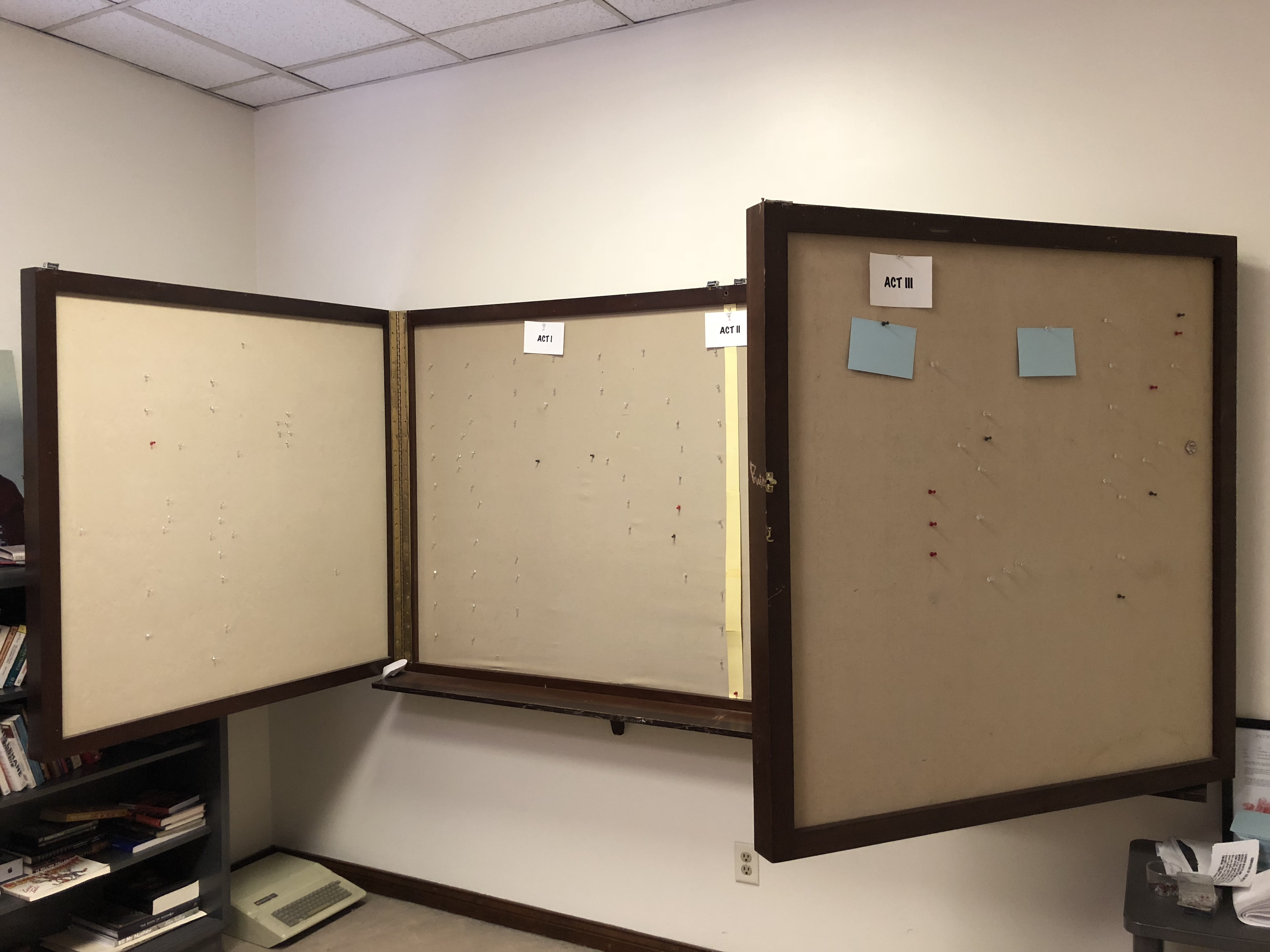
  • Also, as promised in episode 357, this is Craig’s fancy corkboard!
  • The USB drives!
  • David Iserson on Twitter
  • Susanna Fogel on Twitter
  • John August on Twitter
  • Craig Mazin on Twitter
  • John on Instagram
  • Find past episodes
  • Scriptnotes Digital Seasons are also now available!
  • Outro by Rajesh Naroth (send us yours!)

Email us at ask@johnaugust.com

You can download the episode here.

Scriptnotes, Ep 356: Writing Animated Movies — Transcript

July 3, 2018 Scriptnotes Transcript

The original post for this episode can be found [here](http://johnaugust.com/2018/writing-animated-movies).

**John August:** Hello and welcome. My name is John August and this is Episode 356 of Scriptnotes, a podcast about screenwriting and things that are interesting to screenwriters.

This week Craig and I have switched places. He is in Europe while I am back in Los Angeles. Luckily I am not alone. Across from me I have Linda Woolverton, a screenwriter whose credits include The Lion King, Homeward Bound, Alice in Wonderland, Maleficent, and of course 1991’s Beauty and the Beast. She also wrote the book for the stage musical Beauty and the Beast for which she received a Tony nomination. Linda Woolverton, welcome to Scriptnotes.

**Linda Woolverton:** Well thank you.

**John:** I could have gone on for about another five minutes with your credits because they are so vast. And like these are just some of your feature credits, but you also had TV credits from before then and after then. You’ve done a lot of stuff.

**Linda:** Well, I’ve been writing professionally since over 20 years.

**John:** Yeah. Well, I’ve been writing for more than 20 years, but I don’t have anywhere near the credits that you do. It’s just remarkable.

**Linda:** Well, thank you. You know, it’s hard work.

**John:** I sort of want to start with that last credit because Beauty and the Beast, the 1991 movie, I looked it up on Box Office Mojo and I looked up the adjusted gross, all-time adjusted gross income for it. It ranks number 133 of all films adjusted gross income. And that is higher than Iron Man. It’s higher than Toy Story. It’s higher than five of the eight Harry Potters. And then, of course, that also spawned the live action movie from 2017 which made $1.2 billion. So I guess this may be an insensitive question, but Linda Woolverton you must have gotten so much money off of Beauty and the Beast. Can you just give a sense of how much money you’re really talking?

**Linda:** That is a really appropriate question given where we are right now in terms of the business and feature animation and feature animated films being made into live action films.

**John:** Of course.

**Linda:** So, the important thing to note here, we’re going to talk about financial gain, is that feature animation is not covered by the Writers Guild of America. Which means that there are no residuals. There’s only up front. And I was paid I’m going to guess $35,000 to write the script. Took me four years, as animation does. There was nothing else. Oh, there was a bonus when the movie was made that Jeffery Katzenberg gave us checks. Howard Ashman was there. Alan Menken was there. And the directors, Gary Trousdale and Kirk Wise. He handed us a check for $100,000 each. I was blown away. I had never seen that in a check before.

So, I was like, “No!”

**John:** So many zeroes.

**Linda:** Really. Howard Ashman tore it up and threw it him.

**John:** Because that was a pittance. Even back then.

**Linda:** For him.

**John:** Yeah. At that time to be paid $100,000 as a bonus. So I want to make sure everyone’s clear. You were paid $35,000 up front for these four years of work on Beauty and the Beast. And your backend was zero. Well, $100,000, it was that $100,000 check.

**Linda:** Gift.

**John:** Gift. That was what you’ve received from writing one of the biggest movies of all time.

**Linda:** Yes, now, luckily I wrote the theatrical version of Beauty and the Beast, which is a whole different ballgame.

**John:** Having done a musical adaptation, it’s a very different thing.

**Linda:** Completely different thing.

**John:** You control copyright in these stage play versions of what you’ve done. And that is probably a much more lucrative thing. I can guess you’ve made more than $35,000 off of that.

**Linda:** A little. Because the show ran 13 years on Broadway. Traveled around the world twice. And it just opened in China. So that’s very lucrative. Just a little note here, when we did the deal for the theatrical version, Disney – it was really interesting – they had ownership of the movie. Right? Because they owned the movie. So I had to proportion out my royalty as per all the new stuff I wrote. So my royalty, which if it had been a full royalty it would have been a wonderful thing. But it’s only partial royalty.

**John:** I am in the same situation with Big Fish. So I wrote the stage play version of Big Fish, having written the screenplay of Big Fish, but Columbia is considered the author of that. And so they could have brought somebody else in to have written the stage version of Big Fish and I would have had no participation in it whatsoever.

**Linda:** Right. Exactly.

**John:** It’s not a great situation. But, in your case and in my case we got to stay on those projects and that’s fantastic. But I think what’s so interesting is not only did you not get residuals on the animated version of Beauty and the Beast that you wrote, but while your name is listed in the credits for the live action Beauty and the Beast you don’t have a piece of that either because that is – animation is not covered by separated rights. Had the original movie been live action and covered by the WGA, you would have gotten a piece of the live action remake as well.

**Linda:** Probably. Because if there had been an arbitration, because I did not work on the live action. If there had been an arbitration I’m 99% sure I would have gotten at least shared credit, which means I would have had a participation. So, it’s unfair with a capital U. But it is what it is.

**John:** So let’s get into that. Why animation is not covered. Because Craig and I have talked about this before, back in Episode 317 a listener wrote in with a question basically saying “How could animation not be covered by the Writers Guild of America?” And the long answer is long, but the short answer is that back in the days when animation was new the WGA didn’t think it was necessary to cover that. And so the Animation Guild began covering the writing of animated features. The Animation Guild is part of a larger guild, IATSE. They represent animation writing at the major studios. And the WGA can’t just go in and take it back because it’s another union thing. So, US labor law is preventing us from trying to go in and get that.

So it is a real frustration. And I think also a real cautionary tale for people writing in other genres that don’t seem like important things at the moment, but will become very important things.

**Linda:** Right.

**John:** I look to videogame writing. And I look to people doing things that don’t yet feel like they are on the level of film and TV writing but could be one day.

**Linda:** Yes. Yes. It is definitely a cautionary tale. And I didn’t know. Someone from the guild Board of Directors asked me, you know, well you signed the paper. True. I signed the paper. But I didn’t even know that there was a WGA at the time. I was this Saturday morning writer. I wasn’t in a guild at that point. And I went over and wrote a feature film.

So, you don’t know what you don’t know.

**John:** So let’s go back into some of that history because you were a Saturday morning writer, but what were your first writing credits? What got you started? And what made the leap into being able to write a feature animation?

**Linda:** It all began when I wrote two young adult novels. I had just left my job at CBS. I was on a desk and I wanted to be a writer. So I wrote a spec Muppet Babies.

**John:** I remember Muppet Babies. It was a great show.

**Linda:** I wrote a spec. And I didn’t sell the spec but I got work off of it. I started writing Berenstain Bears for Saturday morning. And then my career just never stopped. I was writing Saturday morning for like four years.

**John:** That was here in Los Angeles?

**Linda:** Yes. Here. Really fun. Really fun. Great group of people. You know, it’s just a little group.

**John:** So, in that era of TV animation were you writing as a room or were you just going and pitching a show and being sent to write it? What was the process of writing a half-hour like a Berenstain Bears, or they aren’t even half-hours. You’re writing little smaller segments.

**Linda:** They’re like 15 minutes.

**John:** So Muppet Babies. Was that written as a room or was that written – each individual writer just went off and wrote it himself.

**Linda:** I have never written in a room. Ever. Don’t know how to do it. No, you know, Berenstain Bears, it was very funny. It was my first job, so they gave me an outline. And they said here’s the outline. We want you to write the script. If it’s no good we won’t pay you. And there you go.

**John:** That’s a non-WGA sort of situation.

**Linda:** Exactly.

**John:** Here, work on this for spec, and then if we like it we’ll choose to pay you.

**Linda:** Yes, we’ll choose to pay you.

**John:** But if not it’s a useless thing that you’ve spent weeks writing.

**Linda:** Yes, exactly. So, that worked out. And the process was here’s an idea. Pitch the idea. Just like anything else. Here’s the idea, pitch the idea, pitch a take, and then they hire you and you go write it and then you get paid. So, that went on for – I had a really fun time. And then I just couldn’t think of anything more for silly creatures to do. And I had just seen a Disney animated feature that I didn’t think was very good.

**John:** Are you going to say the name? This pre-Little Mermaid. Little Mermaid is the moment where–

**Linda:** Little Mermaid is the revolution, whatever it is, of animation.

**John:** It was a ground-breaker. And that’s a whole special episode of Scriptnotes. We had a whole episode just talking about The Little Mermaid as a breakout moment.

**Linda:** Oh really?

**John:** Yeah. So, it was a pre-Little Mermaid feature you saw which wasn’t especially good, and that inspired you to say, “I can do better than that.”

**Linda:** Yes. So I went to my agent. I did have an agent. And I said I would like to go try to work at Disney. And she said, “No. They don’t read animation Saturday morning writers, because it’s not real writing in an interview.”

**John:** That whole thing about it’s not real writing is an ongoing thing in animation, isn’t it?

**Linda:** Yeah. It’s an ongoing thing. Yeah. What real writing is? Real writing? So I said, but I have these books, you know, I am a real writer. Here’s a hard cover book published by Houghton Mifflin with my name on it. Does that prove anything? So I drove my book over to the lot and it there was no dwarf building. This is way–

**John:** Pre-dwarf era.

**Linda:** Pre-dwarf. And there was no guard. So I just walked in and put it on the desk and said maybe somebody here wants to read this. And I left.

**John:** Wow. I can’t believe that worked. But it worked apparently.

**Linda:** It worked. My phone rang on Sunday and it was Charlie Fink had picked it up. He was probably hanging out with the receptionist. Picked it up. Read it over the weekend and called me and said you have to come work for us.

**John:** Well that’s great. So they say come work for us. Was it a specific project already at that point, or was it just a general come in and pitch things? What was the idea?

**Linda:** I did have an idea. Several ideas and pitched them. I came up with an idea that they didn’t do. But they offered me a live action Winnie the Pooh.

**John:** Sure.

**Linda:** I mean an animated Winnie the Pooh feature.

**John:** Feature.

**Linda:** I wrote that. They didn’t make it. But it opened the door to Beauty and the Beast.

**John:** I think a lot of writers we talk with, they get hired to do something that doesn’t actually go, but they can demonstrate that they are a good writer who can work with people and that’s what gets them the next job. And one of those things becomes the assignment that actually happens.

**Linda:** Right. Exactly. So that’s OK. You know, you’re getting paid. You’re honing your skills. You’re proving what you can do. And you’re bringing what you bring, which is really important I think.

**John:** So at the time that you’re writing the animated Winnie the Pooh, or eventually you’re brought in to write Beauty and the Beast, are they bringing you in as a special like they’re assigning you this project and you’re writing this, or are you working on a weekly basis? What was the nature of your relationship with Disney at that time?

**Linda:** It wasn’t weekly. It was a contract.

**John:** So just like writing any other feature.

**Linda:** Any other feature. Yeah. Only I didn’t know how animation worked.

**John:** Let’s talk about how animation works, because this is so different. I’ve done three animated movies. And so much of the process of writing an animated film, like the script looks almost exactly the same, but the actual process of making it is so different from live action, not just in terms of the development of it, but then with the live action feature you are writing it, and then you’re shooting it, and then you’re editing it. And those stages are pretty distinct. In animation you’re sort of doing all those processes at the same time. You’re writing a script and you’re hopefully going off and you’re able to get at least one chance to write a script when it’s just a script. But from that point forward it goes through this process of being broken down into shots and storyboards and then into animatics. And it becomes this living thing.

And your script, while still important, isn’t as central as this animated thing that’s in this sort of raw form in front of them. And you have the ability to keep changing story things quite a lot later in the process than you do in live action. It’s a very different situation. It’s not like the editing room. It’s like the clay is still moldable a lot longer.

**Linda:** It’s moldable for years and years.

**John:** Yes.

**Linda:** And what’s interesting about the process, you know, it’s sort of a given that the project will take on a different form from the written word to a different medium, which is usual. Then it will go from that to the next step. But it’s sort of a given that at some point in time the whole thing will get thrown out and you start again.

**John:** Yeah.

**Linda:** If you’re lucky. So, that’s just how that process works. And there’s a lot of, you know, I would say it’s difficult to be a writer in feature animation because they really – you sort of like aren’t on the same par as people who are artists. It’s an artists’ medium. It is not a word medium, even though it’s a story medium.

**John:** It is very much a story medium. But that story is being translated through artists’ hands who are doing some of the functions where in live action the actor would be doing it. The artists are the actors who are making this thing come to life.

**Linda:** Exactly.

**John:** And stuff changes through that process.

**Linda:** It does. It absolutely does. But, again, story is the most significant thing. And the story as a writer as the story-maker, you know, I still believe that we are as significant in feature animation as in a live action feature film.

**John:** Absolutely. And especially the movies that have done well have had their writers as an integral part of the process the entire time through because those are the people who just the keepers of story. The people who can see past that beautiful artistic moment that you created to this is the journey the character is on and this is how we have to get through this.

**Linda:** Because it’s so fragmented. And one person is in charge of this sequence and one person is in charge of this sequence. Which was so confusing to me when I first did Beauty. It’s like well how do you have a singular voice? How do you keep that singular voice? Because every sequence had a different tone as per the person who was boarding it.

So, you know, I fought. I had to fight. I had to fight for Belle. Because Belle was losing her way. She was going backwards, back to being the victim princess, and I had to kick and scream to make her not.

**John:** Also she’s in many situations the only human character on the frame. And everyone else is big and broad and special. And so that’s a thing that happens, especially in animation, but also in live action where the hero becomes the least interesting character on the screen because everybody else can be wild and crazy and be driven by their Id. And the hero has to be this sort of moral compass moving board. And I can totally imagine how Belle could be reduced to just princess of the castle.

**Linda:** Yes. So we couldn’t let that happen.

**John:** No. And you didn’t. Am I correct that Beauty and the Beast was the first animated film nominated for an Academy Award for Best Picture?

**Linda:** Yes.

**John:** And that was a crucial ceiling to break through, because to be able to think of these movies as not just like a good movie for children, but an actual good movie for adults and for everybody else.

**Linda:** That was a huge breakthrough. It was like on a par with all the other live action movies that year. Silence of the Lambs won.

**John:** Yeah. But Silence of the Lambs is a great movie.

**Linda:** It is.

**John:** Nothing to take away from that. But I think just to be on the same list as Silence of the Lambs–

**Linda:** Yes.

**John:** Or these other sort of movies for adults is a crucial thing. And I don’t know if we’ve gotten to a place where Pixar movies could be Pixar movies if we hadn’t gotten an Academy Award nomination for Beauty and the Beast. I do think it was a ground change of sort of how seriously we’re going to take animated films.

**Linda:** Well that’s about the money, isn’t it? Isn’t it about the box office?

**John:** Well, yes. So, I think the box office is a crucial thing to be talking about though because we’re recording this as the Incredibles 2 has just opened and sort of set all sorts of records. Like everybody wants to be that movie. It’s a well-liked movie that is making a tremendous amount of money, so everyone wants to be able to do those things. And very few people can do those things. Disney can do it. Pixar can do it. They’re the same company now. Every once and a while Fox Animation or Warners will have something else that breaks through. But it’s really tough. And it takes a tremendous amount of investment and years of commitment to make an animated movie. Much more so than to make a live action movie.

**Linda:** Yes.

**John:** Anybody could just write a check for $100 million and make a big live action movie. You can’t just write a big check and make an animated movie. Essentially the research and development on making it is just so much greater.

**Linda:** It is. It’s much greater. Yeah. And I’m writing one right now for a company called Skydance.

**John:** So Skydance’s logo used to be often in front of like Paramount Features. They’re a big pool of money that invests in movies and they’re starting animation now.

**Linda:** Yes. They’re starting a live animated feature division, but I guess they produce television now as well. And big budget live action features under the Paramount umbrella I guess. So, there’s three in the pipeline at this moment in time. My one was first, but we got put back because it’s a hard subject. Again, it was one of those like let’s throw it all out and start again. So, you just sort of like I had forgotten all this.

**John:** Well, you choose to forget that. It’s like having a newborn.

**Linda:** Oh, yeah right.

**John:** You forget the darkness of those first months. And then it’s like, “Oh no, but they were so cute. You look at the photos, like oh it was delightful.” And then you’re like, “Oh that’s right, this is what it’s like.”

**Linda:** That’s right. This is what it’s like. I forgot.

**John:** Here’s one of the differences is that making a normal live action movie you’ll go through those places where everything falls apart, but it will fall apart in sort of script land and then you’ll start shooting and then you’ll have troubles during shooting and there will be challenges and there will be a terrible first cut and you’ll get through it. But at no point will you be sort of like a ways into it and then just like, “OK, we don’t know what this is. We’re going to change who the lead character is of the story.” And that happens almost every time in animation. It’s just so regular to know that you’re going to have the complete upset.

**Linda:** Yeah.

**John:** And it’s still surprising. I will say the stop motion movies I’ve made with Tim Burton have been somewhat of an alternative to that because you can’t go back and rejigger things very easily. Because once you’ve shot a frame it’s just sort of shot. And so the most that could happen to us with is we could reboard and reschedule some things for sequences we’re not quite sure of yet, so like if there’s things where like we’re not quite sure how it’s going to work out we’ll put those towards the end of the schedule and so we can sort of see what we’ve got and then write towards those sequences which were not set on, but we can’t do that thing which they can do on Frozen and other movies and just like let’s change that entire sequence and let’s make Elsa a very different thing.

We can’t do that in stop motion the way that you can in traditional or sort of CG animation.

**Linda:** I had the best time of my life working with Tim Burton.

**John:** So tell me about your experience. What was good about that for you?

**Linda:** Working with Tim?

**John:** Yeah. I have my memories of Tim, but I’m curious what it was like from your side.

**Linda:** From my side it was, first of all I was intimidated by him. But he agreed to direct Alice in Wonderland. And I went to London to meet with him and I was intimidated. You know, it’s Tim Burton. But when we started talking, you know, he doesn’t make complete sentences because he finishes it in his head.

**John:** Absolutely true.

**Linda:** So he’ll say something and he won’t finish it, and then he’ll say, “But you know what I mean?” And I realized first of all I did know what he meant and I knew who he was.

**John:** Yeah.

**Linda:** Because he came from here. And it came from animation. So, I got it. And then I was able to kind of connect. And I found him to be so open and many directors I’ve found they want to put their stamp on it immediately. They want to just stomp on what was there and sort of show it around and make it theirs. And I didn’t find that with Tim at all. I found suggestions and he’d say, “Well try this,” and they were great suggestions. And he was very, very supportive. And, you know, we had to throw a bunch of stuff out for budget-wise, and I would say how about we throw this out. “No, no, no, we’ve got to keep that.” So I found him to be fantastic.

**John:** Yeah. What I love about Tim is that he treats a writer like a department head. You are the department head in charge of the script and the story. And he treats you with the respect that he would treat a costume designer, you know, a Colleen Atwood, or a great DP, or a production designer, and like lets them run with this thing. And will give them guidance, but like he sort of trusts that you know what you’re doing. And so often directors don’t trust that you know what you’re doing. And that makes a huge difference.

**Linda:** Huge difference.

**John:** Do you know the backstory? I had the competing Alice in Wonderland project. You know that there was a whole thing here right?

**Linda:** I don’t really know the whole thing.

**John:** Well, let’s go through it. So here’s what happened is at the same time that Disney approached Tim about your Alice in Wonderland, because you had written it first for Disney, right?

**Linda:** Yes.

**John:** I was approached to do an Alice in Wonderland project for Sam Mendes. And Dick Zanuck was the producer of both movies.

**Linda:** Right.

**John:** Which is just an impossible situation for Dick to be in, but being the uber-producer he was and the wonderful gentleman he was he was making it work as best he could. But it became this crazy situation where like I was trying to write this movie for Sam and Sam was going off and doing another movie. Tim was going to do his movie. Mine was for Warners. Yours was for Disney. And it became a place where it’s just like “Well this is just silly. This is just not going to happen.” And so ours went away and yours went into production. And so the choice was made for Dick. He didn’t have to sort of choose between which of his directors he was going to work for. But it was nuts that there were going to be two live action Alice in Wonderland movies in the same space.

**Linda:** I find that when that happens, when you hear that there’s two competing versions of a project, one of them ultimately goes away.

**John:** But sometimes they don’t and it’s always crazy. So Deep Impact and Armageddon is an example of where both things happened. There is the other Jungle Book movie which is coming out. That’s crazy. Mowgli.

**Linda:** That’s right.

**John:** So it does sometimes happen that both movies exist, but you don’t want to be the second movie most times.

**Linda:** No. No you don’t.

**John:** And we were going to be the second movie. So I wrote a movie called Monster Apocalypse for Tim. And we were getting close. And Pacific Rim went into production and we looked – someone read both scripts and is like that’s too close. We’re going to be the second giant robot movie and we don’t want to be the second giant robot movie.

**Linda:** Right. So whoever gets there first.

**John:** Yep. First to cross the starting line is the thing. It’s tough. But, anyway, I’m glad your movie exists and you got it made and you got to make a sequel and that’s fun. I visited Tim on the set while he was doing your movie and it was in Burbank and they had – actually, no, it was down in Culver City. And they had this giant green screen stage and I’d never been in a space that was that much green. It was really painful to be in that set. And Tim had these special weird tinted glasses so he wouldn’t get headaches from it. But it was just so strange being in a space where I just had no idea what anything was.

**Linda:** What was up, what was down.

**John:** Yeah. I mean, the costumes were beautiful, but there was no set.

**Linda:** He kept having to leave and just get his perspective and reality in the blue sky and all that during that whole process. So, yeah.

**John:** But let’s talk about – that movie was a live action movie and there was a tremendous amount of CG and animation. But there’s other kinds of movies like Justin Marks and his Jungle Book that Jon Favreau directed which are essentially animated movies with like one live action element. And now you wrote the original Lion King, but now they’re going to do The Lion King as an all CG thing with real actors voicing those parts. We’re at a place right now where it’s really difficult to say whether that movie is an animated movie or a live action movie.

My understanding is its being shot as a live action movie technically under WGA, but we’re going to run into situations where is that animation or is that live action and we have to fight to keep them.

**Linda:** Who is going to make that determination though? Studios aren’t because it doesn’t behoove them to because they will have to give up something. So, who’s going to decide? What percentage of real people are in it? So, if it’s all CG, does that make it animation?

**John:** That’s the question. I mean, the original Lego Movie is a WGA movie because there’s a live action element to it. The second movie does not have that and it is not a WGA movie. And the difference for what a writer gets off of writing One versus Two is tremendous. And so my hunch is that there will be some movie that will come up, it will be a big enough fight to say this should actually count as a live action movie that WGA and SAG and DGA will all step in to say like this really needs to count as a live action movie. And whether that becomes a lawsuit or there’s some way that you intervene to say like “You have to be acknowledging this as that kind of movie.”

Zemeckis with his stop motion things, those have been WGA movies to date. And so hopefully that’s a good precedent.

**Linda:** That would be wonderful. So that’s it? So the last Jungle Book was WGA.

**John:** Yes.

**Linda:** The Jungle Book. Is there a definitive–?

**John:** No, there’s not. It’ll be figured out at some point. Well, most people go by if there’s one live action person in it, if there’s a real identifiable human being in there that is filmed then it’s not an animated movie. But there’s going to be weird test cases where you’re just not quite sure what it is.

And what happens if the original Lego Movie, if they’d taken out the live action element would it still be a WGA movie? If something starts as a WGA project can it go into animation and come back out? These are difficult situations and you and I both know writers who are in those situations.

**Linda:** Yes.

**John:** Folks who are being hired on to write projects where it’s not quite clear whether it’s going to be animated or live action or a combination of it. And they’re getting hired generally by the worst possible terms.

**Linda:** You know when you’re being hired to write a story, to me it’s like the furthest thing on my mind in the beginning anyway, when I was young and naïve, is how much I’m going to get paid, or how, or what it’s going to land as. I’m concerned about telling the tale. And I’m thrilled to be able to tell the tale. And much less for a big company like Disney that it’s going to be seen around the world. That’s huge.

**John:** Yes.

**Linda:** So the last thing on my mind is like, “Well, do I get residuals for this?” Didn’t cross my mind. So, I think it’s really important for writers who are making a leap from live action to animation to be very conscious, especially the new marketplaces.

**John:** Absolutely. So we were talking about, so Skydance is a new marketplace. But there’s Netflix. There’s Apple. There’s Amazon. There’s new people who are making movies. And if those people make movies under a WGA contract that is so much better for writers like you and me who are trying to make a good movie and actually get paid for it.

**Linda:** Right.

**John:** Than if they were to do it under an Animation Guild contract or no contract like Pixar is done under.

**Linda:** Right. So, when I went to Skydance, you know, I understood intimately the unfairness of it. So, I said, “Well, if you want me to do this then you have to give me a contract that’s as if it’s a WGA deal.” And I actually foolishly didn’t sort of press them to join the WGA, because I actually didn’t know that I could do that, or had that sort of clout in any way. But they agreed. So my contract is as if a WGA contract.

**John:** Which is better. And so I think what we’re going to be looking for in the next ten years for feature animation writers is places where we can get an actual WGA deal, best case scenario. That’s fantastic. That’s great. But in places where we can’t, how do we get coverage there on individual projects, for individual writers, that give them some of the benefits of a WGA contract. That gives them some protection, some backend, hopefully some credit protection.

I looked at some of your credits and you’re listed as additional material by, which is not a WGA credit.

**Linda:** No.

**John:** It’s madness that you could have worked on a movie and clearly would have gotten credit under WGA, but wouldn’t get credit because the studio decides.

**Linda:** The studio decides. Yes. So even in the Skydance project, it won’t be WGA arbitrated. If there are other writers, they’ll decide.

**John:** So ideally you want to get some coverage for that. The other situation which many writers find themselves in is that maybe you’re going back and forth, you’re writing some animation, you’re writing some live action, and getting your pension and health covered between those two things can be really difficult. And so a writer you and I both know said like “Well thank goodness I’m on my wife’s health insurance because otherwise I wouldn’t have health insurance because I don’t work enough in WGA projects. I don’t work enough in Animation Guild projects to get it covered.” And that’s foolish.

**Linda:** And that’s a really scary thing. Like I don’t get WGA coverage on this project and I’ve been on it for two years already. So, thank god I have points, the points system is still working for me.

**John:** So, we’ll explain to listeners that when you work on WGA projects you accumulate points which sort of count against times where you’re not working. So, because Linda and I could be on a project for two years without sort of new income coming in there to sort of pay your things, you have points that sort of carry you over those stretches where you’re not on a new project.

**Linda:** It’s like credits.

**John:** It’s like credits essentially.

**Linda:** Yeah. Then you use them up.

**John:** You use them up. Yeah. And so then you’re looking for the next WGA job because otherwise you’re going to be out of health coverage.

**Linda:** Right. Exactly.

**John:** Scary things. Well, let’s talk about other changes that are out there because just this last week it was announced that Jennifer Lee is taking over as Chief Creative Officer at Walt Disney Animation. Jennifer Lee was on here to talk about Frozen. She is fantastic. She’s a real writer, so it’s great that she’s taking that over.

Pete Docter is taking over that slot at Pixar. Again, a real screenwriter. I would hope that’s somewhat good news for writers overall. They’re both places that really value story. So, maybe there could be some progress made at those two places, at least in terms of we can’t get WGA deals, but at least we can get some better consideration of what it’s like to be a screenwriter working on these projects. A little bit more parity with what we’re getting for writing live action and what we’re getting for animation. I would hope.

**Linda:** Right. I would hope, too. I don’t know if he’s going to change the nature of Pixar, because they’re a non-union joint. So, who knows?

**John:** Who knows?

**Linda:** I hope though that can change a little. And I don’t know Jennifer Lee.

**John:** She’s great.

**Linda:** Well, that’s fantastic. It would not be anything I’d want to take on because, you know, being a screenwriter is one thing and being in charge of all the everything of animation is a whole different ballgame. So, I wish her luck.

**John:** I mean, yeah, it’s more like producing. Or, it’s running a studio really.

**Linda:** Yeah, it’s running a studio.

**John:** It’s all the management aspects of that, but also the creative choices. And so I have a hunch she’ll do a fantastic job of it, but it’s tough.

Like you, she’s also – she went through and adapted her own thing for the Broadway stage, so she’s got that experience too. So, we’ll see.

Do you have any regrets not having gone back and tried to sort of run the show? You haven’t directed any features. You haven’t produced other things. If you were to do it again would you have made different choices in terms of the kinds of things you – the kinds of other roles you would want to take on?

**Linda:** I produced. I guess I have a credit producing a few. You know, people ask me a lot if I want to direct. And I have a skillset. I have big imagination. I have a skillset. I’m a storyteller. I’m a world-builder. And just because I can do that doesn’t necessarily mean I can do something else.

**John:** Yeah.

**Linda:** And maybe I don’t have a director’s eye. Maybe I don’t know where to put the camera. And that’s OK. You know, I create the world, I put the people in it, and when I write I write really specifically, very specifically on the thing. I overwrite, which annoys directors. But that doesn’t necessarily mean that I’m going to be a good director. So I have never taken that on. Because I think I know myself. I also know, I mean, here’s what the really horrible truth is: I get bored.

**John:** Yeah.

**Linda:** Right?

**John:** Totally. And to be stuck on something for three years on the same thing is so tough. At least as a writer you can dip in and dip out. A director, you’re there every day.

**Linda:** Yeah. I can dip in. I like to dip out. [laughs] And do something else, you know. So, if I were to go back and do it again I’d probably just write novels like you have.

**John:** Yeah, writing novels is – that sense of control you have writing a novel is great. So, after your YA novels you haven’t gone back to do prose?

**Linda:** I never have.

**John:** It’s so many words. Man, just so many words.

**Linda:** It’s a lot of words.

**John:** It’s a lot of words.

**Linda:** You have to fill up the white on the page. Right?

**John:** Yeah, you can’t just sort of sketch it in there.

**Linda:** No.

**John:** That is a tough thing. But I’ve enjoyed it. But it’s much more work than I sort of anticipated going into it.

**Linda:** Really. Yeah. I might still try my hand at it.

**John:** You should. It’s fun. I had two listener questions that I thought would be great for you. So I’m going to start with Ben in LA who writes, “I was just wondering if there is such a thing as a bad character want. A character should always want something, but is there an example of something a character shouldn’t want?”

And I’ll sort of put parenthesis around this to say that we talk about want a lot on the show in terms of that driving force behind that character, and really I think animated musicals are a great example of character wants because so often that second song in a Disney movie is the I Want song. It’s basically them singing their wants.

As you’re working on one of these movies how early in the process are you articulating what that character wants? Is it from the very first pitch you’re describing that want?

**Linda:** The I Want issue holds true in musicals, but again I think that if you lean on one thing too heavily it becomes formulaic. And I live in fear of that happening. You know, so my protagonist wants something. And to make them proactive as opposed to reactive they have to proceed through the world with a desire. And however that’s not how everybody lives. So every single protagonist isn’t going to be like the person with I Want who has like I’m never going to stop until I get this thing. That’s not every character in the world.

You know, some characters – isn’t it interesting to have like a normal person who has something remarkable happen to them and then their want becomes to get it back to the way it was.

**John:** Absolutely. Return to normalcy. Yeah.

**Linda:** Return to normalcy, or to find happiness in another way. So, I fear the I Want and it’s also kind of like so getable and kind of easy. Land this I Want on this person and then like whatever obstacle comes at them. They still have this I Want. And then to me it seems like then all the characters become the same. It’s like this relentless pursuit of their desire. And the world is a big place filled with remarkable people who have different experiences and not all of them are the I Want. That’s my rant about the I Want.

**John:** I like that rant. I would say that sometimes I notice that if things aren’t working it’s that the character wants something that I don’t really want for the character. Or the character wants something that I feel like I don’t think the story is set up to give them that want. You know, an example of like it’s a medieval dragon story but the character really wants to sing, or really wants a moment in the spotlight. And it’s like, yeah, but it’s not really a good match for that. It doesn’t seem like you created your universe and your character to fit quite right together. What you’re saying in terms of like there’s characters who like they’re so want driven that it’s the only thing you can see, I get that. And it can be–

**Linda:** It makes it really one-dimensional, or two-dimensional, but it just becomes that. So, then story becomes really simplistic in my view. You just have this drive to get what you want no matter what and then the interesting sub characters come in and out. And then the villain stands in your way. And then you get rid of them to get what you want.

**John:** Yep. You know, some of the fascinating movies, it’s not that the protagonist is opaque, but they’re self-defeating in interesting ways. Like, you may be able to see sort of what they’re going after, but they’re making choices that interfere with their ability to get that. And that draws you in closer because you recognize that weakness in yourself.

**Linda:** Right.

**John:** I think also part of the reason why we’re so attracted to longer form great dramatic television is because it doesn’t have that pattern of like this is the one-time story that you’re going to see this character go on this one-time journey that’s going to epically change everything. It just doesn’t happen that way.

**Linda:** No.

**John:** So they have a bundle of conflicting wants and you see them juggling those different things. And movies tend to be focused for better and for worse on that one road. You started here, you got there, and that is the path of this movie.

**Linda:** Yes.

**John:** Second question comes from Tommy in Toronto. He writes, “At what point during the process do you break down story days? Is this something you tackle in outlining? I’m nearing the completion of a new draft and it’s occurred to me that certain story days seem extremely packed in terms of events while other story days are quite light.”

So, what Tommy is describing is like let’s say you’re watching a movie that takes place, it seems to take place over the course of a week. And if you really look at sort of like day by day by day you could figure out like this would be the Wednesday of the week. I personally don’t find myself thinking about that too much. Do you find yourself thinking about like what day of story this is in your projects?

**Linda:** No. I don’t. I can only think of that where it happened if the time clock was part of the plot, then you would think, OK, well like in 24, whatever it was, this is hour 23. We better get it together. I’m just really old school. I think in the three act structure. And I just do. Beginning, middle, and end. You know, Billy Wilder’s quote, “Get your guy up a three, throw rocks at your guy, get your guy out of the tree.” I think it’s pretty good.

I’ve also never read a screenwriting book, so I don’t know anything.

**John:** Then you’re Craig’s hero, because Craig hates screenwriting books. He rants about them endlessly.

**Linda:** Screenwriting books?

**John:** Yeah. Just like, again, it’s that frustration of formula in the sense that everything has to fit this one model for how things work.

**Linda:** I guess because you’re always looking, you know, if you want to start something you’re always looking for like, because there is no path. There’s no path to being a screenwriter. There’s nothing like if you do this, and you do this, then you’re going to be a screenwriter.

So you grab onto what you can that’s going to guide you through that process. And sometimes screenwriting books are a help, I think, to a lot of people. I steer clear because I don’t want to be on a formula. I don’t want to put – I don’t want to shove my stories or my ideas into this formulaic how to do it.

**John:** Yeah. Getting back to Tommy’s question, I feel like sometimes it is good, like after you finish a draft to just take a step back and look at like realistically could all these things happen over the course of this amount of time. And does it feel like this is happening over the course of a week or a year? And sort of where you’d fall.

A thing that happened in the first Arlo Finch as I got notes back from I guess it was the proofreader or the first production editor was pointing out like the week logic, the week’s logic didn’t really make sense. Like if this was September and this was January, we skipped over Christmas, and so we should at least acknowledge that we skipped over Christmas. There were some interesting things where she was pointing out like, “OK, time does still happen in a normal fashion.” So, trying to figure out sort of when roughly some things could have happened was really good.

And the same thing will happen in movies. At a certain point, you know, they’ll break down and go into boards, but I think even before that process you need to look at did characters wake up twice in a row. I mean, there can be situations where like, OK, that’s actually not possible. Where it went day to night to day again but it’s still sort of the same day. So you got to be looking at that.

**Linda:** I do look at that. It’s like are we at night now? And, again, the time of day, the weather, all plays into it.

**John:** Totally.

**Linda:** Plays into whatever is going on anyway. So, I do step back at a certain point. I don’t realize I do, but I do I guess.

**John:** At a certain point in every project I have kind of a color scheme in mind for the movie or for the book in the case of Arlo Finch, and I sort of see myself moving from like, OK, I’m in here, and then into this new color, and then into this new color. And it’s a helpful way of me thinking about what’s changed along the way. I’m in the green section now. And so if I’m in this section it literally looks more green to me. It’s just the basis of how it is. But some of those logic things aren’t going to be such a thing because I’ve moved forward to a place where I’m in this section now and I know I’m in new days. I know I’m in new places. And even if I’m not like mentally changing the clothes on characters I know that they’ve woken up and gone to sleep again a few times. Things have changed in their life.

**Linda:** I know that actors do that. They’ll color code their script as per what emotions or whatever it is that they’re going through at the time. But that’s interesting. You’re in the green.

**John:** I’m in the green section now. Some interview I was listening to years ago was talking about My So-Called Life. And Winnie Holzman was talking about one of the crucial things she and ultimately the directors had decided is that they wanted her, the lead character’s wardrobe, to repeat. Basically like for her not to have new outfits every time, but to see that she would wear the same things again, because realistically characters do wear the same things again. And they never do on TV, but in this case they wanted to make sure that she was actually a middle class girl who has a limited number of outfits, which I thought was a genius choice.

**Linda:** That was good. Yes it was.

**John:** I’m thinking back to some of your movies and in so many of them characters don’t get a lot of wardrobe changes because they are theoretically just on one quest the whole time through. Like Belle–

**Linda:** Belle gets her yellow dress.

**John:** She gets her yellow dress. That’s crucial and iconic.

**Linda:** She wears her blue dress and then she gets her yellow dress. And then she gets her yellow dress. Or she goes home, and then she comes back and she has her yellow dress.

**John:** I guess with few costume changes each costume change is really meaningful and it really does, you know, it lands bigger.

**Linda:** Yeah. I think you’re right actually. And the yellow dress became such a big thing it needs its own agent. The yellow dress. That’s interesting. Alice shrunk, so she had to get a little mini wardrobe. What else have I written? In Lion King nobody wears clothes.

**John:** Naked people running around the whole time. Rafiki has some like beady kind of stuff, but that’s about it.

**Linda:** And let’s see, Homeward Bound, same thing.

**John:** Not a big wardrobe movie.

**Linda:** Yeah, yeah.

**John:** You know that Linda Woolverton, lovely. Won’t dress her characters at all.

**Linda:** Yeah, sorry, no clothes. You don’t get the clothes.

**John:** All nudists. We do a little thing on Scriptnotes called One Cool Things. Did I warn you about this? Do you have a recommendation?

**Linda:** You did. I was trying to think of – well, I guess, it is a recommendation?

**John:** A recommendation or something you like. If people want to check it out.

**Linda:** OK. Go to Shanghai.

**John:** OK, Shanghai.

**Linda:** Go to Shanghai, China. Go to Disneyland. Disney Shanghai, or Shanghai Disney, and go to the Pirates of the Caribbean ride.

**John:** So why should they check out at that ride?

**Linda:** It’s so awesome.

**John:** Tell me.

**Linda:** If you know Disneyland and the Disney ride, they’ve completely re-envisioned it for like the new version of Pirates, the Johnny Depp version of Pirates, but the whole thing is three domes. And you’re in your little boat. And you go under the sea–

**John:** Of course.

**Linda:** In this little boat. And you’re still on the floaty boat. It’s real water. But these domes are sort of like above you and they’re moving the boat around in circles. And there’s like creatures and there’s a big fight between battleships, you know, the ships. It’s really so imaginative and so impressive. So get on that plane and go to Shanghai.

**John:** My One Cool Thing was almost a Disney Imagineering thing also. So, I’ll put a little bonus. I read a great article, I think it was called Adventure House, and so they were going to do sort of a sequel to the Haunted Mansion. So they have the Haunted Mansion ride or attraction at Disneyland. They were going to build a second one called Adventure House. And so they have all the Imagineering plans for it and what was going to be there and there was like a sleeping bear in a bed and it sounded kind of great. And so I sort of wish they had built that.

But my actual One Cool Thing is an article I read this last week about Climate Central. And I’ll put a link to the NBC News article and also the real website. But what this organization does is a non-profit and they provide information about climate change to local weather stations. So if you’re watching the local news they always have the weather man who is mostly talking about the seven-day forecast. What this group does is they provide charts and graphics and little video packages for local news stations to talk about how climate change is affecting local places.

And so like how pollen counts are going up. And the effect of climate change on pollen counts or on hops brewing and how it will change beer taste because of climate change. It was just a very smart way of getting local news stations to talk about climate change.

**Linda:** Wow.

**John:** In ways they might not.

**Linda:** Interesting.

**John:** This was a really bleak news week and so this was like one of the few little moments of like, “Wow, there’s some really smart people doing some very clever placement of good information.” So, Climate Central, you’re a One Cool Thing.

That is our show. So, as always, our show is produced by Megan McDonnell. It is edited by Matthew Chilelli. Our outro this week is also by Matthew. If you have an outro you can send us a link to ask@johnaugust.com. That’s also the place where you can send longer questions like the ones we answered today. For shorter questions on Twitter I’m @johnaugust and Craig is @clmazin. Linda, are you on Twitter?

**Linda:** No.

**John:** Good. Safe. Stay away.

**Linda:** I know. Those knee-jerk reactions, not good. Yeah, no.

**John:** You can find us on Apple Podcasts. Just search for Scriptnotes. While you’re there leave us a comment. You can find the show notes for this episode and all episodes at johnaugust.com. We’ll also have transcripts up within the week.

You can find all the back episodes at Scriptnotes.net. It is $2 a month. And you can get all the first 355 episodes of the show.

Linda, thank you so much for being here. It was so great to chat with you.

**Linda:** I know. So much fun. Thank you so much for having me. Bye.

Links:

* Thanks for joining us, [Linda Woolverton](https://en.wikipedia.org/wiki/Linda_Woolverton)!
* Adjusted for inflation, Beauty and the Beast ranks [#133 in domestic grosses](http://www.boxofficemojo.com/alltime/adjusted.htm), above Toy Story, Iron Man, and other huge films.
* In [Episode 317: First Day on the Job](http://johnaugust.com/2017/scriptnotes-ep-317-first-day-on-the-job-transcript), we talked about the history of why animation writers are not represented by the WGA.
* In [Episode 92: The Little Mermaid](http://johnaugust.com/2013/scriptnotes-ep-92-the-little-mermaid-transcript), we did a deep dive on the animated film that changed the game.
* [Shanghai Disney’s Pirates of the Caribbean](https://www.shanghaidisneyresort.com/en/attractions/pirates-of-caribbean/) ride is amazing. This [POV video of the ride](https://www.youtube.com/watch?v=1vIchXwRw7U) is definitely a spoiler.
* [Climate Central](http://www.climatecentral.org) is an independent organization of leading scientists and journalists researching and reporting the facts about our changing climate and its impact on the public. It helps [localize reports](https://www.nbcnews.com/news/us-news/global-warming-now-brought-you-your-local-tv-weathercaster-n884831) of the effects of climate change.
* [The Scriptnotes Listeners’ Guide!](http://johnaugust.com/guide)
* [The USB drives!](https://store.johnaugust.com/collections/frontpage/products/scriptnotes-300-episode-usb-flash-drive)
* [John August](https://twitter.com/johnaugust) on Twitter
* [Craig Mazin](https://twitter.com/clmazin) on Twitter
* [John on Instagram](https://www.instagram.com/johnaugust/?hl=en)
* [Find past episodes](http://scriptnotes.net/)
* [Outro](http://johnaugust.com/2013/scriptnotes-the-outros) by Matthew Chilelli ([send us yours!](http://johnaugust.com/2014/outros-needed))

Email us at ask@johnaugust.com

You can download the episode [here](http://traffic.libsyn.com/scriptnotes/scriptnotes_ep_356.mp3).

Scriptnotes, Ep 355: Not Worth Winning — Transcript

June 26, 2018 Scriptnotes Transcript

The original post for this episode can be found here.

John August: Hola y bienvenido. Soy John August.

Craig Mazin: Soy Craig Mazin.

John: Y esto es Scriptnotes, un podcast sobre la escritura de guiones y cosas que son interesantes para los guionistas.

Today we have the grab-baggiest of episodes with topics ranging from screenwriting competitions to toxic fandom to the new Apple deal, plus we’ll be answering questions about capitalizing on heat after a sale, Bad Robot, and NDAs.

Craig: Ohh. But can I do the entire episode in my telenovela voice? Soy.

John: Oh please.

Craig: Craig Mazin.

John: You absolutely should. So, I should say that I’m doing the Spanish because I am here in Spain. I’m in Barcelona at the moment, and it is great. Craig, you’ve been to Barcelona, right?

Craig: I have not.

John: Oh, put it higher on your list of places to go.

Craig: It’s pretty high up there. Just in the midst of all the work travel we sort of put other travel vacations on hold just, because I’m starting to hate planes and time zones. But, yeah, it’s definitely high up there. My daughter is quite demanding about it.

John: It is fantastic. I recommend everything that everybody always recommends about Barcelona. I was here in high school and did not like it, because it was sort of the first big city I’d been to and it was overwhelming. But it’s a really good, approachable big city. I was a little bit nervous about the Catalan of it all, but everyone here speaks Spanish and English. And it’s fun to watch what language they default to you in.

So, if they kind of recognize that you probably are a native, then they’ll speak Catalan. Otherwise they’ll speak Spanish. Unless you’re Asian, and then they’ll speak English.

Craig: Well, what’s going to happen with Melissa is they’re probably going to speak English to her because she looks so not Spanish. And then she will speak Spanish back to them. And then they’ll be surprised, which is one of the most fun things to watch for me.

John: Yes.

Craig: Watching native Spanish speakers listening to Melissa speak Spanish for the first time, they all make the same face. And the first face they make is what’s going on here? What is this? Is this one of those hidden camera shows? What is this?

And they start getting very curious because they want to know where she’s from. Because they’re quite sure she’s not American. Because her accent is too good. But it’s not their accent, so they start thinking are you like one of those German people that ended up in Chile? Or what are you? And thus–

John: She could have escaped–

Craig: The Nazis.

John: Who hid off in Argentina, yes.

Craig: Yeah, no, she looks like the great-granddaughter of some sort of Nazi escapee. Yeah.

John: But she’s a lovely woman and a great wife I take it.

Craig: Yeah. She’s none of those things.

John: She’s none of those things. Let’s get into this because there’s so much stuff on the agenda for today. So, we’ll start with what was going to be our feature marquee topic. We thought it was going to be a whole special episode and it is not a whole special episode. But to sort of give a little recap, this started on Twitter. Someone tweeted at you and me saying like, “Hey guys. You should be aware that there’s a giant scam going on. It’s about Coverfly.” I didn’t know what Coverfly was.

Craig: Me neither.

John: There’s a long blog post. You and I read the blog post. And it looked like, wow, there’s actually a lot here. And then it has all sort of dissipated.

Craig, can you talk us through what you’ve discovered so far, at least what this was?

Craig: I mean, vaguely. I mean, this is the same – so somebody was complaining about this group Coverfly. Coverfly apparently is a service that provides coverage for payment, I guess. And then also offers as part of its conglomeration with 12 other business names offers paid consulting – you know, the sort of thing that you and I don’t like very much.

However, Coverfly also provides a service to other screenwriting contests. They have their own contest, I guess. And then there are other screenwriting contests that become overwhelmed with submissions and need readers to evaluate these scripts. And so they essentially – I guess they outsource that to Coverfly.

Coverfly in turn has its own sort of like script hosting service I guess you’d call it. Right? It’s sort of like a Dropbox for screenplays. And I guess what happened was they started signing people up or migrating accounts to their service without people knowing and then people thought that essentially, “Look, I’ve entered the Austin Screenwriting Festival Competition for instance and suddenly I’m getting an email from these Coverfly people telling me that I can create an account for free if I want, which I didn’t want. And who are they? And why are they sending me ads?” And all the rest of that.

And so it seemed a little stinky and smelly. And interestingly enough it was the same guy that we had our last and final Scriptnotes Investigates episode on which was that former service where the whole thing went kablooey and people lost some scripts.

Anyway, it turns out it’s sort of not really any of that. It’s just kind of actually very mundane, boring, reality of the way businesses work. And it didn’t seem like there was anything particularly unethical going on any more than there usually is in this area of the world.

So, I don’t know, what did you think?

John: I felt we ended up in a place where there were sort of counter-balancing unethical things that were happening. So the initial blog post that we were tipped off to was taken down afterwards, but the Coverfly people had responded to it. I actually tweeted at the Coverfly guys saying like I know you’re going to do a blog post response to this, so I’ll just wait until you do the blog post response to this.

It was not clear who this anonymous person was who was putting up this thing. Whether it was a rival? Whether it was a former client? So the person we were talking to before was John Rhodes. This was back in Episode 191. And the service was called Scripped.com. They’d bought it out, some people lost their material that was on that. It was a special Saturday episode that we put out. Like I think it’s the only time we’ve put out a Saturday episode.

And so we talked with him about that way back when. This seemed like a situation where both sides were doing a lot of Googling of each other to figure out who the other person was and all these Coverfly businesses were related. But also the same guy had taken screenshots from a certain thing. It all got very forensic and kind of dull and boring.

Where I came out of this, and a question I asked on Twitter as it all sort of blew up, was I asked to Twitter at large, “Hey, can anyone tell me whether winning a screenwriting competition actually had a meaningful impact on your career. Like did it actually start your career?” And I said specifically I’m curious who out there has produced credits that they believe only came to be because they won a screenwriting competition.

And if so, which competition? And I think not surprisingly at all Nicholls Fellowship is meaningful. If you win the Nicholls Fellowship, great. That’s fantastic. It’s run by the Academy. Everyone knows what that is.

Some success out of Austin Film Festival. Very little success out of anything else.

Craig: Of course.

John: And that’s what we’ve always kind of said.

Craig: Yeah. I mean, it’s not surprising at all. And one thing that did come out of this which was a bit surprising to me is, look, the guy that made all these charges seemed like an Internet crank honestly to me. One of those people that just goes way, way deep in a Zapruder film-like examination of something. But they did make one point that I thought was kind of remarkable that this company – so the parent company that owns Coverfly and a bunch of other things is called Red Ampersand. And Red Ampersand owns ScreenCraft. ScreenCraft operates at least 15 different screenplay contests. OK?

So, the Coverfly Company is involved with 15 different screenplay contests that are run by itself, meaning its parent company. Also, they are supplying coverage for other people’s competitions. Meaning you’re kind of ultimately paying twice to submit to the same people. Now, what they say is, “Oh, we have different juries and judges for those different kinds of things. And so it doesn’t work like that.”

But here’s the truth. None of this is worth a damn thing and nobody should be using it. Apologies to everybody involved, because some of these people are nice people, but it doesn’t work. It doesn’t work. I don’t know how else we can say it and how many times we can say it. It doesn’t work.

There are so many people out there charging you money to enter contests, charging you money for notes, charging you money for consulting. It doesn’t work. And more to the point, not doing it has worked. In fact, not doing it has worked for literally everyone you and I know who works as a professional screenwriters. So at some point I think we’re asking people to take a leap of faith here and stop doing this. We know that the Nicholls Fellowship matters. It doesn’t always work, but it can work. We know that Austin to a lesser extent can work. Beyond that, stop.

John: Yeah. I do feel like screenwriting competitions are the astrology of our business.

Craig: It’s the homeopathy, right?

John: It is. It is. Just maybe entering one more competition is really what’s going to do it for you. It’s not.

Craig: It’s not. It’s not. And people are losing money and I have to also just point out that there is something at some point when you do look at the fact that the parent company owns 15 different companies, they each run – there’s 15 different screenplay competitions. It’s all promotional so that you’ll end up spending money. They are businesses to make a profit. And it starts to get byzantine and more to the point literally they’re charging you money for a lottery ticket and the thing that you can win is not money or prize but rather a brief moment of pride.

And perhaps even a brief moment of not feeling bad. Maybe that’s the best it can be, right? That’s all they’re selling you is false comfort. That is what that industry is. And I don’t begrudge people a right to make money doing a legal thing, but it is our, I think, obligation to tell all of you at home the truth, which is that they don’t matter and they don’t work.

John: So, when I talked with writers who did succeed off of Nicholls or Austin, like Stephen Falk of You’re the Worst was a person who wrote in saying like, yes, winning at Austin was incredibly helpful. And I asked him why and he said, “It helped me get my managers,” and that was important to him. Basically it provided some legitimacy so as he went in to talk with managers he could get over that next little step. That I could totally see and that’s why the prestige of Austin and the prestige of Nicholls Fellowship helps people start careers.

But these things you’ve never heard of, well, Craig and I have never heard of them. Managers have never heard of them. Winning it is not going to do anything for you and that’s what it comes down to.

Craig: Everybody at some point is going to say I was a semifinalist/finalist/winner of some blank fill-in competition named here. Nobody cares. No one cares. No one knows what those competitions are. You know what else they don’t care about in Hollywood? They don’t care about your college degree. They don’t care about your work experience. They don’t care about how many languages you speak. They don’t care about your skills, your volunteerism. You know what they care about? The document they just got handed. That’s it. Period. The end.

They read the script. They don’t care about anything else. So, stop.

John: Yep. Another group of people we’d like to stop are some fans of the Star Wars franchise who seem intent on destroying it, in a way. So, this has been sort of bubbling up for a while, but this is the most recent example was the stuff that happened to Kelly Marie Tran, who played Rose in Rian Johnson’s film, The Last Jedi. She left Instagram. We’re recording this about a week before the episode comes out, so who knows what will happen in the meantime.

But I wanted to just take a moment to talk about fandom and sort of this most recent wave of destructive fandom that you see out there. And see if we have any recommendations for creators dealing with it, or an industry dealing with it, because it just sucks. And it’s just so dispiriting to see every day.

Craig: I cannot explain this beyond the obvious explanation. It’s so bizarre to me. You and I – I look at a lot of these people out there that are complaining about Star Wars because they don’t like, I don’t know, the cast or something, or what happened to a character. These people certainly must be younger than you and I.

You and I grew up in the age of Star Wars. We were each about six or seven when the first movie came out, right? And then the second movie came out nine/ten. So, we are prime Star Wars generation. We are the Star Wars Generation. And nobody ever, ever, ever when we were young talked about these movies this way ever. Ever. Never. In any way, shape, or form. And part of the reason was we felt no ownership of it whatsoever. None. It was a gift that we went to go see.

We all saw them. And, yeah, you know what? I remember thinking the Ewoks were stupid. I didn’t care. Whatever. You know what? So then the Ewoks were stupid. What am I going to get angry? That’s not how it works.

I have no ownership over these movies. They’re movies. My ticket back then cost the same price to go see Max Dugan Returns. A pretty good movie, by the way. It didn’t matter what the movie is. You paid your ticket, you went down, you saw it. And now what has happened is, and I can’t put all of the blame on the fans. I put part of the blame on the companies. The companies have managed to monetize and exploit this fandom, this experience. I mean, you can’t say convention without con. It’s all a con to take your money. They are religiousifying their products in such a way that people begin to feel religious about it. What a shock.

And then they are surprised when it sort of bites them in the butt. I blame the butt-biters for it. However, I do think that the fact that we have kind of built these mythological and engaging worlds around these movies has engendered a certain problem with what I’ll call a problematic segment of our society, specifically young men, young white men, I’ll say between the ages of 15 and 30.

It’s interesting from an anthropological point of view, or a sociological point of view, they didn’t seem to have a problem with a black man in Star Wars. Well, they did, but they didn’t lose their minds. But when you start putting women in Star Wars then they start getting crazy. And my god, you put an Asian woman in Star Wars and they lose their S.

John: Yeah. There wasn’t backlash against older Leia because Leia was already established. She was cannon. People love Leia. She’s seen as a princess. Everyone sort of got that. It was the other women being added to the franchise that hurt it.

I think you’re picking at two very interesting aspects of this, which is that you have the religious fervor quality and whenever people become true believers in things that belief in things can be transformative and it can become dangerous. It can become sort of fanaticism. It can become this kind of zeal that is destructive. You see that happening again.

And also this sort of that 15 to 30-year-old white male culture, which is really the heart of the sort of troll culture. It’s the people who have grown up in the system of like always snapping back against the things they don’t like and feeling that they need to exert control over things because they feel out of control over things.

Craig: Yeah.

John: A related thing which I listened to this last week was a great piece on the shippers of Sherlock. So basically the people who watch the BBC Sherlock and believe that they are absolutely, 100% a couple and that the creators of the show are lying to them when they claim that they are not a couple. I’ll put a link in the show notes to a really great podcast that sort of explores, called Decoder, that explores how that fandom sort of came to be and how it became a giant schism within the community of the fan fiction writers for Sherlock and their fervent beliefs in the nature of that relationship and the degree to which the creators of the show are lying when they say that they are not a couple.

Craig: Yeah. Including the gay co-creator, Mark Gatiss. It just, ugh, I don’t get it. First of all, I have trouble with just anyone talking about shipping or ship instead of relationship, because it makes me itch. Just like I have a huge problem with people using the word stan for fandom, because it feels so blech.

John: And some of it is generational. Sometimes it’s us old men shaking our canes at things.

Craig: Some of it. Some it also is just like I think you guys are just making up words to make yourselves feel like you’re part of a secret group of people with inside knowledge or coolness. It’s not cool. It’s inherently not cool to explain to creators of a show why they’re lying to you about what their two characters should be doing. That’s it. That’s what they showed you is it. That’s it.

John: So do we have any theories about why some properties seem to be a little bit better protected from that sort of toxic backlash than others? Because when you look at the Marvel universe, it seems to have done actually pretty well at sort of keeping the main through line of the movies moving ahead fine. And all the shipping can happen over at the margins, but it’s not affecting the main product and you don’t see a backlash against the main product from the fans.

Same with Harry Potter I’d say. Like there’s always been a lot of shipping happening in Harry Potter. There’s always people who believe that Harry and Hermione belong together, but it never seems to come back to J.K. Rowling that she has done something wrong.

And I wonder what it is. I wonder what is the difference between those kinds of properties. Is it that Star Wars is perceived as being more adult and therefore adults are sort of more engaged with it? There’s something different happening there. If you could figure what that is it would be so useful for us as people creating these giant properties that go out into the world.

Craig: I have a theory. It’s going to be disheartening, but that’s what I do. I think that had Harry Potter begun to come out say two years ago it would be a nightmare for J.K. Rowling. Every single new book would be a nightmare of how could you do this, why would you do this, what happened to so-and-so, why aren’t they together, how could you lie. When she finally reveals seven years from now that actually Hermione and Ron get together, people go bananas. It’s just going to be – and every single who is or is not white, black, Asian, why are there no transgender characters? Why are there no openly gay characters? It would just be an endless thing. And it would be a very different experience. And the reason I would say it would be horrible for her is because every decision she would make would be terribly questioned.

As opposed to what used to happen where a creator would do something and that person’s creations would be considered “cannon.” In other words you would receive them. You wouldn’t question them or feel entitled to have a conversation with them. You would receive them the way we received Lord of the Rings or the way we received George R. R. Martin’s books, or the way we received the original Star Wars.

Now as things on go, it is no longer considered a receiving. It is considered a conversation. So when something new comes along, like the new Star Wars, it’s considered a conversation. Marvel movies are all based on old characters that have thousands of comics behind them. They don’t give us new ones. They just keep giving us old ones. And so they stay within the cannon that exists. These new movies are tellings of stories that have been around for a long time. Infinity War, that whole storyline has been around for a while.

So they’re weirdly not breaking new ground. The only times that they get in trouble is when they try and cast away from what the comics were, which created a huge problem with Doctor Strange.

In the case of what we’re seeing I think with Sherlock, again, they sort of remade a thing. They made it new. So it’s modern day London Sherlock and therefore people were entitled to have a conversation with it. And I think more than anything it is about the time you start something. And unfortunately if you start something now, that’s the world you live in.

John: Probably so. On the sixth or seventh episode of Launch, I guess it’s the seventh episode, we had Tomi Adeyemi on. And her new book, Children of Blood and Bone, is a bestseller. And so it’s the first of a three-book series. And I am fascinated to follow up with her to see now that the book has done so well and the second book comes out what the nature of her fan relationship becomes. Because right now people love the books. They love her. She’s fantastic. She’s exactly the right vessel for this book, but what’s going to happen when she makes tough choices in book two and things don’t go the way that people had expected. What happens in book three? What is the pressure as a movie comes out? It’s going to be fascinating to see what it’s like because your proposition that essentially any piece of popular culture you make right now that has a fan base behind it is going to face these pressures, she’s ground zero for that.

Craig: Yeah. And it’s terrifying because you cannot actually function as an artist if you are responding to the conversation. It’s just not possible. Well, you can, but you won’t do a very good job. The people out there will destroy that which they love. If you ignore the conversation entirely you just have to be ready to know that you’re going to get beaten around the head and face for a bit from now time to time.

A good example is Dan and Dave who do Game of Thrones got an enormous amount of grief in season, I guess we’ve just seen season seven, so season six I think – maybe season five – somewhere in there Sansa ends up getting married to, what was that guy’s name? He’s so bad.

John: Yeah.

Craig: We’re practically – it’s so terrible that I can’t remember his name. Anyway, that guy. She’s married to that awful, awful guy. And then they had a scene where it was just this very hard to watch, drawn out, difficult rape scene. And the show had already dallied in rape scenes a number of times. This one really sent people into a very bad place because it wasn’t in the books. This was something that they had invented. They didn’t take it from George R. R. Martin. And everyone felt it was just gratuitous and brutal to do to this character that they loved.

And then by extension Dan and Dave were misogynists. They were sick. They were A-holes. They didn’t understand – they were part of rape culture. Etc.

The next season they get the revenge and Sansa watches as Ramsay is ripped apart by his own dogs and everybody loved it, including I think all the people that had complained. And one of the reasons they loved it so much is because his brutal death had been earned by his brutal acts.

Sometimes we just have to be patient. Sometimes characters must suffer. Sometimes in really challenging art they suffer and do not survive. And people seem to not be accepting of this when they are engaged in conversation with the author.

John: Yeah. So to wrap this up, let’s go back and imagine The Empire Strikes Back, and let’s imagine that the Empire Strikes Back comes out now, so there already was a Star Wars. Now Empire Strikes Back comes out. It’s the same movie. Same incredibly great quality movie. But you end that movie with Han Solo frozen in carbonite. What is the fan reaction? How dare you take away my Han Solo? How dare you imprison him? Basically that sense of you don’t know what you’re doing. You’re getting rid of the best character of it all. You’ve made this fundamental change in the nature of Luke and Leia’s relationship. And you’re going to make us wait years to find out what happens next.

Craig: I think that people probably would have approached that the way that many people are approaching the end of the current Avengers movie which is to say, “Not really dead,” and in both instances I suspect, certainly in one different correct, and the other one almost certainly correct. But I think they would have had a huge problem with Luke being weak. They would have had a problem with Yoda. I’m sorry, a Jedi master is a stupid puppet, so now for kids we’re just doing dumb hand puppets. That would have been a meme within four seconds. They would have just absolutely trashed Yoda today.

John: Well, also he has Grover’s voice.

Craig: Exactly. So it’s Grover or it’s Miss Piggy. So, I’m sorry, the most powerful Jedi in the world is Miss Piggy? They would have made fun of that. They would have gone after that. And I think, let’s see what else, Lando, who is this guy? Social justice warriors obviously are demanding that the Colt 45 guy being in Empire Strikes – there just would have been racist stuff. It’s all the things that are just predictable. It’s the same thing every time.

And then for the third movie on the far left people would have been accusing it of being imperialist because it’s talking about white saviors and exploiting the native people of a jungle climate for themselves. You know. It would have been the thing. And we can all write that script. And it’s dispiriting because that’s how you know we can’t go on like this because it can all just be written ahead of time. Nothing will survive the crucible of these extremes on either side. Nothing. There is not art that can survive it except bland art.

John: We don’t want bland art.

Craig: No.

John: No, we want great, vital art.

Craig: Yeah. And you know what? I don’t mind mistakes. I also don’t mind bad movies. Just do them honestly. And so with the case of Rian’s Star Wars movie, I really like that movie a lot and it’s just so bizarre that it is a discussion involving politics. It’s Star Wars for god’s sakes. It takes place in a galaxy far, far away a long, long time ago. What the hell?

John: Frustrating. OK, last bit of new news. This past week the WGA announced a new deal with Apple. So Apple is moving into creating original programs. They have not announced the name of this service or sort of how the service is going to work, but they’ve started making shows and so they need to make a deal with the WGA to cover the writers on those shows. Some shows that Apple is doing are through a studio, like a Paramount, or a Disney, or some other place. Some of the shows they are doing are directly for Apple. And the so the WGA made a deal for those shows which Apple is doing directly. And the deal is better than it could have been.

There’s basically two ways these kind of deals work these days. There’s the deal we have with places like Netflix which are subscription based. And there’s places like Crackle, was the example, things that are free to people to watch those shows, and those deals tend to be terrible.

So, the good news is that the deal with Apple if Apple ends up making a free service, free to consumer service, it will be better than that deal which is a good sign because there will be things like minimums for writers to be paid, residuals, other good stuff along the way.

Craig: Credit protections I presume?

John: Credit protections, yes. So it’s a decent WGA deal by most measures.

Craig: And I think that in time these will become the deals. It seems all inevitable. I don’t know what the specific numbers are on these deals. But I don’t know if any of us have any clue what our contracts or our compensation would be on our initial self-negotiated compensation will be in, I don’t know, ten years. I don’t think we have any clue whatsoever. I mean, ten years ago it was 2008 and the iPhone came out in–

John: 2006 I believe. We’re past the tenth anniversary.

Craig: We’re just past it, right? So that’s how much has changed in ten years. So ten years from now, good lord, right? I mean, it’s going to be unrecognizable.

So, yeah, first generation iPhone was 2007. So, we have to keep doing what we’re doing here I think which is just sort of piecemeal-ing these things and going along. But there will be a reckoning.

John: For sure.

Craig: The reckoning will come. And here’s what’s interesting: when that reckoning does come, it will not come against our usual foes. You know, to strike a company that does nothing but exploit the work that we do is an interesting probability. It’s self-destructive but also other-destructive. To strike Apple, uh, OK.

John: Nope.

Craig: Good luck.

John: It is a challenging thing. So, I mean, the programming that Apple makes will be a very small percentage of the income for Apple overall, or maybe actually it will make no income for Apple, but they’ll be used – if it’s a free service – perhaps they will use the programming they make to sell Apple TVs, or iPads, and other things. So, you know, if we say, no, we’re not going to write your stuff, it’s like, well, it doesn’t sort of matter so much for them.

Craig: Yeah. I don’t think they’re actually running any of these shows in a sense to get people excited about a show. I honestly think they’re doing this just to hurt each other at this point. I don’t even know if Apple knows why they’re doing this beyond, “Well, why let Netflix be the only people that does a thing. That just sounds dangerous to us. And we literally have $80 billion sitting around. So let’s spend a little bit of it just to make it competitive. We’re not even sure why.”

Well, that’s a tough employer to negotiate with.

John: Yeah, but right now if they’re going to spend that money on us, as writers, that’s fantastic.

Craig: Yeah.

John: And what we should stipulate is that it’s not like people who are writing these shows these people weren’t getting paid or individually they might be able to get some good things in their contracts. The challenge is that that showrunner might get a really good contract, but it’s very hard to get a good contract for that staff writer on that show because there are no minimums. And so a union has to negotiate the minimums that any writer is going to get paid. And without that it’s just all the way to the bottom. And that’s what happened with Crackle.

Craig: Is there pension and health involved?

John: I believe there’s pension and health. I have not seen the final deal. I just know that there was a push to get good coverage on the whole shebang.

Craig: I mean, that’s really important.

John: Oh my god, pension and health is so crucial.

Craig: That’s kind of the reason we’re here.

John: If you talk to folks who work in animation, who write for animation, pension and health can be a huge deal, because there’s coverage sometimes through the animation guild, but if you’re working on some WGA projects, some non-WGA projects, it will be hard to keep your health together. So, it’s tough.

Craig: Yep.

John: All right, let’s get to some questions.

Craig: All right.

John: We’ll start with Evan in Philadelphia who writes, “I’m a former comic book author and in comics we call the space between the panels the gutters. The gutters are almost as important as what you see in the panels because your brain is actively filling in all those blanks as you move from panel to panel. Scott McCloud has a book called Understanding Comics for an excellent explanation. Do you ever think about the time that passes in between scenes of a script and what your characters are learning, changing, what’s happening to them, etc., in these interstitial spaces and cuts?” Craig?

Craig: Evan, that’s a fantastic question and a great observation. It’s a really interesting analogy. Absolutely. It’s not just something that I – do I ever think about it – I always think about it. The design of scenes from one scene to another, we talk about a lot of times when we’re reading scripts we want to feel compelled through. We want it to seem seamless. And so much of that is about designing the end of a scene and the beginning of another to acknowledge something is happening. And that’s how you can figure out what you don’t need to show.

A lot of times you’ll hear very broad-based advice like “Start your scene later than you thought you needed to, and end it sooner than you thought you needed to.” Well, that’s really referring to this interstitial phenomenon where we can fill things in. But you have to know what those things are. That’s the most important thing. And therefore you have to be thinking about what they are. And then rather than sort of saying, oh you know, hmm, I wonder what could go in this space, figure out what should be there first before you start thinking about what comes after. So I’m constantly thinking about all this. And for actors, one of the classic bits of acting instruction is the moment before. A scene begins, but what were you doing before it? Otherwise it just seems like you’re one of the hosts in Westworld that gets switched on, you know?

John: Yeah. Exactly. So that common advice, like starting a scene as late as possible, ending a scene, I always think about it as a scene ends and it needs to have a little bit of forward momentum. That’s why it’s sort of slanting into the next scene. You’re tipping that energy across the cut into the next scene.

But you’re also always mindful of what had to happen beforehand. And it’s really not you as the author who is filling in those details. It is the audience. So you have to think about expectation. What is the audience expecting to happen next? Or when they see that first shot of the new scene, what are they doing to expect happened that go them there? And if you can do that math in your head you can very often skip over a lot of things that people will just see what it is that they’re doing next.

When it comes time for direction, really literally like moving left to right across the frame versus right to left across the frame, our brains do stuff to fill in the things that we missed based on the way the camera is moving, the way the characters are moving through the scene. You do that work to figure out sort of what must have happened right before this moment and what’s going to happen next.

So, yes. And I think gutters is actually a really interesting way of thinking about those missing scenes, those missing connection pieces that we use all the time in screenwriting.

Craig: Yeah. That’s a great question. I love that. And we talked about this sort of from a different angle when we discussed transitions. We talk about it a lot when we do our Three Page Challenges because sometimes those things feel like they’re not there.

You know, it occurs to me that when people ask what do you need to become a professional screenwriter and work steadily we always say, look, talent, hard work. But talent in what? Vocabulary? Sentence structure? We’ll talk a lot about dialogue, so an ear for dialogue. Things like that. But I suspect that one of the most important talents that we don’t really talk about is what psychologists call mind reading. There’s this aspect of social communication that’s essentially mind reading where we’re trying to figure out what the other person is thinking. And then we shape our comments or thoughts to achieve a change in their thinking state.

The game of charades is just mind reading in that sense writ large, because you’re trying to figure out what someone is thinking. And when we’re writing we’re always trying to think about what our characters are thinking, how they can change what the other person is thinking. How much they’ve picked up on what the other person is thinking. And then in a meta sense, we are in a relationship with the audience where we’re trying to figure out what the audience will be thinking. So that’s predictive mind reading.

These things if you were bad at are going to limit you as a screenwriter. And possibly disqualify you as a screenwriter. It’s a talent that I don’t think anybody really talks about in film school, but it’s a huge part of this.

John: Yeah. And so when you’re getting feedback from somebody and they say like I was confused by this moment, I didn’t understand what this character was trying to do, really you’re discussing a breakdown in that mind-reading. You had not read their mind properly and they couldn’t figure out what was happening next, or where you were trying to lead them. When they talk about like “I kind of lost faith in it, I lost faith in where the story was going,” that’s again a breakdown of this mind-reading about what you’re trying to do and what those characters are trying to do next.

We can’t see inside their heads. We just don’t know what we’re watching.

Craig: Yeah. And none of us are 100% at it. Of course. We all make mistakes. But generally speaking you want to be more right than wrong with that sort of thing.

All right, well we’ve got another question for Miranda in LA. And she asks, “I have a question that NDAs, that’s non-disclosure agreements, and parting ways with an employer with whom you are working on an idea.” And I really like that you said with whom. “Here’s my scenario. For a while I worked as a writer’s assistant to an established screenwriter.” John, I’m already telling you my butt is clenching. OK. My butt is clenching.

“I had developed a concept for a show that needed a plot. Through the course of my work my employer said something that gave me an idea for the story and I ended up with a cool pitch for a show. I wrote up an outline, we talked about it once, and then I was let go a couple of weeks later.

“I’d like to pursue the project, but not with my former employer. I signed an NDA that grants ownership to everything I came up with to my former employer.” That’s not what an NDA does. “Does that mean I can’t work on this project without them or their permission? Or can I use my original concept and take out anything that relates to my former employer’s idea”

Oh. Good. Lord.

John: Oh. Good. Lord. So, first off, we will say that an NDA does not strictly mean that there’s ownership of ideas, but you could have signed something that including NDA language and included that all things discussed as part of work belong to your employer. Without seeing your contract I don’t know. So we cannot give you great legal advice here. And we’re not lawyers anyway, so we wouldn’t be able to give you great legal advice.

What I will say is as a person who has had a number of assistants who have gone on to have great careers, I’ve always had those kind of discussions about the things they were writing and I’ve offered them advice and they’ve gone off and they’ve done stuff. That kind of discussion should be encouraged and is part of the process. So, I hope your boss is not listening to this podcast saying like, “Oh, I know exactly who Miranda is and I’m going to get that idea back because that is a terrible person.” That is not what a screenwriter should be doing.

Craig: Yeah. We would destroy that person.

John: We would absolutely destroy this person. So that sense of like I have this story world, I’m working on this plot, I had those same conversations with assistants over games of pool and, you know, watching Martha Stewart, and all sorts of other discussions I have now with Megan all the time. And so this is not a thing that is unusual.

I would say it’s a little bit unusual that you signed this contract going in. I don’t know many writers who are having their assistants do that. But my instinct is you should feel free to pursue your idea that is your idea. But I would say just look through that thing you singed to make sure it doesn’t say that anything you ever brought up in the office is theirs.

Craig: Yeah. Certainly have somebody review that and have the discussion with them and just say, look, I’d love to do this and is it OK if I just go off and do that please?

Just a little tip. If you do review your agreement and it is – so non-disclosure agreement basically says you can’t talk about any of the stuff that we do here with other people. Right? So it’s pretty normal. If John and I are working on a screenplay that’s something that’s confidential in almost every case. So, we don’t want our assistant tweeting about it, right? Standard NDA sort of thing.

But then there’s this other agreement where you’re essentially saying anything that you think or say belongs to me. It’s my property. It’s considered a work-for-hire. Therefore the copyright is mine. If anyone asks you to sign something like that it has to be basically a company. And I don’t mean like just some random company. I mean like a studio-type company.

So, if say I wanted to talk to some scientist for Chernobyl, just interview him and get some information, he said, “You know what, I’ll write down some things for you and send them,” and I go, oh, if you’re going to write anything down and send it to me you need to sign this thing that basically says HBO now owns what you just said in this piece of paper because we’re not saying, “Oh, we’re looking for people to write a scene or anything. That’s not what we do. We’re just looking for some research or advice.” And as long as then they’re OK with that that’s the document they would sign with a company like HBO or a studio like Paramount, or Warner Bros., or anything. That’s pretty normal.

But if some person asks you to sign that, that’s an alarm bell. It’s a massive alarm bell. So, I think Miranda what you need to do is find yourself an attorney. Talk to them. And then assuming that that person gives you the thumbs up, reach out to your former employer and say I’d like to do this. Would that be OK with you?

John: Yeah. And hopefully it should be OK. And if the guy says no–

Craig: We’ll destroy him.

John: That was a bad guy. Yes, tell us what his name was and we’ll go after him.

The last thing I want to say is I think there’s understandable concern about NDAs overall and NDAs that are used to protect people from being called out on bad behavior.

Craig: Crime.

John: Crime. And creepiness. And so NDAs cannot and should not be used to protect people from doing terrible – certainly criminal things but also just bad things. And so I want us to always shine a spotlight on NDA abuse.

Craig: I agree. And so eventually there will be some sort of legislation with a different congress that will attempt to address this. And I think it could also be a state-by-state thing.

John: Yeah. California could totally do this.

Craig: California could do this. There is a weird thing that also happens where NDAs start to protect what I would call reluctant whistle-blowers. So people will say I have a whistle I could blow but I can’t because of my NDA. Well, I think you can. I think you can. I think you don’t want to. So, it’s a weird – it’s a whole weird thing. Anyway.

John: It’s a whole weird thing. All right, Dan has a question. He asks, “How do big production companies like Bad Robot work? They get a deal from a studio and that funds the company and the development of shows and movies? What’s the corporate structure like? When JJ is paid does it go to the production company and he just takes a salary? Speaking as a company owner, why would JJ want to deal with the business-running stuff? Wouldn’t he just work as a freelancer? What happens to the company if he’s off directing for six months? It would seem that the revenue that people like JJ would make as a company is insanely profitable. So, anyway, I don’t mean to pick on JJ, but I was just thinking of him as an example.”

So, Bad Robot is a company that makes Mission: Impossible movies, they make Westworld, they make other JJ Abrams movies. Like they make Star Trek. And so I’ve gone into meeting with them. I’ve never written anything for them. But they have really nice offices out in Santa Monica. They have a lot of people who work there and they’re really smart, great people. So they are busy doing stuff. Their deal is with Paramount, but they’re always doing other things. They just started a videogame company as well.

So, Craig, why do you not have a Bad Robot?

Craig: Well, no one has asked me to have a Bad Robot. I think that the prerequisite for these things is television. So, people think of JJ as a movie guy. He’s actually a TV guy. He came out of TV. And when you come out of TV and you’re making a few hit shows then there’s a massive revenue stream.

So earlier this week, Dan, there was a news story about Greg Berlanti who is an incredibly prolific television producer with Warner Bros. And they just made him I think it’s a 10-year deal for $400 million. That’s guaranteed $400 million. And then it goes up from there. And the reason why is he has 14 shows on the air apparently, which is insane. And so this is really a television empire business. And this has always been around.

There have always been these little mini studios that were mini studios making television. So, Chuck Lorre has a little mini studio. Back in the day Stephen J. Cannell who would make a lot of the action programs that John and I grew up watching, he had a little mini studio.

John: You had MTM.

Craig: MTM. And John Wells had a mini studio. So these have always been around. And now we have this crossover where they’re making television and also big movie franchises. So how does it work? Basically, yes, the studio will make a large deal with that business. They will guarantee them a certain amount of money. That money is used to cover overhead and employees. There’s almost always somebody other than the principal creative, which in this case is JJ, who is helping to run the business, like a principal business runner.

And then sub-business runners underneath. JJ and the company are paid as producers. JJ is then also paid individually as a writer. JJ is also paid individually as a director. So he has three different streams of income. And typically the production company is making a fee off of everything it produces and then that fee is either applied against, or in really great cases not applied against a backend percentage of profits or gross, depending on how good your deal is.

So the question is why would JJ want to deal with all the business-running stuff? Well, he’s not sitting there signing certificates for office insurance and handling human resources. There are people that do that for him. But he’s of the mindset of that. That’s what he likes to do. Same with Simon Kinberg. They like this kind of I make things but I also overlord things.

Our friend Chris Morgan has a – I mean, it’s smaller than JJ’s thing, but it is a similar kind of thing. I don’t have an interest in it. I like doing what I do. I mean, I suppose maybe one day, but I don’t want a building with a lot of people in it. I don’t want human resources. I don’t want development people. I don’t want it. I like my office. It’s me and then it’s Jacqueline Lesco who is my associate, who is sort of my editor, and it’s the two of us. And it’s wonderfully quiet. And I love it. So, I think maybe it’s a question of ambition. It’s basically is there a desire for you to do this and do you have the ambition to do it.

John: Yep. That’s really what it is. A talent, and a vision, and an ambition to do all those things. And I would hope that I have talent and that I have vision, but I do not have the ambition to have this massive company. And the overhead, the emotional overhead, of having all of those employees.

So I’ve got four. And four is plenty. Four is a lot for me. And so I’ve got Megan. I’ve got Nima. And I’ve got Dustin. And we make stuff. And that’s great, but really mostly my software company. Megan helps me out with my writing stuff — I am working as a freelance writer. I’m not working as some big production company entity.

I don’t want to have to go to some other office every day. I don’t want all that feeling. And so even though JJ Abrams would have really smart people to do all that stuff, and even though he gets to participate in lots of other projects because his company is making 30 things, that’s exciting. But he also has to participate in some of those projects. And I’m sure it is challenging when he goes off and directs a Star Wars movie in London for all the other stuff to get done. And that’s going to be the same challenge with Greg Berlanti running 14 shows, or Chris Morgan with Fast and the Furious, plus other franchises. But that’s a choice they’ve chosen to make and that’s great. But it’s just not a choice that I would want to make.

Craig: No. Not at all. And Spielberg has been doing this sort of thing forever. So he has his own at Amblin and then DreamWorks and then back to Amblin again. But then he does his own movies. And so, yeah, it’s really just a question of desire and scope.

Yeah, and by the way, even for Greg Berlanti. So he does most of the television shows, but then he does Love, Simon. Right?

John: Yeah.

Craig: I think that’s part of it also is that you like doing different things and you don’t mind never being at home. That must be a part of it. It seems like a very busy life.

Let’s get this last one in here. Alex in LA. Who knows, maybe we’ll get more than one more in. Alex in LA – I get all the LA people. He writes, “Recently,” or it could be she, writes, “Recently after years of struggle I finally made my first big spec sale.” Yay.

“While the sale is great, what I really want is to have a long and sustained career and not just be a one-hit-wonder. So my question is what can I expect to happen next and how can I maximize my opportunities when I’m in that rare moment where I actually have a nice Deadline write up and a little career heat? What are the traps to look out for?

“For context, I’ve had some minor successes before and I’ve even been on the bottle water tour when a previous script of mine got a lot of attention, but sadly no sale. So I’m not a complete newbie at this, but I’d like to know what happens when you move past the level of general meetings at random production companies and into higher levels of the industry.”

All right, John, we’ve got a new kid. What do you tell ‘em?

John: All right, so first Alex congratulations. I would say here are some priorities for you. Priority number one: let’s get that script made. So having sold a script is fantastic. Having a script actually produced and a movie is out is much, much better. So if there’s anything you can do to get this movie made, I say do those things to get that movie made.

So that is taking the notes, trying to make those notes actually work. Always asking about the next step. Always asking how are we going to get a director. What are the things that are happening next? Try to make that thing actually become a movie and not just one thing that you sold. So, great that you sold it, let’s make that a movie would be my first thing.

Second priority I would say let’s get you another job. Let’s get you writing something else. So, that could be a pitch that you’ve gone out with, that you’ve set up, that you’re going to be writing. It could be an assignment for something to write, a preexisting piece of material. It probably won’t be a rewrite if it’s so early in your career, but it could be a rewrite. But getting you as a person who gets hired and not just a person who has sold something is great.

Third I would say maybe you need to staff on a TV show. That’s not advice I would have given ten years ago, but I think most writers are working in television right now. And so if there’s a TV show that you could be staffed on I would look at staffing on that TV show, especially if your script is a perfect example of something out there. Maybe try to staff on a show, even like a short-run show for Apple. An eight-episode Apple show would be great experience for you and get you more scripts under your belt.

Craig: All fantastic. I’m not sure what I could possibly add to that other than you should continue to be concerned that this will end tomorrow, because that’s kind of the way it works. The trend is to get rid of you. You are a new infection in the body of Hollywood. It will try and get rid of you. The good news is eventually it will stop trying to get rid of you and then you will start to try and get rid of it and you won’t be able to. But that’s a long way to go.

So, get the next job. Get. The. Next. Job. Go out there swinging at as many things as you can to get that next job, to keep working. Nothing is sexier than a writer who is unavailable. And it’s a shame, because it has nothing to do with our abilities, but being unavailable is the thing that makes people excited about you because that means somebody else likes you, which means you’re likeable. That’s the mess of it all.

So, yeah, stay ambitious man.

John: Alex, you’re going to be very busy because you’re going to be rewriting your script that you sold. You’re going to be going out and pitching on a bunch of things which means you’re really going to be doing the internal writing of all these different projects. You’re going to be figuring out how you’re going to tackle these projects.

Plus, you’re going to be writing new stuff for yourself because where I do see writers who have sold that one thing who never sell another thing it’s because they never really wrote another thing. They just went out and tried to get that first movie made or try to get a deal and they never wrote something else new.

So, you’ve got to do all three things, which seems crazy because you worked so hard to get to this point, but you’re now going to be probably working a lot harder.

Craig: Yeah. And you’re going to have to assume that there are going to be some swings and misses along the way.

John: Oh yeah.

Craig: You may also work on something that doesn’t work out and you get fired off of it and then, you know, OK, well you’re going to have to deal with that fallout or whatever. But it won’t be your problem because you’ve already got the next thing lined up. So actually now is when you have to work harder than you’ve ever worked before. And you should enjoy and be proud of the moment, but I think honestly Alex your questions are implying the right mindset.

John: 100% agree. All right, let’s save that last question for next week and instead go to our One Cool Things. So, my One Cool Thing is an article by Avi Selk for the Washington Post called The Worst Sex in the World is Anglerfish Sex, and Now There’s Finally Video.

So, anglerfish are those things you’ve seen in cartoons. They’re these monstrous sort of Precambrian Jurassic fish that have the little lantern dangling over their heads. They live deep, deep in the water. They’ve never seen sunlight. But there’s video now of this anglerfish and it’s a female anglerfish you find out because female anglerfish are the giant ones and male anglerfish are tiny, tiny little fish. And when males mate they bite into the female fish. Their teeth hold on basically forever and they basically become subsumed into the bigger fish.

The video is fantastic and disturbing. It looks alien. So I just encourage you to see it. I’ll actually put two different video links in there. One which simulates what it would look like if humans did this, which is so disturbing.

Craig: It’s the best. I’ve seen this, too. It’s awesome.

John: Yeah. So I love that we live in a world that has such incredibly freaky creatures out there. And while it seems like, “Oh, that poor male fish is dying to procreate,” it’s also very kind of smart mechanism. Because literally all of his DNA gets in there because he becomes part of the other fish. So he’s both a parasite and he’s eaten by it. It’s all interesting and it feels alien in a wonderful way.

Craig: Yeah. I got to say once you get past the mammal situation and you get into insects and reptiles and fish, women – I think they generally win the whole battle of the sexes. They seem to be winning. And violently in all sorts of fun ways, like biting the heads off their mate. You know, I always love those things. But, you know, I’m a praying mantis fan.

John: Well, if you think about it there’s a reason why women should win because essentially if the goal of reproduction is to pass along your genes, ultimately the women are going to be the ones who are going to give birth and raise the children in many cases. So there’s a reason why you’d want them to be stronger and survive.

Craig: Yeah. It really comes down to math from what I understand. It’s a question of how many eggs, you know, so mammals are basically we’re pregnant with one offspring at a time. And then when you’re in reptiles, fish, and insects they’re pregnant with a million offspring at times. So, like the math has a huge impact on whose head gets chopped off basically. It’s a real mess out there. Biology is brutal and doesn’t care about our feelings. Isn’t that terrible?

Well, I got all geeked out yesterday and watched two of the E3 press conferences. The one was the X-Box press conference and then the other one was the Bethesda press conference. And really I was just watching the Bethesda press conference to see if they would finally just say, OK, yes, there will be an Elder Scrolls 6. And they did. There’s going to be an Elder Scrolls 6. But not for like four years probably.

And one of the reasons why is because it’s going to be the game they work on after the next game they’re working on. And the next game that they’re working on is their first original franchise in 20 years or something. Because Fallout was actually based on something they had purchased from another company. And then they made it what it is.

But in any case Bethesda, my favorite game studio, has a new game that they are going to be putting out I think probably for the next generation platform, so my guess is 2020. And it’s called Starfield. And what we know about it is it’s in space. That’s it.

But I have a feeling if it is remotely like what we have all come to love from Bethesda games then even if it’s just Fallout in space, I’ll be thrilled.

John: That will be great.

Craig: So, anyway, Starfield is hopefully heading towards us in 2020. And then I’m thinking Elder Scrolls 6 in 2022? Then at that point if I get hit by the bus I’m OK.

John: Yeah. Hopefully there will still be a planet in 2022.

Craig: Well–

John: No guarantees in this world.

Craig: There’ll be something.

John: There’ll be something. Will there be humans? Yeah. There will still be a planet.

Craig: I’m optimistic.

John: All right, good. I like the optimism.

Craig: I don’t why. Because I’m stupid.

John: You’re not stupid, Craig. You’re smart and you’re wise and you have umbrage for only the right things.

Craig: Thank you.

John: That’s our show for this week. Our show is produced by Megan McDonnell. It is edited by Matthew Chilelli. Our outro this week is by Jeff Mooney. If you have an outro you can send us a link to ask@johnaugust.com. That’s also the place where you can send longer questions like the ones we answered today. But Craig and I are always delighted to answer your questions on Twitter. Craig is @clmazin. I am @johnaugust.

You can find us on Apple Podcasts. Just search for Scriptnotes. While you’re there, leave us a comment. That helps people find the show.

You can find the show notes for this episode and all episodes, plus links and such at johnaugust.com. You’ll also find transcripts. They go up the week after the episode goes out.

You can find all the back episodes at Scriptnotes.net. Last episode I proposed that we may end up doing a digital version of the USB drives down the road. We’re thinking through that. We still have a few of the existing USB drives if you’d like one of those. But they may be the last of their kind. So, we may end up going to a fully digital version. And let people download them in chunks or maybe batches of 100 so they can live on with–

Craig: I think that’s smart.

John: Yeah. It’s really the international users are really facing – sometimes the import fees on the USB drive which is hard to value.

Craig: Yeah, you know what, and then they have to pay those taxes that end up coming back to us as foreign levy fees.

John: Yep. Crazy.

Craig: That part’s nice. I finally get–

John: Actually that’s true. Craig is referring to writers get paid these foreign levy fees that are not residuals. They’re kind of like residuals but they’re not residuals. The WGA handles it which is controversial. But it’s nice extra free found money because of Europe and other countries.

Craig: Thank you Europe and other countries.

John: It’s nice. Craig, thank you for this discussion which happened in Europe for me, Los Angeles for you. Lord knows where you’ll be next time we try to talk, but–

Craig: I know where I’ll be next time. In Europe. When you’ll be in the United States.

John: That’s what it is. We’re always – someone is always safe and out of the country when we’re doing this.

Craig: Yep.

John: Cool. Craig, thanks so much. Bye.

Craig: Thanks John. See you next time.

Links:

  • Coverfly’s response to accusations in a now-deleted blog post. Here’s a conversation on the Screenwriting Reddit page about it.
  • In 2015’s Episode 191 The Deal with Scripped.com, we invited John Rhodes from ScreenCraft and Guy Goldstein from WriterDuet to investigate a data management crisis with Scripped.com.
  • Toxic Fandom Is Killing ‘Star Wars’ by Marc Bernardin for the Hollywood Reporter
  • Slate’s Decoder Ring podcast covers the Johnlock Conspiracy.
  • Apple has made a deal with the WGA
  • Evan in Philadephia recommends Scott McCloud’s Understanding Comics: The Invisible Art for a great explanation of “gutters.”
  • JJ Abrams’ Bad Robot is an example of a big production company led by a creative.
  • The worst sex in the world is anglerfish sex, and now there’s finally video by Avi Selk for the Washington Post. This video’s upsetting animation shows what the process would look like for humans.
  • Bethesda’s Starfield has been announced
  • The Scriptnotes Listeners’ Guide!
  • The USB drives!
  • John August on Twitter
  • Craig Mazin on Twitter
  • John on Instagram
  • Find past episodes
  • Outro by Jeff Mooney (send us yours!)

Email us at ask@johnaugust.com

You can download the episode here.

Scriptnotes, Ep 353: Bad Behavior — Transcript

June 13, 2018 Scriptnotes Transcript

The original post for this episode can be found [here](http://johnaugust.com/2018/bad-behavior).

**Craig Mazin:** Hi folks. Today’s episode may feature some strong language. So if you’re listening with your kids you may want to stop that. Or put some headphones on.

**John August:** Hello and welcome. My name is John August.

**Craig:** My name is Craig Mazin.

**John:** And this is Episode 353 of Scriptnotes, a podcast about screenwriting and things that are interesting to screenwriters.

Today on the podcast, we’ll be discussing the hot new trend of firing assholes off television shows and speculate about what happens next. Then we’ll be answering listener questions on feature comedies, biopics, and shopping agreements.

**Craig:** That’s great. You know what’s funny, John, is that those folks who are listening to this heard me just warn them that there might be some strong language. And then you immediately say asshole, which I like. You know, let’s just get right to it. We’re going to say asshole a lot today.

**John:** Yeah, we are. Because people have always been assholes and I think we’re calling them on it more now and we will discuss that trend of calling people assholes.

**Craig:** Wonderful.

**John:** But first some follow up. So back in Episode 348 we discussed the Elif Batuman story for the New Yorker about Japan’s rent-a-relative business. And we wondered How Would This Be a Movie. And the answer is someone will hopefully find out because they’re going to try to develop it as a series it looks like for Anonymous Content, Paramount TV, and Conde Nast.

**Craig:** Yeah. I don’t get it, personally. I mean, I do, but I don’t. I mean, the part that I get is the part where they think, “OK, this is sort of a good inspiration for a show.” The part that always puzzles me is why people feel the need to go get the rights to things. So I’m of two minds about this. One mind is that there are some things about these individual stories that people find really attractive and so just to close the loop on things and be safe and smart they go ahead and they get the rights. But another part of me, frankly the majority part of me, thinks it’s just general media company laziness. They feel like it’s not real unless they’ve purchased a thing to make it real. I just don’t see what the point of buying some of these things is.

**John:** I understand your concern there. I will say that by these companies coming together to say like, “OK, this is a real thing that we’re going to develop” — it gives them ownership – at least some sort of intellectual ownership, not even real legal ownership, of that idea space. And sort of scare somebody else off from trying to do something that’s like that in that space, because they are first out of the gate with the announcement saying we’re going to try to make this as a show.

I think also the idea of trying to do it as a show is a good one. I don’t remember whether we talked about that as whether it’s a movie or a TV series, but the more I think about it I think it is a TV series idea because it’s the ongoing relationships you form with these families, sort of like The Americans, you see people dropping in and playing different roles in different scenarios. That could be very cool.

**Craig:** It absolutely could be. And I think you’re right. That sometimes there is a certain claim-staking value to purchasing some of this material. But there is a flip side to that coin and that is that sometimes companies will do some stake-claiming with – I won’t say it’s like this where there was an article that was published, but rather there’s a book. So someone says, “OK, so-and-so is writing a book about blankety-blank.” And it’s a lot of times with big authors and big books they will pre-sell the film rights. So the book is going to be published in a year but we have the rights to it and we’re going to start developing something.

But meanwhile the writer is still working on the book. Well, actually that happened with Chernobyl. A little bit after I set Chernobyl up, which was just based on my own research. There’s no individual book that I said, “OK, we’re going to purchase this book and make a show of this book.” Another company and another producer, fairly well-known, very reputable producer did this kind of thing where he bought the rights to an unpublished book and then they sort of waited. They had to wait. I guess for the book to be done.

Meanwhile, you know, our show is shooting. So there is a little bit of a danger to that. Sometimes I think – and the only reason I bring it up is because it cuts against us, meaning you and me as writers, and anybody else out there as writers, this thing where companies are constantly buying material, sometimes when they don’t need to, diminishes our individual rights as writers.

So, I don’t know, I guess I’m just saying wouldn’t it be nice if these companies saved a little money and maybe afforded the actual writers of these things a little more credit.

**John:** Yeah. Let’s talk about that credit, because I think what you’re alluding to is that because this is going to be based on preexisting material there are scenarios in which whichever writer comes in to actually do this may not have the degree of rights to the property that they would otherwise have, such as separated rights. They might not have the ability to control spinoff sort of materials. Even if they were to hold onto some of those things, they just have less hand in the project overall because it’s not their thing, it’s the studio’s thing. And that is a power imbalance that will affect the whole project going forward.

**Craig:** It will. And I am constantly struck by the arbitrary nature of the birth of things in this business. And simply by a quirk of, “Oh, I happened to mention it to someone, well now they’re the producer of it.” Or they happened to read this article that no one needs to buy, because we’re not talking about using any actual elements from the article other than the things that are public record. Now they somehow will make more money than the writer who actually does the work.

There’s all these strange things that happen at the beginning of the inception of projects. And I do think that as writers going into the next decade where the, I think – I’m just going to go out on a limb here and say that the demand for content will continue to increase – we have a lot of power that we give away simply by not paying attention in the very beginning. That’s all I’m going to put out there.

**John:** Yeah. But I don’t want to undercut a thing we’ve said often on the show which is that the idea is not the thing. The execution is the thing. Well, this is a situation where the idea kind of is the thing and like they’ve chosen to put a lot of value in this idea or this notion of like, OK, it’s a rental family thing, and these people have bought this idea but not the execution. So it is just a really dangerous precedent that we’re sort of starting to set.

**Craig:** Well, yeah. I mean, look, the interesting thing is that these folks bought this idea, but you and I could write this idea ourselves.

**John:** 100%. Yeah.

**Craig:** So like what are they buying? That’s the weird part, you know.

**John:** They’re buying air.

**Craig:** Yeah, they’re buying air.

**John:** It’s tulip fever. On previous episodes we’ve talked about outlines and whether we outline and sort of what applications we use to outline. Folks have written in with their suggestions for things that they use for outlining and so I thought we’d talk through some of them. So, we’ll start with Workflowy. That’s what Craig and I are looking at right now. It’s how we do the outlines for the show. I use it sometimes for outlining for creative projects. I don’t use it a ton. What I like about Workflowy, it is a shared thing, so Craig and I are looking at the same document. We can update it in real time. That is genuinely useful. And it’s pretty minimalist. Like it just works the way I sort of expect it to work. So, I do like it for that.

But listeners wrote in with some other suggestions, so I thought I’d read through them. And we’ll have links in the show notes if anything is interesting to you.

The next one down here is called Gingko. So I tried that this afternoon. It’s weird. So it’s a web app. You create things on the left hand column. They can branch out into things on the right column, and then the third column to the right. And things can nest together. I never really got it. It could be a thing where you spent some good time with it and it becomes feeling very natural. But it did seem like a lot to learn right off the bat. And sort of a strange way of doing things.

**Craig:** So many of these things are – what’s the word–

**John:** Skeuomorphic?

**Craig:** That’s what I’m thinking of. Skeuomorphic, right? Where we’re doing digital versions of real life things, like index cards. And so this one looks very much like, here, we’ll give you index cards without index cards. But you know what I also have? Index cards.

**John:** You have actual physical index cards.

**Craig:** Which are wonderful.

**John:** So the next thing we have on our list is Cloud Outliner Pro. This is a Mac app. There’s other versions of it, too. This one looks a lot like Workflowy, except it’s actually genuinely a Mac app. It seemed fine. The controls for it weren’t as intuitive as what I’m used to in Workflowy, but I’m sure you get used to it. It seems fine. If you want an application that just does the outlining stuff.

**Craig:** I got to be honest with you. “It seems fine” is not enough of a recommendation for me.

**John:** It’s not a glowing recommendation from me.

**Craig:** No.

**John:** So if you want a really powerful one, an app I’ve used a couple times and I keep trying to love and I just have never fully fallen in love with is OmniOutliner Pro. It’s from Omni. And they’re a great Mac developer. This one is like our Workflowy. It’s like a normal outline, but it actually has columns. And so you can do complicated things with columns across. So you could have like this is the scene, these are the characters who are in that scene. I’ve tried to use it for that purpose before and it’s always felt like too much application for when I want to try to do this.

Someone recommended just using Pages and just using the bullets on Pages. When you’ve done outlines have you done them in Word before? How have you done that kind of stuff?

**Craig:** I do them in Word. And Word has kind of an automatic numbering system which you can format as you like. So, you can – sometimes if I’m doing a true-true bare bones outline I will do a kind of Roman numeral – I guess you’d call it a legal outlining system where you start with a number, then you go to a letter, a Roman numeral, a small letter, and whatever. So I can do that. But typically I’ll just do one, two three. A list, essentially. And it automatically formats that for you. It’s pretty simple to do.

And I do like that because if I go back and stick something between two and three it knows to make three and everything after a bump up one. You know, easy.

**John:** Yeah. And so Highland has a similar feature. So Highland automatically does lists for you, so if you add something between it will renumber the list and sort of make that all work. It’s totally doable and you can use the header formats to sort of break out stuff if you wanted to. But it’s probably not what people are talking about with outlines where you can just drag stuff around simply. That’s a thing that we can do in Workflowy which is really helpful.

**Craig:** Yeah. Workflowy is great, it’s just a little too minimalistic for me. For whatever reason I do like numbering things. I don’t know why. When I’m doing things on index cards, I mean, my proper outlining is to actually – I have a little template that I made for myself in Word that is an index card template. And I have a font that’s like Sharpie font, which is very comforting. So I just type them. I just type them and print them. It’s old school.

**John:** Are you laying those out on a table? Are you sticking them up on a wall? How are you doing those?

**Craig:** Ah, OK, so, folks at home prepare to envy me, if you don’t already envy me. Years and years ago, now we’re talking 15 years ago, when I first met David Zucker, we were in his office in Santa Monica working on Scary Movie 3. And he had this wonderful thing on his wall. It was this corkboard, but then it had two hinged wings that could close in. And the front and back of those wings were corkboard. So you essentially had six corkboard surfaces that could fold in and open up. And this, in fact, was the same corkboard that they were using for Naked Gun.

So he and Jerry and Jim had been using this – they had it built. And years later when David moved out of that office and just was working out of his home, this thing ended up in storage. And I was like I want it. And we got it out of storage. It was like in some lockup in Compton somewhere. And so we got it out of storage and they just gave it to me. And I have it and it’s in my office. So I have the Naked Gun bulletin board and I use it constantly. It’s the best thing. I don’t know what to do – if it should ever fall apart, I think I’ll just retire.

**John:** Oh, that’s charming and sad. So you have your big special corkboard. You know, when I’ve needed to use the actual physical thing I’ve not found index cards to be especially helpful. I’ve done sometimes just like on a big table. You can just lay them out there and that can be helpful. They don’t stay put that way, which is sort of the advantage I guess of a corkboard. But like a TV room I will just use a whiteboard. And just whiteboard and markers. And that’s honestly how most TV is put together is just on a big whiteboard and that’s another good way of doing it.

**Craig:** By the way, do you go horizontal or vertical?

**John:** I go vertical.

**Craig:** So do I. And guess what? We’re the weird ones?

**John:** Oh really?

**Craig:** Because everything I see, early on there were some skeuomorphic – I’m not saying it right, but I don’t care – apps where you could – it was like little index card/corkboard apps. And they would–

**John:** Final Draft still has that.

**Craig:** OK. They would default to horizontal. And for instance when Tom Schnauz, sometimes Tom will publish on Twitter a picture of what the index cards for a particular episode of Better Call Saul looks like. All their progression is horizontal.

**John:** So it goes left to right, then left to right, then left to right?

**Craig:** Yeah. And I’m a big top to bottom kind of guy.

**John:** Yeah. That feels weird to me. But everyone has their own way.

**Craig:** I know. But our way is right.

**John:** Our way is right. The last thing I will point people to, and Craig click the link on this because I’m curious what you think of it, it’s an app called Causality that someone had recommended. It looks just like a lot of app. And so if you thought OmniOutliner was too much, this is a thing that’s trying to actually build your screenplay in a way and there’s a timeline view.

**Craig:** Oh god.

**John:** It’s a lot of app.

**Craig:** Oh my god. This is like they’ve basically tried to Avid a screenplay. So like a stripped timeline with bricks. I hate this sort of thing. I apologize. I’m sure it is a wonderful app for a lot of people. I just look at these things and I think I’m further away from my story than ever. Now I’m into something else, this graphical representation of it. I’m adding layers between myself and the thing I feel. I don’t like it.

**John:** Yeah. You’re a long ways away from the writing in something like this.

**Craig:** Yeah!

**John:** And so for all my criticism of Final Draft, at least you are looking at the screenplay.

**Craig:** Right.

**John:** This you’re looking at some just bizarro representation of what this thing would be. But you will know that there are templates you can download for it that build in Save the Cat, so that’s useful.

**Craig:** Is it? [laughs] I mean, this just seems like an amazing thing for bad screenwriting professors, which is nearly a redundancy, to use in a class to enforce some sort of rigid thing. It’s very pedantic looking. None of this is at all necessary when what you really need – and this is the most unsexy thing, and you can’t monetize this – is inspiration, talent, and either a pen and a pad or just–

**John:** The most basic way of just getting text onto a surface.

**Craig:** Right. And even if you want to just say, look, I think formatting is important to me ultimately. Then you’ve made the app for everyone. Highland 2. Here’s the cheapest solution that totally works. You can write in normal text. It turns it into a properly formatted screenplay. What you need is some kind of inspiration/understanding of how to tell a story. None of this stuff – I guess my point is I feel like if you need this, it’s probably not your business.

**John:** Yeah. Maybe so.

**Craig:** Probably not for you. But, look, I am notoriously a dick. So, there you go.

**John:** I’ll leave this segment on, outlining apps. Definitely use the thing that works for you, I just feel like in general minimalism is going to be your friend and a thing that gets you thinking about the sequences of your story and not about the technology behind it is going to be helpful.

What’s useful about some of these apps is that they’re freeform enough you can just drag stuff around and drop them the same way you could with index cards or something else. You can sort of see what the layout of your stuff is. But if it’s anything that to me is skeuomorphically trying to create Craig’s index cards is probably going to be worse for the process. Because you’re spending your time figuring out how to use the app and not figuring out how to structure your story.

**Craig:** I agree. The one thing you definitely don’t want your goal to be is a pretty outline.

**John:** Oh, a beautiful outline. Yeah.

**Craig:** Worthless. Absolutely worthless.

**John:** Color-coded. Good tags.

**Craig:** Feh.

**John:** Feh. All right, let’s get to our feature topic. I’m excited to get into this.

**Craig:** Here we go.

**John:** So over the past few months something kind of weird and unprecedented happened in TV at least. Is that two, actually three networks now have decided to let loose the stars of their popular series and fire them not because of sort of money or contract demands, which is the classic things, but because of their behavior. So first I guess we had Jeffrey Tambor who was booted from Transparent. We had Clayne Crawford who was knocked off of Lethal Weapon. So Fox agreed to pick it up but with a different star attached. And then this last week Roseanne booted from her show, or the show was canceled at Craig’s request, because of her racist tweet.

**Craig:** I think I did it. [laughs]

**John:** You did it. So, I want to talk about a couple things. First off, am I right in thinking this is actually something new?

I mean, that is in previous seasons the networks would have just hunkered down and made their way through it because the show was successful and they were just going to pretend they didn’t see it. And if it is new, then what’s changed? What are the reasons why we’re seeing this now in 2018 where we didn’t see it in 2017?

**Craig:** Well, it’s sort of new. I think that there have been incidents in the past. Is it Isaiah Washington? Is that his name?

**John:** Yeah, yeah. And I was thinking of him and I was also thinking of Charlie Sheen.

**Craig:** And Charlie Sheen. There have been incidents in the past where networks or producers have terminated stars of hit shows because of their bad behavior. I think what has changed beyond the culture around us, I mean, certainly since the – we are living in a Weinstein era. I guess we’ll call it a post-Weinstein era. That is an enormous difference.

I think the fact that we have a president who is also a many time accused sexual assaulter and also notorious and factually-proven liar has created a lot of sensitivity about these things. And thirdly there’s Twitter. And we now have a situation where you can’t get away with saying things the way you used to before simply because they weren’t noticed. I mean, Roseanne has been saying crap like this for years. Years. Which they knew. And people generally just sort of didn’t know. Or if it happened it happened and disappeared. That doesn’t occur anymore. I don’t think that’s a thing you can do now.

**John:** So the three stars I mentioned, they all had sort of different trajectories. And it’s worth maybe looking at what the commonalties are and what the differences are. So Jeffrey Tambor, there were specifics, sexual harassment allegations against him, but also increasingly just being a dick kind of problems that were surfaced about him, when he was let loose from Transparent. Clayne Crawford, it wasn’t a sexual harassment thing I heard about so much but just that he was the problem on set, or he was a significant problem on set and was an obstacle to actually making the show that they needed to make.

And Roseanne, the final firing line was over a tweet she did. And I think if you were to dial back five, 10, 15 years, these same people could have been in those positions but I think you’re right. There wasn’t Twitter to either let themselves – they couldn’t hoist themselves up by their own petards. They’d have to go through some other media platform to get it out there. So, they say something to a reporter and that gets reported, or they’re caught on TMZ doing something. But there were buffers between this. And Twitter has sort of taken away the buffers.

And in some cases, you know, it’s probably the case of Jeffrey Tambor, people are more willing to speak out because of sort of a Twitter culture that says I’m going to share my story about what actually really happened.

**Craig:** Yeah. And there was a time, too, I think in our culture where people were simply more naïve about how this stuff worked. And networks and studios took advantage of that. They would get rid of people for being huge problems. But they would do it under the guise of their character dies and it’s a bit of drama and then that person says, “Oh yes, I wanted to pursue other projects.” They would lie. So they were just lies.

A bit like, you know, in the ‘50s when a young woman had an unwanted pregnancy and needed an abortion then she would take a holiday or something. Go overseas to visit someone. And then would come back later. There was this weird Kabuki theater that people would do because there was a shame around these things. And everybody bought it. Or maybe they didn’t, I don’t know. But we don’t do that anymore. We don’t need to. We don’t have shame about those things. And similarly for people on television – I don’t think anybody would those excuses anymore. We’re too savvy. I think the culture is too savvy. I mean, remember when you and I were growing up nobody ever talked about box office. Now everybody looks to see what a movie has made by Friday at noon. Because we’re just movie and TV savvy now.

**John:** Yeah we are. So, let’s think about whether it’s useful to draw a distinction between a person who is a difficult and a person who is an asshole. Because you and I have both worked with difficult people, and sometimes it’s worth it to deal with difficult people because they are genuinely talented and they’re not actually mean or bad people, just they are a lot to handle.

And so there’s been people I’ve worked with and people will call me to ask like, “Should I work with this person in the future?” And I will tell them these are the problems you’re going to run into and here’s why you need to decide whether that’s worth it to you. But if someone is asking me is this person an asshole, that’s a different conversation. That’s like this is a bad person who will make your life miserable and will hurt people around you.

I’ve always felt pretty free to speak up about that, but I feel like overall we’re more empowered as a town to be talking about that just in the last year or two. I feel like those conversations are coming much more to the fore.

**Craig:** No question. And it is an important distinction to make. Because it is inevitable that you will work with people that are “difficult.” Everybody’s difficult is different. Sometimes people are difficult simply because the relationship with another person is just not a good fit. So one person may say, “Oh yeah, so-and-so is difficult to work with,” and another person may say, “Oh, no, they were a dream.” That can happen.

Also, “difficult” sometimes is a function of just a person’s way of doing their job, but they’re not trying to be malicious. They just are puzzling. Actors in particular can be difficult in that I find some incredibly gifted, wonderful actors may behave in ways that are illogical. They may behave in ways that are seemingly hypocritical and yet they don’t recognize it. They may say and do things that seem counterproductive or self-destructive. A lot of it is connected to fear and feelings.

And yet if you get through it and survive that process what you get is wonderful work and you understand that that person is being difficult because they don’t know how else to get where they need to go to give you a good performance. And that’s their job.

But then on the other side of that line is abusive behavior and mean behavior which is –- whether it’s part of their process or not — I don’t think is going to be tolerated anymore. And this is sort of the discussion that was going on around Arrested Development the last week or so.

**John:** Absolutely. So I didn’t dive too deeply into any of the articles but it was the question of if you’re doing a group interview and this topic of Tambor comes up, how do you respond in a group interview to the reality of what’s in front of you? And his behavior in relation to everybody else who is in that same room. That’s tough. And it doesn’t sound like people nailed that conversation.

**Craig:** Well, I listened to it and I actually was really impressed by everybody. I know people gave Jason Bateman a really hard time and he went out and said, “OK, I might have flubbed that one,” or he said, “I did flub it.” But I actually thought that there was a very grownup conversation going on about performance and acting and the different temperaments involved in acting. And the fact that the work product of acting is ideally a true emotional expression. Requires actors sometimes to go to strange places inside of themselves psychologically. It is naïve to expect that that will not have some sort of bleed through for some people when you’re not in between action and cut.

But I also thought that it was a very reasonable response to say, “Yes, until you are hurting other human beings,” and at that point we have to protect humans. It’s not fair. There is ultimately, I don’t think, an even balance between treating humans decently and getting a good performance. I’d rather that people just be treated decently. There is no single actor in their genius ability that to me justifies them being cruel to other people.

So, I thought it was a really interesting discussion. Note, this was not about the accusations of sexual harassment against Jeffrey Tambor. This was about Jeffrey Tambor’s behavior, essentially being verbally abusive and being a dick during the shooting of Arrested Development in some prior seasons.

And lastly I will say that it is my experience that a lot of times when we hear that someone is a bad guy, or a bad woman, and then I meet them in person I am sort of stunned by the fact that that is not the case, at least for me. And there are other actors, men and women, who are held up as paragons of virtue, good guys and good ladies–

**John:** Oh yeah.

**Craig:** And then I meet them and I go, “Oh god, no, you’re awful.” There is one person in particular I’m thinking of who is sort of lauded for being wonderful and my personal experience is that this person is a monster.

**John:** Yep. And that’s why you have some of those conversations before you cast somebody in a role. Ideally just know like, “OK, you’ve worked with this person before. Is there anything you want me to know about them?” And that’s why you talk honestly about sort of what’s going on there.

**Craig:** Yeah. And also I would just add that the person that I encountered and went, oh god, this person is a monster, you know, then I asked other people, “By the way, do you know—“ And everyone is like, “Oh yeah, no, of course. This ironically incredibly famous person is also ironically a terrible human being but we all just quietly move about our day.” And that part is shocking.

**John:** Again, I wonder if it’s worthwhile to distinguish between one blow up and a pattern of behavior. So, I was thinking back to Christian Bale’s notorious blow up on the set of Terminator Resurrection and all the brouhaha over that, versus if Roseanne had tweeted this one time and had never tweeted anything else like this I don’t think she would have been fired. If that had been one tweet, and that was the one tweet, I don’t think this show would have been canceled.

I think there’s a difference between a long pattern of behavior and sort of like this one-time blow up that people do look at very differently. And the decision to get rid of her was like, “OK, we’ve crossed that line and we’re never going to go back to a place of normal sanity. We’ve got to cut our losses and run.”

Do you see a difference between the one-time and the pattern?

**Craig:** Sure. I mean, we are human. Every single person on this planet has had a bad hair day, you know. Everybody has lost their temper at some point. Everybody has done something that they regretted. Everybody has said something that they wish they hadn’t said. We’ve all had moments where later we feel ashamed of how we acted and then we make amends. We apologize. First of all, Christian Bale’s thing, I was on his side. Because I’m still angry about the fact that a DP goes behind an actor while the camera is on the other actor. So Christian Bale is trying to do a scene looking at another human being, and meanwhile behind that human being is a guy moving the lights around while they’re shooting. That’s crazy. So I actually understand that blow up. I mean, yes, any individual blow up when you start to listen to it it becomes unhinged and a little scary because that’s what blow ups are. That’s what anger does. And Christian Bale I believe apologized later, because that’s how it goes.

That’s different. The people that I have found scary aren’t the ones that have had moments and then come back to you and say, “I’m sorry about that.” The people that I find scary are the people that have no idea that they’re being cruel and in fact cruelty is sort of their method. They live in a weird space where they show up angry, they continue angry, and then they leave angry. And while they’re there they’re just mean. And mean in ways that make no sense. Those are the people that I just find terrible.

**John:** Yeah. That’s where you start to look at the, like, this person may be a psychopath test.

**Craig:** Yeah.

**John:** These are the people who cover their walls in pictures of predatory animals. They can fake human emotions but not actually demonstrate them. That is a real thing and you will see some of those behaviors.

But I want to talk about though these three examples we gave were all TV examples and there’s a difference I think with what we put up with in features versus what we put up with in TV. I think because TV you’re coming back for another season, you’re going to have to keep working with this person. Versus in features at least to this point we’re like “OK it’s only a month. It’s three months. We can get through this.”

**Craig:** Right.

**John:** “And so we just suffer through with this person and hope to never work with that person again until the movie is a huge hit and then we’re making the sequel.” That is an interesting thing and I’d be curious to see the first movie that fires a lead actor and just says like, “OK, no, you’re horrible, you’re gone.” I mean, Kevin Spacey is sort of an example of that because when they reshot all that stuff, but I’m curious what the first like while a movie is happening we’re just like “OK, no, we’re done, go away.”

**Craig:** Well, it doesn’t have to necessarily be an actor. For instance Bryan Singer was recently fired from the Queen biopic because of terrible behavior. Now, of note, Bryan Singer has been accused of terrible behavior practically for every single movie he’s directed in the last ten years, or more. So, again, it does seem like things are changing. The tolerance for this sort of thing is starting to drop to zero.

In the case of Roseanne, yes, if this had been the only time she had ever tweeted something like that then I suppose there would have been interventions, tears, apologies, the Ambien excuse may have possibly held a little bit of water. But the nature of it was so outrageous and so disgusting that I just don’t think it would have ever been able to continue even if it had been a one-time thing because there is a difference between a blow up where you are so dedicated to your work that you become enraged at inefficiencies or things that keep you from doing your job and incidences where you express thoughts or opinions or feelings that are just repugnant and completely out of line with the experience you want people to have when they watch your show.

**John:** Yeah. I think it’s worth pointing out was that Roseanne’s issue wasn’t about her being a bully on the set. It was about things she was saying off the set that were just abhorrent. And that was one of the first times we’ve seen that. So it wasn’t about what she was doing on the set. It was something unrelated that was causing her to be nixed from it.

So the last thing to sort of talk about, we talked about actors, we talked about directors, but some writers are notoriously assholes. And there’s been writers who have been famously fired or had big scandals that happened because of how they were running their writer’s rooms. Not so much on the feature side, because we’re not sort of in control very much, but there’s writers who are in control who are out of control.

One of the things I find so fascinating and frustrating is that we are one of the only places in the world where someone with no management experience is suddenly expected to manage a staff and be able to do all these things with no training and sometimes very little support around them. So I think it’s not a wonder that some people’s worst instincts come out in those situations.

**Craig:** Yeah. And to complicate matters further, what I said about actors is also true for writers. We’re emotional people, like all humans, but on top of it we’re doing something that is specifically emotional by design. We write and create these things. We do it with emotion. We do it to create emotion. And then we are, in television at least, placed in charge of the process to bring this about. And when things are different or don’t work right or are frustrating it is natural then to have strong emotional feelings about it.

And I think ultimately the best advice for all of us in these situations is when you have those responses, those strong emotional reactions, go have them quietly somewhere else. Have them to your heart’s content alone so as to not dump that on other humans. And then when you have calmed down and are able to be a little more dispassionate, come back and address the cause. Because you can fix things quite easily if you’re not enraged or frightened, you know.

It’s the anger and the fear in the moment that never – you might get what you want right then and there just by screaming or shouting or throwing a tantrum or being angry or afraid, but in the long run you’re damaging yourself, you’re damaging human beings around you, and you’re damaging the show.

**John:** Yeah. When you Hulk out you just destroy things. That’s what you do.

**Craig:** Hulk Smash.

**John:** Hulk Smash. All right, let’s smash our way through some questions. We will start with Mark. Mark writes, “What happened to feature comedy? It’s one of the genres I specialize in. Even though I’ve gotten positive feedback on my script from a variety of sources, people keep turning me down when I go in to pitch. In general the explanation is since comedy is no longer doing well in theaters they are only looking for small budget indie style comedies or ‘high concept’ bigger budget films with star talent attached. And, unfortunately, I fall somewhere in the middle of the scale.

“After doing research it does seems to be true that only dramedies like Bick Sick or Lady Bird or star vehicle comedies seem to be opening in theaters lately. And even then the numbers seem to be declining. Meanwhile, mid-budget comedies in the vein of Superbad, American Pie, and even something like Zombieland seem nowhere to be found as far as I can see. Is this reasoning just an excuse for executives to turn my scripts down, or is it true the feature comedy landscape is actually changing or declining?”

Craig, you write in this space. Tell me about it.

**Craig:** I don’t agree with this argument. Yes, it is true that there used to be more comedies because there used to be more movies. And it is also true that of the reduced amount of movies that now exist, we’re talking about theatrical films, a greater percentage of them are franchise movies which tend to be action films, super hero films, etc. The smaller movies a lot of times are mini-budget horror movies.

So I’m just looking at 2017 and so right off the bat I see Girls Trip. So when we talk about what he says, “Original mid-budget comedies in the vein of Superbad, American Pie, and Zombieland seem nowhere to be found as far as I can see,” it’s staring right at you right there. Girls Trip worked. And there was The House and there was Jumanji which I thought, I mean, it’s a larger thing but it was definitely a comedy. The made Chips which, OK, maybe didn’t work, but again in that same zone. There was Snatched.

Anyway, point is they do make comedies. Kevin Hart makes one a year as far as I can tell. So, they absolutely make these. Melissa McCarthy makes one to two a year as far as I can tell. It has always been the case that comedies are driven by comic stars. When one of them kind of comes out of nowhere then that person becomes a comic star and they keep making movies with that person.

I don’t think anything has changed other than the fact that they make fewer movies in general. If you get turned down when you go to pitch, you’re pitching to the wrong people. I mean, I don’t understand this. You go to pitch a screenplay for a comedy and the person says, “Oh, comedy is no longer doing well. We only want small budget indie style comedies or high concept bigger budget films,” who is sending you into these rooms?

**John:** That does feel weird.

**Craig:** Either you’re in the wrong rooms or they’re kind of just lying to you and really what they’re saying is, “We just don’t want to buy that.”

**John:** Yeah. I can see that. Another comedy that I really loved quite a bit was Game Night of this last year.

**Craig:** Yeah, Game Night, there you go.

**John:** Which was delightful. And, again, mid budget. Stars Jason Bateman. It’s the right kind of thing for what we’re describing.

I think they do still exist. I think Craig is correct that it’s mostly because we’re just making fewer movies overall, so in making fewer movies we’re making fewer of these comedies. I also do wonder is the kinds of comedies we’re talking about, even Game Night, even Girls Trip, as a script you could also make that as that lower budget thing, too. So I’m not sure you’re necessarily – unless it’s Jumanji where it literally is that expensive of a movie to make, or some of the other Kevin Hart things like Central Intelligence that requires a certain budget and scale, a lot of those scripts are going to look the same whether they’re kind of low budge or medium budget. So, write those scripts and if people want to make them they will make them.

And the reason they become mid budget is because they add on some stars and enough of a production value that it just costs that much and they shoot it in Atlanta. But otherwise it’s not that different of a thing. So, keep writing those scripts. And also I’d say writing those scripts is also probably a good way to get staffed on the many, many comedies that are shooting these days for TV.

**Craig:** Yeah. And they’re also making comedy films for TV, you know, Netflix for instance does this sort of thing. But, yeah, I think that there’s still plenty of life in the let’s call it $30 million comedy. Plenty of life there.

Christina from Malibu writes, “What is your opinion on postscripts at the end of a biopic? Are they necessary? Appreciated? Expected? Can they take away from the story you just told?” John?

**John:** They largely drive me crazy. Basically like we’re going to tell a story up to a certain point, and then we’ll roll some cards and tell you the rest of it. I tend to find them very frustrating. Sometimes they work when they’re done well.

What does drive me crazy on biopics is when they show the real people. It’s like, you know those actors you just saw, well these are the real people and this is what they really look like and isn’t that great? That drives me crazy. I can’t explain why it drives me so crazy, but I don’t want the illusion broken by showing me the real person at the end. It makes me nuts.

**Craig:** Well, do not watch the very, very end of Chernobyl, which is going to have a very long postscript only because there’s just so much to say.

**John:** Oh, of course.

**Craig:** But are they necessary? Are they appreciated? Are they expected? I don’t know. I mean, in a movie where you just spent 90 minutes or two hours and you’re a trapped audience member and you can’t go, there’s a limited amount of time there at the end. Basically people are incredibly patient for the first 20 minutes of the movie and I think they’re generally incredibly impatient in the last 20 minutes of a movie. And reasonably so.

So, whatever you say at the end should be quick, I think, if you are talking about people in a theater. For television at home, I mean, I think everybody can – it seems to me like it’s sort of information on demand, you know? The more you want to know, well, it’s there. And if you don’t want to know it, you just hit pause and go to sleep. You’re done. So that’s kind of my feeling about it. It’s sort of up to you. And the good news is it’s something that you can decide very, very late. I mean, you do need to know what it is you want to show at the end if you’re going to be putting up cards. You need to plan for that visually if you need to shoot stuff. But the actual decision of how much you want to put there and why, you know, that’s late – that’s a late sort of thing to worry about. And there’s chances to do it or not.

**John:** The one thing I would urge Christina to think about is that the card should not be the end of your movie. So basically the central dramatic question of your movie shouldn’t be answered by the card at the end.

**Craig:** Right.

**John:** Your movie has to answer the question at the end. If there is an extra beat that is meaningful or poignant or is very helpful for the audience to know after that, basically sort of how much longer this couple lived at the end, great. I can see the argument for that. But you have to really end the story as the movie and not as the card at the end.

**Craig:** No question. The cards really do have to have a little bit of irony to them or they have to be extra credit. Essentially if you love this story, and you love all this stuff, here’s some more that would be cool for you to know. But beyond that, yeah.

**John:** Cool. Tony writes, “I was wondering what your thoughts are about shopping agreements. I’ve adapted a novel I co-wrote and a small production company here in Australia is offering a shopping agreement, giving them the rights to represent the screenplay for 18 months. From what I can see on the intertubes, the agreement I’ve received is pretty standard to others out there, but I’m curious how effective these agreements are.”

**Craig:** I mean, pretty standard sort of thing. How effective are the agreements? I’m not quite sure how to answer that. I mean, what you’re really asking I think is how often do people that sign shopping agreements end up actually selling something, and the answer is I don’t know. And it doesn’t matter. Let’s say I gave you the average. Let’s say I told you that 0.5% of the time it works. What are you going to do? Cancel it? Of course not. You want to be the 0.5%.

So, I wouldn’t worry about any of that. Generally speaking if you want to work in this business and you’re starting out you need to make friends with uncertainty because that’s what you got.

**John:** Yeah. So to define terms here, a shopping agreement would be Tony making a deal with this production company saying that for this period of time you can be essentially the producer, the creative financial partner behind this thing as they go out and try to find more money to raise to actually make this project. They’re kind of standard. If you’ve looked up other ones online that would be good.

I would say that your trust and faith in this production company is worth as much as the actual contract is. And so hopefully you’ve done your research to figure out what else have they actually made. What is the reputation they have for things? You’ve talked with them about what their actual goals and intentions are with the thing.

I haven’t done a lot of these shopping agreements. The closest we came was a project that Jordan Mechner and I did together, which was to be shot in Asia, and we ended up partnering up with this small Asian production company which was trying to find the larger financing. It was fine. But, you know, it’s not a thing that Craig and I are doing on a regular basis. It’s a thing that happens more in indie finance things or things that are using a lot of international financing.

**Craig:** Correct. Nate writes, “Recently your colleague Josh Friedman was fired as showrunner on his TNT series Snowpiercer and was replaced by Orphan Black creator Graeme Manson. Friedman was hurt when Graeme failed to reach out to him and he said so on Twitter. What is your opinion on proper etiquette? Was Josh justified in making this public?”

All right, John, what do you think?

**John:** So Josh is a friend. I don’t know Graeme at all. I’ve known Josh for a good long time. And I knew Josh as he was headed off to make Snowpiercer and I know that he had a vision for the show and was not at all happy to be replaced on the show. And I think what I respect about Josh is he actually sort of openly communicated his feelings about how it all happened. Because there’s a tendency we have is to buckle down and pretend that everything is OK and that it’s all just fine and good and that’s just the way it goes. And it’s not always well and fine and just the way it goes.

And so Josh has been – back even from his blogging days has been just very up front and honest about sort of how it feels to be doing this job. And so I get that.

I would say overall protocols for when I come on to a project to replace somebody, when I am replaced by somebody, that reaching out, that conversation is good and helpful and just lets the person know where all the bones are buried. Just that little bit of a blessing to go forward. But it’s not always easy.

I can very much see it from Graeme’s side as well. I don’t know what the real situation was. I don’t know how bad things got or sort of who was saying what. I know it’s hard to sort of come in and make that first phone call to the person who just got let go. But I think I am mostly with Josh in the sense that it sucks. And I think it’s good sometimes to acknowledge that it sucks publicly because otherwise it seems like it’s all happiness and success in this town. And if you don’t talk about the failures people get even more distorted views of how the industry works.

**Craig:** I agree with that completely. And that part is very admirable. We should talk about our failures more than we do because it is a huge part of our lives. For many writers, probably most writers, it’s the majority of their careers is failure. Because this is a tough business and the odds are brutal. It’s why, for instance, when the critics ripped me open for Identity Thief that’s why we did that show, because I wanted to talk about that specific kind of fail. I mean, the movie was a success happily, but critically it was a failure. So I wanted to talk about that.

Look, that to me is – protocol wise I feel like our failures are ours. We own them and we are free to talk about them and I encourage that. And I think it’s wonderful – anything that avoids shame about that is wonderful.

However, I don’t take swings at other writers in public just as a matter of course because, again, I feel like even if another writer flubs it or blows it – and I certainly support always reaching out to writers. That’s something I’ve always done.

I just don’t like making other writers the villains. I feel like this business is brutal and a lot of times we just don’t know what’s going on. There are times when people are hired and someone says, “Listen, if we can’t keep this show going the following 150 people lose their jobs. We need you to keep it going. And for the following reasons we are asking that you do not have contact with the person we just fired.” Well, that’s a tough spot. And then it becomes tougher when you can’t respond and someone is taking swings at you in public.

Now I don’t know if that’s what happened. It may be as simple as that in fact it was just kind of poor etiquette. I don’t know. But because I don’t know – and because I generally think that taking swings at writers and taking swings at their work is not good for us as a community, that’s something that on that front I think it’s better etiquette to refrain from that sort of thing. But I certainly feel for Josh completely. And so as much as we can show empathy for each other I’m in full support.

**John:** So I don’t want to go back through the whole Twitter timeline right now to see who said what exactly, but my recollection is that Josh was talking about his situation and how he felt about not getting a call from the person who is replacing him. Is that taking a swing at the guy who replaced him? Kind of, but like there’s sort of no way to even talk about it without acknowledging that he hasn’t had any conversation with the guy who is taking over the show.

One thing I should say is that Josh and I actually developed a show together. So we did a show at Fox that didn’t make it past the pilot. And it was heartbreaking, but I’ll tell you that it is so much nicer to have a script not go to pilot than to go to pilot and not get picked up, or go to series and last a few episodes. The more you’ve done on a project, the more fully emotionally committed you are to something and it’s just devastating when it doesn’t go forward.

TV is just this crazy thing we make where we’ll shoot 30 shows and four will make it to the air. And there’s just so much buried labor in making TV.

**Craig:** It is an awful situation. And these things do happen – they don’t happen often, but they do happen. And they can be very upsetting. They should be very upsetting. I mean, to be asked to leave something that you love and care about is hard. And it’s happened to all of us. And it is very, very hard.

I’ll tell you what I do with writer etiquette and it’s just my way of etiquette. It’s not the right way, it’s just my way. I love to give positive examples. So I like to talk about how I feel when a writer calls me, or how writers react when I call them. Because I think that’s helpful. And then I also will from time to time I will send a private message to somebody who I think is doing it wrong. And certainly not in this case. Not Josh. I don’t think he did anything. I’m talking about other writers occasionally do things on Twitter and I go, “Oh no, no, no, nope, nope, nope. No.” And then I send them a little note. I’m like an old guy now, so I can say “I just don’t think that’s good for us as a group.” And I’m polite about it. And it has nothing to do with me, so I’m just an independent observer. I’m just saying this isn’t good for us. And every single time I’ve had that conversation it’s gone well actually.

I think a lot of times it’s just that we don’t see it. We miss it. And we’re human, right? We make mistakes. But we must protect each other and take care of each other. And when we fail to do so it’s weirdly even more important to figure out how to take care of each other while we correct each other. I think that’s just generally my feeling about these things.

**John:** Yeah. I’m sure I’ve said it on the show before, but I’ve become good friends with screenwriters who I only met because either I was replacing them or they were replacing me. And we had that phone call to talk through stuff. And it was fantastic. So, it’s just a way to do that. And especially in the age of Twitter now it’s much easier to reach out to somebody, even if you don’t have the mutual contact, to just chat about things and wish them well and let them know that you are there to listen if they have things they want to tell you about the baby that you were raising for those past months.

**Craig:** I mean, how often do you read something, have a reaction to it like, “Oh my god, this person has reported a story, they have been wronged, this other person is a jerk.” And then maybe you meet that person, or you meet somebody that knows that person and you hear a different story and you go, “Oh, OK, that’s not what I –“ that’s pretty common. And all the more reason I feel like there’s rarely any practical good that comes from this sort of thing in public. Far more practical good comes from it in private.

However, the big difference is the stuff we were talking about earlier. The abusive stuff. So now we’re not talking about etiquette. We’re talking about people that are bad people. They’re abusive. They’re hurting other human beings. Then I think actually we do ourselves a disservice by not talking about it in public.

**John:** Yeah.

**Craig:** That’s where it gets dangerous.

**John:** It’s tough. And I think for far too long we’ve just assumed that saying nothing is the best approach and maybe a thing that’s happened over the course of the last 18 months is we’re starting to realize if we say nothing things will just continue.

**Craig:** Yeah. That’s true.

**John:** All right. Let’s go to our One Cool Things. My One Cool Thing is a card game called No Thanks! I’m not even sure who first recommended this card game to me, but it’s really good. It’s by this guy Thorsten Gimmler. And the idea behind it is you are sort of bidding to not take cards. And in the bidding you are putting these chips on the card that shows up. And eventually you’ll decide like, oh you know what, I’m just going to take this card and get all these little chips. It’s a very clever mechanic and I’ve never seen it in any other game before.

It’s good for like three to five, maybe six players. But we really liked it, so it’s become a new Friday afternoon game here around the office. So it’s No Thanks! It’s by Thorsten Gimmler.

**Craig:** Excellent. I also have a little game this week. It’s the third chapter of a series that I enjoy called Faraway. This is an app on iOS and maybe it’s for Google, but as we all know I don’t care. And Faraway is sort of a puzzle solving game. John, did you play The Witness by the way, or I guess it’s just Witness?

**John:** I never played it. I know what it is though. It’s by the same guy who did Braid.

**Craig:** Yeah. Exactly. Jonathan Blow. Excellent game. The style of puzzles in Witness are I guess more complicated versions of what you see on Faraway, but it’s a very fun game. It goes through pretty easily, but inside each level there are three little hidden pieces, notes essentially, and finding two of the notes is usually very, very simple. Finding the third note is very, very hard.

I tend to like games that add little collectible hunts. It’s just an interesting little mechanic that makes me happy. So anyway, Faraway 3. Pretty cheap little game in terms of cost. But fun.

**John:** Nice. Cool. Well that is our show for this week. Our show is produced by Megan McDonnell. It is edited by Matthew Chilelli. Our outro this week is by the great Jon Spurney.

**Craig:** The great Jon Spurney?

**John:** It’s a pretty great outro, so he gets the great for this one.

**Craig:** OK.

**John:** If you have an outro you can send us a link to ask@johnaugust.com. That’s also the place to send questions like the ones we answered today. On Twitter, Craig is @clmazin. I am @johnaugust. That’s a great place for little short questions we can answer.

You can find us on any place where you get podcasts, including Apple Podcasts. Just search for Scriptnotes. While you’re there you can leave us a comment or a review. Those help.

You can find the show notes for this episode and all episodes at johnaugust.com. That’s also where you’ll find transcripts. For all the back episodes you can go to Scriptnotes.net. For $2 a month you can get all the back episodes. There’s also an iOS app that will let you listen to them easily.

We still have a few more of the 300-episode drives. Let us know if you want us to make more of those because we were encountering situations, especially overseas buyers will say like it’s cool to get the drive but the import taxes on the drives are incredibly expensive so is there another way to do it. So we’re thinking through that. Let us know on Twitter what you’d like us to do about the drives, or the situation for that, because we might just go to a purely digital version of that. We’ll see.

**Craig:** Right. Yeah, I mean, because somebody can go and buy themselves a little thumb drive for $20 and then download just our archive right?

**John:** Yeah. So we’re thinking about maybe we could break them up into either 50-episode or 100-episode chunks that are like still manageable for downloads. We’ll see.

**Craig:** What will be the most profitable for me?

**John:** The most profitable for you would be anything. Really nothing would make any difference for you.

**Craig:** Right. Right. OK. Interesting. Interesting. Great.

**John:** Now, Craig, if you want to negotiate a split on this we can? Tell me what more you’d like to do on the show to ensure its profitability.

**Craig:** I feel like I do so much, you know, just in terms of personality labor.

**John:** Oh yeah. For sure.

**Craig:** Just like my glowing personality has a value.

**John:** So going back to Kevin Hart, so I went to the Survivor Finale which was great, because Jeff Probst who is a Scriptnotes listener invited me to come to the finale. And it was fantastic. But Kevin Hart shows up at it to promote his new show. And I really wonder about the business model of Kevin Hart’s new show, because it’s this competition show where it’s this silly thing where you’re racing across these obstacles and the other team is trying to knock you off these obstacles. Sort of like American Gladiators but with like–

**Craig:** Regular people?

**John:** Regular people doing American Gladiators. And he’s a charming host, he’s wonderful, but how much are you getting paid? What is the split that gets Kevin Hart to do that show?

**Craig:** So much money.

**John:** So much money. So like you, Kevin Hart has that sort of personality plus is what he gives.

**Craig:** So true.

**John:** He is the intellectual property. He’s the emotional property. That’s what it is.

**Craig:** Kevin and I go back. We go all the way back to 2008.

**John:** Was he in Superhero Movie?

**Craig:** He was in Scary Movie 3 and Scary Movie 4 and Superhero Movie.

**John:** So you directed Kevin Hart.

**Craig:** Yeah, I did. I don’t know if Scary Movie was his first movie, but it was close to his first movie. We hired Kevin because he came in – remember, he came in for like a fill in for a table read.

**John:** That’s so great.

**Craig:** Yeah.

**John:** That’s great. And he was small back then. But he’s grown so much.

**Craig:** Well, he’s still physically small.

**John:** But now as a force of personality.

**Craig:** I have loved watching the rise of Kevin Hart so much because just to close the circle, let’s come full circle on our theme. Kevin is such a good guy. He’s always been such a good guy. He’s always been a gamer, up for anything, hard-working dude. Doesn’t get any like ego in the way. And he’s good at what he does, obviously. He’s just a delight. Kevin, every time he would walk on set, every single time he would go, “OK, it’s magic time.” That was what he would say every time. I loved that. He’s the best. I love Kev.

**John:** And the minute we stop recording we’re going to talk about all the actors who are not good people. Bye Scriptnotes!

**Craig:** By the way, I know, exactly. I made a mistake. I said 2008. I meant 2003. Sorry, Scary Movie 3 was in 2003.

**John:** Wow. We’re old.

**Craig:** So Kevin Hart’s first role was in a movie called Paper Soldiers in 2002. I don’t know what that movie is. But his second role was in Scary Movie 3. So that’s how far back me and Kev go.

**John:** Very nice.

**Craig:** Yeah. All right, that was a good show.

**John:** Good show. Thanks.

Links:

* A [series](http://deadline.com/2018/05/series-japan-rent-a-relative-business-in-works-anonymous-content-paramount-tv-conde-nast-entertainment-1202397497/) is in development based on Elif Batuman’s New Yorker [article](https://www.newyorker.com/magazine/2018/04/30/japans-rent-a-family-industry) about rental families.
* Some listener-recommended outliners include [Workflowy](https://workflowy.com/), [Gingko](https://gingkoapp.com), [Cloud Outliner](https://itunes.apple.com/us/app/cloud-outliner-pro/id1024917449?mt=12), [OmniOutliner](https://www.omnigroup.com/omnioutliner) from Omni Group, [Pages](https://www.apple.com/pages/), [Causality](https://www.hollywoodcamerawork.com/causality-videos.html), and good old index cards.
* Some recently fired examples include [Roseanne Barr](https://variety.com/2018/tv/news/roseanne-canceled-abc-1202824211/), [Jeffrey Tambor](https://www.hollywoodreporter.com/live-feed/jeffrey-tambor-officially-fired-transparent-wake-harassment-claims-1085236), [Clayne Crawford](http://www.latimes.com/entertainment/tv/la-et-st-lethal-weapon-clayne-crawford-fired-20180514-htmlstory.html), and [Bryan Singer](https://variety.com/2017/film/news/bryan-singer-fired-bohemian-rhapsody-1202630247/).
* A [question of etiquette](https://www.hollywoodreporter.com/live-feed/fired-snowpiercer-showrunner-calls-replacement-an-idiot-not-reaching-1112964) regarding replacing another writer
* [No Thanks!](http://www.amazon.com/dp/B013FAC4FK/?tag=johnaugustcom-20), a game by Thorsten Gimmler
* [Faraway 3](https://itunes.apple.com/us/app/faraway-3/id1336928392?mt=8), a puzzle game for iOS
* [The Scriptnotes Listeners’ Guide!](http://johnaugust.com/guide)
* [The USB drives!](https://store.johnaugust.com/collections/frontpage/products/scriptnotes-300-episode-usb-flash-drive)
* [John August](https://twitter.com/johnaugust) on Twitter
* [Craig Mazin](https://twitter.com/clmazin) on Twitter
* [John on Instagram](https://www.instagram.com/johnaugust/?hl=en)
* [Find past episodes](http://scriptnotes.net/)
* [Outro](http://johnaugust.com/2013/scriptnotes-the-outros) by Jon Spurney ([send us yours!](http://johnaugust.com/2014/outros-needed))

Email us at ask@johnaugust.com

You can download the episode [here](http://traffic.libsyn.com/scriptnotes/scriptnotes_ep_353.mp3).

« Previous Page
Next Page »

Primary Sidebar

Newsletter

Inneresting Logo A Quote-Unquote Newsletter about Writing
Read Now

Explore

Projects

  • Aladdin (1)
  • Arlo Finch (27)
  • Big Fish (88)
  • Birdigo (2)
  • Charlie (39)
  • Charlie's Angels (16)
  • Chosen (2)
  • Corpse Bride (9)
  • Dead Projects (18)
  • Frankenweenie (10)
  • Go (29)
  • Karateka (4)
  • Monsterpocalypse (3)
  • One Hit Kill (6)
  • Ops (6)
  • Preacher (2)
  • Prince of Persia (13)
  • Shazam (6)
  • Snake People (6)
  • Tarzan (5)
  • The Nines (118)
  • The Remnants (12)
  • The Variant (22)

Apps

  • Bronson (14)
  • FDX Reader (11)
  • Fountain (32)
  • Highland (73)
  • Less IMDb (4)
  • Weekend Read (64)

Recommended Reading

  • First Person (87)
  • Geek Alert (151)
  • WGA (162)
  • Workspace (19)

Screenwriting Q&A

  • Adaptation (65)
  • Directors (90)
  • Education (49)
  • Film Industry (489)
  • Formatting (128)
  • Genres (89)
  • Glossary (6)
  • Pitches (29)
  • Producers (59)
  • Psych 101 (118)
  • Rights and Copyright (96)
  • So-Called Experts (47)
  • Story and Plot (170)
  • Television (165)
  • Treatments (21)
  • Words on the page (237)
  • Writing Process (177)

More screenwriting Q&A at screenwriting.io

© 2026 John August — All Rights Reserved.