• Skip to primary navigation
  • Skip to main content
  • Skip to primary sidebar

John August

  • Arlo Finch
  • Scriptnotes
  • Library
  • Store
  • About

Search Results for: notes on notes

Paperback version of shooting script now available

January 27, 2004 Big Fish, Projects

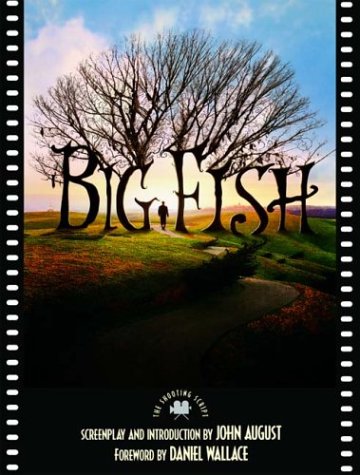
BF book coverNewmarket Press has published a paperback version of my screenplay for BIG FISH. You can order it here.

How does the paperback compare to the .pdf version available on this site? Well, it’s the same script, but it adds a kind foreward by Daniel Wallace (who wrote the novel), a very long intro by me, photographs, and production notes. Plus, it looks better on a shelf.

Big Fish script

January 27, 2004 Big Fish, News

Newmarket Press will be publishing a paperback version of the BIG FISH screenplay in February. It will be loaded with extras, including photos, production notes, and intros by Daniel Wallace and John.

In the meantime, you can download a .pdf version of the final shooting script here. Print it out on three-hole paper, and you’ll have exactly the same script we shot — and exactly the same the script you could buy for $10 bootlegged in Times Square.

If you read it and feel so inclined, by all means send a comment.

[originally posted December 20, 2003]

Script comments

September 10, 2003 QandA, Writing Process

When you finish a first draft, how many close friends or
confidants, do you show
it to? Do their comments change the script much?

–George Moise

At this point, the only person who reads absolutely everything is my assistant
Dana, not only for her opinion but also her much-needed proof-reading skills.
I think every writer needs a Dana – be it a friend, a parent, a colleague or
professor – to be a trusted set of eyes, and hopefully give unbiased feedback.

Many screenwriters have a circle of other writer friends with which they share
their work, either in person during a weekly writing group, or on-line. Walter
Bernstein
, who at 83 has written more than 27 movies, uses the
emailing-with-notes function of Final Draft to swap scripts with his colleagues.
It’s a great idea.

The extent to which you end up changing your script depends entirely on how
much you believe in the notes. Obviously, never make a change you disagree
with, unless some other factor makes it obligatory.

Being a writer’s assistant

September 10, 2003 First Person, QandA

I am interested in becoming an assistant to a TV or Film writer. I have experience in the industry as an assistant to a Producer/CEO of a Production company, but I’m not sure what the qualifications are to be a writer’s assistant or how to apply for the job.

–Beth

I’m passing off the question to my own very capable assistant, Rawson Thurber, who is an aspiring writer/director in his own right. He first started working with me on the TV show DC; and continued on with me since.

—-

first person

rawson thurberThe qualifications to be a writer’s assistant are by no means Herculean. As long as you have basic assistant skills (answering the phone without hurting yourself, computer literacy and a working knowledge of the film & TV industry) you’re already there, especially if you’ve already assisted a producer/CEO of a production company.

The more important question you should ask yourself is: why do you want to be a writer’s assistant? Generally speaking, if your answer is anything other than, “Because I want to be a writer myself”, then you shouldn’t be one. There are other Hollywood jobs that pay better and have better chance for advancement.

That said, there is a big difference between being an assistant to a TV writer versus a feature writer. If you work for a TV writer, you’ll usually be working for the show-runner, the main voice/architect behind the show, in addition to doing the research/transcribing/copying for all the other staff writers. You’ll sit in on all the writer’s meetings, taking notes: jokes, storylines, plot points, etc.

Working on a television show, especially a sitcom, can keep you up until all hours of the night. When it’s crunch-time, several of my writer’s assistant friends don’t get home until 2 or 3 in the morning for several days in a row (weekends included). It can be exhausting and exhilarating (you learn how a writer’s room is run and how a television show is produced from politics to post-production). But it is also a great way to break into television – often times, television shows promote from within, and occasionally farm-out an episode or two to promising assistants — you just can’t say that about CAA.

Working as an assistant to a feature writer is generally less demanding, but just as educational. Of course you learn the tricks of the trade: what works and what doesn’t work in a two hour movie, how to deal with studio executives and how to ignore or embrace notes (sometimes contradictory or just plain wrong) given from all sides. This is, of course, on top of the usual assistant duties of research, faxing, and scheduling lunches, meetings, pitches, parties and premieres.

The only words of warning I would offer, before jumping headfirst into this breed of assistant-hood, is to understand that writing is a solitary process. Whomever you work for will spend most of his or her time behind closed doors creating. This leaves you with a lot of time to spend doing what you’re there to do, which is write.

Additionally, working for a writer isn’t like working at a production company. There’s usually only one or two projects going on at a time, not fifteen, and it’s just you and your writer, usually in separate rooms – there isn’t much “office culture” to be had, so if you’re looking for football pools or water cooler gossip, best look elsewhere. Lastly, and this is the most important one, only work for a writer whose writing you respect. There are plenty of millionaire screenwriting hacks out there and life is too short to begrudge your boss his or her success.

Being a writer’s assistant can be a wonderful apprenticeship, just be sure you want the job when you finally earn your stripes.

John would like to add: For the record, not all that many feature screenwriters have assistants. Partly that’s because the workday life of a feature writer is generally less hectic — fewer meetings and less to stay on top of — and partly it’s because many feature writers work in their homes. Rawson’s point about the solitary nature of the craft is important. It’s one thing to be stuck in an office with a maniac boss, and another thing to be trapped in his house. So make sure the personality is the right fit before considering the job.

« Previous Page
Next Page »

Primary Sidebar

Newsletter

Inneresting Logo A Quote-Unquote Newsletter about Writing
Read Now

Explore

Projects

  • Aladdin (1)
  • Arlo Finch (27)
  • Big Fish (88)
  • Birdigo (2)
  • Charlie (39)
  • Charlie's Angels (16)
  • Chosen (2)
  • Corpse Bride (9)
  • Dead Projects (18)
  • Frankenweenie (10)
  • Go (29)
  • Karateka (4)
  • Monsterpocalypse (3)
  • One Hit Kill (6)
  • Ops (6)
  • Preacher (2)
  • Prince of Persia (13)
  • Shazam (6)
  • Snake People (6)
  • Tarzan (5)
  • The Nines (118)
  • The Remnants (12)
  • The Variant (22)

Apps

  • Bronson (14)
  • FDX Reader (11)
  • Fountain (32)
  • Highland (75)
  • Less IMDb (4)
  • Weekend Read (64)

Recommended Reading

  • First Person (87)
  • Geek Alert (151)
  • WGA (162)
  • Workspace (19)

Screenwriting Q&A

  • Adaptation (65)
  • Directors (90)
  • Education (49)
  • Film Industry (489)
  • Formatting (128)
  • Genres (89)
  • Glossary (6)
  • Pitches (29)
  • Producers (59)
  • Psych 101 (118)
  • Rights and Copyright (96)
  • So-Called Experts (47)
  • Story and Plot (170)
  • Television (165)
  • Treatments (21)
  • Words on the page (238)
  • Writing Process (177)

More screenwriting Q&A at screenwriting.io

© 2026 John August — All Rights Reserved.