• Skip to primary navigation
  • Skip to main content
  • Skip to primary sidebar

John August

  • Arlo Finch
  • Scriptnotes
  • Library
  • Store
  • About

Search Results for: koo

Scriptnotes, Ep 239: What is good writing? — Transcript

March 3, 2016 Scriptnotes Transcript

The original post for this episode can be found [here](http://johnaugust.com/2016/what-is-good-writing).

**John August:** Hello and welcome. My name is John August.

**Craig Mazin:** My name is Craig Mazin.

**John:** And this is Episode 239 of Scriptnotes, a podcast about screenwriting and things that are interesting to screenwriters.

Today’s episode is 100% craft, there will be no follow-up, there will be no questions, no discussion of etiquette. We are going to try to answer the question of what is good writing before we take a look at three new Three Page Challenges.

A warning that one of the Three Page Challenges has some bad words in it, so if you’re driving in the car with your kids, you may want to turn down the dial before you get to the Three Page Challenges. But other than that, it should be a pretty clean show.

**Craig:** I’m glad for it. I feel like while it was fun to wander around a bit, we need to focus. We need to refocus on our mission.

**John:** We need to focus on our mission, which is to talk about screenwriting and things that are interesting to screenwriters.

**Craig:** Mm-hmm.

**John:** Mm-hmm. So the idea for this topic came up because I read this piece in Slate and which is originally from Quora. It was by this guy, Marcus Geduld. And he was trying to answer the question, how do you differentiate good acting from bad acting? So I’ll put a link to the show notes for his original piece but I thought it was actually a really nicely designed explanation of sort of what he’s looking for in good acting.

And what I especially liked about it is he says, “If anyone tells you there are objective standards, they’re full of crap. This is a matter of personal taste. There are trends — there are many people who love Philip Seymour Hoffman’s acting but if you don’t, you’re not wrong.”

And so, as we get into the succession of acting and writing, I would back up what he says. It’s not there’s a one objective standard, but there’s things that I tend to notice when I’m saying like, well, that’s really good acting or really good writing and it may be useful to point them out.

**Craig:** This is a large philosophical discussion but I do agree with this gentleman as well. When it comes to writing, it’s not possible to say that this is capital G good and this is capital G bad. What you can say is that this is to my taste or it is not and here’s why. We do know that there are certain kinds of writing and the writing of certain writers that tends to be toward to most people’s taste, to a lot of people’s taste. There are some writers who appeal to the taste of those who consider themselves refined. There are some that appeal to the average man or woman.

But I’m with this guy completely. That’s why anytime I talk about a movie, I’m like, “It wasn’t for me.” That’s the best I could do.

**John:** Let’s take a look at his criteria for good acting. He says, “Good actors make me believe that the actor is going through whatever his character is actually going through.” So there’s a believability. You really believe that he has been shot, that he is terrified in this moment. And he singles out sort of like if you can tell they’re faking it, then it’s honestly kind of worse. Like you can sense that they’re acting.

And that’s very true. I mean, the performances that I admire the most, I genuinely believe that they are experiencing — obviously you know there’s artifice, you know that they’re in a movie — and yet the moment feels incredibly real because they’re responding to things in a very real way.

**Craig:** And ultimately verisimilitude is kind of what we do, right?

**John:** Yeah.

**Craig:** We’re trying to create a fake world that at least seems real to you while you’re experiencing it or is real enough that you can suspend your disbelief. And this advice I think is perfect for actors or writers.

**John:** Yeah.

**Craig:** Actors, obviously it’s immediate. We see and hear them and so we know that they’re believable or not. But for us as writers, believability, that probably is my number one problem with most screenplays I read. I read something, I read a character’s line or I witness their choice and I think, “I just don’t believe that that’s what a person would do in that circumstance.”

**John:** Absolutely. You say like, “I don’t believe it. I don’t buy it. I don’t get it. It doesn’t connect for me.”

**Craig:** Right.

**John:** That’s because you don’t believe that character is performing that way in that moment. But very related to that, Geduld is looking for surprise. The great actors surprise him. So out of all the choices they could make, they are making really interesting choices.

So he singles out sort of like if there’s a bank teller, you sort of want that bank teller just to be believable as a bank teller and not draw any attention or draw any focus to himself. But your main actors in your piece, they should be making really fascinating and interesting choices at times so you don’t know what they’re going to do next. Because if you can predict perfectly what they’re going to do next, you get bored.

I think I see the same thing with writing. If I can tell you what’s going to happen three pages later or three sentences later, then I stop being so intrigued. I’m not curious what’s going to happen next.

**Craig:** Yeah, that’s where the boredom happens. And when we see characters doing these things that are sort of obvious, right, there’s the lack of surprise, this is when you tend to hear things like, well, tropey or just sort of, “I’ve seen it before.” The element of surprise isn’t so much about leaping out and going boo at the audience as much as it is delighting them with something that they were not expecting.

All comedy is surprise. You cannot get a laugh if there’s no surprise, right?

**John:** Right.

**Craig:** Everybody knows that. If you tell somebody a joke and they’re like, “I’ve heard it before,” don’t keep telling the joke. There will be no surprise. All actors surprise, all emotion I think is surprise. It creeps up on you. Even when you are not surprised by the thing that happens, the intensity of it surprises you, and thus, the tears come.

**John:** And there’s no surprise without expectation. So the reason why a joke works is because you set up an expectation for what the natural outcome is and the punch line is a surprise.

The same thing happens in drama. You set an expectation for what is going to happen next and the surprise is something different happens or a different choice is made. So you don’t get those moments of surprise unless you’ve set expectation really well.

That’s one of the things I enjoyed most about Drew Goddard’s adaptation of The Martian is he was very clever about setting up expectations about what was going to happen next so that all the calamities that would happen to poor Matt Damon on Mars can still be surprising. You don’t get those surprises unless you’ve very carefully laid out for the audience what he thinks is going to happen next.

**Craig:** It’s remarkable how similar what we do is to what magicians do, because there is no surprise for the magician and there’s none for us. We know how it ends. We know everything. So there’s this careful craft of misdirection and misleading and setting up one expectation only to deliver something else. It’s all very crafted.

You know, if you spend any time reading Agatha Christie, she is just a master of this because in her case, think about what she has to do. She has to surprise the reader at the end and the entire time they are battling her.

**John:** Yeah.

**Craig:** They are not surprised that there’s a surprise. So it’s a bit like watching a close-up magician at work. You know he or she is trying to fool you. And then they fool you anyway.

**John:** Yeah. I think the other crucial thing to remember about surprise is if everything is surprising, nothing is surprising. And so if you don’t allow characters to behave in a way that we can have some ability to predict what’s going to happen next, we will stop caring or just stop trying to put our confidence in you that they are going to do something worthwhile. That there’s going to be a payoff to this.

And you see that sometimes in writing as well, where it’s just such a scramble of different things, it’s going in so many different directions. The rug is always being pulled out from underneath you to the point where like, “You know what, I’m not going to stand on that rug because I just know you’re going to pull it out from under me.”

**Craig:** No question. And in acting, we know this feeling when we’re watching a movie and we want to turn to somebody next to us and say, “Do you have any idea what this person is doing or talking about?” I love Apocalypse Now. I love that movie and my favorite book is Heart of Darkness. And I think there’s more great performances in that movie than practically any other movie I can think of.

But Marlon Brando’s performance is essentially surprising constantly to the point where I can’t quite get a handle on him at all as Kurtz. For me at least, that performance, it’s just all surprises and nothing to push against.

**John:** Yeah. It can be the real frustration. And of course, when you talk about an actor’s performance, we really are balancing what was written, what was the scripted performance and what was the actor actually doing. And in the case of Apocalypse Now, that was just a huge jumble.

**Craig:** Oh, yeah. [laughs]

**John:** But there’s times where, you know, you’re trying to look at a character in a movie and it becomes very hard to tell, like, did that not work because it was bad on the page or did that not work because the actor made bizarre choices that made it impossible for that to function? And it’s one of the reasons why it can be so crucial to have a writer around on a set to sort of be that set of eyes to let the director know and everybody else know, like, “Okay, what they’re doing is fascinating but it will not actually add up and you’re going to be in real trouble when you get to the editing room.”

**Craig:** Yeah, there’s no question. I think Brando famously showed up on that set like 100 pounds overweight, hadn’t read the book, probably hadn’t read the script, didn’t know any of his lines. [laughs] Yeah, that one was a disaster.

**John:** Geduld’s next point is that great actors are vulnerable, which is very true. You feel like the great actors are letting you see parts of themselves that they might be embarrassed by or essentially that they’re not embarrassed to show you those things that are sort of icky inside them and they’re not trying to be perfectly put together at all moments. They’re letting you in and showing you the cracks.

And good writing does that, too. Good writing isn’t trying to impress you at all moments. Good writing is trying to explore uncomfortable emotions and uncomfortable feelings.

**Craig:** Yeah. This can be a little bit of a trap for writers who work in comedy because comedy is one of the great defense mechanisms of all time. And there are very funny movies that essentially truck entirely in comedy and they never show vulnerability and they never get you in a moment where suddenly you feel, you deeply feel. You’re there to laugh. And by the way, it’s perfectly fine. I mean, you know, there are a lot of terrific movies that are just there to make you laugh.

But if you are trying to do a certain kind of comedy, you need to be able to access your vulnerable side and put aside your humor armor and just be real. Sometimes, it’s those moments inside of comedies that are the most touching because of the contrast.

**John:** Absolutely. I mean, you obviously had that moment with Melissa McCarthy in Identity Thief but I’m also thinking about Melissa McCarthy in Spy. And I think one of the reasons why Spy worked so well is you definitely see what she is longing for and sort of her obsession with her boss that she doesn’t really want to own up to and her own fears and frustrations sort of bubbling out. And so they find great comedic moments for it but they also really let you deep inside. And that’s why you can sort of identify so closely with her character.

**Craig:** And Melissa’s really good at that. I mean, Melissa, you know, she has one of those faces, like Zach Galifianakis and Steve Carell, these are people that you want to take home and hug, and yet they’re also so funny.

**John:** Yeah.

**Craig:** Then there are some really funny people that I don’t want to take home and hug. Like Ryan Reynolds is really funny. But he doesn’t seem to need my emotional support. [laughs] He seems to be just fine, you know what I mean?

**John:** Yeah.

**Craig:** Whereas like Zach or Steve Carell or Melissa, I’m like, “Okay, come here, here’s some soup. Let’s talk it out.”

**John:** Yeah.

**Craig:** You know, let me take care of you.

**John:** Yeah. His next point is listening, that the great actors watch them when they’re listening to other characters speak, which is a thing I’ve definitely noticed is that there are some people who just seem to be waiting for their turn to act next and there’s other actors who you feel like everything they’re saying is in response to the previous character, that they’re engaged in this moment, they’re engaged in listening. And those actors help the other person’s performance so much because they direct your attention back to what the other character is saying.

It’s such a simple and kind of obvious thing, but if you look at scenes that aren’t working, it’s often because you don’t believe that the other character is actually listening to what the first character is saying.

**Craig:** Yeah. This is acting school 101, you know. Sometimes all you do is just sit and listen and learning how to listen seems weird. Like why would it be so hard for me to do something I’m constantly doing anyway? But in the moment, when you are required to say things that you didn’t think and they are not extemporaneous, they were written down and studied, the act of listening in and of itself is a challenge, because suddenly you’ve lost yourself listening to this other person and you forgot you have something to say. That’s really tricky but what it comes down to is essentially putting your ego aside and not feeling like it’s more important for you to be in command of your moment when you say words.

Sometimes the big moments are the ones where you listen. Film actors, the ones who’ve been around the block a lot, they know that oftentimes the camera is on them more when they’re not talking.

**John:** Yeah.

**Craig:** So listening becomes crucial.

**John:** From the writer’s point of view, you are often writing those words that they are saying. And so if you are just batting a ball back and forth, it’s unlikely that you’re writing your very best dialogue for those actors because it doesn’t feel like they had to hear what the previous person said to respond to it, didn’t actually need to process it, but rather is like, funny line, funny line, funny line, funny line, that scene is not going to work or this is not going to work as well as it could. And the actors are not going to be able to bring anything special to it because you’re not giving them any things to hold on to. There’s just no handholds in that kind of dialogue.

**Craig:** There are exceptions. Sorkin is very good at putting lots of dialogue and not giving his characters a lot of time to listen because he demands that they’re fast and smart. So I think of the first scene of Social Network, it’s very ratatat. It’s very verbal. But then in that scene, when there is a moment where somebody suddenly stops, it means something.

**John:** Yeah.

**Craig:** You realize that they’ve been knocked back on their feet a little bit. Those are very challenging scenes for actors to do.

**John:** Yeah. Well, you know, if you’re writing things where the point is that they actually sort of aren’t listening, where they are basically two simultaneous monologues directed towards each other, that can be great and be fascinating. But if your whole movie is built of that, you better be Aaron Sorkin.

**Craig:** Well, yeah, and even Aaron Sorkin understands that after a scene like that, you need a break.

**John:** Yeah.

**Craig:** Yeah.

**John:** Yeah. His next point, the great actors use their instruments to their best effect. So by instruments, he means their body, their voice, basically what they came to the show with. And so it’s recognizing what you have and how to make the most of what you have.

So his example is Philip Seymour Hoffman who was overweight and not conventionally attractive but definitely knew how to use his body to best effect to, you know, be that character or sort of provide that character a reality within that world. And I think that’s something we’re always looking for with our own writing and with the characters we’re creating is how do you use who they are and what they bring to best effect.

**Craig:** And also for ourselves, there are things that we know we do well. John Lee Hancock, he always says that when he is sent something, a script for consideration to direct, the first question he asks while reading it or after reading it is, “Is this a pitch I can hit?”

**John:** Ah, yes.

**Craig:** You know, and the truth is, not everyone can do everything. And there are things that sometimes we want to do for a change because they’re exciting, and those are terrific. But there are also things we know we can do. And this is why some great actors have been bad in movies because they were miscast. That’s what miscasting is, right? So for us as well, we have to kind of cast ourselves into what we write to make sure that we’re writing with the wind at our back and not in our face.

**John:** For sure. So let’s go on beyond his suggestions and think of some of our own suggestions for the things we notice about good writing that are sometimes lacking in writing that is not so good. Do you want to start?

**Craig:** Sure. For me, just a few things that came to mind that don’t really apply for the acting model of things. One is layers. Good writing I think is accomplishing more than one thing at a time. Usually, I’m watching plot happen while I’m also watching a relationship change or watching a character grow. There’s just layers to things. I think audiences appreciate those complexities when it’s very — okay, this, now we stop doing and we talk and we have a relationship. Now we do talking again. It starts to feel very simple to me.

**John:** Yeah. And sometimes in procedural dramas on television, you’ll notice this, like they’re just doing the one thing. They’re basically like just putting out information about the next thing they’re going to do. And that’s sometimes how procedural dramas need to work but it’s not sort of the best writing we could aspire to in other forms.

**Craig:** Agreed. The other thing I think is a hallmark of good writing is hidden scenes because, you know, we are trying to create the illusion of something that is whole and of one piece because it really happened even though it didn’t. Of course, that requires us to stitch things together. And sometimes we have to do things in our stories to make them work that aren’t completely organic to what happened before. And I think good writing knows how to hide those scenes so that they’re not even visible at all. It’s like a good tile guy knows how to fit two slabs together so you don’t even notice that it’s two pieces and it looks like one.

**John:** Yeah. You brought up magic before and I think of sort of what David Kwong does in his close-up work. And I don’t ever want to ask him how he does what he does because I’m never going to be able to do it. It’s sort of more fun for me not to know. But I’m sure some of the misdirection is a real vigilance about where the audience’s attention is going to be.

And so when you talk about hidden seams, you’re really basically being very mindful of like what are they going to see and what are they not going to see. And by putting something over here, they’re not going to be paying attention to this thing that I’m doing over sort of down here on the page. It’s being very aware of like where they are at and their experience of reading the story, of watching this movie so they’re not going to see what you’re actually needing to do.

**Craig:** Yeah. A lot of times when people talk about good craft, I think this is a big part of it, is just hiding the artifice and avoiding all those — you know, there’s a common thing people say in Hollywood when they want to say they had a problem with something in a script. They’ll say, “This bumped me.” And bumped means, literally, I felt the seam, you know. Like I was in a car, I was on what I thought was a smooth stretch of road and then bump, right? So those are the things we try and hide.

The other thing that I think is part of good writing is a point of view that unlike a performance which is delivering one character and making us believe that character, the writer needs a point of view because otherwise the story isn’t really about anything in particular. The writer needs something interesting to say and they have to have an interesting way of saying it. It doesn’t need to be text, it could be subtext. And it doesn’t have to be grand. It doesn’t have to be unsaid by anyone else before. But we do need a point of view.

**John:** Yeah. On the blog about two weeks ago, I addressed this article that Michael Tabb had written about — he called it premise and I sort of disagreed with him calling it premise. But what he was really talking about was this idea like what is the point, like what are you actually wrestling with in the story? Even if characters aren’t speaking aloud, even if it’s not even sort of obvious subtext, it’s the reason why you wrote the story, it’s the question you’re trying to answer. It may not even be like the dramatic question that a character is going to ask or resolve. It’s not the plot. It is sort of the point.

It’s like, I want to believe that the story is about more than just the surface plotting of it and that there’s a reason why you wrote this story, there’s a reason why I should be spending my time on it. That even if there’s not necessarily one answer, that you’re going to try to convince me of some point of view.

**Craig:** Yeah. I call it the central dramatic argument. Everybody’s got a different, you know, phrase for it.

Scott Frank told me he wrote a script once and he sent it to, I won’t say who, but a big screenwriter, to get their opinion and that person’s response was, “This screenplay is well-written but it’s answering a question no one is asking.” And I thought that was a really tough love way of saying that whatever the point of view was there, it wasn’t something that would connect universally.

And we talk about this a lot. When you’re writing movies, you are creating the uncommon and the bizarre and the remarkable and notable because those are the stories worth seeing. But buried in there, something that is the opposite, incredibly common, completely universal, applicable to everyone’s life experience.

So that’s where the point of view comes in. And similarly, I think that connects to another part of what I consider to be good writing, and that’s a general unity, that there’s a cohesion of the narrative, the end feels like a proper resolution of the beginning. The phrase coming full circle. A good movie comes full circle.

**John:** Yeah. And when we say coming full circle, meaning both in terms of like story and plot. So like we started some place and we got some place, the characters went through a journey, we actually saw them do something, we saw them accomplish something or failed something in an interesting way.

But also, thematically, that there was like these were the themes we were exploring and we succeeded in exploring these themes through different characters, through different situations and we got someplace. And it all feels like it’s of one piece and it’s not just like a bunch of things that happened and now the credits are rolling.

**Craig:** Yeah. Ideally, the beginning informs what the end is and the end informs what the beginning is, the two of them are yin and yang. And those pieces fit together gorgeously. By the time you get to the end of the movie, you go, “Yes, it had to start that way, it had to end that way.”

**John:** And yet, at the same time, ideally, starting at that place, you should not have been able to predict that it got to that place.

**Craig:** Bingo.

**John:** And that’s the narrative trick. That’s good writing.

**Craig:** That’s good writing. And the way to, I think, your best friend in achieving that trick is having a point of view, because that’s what you’re bringing that the audience doesn’t walk in with.

**John:** Yeah. The thing that I think I’ve noticed about good writing is confidence and that the writer has confidence in his or her words and that his or her story is going to be interesting enough that me as the reader should be spending my time to follow them on this journey. And it’s a hard thing to describe because you don’t sort of see it, you just feel it. You feel like, okay, this writer is confident, I am confident in this writer that this is going to be an interesting journey worth taking.

Some of the things that make me lose confidence at times are simple mistakes. And so, you know, a typo here and there isn’t going to kill you. But a lot of typos makes me wonder like, “Wow, are you really that dedicated to your story? Did you not even proofread this?” And sometimes it’s sort of more they’re not typos but they’re just like things they didn’t think through, like logic flaws that make me question whether this is going to end well.

And so, confidence is a thing I look for in writing. And when I see it, I sort of lean into it. I’m excited to see where they’re going to go next.

**Craig:** Yeah. You know, you say that the idea that the writer is in control of the story and that’s exactly right. When you read a well-written script, you’re turning the pages knowing full well that when you turn the page, the next one is not going to be the one that makes you go, “Oh, god, really?” Whereas in bad writing, I’m feeling that on almost every page.

I mean, all of your triggers that you mentioned are correct. The one that always gets me is when I see the writer solving a problem in an evident way. And then I go, “Okay, I get that you had a problem and I get you needed to get out of that problem so that you could do blah, blah, blah, blah, but I don’t want to see that. Now I have no confidence in your story. Now I see the artifice.”

You know, I’ve been starting to create crossword puzzles because I’m not a dork enough, I guess. And when you’re building crossword puzzles, you have your big theme answers and then you’re going to fill in words around it. And sometimes you get jammed in a spot where, in order to make everything work, you need to stick a word in that’s just a really bad dumb crossword word.

**John:** What’s an example of a bad crossword word?

**Craig:** Well, there are so many. Well, there’s the crossword ease words like Etui and Esai and, you know, ero. And then there’s ones that are just like, you know, NGP and then you’re like, “What the heck’s an NGP?” And then it’s like, okay, one person once said it and it’s like this bizzaro thing or some foreign capital no one even knows.

And people do it because they have to solve their problem. But the good crossword puzzle creators, they just go, “Nope, let me undo this section and do it again because I don’t want people to hit that thing where they go, ‘Oh, that’s right, this is fake and you just magneted a solution on here so you could get to the next page.'”

**John:** Yeah. So things that make me lose confidence — typos, those kind of just like hacky solutions to things, and clichés which is a general kind of hackiness where it’s like, okay, that’s a really obvious tropey either plotting device or just a bad phrase that you just didn’t spend the time to think of a better way to say that thing.

And so, cliché can be great if you’re going to explode the cliché or sort of like play against the cliché. And if I have a lot of confidence in your story, in your writing, I will see that cliché and like, “You know what, that’s fine because they’re going to do something great with it. I’m going to keep turning pages because it’s going to be awesome.”

But if I was starting to lose confidence and then I encounter one of those cliché’s, I’m like, “Oh, it’s dipping low.” And remember in our last live show or two live shows ago, we had Riki Lindhome up. She was talking about when they were staffing for Another Period. And it’s like, oh, how many pages of a script do you read before you say yes or no? It’s like, well, about three.

**Craig:** Right.

**John:** And so, if she encounters a really hacky cliché on page three, she’s done. And that’s what you have to be so vigilant about.

**Craig:** Yeah. This idea of confidence in what the writer is doing is going to come up in one of our Three Page Challenges. I think we’ll see it pretty clearly. Part of what happens is when you feel good about the writing and then something comes along that’s a little squidgy, you give the writer the benefit of the doubt, “This must be intentional, it will work out.” And then, in well-written scripts, it does.

Think of like a script as the Titanic and it’s sailing along and it’s got its watertight compartments. You can hit, you know, one or two things and if you fill one or two watertight compartments, you can stay afloat for a while. But when you’re dragging something across all of them, you’re going to sink.

**John:** Yeah.

**Craig:** And when I read scripts where characters are, their voices are changing from scene to scene, characters are behaving in the middle of situations that are just bizarre and not realistic at all or inconsistent with what they did before, suddenly, the Titanic is being ripped in half, Jack is drowning, Rose is on the piece of door.

**John:** Spoilers.

**Craig:** Oh, yeah, the Titanic does go down.

**John:** Sorry, man.

**Craig:** Yeah, spoiler.

**John:** It’s good to bring up voices because voice is one of those things — we talk about characters having voices and making sure the voices sound believable. But writers also have voices. And good writing, that writer has a voice. And so I don’t care if it’s a non-fiction piece in Slate or something in The New Yorker or a Hemingway short story or Faulkner, or just any screenplay. You know, you read a Tarantino screenplay versus an episode of Game of Thrones, you read one of their things, they’re all very different but they all have a voice. They all sound like they’re written by a person who is confident about the words that they’re using to describe their world.

And as we get to the Three Pages, I think this sense of voice is really crucial. It’s a thing that keeps you turning pages because like, “Oh, even if I don’t necessarily love the story, I love hearing this person’s voice.”

**Craig:** Mm-hmm.

**John:** And there are writers who like, I’m not actually nuts about some of their plotting but their voices are just so fantastic. You want to talk about an amazing writer, someone we both follow on Twitter, Paul Rudnick.

**Craig:** Yeah. [laughs]

**John:** What an amazing voice he has.

**Craig:** Brilliant.

**John:** So Paul Rudnick wrote In & Out and lots of other movies.

**Craig:** Addams Family.

**John:** Was it Addams Family or —

**Craig:** Yeah.

**John:** Yeah, you’re absolutely right. But he also used to write as Libby Gelman-Waxner. It was a column for Premiere Magazine which was the big film magazine at the time. And it was written for the point of view of this film critic kind of. She would review two movies in every issue. But it was mostly about her life and sort of her daughter and her dentist husband, Josh, I think.

**Craig:** [laughs]

**John:** And basically, it was all about sort of her even though she was technically reviewing these films. And it was all just a wonderful exercise in voice.

**Craig:** Yeah. I’m just such a fan of his. In & Out is such a good movie. I love that movie. I mean, that’s a great movie, by the way, for anyone to study in terms of structure because it’s structured perfectly. And talk about, it’s loaded with surprise. I mean, you have a movie where someone is gay but isn’t ready to come out of the closet and you’re like, okay, it’s going to end with him coming out of the closet. Yeah, but that’s not where the surprise is, you know.

And then his voice, look, he’s one of the wittiest people ever. [laughs] He’s like Dorothy Parker witty. That guy is, he’s great.

**John:** He’s fantastic.

**Craig:** Yeah.

**John:** My last little thing I’ll say about good writing, and this is not an exhaustive list, there’s probably other things you can think of, but I want to talk about finesse. And this is a thing that you maybe only kind of recognize when you have written a lot. But when I see a writer doing something that’s actually really difficult and they make it look so easy, you’re like, “Wait, how did you do that?”

**Craig:** [laughs]

**John:** And that’s the thing that I start to really appreciate. And so, two recent examples I can think of, over the Christmas break I read To Kill a Mockingbird. And obviously the book is great on many levels and that’s why you study it in high school.

But looking at it now, Harper Lee was able to do these things, these transitions where she was in a scene and it was like really a detailed scene and like every moment, every sort of gasp and every, you know, scratch on the floor, and then like within just a few sentences, several months could pass and then we’re off to something completely new. She was able to transition in and out of these sort of close-up moments in ways that were just remarkably subtle and clever and adept that you didn’t even sort of notice. Like, “Oh, wow, just months passed and now Scout’s older and like two sentences have gone by.”

**Craig:** Yeah.

**John:** That’s a really remarkable thing.

**Craig:** It is. I think that the idea of making the difficult scene easy is more a hallmark of great writing. You know, the person that confounds me time and time again is Neil Gaiman. I read this guy and I’m like, “How did you just do that? How did you pull that off?”

You know, just reading through the entire Sandman series at least once in every issue, I’d go, “Wow. Wow. How did you — ” especially later on when you’re like, “Wait, did you set up something three years ago and it just paid off?” [laughs] I mean, his mind is just remarkable and he makes it look so easy.

**John:** Yeah. And I had this filed underneath the finesse category but it speaks back to sort of all these things, so maybe my final example will sort of talk about how well she did on all these different levels.

So Gillian Flynn in Gone Girl, both in the book and in the movie, and different ways how she did it in both the book and the movie, there’s this narrative handoff that has to happen halfway through. And when you see what she did, we’re talking about the layers, there was actually much more going on than you sort of thought was going on. There were these hidden scenes that she was just masterful.

She had a point of view as an author about what she was trying to express but also very clearly you could understand the characters’ points of view on this. There was a unity, there was a deeper thing that this was all sort of connected to. And she had confidence and it’s only because I had confidence in her writing and sort of what she was doing that I was able to take this giant leap halfway through the book and halfway through the movie that like, “Okay, everything has completely changed and I’m so excited to see where this is going next.”

**Craig:** It’s such a good feeling knowing that every page you’re reading has been thought out and is part of a larger plan.

**John:** Yeah.

**Craig:** And you never get that sense of — because I’ve read some novels where — I read one in particular recently where I was so happy halfway through. And then I got into the second half and it just seemed to me that the author had kind of gone, “Okay, that’s enough craft. Let’s just wing it.” [laughs] And it just fell apart.

**John:** I will tell you quite honestly, there was a book I was sent as an adaptation, I had this two years ago maybe, maybe even more than that. And it had sold for a fair amount and then I heard back — so I read it, it’s like, “Well, the first half is really good and the second half is not really good at all.” And the backstory was like, yeah, people only read the first half. They bought it at an auction, they only read the first half. And so no one sort of knew how it ended. And then they got the rest of it and they’re like, “Oh, oh, no. Oh, no.” And it just wasn’t a good ending.

**Craig:** No. And that’s a real challenge for us when we’re adapting these things because, like I said before, the ending must be fundamentally there in the beginning. So it means that the beginning that you like so much, you might have to change that a little bit.

**John:** Yeah.

**Craig:** Yeah.

**John:** That’s the frustration. And as we start these Three Page Challenges, we are just looking at the beginning. So we have to be mindful of, the first three pages are so crucial but in some ways they’re so easy because you’re not responsible for like the next 90 pages as you’re writing these three pages and giving them to us. But of course, if you’re writing the full script, these three pages would actually have to set up the things you want to do for, you know, another two hours of the movie.

**Craig:** Yeah, they’re crucial. Crucial.

**John:** They’re crucial.

**Craig:** Yeah.

**John:** All right, let’s get started with this. Which one should we do first?

**Craig:** Here, I’ll do Brewed.

**John:** Great.

**Craig:** Brewed is written by Joey Perotti.

**John:** So as always, if you’re new to the podcast, you may not know that there are links to the PDFs of these Three Page Challenges in the show notes, so you can read along with us if you’d like to. So these are people who have written in to johnaugust.com/threepages and they said that we could talk about their pages on the air. So these are willing participants in this and they’re all very brave to give us their pages.

**Craig:** Indeed they are. So we summarize them and then we discuss and you can play along with the home game. And for those of you listening and you don’t have the pages in front of you, Brewed is B-R-E-W-E-D, not B-R-O-O-D. Brewed by Joey Perotti.

So we open in the brew house which is a small, moderately busy coffee shop and we’re listening to Chuck, an overweight buffoon and manager, and he’s holding up a journal and he’s basically instructing his employees, it seems. And he’s talking to Henry who’s in his late teens and giving him this information. And then Henry notices Robert, he’s a homeless man. The homeless man is talking to Jude who works behind the register. And the homeless man, Robert, is asking to use the bathroom. Jude says, “No, it’s for customers only.” Robert then walks up to Henry and says, “Hey, can I get some change?” Henry gives him some money.

A customer named Paul tells Henry he’s made a big mistake. That Jude is going to be mad at him. Paul is a regular, he’s been there all the time. He sees everybody and what he knows is the most important thing in the coffee shop is the bathroom key, it’s for customers only. At which point Robert, the homeless man, says to Jude, “I want the bathroom key, I’m a customer.” And Jude is annoyed.

**John:** Yes. So we’re going to have I think two really promising things to talk about next. But to me, I felt like that this was one of Joey’s first screenplay exercises. And there was a lot here that didn’t work for me. So this is going to be one of those things where like it sounds like I’m just going to pick and pick and pick and pick. But I think there’s a lot to pick at here.

So we can talk about sort of the concept but I’ll tell you where I had issues on the page and we can work through those and then maybe other ways he could sort of set up this thing which read to me like it was maybe a pilot or an indie com. I wasn’t quite sure what I was reading.

**Craig:** Right. All right, well, go for it.

**John:** Go for it. So this is going to be some tough love for Joey, but hopefully helpful. So let’s just look at the first page. There’s a fade in, which you don’t need. You can have it, you can let it go. A lot of typos, just a lot of typos. Buffoon is B-U-F-F-O-O-N. We see the Brew House a lot in this first bit. You could take that out. So Chuck tells a joke and then like laughs hysterically and then like laughs bigger about it. I didn’t believe it. So going back to our discussion, like I didn’t buy that. I don’t think I would buy any actor actually being able to do that. Unless there’s like a meta joke about someone doing that, it felt really strange and weird to me.

I also got lost about like, wait, is he giving instruction to a bunch of people or just to this one new guy because it wasn’t clear. Just the geography of the space was not clear to me.

**Craig:** Yeah.

**John:** If we’re going to be in a place called the Brew House, are we behind the counter? Are we on one side? Like I had no idea how the layout of this place was working.

Opportunity is misspelled twice.

**Craig:** Three times.

**John:** Three times. [laughs]

**Craig:** Yeah.

**John:** Opportunity is misspelled consistently.

**Craig:** Yeah.

**John:** Slightly is missing a T. On page 2, a few things, parentheticals. Parenthetical, the first letter is not capitalized. And so if that parenthetical is truly that thing that’s underneath the character name, that first letter is not capitalized. OS when it’s like off screen or voice over, those abbreviations, those are different kinds of things. Those actually go up on the line with the character name. So those are two different things.

**Craig:** Yeah.

**John:** Page 3, we have the same problem with the capitalization and the parenthetical. I asked Stuart why he picked this and he said that we hadn’t done a lot of things that were just comedy and we hadn’t done things which were just dialogue and that’s why he picked it, which I think is true. So I think it was useful for that reason. But also because there are some things here that people would probably — they might see in their own scripts and fix.

**Craig:** Yeah. Well, this is the one I was thinking about when we think about confidence in reading. So we look at this line here, Chuck says, “I want you to jot down any time you size an opprotunity. And then Henry goes, “Size?” “Yeah, is the opprotunity big? Is it small?” Okay, so there’s a joke here that Joey is trying for which is that Chuck isn’t good at talking. But now is opprotunity on purpose? Does he not know how to pronounce that word or is that just a typo like all the other typos on this page? This is the point. I don’t know what you’re going for and I have no confidence in it, so now I’m just chucking it up to a typo.

**John:** Yeah.

**Craig:** Since you talked a lot about form and I agree with every single thing you said, I’m going to talk a little bit about content here. I have no idea what a journal is in terms of a manager at a coffee house instructing what appears to be a new employee. Chuck says, “This is your cold beverage journal. And your pastry journal, and your tasting journal, and you’re African coffee journal or as I like to call it, your ‘urban’ journal.” And that’s his joke.

Okay, A, that’s not a very good joke. And not because of racism, it’s just not a very good joke. B, I have no idea what a journal is. So I don’t know what’s going on. Is it an instruction manual? Is that a menu? So journal is a weird word. If I haven’t worked in Starbucks, then I don’t know what that is and I don’t know if that’s a specific word for that.

And Henry isn’t saying anything here at all. He’s just sitting there, so I have no idea who he is, what he’s about, I suspect he’s our hero. This is not good. Chuck ends this conversation on the top of page 2 by saying, “Wait here, I’m going to grab Zoe,” gets up and walks into the back. Great example of not hiding the scenes. [laughs] Character just says, “I have to go away now, bye.”

**John:** Yeah. Let’s talk about character names. All the characters have very similar names and it was very easy to get them confused. And so when your homeless person is named —

**Craig:** Robert.

**John:** Robert. Well, that doesn’t feel like — I’m sorry, that doesn’t feel like the homeless guy to me. I couldn’t tell Robert from Jude from Henry by the bottom of page 2 and that’s really a problem. Particularly if Henry is supposed to be our lead character, he’s not particularly well described or set up. And we don’t see him, going back to our craft thing, we don’t see him listening. We are never given any instruction for sort of what he’s like as he’s listening or sort of how he’s reacting to this crazy stuff that’s he’s being told.

**Craig:** Yeah. There’s little bits. He nods his head confused. But who wouldn’t nod their head confused at that?

**John:** Yeah.

**Craig:** There’s something particularly unique to him or his responses. Henry looks at all the journals. I still don’t know what those are. Then Robert is having an argument with Jude. Now, Robert’s had this argument many, many times with Jude.

**John:** Yeah.

**Craig:** First of all, in the parenthesis, apathy on the verge of annoyance, you can just substitute the word annoyed, okay? Just bored, annoyed if you wanted to, right? Shorter. You don’t want to ever have two lines of parenthetical. Just indicates that you’re a failure of imagination basically. So Robert says, “Come on man, I just got to take a piss.” And Jude says, “Restroom’s for customers only.” How many times has he said this to this guy? A thousand? So wouldn’t it be, “You know the restrooms are for customers only.” [laughs]. You know right, there’s got to be some indication of a past life. Talk about acting — one of the things they drill into you in acting class is the moment before. So there’s a whole world before this. So that’s a moment where I don’t believe it.

**John:** So the parenthetical for what Craig is describing could just be in parenthesis, (thousandth time). I mean that gives the actors something to play.

**Craig:** Right, exactly. And that’s what those things are there for, right? It’s to get them something to play. Apathy on the verge of annoyance is rather wordy. This, by the way, is where parentheticals get a bad rap, you know. And people will say, “Never use — don’t tell what actors what to do, blah, blah, blah.” You know, that nonsense. You know, just don’t do it like this.

**John:** Yeah.

**Craig:** But yeah, for the thousandth time would be a terrific thing. Then we introduce Paul. And Paul delivers this monologue on page 3 that feels very written. And the way he gets into it is so written. I don’t know if Paul is empathetic toward Henry. I don’t know if Paul is a weirdo. I don’t know if Paul is attracted to Henry. I don’t know if Paul is trying to make Henry stay a little bit better. I know nothing. All I know is that he delivers exposition that feels like an announcement about what this movie is.

**John:** Yeah. Let’s look at Paul’s introduction because there’s potential here. So let’s look at what it says. “Henry turns around to face Paul (60s), a bearded gentleman wearing two sets of eye glasses, drinking from a ceramic mug and holding open a book, Factotum.” So there’s a lot of gerunds happening here kind of. But each of those is sort of individually a good idea. I could sort of see him like as a kind of like he is an NPR tote bag kind of person. And that may be fine. But I don’t know specifically what Craig is going to, like I don’t understand like what he’s trying to do for Henry in this moment.

**Craig:** Yeah.

**John:** I don’t understand like what’s the moment he’s playing. You give me sort of a physical description, but I don’t get a sense of who he is.

**Craig:** Yeah. Look, characters always want something. Always, even the littlest things. But they want something. I have no idea what Paul wants when he said — by the way, they’re not gerunds. I actually realized, the gerunds are the noun like the wearing of clothes, right, yeah.

**John:** Yeah, yeah.

**Craig:** But Paul has no motivation to deliver this, so that means the writer is forcing it in there and now I’m aware once again that we have a problem.

**John:** Yeah. Paul’s big block of dialogue — I’ll just read it for people who are not reading along with us. He says, “I’ve been coming to the Brew House for seven years. You see a lot of strange stuff, all walks of life: bums, businessmen, commuters, teens, hippies, hipsters, wanna-be writers, wanna-be intellectuals, druggies, psychos, stressed-out mothers, cat ladies, and creeps. And they all want the same thing.” “Coffee?” “The bathroom key.”

And so let’s get back to sort of the idea of the scene that I think there’s a good idea underneath all of this where it’s just like, okay, no, the most important thing in this entire place is the bathroom key. That’s actually a good comedic idea behind a scene. And so if the scene around it were sort of like, you know, talking about sort of like the training and all the stuff, or like how to do this and how to — the temperature you have to do for these kind of beans and stuff like that, but the most important thing in this entire place is the bathroom key. That’s a comedic premise which I don’t think this achieved.

**Craig:** No. I mean there’s a way of redoing this where we begin with Henry sitting with Chuck, his manager, and Chuck is like, “Okay, so I graded your test and it’s 100. So you scored a 100 which is really remarkable. You obviously studied the manual. So now I’m just going to ask you a question that isn’t on the test. What is the most important thing here in this coffee shop?”

**John:** And so the natural answers you could give is like respect.

**Craig:** Hard work, coffee, equality. [laughs] Cleanliness.

**John:** Yeah.

**Craig:** There’s a million things and for him to go, “No.” And then he just holds up this thing. “This is. This is the bathroom key. This is the one thing, this key, that separates this store from civility and success and absolute chaos.”

**John:** Yeah.

**Craig:** And then you go, okay, there’s a point of view, right, instead of somebody just being this guy that just says, and now a monologue that is unmotivated by anything to a person I do not know for no reason. [laughs]

**John:** What we didn’t put on our list of good writing, but what this describes is you’re in and you’re out. Sort of like what is the first thing we’re going to see in the scene and what’s the last thing we’re going to see in the scene. And what we’re pitching is like how are you going to open this moment? And if you’re going to open this moment with the manager guy, that should get you to the comedic payoff here and that probably is the key.

**Craig:** I agree. And that’s why you can really see the gears turning and hear the metal on metal noise when Chuck says, “Wait here, I’m going to grab Zoe.”

**John:** Yeah.

**Craig:** That’s just bad showmanship, you know, as a writer. The other thing is that Paul’s speech doesn’t really tell us anything that we haven’t heard before. We’ve all been to coffee shops. We know who goes in and out of there.

**John:** Also, if you’re going to make a list in a comedy, you have to throw in some wild things there. Like, you know, like Frisbee duelists, you know, something that’s just like really absurd or like, you know, something to break it. Because you’re setting a pattern — and in comedy you set a pattern and then you break it wildly and so break that pattern.

**Craig:** Yeah. So lot of trouble here. And this does feel like early work. This feels like the beginning of something. Maybe Joey’s first attempt at something. There are a lot mistakes here. And I think that you need to — this is one where I feel like you need to do a little bit more homework. You need to watch and think more about how the things that you like are and then ask yourself if you can rise to that standard.

**John:** I think it’s worth looking at your favorite comedies and pulling up those scripts and going through it scene by scene looking at sort of how they work and really figure out where the ins and the outs are, how — the economy of those scenes.

**Craig:** Exactly.

**John:** All right, let’s go to our next one. This is HALCYON by Amanda Mar”n. We are in Gus’s sporting goods store in Dartmouth, New Hampshire. It’s day. There’s a revolving stair-climber caught in an endless cycle climbing to nowhere.

Paul Adam (50s) shuffles in. His preppy, upper class clothes are wrinkled and stained. Goes up to the counter where he talks to a sales woman and he’s thinking about buying a new gun for the hunting season. She says, “Well, hunting season doesn’t start till fall,” but there’s some stuff on sale so she’s showing him options for guns. Shows one that might be a good fit for him. He clearly doesn’t actually know a lot about hunting. He doesn’t know a lot about the geography of the place. He wants something that takes a 3.5, a 3.5 magnum. So she shows him that gun. She’s very clear about like we don’t have ammunition here, so you’re not going to be able to load the gun. She seems suspicious and weary, but is also still trying to sell him the gun.

He ultimately takes the gun, loads it with a single bullet that he has, and puts it to his forehead and he says, “I have not changed the world. I’ve destroyed it.” Steels himself, finger on the trigger, face tight and closed, as we end on the bottom of page 3.

**Craig:** Okay. Well, Amanda, this is I think a good idea for an opening scene. It does all the things that opening scenes should do. I just have major issues with the way you’ve executed it. So I’ll begin with the simplest thing and then I’ll go to content. You begin by saying over blackness. No. Over black, yeah. Unnecessary-ness. But already it’s shaking my confidence because it’s such a clunky word and it’s unnecessary.

But let’s talk about what’s going on here. Paul wants to commit suicide. Paul is walking into a store that sells guns. He has a bullet in his pocket. The store does not sell ammunition. They’re going to give him a gun to look at. He’s going to take his bullet out, load it or in this case, a shotgun, shall load into the weapon. He’s going to say these very creepy things. And then presumably he’s going to die. We didn’t get quite there at the end of page 3. That’s terrific. I really love the idea of somebody going gun shopping, having somebody be nervous and say, by the way, we don’t sell ammo here. And the guy would be like, “No, no. No problem.” And then taking out his own ammo. Very clever, very smart. Here’s my —

**John:** Yeah, it’s a surprise.

**Craig:** It’s a surprise. Here’s my problem. You make way too much of Paul being scary. So this woman knows he’s scary. We all know he’s scary. So all of the juiciness and creepiness at the end you have diminished greatly.

**John:** Yeah.

**Craig:** Whereas if this man walks in and is maybe a little bit off but almost a little too chirpy, then suddenly there’s that other thing like, hmm, does anybody in the audience or the people in my row get the same creepy feeling from this guy? Probably not. He’s overtly okay.

**John:** Yeah.

**Craig:** There is two pages solid of back and forth about guns. And it’s boring. It just goes on too long. The idea is he would like to buy a gun and he should be talking and she should say, “Okay, what kind of gun are you interested in?” “Well, I was thinking about this or this, but, you know, what about this? Do you have that?” “Yeah, we do. I should let you know that we don’t have ammunition.” “No problem.” Can you just show me how to — how do you open it? Does it like — do you have one with this?” “Yes.” So much. I mean the saleswoman does this enormous chunk of dialogue on page 2 where she’s trying to sell him the shotgun and it just was, it just kept going. So just too much.

Lastly, gun choice. He goes in there to kill himself. He has a shotgun shell and he needs a shotgun. Shotguns are not great ways to kill yourself. I mean they’re long. So it’s really hard to do and it’s very easy for somebody to stop you from doing it because you’ve like got to wrestle it into position and everything. [laughs] Why wouldn’t he just be in there with a 9mm bullet asking to see a Glock and then load it and put it in his mouth? That’s one where I was struggling with his choice.

**John:** I was struggling a little bit with the bullet and sort of the issue of sort of the size caliber of it all. I got confused about that, too. But I felt the idea that like, “Oh, this isn’t for the size bullet I have,” is actually really good. He actually knows nothing about guns at all so he just happened to find one bullet.

**Craig:** Right.

**John:** That was really interesting to me. So it wasn’t that he magically had the right — he had a bullet and this was his plan from the very start. Like somehow he came across a bullet and decided that this is what he was going to do.

**Craig:** Right. That would be cool.

**John:** So I liked this a lot more than you did. And I agree with you that I think most of page 2 should be greatly compressed because I can imagine filming all this. And if you filmed the scene as written, you would take out most of it because you sort of get it. Like you get like — what I love about the saleswoman is like she’s trying to do her job, she’s trying to sell the gun. At the same time, she’s like, but just so you know, we don’t sell the stuff. The natural red flags are going up for her and I was so happy to see that she was aware of the situation. But there’s just too much of it.

**Craig:** Too much.

**John:** Too much awareness. And so we were ahead of the story and if we’re ahead of your story, that’s not good.

**Craig:** Yeah, I struggled with the saleswoman. There’s red flags and there’s red flags. Somebody walks in, here’s how Amanda describes this character, Paul. His clothes are wrinkled and stained. His hair is matted with something dark and sticky. His eyes are blood shot. He is unblinking. He answers with no emotion each time she speaks. That to me is more than a red flag. And that I think was putting stress on it. It started to make me hate her for like not just going, you know what, I’m sorry, you should probably talk to my manager. Like there’s got to be some way to bail out of this discussion. [laughs] This guy is off, really off, as opposed to curiously off and then we are surprised.

**John:** Craig, as an exercise, on page 1, if we take — so once the dialogue starts, if we took out all of the scene description, I think you actually have a better flow. So, “Help you hun?” “Thinking of a new one for hunting season.” “Well season doesn’t start till fall, but you’re in luck we got a few on sale cause of that.” Like essentially like, if we stop stopping so often for the scene description, I think there’s a flow there that might just give it a little bit more energy there and make it feel like, you know, she’s just not so vigilant from the very start.

**Craig:** I agree. I agree. There’s a lot of — all that I think exacerbated my problem that things were overwritten here. And I’m such a believer that the first 10 pages are precious, precious real estate. There shouldn’t be one wasted letter on those 10 pages. So, you know, your job should be to be ruthless about weeding out the unnecessary.

There’s a couple of other things I’ll mention and then I’ll turn it back over. There are some typos here. Holds it’s weight, I-T apostrophe S, there should be no apostrophe there. Feel it’s cold steel, same there. Its-it’s thing, your-you’re, there’s just no excuse anymore. It makes me upset.

And in the moment, here’s what happens on page 3. He’s looking at the gun and then he says to her, “I’m sorry. I have no choice. Then he pulls his hand out of his pocket, a shell casing gripped in his palm.” Then he says, “I’ve done a terrible thing.” Then he shoves it into the shotgun, closing it with a pump. Then he says, “Without our suffering we are no longer human. We become monsters.”

Then the saleswoman lets out a scream. This is the latest scream in movie history, right? So he says, “I’m sorry. I have no choice.” He pulls out a shell casing. We all go, oh, and she needs to go, gun, gun, right, and just go. [laughs]

**John:** Yeah.

**Craig:** And he can do all the rest of his lines to himself but that was crazy.

**John:** Yeah. Take out all those lines there and I think it’s actually a stronger moment. Going back to sort of typos and other things. On page 1 again. So we’re inside Gus’s sporting goods store. The sound of a revolving stair climber caught in an endless cycle. The sound happened beforehand so if you’re going to show it, then it’s not the sound. I think you probably want to show it because that’s a great image. So take the sound of out of there. Bloodshot is one word or hyphenated. You can make your choice. So this is the fifth sentence of the scene. “A long expired in summer banner exclaims — New Year New You! With a woman in a bikini.” I doesn’t actually make sense. I get what she’s going for but it was very hard to read. And it stopped me three times. So get rid of anything that is hard to read basically.

**Craig:** Yeah, yeah. Also, beeline is a wonderful word for somebody that’s walking quickly or running quickly towards something he’s not. He’s shuffling, so you can’t beeline while you’re shuffling

**John:** Yeah. But I do like that he had single focus on something. That’s a great description for where he’s headed.

**Craig:** Yeah, exactly. So there’s other words you can do to accomplish the same thing so that you’re not confused. Is he running suddenly? We have the same thing where Amanda capitalizes “whispering,” the first word inside a parenthetical, which generally you don’t do. I mean it’s not the end of the world.

**John:** No.

**Craig:** If these were three terrific pages, I wouldn’t care.

**John:** Yeah.

**Craig:** So, okay, well, John liked that one a bit better than I did. But I love the idea, Amanda. I thought it was really creative, really smart. So, you know, basically even though John and I seem like we’re slightly different on this, I think we’re king of saying the same thing. Just tighter. Tighter.

**John:** Tighter. Tighter.

**Craig:** Tighter, tighter. All right. Well, let’s go to our last one. This one is called Blue Forty-Four. And it’s written by Josh Corbin. All right. So here we go. So this one begins outside a field in morning. And it’s the kind of day that was shitty twenty minutes ago. Gray overcast split open by a blast of early-morning sun. We’re behind a dog. And the dog looks like he’s been beat up a bit and then he hears somebody whistling. He stands at attention and then in audio we hear a phone ringing. Somebody is yelling for Benny, or Benny is yelling over the phone to somebody named Daniel that he needs cavalry.

And then we are now in a chase. Benny Miller is in a car and he’s speeding down the road on the phone with Daniel trying to get help because some guys are chasing him. And each one of them is wearing a monster mask. There’s a wolfman and then there’s a skeleton and a zombie and they’re shooting at him. They’re not cops and Benny is shooting back at them. And then Benny gets a moment where he can actually kill one of the guys but he can’t actually take the shot and kill the guy.

And then Benny’s rear window explodes because it’s been shot by the wolfman character and Benny loses control of the car.

**John:** And we should say that he’s on the phone with Daniel throughout this so it’s a speaker phone we’re hearing this other voice who is not actually in the scene.

**Craig:** Correct.

**John:** I thought these pages were really strong. There were some problems but I dug the moment. I could see it. I believe that the writer could see it. I believe that it could be shot. I believe that it would probably be exciting. And it read like the kind of action sequence I like to read on the page when I’m going to see a movie.

**Craig:** I completely agree. I have no idea what’s going on with this dog.

**John:** I don’t really either. And honestly, my confidence was flagging from the very first sentence. “The kind of day that was shitty twenty minutes ago.” What does that mean? I have no idea what that means.

**Craig:** Well, I actually understood it because the next sentence — I agree, like when I first read that I’m like, “What?” And then he says, “Gray overcast split open by a blast of early-morning sun.” I’m like, oh yeah, I know what that is. That’s that thing where it was like the sky looks like it was just raining and now it’s not.

**John:** All right. So flip those two sentences and I understand it.

**Craig:** Right. Exactly, exactly. Very good advice. The thing about the dog, maybe I assume it will eventually make sense. And that’s fine. But it was well-written.

**John:** But it was confusing at times. And here’s where I got confused. “Until someone whistles from afar. He stops, alert as we angle on him.” So the dog suddenly was a he but I thought that he was referring to the someone whistling. And so I just got confused. And so either keep the dog the dog. I just felt like it was overwritten for what was actually happening here. And I just don’t even quite know what I was seeing there.

**Craig:** Right.

**John:** I think you could have just set up the dog staring, looking at something, and then got me to the chase faster. I bet you could have lost two-eighths of this page.

**Craig:** Yeah. But the meat of it is obviously this chase. And once I was into the chase, I was really happy. I believe that we should be allowed to write things to match the feeling we want the audience to feel. The feeling that Josh wants me to feel in this chase is panic. And so even his slug lines are panicky. A cutlass. Moving. Fast as fuck. Day. The car engine working its ass off because Benny is fucking panicking. And Josh is capitalizing. He’s bolding. He’s italicizing. Which, you know, in a scene where people are just moving through a space and talking is incredibly annoying. In a scene where it’s life and death and cars are screaming down a road and people are shooting, that’s right.

**John:** Yeah. This is as good as I’ve seen it. I mean, I’m not a big fan of like crazy bolding and underlining and all that stuff. But this is a really good version of it. He’s using the double dash to sort of keep connecting thoughts together and sort of single out what shots are. And it works really well for it. And it gives a good feeling. He’s also using a lot of onomatopoeia for shotgun in the hand — SHK-RK — wolfman aims at Benny. Some bwooms, the difference between a blam and a blam, blam. It works.

**Craig:** Yeah. No, it works and I really appreciated as a reader that I could identify these three people. It’s creative. Look, we’ve seen movies where guys are in kooky masks. That’s a cliché, right? Bad guys wearing masks. And that’s fine. I mean they actually do wear masks so the cliché is fine. What I appreciated was that there was a wolfman, there was a skeleton, and a zombie. And all of a sudden now I can see what’s happening.

**John:** Yeah.

**Craig:** The fact that those were specified unlocks my visual mind. Otherwise, it’s guys and what am I looking at? Guys.

**John:** Yeah.

**Craig:** You know?

**John:** Thug one, thug two, thug three.

**Craig:** Exactly. And boring, right? Now, I’m imagining when he says, because he makes a moment here, right? And this is what I also really appreciated about what Josh did. Inside of plot and we talked about layers before, there should be character, right? So here, this is this crazy, hyperactive chase with guys wearing monster masks and then everything slows down for a character choice because he structures this so that Benny is afforded a choice. And the choice is should I shoot this guy wearing a zombie mask in the head and he chooses not to.

So that’s really the payload for this. All of the other stuff is icing. That little moment is why the scene exists in the movie. I assume that is going to be something very meaningful going forward. So I thought that this was done really well.

**John:** Yeah.

**Craig:** Yeah.

**John:** So I have no idea what the rest of the story is. But I would be curious to keep reading the story. I have confidence that he seems to know what he’s doing. That’s a lot sometimes.

**Craig:** Yeah.

**John:** These were also I think three really good examples because the problems they had were addressable and they were all very different. And they very well illustrated some of the things we’re talking about with like what is good writing and sort of what we’re looking for with good writing and what makes us not think something is as good as it can be which is the moments that stick out in the wrong ways.

**Craig:** Absolutely. By the way, I should add that I really like this title, Blue Forty-Four. I don’t know what it means, but it grabbed me.

**John:** Yeah. So as always we want to thank our three very brave listeners who sent in their pages to let us take a look at them. If you would like to send in your own pages for us to look at, the link is in the show notes. You can also find it at johnaugust.com/threepage. And Stuart will take a look through those and occasionally pick three of them to send for us to read through.

All right, it has come time for our One Cool Things. My One Cool Thing is a very simple little web game. Not even game, it’s like sort of a demonstration. It’s called Creatures Avoiding Planks. And basically it’s these little AI, adorable, little googly eyed things that will try to avoid running into these planks that keep drifting past them. It’s a very good example of sort of like emergent behavior based on changing environment. So each of the little things is just doing its own thing and has very simple rules. But those simple rules sort of act to help keep it alive. And so because we are all malevolent gods, we will inevitably try to put too many little creatures in a space or like too many planks and then they’ll get crushed. But it’s a fun way to pass a few minutes of time.

**Craig:** Well, that sounds interesting. My One Cool Thing is a substance. There’s no particular product I can endorse here. But it’s a substance I didn’t know existed. I didn’t know why anybody would need it. And now I need it. And it’s very, very good. So John, as you know, I have a beard now.

**John:** Yes.

**Craig:** A lush, lush beard. And this means now I have to start thinking about hair because like you, not a lot up top. [laughs] So not really that much of a concern for me. But now, it is and beard hair gets really coarse and dry. So there’s this stuff called beard oil. And my whole life, I thought the whole point of hair care was to get oil out of your hair. So the idea of putting oil in your hair sounds gross. But beard hair literally becomes like fire kindling. It’s so dry and nasty. So you put this oil in and it actually is quite lovely. So if you have a beard and it’s getting a little dry, scraggly, scratchy, buy some beard oil. It’s cheap. There’s like a thousand brands. They all have some different stupid smell that’s designed for a man, you know. [laughs] So like what are man smells? This is a whole thing. Like what would you say are man smells?

**John:** Sandalwood?

**Craig:** Yeah, a lot of wood. A lot of wood.

**John:** Yeah. Wood, leather.

**Craig:** Yeah, wood, leather, tobacco.

**John:** But weirdly, Drakkar Noir has that sort of orange peel smell and you often find that in men’s things as well.

**Craig:** Yeah, it’s fascinating. Like why do men like the smell of wood and leather? I mean I guess.

**John:** I’ll also put a link in the show notes to the #masculinitysofragile, which tends to be a bunch of photos of like side by side on the shelves they’ll have like toothbrushes for men and toothbrushes for women and they’re like the men’s packaging is always like, you know, corrugated, steel and stuff like that.

**Craig:** [laughs]

**John:** I think there was actually a pack of Q-tips, like Q-tips for men and they’re actually the same, but it’s like a corrugated cardboard/sort of metal thing.

**Craig:** I mean, gendered packaging is so insulting to everyone, to everyone. I mean, you know, like I was standing in the pharmacy like, you know, behind the counter waiting for them to bring some prescription and they had a wall of stuff and I didn’t know — and because it was their, you know, prescription meds, it’s not marketed for consumers, but still there’s packages. And I looked at this wall and I was like this is the wall of either contraceptives or hormone replacement therapy for women or something because every box had some pastel swirl, a butterfly, some tulip opening up. I mean, it was incredible. [laughs]

**John:** Yeah.

**Craig:** And that’s not even for sale to consumers. That’s just for the pharmacist. [laughs]

**John:** Yeah.

**Craig:** And like what do Viagra bottles come in like with like a mushroom cloud on it or a jet fighter? [laugh]

**John:** They come in solid steel packaging, yeah.

**Craig:** It comes in a steel cube.

**John:** Yeah.

**Craig:** I mean, like what? Stupid.

**John:** It’s stupid.

**Craig:** It’s all stupid.

**John:** All right. Well, that’s our show for this week. So thank you for joining us for that. Our outro this week comes from Daniel Green who I just saw in New York. And he has a big beard, too, so he can use that beard oil that you recommended, Craig. If you have an outro you’d like us to consider for the show, you can write into ask@johnaugust.com and send us a link. If you have questions for us, that’s also the great address to send questions. Short things on Twitter are fantastic. I’m @johnaugust. Craig is @clmazin.

Our show, as always, is produced by Stuart Friedel and is edited by Matthew Chilelli. You can find us on iTunes. Please subscribe if you’re there because that helps people know that we exist. And, also, leave us a comment because that tells people that you like the show. We have all the back episodes available in the Scriptnotes app which you can download on the applicable app store. Subscriptions to the app and to Scriptnotes.net where all the episodes are stored is $1.99 a month. A steal.

**Craig:** Come on.

**John:** We also have a few of the 200 episode USB drives left. And so I’m not sure we’re going to make anymore. So if you’re curious about one those, just go to store.johnaugust.com and get one of those. You can find the show notes for all the things we talked about on the webpage at johnaugust.com. Just look for this episode title. And that’s our show. Craig, thank you so much.

**Craig:** Thanks, John.

**John:** Bye.

Links:

* Marcus Geduld looks at [how you differentiate good acting from bad acting](http://www.slate.com/blogs/quora/2014/09/10/how_do_you_differentiate_good_acting_from_bad_acting.html?wpsrc=fol_tw)
* Michael Tabb on [The Concept of Premise](http://www.scriptmag.com/features/script-notes-where-story-begins-premise), and [John’s response](http://johnaugust.com/2016/the-premise-or-whats-the-point)
* Paul Rudnick’s [Libby Gelman-Waxner](http://paulrudnick.com/secret/libby-gelman-waxner/)
* Three Pages by [Joey Perotti](http://johnaugust.com/Assets/JoeyPerotti.pdf)
* Three Pages by [Amanda Marín](http://johnaugust.com/Assets/AmandaMarin.pdf)
* Three Pages by [Josh Corbin](http://johnaugust.com/Assets/JoshCorbin.pdf)
* [Submit your Three Pages here](http://johnaugust.com/threepage)
* [Creatures avoiding planks](http://otoro.net/planks/)
* AskMen on [beard oil](http://www.askmen.com/grooming/appearance/best-beard-oils-reviewed.html)
* [#masculinitysofragile](https://twitter.com/hashtag/masculinitysofragile) on Twitter
* [Outro](http://johnaugust.com/2013/scriptnotes-the-outros) by Daniel Green ([send us yours!](http://johnaugust.com/2014/outros-needed))
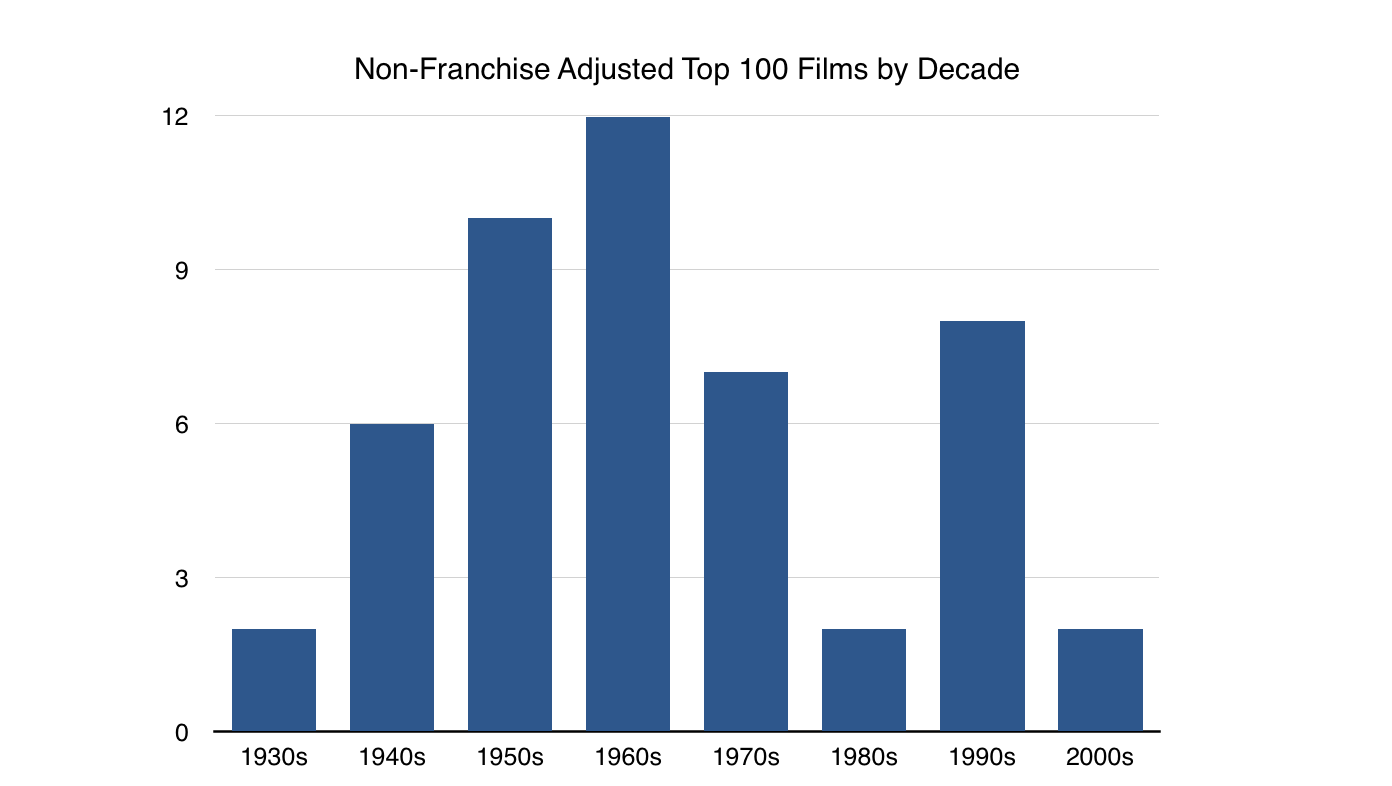
It’s franchises all the way down

January 29, 2016 Film Industry

Over lunch, I wondered aloud how many of the 100 top grossing movies were either sequels or the first film in a franchise.

Take a moment and think about it.

Of the top movies, what percentage are part of a larger franchise? And we’re only looking at theatrical. For this exercise, home video sequels don’t count.

Around the table, guesses ranged from 50 to 83 movies.

The answer is 86. Yes, 86 of the 100 all-time worldwide top-grossing movies are part of a franchise. (See Update 2 below.)

Here is [the list](http://www.boxofficemojo.com/alltime/world/):

Rank Title Type
1 Avatar Franchise Origin†
2 Titanic Single
3 Star Wars: The Force Awakens Franchise
4 Jurassic World Franchise
5 Marvel’s The Avengers Franchise
6 Furious 7 Franchise
7 Avengers: Age of Ultron Franchise
8 Harry Potter and the Deathly Hallows Part 2 Franchise
9 Frozen Franchise Origin†
10 Iron Man 3 Franchise
11 Minions Franchise
12 Transformers: Dark of the Moon Franchise
13 The Lord of the Rings: The Return of the King Franchise
14 Skyfall Franchise
15 Transformers: Age of Extinction Franchise
16 The Dark Knight Rises Franchise
17 Pirates of the Caribbean: Dead Man’s Chest Franchise
18 Toy Story 3 Franchise
19 Pirates of the Caribbean: On Stranger Tides Franchise
20 Jurassic Park Franchise Origin
21 Star Wars: Episode I – The Phantom Menace Franchise
22 Alice in Wonderland (2010) Franchise Origin
23 The Hobbit: An Unexpected Journey Franchise
24 The Dark Knight Franchise
25 The Lion King Single
26 Harry Potter and the Sorcerer’s Stone Franchise Origin
27 Despicable Me 2 Franchise
28 Pirates of the Caribbean: At World’s End Franchise
29 Harry Potter and the Deathly Hallows Part 1 Franchise
30 The Hobbit: The Desolation of Smaug Franchise
31 The Hobbit: The Battle of the Five Armies Franchise
32 Harry Potter and the Order of the Phoenix Franchise
33 Finding Nemo Franchise Origin†
34 Harry Potter and the Half-Blood Prince Franchise
35 The Lord of the Rings: The Two Towers Franchise
36 Shrek 2 Franchise
37 Harry Potter and the Goblet of Fire Franchise
38 Spider-Man 3 Franchise
39 Ice Age: Dawn of the Dinosaurs Franchise
40 Harry Potter and the Chamber of Secrets Franchise
41 Spectre Franchise
42 Ice Age: Continental Drift Franchise
43 The Lord of the Rings: The Fellowship of the Ring Franchise
44 The Hunger Games: Catching Fire Franchise
45 Inside Out Single
46 Star Wars: Episode III – Revenge of the Sith Franchise
47 Transformers: Revenge of the Fallen Franchise
48 The Twilight Saga: Breaking Dawn Part 2 Franchise
49 Inception Single
50 Spider-Man Franchise
51 Independence Day Franchise
52 Shrek the Third Franchise
53 Harry Potter and the Prisoner of Azkaban Franchise
54 E.T.: The Extra-Terrestrial Single
55 Fast & Furious 6 Franchise
56 Indiana Jones and the Kingdom of the Crystal Skull Franchise
57 Spider-Man 2 Franchise
58 Star Wars Franchise Origin
59 Guardians of the Galaxy Franchise Origin
60 2012 Single
61 Maleficent Franchise*
62 The Da Vinci Code Franchise Origin
63 The Amazing Spider-Man Franchise
64 The Hunger Games: Mockingjay – Part 1 Franchise
65 Shrek Forever After Franchise
66 X-Men: Days of Future Past Franchise
67 Madagascar 3: Europe’s Most Wanted Franchise
68 The Chronicles of Narnia: The Lion, the Witch and the Wardrobe Franchise
69 Monsters University Franchise
70 The Matrix Reloaded Franchise
71 Up Single
72 Gravity Single
73 Captain America: The Winter Soldier Franchise
74 The Twilight Saga: Breaking Dawn Part 1 Franchise
75 Dawn of the Planet of the Apes Franchise
76 The Twilight Saga: New Moon Franchise
77 Transformers Franchise Origin
78 The Amazing Spider-Man 2 Franchise
79 The Twilight Saga: Eclipse Franchise
80 Mission: Impossible – Ghost Protocol Franchise
81 The Hunger Games Franchise Origin
82 Mission: Impossible – Rogue Nation Franchise
83 Forrest Gump Single
84 Interstellar Single
85 The Sixth Sense Single
86 Man of Steel Franchise
87 Kung Fu Panda 2 Franchise
88 Ice Age: The Meltdown Franchise
89 Big Hero 6 Single
90 Pirates of the Caribbean: The Curse of the Black Pearl Franchise
91 The Hunger Games: Mockingjay – Part 2 Franchise
92 Star Wars: Episode II – Attack of the Clones Franchise
93 Thor: The Dark World Franchise
94 Kung Fu Panda Franchise Origin
95 The Incredibles Franchise Origin
96 Fast Five Franchise
97 Hancock Single
98 MIB 3 Franchise
99 Iron Man 2 Franchise
100 Ratatouille Single

Films marked † have a sequel in production or very nearly so. Films marked * could be considered single or part of a franchise.

It’s worth taking a closer look at the 14 films that never got a big-screen sequel, and why:

Titanic, 2012, Interstellar, Gravity
You can’t sink the same boat twice. (Or blow up the same planet/shuttle.)

E.T.
There was apparently [talk of a sequel](http://birthmoviesdeath.com/2015/04/13/the-incredibly-ill-advised-e.t.-sequel-that-almost-was) at some point.

Forrest Gump
Eric Roth actually [wrote a sequel](http://www.slashfilm.com/911-killed-the-forrest-gump-sequel/).

The Lion King, Ratatouille, Up, Inside Out, Big Hero 6
There are rumblings of a [Big Hero 6 sequel](http://www.cinemablend.com/new/Big-Hero-6-Sequel-Stan-Lee-Seems-Think-It-Already-Happening-71081.html), and it’s not impossible to imagine big-screen sequels to all of these.

Inception, The Sixth Sense
DiCaprio has never done a sequel. But could you do Inception 2 without him? Sure. And you could do a Sixth Sense sequel without Bruce Willis. I bet we’ll get one of these.

Hancock
Not a hit, not a bomb, but not crying out for a sequel. Also, it’s low enough on the list that it will be knocked off soon.

Whenever you talk about the top-grossing movies, the first question is always, “What about adjusting for inflation?” (Also known as, “What about Gone with the Wind?”)

Fine. Let’s do that.

Here are the top 100 movies of all time, [adjusted for inflation](http://www.boxofficemojo.com/alltime/adjusted.htm?sort=year&order=ASC&adjust_yr=2016&p=.htm):

Rank Title Year Type
1 Gone with the Wind 1939^ Single
2 Star Wars 1977^ Franchise Origin
3 The Sound of Music 1965 Single
4 E.T.: The Extra-Terrestrial 1982^ Single
5 Titanic 1997^ Single
6 The Ten Commandments 1956 Single
7 Jaws 1975 Franchise Origin
8 Doctor Zhivago 1965 Single
9 The Exorcist 1973^ Franchise Origin
10 Snow White and the Seven Dwarfs 1937^ Single
11 Star Wars: The Force Awakens 2015 Franchise
12 101 Dalmatians 1961^ Franchise
13 The Empire Strikes Back 1980^ Franchise
14 Ben-Hur 1959 Single
15 Avatar 2009^ Franchise Origin
16 Return of the Jedi 1983^ Franchise
17 Jurassic Park 1993^ Franchise Origin
18 Star Wars: Episode I – The Phantom Menace 1999^ Franchise
19 The Lion King 1994^ Single
20 The Sting 1973 Franchise
21 Raiders of the Lost Ark 1981^ Franchise Origin
22 The Graduate 1967^ Single
23 Fantasia 1941^ Single
24 Jurassic World 2015 Franchise
25 The Godfather 1972^ Franchise Origin
26 Forrest Gump 1994^ Single
27 Mary Poppins 1964^ Single
28 Grease 1978^ Franchise Origin
29 Marvel’s The Avengers 2012 Franchise
30 Thunderball 1965 Franchise
31 The Dark Knight 2008^ Franchise
32 The Jungle Book 1967^ Single
33 Sleeping Beauty 1959^ Single
34 Ghostbusters 1984^ Franchise Origin
35 Shrek 2 2004 Franchise
36 Butch Cassidy and the Sundance Kid 1969 Single
37 Love Story 1970 Franchise
38 Spider-Man 2002 Franchise Origin
39 Independence Day 1996^ Franchise Origin
40 Home Alone 1990 Franchise Origin
41 Pinocchio 1940^ Single
42 Cleopatra (1963) 1963 Single
43 Beverly Hills Cop 1984 Franchise Origin
44 Goldfinger 1964 Franchise
45 Airport 1970 Franchise Origin
46 American Graffiti 1973 Franchise
47 The Robe 1953 Single
48 Pirates of the Caribbean: Dead Man’s Chest 2006 Franchise
49 Around the World in 80 Days 1956 Single
50 Bambi 1942^ Single
51 Blazing Saddles 1974^ Single
52 Batman 1989 Franchise Origin
53 The Bells of St. Mary’s 1945 Single
54 The Lord of the Rings: The Return of the King 2003^ Franchise
55 Finding Nemo 2003^ Franchise Origin
56 The Towering Inferno 1974 Single
57 Spider-Man 2 2004 Franchise
58 My Fair Lady 1964 Single
59 The Greatest Show on Earth 1952 Single
60 National Lampoon’s Animal House 1978^ Single
61 The Passion of the Christ 2004^ Single
62 Star Wars: Episode III – Revenge of the Sith 2005^ Franchise
63 Back to the Future 1985 Franchise Origin
64 The Lord of the Rings: The Two Towers 2002^ Franchise
65 The Dark Knight Rises 2012 Franchise
66 The Sixth Sense 1999 Single
67 Superman 1978 Franchise Origin
68 Tootsie 1982 Single
69 Smokey and the Bandit 1977 Franchise Origin
70 West Side Story 1961 Single
71 Harry Potter and the Sorcerer’s Stone 2001 Franchise Origin
72 Lady and the Tramp 1955^ Single
73 Close Encounters of the Third Kind 1977^ Single
74 Lawrence of Arabia 1962^ Single
75 The Rocky Horror Picture Show 1975 Single
76 Rocky 1976 Franchise Origin
77 The Best Years of Our Lives 1946 Single
78 The Poseidon Adventure 1972 Franchise Origin
79 The Lord of the Rings: The Fellowship of the Ring 2001^ Franchise Origin
80 Twister 1996 Single
81 Men in Black 1997 Franchise Origin
82 The Bridge on the River Kwai 1957 Single
83 Transformers: Revenge of the Fallen 2009 Franchise
84 It’s a Mad, Mad, Mad, Mad World 1963 Single
85 Swiss Family Robinson 1960 Single
86 One Flew Over the Cuckoo’s Nest 1975 Single
87 M.A.S.H. 1970 Single
88 Indiana Jones and the Temple of Doom 1984 Franchise
89 Avengers: Age of Ultron 2015 Franchise
90 Star Wars: Episode II – Attack of the Clones 2002^ Franchise
91 Mrs. Doubtfire 1993 Single
92 Aladdin 1992 Single
93 Toy Story 3 2010 Franchise
94 Ghost 1990 Single
95 The Hunger Games: Catching Fire 2013 Franchise
96 Duel in the Sun 1946 Single
97 The Hunger Games 2012 Franchise Origin
98 Pirates of the Caribbean: The Curse of the Black Pearl 2003 Franchise
99 House of Wax 1953 Single
100 Rear Window 1954^ Single

The ^ indicates that a film has been re-released, which can raise its rank. When in doubt, I’ve labelled films as Single (e.g. Snow White and the Seven Dwarfs).

What can we learn from looking at the inflation-adjusted list? Well, of the top 100 movies, 49 are neither a sequel nor the start of a franchise. That’s a huge difference from the non-adjusted list.

Hollywood didn’t always make sequels from every hit.

chart

A few observations I’ve made from this exercise:

1. Franchises are a huge part of how Hollywood makes money, not just now but historically.
2. Franchises have to start somewhere. You don’t get Minions without Despicable Me (which isn’t in the top 100).
3. Some franchises I’ve ignored (e.g. The Hobbit, Transformers) have made bank.
4. James Bond is a good business to be in.
5. There’s a reason studios don’t want you to kill the hero at the end of the movie.

Update #1 (1/29/16):

A reader asks what percentage of the top movies are sequels — that is, part of a franchise but not the origin.

On the non-inflation list, 73 of the top 100 are sequels.

Update #2 (1/30/16):

In the first list, I had mistakenly marked Gravity as a franchise. It’s a Single. So that knocks the total number of franchise movies down to 86.

In the second list, readers pointed out that several of the Single movies actually did have sequels: [The Sting](https://en.wikipedia.org/wiki/The_Sting_II), [Love Story](https://en.wikipedia.org/wiki/Oliver%27s_Story_(film)) and [American Graffiti](https://en.wikipedia.org/wiki/More_American_Graffiti). I’ve adjusted the number of non-franchise movies down from 52 to 49, and fixed the graphic.

Finding Dory, the sequel to Finding Nemo, comes out June 17th. Here’s the [trailer](https://youtu.be/3JNLwlcPBPI). It’s certainly going to exist, which means Finding Nemo counts as a Franchise Origin.

A person could reasonably argue that the Avatar and Frozen sequels won’t happen. But as someone who knows both the industry and the people involved, I very strongly suspect they will. I’m keeping them as Franchise Origins.

Scriptnotes, Ep 222: Live from Austin 2015 — Transcript

November 6, 2015 Scriptnotes Transcript

The original post for this episode can be found here.

John August: Hey, this is John. So today’s episode of Scriptnotes was recorded live at the Austin Film Festival. There are enough bad words, you probably don’t want to listen to it in the car with your kids or at work if you work at some place that doesn’t like to have occasional swearing.

Our thanks to the Austin Film Festival for having us there. It was tremendously fun. And we look forward to seeing you next year.

Craig Mazin: Hello and welcome. Thank you, everyone. Thank you. This is a real church crowd. Yeah. All right.

John: My name is John August.

Craig: My name is Craig Mazin.

John: And this is Scriptnotes, a podcast about screenwriting and —

Audience: Things that are interesting to screenwriters.

John: Really well done. So a few of you may have listened to the podcast before. Can I see a show of hands of who’s actually heard of the Scriptnotes podcast? Oh, that’s a lot of you.

Craig: That’s a softball to use. You’re just —

John: Yeah.

Craig: Looking for praise now.

John: Yeah, we are. Basically, we’re looking for t-shirts out there in the crowd. Some of you might not know what the podcast is like. So Craig, what do we do on a weekly basis?

Craig: John carefully prepares a bunch of topics. He talks to his staff about how to produce the show. He lets me know what time the show will happen. I am five minutes late. I don’t know what we’re doing.

John: Yeah.

Craig: And I talk too much.

John: Oh, no. You talk just the right amount, Craig. So what are we doing today? I’m going to put you on the spot.

Craig: Today, I know what we’re doing.

John: All right. Tell us what we’re going to do today.

Craig: Because it’s special.

John: All right.

Craig: Well, we have two great guests today. We have Nicole Perlman who wrote Guardians of the Galaxy. Little movie. And we also have Steve Zissis, star of HBO’s Togetherness and writer and creator thereof. And those of you who are looking in the book, the guest list has changed a bit because of flights and whatever. I think, frankly, it has improved.

John: Tornadoes, yeah.

Craig: Yeah.

John: Floods.

Craig: We’re also going to be —

John: Acts of God in a church.

Craig: Acts of — we should be safe here.

John: Yeah.

Craig: Well, not me.

John: Listeners at home — and I realize that we’re actually in a historic sanctuary at St. David’s Episcopal Church. And so we are looking over a crowd that’s like maybe, I don’t know, 2,000 people.

Craig: Yeah.

John: And they’re all in pews.

Craig: It’s a mega church.

John: We have this little, you know, satellite room, too.

Craig: Yeah, it’s a mega church.

John: Thank you for being here in this church with us.

Craig: Yeah. And we’re also, today, going to be doing this little feature that we started kind of recently where we take three different stories from the news — current stories from the news and ask, and we’ll have our guests who are in, how would we make a movie out of this. So we’ll be doing that with you guys today.

John: Hooray.

Craig: Hooray.

John: So this will be really fun. So this is probably my seventh Austin Film Festival. You’ve been here a bunch of times, Craig.

Craig: I think this is my fourth or fifth.

John: Yeah. So we love the Austin Film Festival. And yesterday as I arrived, I had maybe not the best start. So I wanted to talk through sort of what happened going from the plane — actually, going from the escalator to the baggage claim. I managed to make a series of faux pas that I feel if I would share them it will make me seem human and relatable.

Craig: Let me just point out, he’s not human.

John: No.

Craig: But he will seem human and relatable.

John: Yeah. So I want you to sympathize with my plight here. So I get down off the escalator and there’s a guy there waiting — maybe you’re out here in the crowd right now — with a big blank sheet of paper and said, “Mr. August, would you draw us a sketch from like, from one of your movies?” I’m like, “I didn’t illustrate any of these movies.” And so like, you know, “Sketch us something from like Frankenweenie or something from Corpse Bride.”

I’m eager to please people. I’m a teacher pleaser. And so I was like, “You know what, I’ll try something. I’ll give it a shot. Like, I’ve never drawn anything from these movies, but sure.” Tim Burton won’t mind if I draw one of his creations.

Craig: And did that guy’s face just go, “Uhh?”

John: No, no. He was really pushing me. And so I was trying to decide whether I was being punked or like to see like how badly I could draw Sparky from Frankenweenie. So I ended up drawing the female dog from Frankenweenie. And like the ball being pushed underneath the fence, and it was like a charming little scene, but completely the wrong thing to draw.

So I’m drawing this thing and I signed it, whatever, and I signed another autograph. And then people started to think like, “Oh, that must be a famous person.” So random people started to like try take photos with me as if I was a famous person. And they have no idea who I am in their photos.

That’s by far the better part of what happened.

Craig: This is what he thought would make him sound human and relatable.

John: No. No, no, no. No, wait. Because the whole thing is about to flip.

Craig: Okay.

John: So as I’m waiting for my bag in baggage claim, there’s a guy who I recognized who was on the flight. I was like, “Is that an actor? I can’t picture him.” But he seems familiar, and he’s wearing sunglasses. And there was a limousine driver who was meeting him there. And so I was like, “He’s somebody famous. Who is that person?”

And then I could see the driver’s little card that he would hold up. And it was flipped over and it said “Raimi.” I’m like, “That’s Sam Raimi.” And so I’m like, “Oh, I should say something to Sam Raimi because we have mutual friends. I mean, like Laura Ziskin and other folks.

And so I finally, like, sort of screw up my courage and say, like, “Hey, Sam. Sam, it’s John. It’s John August.” And he just completely stone faces me. Like does not acknowledge me whatsoever, like I’m just a crazy stalker person. So I became that stalkery person who sort of wanted to, like, get his attention.

So this other nice guy who might be in the audience here today said, “That’s not Sam Raimi.” It wasn’t Sam Raimi. It was Sam Raimi’s brother apparently. And so —

Craig: You met Ted Raimi?

John: Ted Raimi is here.

Craig: Ted Raimi I would have thought would have been like, “No. But let’s talk.”

John: No.

Craig: You know —

John: Ted Raimi shut down.

Craig: Wow.

John: And so this is no slam on Ted Raimi. This is no slam on Sam Raimi who wasn’t even here to defend himself. It’s just this is a situation at trying to get my bag, I managed to humiliate myself kind of twice. So the tornadoes in Austin have been, like, really a highlight after that point.

Craig: I’m really sorry that that happened.

John: Oh, thank you, Craig.

Craig: I care about you.

John: Thanks. That’s nice to hear.

We’re going to try something very new and very different that we’ve never done before. So back on our 100th episode of the show, we did this thing where underneath the people’s seats, there was a golden ticket hidden. And if you have that golden —

Craig: Don’t go looking.

John: Or, maybe go looking but you won’t find anything.

Craig: Yeah.

John: Underneath one seat, there was a golden ticket and that person won a very special prize. So today, we’re going to try doing a raffle of a very special prize. So as you guys came in, each of you should have gotten a little raffle ticket, hopefully most of you. And —

Craig: Did you throw your raffle ticket out? You ate it? What did you do?

John: You ate it? Yeah. It wasn’t edible, no. I guess it technically is edible, just not really good.

Craig: Not tasty.

John: Not tasty.

So this is Annie Hayes, everyone. Annie Hayes is our Austin Stuart. Say hi to Annie Hayes. So Annie Hayes is helping us out.

Craig Mazin, will you pick one ticket from there?

Craig: Yes. Oh, so many. Okay, I got it.

John: All right.

Craig: I have it.

John: So let’s read the number and see if it matches up to anybody here.

Craig: Six. Good. So far so good. Two. One. I think everybody started with 621. Zero. One. Zero.

Amanda Murad: Oh, that’s me.

Craig: Yay.

John: Come on up.

Craig: Let’s see. I’m going to hold on, I’m going to figure out what your name is. It’s Amanda.

Amanda: Amanda.

Craig: Amanda Murad.

Amanda: Murad.

Craig: Murad.

Amanda: Close.

Craig: I thought it was Norad for a second.

John: That would be cool.

Craig: Yup.

John: But Murad’s great too.

Amanda: Okay.

Craig: No, no. It’s not that cool.

John: So are you a screenwriter?

Amanda: I am a screenwriter.

John: And do you live in the Austin area or are you just here for this conference?

Amanda: Just here for the conference. I live in LA.

John: Oh, holy cow.

Craig: Great.

Amanda: Yeah.

John: Is this your first time in the Austin Film Festival?

Amanda: It is.

John: And how is it so far?

Amanda: It is really fun.

Craig: It just got awesome.

Amanda: It just got way more awesome.

John: What are you writing right now?

Amanda: I am working on my second pilot.

Craig: Great.

John: And have you only done TV stuff so far? Have you written a feature? What else have you written?

Amanda: I’ve written one feature. But I have two pilots and a play.

John: Cool. That’s awesome. In these envelopes, they’re marked A, B, and C, there are three different items. And I want you to pick which envelope you would like to open.

Amanda: Whose fate am I deciding in this decision?

John: Your own fate.

Craig: I like her sense of nervousness and caution though, I have to say.

John: Yes. She’s not just blindly rushing in.

Craig: Yeah. She’s not like, “Okay.” No. She’s like, “Okay.” So A, B, or C?

Amanda: Okay. The letter A is usually pretty good to me.

John: All right. Great.

Amanda: A.

John: A. So take this envelope but don’t open it yet.

Amanda: Okay.

John: And we are going to open up one other envelope. So I want a vote from the crowd. Which of these other two envelopes should I open up?

Audience: B.

John: Everybody who wants me to open up envelope C, raise your hand.

Craig: C.

John: Yeah. All right. We’re going to open up envelope C. Open up envelope C, Craig.

Craig: Okay. All right.

John: Let’s see what’s inside.

Craig: See, he gives me stuff to do and everything, keeps me involved. Okay. Oh, this was the good one.

John: Yeah, this was the good one.

Craig: This was the best one.

John: All right. Yeah, it’s a really good one.

Craig: Just let her have it. [laughs]

John: Maybe we should.

Craig: No, because she’s so normal. I mean we had like a chance of getting a total freak. Not that — I mean, there’s at least one of you in here who’s —

John: Yeah. So there’s a thing which I was going to do with all this but apparently, you chose so well or the audience chose for you. Maybe it’s the audience who chose for you.

Craig: You know what? The audience chose this for you.

John: That’s really the audience choice.

Amanda: Thank you, guys, so much.

John: So what this card says is, “John and Craig will read your script.” If you would like to.

Amanda: Yes.

John: Great.

Amanda: Yes.

Craig: And we’ll talk about it on the show. And you can come on the show.

Amanda: Yes. Yes.

Craig: Great. Or you can have a t-shirt.

John: Yeah.

Amanda: I’m going to pick C.

John: All right. Well done.

Craig: C.

Amanda: The letter A has failed me.

John: Yeah. Amanda, at whatever point you feel like you have a script that you want to send in, just send it in to Stuart at ask@johnaugust. I’ll remind him that you were the one who won this competition and the audience won it for you, really.

Amanda: I will be sure to thank you all in my email.

John: And we look forward to receiving it.

Amanda: All right. Thank you, guys.

John: Amanda, thanks so much.

Craig: Envelope B was money, by the way.

John: Yeah, exactly.

So the idea behind that was the Monty Hall problem which is essentially we were going to open up one thing and then she would decide whether she wanted to keep or switch and it involved math and statistics and probability.

Craig: These guys messed it up.

John: No. You guys did a nice thing. You did this all for her.

Craig: They did. Yeah, they did.

John: They did.

Let us get to our very first guest of the podcast.

Craig: Great.

John: Nicole Perlman is the writer of Guardians of the Galaxy. And she’s writing a bunch of other stuff right now and we cannot wait to talk with her. She was a guest way back when, right when that movie came out. And let’s welcome Nicole Perlman up to talk to us again.

Craig: Nicole Perlman.

Nicole Perlman: Thank you.

John: Nicole Perlman, you were on the show before. You had just written Guardians of the Galaxy which was a giant, giant hit. What has changed in your life since we’ve talked to you last, in writing?

Nicole: I’ve descended into heroin use and I’ve lost all my friends and family. [laughs]

Craig: God, I know how that goes.

Nicole: Yeah. Totally. No, it’s been good. It’s been really crazy. It’s been so crazy that I sort of fled to San Francisco. I was like, “Oh, too much stuff. Too much good. Must run north.” So no, it’s been very good. Lots of projects. I’m doing Captain Marvel —

John: Great.

Craig: Awesome.

Nicole: With Meg LeFauve. So that has been cool. We’re really in the early stages but we’re having a lot of fun. And I’m doing a project for Fox, an adaptation of Hugh Howey’s Wool Trilogy, and that has been very cool.

That guy, by the way, really knows how to live. He wrote a best-selling novel and he’s like, “I’m going to go build a boat and sail around the world. See you.” And he like checked out. So that’s what he’s doing which is really cool.

John: I mean you’re checking out to some degree.

Nicole: Totally.

John: Like you’re keeping out of the rat race.

Nicole: Yeah.

John: And so what really prompted the decision? Was it just you had enough stuff on your plate that you actually could leave and —

Nicole: Yes. That was it.

John: That’s the response?

Nicole: And also, people just kept asking me to be on their podcasts and it was just —

John: Yeah, it was such a huge drag.

Nicole: It was a huge drag.

Craig: It’s the worst.

John: Yeah, I mean, Craig, I tell you, you got to back off a little bit.

Craig: I mean, I don’t know what those podcasts are because I don’t listen to podcasts. But I know what it’s like.

Nicole: No, it’s good. It’s probably just for like a year. I’m in LA every week for work but I felt like I could just do it. I spend less time commuting by flying in and out than I did when I was in LA in my car, which is kind of crazy.

John: That’s actually scary, yeah.

Nicole: It’s true though, yeah.

John: So talk to us about — obviously, you can’t give us any character details or really plot details about Captain Marvel.

Nicole: Yeah.

John: But what is it like writing with another writer? Is this the first time you’ve had a writing partner on something?

Nicole: It’s not the first time. I’m working with another writing partner on a spec, my first spec in a long time. So that is another experience. It’s been really good.

Meg and I are really, really just starting out. And she comes from a Pixar background so she’s really used to collaborating. So I think we’re still feeling it out a little bit. The being on the phone part, I’m very meek on the phone when other people are talking. I’m very respectful. I’m just, like, “No, no. You go ahead. No, no. You go ahead.” You know, and —

Craig: You got to lean in, girl.

Nicole: You got to be like, [roars], “Listen to me.” So I think that is — because that goes over really well, too.

John: Yeah, it does.

Craig: I don’t think that’s a good idea, actually. I don’t want you to do that.

John: But you need to get a Groot voice is really what you have to do.

Nicole: A Groot voice for sure. For sure.

John: Simple things.

Nicole: But Meg is wonderful and so she’s really good about character. And I think she comes from a non-genre background and so there’s a little bit of me being like, “Oh, you know, so there’s this history of this type of character, you know, we don’t want to do that because it’s been done that way.” And she’s like, “But we want to have this with character and integrity.” I’m like, “What? Integrity? What? What’s that?” So she’s great. And I think that we balance each other out in a good way. But again, it’s early days yet.

John: So one of the challenges would seem to be that you have to come to a consensus between the two of you about what it is you want to do and how you want this movie to work and how you want the character the work. But also then you have to be able to pitch in a unified sense to Marvel. And Craig sort of loves Kevin Feige or sort of really admires Kevin Feige.

Craig: I do.

John: And so that must be a challenge of like how you want to do your work and also fit into this greater picture. Do you have to be mindful of everything else that’s happening in the Marvel Universe to do your one story?

Nicole: Well, you know, without giving away anything that would get me, you know, excommunicated, basically Kevin and his group of brain trust people go and figure out where we fit in and then have let us know where we fit in. And so Meg and I gave them a list of questions, very long and epic questions and then potential answers to those questions. And they, you know, returned from their mountain top retreat which they [laughs] went to and then returned from and said they —

Craig: Handed you tablets.

Nicole: Pretty much. Pretty much. And so that’s what we’re working with now. And we’re also really in the phase of reading through massive packets of information, you know, which is always fun.

John: Cool.

Craig: I love that you’re writing a spec at the same time you’re doing all this other stuff.

Nicole: Yes.

Craig: In the wake of the success that you’ve had and all of the stuff that they’re now asking you to do, how do you manage to carve these spaces out and keep these things separate? Because you’re working on, you said, Captain Marvel and a spec and —

Nicole: The Hugh Howey Wool.

Craig: The Wool.

Nicole: Yeah. And I just sold a sequel to a movie that was my favorite movie from childhood but I can’t talk about it yet, so that’s going on. And then I’m also doing a virtual reality project with Steven Spielberg.

Craig: That’s five.

Nicole: And then I’m also doing a comic book —

Craig: I’m sorry, with who?

Nicole: Nobody. Nobody. Just a real, you know, up and coming —

Craig: So that’s five things.

Nicole: Yeah. And then a comic book series, too.

Craig: Six things.

Nicole: Yeah.

Craig: So I’ll ask my question again. I mean, how do you keep it all — I mean, do you just push a few things off?

Nicole: Well, honestly, it’s just because — and I’m sure you guys have experienced this — that things go into holding patterns. And especially with Marvel, the movie doesn’t come out for three-and-a-half years, so it’s got a lot of long pauses in between submissions of stuff. So with that and with the other projects, too, there’s a long waiting period.

The people who’ve made me wait the longest are the Marvel publishing people. And that’s like a 20-page thing. You send them and like months go by and then they’re like, “Good work.” “Okay.”

Craig: So in a situation like yours, you’re almost kind of hoping that they’ll take time.

Nicole: Right, exactly. So it’s okay. I think the more projects you have to fill the empty spaces, the less fear, that existential dread of like, “What’s happened to my projects?” You know, they just take a while and so that helps.

Craig: Yeah, because all of your eggs aren’t in that basket. But then there is that sense of being overwhelmed.

Nicole: Yes.

Craig: Do you have that?

Nicole: All the time. All the time.

Craig: Right now?

Nicole: I’m just veering between sheer panic and like different kinds of panic. Like panic of like “I have nothing going on. My career is going to crash.” And “Oh my, god. I’m going to be overwhelmed and die and never get anything done.” So, yes.

Craig: Sounds just like me.

Nicole: I’m really happy all the time.

Craig: Right. Of course. So what do you do to deal with that?

Nicole: I moved to San Francisco.

Craig: Of course, yes. Yes, of course.

John: So I want to get back to the idea of writing a spec. And so what was it? It was an idea that was just burning that demanded to be written? What was the —

Nicole: What it was, was that I’m doing a lot of big, fantastical, world-building projects and I wanted to do something that was contained, low-budget, very character-driven, just a cast of three or four people, and possibly something that would be able to, you know, produce or direct.

My writing partner is a writer/director and so we wanted to do something that was manageable. Which of course my representatives were like, “You realize you’re not going to get paid anything for that.” And I’m like, “Yeah. But get excited about it. Like, you know, get so excited about this guys.” And they’re like, “Yeah. Mm-hmm. That’s great.” So it’s basically what we’re doing in spare time to remind me that I am a writer [laughs] and not a cog in the machine.

John: Yeah, it’s the Joss Whedon do a smaller thing in between the two giant projects.

Nicole: Exactly. Exactly, yeah.

John: Cool. So Scott Neustadter was supposed to be joining us here up on the panel. And Scott Neustadter couldn’t be here because the airport is completely shut down. So like one of many panels who’s not going to be here today. Luckily, Steve Zissis has agreed to fill in. This is Steve Zissis —

Craig: Upgrade.

John: Who is the co-creator of Togetherness. Steve Zissis, come up here.

Steve Zissis: So what’s the processional hymn?

Craig: I’m Jewish. And this is not Greek Orthodox at all. At all. Like the two of us — actually, three of us. And he —

John: I’m good. I’m good. The android faith alone —

Craig: Fucking white privileged man.

John: Yeah. It’s so good.

Craig: I’m good.

John: I’m good.

Steve: What are you?

John: I’m sort of, like, random protestant.

Steve: Oh, random protestant.

Nicole: Random protestant.

Craig: Yes. Yes.

John: Culturally. Steve, thank you so much for filling in.

Steve: Of course.

John: But thank you also for you great TV show, Togetherness.

Steve: Thank you.

John: Tell us how that came to be because this is an HBO show. It was an idea that you sparked with a Duplass brother and is now going into its second season.

Steve: It started, I guess, with Jay Duplass and I fooling around in his backhouse trying to do something creative together. And —

John: It sounds terrible.

Steve: Yeah. We just wanted to do something creative. And at first we started recreating ’80s soap opera scenes from like YouTube clips. And then Jay and I would act them out and we would record them. We didn’t really have a goal in mind.

Craig: How high were you guys? [laughs]

Steve: We just stole someone’s lithium. But then that just started snowballing into something, like, “Okay, we need to do something more structured.” And then we really borrowed upon our own lives and created a relationship show that was very autobiographical.

I was waiting tables at the time. And I would get off of work and stay on the phone with Jay because he was on the graveyard shift with his newborn child. So we would work out the story and the season arc for the first season during the graveyard shift, basically, on the phone.

Craig: Amazing.

Steve: And that’s how it started.

John: So by that point, you were thinking about this as probably a half-hour for cable and it’s going to revolve around these central characters, this family, this guy who’s moving in. You had all those dynamics sort of figured out early on.

Steve: Actually, initially, it was just going to center around the Alex character who was my character. But then when we went to HBO, they were like, “We love it. We really want to work with you. But we’re looking for relationship shows that could be a four-hander.” And we were like, “Yeah. Yeah. We could do that.”

We went back to the drawing board and — I mean, it was tough because we had built something centered around one character. So we were panicked for a little bit. But ultimately, HBO was right.

Craig: Well, I love moments like this because you never — we just did this show last week about William Goldman’s Nobody Knows Anything, which is not nobody knows anything but nobody knows anything. You never know.

So these people hand down these edicts sometimes and our first reaction is, “You know, goddamn. I mean, sure go ahead and turn it into whatever you want. It’s not something that we bled over the graveyard shift while he’s up with his kid and I’m slaving away waiting tables. No, no. Your whim is my command.”

But then sometimes they’re right. And I love that you guys did it. Because the truth is, what was the worst that happened? You tried and it didn’t work, right? But it does work. It’s amazing.

Steve: And HBO in general is really — they’re pretty hands off with notes. I mean, once they sort of, you know, tap you, they want you to do your thing. And they’ve been pretty hands off since then, actually.

John: So when did you actually start writing? So had you written anything before you went in to meet with HBO?

Steve: So we wrote the initial pilot called Alexander the Great which was centered around my character. And then they said, “Let’s go back to the drawing board.” And then it took us about four months to come up with the pilot for Togetherness. We went in and shot that. And then, you know, I was still waiting tables and rubbing rabbits’ feet. And we got the green light for this first season.

John: Great. So you turned in this pilot script. They said yes. They blessed you to go shoot a pilot. But then there’s that long waiting process, you know, whether it’s a show that they’re going to actually want to put on the air.

Steve: Yeah. And we had had the first season sort of arced out. We didn’t write the first season until after we got the green light.

Craig: And then the panic of success set in and you realized, “Oh my, god.” I mean, were you overwhelmed by the thought that you had to do the thing that took you four months again and again and again and again?

Steve: All I remember is calling my mom and crying. And I remember the last day at the restaurant, my last shift, I was so happy. There was such a weight lifted off of me. But I was trying to contain my joy because I didn’t want my fellow friends that I’ve been like slaving with in hell to look at me.

Craig: You’re nice.

Steve: Yeah.

Craig: You’re nice.

Steve: You know, I didn’t want to —

Craig: Right.

Steve: So then I got home and, you know, exploded.

Craig: Oh. It’s such —

Steve: Literally.

Craig: And then — [laughs]

Steve: I exploded.

Craig: I exploded.

Steve: Like the blimp that was released from — .

Craig: Well, we’ll be getting to that.

Nicole: Yes, they will.

Craig: I see you’ve done your homework. You were mostly following the career path of an actor. Is that correct?

Steve: Yeah.

Craig: Prior to Togetherness? Had you done a lot of writing before that? This was kind of the first stab at it.

Steve: The only real writing I had been doing is the countless improvisational —

Craig: He’s an improvisational master, by the way.

Steve: Which I know isn’t really writing.

Craig: Master of improvisation.

Steve: But Jay, Mark, and I had been doing really highly improvised independent films since, like, the early 2000s, even in 1999. And then it just sort of evolved out of that style.

Craig: For your show, I get the sense that it’s not quite like the Curb Your Enthusiasm model where you’re scripting it but you’re almost scripting your own improv. That’s kind of the sense I get from it.

Steve: Well, like Curb and I think, like, the show like The League, they go in with just an outline.

Craig: Right.

Steve: But our show is completely scripted, really tight, really structured. But we just find that, like, the golden nuggets in the scenes and oftentimes the funniest jokes are the ones that are found in the moment. Even the emotional scenes, not just the comedic scenes. Like we talk about it like, sort of like setting up like lightning rods, and then just creating the perfect conditions for lighting to strike.

Craig: Right.

Steve: You don’t always get gold and there’s a lot of trial and error. But if you’re patient, you will.

John: Now, on a show like Togetherness, do you have — obviously you don’t have act breaks, but do you have a template in your head of like over the course of an episode these are the kinds of things that need to happen. We need to be able to take a character from this place to this place. We need to like hit certain milestones. Did you and Jay figure out sort of what the show is like, you know, structurally?

Steve: Yeah. We had a good sense of where the first two seasons were going to be in terms of a story arc and character arc. And then now, we’re preparing to write season three. And for the first time, we’re having to really — we sort of have an open map. We can create our own map at this point. So we’re finding new things now with season three, because the first two seasons were sort of already mapped out in our heads. So now, we’re writing a new map.

Craig: It’s such a great cast, too. I mean, everybody —

Steve: Thank you.

Craig: Everybody is spectacular. You know, the first time I saw the show — I tuned because you know I don’t watch anything. You guys know that. But I watched the show because I’m friends with Amanda Peet and she was in a movie I did and her husband and everything. And so I wanted to see it and there was something about it.

I was one of your first Twitter followers. Because you just — well, there was something, like, you know, I don’t know why I’m attracted to sort of schlumpy side stacks. Yes. Something about you. Something about ethnic, sad men — [laughs]

Like that face right there. It’s like, it’s all I want, like that. Like, look at me moving towards it. [laughs]

No, I mean, honestly, you’re the best. I mean it’s a great show. I’m just so glad that you — I love stories like yours but we don’t hear them a lot. Now, what we do, in a way we celebrate them, I think, sometimes more than we should because a lot of people who are waitering, they’re like, “Fuck it, man. Steve did it. I’m next.” Probably not. Probably not. It’s incredibly rare. So it’s so exciting that it happened, that the incredibly rare thing happened to you.

Steve: And I grew up with Mark and Jay back in New Orleans. We’re all from New Orleans. We all went to the same high school. And we all sort of came across this method of filmmaking sort of by accident. Out of necessity, really, because, you know, we were all broke. [laughs] So, you know, this whole John Cassavetes style, we could say that it was our intention from the beginning but it actually wasn’t. Like Jay and Mark’s first attempt to make a feature film was a complete disaster. It was a failure.

Craig: Because they were trying to make a real —

Steve: They were trying to make something big. They were trying to emulate the Coen Brothers. They failed miserably. They borrowed $100,000 from their father who was like a very successful lawyer in New Orleans. And they squandered — like it was a complete failure. [laughs]

Craig: Was he angry?

Steve: No, not at all. Because he’s —

Craig: Cool dad.

Steve: Yeah. He’s a great guy and so supportive.

Craig: I would be pissed off. My kid blows $100,000, I’m pissed.

Steve: But then after those failures and those failed attempts that they started to find their own voice and style just sort of out of necessity, which is cool.

Craig: And you were part of that from the start.

Steve: Yeah. I did their first experimental films. I did shorts with them. And I loved sort of the improv style of their way.

Craig: Right.

Steve: It just fits with me well.

Craig: Yeah, excellent.

Steve: Thank you.

John: So because we have two of you up here, we want to talk through this feature we usually do called, “How would this be a movie?” And I asked on Twitter for people for suggestions. I’m like, “What should we talk about for how to make into a movie?” And the three best suggestions we got were Zola. People who’ve done their homework, Zola is sort of amazing. So I want to talk through sort of what that is.

We’re going to talk about Zola, we’re going to talk about the rogue blimp, and we’re going to talk about George Bell, The Lonely Death of George Bell. And try to figure out how to make these into a movie or a TV series. Or if someone approaches you with this idea, how do you run with it?

So let’s get some back story on Zola. Actually, I took notes because I’m the preparer. So Zola, if you don’t know is —

Craig: I don’t need notes. I could do this just fine.

John: Just —

Craig: No, no.

John: No, it’s fine. I’ll —

Craig: No, no. I’m done.

John: Just for everybody else, Craig. They might need it.

Craig: Yeah.

Steve: We’ll just ‘prov it.

John: What was the white boyfriend’s name?

Craig: Jarrett.

John: Oh, he’s got it. All right, so for people who —

Craig: I don’t drop mics because it’s not good for the microphone.

John: Yeah. So for people who’ve missed out on the story so far, Zola is a Twitter account. And basically, she had like this epic tweet of like 174 tweets that detailed this wild experience she had in March. And you read this and it is amazing and sort of tweet by tweet sort of going through this long saga of what happened.

Her name is Zola. She meets this girl named Jess at a Hooters. They strike up a friendship. They talk about hoeing. And they exchanged phone numbers. And Zola agrees to go on this trip.

Craig: Just to dance.

John: Just to dance.

Craig: She’s not a hoe.

John: She’s not a hoe. She’s a dancer.

Craig: And she doesn’t know that the other girl is a hoe either.

John: True.

Craig: She knows she’s a dancer. That’s it.

John: Yeah, but —

Craig: She’s not out there trapping —

Nicole: She didn’t seem that surprised though. She’s like, “Oh, yeah.”

Craig: Right.

John: She doesn’t seem that surprised because even early on they were talking about hoeing. So like —

Craig: There was some hoe talk.

John: Yeah. Even not if profession, it’s — they’re sex worker adjacent, if nothing else.

Craig: I ain’t touching that one.

John: All right.

Craig: I’ve gotten in trouble before.

John: So the characters we have are Zola. We have Jess. We have the black pimp whose name is eventually revealed to be Z something.

Craig: Z.

John: Z something. We have Jarrett and Jarrett’s fiancée who shows up every once in a while and is a complete character of mystery. But you guys looked through these tweets and someone approaches you with this, you know, Nicole Perlman, what is a movie you spin out of there? What’s interesting to you as a movie out of the Zola story?

Nicole: Nobody would ever give me [laughs] this project to adapt. I was impressed at her excitement and her enthusiasm about this and she was like, “And then, and then, oh no but wait, oh no, but wait,” you know. And that part was great but I actually kind of lost the thread a little bit, I was just like ah — so I’m going to be lame about it. But I kind of loved the idea of them talking about hoeing like they were farmers, you know. They’re just hoeing and —

John: Yeah. [laughs]

Nicole: That was the twist like —

Craig: I think we’re going to pass on you.

John: Yeah.

Craig: I don’t think that that’s —

Nicole: All right, that wasn’t mine —

Craig: But thanks for coming in.

Nicole: That’s okay, that’s okay.

John: Craig, if someone approached you with that story, do you tell the story as just that? Because it felt like a Magic Mike kind of like road trip sort of, like Magic Mike XXL which is —

Craig: Right.

John: Just following a series of events and perspective.

Craig: Well, it’s so crazy that if you try and tell it, it’s just going to seem like you told it again because the story that she lays out is in bananas. The one way to think about it is, like I was thinking about how sad it was. I mean, the woman that is the actual hoe and she’s getting beaten up and snatched and a man gets shot in the face. This is terrible.

And yet, we’re all reading and everyone’s like, “Oh, my god, you got to read what Zola wrote.” Like that’s an interesting movie to me is that somebody types up something like that and it becomes viral. Meanwhile, the people that are in that have no idea and they’re out there somewhere —

John: Yeah.

Craig: And going through something real. That could be kind of interesting because the nature of these viral things, there’s something really creepy about how it separates us from the real. Someone died. That guy murdered someone.

John: Yes, shot them in the face.

Craig: And they beat that woman up.

John: Yeah.

Craig: Plus the hoeing.

Steve: Is the Twitter account verified?

John: Yeah, the Twitter account is not verified, so let’s talk about that possibility.

Steve: Okay. I’m not sure about the movie, you guys would be better for that. But I think at the end, there should be voice over throughout, we should see the little emoticons on the screen, the tweets, and at the end of the film, there should be a 72-year-old grandmother in Ohio —

Craig: [laughs] Right. Catfishing everyone.

Steve: That has catfished the whole thing.

Craig: Right.

Nicole: That would be amazing. That would be so great.

Craig: That’s pretty great. That’s pretty great. And like her grandson is there in the background playing “Grandma, almost done.”

John: So we’ve talked about this on the podcast before, who was the writer who pretended to be much younger than she was and was Felicity. Was that Riley Weston?

Craig: Riley Weston.

John: Riley Weston. So it would be fascinating if it were a Riley Weston situation where somebody is basically spitting a giant yarn for what all this is. It has such a feeling of truth though. I also had the question about whether all those tweets were written in advance or was she writing them one by one.

Nicole: I think she was writing them all in one stream of consciousness.

Craig: I think so too, yeah.

John: But it’s so hard to, I mean I have such a hard time fitting everything I want to say into one tweet. So to be able to stretch that out over —

Craig: She just got to that character limit, hit return and kept going, you know, I can hear the clacking of her nails on the laptop. And she’s like “Bam, ding ding ding ding.”

John: Yeah. And yet it had a structure to it. She just kind of knew where to start and she knew — she was very good about reminding you, this person you saw before, like I didn’t know his name, but now, I know his name was Z, and it was brilliantly done to me.

Steve: Yes. And just when the energy started to wane, she said, “Only four more tweets till the end.”

John: Yeah.

Craig: I know like she actually knew.

Steve: Yeah.

Craig: You think that there’s — you think grandma —

Steve: It’s a 72-year-old grandmother. That just graduated from the Iowa writing program.

Craig: Nothing good comes out of that.

John: Nothing good possibly can.

Craig: All right, all right. That’s pretty solid.

John: Right. Let’s talk about rogue blimp. So for people who are listening to this, way after the fact, there was a giant blimp, actually particularly an aerostat that was designed for East Coast defense. Basically it wasn’t a camera, but it had a like long range radar for detecting incoming missiles that could hit the East Coast. It broke free of its mooring and all hell sort of broke loose. And so it ended up dragging a cable behind it that did not have power and did other things. This is the sort of a little more in your wheelhouse.

Nicole: Yeah.

John: And a producer comes to you and is like, Nicole —

Craig: [laughs] She’s written a ton of blimp movies.

Nicole: Yeah.

John: Yeah, indeed.

Nicole: A whole sub-genre.

Craig: Like another one. I can do more than blimps. [laughs]

Nicole: Dammit, I’m so pigeon-holed.

John: What kind of movie is the blimp movie to you?

Nicole: It seemed like a wacky sort of like two guys think they’re going to get in the Goodyear blimp but they choose the wrong blimp and then they cut it free. And then because of that they end up almost starting World War III because they keep — I don’t know, but I could see it with the whole cruise missiles with blimps, by the way. I was like that’s how we detect incoming cruise missiles, is with a blimp? You know, that just seems really shoddy. [laughs] I was really disappointed in the Department of Defense. I was like, guys, seriously.

And also the whole Google blimps. Somebody has to get something mixed up with the Google blimp. And I thought it would be fun if they — If they took off on the sort of the like cross country trip in this NSA blimp not realizing it wasn’t the Goodyear blimp and causing a whole bunch of problems with the DOD thinking there was some sort of terrorist attack.

John: Steve, what kind of movie do you make out of the blimp?

Steve: Well when I saw NORAD, it made me think of the 80s movie WarGames.

Nicole: Yes, totally.

Steve: So like tonally I think WarGames would be a [laughs] good match. But I think it should be about the guy that was holding on to the blimp, you know, by the line there. And what happened to him the day before.

John: Yeah, so it’s sort of like Up but bigger.

Steve: Why did he — yeah, like Up. Exactly. Why did his grip — why did he lose his grip?

John: I see the campaign for Crazy Ex-Girlfriend and she’s — who’s carrying in the balloons and like it’s sort of like that, but it looks — you need to never let go.

Craig: Never let — that’s the tagline.

John: Never let go. Craig Mazin, what movie would you make out of the blimp?

Craig: You know what, I think you could make a really good Pixar kind of movie about a blimp. Because I love the fact that it seems so anachronistic. And I like the idea that this blimp has been there for so long and he’s just blimping along protecting America and we don’t know. And he just follows orders and he just never doesn’t do his job. And then they come in they’re like, “Oh, you know, we’re replacing blimps, we’re replacing it all, you’re done.” And he’s so depressed. And he basically pulls himself away to just go. And then he kind of goes on this journey that may — helps him find his purpose again and he meets other things that float.

I mean there’s, you know, like dandelions and —

John: There’s a cloud.

Craig: A cloud, you know. But the blimp finds his, you know — it’s basically, he’s committing suicide is what he’s doing but, you know — so it’s — I think he could — I don’t know —

Nicole: It’s really heartwarming.

Steve: I think for sure, at the end credits, there should be a Led Zeppelin song.

Nicole: Ah.

Craig: Nah. No, no. Yay. [laughs]

John: It’s improv. Only good ideas — yes and…

Craig: Yes and.

John: The other —

Craig: Yes and no.

John: Yes and. Another possibility is a — the Michael Bay version is essentially it’s stealth because essentially like the death blimp sort of goes out there and you cannot possibly stop it. And so like if it has a sentience, if it has a thing it’s trying to do. There’s something also kind of like slow motion zombie about it because it’s not fast, it just like — it’s a path of destruction, it’s like the tornadoes this morning. It’s just that it’s going to move through in a straight line.

Craig: So even more blimps start coming and they just keep coming.

John: Yeah. Absolutely.

Nicole: It’s kind of like that — what is it, Rubber with the one about the tire?

John: Oh yeah the tire, yeah.

Nicole: It’s just like this rabid tire that’s running over people. It’s just like that. It’s like the cable very slowly dragging and causing devastation. It would be like, “No,” and it just keeps coming.

Craig: [laughs] It’s a little low stakes. It just — shoot the — just takes the —

Nicole: You just step to the side —

Craig: Just shoot the blimp — yeah.

Nicole: One foot.

Craig: It’s a blimp.

John: Yeah. But the fact that it just keeps coming. And they had to shoot it down. That’s actually the funniest thing. It’s like —

Craig: They do. Use a shotgun.

John: They use a shotgun to shoot a blimp.

Craig: But by the way — I’m sorry but if that’s Pixar and they shoot him at the end and he deflates. You’re going to feel, like that will kill you.

John: It’s Old Yeller. It totally is.

Craig: It’s freaking Old Yeller, but then somebody finds him and inflates him again. You see what I’m saying? It’s like, let’s go make that, guys. Somebody just steal it. I mean, it’s gold.

John: All right. Another option, you have the Macy’s Thanksgiving Day Parade, one of those gets loose and you have to go after that thing and shoot that thing down and that’s pretty good. So Underdog gets loose, and you have to shoot down Underdog.

Craig: Underdog.

John: Yeah. That’s how I would do it. Or Snoopy. One of them would do it.

Let’s get to our third possibility which is, well maybe there’s a comedy but it’s The Lonely Death of George Bell. This is a New York Times story.

Craig: Hehe. Hahahahaha.

John: Hahahaha. Written by N. R. Kleinfield. And it talks through the death of this man, George Bell, who was found in his apartment, he’d been dead for about a week. He was a giant, obese, he was a hoarder, everything was sort of awful and he had no —

Craig: Otherwise, good.

John: All of it was great —

Craig: Yeah, yeah. Otherwise, good.

John: He had no next of kin and so he talks through this, how does the city and the state have to deal with people who have no next of kin and sort of what that whole process was. It was a fascinating look at sort of the different layers of bureaucracy that sort of happen to settle out the estate and deal with the body.

Craig: And a lot of people do die alone and disconnected and they don’t even — like they were having trouble even just identifying him even though he was — everyone was like, “Oh yeah, that’s George Bell.” They had to find some — it took them forever to even match up an x-ray to know that it was really him.

John: Yeah. And it wasn’t a remarkable case —

Craig: No, just a guy.

John: The journalist picked this one situation, but like it’s a very common situation. So what kind of movie? You do sad well. So what kind of movie do you make out of George Bell?

Steve: I was — It was a great article. I was really — I immediately thought of It’s a Wonderful Life when I was reading this, for a bunch of reasons. The main character’s name was George Bell instead of Bailey. And then also, if you’re reading the article where unclaimed bodies go, is a place called Potter’s Field which is where the evil Mr. Potter, you know, his area became — but I was thinking, you know, It’s a Wonderful Life is about George Bailey learning about the lives he touched while he was alive. But in this article, you could study the lives that this man touched by his death, which I find it really interesting like the workers who were sifting through his apartment and his other relatives that were getting like — they weren’t hardly relatives, but they were getting some of his money through his death. It’d be interesting to examine how the death of someone can bring people’s lives together and unify people in a way that is unexpected.

John: Nicole, what kind of a movie do you make out of Bell?

Nicole: I mean it’s going to be a sad movie no matter what I think, but if it’s one of those movies that makes you feel better about your own life [laughs] or rather it gives you a more insightful look into what makes a life worth living. I thought that the heartbreaking thing was the lost relationship, the woman that he loved, and he left in his will, and she still cared for him and how he had withdrawn it. And I think that there’s something really interesting about how objects reflect choices that we make in our lives sometimes. And the whole investigation into who this man was, trying to piece together who he was based on objects left behind. And that was really interesting because it, you know, was definitely a memento mori, but it was also a — it was like a case study of every object represented — I almost saw it more as like a mini-series, almost like a Serial kind of thing. But, you know, each object represented a choice that he made to either connect or disconnect and leading to the final disconnection with the one person who still loved him, you know. And what else do you have to live for, you know.

Craig: I love that part. So in the story, he’s left money to people and they have to find these people. Some of those people are dead, one of them is this woman who we find out he was engaged to. The woman’s mother told her daughter, you have to get a prenup, and the guy said, “I’m not signing any prenup,” and he left. And they never spoke again except for occasional cards. And the woman always felt like that was the path she should have gone. And then by the time they find her, she’s also dead, and she kind of ended up in a bad way. And you know what I was thinking was, just because — my whole thing about these stories is, at some point, obviously we need to find the uplift and the redemption or else it’s kind of brutal.

And I love the characters of these people that go into your apartment and start investigating from your stuff. And I thought what if a man dies alone in an apartment in New York, and a woman dies alone in an apartment in Florida. And you have a guy in New York — or probably a woman in New York looking through the stuff and a guy in that apartment in Florida looking through the stuff. And they find things that are related to each other, and they have to call each other to help, and they fall in love.

John: Oh, Softie Craig.

Craig: Well, I mean because they’re — it’s like The Notebook except with different people, you know, and just like —

They’re both like — well, the point — I mean — because I love — there was one guy they talked to who was like, “Yeah, I’m probably going to end up like George, like his buddy.” He’s like, “Yeah, I’ll probably die alone, too.” And here are two people that are like, this could be me, you know, and almost have given up, and then through this they — and so their love happen, you know. It was like there was some George and whatever her name was, you know. I’ll give her a name, Evelyn.

John: As I was reading through this, I looked at it more as a world in which you could set a story, rather than looking at George Bell because it felt like the people who were the investigators, that was a fascinating job and that fascinating job could take you into lots of really interesting places. So you could have the comedy version where — or the romantic comedy where people meet this — sort of meet-cute over death. But you also have lots of good thriller options. So you discover like — it looks like it was just a guy who died, there actually is a much more complicated situation. And once you start digging around, you yourself get in danger. So that’s the thriller way to take it.

With all these three scenarios, this one has characters and has a world which is great, but doesn’t really have a story. It doesn’t have a story driver. It doesn’t have like present day story drive, so we have to find a way to make the story drive take place. The blimp one has a lot of sort of like present day stakes, but there’s no characters, whatsoever, so we have to create a whole new characters.

Craig: Except for the blimp.

John: Except for the blimp. If the blimp is anthropomorphic and can talk. If the blimp can sing, well…

Craig: “Well, I guess they don’t want me no more.”

John: Yeah.

Nicole: Plush toy potential.

John: Yeah

Nicole: Inflatables.

Craig: Actually, you know who’d be a great voice for the blimp?

John: Josh Gad. Oh Steve Zissis.

Craig: A great voice for the blimp. He would, because he can bring sadness but then he can bring joy.

John: I like it — I like it so much.

Nicole: He can lift your hearts.

John: How do you feel about — ?

Craig: Look, look, that’s blimp. That’s it. That’s the blimp face. We should totally do this.

John: Zemeckis. Motion Capture. Steve Zissis. Done.

Craig: Wait, hold on.

Steve: Or it could be Andy Serkis being the blimp.

Craig: Yes, yes. Andy Serkis. He does the voice and he does the blimp.

John: That’s nice. I think Andy Serkis would be delighted to have someone else do the voice because it’s going to work out really, really well.

Steve: Sure.

John: And then the first one has characters and plot and there’s so much but it feels like it’s so already made. I mean it’s Spring Breaker 2 or like my first movie, Go. It has that same aspect of like all this stuff just happening.

Craig: It also has that thing that a lot of real life stories have which is that they’re incredibly episodic and then and then and then and then and then and then and you know what happens at the end? This.

John: Yeah.

Craig: And you’re like, okay, but that actually is a great example of a story that if you just took and tried to narrativize without re-contextualizing anything, people would go, “Why did I watch that?”

John: Although I would push back on that. Zola herself has a lot of agency in the story so Zola is the one who’s like taking photos of the girl and putting it on the back page.

Craig: I know. So who are we rooting for?

John: Yeah. It’s a real question.

Craig: There — I mean Zola literally starts — Zola starts out great like, “I’m not — I’m just a dancer and that’s fine.” And then she’s like, “Oh no, this guy is trying to hoe us. That’s no good.” And this girl is scared and says, “Please, you know, we just got to do this.” And Zola is like, “Well, okay, if we’re going to do this, we might as well do it right. I’m now going to make a whole bunch of money. I’m going to pimp you.” Who are we — ?

John: Yeah, it’s Risky Business though. I think what’s fascinating is that —

Craig: Well —

John: If you would — well, if you take — I think Zola is part of the reason why she’s so fascinating is because she is a woman in that situation. She is taking control and ownership of —

Craig: Another human being.

John: Yes.

Craig: Yeah.

John: Yes.

Craig: Not good.

John: [Crosstalk] another human being.

Craig: Like she’s sex trafficking a person.

John: I also love that she will just run at the first sign of danger.

Craig: Right.

John: Anything goes, she’s out of there.

Craig: That was the other thing. Yeah. So this poor woman gets snatched up. What does Zola do? Runs. Does she call the police?

John: No.

Craig: No, just runs.

John: Yeah. So people who listened to the show before know that we’ve had a really good track record of the things we discuss on what would — would this be a movie. They always get kind of picked up. At least one of the three things gets picked up and so maybe an audience poll, of these three movies, which one do you think Matt and Ben are going to try to make into a movie first?

Craig: Right.

John: Because it’s usually them. Sometimes it’s DiCaprio, but usually it’s Matt and Ben.

Craig: Usually it’s Matt and Ben.

John: All right. So can I get by applause, who thinks the Zola movie will happen? Okay, by applause, who thinks the blimp movie will happen? And who thinks the George Bell movie will happen?

Craig: People love death. They love death.

John: They love death and uplifts. Yeah.

Craig: And there’s tragedy and it’s good. It’s Greek tragedy.

Steve: Yeah.

John: It’s good Greek tragedy. This is the time in the podcast where we open it up to questions which we can’t normally do because we’re usually recording this on Skype and there’s no one else in the room. But at this point, we would love to hear your questions.

So there’s not a microphone out there, so you’re going to just raise your hand to ask your question. I will repeat back the question and then we’ll answer it. So if anyone has a question, raise your hand. You have a question right there in the first row.

Craig: So the question is that, so this woman knew about the George Bell story, wanted to write the George Bell story. I assume you contacted the author of the story to try and get the rights, and the author said, “No,” and then sold the rights to somebody bigger.

So John Lee Hancock is here. He’s an excellent, excellent director and filmmaker. And John Lee and I tried to get the rights to a story and we failed, we got beaten out by Brad Pitt. It’s hard. The truth is that the people who write these things, they kind of go where they want to go. It’s tough, you know.

John: So let’s talk about what her options are. So I would say if there are things that are so appealing about that movie for you, you might be able to find different real life details or basically a fictional version that can get you to those places because the stuff we talked about with the George Bell movie, it doesn’t necessarily need to be George Bell.

There were things that were interesting about his specific case, but there were also just things that are interesting about that world and that world is —

Craig: I’d even go a step further. There’s actually nothing specific to his story that — I mean, well, the thing about the woman is great, you know. But you can invent a lot using — no, you can’t? Okay.

You know, and the other thing to remember is that the rights are granted on cycles. They are not in perpetuity usually. So they give people 18 months and if nothing happens in 18 months, a lot of times there’s an option to renew and sometimes they don’t and the rights become available, so stay on top of it. You know, that’s the best you can do, but it happens to everyone. And it’s not just, “I’m a little girl and I’m nobody.” Everybody has to deal with this. It’s one of those things.

John: John Lee should direct that movie. Wouldn’t he do a great job?

Craig: He does a great job all the time with all movies. Yeah. Thank you.

John: Thank you, John Lee. Another question from the audience. Anything you want to ask us. Such a quiet group. Right here. So I’m going to repeat the question. Question is, is anything happening with Challenger that someone might see down the line?

Nicole: Yes, this is the project, this is the zombie project that will not die and I’m glad because it’s my favorite but it keeps coming back from the dead and every time I’m sure it’s dead, it keeps coming back.

So yes, it’s been re-optioned, we have financing from E 1 but again this whole, it all really depends on casting. There’s like four people who could play the part and so if we get one of those four people, hooray. If not, it will die again until somebody else wants to option it.

John: I don’t even know what the project is so this is a script that you wrote?

Nicole: This is a script I wrote a million years — I wrote this script in college actually and it was a love letter to Richard Fineman because he was my childhood crush when I was in high school which is why I had no dates until college. But I really, really loved Richard Fineman. And so I wrote a screenplay about his investigation into the Challenger shuttle disaster and it was my golden ticket kind of, you know, my Willy Wonka ticket in a sense that that was what got me meetings and I won a bunch of contests and got my first job off of that as a sample.

And so it was this project that had, one day it’s like a hair raising story of lots of crazy experiences with directors and actors and it hit financing like five times. So it’s funny every time I get a new financier, I’m like, “Great, awesome, yay. We’ll see. That would be so great if it happens.”

But yes, I love that project. I’ve rewritten it a million times. We’ll see what happens.

John: I remember it now because you talked about it on the podcast the very first time.

Nicole: Yeah.

John: Great. Another question from the audience. Right here.

Craig: It’s a big question.

John: I’ll try to recap it. So what is the intellectual property at the heart of a movie and related, sort of what do we really mean when we’re talking about sort of what a movie is or what the fundamental idea of a movie is?

Craig: Well, I guess we’ll limit it first to screenplay, you know.

John: Yeah.

Craig: Because once the movie is made, that’s the intellectual property. So intellectual property is unique expression in fixed form movie, fixed form done so that works, right?

Screenplay, that’s the intellectual property. It’s the unique expression in fixed form. Courts interpret this. That’s why judges sometimes go, yeah, no. We know that ideas aren’t intellectual property so the blimp idea is just an idea, right, plus it’s not written down. It’s not in fixed form.

If you write a screenplay, that contains dialogue but it also contains scenes that you’ve written, characters that you’ve described so everything that is evidenced by the text in your screenplay is in large part your intellectual property. It’s just the concept, the basic idea of it that isn’t.

So more is protectable than you think. In fact, that’s why so many of these cases fail because eventually somebody goes, “Well, show me what you have and let me see what you have.”

John: So arbitration which we talked about on the show is the WGA process for figuring out who deserves the writing credit on a script when there were multiple writers. And that’s not copyright. That’s literally looking at sort of the copyright is owned by whoever is making the movie.

The arbiter’s job is to figure out, of the things that constitute this screenplay, who did what and sort of whether that person did enough that it actually should count as being her movie or it should be shared credit. And that is a difficult thing. That’s why it’s a good thing overall that we are having screenwriters look at that stuff because it’s a hard thing to judge.

Craig: Yeah.

John: And when you see those weird copyright cases or those things where like, “Oh, this person stole my movie,” they’ll often be — those cases will often be brought in really weird venues because it won’t be sort of in Los Angeles, it will be in like some weird Texas court because they have a better track record of getting those things to happen there.

Craig: But they never —

John: But they don’t actually work. Yeah.

Craig: Yeah, but you’re protected. I mean — great example. Okay, so the question is, you write an in-depth outline for a movie and then somebody else takes that outline and writes a script. Have they infringed on your copyright? Essentially is what you’re asking. The answer is absolutely, no question.

One of the things that copyright gives you is the right to make derivative works which means other people do not have the right to make derivative works unless you license and grant them that permission. So the screenplay that is taken from an outline is a derivative work of that outline.

So this is why when we sell screenplays to the studios, they buy everything. They never leave anything out. They want to own everything. The last thing they want is for you to then go, “Oh, by the way, I’m writing another screenplay that you don’t own this derivative of my treatment that somehow you didn’t buy stupid, haha,” right? Okay.

So yes, that is a treatment and outline in fixed form is protectable copyright. That is intellectual property for sure.

John: Great. Question right back there. Nicole Perlman is a great person to answer that question.

Nicole: I don’t know if I could answer it particularly because I didn’t write samples of different genres. When I was starting out, I kind of got a lot of work from my Challenger sample, got me a lot of biopic, space, aviation, technology work and then randomly an Argentinean tango movie with Sandra Bullock. [laughs] Which did not get made. I can’t imagine why.

So yeah, I would say that it can help you having a brand. I think that if maybe it’s not your strength, definitely try other things and if you might find that you — and I personally — I’m writing Marvel movies and big fantastical science fiction and fantasy kind of things and I’m also interested in space, technology, aviation as well at the same time so — which drives my representatives crazy, but I think it’s a — I think you write what you want to write and what you love and don’t really — if you have a great idea for romantic comedy, write the romantic comedy and then maybe people who are looking for romantic comedy wouldn’t have thought of you because they thought you only did, you know, thrillers so I’d say whatever is your best idea that’s most on fire at this stage in your career, write that, and don’t worry about it.

Craig: Have you sold a screenplay yet or — ?

Audience Member: No.

Craig: Then think of it this way, you don’t even have a brand yet because the brand thing is really just, “Well, we bought something from him so now we’re going to put him on a list for things like that.” So at this point, you’re free, free, free, and by the way, you’ll be free later too.

I mean the nice thing about writing is you can write yourself in and out of trouble. So yeah, now write that great script. There’s no need to worry about pigeon-holing.

John: We have time for one more question. Which question will be — right here.

Craig: That’s a good Zissis question because I feel like your character is a bit of a reluctant hero in Togetherness. I mean it’s not a movie, it’s — but I look at that season, that first season.

Steve: Yeah, in terms of the first season, Amanda Peet’s character is kind of like the catalyst. She’s the kick in the pants of my character that gets him going on a trajectory. But after that, after she does do that, I am on a mission to, you know, transform and pursue my acting goals and et cetera.

Craig: So there’s this tension that happens with the reluctant protagonist where we’re actually waiting for them. You know, a lot of times reluctant protagonists will take on some job begrudgingly just to go back to what they had. It’s very common. Shrek I think just wants to get his swamp back. He’s a pretty reluctant protagonist, right? But then they are transformed.

I think that’s the key for the reluctant protagonist is that we’re waiting for somebody to light that spark. They don’t really — they’re reluctant because they’re afraid, it’s probably a better word, the fearful — and I think all protagonists are afraid, on some level.

I mean your character, definitely, you can feel it. He’s just scared, you know, and then Amanda comes along and she forces you but then — and I love the dramatic irony of what it also does between the two of you which is great, you know, but that’s — that would be my short answer.

John: So what we’re describing with Steve’s show is a show where you have, you know, multiple characters who are functioning as each other’s protagonist and antagonist. They’re causing each other to change. Classically what we are often talking about with movies is you have one character taking a trip that they’re only going to take once.

And so I can’t think of a lot of movies where I’ve been willing to watch a character just never engage and like finally at the end engaged. That doesn’t tend to be a really successful paradigm. So you as the writer have to find a reason to get them engaged with your story so whether that’s burning down their house, so they can’t go back to their original ways, or taking that one thing that actually means something to them which is what Shrek ultimately does.

You are forcing them into because you’re creating a situation where they have to change. Go back to sort of those Pixar story rules, like every day is the same except one day and that’s usually the day that your movie is taking place.

Steve: I think it happens a lot with the lovable loser archetype actually now that I’m thinking about it. If you think about a lot of Bill Murray type movies, he’s usually in that role like Stripes where he is that reluctant — reluctant guy.

Craig: Groundhog Day, he’s just refusing to change, refusing, refusing, refusing to the point where he just, he would prefer to kill himself than change which is the sort of ultimate reluctant hero but again, there’s Andie MacDowell transforming him.

And so I love that you said that that because that’s the answer to every reluctant hero is a relationship that changes them. That’s why we go to movies. It’s for that. I think all heroes in a weird way are reluctant. I mean I don’t like heroes that wake up in the morning and go, “Time to kick ass, let’s go.” Jerry Bruckheimer loves that.

I wrote a movie for Jerry once and the first note I got back was, “He doesn’t seem like a hero on page one.” I’m like, why would — who wants to beep, that’s the movie, beep, hero, hero, hero, hero, credits.

John: Things blow up.

Craig: Yeah. Boom. That is not me.

John: But think about George Bell. Like George Bell is like a reluctant hero who never actually sort of kicks out of gear but there’s a version of George Bell where like he’s in that situation.

Craig: Right.

John: And something kicks him out of that life.

Craig: Okay, so —

John: And he’s a Shrek.

Craig: So have you seen the movie Marty, classic Paddy Chayefsky screenplay, 1955? Ernest Borgnine won an Oscar for it, beautiful movie, and it’s one of those old movies that honestly is not old.

And it’s a very simple story of a butcher who’s not a particularly good-looking guy and he’s lonely and he lives with his mom who harangues him, and he’s resigned and then he meets this woman. And stuff happens and there’s a transformation but it’s a difficult transformation. There’s a price to pay for leaving your shell, you know. You should come to this, I’m doing this structure talk tomorrow, I don’t know if you’re available, this is all I talk about — okay, good. You’ll hear it again but like, blah, blah, blah, blah, blah. It will be a lot —

John: Okay, very quickly because we’re running out of time. I forgot to do One Cool Things. So One Cool Thing is a tradition in the show. My One Cool Thing is actually a little thing I used for filming this last week. It is called a Glif. It comes right here in Austin, Texas. It was a Kickstarter, so Craig’s favorite thing in the world.

It is a little device for holding your phone, being able to mount it on tripod which is tremendously useful when you want to shoot photos or video with your phone because the iPhone is a really great camera these days and so it’s a little mount for your phone so you can attach it to a tripod. That’s my One Cool Thing, the Glif.

Craig: Fantastic. Nicole, what is your One Cool Thing?

Nicole: I was in London last week and I went to the Cosmonauts Exhibit at the London Science Museum and it was amazing and the Russians had some great stories and I highly recommend you guys all look into Cosmonauts. They are fantastic.

John: Great. Steve, do you have One Cool Thing?

Steve: I was just going to recommend an animated film called The Man Who Planted Trees. That’s old but you can get it on Netflix. It’s one of the greatest pieces of animation ever.

Craig: Is it American, Japanese, or?

Steve: It’s, it was a Canadian animator and it’s narrated by Christopher Plummer.

Craig: Awesome. Well, my One Cool Thing is an update on an old One Cool Thing called Thync. I don’t know if you guys listened to the show. A while ago, I found this product that you stuck on your head and it sent electrical impulses into your head in an attempt to calm you down or perk you up and I thought, “You know, this sounds cool.”

And then every now and then on Twitter, someone will be like, “Have you done it? Have you done it?” I’m like, “No.” So I did it, kind of works. It kind of works. You definitely feel it and it allows you — you have an app that sort of is Bluetooth connected to this ridiculous thing and as you move the dial up and down, you can feel it. And if you move it too high, it hurts and you feel your scalp contracting, it’s bad.

So, but there’s this calm lady on your iPhone going, “Find your sweet spot,” and you’re like, “My head, my head, my head, my head, fuck” but then you get, and it actually did. I felt spacey. I don’t know if that’s calm, but I felt spacey.

Nicole: It’s like electroshock therapy.

Steve: I’m thinking of the last scene of One Flew Over the Cuckoo’s Nest right now. Craig, we might need to smother you with a pillow.

Craig: Pillow me. Yes, give me the L’amour treatment, I need it. Yeah, it’s time.

John: Excellent. So glad we actually got to shock you, Craig and actually — and attach you —

Craig: Shocking myself.

John: It’s so good.

Nicole: Can we get access to that? Can we just shock you whenever we want?

John: I think —

Craig: No.

John: We’ll build an app for that and soon everyone will be able to zap Craig.

Craig: Shock Craig.

John: Yeah. Nicole and Steve, thank you so much for being our guests.

Craig: Thank you, guys.

Steve: Thank you.

Nicole: Thank you.

John: We need to thank the Austin Film Festival for having us. It’s a huge pleasure to do this every year. Thank you guys for being an incredibly good audience. We need to thank Annie Haze who’s our assistant this week. So thank you very much. Guys, thank you so very much.

Craig: Thanks, guys.

Links:

  • The Austin Film Festival
  • The Monty Hall problem on Wikipedia
  • Nicole Perlman on IMDb and Twitter, and on Scriptnotes, 164
  • Steve Zissis on IMDb and Twitter
  • Togetherness on HBO and Wikipedia
  • Papermag on The Harrowing Twitter Odyssey of @_zolarmoon
  • The Baltimore Sun on the rogue JLENS blimp
  • The Lonely Death of George Bell, from The New York Times
  • Variety on Nicole Perlman and Challenger
  • Marty on Wikipedia
  • Glif tripod phone mount
  • Cosmonauts: Birth of the Space Age at the London Science Museum
  • The Man Who Planted Trees, on Wikipedia and Netflix DVD
  • Thync
  • Intro/Outro by Matthew Chilelli (send us yours!)

Podcaster as cult leader

April 21, 2015 Hive Mind, Psych 101

In a post that [has since been taken down](http://www.nobullscript.net/screenwritingtips/how-to-know-if-you-are-leading-a-cult/?utm_source=Supersized%20April%20Newsletter&utm_campaign=April%20Newsletter&utm_medium=email), Danny Manus [warned](http://webcache.googleusercontent.com/search?q=cache:http://www.nobullscript.net/screenwritingtips/how-to-know-if-you-are-leading-a-cult/) that screenwriters are unwittingly being drawn into cults:

> To be honest, I’m not even sure the professionals themselves are aware of their Jim Jonesy behavior and what type of insulated, self-aggrandizing, arrogant dome of cynicism and power they are creating. So, in hopes that there is still time to save others from drinking the Kool-Aid, and as a public service to inform those unknowingly responsible, here are some ways to know if you’re leading a cult.

> …

> – You cast aspersions on outside computer programs or software your followers may use (…and then launch your own and charge for it).

> – You advise your followers that they need to move closer to you, and can only truly be part of your world if they are living nearby in the same town.

> – You create your own terminology for words and concepts that don’t require new terminology (or perhaps your own FONT because the font others use aren’t good enough for you?).

While the first bullet point could apply to [Marco Arment](http://marco.org), I have a strong hunch that Manus is mostly referring to me and Craig Mazin, and our [Scriptnotes](https://itunes.apple.com/us/podcast/scriptnotes-podcast/id462495496?mt=2) podcast.

If he’s calling me a cult leader, he’s not altogether wrong.

By these standards, most popular podcasters are cult leaders.

## Sound of My Voice

Here’s the thing: I’m fascinated by cults. I read books about Jonestown. I watch movies like Martha Marcy May Marlene. I wrote a pilot for Fox about an apocalyptic cult in the Santa Ynez Valley.

I know cults, and podcasts are inherently kind of culty.

Week after week, you’re hearing the same voices talking in your head about the same topics. You begin to learn the hosts’ quirks, opinions and predilections. They feel like friends even though they’re strangers. ((Meeting people in person, I’ve experienced both sides of this asymmetric familiarity. It’s weird both ways.))

Podcasts never abandon you. They are with you when you’re alone in the car, or riding the train, or washing dishes. They take you out of the tedium of the moment and engage you in something more interesting.

Podcasts offer secret knowledge. Anyone can watch The Daily Show, but to listen to a podcast you have to know it exists. You have to seek it out. You have a source of information almost no one else in the world does.

Some podcasts even provide a special wardrobe, say, a [t-shirt](http://atp.fm/shirt).

Yet there are some significant barriers to podcasts becoming full-on cults.

For starters, listening to a podcast is a solo experience, while cults are inherently group activities. Social media can get you part of the way — but you’d want to do some [live shows](http://www.slate.com/articles/podcasts/culturegabfest/2014/10/slate_s_culture_gabfest_is_live_from_l_a_the_critics_talk_to_jenny_slate.html) so your fans can interact with each other.

Second, the opt-out is way too easy. True cults have ways to punish apostasy. With podcasts, you can simply stop listening, or delete the show from your podcasting app. No one is going to know that you bailed. ((I’ve stopped listening to several of my friends’ podcasts. No, not yours. Another friend’s.))

## Cult-like isn’t the same as cult

I don’t believe podcasters are cult leaders in the sense of Jim Jones. Manus is comparing the murder of 913 men, women and children to a few mean Facebook comments.

A podcast like Scriptnotes — or The Talk Show, or Serial, or the Slate Political Gabfest — does share some characteristics with a cult. It has charismatic leaders voicing an opinion. It singles out heroes and villains. Just like Apple and Android, a podcast can attract fans and fanatics.

Should podcasters be aware of the dangers of cult-like behavior? Absolutely. So should bloggers, tweeters, Viners and YouTubers. Any time you have a crowd, you have to consider responsible crowd management.

Manus writes:

> Those who spout off about how THERE ARE NO RULES – but then continue to tell you exactly what to believe and think and how to act and who to do business with – are either wildly hypocritical, or completely oblivious.

I don’t think Craig and I are hypocritical or oblivious. We’re mindful of our responsibility to both our audience and the industry, and always aim to be inclusive rather than isolationist. If we’re cult leaders, we suck at it.

But I guess that’s what a modern cult leader would say.

« Previous Page
Next Page »

Primary Sidebar

Newsletter

Inneresting Logo A Quote-Unquote Newsletter about Writing
Read Now

Explore

Projects

  • Aladdin (1)
  • Arlo Finch (27)
  • Big Fish (88)
  • Birdigo (2)
  • Charlie (39)
  • Charlie's Angels (16)
  • Chosen (2)
  • Corpse Bride (9)
  • Dead Projects (18)
  • Frankenweenie (10)
  • Go (29)
  • Karateka (4)
  • Monsterpocalypse (3)
  • One Hit Kill (6)
  • Ops (6)
  • Preacher (2)
  • Prince of Persia (13)
  • Shazam (6)
  • Snake People (6)
  • Tarzan (5)
  • The Nines (118)
  • The Remnants (12)
  • The Variant (22)

Apps

  • Bronson (14)
  • FDX Reader (11)
  • Fountain (32)
  • Highland (74)
  • Less IMDb (4)
  • Weekend Read (64)

Recommended Reading

  • First Person (87)
  • Geek Alert (151)
  • WGA (162)
  • Workspace (19)

Screenwriting Q&A

  • Adaptation (65)
  • Directors (90)
  • Education (49)
  • Film Industry (489)
  • Formatting (128)
  • Genres (89)
  • Glossary (6)
  • Pitches (29)
  • Producers (59)
  • Psych 101 (118)
  • Rights and Copyright (96)
  • So-Called Experts (47)
  • Story and Plot (170)
  • Television (165)
  • Treatments (21)
  • Words on the page (237)
  • Writing Process (177)

More screenwriting Q&A at screenwriting.io

© 2026 John August — All Rights Reserved.