• Skip to primary navigation
  • Skip to main content
  • Skip to primary sidebar

John August

  • Arlo Finch
  • Scriptnotes
  • Library
  • Store
  • About

Search Results for: koo

Inciting Incident: Koo Koo Roo edition

May 7, 2005 Genres

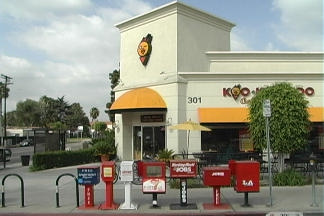
kookoorooI went to [Koo Koo Roo](http://www.kookooroo.com/) on Larchmont last night to grab dinner: half rotisserie chicken, cucumber salad, mixed veggies, to go.

While I was turning to go into the parking lot, I noticed a white SUV near the curb. It was bucking strangely. My first instinct was that the driver didn’t know how to use stick. Then I thought, maybe it was crazy custom low-rider shocks. But you really don’t see that on SUV’s, even on [Pimp My Ride](http://www.mtv.com/onair/dyn/pimp_my_ride/series.jhtml?_requestid=537594).

Then I saw that there was a man standing on the passenger side running board. It looked like he was strapping something down to the roof. That would explain why the car was shaking.

My curiosity satisfied, I parked.

When I came back around to the front of the restaurant, I noticed the SUV was still in roughly the same spot. The guy was still standing on the running board, but he wasn’t trying to attach anything. Rather, he had both hands on the roof rack, holding on tight while the SUV’s driver (a woman) tried to shake him off. That’s why the car was “bouncing” earlier.

I stood at the door of Koo Koo Roo for about 10 seconds, trying to figure out what the hell was going on — and what, if anything, I should do. Here’s roughly my thought process:

* The woman’s on her cell phone. She’s in her late 20’s, maybe. It’s hard to see inside the car.

* The man is maybe 40. Latino. He keeps knocking on the windows.

* She seems upset, but not terrified. Almost more annoyed. She’s not crying.

* I wonder who she’s talking to on the phone. A friend? The police?

* He keeps saying (in English), “I need to talk to you.”

* He seems really rational. But rational people don’t cling to moving vehicles.

* She should drive to a police station. That’s what I’d do.

* Where is the nearest police station? I have no idea.

* I don’t know if he knows her. He’s not saying her name.

* He’s wearing white. Maybe a uniform. Maybe a parking attendant.

* She should keep driving down Larchmont. There’s a ton of people, so if she really does need help, she can get it.

* I bet he’s a parking attendant, and she drove off without paying.

* There’s only one other spectator watching. That guy at the bus stop.

* He was there when I pulled in, so he must have seen more of this. He probably knows what’s going on.

* If I got involved, maybe he’d back me up.

* She’s trying to shake him off again.

optical illusionThe weirdest thing was how my perception of who was the “good guy” kept flipping back and forth, like one of those [foreground-background optical illusions](http://www.sapdesignguild.org/resources/optical_illusions/foreground_background.html) where you see either the Young Woman or the Old Crone but not both at the same time. Second by second, I thought, “she’s in danger” or “he’s in danger.”

He’d bang on the windows, so I’d decide he was a threat. Then she’d try to shake him off, and I was suddenly worried he’d fall to the pavement and get run over.

With both scenarios equally plausible, I decided I’d cautiously approach and ask the man what was going on. With the right tone of voice, it wouldn’t sound like a direct threat. If he gave a reasonable answer, I could talk to him like a reasonable person. If he gave me a Crazy Man answer, I’d know he was the problem, and…well, I didn’t know what I’d do, but at least I’d know he was the bad guy.

Just as I stepped forward to move from Spectator to Participant in this drama, the SUV pulled around the corner onto Beverly, picking up considerable speed. The man seemed unfazed. I realized that it’s surprisingly easy to cling to an SUV. No one would consider clinging to my little Toyota.
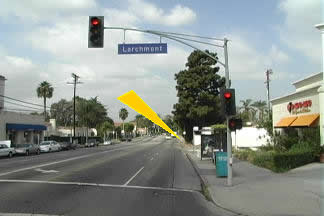
larchmontThe SUV took the first right turn, then disappeared from sight. I looked over to the guy at the bus stop, hoping for some gesture or nod that would reassure me that everything was okay, that neither of the two parties would end up harmed tonight.

Bus Stop Guy gave me nothin’. He just turned back to the street, waiting for his ride.

At the Koo Koo Roo counter, John August Concerned Citizen slowly reverted into John August Screenwriter, as I tried to construct scenarios to explain what had just happened. The parking lot attendant theory made the most sense, because I’ve encountered some surprisingly zealous asphalt barons in Los Angeles. Would one really risk his life by clinging to the side of a car? Maybe.

But the other scenarios — Furious Boyfriend, Eerily Calm Stalker, Random Psycho — also seemed to fit.

After watching this scene unfold, I wasn’t even sure what “genre” it belonged in. If you put Will Ferrell in the guy’s role, clinging to the side of an SUV, then it’s a comedy. Hugh Grant, and it’s a romantic comedy. Sean Penn, and it’s a thriller. (Unless Sean Penn’s playing mentally handicapped, then it’s [I Am Sam](http://imdb.com/title/tt0277027/combined).)

As I was driving home a few minutes later, I kept mulling over the scene — though part of me was busier contemplating actors and their career choices. Sean Penn used to be funny, damn it. C’mon, Spicoli!

I drove past the intersection where the SUV had turned, and glanced up the street out of idle curiosity.

The SUV was stopped there. The man was on the roof.

He was hugging the top of it like every action movie cliche, ankles dangling off the edge. The SUV wasn’t moving, but the guy seemed braced for doing 60 on the freeway.

By the time I spotted them, it was too late to make the turn. Instead, I hung three rights to circle around the block. It seemed to take forever. These were quiet residential streets — exactly the place you shouldn’t go if there’s some random lunatic clinging onto your car. Also troubling: my stubborn parking lot attendant theory was making less sense by the moment. Whatever urban logic makes it reasonable for a guy making minimum wage to wrestle a car also dictates that at some point he gives up.

This guy wasn’t giving up.

As I turned the third right, I figured that the driver and I would now at least be adjacent. I could roll down my window and ask if she was okay, if she was in danger. I could do something. By now, it was obvious I should have done something back at Koo Koo Roo.

But when I got back to the corner, there was no SUV. While I was circling the block, she must have driven off, with the guy still presumably clinging to her roof-rack. They were gone, and I didn’t know which one to worry about.

Do you call the police in this situation? Do you just forget about it, and check the papers in the morning? I was left — I am left — with an unsettling lack of closure. Yes, I want to know that no one’s hurt, but even more, I want to know what the hell I saw.

Was it funny or scary? Young Woman or Old Crone? I don’t know. Real life sucks that way.
Scriptnotes, Episode 711: The State of Pitching, Transcript

November 14, 2025 Scriptnotes Transcript

The original post for this episode can be found here.

John August: Hey, this is John. Standard warning for people who are in the car with their kids, there’s some swearing in this episode.

Hello and welcome. My name is John August, and you’re listening to Episode 711 of Scriptnotes, a podcast about screenwriting and things that are interesting to screenwriters.

Today on the show, we’ll discuss trends in pitching both film and television. We’ll also discuss whatever happened to single women sitcoms and answer listener questions, ranging from getting that first job to characters playing other characters.

In our bonus segment for premium members, we’ll talk with our very, very special guest about what she learned making the long-awaited sequel to her hit film. Our guest is Aline Brosh McKenna.

Aline Brosh McKenna: Hi.

John: I’m so excited to see you. I haven’t seen you in months and months.

Aline: I can’t remember the last time I saw you.

John: I don’t know.

Aline: Incredible.

John: This is your 36th Scriptnotes appearance. Champion.

Aline: 36 out of 711. What’s that?

Drew Marquardt: Oh, no.

John: It’s a big fractional number. It’s a rational number.

Aline: It’s not 10%. It’s 5%.

John: Yes, about that.

Aline: I love it. Proud.

John: Yes, it is 5%, almost exactly. That’s some good math in there. I like it. Last time you were on the show, you had only written one Devil Wears Prada movie, and now you’ve written a whole second Devil Wears Prada movie.

Aline: That’s correct.

John: You’ve actually made this movie now. In the bonus segment, we’ll talk a little bit about what it was like being back on the set for that. Also, last time you were here, there was no Scriptnotes book, and now there’s a Scriptnotes book sitting in front of you. You have the galley copy of a Scriptnotes book.

Aline: She’s gorgeous.

John: Yes.

Drew: [chuckles]

John: There’s even a chapter with your name on it, which is-

Aline: Ugh, so excited.

John: -a chapter about screenwriting based on the 30 or so appearances you’ve had on Scriptnotes.

Aline: Amazing. You took people and then you amalgamated their thoughts?

John: Yes. They were answering questions that we were talking about on the show and just sort of zhuzhed and cleaned them up a little bit just because people don’t talk the way they would write.

Aline: That’s right.

John: It’s just a little bit edit for clarity and conciseness.

Aline: Amazing. I can’t wait. I like to read stuff like this. I like to listen to the podcast. I like to read things like this. I feel like even though it’s become a more social environment because of social media and because we all know each other now in a way we absolutely did not 20 years ago, but I still– When you get together with your screenwriter friends, it’s not that often that you dig into craft, a little bit more goss than the craft. I like craft stuff. I’ve obviously learned a lot of from this podcast, so I’m excited to dig in.

John: First half, two-thirds is craft stuff. Back half is the business and notes, and all the other parts about putting together a career, and also an appendix, which is the history of Scriptnotes in there as well. Something for everybody. The list of other guests who are in there besides you is terrific as well. You hear everyone from Greta Gerwig to Christopher Nolan to other super smart–

Aline: Chris Nolan and I are always doing the same stuff. You know what I mean? Everyone’s like, “Chris and Aline, Aline and Chris.”

John: You can’t tell them apart.

Aline: No. It’s always like where he goes, I go. No, this is an incredible list of folks. This is exciting. I will read this.

John: Cool. I will sign your copy today, but you can get a signed copy of the actual hardcover, the good book, at our live shows. We’re doing it at Dynasty Typewriter yet again.

Aline: I know. I’m out of town.

John: Oh, it’s November 30th at 3:00 PM.

Aline: I know. I can’t make it, but I did preorder.

John: Fantastic. Thank you very much.

Aline: I actually preordered it on Amazon, but I’m also going to go get it at our local bookstore, Chevalier’s.

John: Absolutely. Chevalier’s will be our bookseller sponsor for our live show there. As we’re recording this, there are still tickets available. The episode just came out, so you didn’t get a ticket. Sorry, but you can still preorder your book.

Aline: I will be listening.

John: All right. Let’s talk about single women sitcoms. This is something that Mike and I were discussing as we were getting ready for bed one night. I mentioned a show. I think it was Just Shoot Me!. I was like, “Wait a minute, who was the star of Just Shoot Me!?” Then we were thinking about Caroline in the City.

Aline: Suddenly Susan. That era. Obviously, Mary Tyler Moore.

John: Veronica’s Closet.

Aline: Rhoda was my fav.

John: Let’s talk about this as a genre because the four I was mentioning were all like the mid-‘90s. I can find an article about the women of Monday Night. They’re all NBC sitcoms that are always on the same block of this. It’s Mary Tyler Moore. That’s the fundamental template here.

Aline: Yes. There’s been a paucity, for sure. Before we get into the why’s of that, who knows why anything is happening in the business anymore? Someone sent me an article that Dick’s Sporting Goods is going to be making content. It’s a whole new world. Before that, I don’t know what– I’m just going to make every character some sort of different– everybody will be holding a different stick.

John: We should probably explain that block of four sitcoms because it’s a very specific ‘90s thing, which our younger listeners may have no idea what we’re talking about.

Aline: It’s all post-Friends era. It’s all around Caroline in the City. They often had women’s names in them. The inheritor of that mantle was New Girl, which ran for a very long time. I’ll tell you a funny thing, which was, I had started as a screenwriter. Then I went into TV with Jeff Kahn, who’s an incredible writer. We did a bunch of pilots together. One of the first ones we did was based on when I graduated from college, I lived with three guys: an actor, a musician, and a guy who became, I believe, a lawyer.

We wrote a show about that because we were broke. We were right out of college. The apartment was disgusting. I don’t know how men go through so much toilet paper, but I was always going out for toilet paper. It was about being 20-something Gen X. We wrote it for Disney. People liked it, but it didn’t go. Then we were trying to find another place to do it. It ended up being the last episode of Margaret Cho’s show. Margaret Cho had a show called All-American Girl, which was a groundbreaking show.

Obviously, Margaret is an incredible talent and just sort of an iconic stand-up. She was a very young woman. She had this show about her family. The network was wanting to pivot into a show where she was exploring her 20-something life. They took our pilot, and they made it the last episode of Margaret’s show. It was a woman living with three guys, and they’re broke. It’s funny because it’s out on DVD. You can’t stream it anywhere, but it’s on DVD. I went back and watched it recently because I had watched– this is one of my mother’s stories. I had watched Mariska Hargitay talk about her mom, and she’s in that pilot, so I wanted to see it. Anyway, one of the main dilemmas–

John: I want to note for one second. It’s like a classical thing has just happened where there’s a story nested within a story nested within a story.

Aline: Yes, it’s nesting. What happened is that the whole pilot is about them trying to get their phone turned back on so that she can find out if she got a job. There’s a lot of going to pay the phone bill. There’s so much anachronistic stuff. I’m going to just say one more anecdote, and then we can talk about script stuff. We wrote this pilot. We were waiting to see if anyone wanted it. Jeff was friendly with David Schwimmer, and we knew Jen Aniston. Anyway, we got invited to the pilot they were working on, which was also an ensemble show. Jeff and I were at the taping of Friends. I was at the taping of Friends.

John: The original pilot of Friends?

Aline: The original pilot.

John: Incredible.

Aline: It was amazing.

John: I’m sure it was amazing. James Burrows is directing it.

Aline: All those people. We knew Matt a little bit, too. We knew Maddie a little bit from before. Jeff and I looked at each other. We were like, “We’re screwed.” I think that, to me, there’s been a little bit of a trend of coming-of-age stuff that’s a little younger. They’re a little bit more like those things of a young woman, like The Summer I Turned Pretty. Obviously not comedies, but I think Outer Banks perhaps has some–

John: [crosstalk] I do hear what you’re saying. I want to see if we can draw a little bit of a line between– just because it’s around a female character, it’s a little bit different than some of this group of four and the Mary Tyler Moore.

Aline: That’s right. You’re right.

John: Because the Mary Tyler Moore show, if you think about it, her family is the workplace. We do see her at home some, but the family is really the workplace. That was really what’s so notable about these four sitcoms is that they were all in the ’90s. You have a successful single white woman in this glossy office surrounded by these kooky work friends who are her work family, basically. That is the premise of the show. A reason why I think you’re so relevant to this conversation is they’re all magazine adjacent.

Aline: Yes, media vibes.

John: They’re media vibes.

Aline: That’s also a rom-com thing where everybody’s working at a magazine and up for a promotion. You’re right that those stories have– Girls is not quite that. Girls is one of my favorite shows. Girls is a your friends or your family show, but the workplace stuff is all separate.

John: I want to posit that 30 Rock is an explosion, a popping the balloon of this.

Aline: That’s right. Liz Lemon is the spiritual inheritor, for sure, of Mary Tyler Moore, done in a more contemporary way.

John: Murphy Brown was the CBS version of it, where you have an older single white woman doing that thing and her work family.

Aline: Abbott Elementary, I would say, is that.

John: I think that’s a very good point. It’s very ensembly, but to the degree that Quinta is-

Aline: The heart.

John: -the heart, the central character, and it’s a work family, you can sometimes leave that space. Sex and the City is, in some ways, the work, the HBO version of that. The work environment is a little bit less featured. It’s more the friendship, but it does that.

Aline: I will say, this seems like we’re here to plug it, but I Love LA just premiered, directed by Lorene Scafaria, who we both know.

John: Starring and created by Rachel Sennott. It is incredible.

Aline: Yes. Again, it inherits the mantle. It always has to take on the cultural trappings of the time. I remember watching an episode of Suddenly Susan, and Brooke Shields was wearing bootleg pants. It was the first time I’d seen bootleg pants. Bootleg pants are fitted all the way through, and then they flare at the end. That’s the pants everyone wore through the ’90s. I remember seeing them on Brooke Shields and being like, “Where do I get those pants? Where are those pants?”

Sitcoms really set the tone for so much of what a female was in the way rom-coms did, which was like a certain kind of hairstyle, a certain kind of look. When we went to do Crazy Ex, Rachel and I had this debate about whether it should be shot in a verite way. What should the default style be? I think she leaned a little bit more indie film. My argument was that the default style should be ingénue.

Ingénue is musical theater, those ’90s rom-coms you’re talking about, rom-coms where it’s like she’s a little prettier than she should be, she doesn’t have bags under her eyes, her hair’s always done, her accessories are great, and there’s a little bit of wish fulfillment and living vicariously through somebody who’s clearly gone through an hour and a half of grooming.

John: You made the right choice, Aline. I want to specify this. I think Crazy Ex-Girlfriend would be the example of this kind of show had it been more focused on her legal career in the law office, had it been a little more Ally McBeal and less her home life and her wild romantic life and all the detours she takes there. It blends the two really well together, but like with Suddenly Susan, it is centered around one character who has come into a place and is surrounded by loony people.

Aline: I Love LA in a funny way. The workplace is sort of inseparable from her personal life because her friend is an influencer, and her boss comes to her birthday party. It is kind of a funny thing now where, for young people, their public and their personal life are very meshed because you’re looking at pictures of people’s personal and professional life on their social media. I think there’s much more of a sense that those things are one and the same. I think there was more of a sense of like, I put on my curling iron curls, and I go to this workplace, and that’s where I come of age.

Obviously, the big daddy of that one for me is broadcast news. I do feel like it’s partly the decline of single female rom-coms goes hand in hand with the decline of single female comedies. I do think that when they make them, I don’t know how I Love LA did, but I thought it was successful on the terms it set out for itself.

John: I would say that Emily in Paris is another example of a contemporary version of that, where-

Aline: Yes, very much.

John: -it’s a glamorized, romanticized version of being that young person in a media world, in this case, in Paris.

Aline: I have a slight theory for you, which is, I think that reality TV has slightly taken the place of this. During the strike, I started watching all of The Kardashians. It took me, I’m going to say two years, because there are 20 seasons, and then 7 seasons on Hulu. It’s an ensemble comedy, I would say, strongly featuring Kim and Khloé. I don’t want to neglect any of the other major players there. For a lot of the show, I felt like those were our leads, and they were different.

I think that dating shows, Love is Blind, I think those are teaching people how to date. It’s interesting. I just saw Reese on Dax’s podcast, talking about the fact that romantic comedies used to teach people how to date. It made me think that, now, reality shows– she may have said that. I don’t know. I listened to the clip on TikTok, obviously. I think reality shows are now teaching people how to date, which is terrifying. Frankly terrifying.

John: It’s performative behavior in order to just sell a storyline.

Aline: It’s funny. The first season of Bachelor, the first season of Love is Blind, the first season of these shows, first season of Survivor, the first season of whatever, when they don’t know the format, you get pure human behavior. Everything after that is–

John: There’s a meta quality to everything.

Aline: Yes. They’re just marketing themselves, and they’re already thinking about their cosmetics brands and whatever. I think in their purest forms, those reality shows teach us how to act. I got to say, enjoyed every minute of The Kardashians. I really loved it. It was the perfect thing to do over the strike. I do think that we have moved some of our discourse about how to be a human into that, and then also into Instagram, which is also a little terrifying because, again, that’s filtered through a bunch of things. There’s a level of artifice in these sitcoms and rom-coms that we’re talking about as well. Interesting.

John: Let’s talk about the practical implications of this because there used to be a lot of shows. These were sitcoms that had 22 episodes per season times 4. It’s just hundreds of episodes available to write for these female characters in comedy. Those were obviously jobs, but they’re also, you talk about how they’re training about what–

Aline: How to behave.

John: How to behave, how to aspire–

Aline: Parks and Rec was another one. Parks and Rec.

John: Absolutely. That’s both–

Aline: Mindy Project.

John: Mindy Project, exactly. They came a little bit later, and so they’re responding to the tropes of the genre. They were really helpful, I think, for people to think about what it’s like to do this. Weirdly, because we don’t have those as models of, you should go to New York City, you should go to Los Angeles, and enjoy this life. I wonder whether that’s partly responsible for this retreat away from the big cities or–

Aline: When we did our pilot, which was called Young Americans, the idea was that they were broke and that they couldn’t pay their telephone bill, and they had a rat living in the pizza box. Because the Gen X thing was, we went and we rented not-great apartments in the Lower East Side. If I think about it, that was all relatively affordable. We split an apartment that I think cost– I’m going to say that it was $1,800 for three of us or something like that. It’s just the affordability. We’re talking Election Day. The affordability aspect of these cities. I think the cities that are exploding, and I think I’d love to see more shows set there, is like Reno and Detroit and Omaha and these smaller cities.

John: Denver and Austin.

Aline: Yes, Nashville. These are places that are attracting young people with an easier lifestyle. The problem with sitcoms right now in our business is, I just don’t know, you sound like a dinosaur anytime you talk about this, but guys, they used to order 100 scripts and shoot 20 of them and pick up 7. It just doesn’t work like that anymore. There isn’t this sense of we’re making a smorgasbord for everybody. It’s just very, very targeted.

John: Looking back to those four examples, they were all taking women who were movie or TV stars and centering them in the middle of a sitcom. They don’t do that now. Grace and Frankie, to some degree, was that you could argue that some of the Apple comedies are taking male stars and doing the same kind of thing, like shrinking. What is shrinking about that?

Aline: Ted Lasso.

John: Ted Lasso is not that.

Aline: Right. Ted Lasso is also your work, teaching you, being your forum for moral growth. Listen, I love workplace stuff. I’ve written a lot of stuff that takes place in a workplace. It’s funny because we’ve talked about this on the podcast before, but yes, I understand I write romantic comedies, but in some ways, your coming of age doesn’t happen there. I think of romance a little bit more as– It’s a little bit more of a game. There were times, certainly, where it felt like musical chairs.

For me, a lot of what I learned about myself were through my friendships in my 20s and 30s and then through the workplace. That’s really coming at me. Because I think I’m very interested in how people come of age, I think work is a natural venue for that.

John: What’s also nice about these workplace comedies is that while romance is part of it and there’s tension, also because they’re TV shows, it’s not meant to be fulfilled. It’s always meant to be a thing that you’re pushing off. They’re always going on dates, but they’re never settling down. That’s an aspect of it, which is–

Aline: Yes, there’s always a challenging thing when people either get married or have a baby on these shows. It’s a challenge. Obviously, Murphy Brown had caused a little bit of an uproar. As you move people through their life phases, it’s interesting. I worked on a movie about a working mother, and I was in that phase of being a working mother, and it was so gripping to me. Then, two years after I was out of that phase, I was like, “I can’t remember what any of that was like.” People would be like, ‘When did you wean your second one?” I was like, “I don’t know. I don’t remember. It doesn’t matter. You’ll figure it out.”

I think coming to a city, figuring yourself out, you’re right, I think Ted Lasso’s probably the most successful one. I think that’s just always going to work in some way, shape, or form. I just think the workplaces now, we’re just so much more cynical. They’re so much more corporate. It’s hard to think of doing WKRP in Cincinnati without somebody constantly saying, “Oh, they called us, and we got to do this, and we got to do that,” because everybody is sort of laboring under these giant corporate systems now.

John: Well, let’s think about practically for our listeners, if they’re thinking about writing a pilot or they’re thinking about something as a writing sample, I do feel like this is a missing genre, a missing piece. It’s a question of like, what is the sample that you could do that’s in this space that would actually break through? Because it’s not going to be a three-camera sitcom, probably, because we’re just not used to it. We’re not making it anymore, so it’s going to feel weird on the page, likely.

There’s probably something about that sense of a female-centered workplace comedy that is new and interesting and different. It could have a broad city vibe, but in a workplace thing. There’s a way to do it. The Rachel Sennott show may be the example of what this is, but it’s a space that could use more writing. Anything you write in that space is probably a really good sample for Aline starting our show.

Aline: Listen, I’m hungry for comedies in general. I think we’ve scooped the bottom of the pool, and that was a sound, and we skinned our knees on the bottom of the pool. I feel like comedy is starting to come back. I miss comedies across the board because I try and find things to watch with Will at night, and it’s like the number of things that you watch that start with a teenage girl running across the forest all bloody, and she’s about to be murdered. My God. It’s a Swedish show, and it’s a South American show, and it’s whatever show. I’m like, “Here comes a teenage girl, this poor thing, running through the forest, and then we’re going to talk about her murder for 10 episodes.”

I think when they work, nobody wants this. Will and I watched the first season and really enjoyed it. The other show that I think is a great rom-com is The Diplomat.

John: I love The Diplomat.

Aline: I love The Diplomat.

John: We’re watching the second season right now.

Aline: Oh, wait until the third season, if you like that relationship, it’s a ripper. They’re awesome.

John: It is the third season now. We’re early in the third season, but it’s–

Aline: I got to say, for me, that’s like Gable and Lombard level, but contemporary banter between Rufus and Keri’s character. I just think that she’s really tearing it up. That is true. I feel like now I’m finding comedy elsewhere. I thought Weapons was hilarious. Hilarious. A very biting satire about what it’s like to live in the weird house in the suburbs. I feel like we all felt like our house was the weird house in the suburbs, and had the newspaper on the windows in some respects. I definitely think that comedy is creeping into other genres.

John: That’s also why I feel like writing a great comedy sample right now is really helpful for staffing on a diplomat or other things, too. Yes, you want to be able to write smart, but those writers are funny writers who also can write very great, detailed character work.

Aline: Yes. I think Matt Bellamy was talking about this because it’s also in the animated movies are really funny. You can’t make a Pixar movie or a Disney movie that doesn’t have jokes in it. It has migrated.

John: The criticism is that everything is funny and nothing is a comedy. It’s like we’re not making comedies, per se, but our Marvel movies are really funny and joke-filled.

Aline: That’s right. You mentioned Marvel, too. I would just love to see what it really is like to be dating now. I think I’m looking for my Harry Met Sally or Girls, I thought. I really think that’s one of the great fucked-up love stories of all time. Hannah and Driver’s character, whose name was Adam. I am really hungry for show me how people are dating now that’s different and interesting. Again, what I know about it is from reality shows and TikTok.

John: Let’s say we are now ready to pitch one of those shows in the world. It’s different now than it’s been 5 years or 10 years ago. We have a question to set this up.

Drew: Reaia writes, “What content is necessary in a pitch deck? Is it just the story and why now of it all, or is there something else that I’m missing?”

John: Here we’re talking about pitch decks, but we need to go back 20 years ago. Aline, pitch decks were not a thing.

Aline: [laughs] In fact, if you brought anything into the room, it was very odd. God, we were just entertaining them with our faces.

John: We were just entertaining them with our faces and our words.

Aline: And our arms.

John: What changed was the pandemic. There were a couple of times where I’d bring in boards of artwork and show some stuff. In general, you were just sitting down in front of an executive in person and describing the movie and doing a little tap dance. With the pandemic, we moved to Zoom for things. Instead of just staring at the people, sometimes you would have slides that you would show during this process. That’s one form of pitch deck, which is the things you’re showing during a pitch.

There’s another thing that Reaia may really be referring to, which is something I’m sure you’re familiar with, which is the nicely produced thing that talks through the show that’s independent of the actual pitch process. Either you’re saying it ahead of time or afterwards, that’s also a pitch deck. It’s confusing that they’re using it for both. Have you done that for any of the things you pitched?

Aline: No, I don’t think I’ve ever sent over materials that wasn’t a script. The interesting thing about migrating to Zoom is that, in an ideal world, it’s more entertaining for people because you have things, pictures to look at. The funny thing was, back in the day, and John and I can discuss later who did this, but I’ve had people fall asleep with it. I’ve sold a lot of pitches, but I’ve had people fully sack out while I was talking to them, especially if it was three o’clock.

The contemporary version of that is people looking at their phones while you’re talking. I just feel like if you could put your phone here, up eye level, or just look at the thing on your screen so that you can– because it’s a little harder to clock the eyeballs, but the full look down. Then we had someone pitching something that we were producing, and the gentleman that we were talking to was vaping, which I don’t think you would do if someone was in the room. I don’t know that you’d be ripping it with a vape.

John: No, I wouldn’t.

Aline: Then later, I said to him, “Hey, I feel like it was a little disconcerting.” He said, “Oh, it was my camera on.” It’s good to know if your–

John: Camera is on.

Aline: I would say, in general, it’s good to know when your camera’s on.

John: Learn to look for is the icon, what the status is there, yes.

Aline: I have always pitched a lot. I have sold a lot more pitches than specs. I don’t know why. I’m not a huge performer. I don’t go in there and do something fancy. I think there’s something about talking through the idea and about going with the vibe of the person that you’re talking to. A great deck that you’re using as you’re talking takes the onus off of you to be as word-perfect. I have learned, which I didn’t know, as I produced more things, some writers have been told to read, and they read. Reading in a room probably works better than reading on Zoom, which is rough.

John: Let’s talk through some of the pitch deck first. Let’s talk about the pitch desk that’s for when you’re on a Zoom. That pitch deck, maybe it could be five slides, it could be–

Aline: It’ll probably be like this. It’ll be like, here’s the idea, bang. Here’s four comps, bang. Here are the characters. Here’s the pilot. That, I try and do as fast as I humanly can because that always is like– and then here’s where the series is going. For each of those, it’s so easy now to find these images that go with– you can carry the tone.

John: Absolutely. We’ve recommended on previous episodes, ShotDeck is a really good utility for finding images from movies and TV shows. You can search for and find things that match your style. Images that you’re showing while you’re giving a pitch on Zoom, those slides should not have text on them, basically. You don’t want people reading what’s on your thing. It’s an image that–

Aline: Unless there’s a joke.

John: Yes. If it reflects what you’re saying, so they’re paying attention to your words that are being spoken, rather than what’s on the screen. In terms of reading, yes, you should not be looking down to read. The hack that everyone, I think, now does is you actually have your text up very close to the camera, so you’re actually just scrolling and reading off of that, and so you’re keeping eye contact.

Aline: We pitched with writers before who were very, very nervous, and they can turn everybody off, so they’re not looking at their faces. You didn’t have that option when you went in person. A lot of weirder things happened in person. You couldn’t find them. They were busy and kept you waiting. Something weird was going on in the office. People were sacking out. People were eating. More inappropriate things.

Now, I was younger, but also, people– I’ve told this story before about going into a room largely pregnant, and an executive said to me, “I guess today would be a bad day to punch you in the stomach.” I don’t think he would have said that on a Zoom. I think Zooms are like you have a sense that almost like you’re being recorded or it’s on a record. I think you build real relationships when you went in person.

John: You do. There’s executives who I’ve been on 10 Zooms with, as we’ve pitched various places. It’s a piece of IP that we’re pitching in various places, and I still don’t really know them. If I traveled into a room to accompany with them and so we’re doing the chitchat in the lobby, I feel like I knew them better. When I finally do see them at a Christmas party, it’s like, “Oh, wow, you’re nothing like what I expected.”

Aline: Right. Their shape is always there. One of the things that’s really giving me the giggles is Zoom boxes. Everybody’s face is nicely framed up. In the beginning, people were like, you had their dirty socks in the back or like a murdery window or whatever, but people got that under control. Then they moved to a thing where they would have their whole team, so the whole comedy team, the whole drama team, and they put a camera. Have you done this?

John: Up on the wall at the worst.

Aline: They put a camera high up in the– It’s always high so that you see everyone. What happens is, then the Zoom box is very small, so then you’re pitching to three ants on a sofa, and you can’t see their faces. You have no idea– Zoom box, you can really see how it’s going. A wide shot, a super wide from a high angle of a sofa. We once had a Zoom with a management company, and they had 16 people, and the camera was up there, and so there were people introducing themselves, looking backwards. No, go to separate offices. Yes, I know the owl.

John: This is the solution.

Aline: Yes.

John: The owl is a good solution for that. I’ll talk about this in the future. I think that’s a wonderful thing. Let’s talk now instead about the kind of depth that is a sales document for your show that is independent from what the actual Zoom presentation is. This is something that is really common in one-hour series development. I did it for a project that we’ll hopefully set up soon.

Aline: It’s a separate from your pitch?

John: Yes. I’m going to show you an example of it.

Aline: A lookbook?

John: A lookbook. Oh, yes. A lookbook is a similar thing. I can’t tell you what this one is, but-

Aline: I’m looking at it.

John: -this one is an example of–

Aline: You send this to them. Well, directors do this a lot.

John: Yes. This actually has a lot of text, unlike a slide deck that you’re showing during the Zoom. This is a thing that’s meant to be read.

Aline: Like a brochure.

John: It’s a very nicely done brochure. In this case, the studio hired me to write this and hired a designer to design it. It was a whole thing, so that as we were approaching people with the script and this, they could see this is the script, this is what the thing, the show feels like.

Aline: That’s right.

John: That was very useful.

Aline: Yes, that’s very useful when you’re sending in a script. Right now, I think sending cold scripts, it’s really helpful to have something like that, which is a lookbook or tone book, basically, that goes with it because people are now used to these pitch decks.

John: Let’s talk about what’s in this thing, which is very typical for these kind of decks you’re turning in with something. First, it starts with a note from the creator, the show creator, the person behind it. This is why it matters to me, this is why I want to do this, and also the why now at all. This is why it’s a show to make in 2026. A bit about the history of the project. If there’s any IP underneath it, that’s where you talk about how many units it sold, what a big deal it is.

Then you get into the characters, and this is a chance where you actually can show your sample image of the kind of actor who would be in this role, and stuff about them. You’re going through your main characters, your supporting characters, giving a sense of how everybody connects the big themes of your show, what are the tensions. Crazy Ex-Girlfriend, you can imagine that deck would be talking about who is Rachel’s true love and what this is, but also, this is a show that’s about the absurdity of that question and the tropes of that question.
Then you go through your Season 1 overview, notable events in it, future seasons, and then a closing statement. This thing I did for this project was 30 big pages of this with big images, but it’s very useful.

Aline: This is also a “show to your boss” item.

John: Yes, for sure.

Aline: Because when someone says, “Hey, John August, I read a script,” and it comes to the lookbook, and then if that guy doesn’t want to read the script even, he’s got a thing to look at.

John: A sense of what the show is. We say show because it’s not really a thing you do for movies at this point. I wouldn’t be surprised if, down the road, we get to this for movies.

Aline: We pitch our movies, we always have a deck, but we don’t have a book. As a director, you do.

John: As a director, you do, or a reel.

Aline: I will say, one of the reasons I think you need to do this, John, is because when we were coming up, it was like, “Is it Suddenly Susan? Is it a cop show?” There were such well-worn grooves to what things were. So many of the successes now are so out of the box that Stranger Things is as much about the vibe as it is about the story. I think because everything is much more bespoke and sui generis. You got to tell people what it is.

John: Stranger Things had a great deck, too.

Aline: I think it did, yes.

John: We can probably find a link to that.

Drew: It’s online.

John: It’s online. You can look up that– It gives you a sense of what is going to be unique and special about that show. There probably was a script already for people to look at, but the script tells you what’s happening in the pilot. It doesn’t give you a sense of what the show is meant to feel like overall. Let’s answer a listener question. I want to start with this one, which is an epic one, but I think probably will resonate with a lot of our listeners.

Drew: “My name is Sam, and I live in LA. I’m 34, a father of a two-month-old, and I almost applied for the USC Screenwriting MFA. I’ve been writing for 10 years now. I’ve queried and networked. I’ve applied to the mailroom at every major agency and every entry-level job at every major studio. Nothing. I’m not looking for a big spec sale. I’m not completely delusional. I’m not even looking to get repped. I’m just looking to get my foot in the door as an assistant and eventually get an opportunity to be a writer’s assistant, then eventually maybe get staffed and so on and so on.

I want to start at the bottom and pay my dues. I don’t have a formal education in the business, so I need to learn. I’m told AI is replacing writer’s assistant jobs in TV, so I’m not optimistic about that route. Other assistant jobs seem impossible to get if you don’t know someone. I assume you guys find your assistants via word of mouth. I’m curious. Would you ever take a flyer on someone who isn’t already an assistant? All signs point to no.

I almost applied for the MFA at USC. I figured I could get some formal training and network at the same time, but at $100,000, this feels like an insane choice to make, given how I now have a child’s education to pay for. I’m thinking about paying an Etsy witch to give me my big break. That feels like it would be just as helpful as everything else I’ve been doing. I understand that this business sucks right now, but what the hell do I do? Obviously, keep writing, but what the hell else do I do?”

Aline: What’s this gentleman’s name?

Drew: Sam.

Aline: Well, I talk about this every day because I have a lot of young people in my life: my kids’ friends, my friend’s kids. I feel that Sam probably has a ton to offer the world and is very bright and very creative and very interesting. Right now, there’s just not enough runway. I really have always been if you build it, they will come person. I had this exact thing. I had an assistant who was really fantastic. He really went above and beyond. Then he left to work on an independent movie. When he got back, I tried to get him a job, help him get a job, and I could not find anything for him.

My concern is that writing is getting to be a little bit more like acting, where if you can withstand it, then that’s really most of the game. Writing used to be like if you wrote something good, you could wiggle in somewhere. I don’t know that that’s the case anymore. It’s a little bit like– I used to say there are no great undiscovered screenwriters, but I don’t think that’s true anymore. I think in the same way that there are many undiscovered great actors, many, I think there are now many undiscovered really good writers who would have slotted right into the system 20 years ago.

My concern is, I just think that people have a lot to offer the world, and that if this was my kid, I would say, “Go have a conversation with the world.” That’s what you’re doing when you’re a young person is you’re saying– For example, I started out writing broad comedies, and the world was like, “Maybe not.” Then I wanted to write half-hour TV, and the world was like, “No, I don’t think so.” I would have experiences. Well, magazine writing was first, but then the minute I started writing grounded comedy, doors started to open.

It was a conversation that I was having with the world about here’s what I have to offer; here’s what you have available. Unfortunately, what I see is happening now is these kids are hitting tennis balls over the net, and no one’s hitting them back in the business. The thing that people are doing, as my young assistant is now doing, is he’s producing his own movies. He’s raising money. He’s making $2 million, $1 million, $2 million movies. He’s making stuff.

If you can make stuff, make stuff. I want to know for Sam, who now I’m the auntie of this baby, I want Sam, who’s probably a really, as I said, smart, interesting guy, I want him to go where there is opportunity. Right now, writing is a skill that can take you anywhere. Truly, if you’re a good writer– My husband works at a mutual fund, they always need good writers. Probably not what Sam wants to hear today, but writing is a skill, still is a skill that is very important in a lot of businesses, and being able to understand what type of writing is going to support a business or contribute.

I’m worried about the only circumstance in which I really encourage people to stay at it is if it’s someone who can withstand it, who can live in a small apartment, who can work a side hustle. I have a couple of friends like this that I can say, okay, hunker down, stay on the bus, and you’ll get to your stop. As Sam’s now aunt, I want Sam to be somewhere where he’s fully appreciated and doesn’t have to worry so much about where his next paycheck is coming from.

John: I had two conversations at the Austin Film Festival that feel really relevant to that. One of them was with a guest who was on stage with us, there with Anthony Sparks. Anthony was talking about his transition from being an actor working on Broadway to start working in this industry. He was older and already had a kid, just like Sam already had a kid. It was always a struggle. Am I going to be able to get in and stay in? He was doing his academic career at the same time.

It worked for him, but he also had to construct a life that was going to be really great and meaningful, even if the Hollywood part hadn’t worked out. Sam, at 34, now with a kid, needs to be thinking about both of those things. You can still pursue your Hollywood dreams, but that shouldn’t be deferring all other things until the Hollywood stuff kicks in. You and I have both been in this business more than 20 years, and a 34-year-old starting in the business was always tough. The assistant track, the assistant way in, was for kids right out of college. Early 20s, mid-20s, you could do that. Being an assistant at 34 is tough, and moving your way up there.

I had another conversation at the opening night party with a guy named Brandon Cohen who’s sold two comedies recently. He’s probably about the same age. He just sold specs. Specs are selling. They’re comedy specs. He wasn’t trying to go through any side door. He’s just like, “I’m going to write specs. I’m going to keep writing. I write fast.” He sold them, and it happened. That may be the more real estate path, honestly, for Sam, is for his writing.

Aline: It’s much more of an actor model where we’re accustomed to actors teach yoga, and they work at restaurants, and they’re graphic artists. For writers, it used to be like, oh, you’re going to come here and in your 20s, you’re going to find a way to support yourself writing. I think it’s becoming more common to even be working as a writer and selling things, and then also being a Pilates instructor.

John: Doing test prep and doing all the things that writers do.

Aline: That’s right. Test prep. It’s just a question to me of, can you withstand it? By withstand it, I mean not get all the stuff you want at Trader Joe’s and take the smaller apartment.

What I’m sad about is that we used to wick people into the system in a completely different way. The flip side of that is, and we’ve talked about this before, but I think some of the best comedy, and I heard Judd say this somewhere, some of the funniest stuff is on your phone. I mean, the people who have had opportunities to be funny on TikTok are unbelievably funny, and they don’t require a dime to do it. Again, as your auntie, I don’t know where that’s getting you diapers.

John: Is it going to springboard you into the traditional Hollywood careers that Aline and I have had? I don’t know. Those other paths may lead you to another way that’s actually fulfilling and doing interesting stuff that can pay the bills, and you love doing. I would just say, I worry that over the course of doing this podcast, we’ve talked about such a traditional way in, which is you move out here, you intern at a place, you get hired on as an assistant, you work your way up to another thing. Eventually, someone notices you and you get started writing. That does happen, and it probably still does happen, but it’s not a realistic path for a lot of people.

Aline: Also, because a lot of people came in through TV and those jobs, those shows that we were talking about earlier, where it’s 22, 25 episodes, and basically that could be your whole life, and you could be like a professor, take the summer off in between seasons. People get jobs, it’s eight episodes. They’re taking whatever pay is being offered to them. They have to get three of those a year.

Even that, even getting staffed, which used to be like Victory Dance, you’re in, and I don’t want to be gloomy. I just want all the young people to be in spots that really appreciate them and where they can use their maximum power. I would say, in the conversation with you– I had a friend say to me, “Make sure that your dream is something that still exists.” We were talking to somebody who wanted to be a novelist, and this person was saying, “There is no Saul Bellow and there will never be another one.” There are no novelists who set the tone for us culturally anymore because we have other things that do that.

Make your dreams, things that still exist. There’s a lot of beloved occupations, things that I love, like journalism, that are really rough right now. I don’t want to be discouraging because to me, to be discouraging is like, well, you’ve hit the end of the road. What I want to do is be encouraging and say, “If you’re a smart, capable young person, the world needs you. It’s just Hollywood might not need you in this moment.”

John: You mentioned journalism, and your son is an example of a kid who really loves journalism and went into journalism and found a program that got him into working at a newspaper doing the grunt work. It was a very classic path. Some of those classic paths are still open, but it’s also a classic path for a kid just out of college who could eat ramen and do these things. I want to make sure that we don’t mistake advice for people who are 22 years old versus 34 years old with a kid. The different paths are open to them.

Aline: That’s right. Again, I feel like there is still opportunity. It just may not be in studio films and television. It might be elsewhere, and maybe you’re going to make an independent movie, and it’ll get noticed, and then you can make weapons. I think it’s a call to the entrepreneurial. In some ways, it favors the people who have privilege, as we’ve discussed before. I’m not happy about it.

For many years, I was always able to help my kids, not my actual kids, but my friend kids, kid friends, get into the business and get them started. I am at the limit of my powers. I want people to be realistic and start thinking about, do I want to take those talents and go to games, which are booming? Do I want to write for another kind of entertainment? Do I want to write live events, which are booming? Do I want to understand AI better? Do I want to understand technology better?

So many businesses have gone through that. That’s why every musical artist we know is touring. Again, part of this conversation you’re having with the world is that it goes, you know what? There’s not a lot of chairs left here. Let’s go somewhere else where there are chairs, Sam. I bet you that there’s something that Sam could do that would be both fulfilling his creative drive, but also would make him feel like he could get some money in that 529.

John: Let’s have one more question. This one’s from Alex in Missouri.

Drew: “The screenplay that I’m writing involves a stage play. Throughout my script, several of my characters play different stage play characters. I’m curious how I should title their names in the script when they’re in-character, so to speak. Should I include the stage play name in parentheses next to the character name, or just simply leave it as just the character name, or something different altogether?”

John: The thing I’m writing right now has exactly this situation. What I’m doing is, if there are characters who are really actually not important in the outside or the offstage or not important, I just use their onstage name. If it’s Romeo and Juliet and there’s Tybalt, I’m just calling that kid Tybalt. Then, if there are characters who it is important who they are as the two different people, I’m putting their onstage name in parentheses afterwards so we can remember who it is. Oberon would be Mark (Oberon), so we know that he’s speaking Oberon’s lines there.

Aline: My guideline for is it confusing is are you confused? I am often confused. I don’t pick up on things that quickly, actually. As a reader, I write the way I read, which is if it’s like– I would write Romeo/James or James/Romeo, and then I would say, out of character now, James, and then I would say, back in character as Romeo. These are directions, a recipe, and if you had a recipe and it just was like, hey, some reasons, you’d be mad.

I think I have written some good scripts and some not good scripts, but I don’t think I’ve written confusing scripts. If you don’t like it, you got it before you didn’t like it. I really think that one of the biggest mistakes people make is thinking about it with their brain that knows and trying to read it through the eyes of someone who has no idea what the fuck is going on, which is everyone, except for you.

John: Absolutely. Again, ambiguity is confusing, and confusing is death for someone who’s reading a script. You want them to be intrigued, you want them to be curious, but if they’re just confused, they’re going to stop reading. Anything like this that’s going to make it simpler for them, don’t worry about it. Just remember, you are limited on the page because on screen, we’ll be able to see, oh, it’s the same guy. I think we see faces, but sometimes not.

Aline: Sometimes I am like the classic middle-aged lady watching a TV show, looking at my husband or my kids and going, who’s that one? Who’s that one? Is that the guy who did the thing?

John: Who’s that one? That’s Game of Thrones. House of the Dragon, I still have no idea what anyone’s name is. It’s like, “That guy.”

Aline: Wait, John, here’s the thing. My whole life, whenever anyone’s like, “Well, I just have to tell Claudine Jones about blah-blah-blah.” I don’t care if you have said Claudine Jones on every page of your– every minute that I [unintelligible 00:50:33] I do not know people by their names. I don’t. Ted Lasso, maybe. Even if you said Ted, I think I’d go, “Is there a Ted on this show? Who’s Ted? Wait, his name is Ted, huh?”

John: Same with Survivor. We watched Survivor.

Aline: Oh my God, I watched Survivor. I don’t know. It’s shirt guy. Hat guy, doctor, lawyer.

John: Exactly.

Aline: Guy with his balls hanging out.

John: Amy will ask about, like, “Oh, well, when–”

Aline: 100%

John: When Neil said that, I’m like, “Who is Neil?”

Aline: [laughs] Before Survivor gets down to six, when it’s at 12, during the merge especially, they’re like, “I’m very worried about John.” I’m like, “Who the fuck is John? I don’t know who that is. I have no idea.” I think never underestimate. It’s funny because I just haven’t come out of production. You know, when you’re in production, you think you’ve written it super clearly. Then someone asks you a question, and you’re like, “Wow, I wouldn’t even have anticipated that you read it that way. It’s so interesting. Even when you’re trying to be your most clear, it can still be confusing.

John: It’s time for our one cool thing. My one cool thing is on the wall behind you. It’s what’s called a big-ass calendar. The big-ass calendar is a thing I’ve been using the last couple of years. It’s a giant wall-sized calendar. It’s four feet by three feet. Every month is just one line on it. It can really give you this chance to see the entire year all laid out in front of you. It’s really helpful for vacations.

Aline: Yes, and blogging. Now, let me ask you a question because people have been talking about this on TikTok. Drew, I need your answer too. When you picture the year, some people picture a clock. Some people picture a calendar. Look at your face. Some people picture a calendar. What do you picture? When you picture a year, do you picture that?

John: I probably do picture a big ass calendar.

Aline: I picture a grid.

John: Drew, what do you picture?

Drew: I picture a calendar, but it’s in three-month chunks.

Aline: A lot of people say that. I do not. I picture months going by like a river, and I can pull it backwards or forwards, but January’s over here and December’s over here, and it rolls in front of me like a measuring tape. That’s a perceptual thing. It’s similar to how some people can picture things, and some people can’t picture things.

John: Also, anthropologists will study different cultures and say, “Where is the future?” The future’s always either in front of you or to your right in most cultures. Occasionally, some cultures, the future is behind you, which is just a strange thing.

Aline: This allows you to get a sense of the shape of your year. Absolutely.

John: Absolutely. It’s a big-ass calendar. It’s just giving you a sense of the overall flow of things. I’ll put sticky notes on there for important dates, like kid home from college or trips, or vacations. I’ll use paper spike tape to mark off Austin and Film Festival and things like that, just so you know what the roadblocks are ahead. It’s also good as you’re starting a project to say, “Oh, I have 12 weeks to write this. What does 12 weeks actually look like?” I’ve just found it so useful. I just got my 2026 calendar. I’ll be replacing this one, and I’m excited.

Aline: It helps you with the thing of like, oh, it’s November.

John: Yes.

Aline: Which really happened big time this year.

John: It did.

Aline: This year was a real big like, “Wait, what happened? Why are we in the middle of November now? What the hell happened?” True.

John: I don’t know. It’s my fault?

Aline: My one cool thing is I got this off Instagram. I sound like a teenager. I’m talking about TikTok and Instagram. There’s a company called RAREFORM, and they make bags out of old billboards.

John: I’ve heard of this.

Aline: They’re quite pretty. You can pick the color that you want. The reason that I’m obsessed with this is because I am not a backpack gal. I don’t like the way it feels, and I find that it’s just I don’t like the way it lays out spatially. Look at this guy.

John: It’s gorgeous.

Aline: I got the absolute biggest one, which is also a carry-on, a plain carry-on. You can abuse this thing. You can stuff it full of stuff. I found, look how big that is. That was my onset bag. It was great for a number of reasons. I can get a script in there, a computer in there, clothes. I always had clothes, a big water bottle, everything I needed for the day. It could also be a little bit of a garbage can when I was tired, just zip that thing.

Then it also was good because it was identifiable. It was like a Leans bag. There was a Leans bag. If I left it in the way, which maybe I did once or twice, they could always just throw a Leans bag somewhere. It’s not like a precious item. I don’t really get backpacks, and I don’t enjoy them. These RAREFORM bags are really good, and I really use the crap out of that one.

John: I have a backpack, my everyday day pack is 20 years old. It’s made of Cordura, and it is flawless. It is not damaged at all. It’s going to outlive me for sure. I really like the idea of this RAREFORM bag because the vinyl that they use for outdoor ads is really durable, because it has to be, because it has to stand up on those billboards for months at a time. It’s a great second use of that.

Aline: I love it.

John: Cool. That is our show for this week. Scriptnotes is produced by Drew Marquardt. It is edited by Matthew Chilelli. Our outro will be sung by Aline Brosh McKenna. If you have an outro, you can send us a link to ask@johnaugust.com. That’s also the place where you can send questions like the ones we answered today. You’ll find the transcripts at johnaugust.com, along with a sign-up for our weekly newsletter called Interesting, which is lots of links to things about writing. You’ll find clips and another helpful video on our YouTube. Just search for Scriptnotes and give us a follow. Aline, have you checked out our YouTube videos at all? We have some really good ones now.

Aline: No.

John: We have things from previous episodes, but they’re cut with the footage of the guest’s movies. The Christopher Nolan one is really good.

Aline: Wait, I did see one.

Drew: We have an Aline one.

Aline: Oh, okay.

John: You should watch the Aline one.

Aline: Wait, what about TikTok, Drew?

Drew: We’re on TikTok.

Aline: Okay, you are. Great. There’s people who scroll YouTube before they fall asleep, and there’s people who scroll TikTok. I think it’s a bit gendered. I think the dudes watch YouTube. I think the men in my family are big YouTube watchers, which I haven’t fully gotten there yet. Certain things, I’m a very early adapter and some less so.

Drew: I think it’s one or the other, but we’re looking to get more on there. Keep an eye on it.

John: You can find us on Instagram and TikTok @scriptnotespodcast. We have T-shirts and hoodies, and drinkware. You’ll find us at Cotton Bureau. You’ll find the show notes with the links to all the things we talked about today and the email you get each week as a premium subscriber. Aline, thank you, in person, for being a premium subscriber. You’ve been there from the very start. You’re hearing all those bonus segments.

Aline: I love it.

John: You keep the show going. You can sign up to become a premium member like Aline at scriptnotes.net, where you get all those back episodes and bonus segments like the one we’re about to record on.

Aline: What’s that old ad? I’m not just a member. I’m a client.

John: You are.

Aline: Remember that ad? It’s for hair.

John: Sure. Aline Brosh McKenna, thank you so much for coming back on Scriptnotes. It’s so nice to see you again.

Aline: Scriptnotes.

[Bonus Segment]

John: Love it. Fantastic. Aline, you were gone for months and months and months and months because you were making the sequel to Devil Wears Prada. We’re not going to spoil anything. We’re not going to talk about the movie at all.

Aline: I’m not going to say anything interesting.

John: I want to talk about just the experience of going back to, here’s a property that you wrote the first time you loved, but you can’t step in the same river twice. You’re a different person than you were then. Just compare a little bit the experience of being a writer who’s getting this big movie made based on a book. Let’s recapture what we know about the book. The original movie is based on a book written by-

Aline: Lauren Weisberger.

John: -Lauren Weisberger. You are writing the screenplay for this, working with the director.

Aline: The first time?

John: First time.

Aline: It was a Fox 2000 movie.

John: Fox 2000, that’s right.

Aline: In the heyday of that, when they just had jam after jam after jam.

John: We should explain Fox 2000. Fox 2000 was a sub-label at Fox that was focused on a lot of book adaptations. You would say female-oriented was more commonly their mandate, whereas Big Fox might have been making Predator.

Aline: We were in a run of, Prada came out around Walk the Line, Life of Pi, Family Stone, and then I made another one, 27 Dresses, and those were all signature Fox 2000 thing. The funny thing about the first movie is that I was 36, 37 when I got it, and I felt like the oldest hooker at the ranch. I really did because I had gotten here when I was 22, 23. It took me 15 years, guys, to have my first big success. It was my third movie, and I’d shot several pilots, but it was the first big movie.

I was scared to death most of the time because, for some reason, I always had a sense that, well, honestly, the minute we cast Meryl, I was like, “This really could be something.” Then it’s similar to Crazy Ex in the way that it was like, launching pad for a lot of people, and it was like a seminal thing for a lot of people, so it has a family feel to it, and the way that Crazy Ex is like, that’ll always be a family of origin for me. Prada’s like that, too, because we were all 20 years younger.

One of the things that I think is interesting is that a lot of the reboots and redos and sequels and prequels, etc., the impetus came from the studio. This was not the case on this one. This came from I had started a couple years ago to talk to David about what I thought this could be, and separately, the producer of the first movie was talking to the actor Sam. Then it was like we all decided to go to the studio and say, “We have an idea.” We did all of this before we vetted it with them and say, “we have an idea of what the story was.”

John: We should notice that it’s a whole different studio because Fox 2000 had been shut down, but then Fox itself got absorbed into Disney. It still exists as an independent entity, but it’s really going to be a Disney decision whether to do this.

Aline: That was unusual because Fox 2000 had basically moved to Sony and become Sony 3000. Elizabeth’s over there. We were at Big Fox, but Big Fox is now under the umbrella of Disney. It’s two studios. What’s cool about it is sometimes when you get an assignment, it feels like an assignment, and it might feel even like an assignment to the viewer.

I’m hoping, my hope, and I, of course, I have no idea, was that this really came from, hey, I think there’s another chapter to be told here, another story to be told. It came from the filmmakers and the actors and the producers, and all the squad from the original movie. It’s shocking. There are so many, almost all of the department heads, most of them worked on the first movie. Almost everybody. A lot of people. A couple people are not with us anymore, but in those 20 years.

John: Not just fans of the original film, but folks who worked on it.

Aline: Oh, yes. Same production designer, same DP. Yes. [unintelligible 01:01:49] what I was saying was I didn’t feel young because I was 36, 37, 38, and I had two kids and I was married. Now I look at someone who’s 36, 37, 38, and I’m like, “Oh, what a baby. Little baby.”

John: It’s Sam getting the advice.

Aline: “You’re just a little baby.” What’s funny is I was the younger member of the brigade last time. I’m still the younger member of the brigade, and I don’t really get to be the younger member of the squad much anymore. That was enjoyable. The actors also, they all kept in touch. They’re a family. Then adding new people, new young people, was really wonderful. It’s this thing that we’ve talked about here before, which is when I first got to Hollywood the first 10 years, I was so frustrated by how little you make things. Will said to me, “Yes, you didn’t come out here to be in the document production business.”

When you get to go and shoot something, first of all, the process of coming together and sort of– The characters are like family to me, too. I’m a fan. The first time that Meryl, Stanley, Emily, and Annie walked out together in wardrobe, I peed myself a little bit. I’m a fan. I was really excited to see the four of them together. To me, that’s like my Avengers. I had moments like that that I just was like a lot of pinch myself moments.

John: I also want to talk about you also. You were a younger, less experienced writer at the time, but you also have had so much more experience. Now you’ve run an incredibly successful show. You’ve directed movies. You’re coming onto this project and onto the set with just so much more background.

Aline: I was a producer this time. There was four people on the producing team. I got to be a producer this time. That was really nice. It ameliorated the scared shit list from the first time a bit too, because I was sort of at the meetings. I was on the first movie, too by virtue of how inclusive David Frankel is. This time, I really got to be there in every stage of it as a producer, and sometimes to pass along thoughts to the writer. About like, we really can’t do that, or that doesn’t make any sense.

John: [unintelligible 01:03:58]

Aline: Yes. One of the funny things is, first movie, I met David Frankel and we went right into working together. I didn’t know him at all. I sent him an email really early on, which I’ll post someday, which was like, “Hey, man, if I’m being too opinionated and sassy, just tell me to shut up. I can be adjusted.” One of the early things he said to me, which really made me trust him, was whatever. “I love how opinionated you are. I love how passionate you are. Whatever you got, keep it turned up to 11.” That is very much the spirit of my collaboration with David. It’s like he wants to hear the ideas. That was the most welcoming.

The funny thing is, I didn’t know him. I was getting to know him. It was really a blind date. Now it’s 20 years later. We’ve been friends for 20 years. It’s funny. I haven’t really found the right word for us. It’s sort of like if you and I were to work together, our relationship is not live. Do you know what I mean? When you’ve known someone for so long, it wasn’t like– I posted a picture of myself riding a horse, and David was like, “You rode horses? How did I miss that?” Because we’ve known each other for such a long time.

There was a nice relief in that of like, you can tell me to fuck off or whatever. We can have really open conversations because we have that history there. I think everyone felt that incredible sense of history. I have never worked on anything that anyone cared about while we were making it, except for maybe the TV. We had fans on Crazy Ex. We were just also the least-watched show.

John: You guys had niche fans.

Aline: So niche. That’s been the wildest thing.

John: There were constantly paparazzi photos of things and spoilers.

Aline: People know these actors really well because they’ve all done extremely well. People know them really well, but they also know the characters really well, and they feel connected to the characters, too. That’s an interesting thing. I feel like we’ve reached a point where– I think there are people who think Miranda Priestly is a real person because especially when she came to the fashion shows, I feel like if you were only mildly following this, you’d be like, “Oh, yes, she’s that lady, and she’s an editor.” Some of that has to do with the super iconic look that she created and was created with her team. It was Old Home Week.

John: This is your first-ever sequel, right?

Aline: To this?

John: Yes, first sequel you’ve ever done. Have you done it?

Aline: Yes, first sequel I’ve ever done. Lauren did write a sequel book, but it’s not based on that. It’s a new thing. It’s a new story with these characters. It’s funny. I don’t know if you feel like this when you ever go back to something, but it felt like opening up a dollhouse and being like, “Oh my God, I remember this doll and this doll and this bed and this thing.” Then you’re doing new and different things with that.

John: You’re always mindful of what the original story was and how it all forced, but you have to be focused on this is the two hours of time we’re spending here.

Aline: For sure. They’re 20 years later, and we’re 20 years later. I know what a 20-year span is in everyone’s life, which is why some people ask me what it’s about. What I can tell you is it’s not a heist.

John: It’s these characters 20 years later.

Aline: Yes. Here’s the thing. I know that we all have feelings. We all have fiefs about the reboots and the sequels and the prequels and the whole thing. The movies I love from the ‘30s and ‘40s, if it worked, they made 10 of them. They just kept remaking them. In a sense, even though those Hepburn and Tracy movies were not remakes, it’s the same thing. You’re recombining people. You could probably create a universe where all of those Hepburn and Tracy movies are in the same universe.

I don’t think I have that sense as much of like, “Oh, this already seems exhausted.” In my mind, it’s not so much the ‘80s and ‘90s sequels, but it’s more like in the ‘30s and ‘40s, if something worked. They made some version of My Favorite Wife 10 times. I think that, to me, revisiting, especially because we have a chunk of time here that you’re curious about these people, and I was curious about them. You know what? I feel grateful.

John: My only sequel was Charlie’s Angels. It was tough doing Charlie’s Angels, in part because it was after the huge success of the first one to go back into the second one. There was a lot of energy and momentum, but we were still just finding our feet after the first one. It was tough going into it. It was very much a live ball. Over the years, I had conversations about, “Oh, if we were to do a new Charlie’s Angels, what would that be like, and what would the experience be like?” That’s the fun of it, to figure out, oh, who are these characters now? What is it like? What would the story be? No announcements happening here.

Aline: Well, I think that would smash. Lucy is in product. Just to imagine, I grew up loving Charlie, the original Charlie’s Angels, and I was just looking at pictures of Jacqueline Smith, who looks incredible, like really incredible. I think, as you get older, you get really nostalgic. I was driving up to your house, and I was like, “God, I have known John along time. I’ve been driving up to this house for a long time.” You definitely feel that nostalgia. I think that I want to know what the girls from Charlie’s Angels are doing and who’s had their hip replaced.

Charlie’s Angels, to me, is a great movie star movie in that it was as much about being those women as it was about–

John: It’s hard to believe it’s 25 years ago today, as for importance.

Aline: We followed Drew, and we followed Cameron. We know where they are.

John: We still have them.

Aline: We’ve seen them. To see them back in that, and that’s the cast of Prada too, we’ve seen them in a million different Rubik’s Cubes variations. By the way, if they had ever made a reunion TV show with Kate and Jacqueline and Farrah, and Cheryl, and whatever, I would have watched every second of that. [chuckles] Although the Farrah, Cheryl, then there was also Shelley Hack, Tanya Roberts.

John: I love them all, honestly.

Aline: I loved them all.

John: Angels.

Aline: Do it.

John: Do it. Thank you, Aline, and thanks for coming back.

Aline: Thank you.

Links:

  • Preorder the Scriptnotes book!
  • Scriptnotes LIVE at Dynasty Typewriter in LA, November 30th! Only a few tickets left!
  • Dick’s Sporting Goods Launches Entertainment Studio by Etan Vlessing for The Hollywood Reporter
  • The Ladies of Monday Night
  • I Love LA on HBO Max
  • The Diplomat on Netflix
  • Shotdeck
  • Stranger Things pitch deck
  • Paramount Makes Big Buy of Comedy Spec Script ‘Bald Eagles’ by Borys Kit for The Hollywood Reporter
  • Big A## Calendar
  • Rareform bags
  • Aline and John talk about writing memorable endings on YouTube
  • Preorder the Scriptnotes Book!
  • Get a Scriptnotes T-shirt!
  • Check out the Inneresting Newsletter
  • Become a Scriptnotes Premium member, or gift a subscription (now with fewer emails!)
  • Subscribe to Scriptnotes on YouTube
  • Scriptnotes on Instagram
  • John August on Bluesky and Instagram
  • Outro by Aline Brosh McKenna (send us yours!)
  • Scriptnotes is produced by Drew Marquardt and edited by Matthew Chilelli.

Email us at ask@johnaugust.com

You can download the episode here.

Scriptnotes, Episode 692: Crafting the Perfect Villain, Transcript

July 16, 2025 Scriptnotes Transcript

The original post for this episode can be found here.

John August: Hello, and welcome. My name is John August, and you are listening to episode 692 of Scriptnotes. It’s a podcast about screenwriting and things that are interesting to screenwriters.

Today on the show, it is a villains compendium. Producer Drew Marquardt has selected four segments from previous shows where we celebrate the bad guys. Drew, tell us what we’re going to hear today.

Drew Marquardt: Ooh, so we are going to start with episode 75 and get like a villains 101, how our bad guys operate in a story. Then we’re going to go to episode 590, which is anti-
villains, understanding your villain’s motivation with a dozen examples of famous villains and what makes them tick.

I will say here, when we talk about Annie Wilkes, John, you mentioned that you– you said something like, “I don’t know if she would have been a bad guy if she hadn’t found the car in the snow.” We later found out that, yes, it’s established that she murdered babies, I think, before that.

John: Yes, in her past life as a nurse.

Drew: Yes. We don’t need to do any follow-up on that.

John: Don’t write in again. Please don’t.

Drew: Then we’ll go to episode 465 about lackeys and henchmen and making sure that your evil organizations are believable. Then we’ll finish up with episode 257 with our seven tips for unforgettable villains.

John: Oh, Drew, these all sound great.

Drew: I’m excited.

John: Thank you for reaching back to the catalog, finding these segments and putting them together in a new form.

Drew: Yes, of course.

John: Then in our bonus segment for premium members, let’s talk about monsters. Craig will be back here to talk about monsters.

Drew: Before we get into all that, we have a little bit of news because your new project was announced.

John: Yes, I’m very excited. I’m writing a new animated feature for LAIKA, the stop-motion folks who did Coraline and Kubo and the Two Strings. There are also folks there who I met who worked on Corpse Bride and Frankenweenie with me, so it feels like a big reunion. This new movie is directed by Pete Candleland, who is a animation genius. I’m so excited to be working on this.

Drew: I’m so excited to be able to finally talk about this [chuckles] because I’ve known about it for months. It’s a really exciting project.

John: Yes, it’s going to be great to write, and I’m really looking forward to it. I’m also really excited that this is the first animated movie I’ve written under a WGA contract. I have credit protections, pension and health, residuals, the whole thing, which is obviously a huge frustration with animation writing, that it’s not default covered by the WGA. LAIKA stepped up and made this a WGA deal.

Drew: You’ve been fighting for this for a long time.

John: I have. This is the fifth animated feature I’ve done, and none of those other ones, could I get WGA coverage on. I’m so excited to be writing this one under this coverage. Listen, I’m excited to be writing this movie, but it’s great to see companies stepping up and making WGA deals. It’s great that LAIKA did, and I hope other companies will follow their lead because there’s great animation writing that is not happening, I think, because many writers just won’t take this non-WGA deals.

Make WGA deals, and you’re going to get some great writers doing that. Animation writing is so valuable, so essential that it’s time that it’s treated like the hard work it is.

Drew: The doors open now.

John: Yes. Now let’s get started with our villains. Enjoy this compendium episode of our greatest villain segments.

[music]

John: One of the things that came up in shows, and it’s also come up with this other project that I’ve been working on this last week, is the idea of who the villains are and what the villain’s goal is. I thought that would be something we could dig into this week, because many properties are going to have some villain. There’s going to be somebody else who has a different agenda than our hero, and our hero and that villain are going to come to terms with each other over the course of the story.

What happened in the discussion on this other project, they kept coming back to me with questions about the villain, what the villain’s story was, and what the villain’s motivation was. It became clear that eventually, they were really seeing this as a villain-driven story rather than a hero-driven story. I want to talk through those dynamics as well.

Craig: Yes. Great.

John: Craig, who are the villains you think of when you think of movie villains? Who are the big ones?

Craig: Immediately one’s mind goes to the broadest, most obvious black hat villains like Darth Vader and Buffalo Bill, people like that.

John: Especially if you say Buffalo Bill, it’s like Buffalo Bill versus Hannibal Lecter.

Craig: No, Hannibal Lecter’s not a villain.

John: I think that’s an important distinction I want to get into that as well. When you think about villains, you need to really talk about what kinds of genres can support a villain that is actually a driving force villain. Identity Thief has bad guys, clearly. I’ve seen them in the trailer, but do they have their own agenda that would be supported by a villain?

Craig: No, they don’t. That’s the part of the movie that I think least reflects what my initial intention was. To me, those villains really are obstacles. To me, the villain in the movie is Melissa McCarthy, but she’s an interesting villain that you overcome and find your way to love. She’s the villain.

John: Yes, she’s the villain. She’s the antagonist.

Craig: Right, thematically, she’s the villain.

John: Yes. I think I want to make that distinction that almost all movies are going to have a protagonist and antagonist structure. You have a protagonist who’s generally your hero who’s the person who changes over the course of the movie. You’re going to have an antagonist who’s the person who is standing in opposition to the protagonist and is causing the change to happen. Sometimes, just based on the trailer, you can see there’s two people in the movie. They’re going to be those two people generally.

A villain is a different situation. A villain is somebody who wants to do something specific that is generally bad for the world or bad for other people in the world. If we talk about general categories of what villains could be, there’s the villains who want to control things, who want to run things. You have your Voldemorts, your Darth Vaders, your General Zods. I’d say Hal from 2001 is that controlling villain, where it has this order that he wants to impose on things. If you don’t obey that, you’re going to suffer for it.

Craig: Right.

John: You have your revenge villains. You have Kahn, you have De Niro in Cape Fear. I’d argue the witch is basically– the witch in The Wizard of Oz is really a revenge villain. If you think about it, this outsider killed her sister and stole her shoes and she wants revenge.

Craig: She wants revenge. She also falls into the power hungry model also. Dual villain motivation.

John: She does. I think the power hungriness is something we put on the movie after the fact. If you actually looked at what she’s trying to do in the course of it, she doesn’t have this big plan for Oz that we see in the course of this movie.

Craig: Right. You’re right. No, basically, “You killed my sister and I’m going to get you. And your little dog too.

John: Your little dog too. Speaking of animal suffering, we have Glenn Close, who’s the great villain in Fatal Attraction, who wants revenge. it’s basically, “How dare you jilt me and this is what I’m going to do to show you.”

Craig: Yes.

John: Then there’s the simpler, just, this villain wants something and it’s trying to take something. You have Hans Gruber in Die Hard.

Craig: Right.

John: What I love about Hans Gruber is, Hans Gruber probably sees himself as, he’s Ocean’s 11. He probably sees himself as like, “We’re pulling off this amazing heist.” It would have been an amazing heist if not for John McClane getting in the way.

Craig: Right.

John: You have Salieri in Amadeus. Salieri is like, he has envy. He wants that thing that Mozart has. You have Gollum who wants the ring. Those are really such simple motivations.

Craig: Right.

John: The last villain I would classify as insatiability. These are the really scary ones who like, they’re just going to keep going no matter what. The Terminator. Unstoppable. Anton Chigurgh from No Country for Old Men. He scares me more than probably anything else I’ve seen on screen.

Craig: Yes. They embody the same thing that attracts us to zombies as a personality-less villain. That is inevitability. They basically represent time.

John: They represent time and death.

Craig: Mortality, exactly.

John: Yes. He will not be able to escape them. Freddy Krueger is that too. Michael Myers is he’s the zombie slasher person.

Craig: Freddy Krueger actually I think is really revenge.

John: Oh yes. That’s a very good point. His underlying motivation for why he hates– why he wants to kill all the people he’s going to kill, it’s a revenge by proxy. One of the challenges with screenwriting I’ve found is that you’re trying to balance these two conflicting things. You want your hero to be driving the story and yet you also want to create a great villain, and that villain wants to control the story as well. Finding that sweet spot between the two is often really hard.

This project that I was out pitching this last week, I pitched it as very much a quest movie and like, here’s our group of heroes and this is what they’re trying to do and these are the obstacles along the way, and this is the villain, all the questions came back to the villain. The questions were natural, fair questions asked which I hadn’t done a good enough job explaining and describing was, what is the villain’s overall motivation? What is the villain trying to do?

Because we had just done the Raiders podcast, I kept coming back to like, well, in Raiders, what is the villain trying to do? Help me through that.

Craig: He’s trying to do the exact same thing that the hero’s trying to do, which is interesting. He just has far less moral compunction. I guess really the point there is that what the hero was trying to do initially wasn’t what he should be doing. You can see that change occurs. This is how I tend to think of really good villains. What they want, it’s a good topic because I think there’s a very common screenwriting mistake and it’s understandable.

You have a character, you’re a protagonist and you have perhaps his flaw and you have the way he’s going to change. Then you think, “We need a villain.” You come up with an interesting villain. The problem is, the villain’s motivation and the villain’s, villainy, has to exist specifically to fit into the space of your main character, of your protagonist. They are the villain because they represent the thing that the main character is main character is most afraid of or is most alike and needs to destroy within himself. If you don’t, if you don’t match these things together dramatically, then you just have a kooky villain in a story with your character.

John: Yes. The challenge to also keep in mind is that you want a villain who fits in the right scale for what the rest of your story is. You want somebody who feels like the things that they’re after are reasonable for what the nature of your story is. Let’s go back to Raiders. You can say Belloq is the villain and Belloq wants the same thing that Indi wants, he wants the Ark of the Covenant. Belloq is actually an employee. He’s really working for the Nazis.

What I felt, this pitch, last week, people kept asking me for like– it was also a quest movie. You could think of it like Raiders in the sense that it’s a quest, you’re after this one thing. They kept pushing me for more information about like, “Basically, who are the Nazis and what is their agenda?” You can’t really stick that onto Raiders of the Lost Ark. I guess with Raiders of the Lost Ark, we know what the Nazis are and you can shorthand them for evil. You can’t literally stick Hitler there at the opening of the Ark of the Covenant. That wouldn’t make sense. It’s the wrong thing.

Craig: It would be bizarre.

John: Absolutely.

Craig: In that movie, they very smartly said, “We’re going to have a character who is obsessed with objects and needs to become more interested in humanity. Let’s make our villain just like him. Except that guy won’t change at all.” We watch our hero begin to diverge from the villain. That’s exciting. That’s smart. I have to say that there’s a trend towards this. You can find villains like this throughout film history. However, even in broader genres, like for instance, superhero films, or even James Bond movies, there was a time when you could just put a kooky villain in because they were interesting.

There is nothing thematically relevant about Jaws, for instance, from the Spy Who Loved Me. There’s nothing particularly relevant even about Blofeld. They’re mustache twirling villains. When you, sometimes people look at This Note, this villain is too much of a mustache twirler, meaning he’s just evil because he’s evil, ‘ha, ha, ha’. If you look at Batman, the Batman villains were very typically just kooky. They were nuts. The Riddler is a villain because he’s insane.

He’s so insane that he spends all of his time crafting bizarro riddles just because he’s criminally insane. What’s happened is, for instance, take Skyfall– and whatever people’s beefs are with Skyfall, I think, honestly, one of the reasons the movie has done better than any Bond movie before it, in terms of reaching an audience, is because the villain was matched thematically to the hero. The hero was aging, and he is concerned that he is no longer capable to do his job.

Along comes a villain who is aging, who used to do his job and was thrown away. All the internal conflict and sense of divided loyalty that our hero has is brought to bear by the villain. Suddenly things begin to suggest themselves. Maybe the opening sequence should be one in which the hero’s life is tossed aside by the person he trusts. Then he meets a villain whose life was tossed aside by the same person. They just take different paths to resolution.

Look at the Nolan movies, I think very notably have taken Batman villains out of the realm of broad and silly and thematically match them specifically to Batman. The first one, you have Scarecrow, right on target. Batman is a hero born out of fear, and your villain is a master of fear.

John: Yes. Fear personified.

Craig: Yes. It’s a trend. It’s a trend to do it more and more. I don’t think it’s going away anytime soon. Frankly, I think it makes for better stories.

John: What I would point out the challenge is, you can go too far. I think the second Batman movie in which we have the Joker, who is phenomenal and we love it, we love every moment of it. In the third Batman movie, I became frustrated by villain soup. I didn’t feel like there was a great opportunity for a Batman story because we just basically follow the villains through a lot of our time on screen.

It’s also dangerous because it raises the expectation that, the villain has to be this big, giant, magnetic character. If that villain is driving your story, then your hero is going to have a harder time driving the story. What it comes down to is, movies can only start once. A movie can start because the hero does something that starts the engine of the film. It can start because the villain does something that starts the engine of the movie.

In many movies with a villain, the villain is really starting things. Even Jaws, the shark attacks. The shark is the problem. The shark happens first. It’s not that you can envision a scenario in which a scientist went and found the shark and tracked it down and it became the start of things. No, the shark happens first. Where I ran into this, both with the TV show and with this other project we’re pitching, is this fascination of who the villain is and what the villain’s motivation is.

It’s good to ask those questions, but in trying to dramatize those questions on screen, you’re probably going to be taking time away from your hero, and your hero should be the most interesting person on screen.

Craig: Yes. I just don’t know enough about TV to– I watch TV, but I don’t watch it the way that I watch movies. I don’t think about it the way I think about movies. Certainly, if you have a very oppositional show where it really is about one person versus another, they both, ultimately, will occupy a lot of screen time, I suppose. That’s why I think it’s pretty smart what they do in Dexter, for instance. Every season there is one new arch villain who thematically tweaks at some part of Dexter. When that season’s over, they’re gone because they’re dead

John: Yes. Did you watch Lost– you probably watched Lost.

Craig: I didn’t. My wife watched it, and I should say on behalf of our friend, Damon Lindelof, my wife loved the final episode and cried copiously, I don’t know anything about it. [chuckles] I know that there’s an island and a smoke monster, and in the end, they were in a church.

John: The point I was going to make about Lost, which I could also make about Alias or many other shows that have elaborate villain mythologies, is that while it became incredibly rewarding that you did know what the villains were and why the villains were doing the things they were doing, if you had known that information from the start of the project, if you’d known what the villain’s whole deal was at the very start, it wouldn’t have been nearly so interesting, or, you would have spent so much time at the start explaining what the villain’s motivation was that you would have been able to kickstart the hero’s story.

I guess I’m just making a pitch for there can be a good because for understanding what the whole scope of the villain is, but you have to realize in the two hours or the one hour or the amount of time that you have allotted, how are you going to get the best version of the hero’s story to happen and service the villain that needs to be serviced?

Craig: Yes. I tend to think about these things in a somewhat odd dichotomy. Forgive me if this sounds bizarre, but hero-villain relationships are either religious or atheistic in nature, meaning this, the case where there’s a villain who is doing an evil thing and there is a hero who is trying to stop them, is basically religious in nature. It’s a morality play and good tends to win, obviously, in those morality plays. In fact, the satisfaction of the morality play is that good does triumph against seemingly impossible odds.

We want to believe that about the world that we live in, that even though, oftentimes, it is the evil who are strong and the good who are weak, good still triumphs. There’s a religious nature to that struggle. There are also an atheistic type of stories, actually A-religious type of stories, because they’re not making a point about the existence of God, but rather they are saying the drama that exists between the hero and the villain is one of absurd dread, the existential nausea.

For instance, the classic PBS series, The Prisoner, where the nature of evil is Kafkaesque. It was uncaring. It was inexplicable. It would simply emerge out of the ocean like a bubble or oppress you by simply being a disembodied voice. Essentially, it was, again, that unquantifiable dread of mortality and death. That will color, if you’re trying to tell a story that is seeped in existential dread, don’t over-explain your villains, because the point is, there is no explanation. It’s absurd, as absurd as existence is, which is scary in and of itself.

John: Yes. I think the root of all slasher films, Terminator is an extension, a smarter extension of a slasher film, but it’s that wave is coming for you and you will not be able to get away from it. The zombie movies work in the same situation too. It’s not one zombie that you’re afraid of, it’s the fact that all the zombies are always going to be out there and the world is always a very dangerous place.

Craig: Yes. Zombies don’t have– zombies aren’t even evil. They’re like the shark, basically, they just eat. You can’t stop them. That’s why, by the way, so many zombie movies end on a downer note. They don’t make it, heroes just don’t make it. You can’t beat zombies.

John: What I would say, though, is if you look at, regardless of which class class of villain you’re facing, you’re going to have to make some decisions about perspective and point of view. To what degree are we sticking with the hero’s point of view and that we’re learning about the villain through the hero, and to what degree do we as the audience get to see things the hero doesn’t know from the villain’s point of view and from the villain’s perspective?

Making those decisions, it’s a very early part of the process, is how much are we going to stay in point of view of our hero and to what degree are we going to go see other stuff? In Die Hard, we stay with John McClane through a lot of it, but eventually we do get to see stuff from [unintelligible 00:20:33] point of view, and we see what he’s really trying to do. With slasher movies, we tend to stay with our hero’s point of view for most of the time because it’s actually much more frightening to not know where the bad guy is and what the bad guy’s trying to do.

If you have a villain who’s smart, if you have a Joker, at some point you will want to see them explain themselves and have that moment at which they can talk about what it is they’re trying to do. Ideally you’d love for them to be able to communicate that mission and that goal to the protagonist.
That’s often very challenging to do. In Silence of the Lambs, to the degree that Hannibal Lecter is a villain, Hannibal Lecter is a person you fear in the movie, he’s in jail, so he can talk to her through the bars and we know that she’s safe and it’s reasonable for her to be in that situation and not be killed.

When we talked about Raiders, Belloq and Indy had that conversation at the bar and he’s able to get out of this, but Belloq is at least able to explain himself. If you can find those moments to allow those two sides to confront each other without killing each other before the end of the story, you’re often better off.

Craig: Yes, you need some sense of rationality. It is discomforting to watch a villain behave randomly. Random behavior is inherently undramatic. Even if your villain’s motivation is, in fact, just mindless chaos, they need to express that is their motivation. The Joker, in the second Batman movie, they say, “Some men just want to watch the world burn,” and the Joker can express that, but okay, that’s a choice, you made it. Your job now is to create chaos because you love chaos, but you’ve articulated a goal.

If we don’t have that, then we’re just watching somebody blow stuff up willy-nilly and we start wondering why. You never want anyone to stop their engagement with the narrative. One of the great things about all those wonderful scenes between Clarice Starling and Hannibal Lecter is that while they are doing this fascinating dance with each other and falling in love in a matter of speaking, what Hannibal Lecter is promising her, and in fact, the entire context of those meetings, the plot context of those meetings, is he is explaining to her why the villain of the movie is doing what he’s doing. He is grounding that villain in some rational context.

John: Yes, which is spooky. What I would recommend all writers do is, if you have a story that has a villain, especially like a bigger villain, like someone who is doing some pretty serious stuff, take a second before you begin and write the whole story from the villain’s point of view. Because remember, every villain really does see himself as the hero of the story. If you’re making Michael Clayton, Tilda Swinton sees herself as a savior trying to protect this company and protect herself. She sees herself as the good person here, she’s being forced into doing murder or whatever to protect herself, she will.

Even the Queen Mother in Aliens, she is protecting her brood. From her perspective, these outsiders came in and started killing everything she’s going to protect. When you see things from their perspective, you can often find some really great moments. Write and figure out what the story is from their point of view. Remember, you’re probably not going to tell it from their point of view. You’re going to tell it from our hero’s point of view and make sure that you’re going to find those moments in which our hero is going to keep making things worse for the villain, and therefore the villain is going to be able to keep making things worse for the hero. There’s going to be a natural confrontation, but that the final confrontation won’t come until the climax that you want to have happen.

Craig: Yes, there’s a nice way of approaching certain villain stories where the movie is, in many ways, about figuring out the rational context for the villain. You’re trying to unearth a mystery, and that, in fact, if you figure out why the villain’s doing what they’re doing, you can stop them. Mama, which is out in theaters right now, I don’t know if you saw it. It’s a good horror movie. It’s very thoughtful and is very thematic. It’s about something. I thought they did a good job.
That movie’s a good case in point of if you can figure out why Mama is so violent and evil, then you might have a shot at getting rid of Mama. You build a mystery, and then the mystery is why is this bad person doing these bad things?

[music]

John: Our main topic today, this all comes out of Chris Csont, who does The Interesting Newsletter, was putting together a bunch of links for people writing about villain motivation and how villains come to be. When you laid them all out, side by side, I realized they’re really talking about character motivation overall, whether they’re heroes or villains. Often what we think about is like, “Oh, that’s the reason why they’re the villain.” You could just turn around and say, “Oh, that’s the reason why they became the hero.” It’s basically the reaction to the events that happened or what’s driving them.

I thought we might take a look at villainy overall, look at some villains, and then, in the lens of these articles, peel apart what are the choices that characters make that because us to think of them as being heroes or villains and how we use that in our storytelling.

Craig: Great, I love this topic.

John: There’s an article by Daniel Efron here, we’ll put a link to the show notes, about why good people do bad things. He’s an ethicist, he’s really talking about– we think that people will make a logical decision about the cost and benefits of breaking some rule, transgressing in some way, but they really don’t. That’s not about the act itself, it’s really, they’re doing things or not doing things based on how they’re going to be perceived by others.

It’s that the spectator thing is a major factor. If they can do something without feeling like a bad person, they will do it. Cheating is not just about whether you can get away with it, it’s like how will you feel if you do this thing?

Craig: Which is really fascinating when you consider it in the context of a traditional existentialist point of view, which is that we are defined, solely, by our deeds, the things we do. It doesn’t matter how you feel. If you do something bad, you are a bad doer. That is true, to an extent, meaning the rest of the world doesn’t necessarily care why you killed that person, as long as it wasn’t self-defense. He made you nuts and you couldn’t handle it anymore and you killed him and you have perfectly good reasons in your head. The rest of the world doesn’t care. You killed him. You’re a murderer.

John: Yes. We’ve talked many times about character motivation, villain motivation, and how every villain tends to see themselves as the hero, if they even have a sense of a moral compass at all. We’re leaving out of this conversation this supernatural alien creatures. The degree to which we apply motivation to those characters in aliens, we see that it’s a mother against a mother, that makes sense. That tracks, we could understand that.

In most of these supernatural demonic things, there’s not really a moral choice there. They are actually just true villains. Even like the slasher villains, we might throw some screen time just setting up like what their past trauma was that’s made them this way.

Craig: Yes.

John: We don’t really believe that they have any fundamental choice. They’re not choosing to do these actions.

Craig: They made a choice. The choice was made. It is now complete. Freddy Krueger was burnt by a Lynch mob. He made a choice, in his supernatural return, to come back and kill all the children of the people that killed him. He’s good. He doesn’t wake up going, “What should I do today?” He’s like, “Good, one more day to do the thing I decided to do that I will do every day.” There’s wonderful clarity to being that kind of villain, isn’t there?

John: It is. In some ways, you can say that he is cursed. basically he’s living under the thing, like he can’t escape this. He can’t choose to get out of this. A curse is like the opposite of a wish. We always talk about like what are the characters I want, what are they actually going for? The curse is the mirror opposite of that. They are bound by fate to do this thing and they can’t get away from it. There’s a freedom in that.

Craig: There is, because, as a human, you’re really more of a shark. There are no more choices to make. There’s no questioning of self. Sharks kill. When I say shark, I mean the fictional shark, not the regular sharks that probably are like, “I’m full, I’m not going to do that today.” You are a creature that is designed to kill and thus you must kill. You are more like a beast than a person. Those characters often do feel like they become part of nature.

Zombies, whether they’re slow or fast, whether it’s a virus or it’s supernatural, they ultimately are will-less. They are compelled to do what they do. They make no choices. Thus, they become a little bit like a storm, flood, lightning, fire, monsters, the devil, these things that just simply do stuff.

There’s a wonderful place for those kinds of things, but I think, ultimately, we do want villains that feel like they are reflecting something back at us. That they are dark mirrors that say, “Hey, you might feel these things, don’t end up like me.” They’re almost designed to be negative instructors, to make people identify with the villain. To make us understand why the villain’s doing what they’re doing, to make us think, “I actually have felt the same things, I’ve wanted to do the same things, but here’s what happens if I do,” because, typically, the villain will fail.

John: Let’s talk about some villains. I have a list of 20 villains here for us to go through, and let’s talk about what’s driving them and what’s interesting and what could be applied to other things. We’ll start with Hans Gruber from Die Hard, our special Die Hard episode. Of all the folks on this list, he’s maybe come closest to seem like the mustache-twisting villain because of that amazing performance, but his actual motivations are more calculating and he doesn’t seem to be just cruel for the sake of being cruel.

Craig: No, he’s a thief. He wants to steal money, as far as I remember. Is there a greater motivation than that? It just seems like he’s a very arrogant man who wants to steal a lot of money and doesn’t mind killing a bunch of people to do it.

John: Yes. He gets indignant when somebody gets in his way and he will lash out when his plans are thwarted. We think of him as being– I think it was just because that performance was being grand and theatrical, but actually, he has a purpose and a focus. He also, I think, very brilliantly in the course of the structure of the movie, as we talked about, the false idea of what the actual motivation is great. It seems like they have some noble purpose beyond the money, and of course they don’t. It’s all just a ruse.

Craig: That was a wonderful thing that happened. It was a very meta thing. For us growing up, that was a startling one, because we had become so trained to think of these villains as people who were taking hostages. Terrorists are an easy one. They’re always taking hostages and they often, in bad movies, were taking hostages because they were associated with– like they made fun of in Tropic Thunder, flaming dragons, some rebel group that was trying to, do a thing, the fact that Hans Gruber used that against us to make us think that’s what he was doing, then the big surprise was, “No, I’m simply a thief.” It was actually quite clever. Alan Rickman, I think, his performance in no small part, elevated what that character was, into something that felt a little bit more, wonderfully arch.

John: Yes. Let’s talk about the two villains in Silence of the Lambs. You have Buffalo Bill, who’s the serial killer, who’s like, kidnapping people. Then you have Hannibal Lecter, who is also a serial killer, but a very different serial killer. They’re two monsters, but with very different motivations. They’re very different villains in the course of the story. How do we place them and how do we think about what’s driving them?

Craig: Buffalo Bill, to me, because he’s portrayed as somebody with a severe mental illness that has led him to do these terrible things, is more in the shark territory. He is beyond choice. He is no longer making choices. He is simply compelled to do what he does and will continue to do it until he’s stopped. There’s nobody is going to have a sit down with Buffalo Bill and he’s going to be like, oh, we’re making a really good point and we’re going to stop killing all these people. He’s not going to do that.

John: No.

Craig: Hannibal Lecter, you get the sense, absolutely, has choices. What is presented in his character that Thomas Harris created that’s so beautiful is the notion that he might be some avenging angel, that maybe, he only does horrible things to the people that deserve it. What’s interesting about the story is they tease you with that. Then what do they tell you? They tell you that he bit a nurse’s face off. We see him killing two police officers that didn’t do anything to him. He kills a guy in an ambulance.

He will kill indiscriminately to protect himself. As Jodie Foster, as Clarise, says at the end of the movie, he doesn’t think he’s going to come and kill her because it would be rude. We get fascinated by the notion of the serial killer with a little bit of a conscience. It tempts us to think, if we were interesting and good enough and cool enough, he wouldn’t want to kill us.

John: Damien in The Omen, a terrifying little child. To me, he feels like he’s cursed at that. He’s not made a single choice. He is who he is.

Craig: Yes. He’s bad to the bone.

John: Born into it. Yes. Yes. As opposed to Amy Dunn in Gone Girl, who I think is one of the best, most recent villains. She is aware of what she’s doing. She is a sociopath. She has some sort of narcissistic– I don’t want to say narcissistic personality disorder. I wouldn’t want to diagnose her that specifically, but she has some ability that puts her at the very center of the universe and sees everyone else around her as things to be manipulated.

Craig: Yes. Why we are fascinated by Amy Dunn is because her conniving and manipulation and calculations are very well done. She’s formidable. This is something that you’ll hear often in Hollywood from executives. They want the villain to be formidable. They want us to feel like it’s really hard to win against somebody like that. I think also there’s a little bit of a wish fulfillment there because she is occupying a place in society that typically isn’t in charge, isn’t the one that comes out on top. We get to watch the underdog go a little crazy and win, to an extent. Yes. That’s always fascinating to me.

John: I think the other brilliant choice Gillian Flynn made in the structure of this is that ultimately, she becomes a victim herself in breaking free of all this stuff and executing her plan. She has become trapped by someone that she shouldn’t have trusted and that has to break herself out. We see like, “You think you’ve caught me, but I’ve actually caught you,” it’s ingenious. Smartly done.

Craig: “I’m not locked in here with you, you’re locked in here with me.”

John: Gordon Gekko in Wall Street, a whole generation of young men thought that he was the hero of the movie Wall Street.

Craig: Oh, bros.

John: Yes, bros. I think it comes back down to his idea that greed is good. There’s more to it than that one speech, but essentially that whatever it takes is what’s worth doing. That is an American value that’s pushed to an extreme degree.

Craig: Which is the point. When you mentioned the Daniel Efron article, the average person cares a lot about feeling and appearing virtuous. If they can do bad things without feeling like a bad person, that’s when they start doing bad things.

What Gordon Gekko is doing is essentially giving himself license to commit crimes. The license is through philosophy, that in fact, he’s helping people. If you think about it, really, I’m the hero.

Somebody naturally is like, you really convinced yourself of this. We always wonder when Gordon Gekko puts his head on the pillow, does he really believe that? Is there some piece of his conscience gnawing at him? We don’t know. That is a great example of somebody articulating a value that we all have, ad absurdum, to force us to examine ourselves.

John: Alonzo Harris in Training Day, Denzel Washington’s character in Training Day, an amazing performance, an amazing villain, amazing centerpiece role. Here he is in a position of power with inside a structure. Of course, that’s not his true source of power and wealth is all the way, he’s subverting all that and breaking the codes to do this and is now trying to entrap Ethan Hawke’s character into what he’s doing.

Craig: Yes. An excellent film. I remember feeling, when I watched Denzel’s portrayal of Alonzo, he was managing to do two things at once that are very different and difficult to do simultaneously. He was letting us engage in a power fantasy because it’s attractive. He made it look sexy and fun and awesome; the idea that if you go through life having the upper hand and being able to get over on anyone, it’s exciting.

On the other hand, he also showed you the terrible cost of it. That in fact– he said, there’s no free lunch. That you cannot engage in power like that without it hollowing you out and gnawing at the foundations of who you are as a person until finally you’re brought low. It’s inevitable. You will come down to earth, gravity applies to you. It’s wonderful. It’s a great lesson, which is why I think Training Day is one of the great titles of all time. This is such a great lesson. It’s like we’re all getting trained about the danger of having that kind of power.

John: We should put that on the shortlist for a future Deep Dive because its [crosstalk] turn of events [unintelligible 00:39:23] two more I want to go through, Gollum from The Lord of the Rings. I think he’s unique on this list because you pity him and yet he’s also a villain, he’s also dangerous. There are other examples of that. They’re usually like sidekick characters, but here he is in this centerpiece role where he has control over this little section of what the characters need, yet he’s pathetic. It’s just such an interesting choice.

Craig: Yes. Gollum to me is not a villain. Gollum is an addict. He is somebody who is portraying an addiction and he will do bad things to feed his addiction, but where Gollum takes off and becomes somebody really interesting is when he is a split personality, when he’s slinker and stinker, and you can see him arguing with himself.

That is so human. It’s just so wonderfully– we can identify, we feel bad for him because we know that inside, there’s somebody who is good, who was a great, perfectly fine guy until he shot up heroin for the first time and then that was it. He’s essentially been enslaved to his own addiction and his own weakness.

John: Yes, and I think that’s the reason why we can relate to him so well is because we can see, “Oh, the worry that if I were to do those things, I could be trapped the same way that he is trapped.”

Craig: Yes.

John: I’ll put a link in the show notes to this article about Wile E. Coyote, but it’s arguing that essentially, Wile E. Coyote is an addict. He’s demonstrating all of the addicts, things that he’s going to keep trying to do the same thing even though it’s never going to work. It’s always going to blow up in his face, a different form of that thing. He’s always chasing that high, which is the Roadrunner. If he doesn’t get it, he won’t get it.

Craig: It’s rough, man. Yes, he needs a program.

John: He does need a program. 12 steps there. Finally, let’s talk about Annie Wilkes in Misery, who I think is just a spectacular character. You look at the setup of her in that if she did not kidnap somebody and do the things she does in the movie, she would just be an obsessive fan. She would just be someone that, you know her, you understand her, she’s annoying, but she also probably bakes really well, and you get along fine with her. It’s that worry that you push somebody, given the chance, some of these people would go too far, and it would, Annie Wilkes you.

Craig: Yes, so that’s a portrait of obsession and love gone bad. What was so fascinating about Annie Wilkes and Stephen King was so smart to make her a woman is that in society, we see men doing this all the time. Men become confused by their love for someone or they think they love someone, it becomes an obsession which turns violent and possessive and often deadly, women are very often the victims. Here, what was so fascinating was to see a woman engaging in that very same power trip and obsession.

I remember at the time thinking that the only thing that held me back from love, loving misery was that Annie Wilkes did seem like an impossible person. There was part of me that was like, but no one’s really like that. Now we have Twitter and we know that there are. Stephen King was right.

John: Yes, he’s out there.

Craig: Oh my God, she and he, there are many Annie and Andrew Wilkes’s out there who attach themselves, so strongly, to characters. When those characters– the whole thing, the whole thing kicks off when her favorite author dares to kill her favorite character. She reads it in the book and she snaps. We have seen that a lot in popular culture. That form of love that has gone sour, that has curdled into obsession is something that’s very human.

The story of that villainy is you must get away from that person because they are going to destroy you to essentially mend their own broken heart. That’s terrifying.

John: Yes, it’s fascinating to think of, would Annie Wilkes be a villain if she had not stumbled upon that car crash? Is this the only bad thing that she’s done?

Craig: I would imagine that she’s probably done a few other things, but nothing like that.

John: Yes, this transgression would not have happened if not for fate putting him right there. If the book had come out and she’d read the book, she would have been upset and she would have been angry for weeks, but she probably wouldn’t have, stalked him down in his house and done a thing. The fact that she could affect a change because she had the book before it came out was the opportunity.

Craig: Yes, the woman was definitely off to begin with. Anybody that says dirty birdie as a friend, you can imagine people are like, “Oh, here comes Annie, she’s gotten into some pretty nasty fights at the post office, but nothing like this.”

John: All right, so let’s try to wrap this up with some takeaways here. As we’re talking about these villains, I think it’s important for us to stress that we’re looking at what’s motivating these iconic villains in these stories. These iconic villains are great, but they wouldn’t exist if you didn’t find a hero to put opposite them, if you didn’t find a context for which to see them in, because they can’t just float by themselves. You can’t have Hannibal Lecter in a story or Buffalo Bill in a story without Clarice Starling to be the connective tissue, to be the person who’s letting us into their world.

I see so often people try to create like, oh, this iconic villain who has this grand motivation, terrific, who are we following into the story? How are we getting there? How are we exploring this? How are we hopefully defeating the villain at the end of this?

Craig: Yes, we need somebody to identify with. We don’t want to identify with villains, but I will suggest that if you can find moments where people are challenged to identify with the villains, that’s when things get really interesting to me. Because there is a story where we just give up on the whole hero villain thing entirely, we ask ourselves in these situations, what would you do? When people start to drift away from the hero and towards the villain, that’s when their relationship with the material becomes a little more complex.

It doesn’t mean it’s better. Sometimes I like nice, simple relationships with the things I watch and read, but sometimes I do like it messy. I like a messy relationship sometimes as well.

John: Yes, I thought Black Panther, the Killmonger character was a great messy relationship with Black Panther, because they both had strong points. While we wanted Killmonger defeated, we also said like, “Yes, you know what, he was making some logical points there.”

Craig: Yes, he’s a good example of gone too far.

[music]

John: The inspiration behind this is this book I’m reading, it’s based on a blog by Keith Almon called The Monsters Know What They’re Doing. I’ll put a link in the show notes to that. It is a book that is really intended for people playing the fifth edition of Dungeons & Dragons. It’s not a general interest book for everyone out there. It’s an interest to me and to Craig.

Craig: Yes, it’s great. Great blog, I love that blog.

John: Why I thought that this could be generalized into a topic for discussion overall is one of the things I liked so much about Keith’s book is that he talks about the monsters that you’re fighting and how they would actually think and how they would strategize in combat. One of the points he really makes very clearly is that they have a self-preservation instinct. They’re going to do things to– they will fight, but then they will run away and they will flee when it makes sense for them to run away and flee, because they exist in this world, they’ve evolved to survive. That survival instinct is very important.

It got me thinking about movies I’ve seen. I re-watched Inception recently, which is great. It holds up really well. The third section of Inception, or the fourth or the fifth, however many levels deep we are in Inception, there’s a sequence which very much feels like a James Bond movie, where there’s this mountain-

Craig: [unintelligible 00:47:24] raid on–

John: -outlying sequence. In there are a bunch of just faceless lackeys who just keep getting killed and offed. It struck me like, wait, no one is acting– why are they doing what they’re doing? You can see this in a lot of movies, a lot of action movies, but also I think a lot of comedies them in, where the people who are not the hero, not the villain, but are working for the villain, do things that don’t actually make any sense.
They will fight to the death for no good reason. They don’t seem to exist in any normal universal world. I want to talk through this. I don’t necessarily have great suggestions for this, but I think we need to point it out and maybe nudge people to be thinking more fully about the choices they’re making with these henchmen characters.

Craig: That’s probably the best we can do, is just be aware of it, because it’s more than a trope, it is bizarre. Here’s a movie that did it fairly well and for a reason. In Die Hard, there are all sorts of lackeys. There are some lackeys that are front and forward, and then there’s some lackeys that are in the back. One of the things you understand from this whole thing is that this organization is a worker-owned business. They’re all going to split the money.

Sure, maybe Hans Gruber gets a little bit extra because he masterminded it, but they’re all splitting it. They’re all the heroes of this job. If John McClane gets away with his shenanigans, they’re not going to get their money. I understand why they fight. Then if someone’s brother happens to be killed, oh, now it’s personal. When it is not a worker-owned collective, but rather a standard boss and employees, it is odd that they seemingly fight as if they were trying to protect their own dad or something.

John: Yes, and so they’ll fight and fight, and then they’ll get thrown over the edge and give the villain scream as they fall, and they’ll move on. They’re basically just cannon fodder there to be shot at, to be taken down. You see this most obviously in Bond movies. The Spy Who Loved Me has the whole crew of that tanker at the end, the [unintelligible 00:49:34] Moonraker, Drax Industries has all these people who are doing these space shuttles.

Who are they? Why are they doing this? Are they zealots? Are they science zealots? You just don’t know. This is really very well parodied, of course, in The Simpsons. There’s a whole episode with Hank Scorpio, where he recruits Homer. You see why these people are working there, because he’s a really good boss, he’s really caring and considerate. I would just say, pay special attention to those minor characters, those guards, those watchmen, and really be thinking about, why are they doing what they’re doing? You may not be able to give dialogue or even a lot more time to those characters, but do think about what their motivations are.

Sometimes, if you do that, you can come upon some surprising choices, which is, like Iron Man 3, one of the henchmen just says, “Oh, no, I’m not being paid enough,” and just, walks away, or just runs. Those can be surprises that let the audience and the reader know that you’re really paying attention, and that could be great.

Craig: There’s a really funny parody of the henchman syndrome in Austin Powers. I want to say, is it in the first one? Yes, I think it’s the first one. Everybody remembers, I think most people remember the scene where Austin Powers is driving a steamroller very slowly at a henchman who doesn’t seem to be able to get out of the way, [laughs] and then he rolls him over. There’s a deleted scene, I think you can watch it on, I think it’s on YouTube, where they actually go to that henchman’s home, and you see his wife and child mourning the loss. [laughs] It’s like, he was a person.

It’s true, one of the things that that stuff does is both limit our interest, and also in, and the capacity, or the impact of death in a movie or a television show, and it also, I think, makes the world seem less real, and therefore, the stakes less important.

John: Yes, I agree.

Craig: Because, look, if everybody’s dying that easily, it’s the stormtrooper problem, right? Who’s afraid of stormtroopers anymore? If you make a Star Wars movie now, I think just your hero being actually killed by a rando stormtrooper in scene one would be amazing. That’s it. We got to go find a new hero because, yes, one of those randos, they can’t all miss all the time.

John: No. I think one of the good choices that Force Awakens made was to have one of the heroes be a stormtrooper, who takes off his helmet, and you’re always like, “Oh, there’s an actual person there.” John Boyega is an actual person.

Craig: The only one.

John: Yes. He’s special, but I think the point is that he’s not special. Actually, all those people you’ve seen die in all these movies were actually people as well. In The Mandalorian, in a later episode, there’s just a long conversation happening between two stormtroopers, and they’re just talking, and it’s recognized, oh, they are there for not just the plot reasons. They actually were doing something before the camera turned off.

Craig: Yes, so it’s the red versus blue, the halo. It’s like, generally speaking, when we do see henchmen talking to each other, they’re talking about henchmen stuff, so it’s purposefully pointless and banal, and then they die. They die.

John: They die.

[laughter]

Craig: They don’t go on. They do not live on. Yes, just be aware of it, I guess, right?

John: Yes, so the henchmen’s problem is really a variety of the redshirt problem, which we’ll also link to there. John Scalzi’s book, Redshirts, talks about, in the Star Trek series, the tourists, the people with the red uniforms who’ve been down to the alien planet are the first ones to die. There’s actually statistics about how often they die versus people in other color uniforms. I think we’re all a lot more mindful of that now with the good guys, and I think we see a lot less redshirting happening. You still see some of it. I just rewatched Aliens, and there’s a little bit of redshirting there, but not as bad as the classic.

I would just urge us to be thinking the same way on the villain side and always ask ourselves, is there a smarter choice we can make about those people who would otherwise just be faceless to death?

Craig: Yes, and that’s why the Bill Paxton character was so great in Aliens because it was an acknowledgement that not everybody is brave in a psychotic way. Some of those characters are nuts for engaging the way they do with this incredibly scary thing. They don’t seem to have fear. They don’t seem to be thinking ahead like, “I had plans for my life, investments, [laughs] a girlfriend, a boyfriend. I got things I want to do.” They’re just like, “Screw it. If I die, I die.” That’s crazy. That’s just a dangerous way of thinking. Bill Paxton was like, “No way, man.” I feel like he was the only person that was sane, and he was correct, they should have gotten the hell out of there.

John: Nuke it from space.

Craig: Yes, “Nuke it from orbit, man.” There’s nothing wrong with being afraid and rational, because that is, in fact, how people are. Look, a lot of it’s tonal, so some things are going to have henchmen. That’s just the way it is because the show or the movie is pushed a little bit. For instance, Snowpiercer, which I love, they’re henchmen. They don’t have faces. I don’t know what the arrangement is exactly. I assume they get a slightly better car maybe, but they’re going in there and people are getting shot, and they’re like, “Oh, okay, well, I guess it’s our turn to go in there and get into a shooting.” I would be terrified.

They never look scared. That’s also a movie about everybody on the planet living on a train that’s going around a frozen Earth and they’re eating bugs. It’s sci-fi, it’s different. If you’re talking about Breaking Bad, then you’re not going to see a ton of henchmen there because people live in the world where they can get scared.

John: In television, obviously, you have more time to build out universes and scenarios, so it’d be more likely you’d be able to understand. The supporting characters on Sopranos, you have a good sense of who they are, and so that’s all built out. In feature films, it’s tough because you cannot divide focus so much. In a Robert Altman movie, you really could see everyone’s point of view, but you’re not going to encounter that in a more traditional feature. That’s just not how it works. I guess I’m just asking you to be mindful of it.

If you’re writing in a pushed universe in science fiction or fantasy or an action movie, yes, some stuff is going to be a little bit more common, but I also see this in comedies, especially high-concept comedies, where everyone just seems to be there to service this plot, this high-concept plot. I don’t see a lot of attention being paid to like, “Wait, how would a real person in the real world respond to this and is there anything useful to be taken from that?” because people just accept the premise a little too easily.

Craig: Yes, it’s amusing. They’re like, “This job is so good, I need to die.” [laughter] It’s not that great if you’re dead.

John: No. Defend your own interests first. Everyone is selfish enough and wants to survive enough that they’re going to pull back and defend themselves when they need to, instead of just be thinking about that for your characters.

Craig: Yes, probably if you’re writing Guard 3 and Next Guard and Tall Guard, and yes, there’s trouble.

[music]

John: A lot of times in features and TV as well, you’ll see functional villains like, well, that villain got the job done, basically served as a good obstacle for your hero, kept the plot moving, but a week later, I couldn’t tell you anything about who that villain was. I wanted to look at in the movies that I love and the movies that had villains that I loved, what were some of those characteristics of those villains that I loved? I boil it down to seven things. Then Chris wrote a nice long blog post that talked through in more detail and gave more examples of what those villains were and how they functioned. I thought we’d take a few minutes to look at this list of unforgettable villains and how you can implement them.

Craig: Great.

John: Cool. My first tip for unforgettable villains is something I’ve said a lot on the show, is that the best villains think that they’re the hero. They are the protagonists of their own stories, they have their own inner life. They have hopes, they have joys. They might seek revenge or power, but they believe they have a reason why they deserve it. They can reframe all of the events of the story where they are the good guy in the story.

Craig: Yes, nobody does bad things just because. Even when we have nihilistic villains, they’re trying to make a point. The Joker is trying to make a point. There’s always a purpose. Yes, of course, they think they’re the hero. They have, you know that thing where you look at somebody on TV maybe in the middle of a political season, and you think, “How is that guy so happy about all these terrible things he’s saying?” Because he believes, in part, that he’s the right one and that his purity is, in fact, why he’s the hero. Just as a character says, I won’t kill is being pure, Luke, at the end of Return of the Jedi, is being pure, “I’m not going to kill you. I’m not going to kill you because I’m a good guy. That’s my purity.”

On the other side, the villains are heroes with the same purity towards their goal and other people are these wish-washy, mush-mouthy heroes in name only. They’re HYNOs.

John: Yes. I think it’s absolutely crucial that they are seeing all the events of the story from their own point of view, and they can defend the actions that they’re taking because they are heroes. Our favorite show, Game of Thrones, does that so well, where you see characters who are, on one hand, despicable, but on the other hand, are heroic because you see why they’re doing what they’re supposed to be doing. Daenerys could completely be the villain in that story. It’s very easy to frame her as the villain in that story, and yet we don’t because of how we’ve been introduced to her.

Craig: Yes, for sure. Then look back to the very first episode. It’s maybe the last line of the first episode, I think. Jaime Lannister pushes Bran out the window, sends him, theoretically, to his death, although it turns out to just paralyze him. Then he turns back to his sister and he says, “The things we do for love.” He’s doing it because he’s protecting her because they’re in love. Now I go, “Okay. I don’t like you and I don’t like what you did, but I recognize a human motivation in you.” Now, some movies are really bad at shoving this in.

You’d ever get to the end of a movie where you’re like, “Why the hell was this guy doing all this bananas stuff?” Then as he’s being arrested, he goes, “Don’t you understand?” blah, blah, blah. [laughs]

John: Yes, it’s like, “It’s already done. It’s already over.”
Or that bit of explanation comes right before, “Before I kill you, let me tell you why I’m doing what I’m doing.”

Craig: It’s like a weird position paper. It not felt. Whereas at the end of, speaking of Sorkin, A Few Good Men, when Jack Nicholson says, “You’ve weakened a country,” I believe he believes that.

John: 100%.

Craig: I believe that he instructed people to hurt other people because he’s doing the right thing. He’s pure and they’re not.

John: Let me get to my next point, which is unforgettable villains, they take things way too far. Whereas hopefully all villains see themselves as the hero, the ones who stick with you are the ones who just go just too far. Simple villains who just have simple aims like, “I’m going to rob this bank,” well, you’re not going to remember that one. The one who’s like, “I’m going to blow up the city block in order to get into this bank,” that’s the villain you remember. You have to look for ways in which you can take your villain and push them just too far so that they cross, they transgress something that no one is ever supposed to transgress.

The ones that really stick, the Hannibal Lecters, the Buffalo Bills, the Alan Rickman in Die Hard, they are just willing to go as far as they need to go in order to get the job done, and actually too far to get the job done.

Craig: Correct, and in their demonstration of their willingness to go to any length to achieve their goal, you realize that if they get away with it, this will not be the last time they do it. That this person actually needs to die because they are a virus that has been released into the world, and if we don’t stop them, they’re going to keep doing it forever until the world is consumed in their insanity. Then you have this desire in the audience for your hero to stop the villain. We rarely root for a hero to stop the villain because we want the hero to feel good. We rooted for it because that person has to go.

John: Absolutely. We don’t root for the hero as much if it’s a mild villain. It has to be the villain who is absolutely hell-bent on destruction. It doesn’t have to be destroying the world, but destruction of what is important to us as the audience.

Craig: Yes, it could be somebody who just wants to take your kid from you.

John: Yes, that’s a good time to leave.

Craig: Then you’re like, “Ugh,” and you just realize, “If you won’t stop, you’ll ruin the rest of my kid’s life, and you might do this to somebody else’s kid.” You just feel like you should be stopped in order to return the world to its proper state of being a just world. Which, as we know, realistically, it’s not.

John: Never going to happen.

Craig: No.

John: Third point about unforgettable villains is that they live at the edges of society. Sometimes they are literally out in the forest or they’re a creepy old monster in the cave, but sometimes they are at the edges of moral society. They place themselves outside the normal rules of law or the normal rules of acceptable behavior. Even if they are the insiders, even if they are the mayor of the town, they don’t function within the prescribed boundaries of what the mayor of the town can do. You always have to look at them. They perceive themselves as outsiders, even if they are already in positions of power.

Craig: They certainly perceive themselves to be special.

John: Yes.

Craig: There were a lot of people, speaking of the Soviet Union, in the ‘30s and ‘40s, a lot of people who were Soviet officials who did terrible things. Frequently, they were tools, or sometimes Stalin would go so far as to call them “useful idiots.”

Stalin was special. He considered himself special, and special people are different than people who do bad things. When you’re thinking about your villain, it may not be one of those movies where the villain actually has henchmen, per se, but special people do have their own versions of henchmen. People who believe them at all costs. The albino guy in The Da Vinci Code, he’s a villain kind of, but he’s not the villain. He’s a tool.

John: Even if the villain has prophets or a society around him, he perceives himself as being outside that society as well.

Craig: He can go ahead and bend the rules because, once again, he knows what’s better. He is different and above everybody else. That’s why we’re fascinated by a good one.

John: Also, because they hold up a mirror to the reader. That’s my fourth point, is that a good hero represents what the audience aspires to be, what we hope we could be. The unforgettable villain is the one who you fear you might be. It’s like all your darkest impulses, it’s like, “What if I actually did that terrible thing?” That’s that villain. It’s that person you worry deep down you really are.

Craig: Which goes to motivations, universally recognizable motivations, and this is something that comes up constantly when you’re talking about villains. The first thing people will ask is, what do they want? Just like a hero because they are the hero of the story, what do they want? What are they motivated by? What’s driving them to do these crazy things? It’s never, “Oh, it’s just random.” For instance, you can look at Buffalo Bill, the character in Silence of the Lambs, as really more of like an animal. We can talk about his motivations, and they do, but those motivations are foreign to all of us.

It’s a rare person who is sociopathic and also violent and also attempting to convince himself that he will be better if he’s transgender, which he’s really not. That’s not any of us, but Hannibal Lecter is. Hannibal Lecter has these things in him that we recognize in ourselves, and in fact, it’s very easy to fantasize that you are Hannibal Lecter. It’s sexy, it’s fascinating. A good villain is somebody that you guiltily imagine being. Who hasn’t imagined being Darth Vader? He’s the coolest.

John: Yes, you imagine having that kind of power. Either the power to manipulate, the power to literally control things with your mind. That’s a seductive thing, and I think that the best villains can tap into that part of the reader or the audience.

Also, I would say that the great villains, they let us know what they want. You hit on it earlier, it’s like, sometimes you’ll get to the end of a story, and then the villain will reveal what the plan was all along. That’s never satisfying. The really great villains that stick with you, you’re clear on what they’re going after from the start.

Even if it’s Jaws, you understand what is driving them, and you understand at every moment what their next aim is. They’re not just there to be an obstacle to the hero, they have their own agenda.

Craig: Yes. A good villain, a good movie villain, will sometimes hide what they’re after, and you have to figure it out or tease it out. For instance, you mentioned Seven. You don’t quite get what Kevin Spacey’s up to. In fact, it seems just random, so a bad villain. Random acts of senseless violence connected together by this interesting motif until the end when you realize, “Oh, there’s some larger purpose here.” They often tell us what they want because they have clarity. Good heroes don’t have clarity. The protagonist shouldn’t have too much clarity, otherwise, they’re boring as hell, right?

John: Yes.

Craig: They should be conflicted inside about what’s right and what’s wrong. They make choices. Villains are not conflicted at all, so of course, they’re going to be able to say, “What do I want? I want this because of this. That’s it. I figured it out already. I don’t have any of your hand-wringing or sweating. I know what I’m going to do, and I know why, and I believe it’s correct. That’s it.”

John: They tell us what that is. They may not tell the hero what that is, often they will, but we, as the audience, know what they’re actually going for, and that’s really crucial.

Ultimately, whatever the villain is after, the hero is a crucial part of that plan. The great villains make it personal. We talked about Seven, you can’t get much more personal than what Kevin Spacey does to poor Brad Pitt’s wife in Seven. It starts as a story that could be about some random killings, but it dials down to something very personal. That’s why we are so drawn into how things end.

Craig: What’s interesting is that in the real world, this is another area where narrative drifts so far apart from the real world, in the real world, most villains are defined by people that do bad things and they’re repugnant. We like our movie villains to be charismatic. We love it. We like our movie villains to be seductive and interesting and charming. Part of that is watching them have a relationship with the hero. We want the villain to have a relationship with the hero. It can be a brutal relationship, but a fascinating relationship. The only way you could have a relationship is if the villain is interested in the hero.

Inevitably, they are. Sometimes it’s the villain’s interest in the hero that becomes their undoing. Again, you go to the archetype of Darth Vader and Luke. He wants to know his son, and so ultimately, that’s what undoes him.

John: You look at the Joker and Batman in Christopher Nolan’s version of it, it’s that the Joker could not exist without Batman, fundamentally. They are both looking at the same city, the same situation, and without each other, they both wouldn’t function, really. The Joker could create his chaos, he could try to bring about these acts of chaos to make everyone look at how they are and how the city functions, but without Batman, if he can’t corrupt Batman, it’s not worth it for him.

Craig: Right. Batman is the thing he pushes against, and The Killing Joke, which is maybe the greatest graphic novel of all time, is entirely about that relationship. There’s something at the heart of the Joker-Batman dynamic that’s probably at the heart of most hero-villain dynamics in movies, and that is that there is a lot of shared quality. That there’s a similarity. It’s why you hear this terrible line so many times, “You and I, we are not so different” because it’s true.

John: [laughs] Because it’s true. It doesn’t mean you should say it-

Craig: That’s right, don’t say it.

John: -but it is true. You can maybe find a way to visualize that or let your story say that for you, but just don’t say that.

Craig: Just don’t say it or have them make fun of it.

John: Yes. My final point was that flaws are features, and that in general, the villains that you remember, there’s something very distinctive about them, either physically or a vocal trait. There’s something that you can hang them on so you can remember what they’re like because of that one specific tick or look or thing that they do. Obviously, Craig is a big fan of hair and makeup and costuming, and I think all those things are crucial, but you have to look at, what is it about your villain that a person’s going to remember a month from now, a year from now? That they can picture them, they could hear their voice.
Hannibal Lecter is so effective because you can hear his voice. Buffalo Bill, we know what he looks like when he’s putting on that suit. Find those ways that you can distinguish your villain so that we can remember him a year from now.

Craig: It would be nice, I think, for screenwriters to always think about how their villain will first be perceived by the audience because you’re exactly right. This is part of what goes to the notion that the villain is the hero of their story, that the villain is a special person. What you’re signifying to the audience is, “This is a person who is more important than everybody else in the movie except our hero. Just as I made a big deal about the hero, I have to make a big deal about this person because they are special.” If you look at the first time you see Hannibal Lecter, his hair, let’s first start with the hair, it’s perfect.

It’s not great hair, he’s a balding man, but it’s perfectly combed back. Then he’s wearing his, I guess, his asylum outfit, crisp, clean, and he’s standing with the most incredible posture. His hands, the way his hands and his arms are, it’s as if he’s assembled himself into this perfected mannequin of a person and he does not blink. That’s great. Just from the start, you know we all get that little hair-raising feeling when somebody creepy comes by?

John: Yes.

Craig: Sometimes it’s the littlest thing like that.

John: Sometimes it’s a very big thing. Like Dolores Umbridge from the Harry Potter movies is one of my favorite arrivals of a villain in the story because she’s wearing this pink dress that she’s in for the whole movie. From the moment you see her, you know in a general sense what she is, but you just don’t know how far she’s going to push it. She seems like this busybody, but then you realize she’s actually a monster. She’s a monster in a pink housecoat, and she’s phenomenal. That’s a very distinctive choice of the schoolmarm taken way too far, and you see it from the very start. I could never see that costuming again without thinking of her. That’s a sign of a really good–

Craig: Yes, that’s an example of taking something that’s amusingly innocuous and not villainous. Like, “Oh, a sweet old lady who loves cats and collects plates and loves pink and green and pastel colors”, and saying, “That lady? Now she’s a sadist.” Ooh, that’s great. Just great. Then you get it. You walk into her office and you can smell that bad rose perfume. Terrific.

[music]

John: That is our show for this week. Scriptnotes is produced by Drew Marquardt with segments produced by Stuart Friedel, Megana Rao, and Drew himself. It is edited by Matthew Chilelli, and our outro this week is also by Matthew Chilelli. It’s his homage to Silence of the Lambs. Matthew is so talented.

If you have an outro, you can send us a link to ask@johnaugust.com. That’s also a place where you can send questions like the ones we answered today. You’ll find transcripts at johnaugust.com, along with the signup for our weekly newsletter called Interesting, which has lots of links to things about writing. You can find clips and other helpful video on our YouTube. Just search for Scriptnotes. There’s a new one up with Christopher Nolan that’s just great that is writing process.

We have T-shirts and hoodies and drinkware. You’ll find those at Cotton Bureau. You can find show notes with the links to all the things we talked about today in the email you get each week as a premium subscriber.

Thank you to all your premium subscribers. You make it possible for us to do this each and every week. You can sign up to become one at scriptnotes.net, where you get all the backup episodes and bonus segments, like the one we’re about to give you on monsters. Drew, thanks for putting together this compendium.

Drew: Thank you, John.

[music]

John: All right, let’s move on to our main topic today, which is monsters.

Craig: Yes.

John: I thought about this because three of the projects I’m currently working on have monsters in them to some degree.

We’ve talked on the show a lot about antagonists and villains, but I don’t recall us ever really getting into monsters per se, which means we probably need to describe what we mean by monsters. In my head, I’m thinking basically non-human characters that, while they may have some intelligence, are not villains in the sense that they have classic motivations and who can interact with other characters around them the way that human characters can.

I was grouping them into three big buckets, but I’m curious before we get into that if you have a definition of monster that might be different than that.

Craig: Monster to me is either a non-human or an altered human, a human that has been changed into something that is non-human, that has both extraordinary ability compared to a human and also presents a danger to regular humans.

John: Yes, that feels fair. The kinds of monsters I’m talking about, I have three broad categories, and I think we can think of more than that, but there’s primal monsters, which I would say are things that resemble our animals, our beasts, but just taken to a bigger extreme. Your sharks, your bears, your wolves could be monsters. Any giant version of a normal animal. They tend to be predators. Werewolves in their werewolf form feel like that primal monster. The aliens in Alien feel like that kind of primal monster.

Craig: Dinosaurs.

John: Dinosaurs, absolutely. In D&D terms, we say that they are generally neutral. You can’t even really call them evil because they’re just doing what they do. Evil requires some kind of calculation that they don’t have.

Craig: Yes, they instinctive. Even the aliens in Alien, I suppose, we’ll get some angry letters from Alien fans, but those creatures do seem like they are driven by such a pure Darwinism that it is no longer a question of morality. They are simply following their instinct to dominate.

John: We have another category I would say are the man-made monsters. These are killer robots, Frankenstein’s monster. Of course, that monster famously does have some motivation beyond any Gollum-y creature. Some zombies I would say are man-made; it depends on what causes them to become those monsters. Craig, would you say that the creatures in The Last of Us, would you call them monsters?

Craig: They are altered humans, yes, but they’re monsters. There’s no question. Part of what we try and do is, when we can elicit some, at least if not sympathy, a reminder that they are not to blame. They’re sick and they are no longer in control of their bodies and they are no longer in control of what they do, but the fact is, no matter how hard we try and do that, they’re behaving monstrously. They’re monsters. More importantly, when you look at their provenance from the video game, they look like monsters, and we want them to, and there are more monsters coming.

John: Of course. I know. I’m excited to see more monsters.

Craig: More monsters.

John: The last bucket I would throw things into would be called the supernatural. There you have all the Lovecraftian creatures. There are other kinds of zombies that are, it’s not human-made that created them, they’re shambling mounds of things. There are mummies. At least, there are mummies who are not speaking mummies, like the classic stumble-forward mummies.

Craig: Ah, mummy.

John: Muuuu. You’ve got your gargoyles. You have some demons or devils, the ones that aren’t talking. I really think it comes down to, if they have the ability to use language that our characters can understand, I’m not throwing them in the monster bucket.

Craig: I would still like, to me, a vampire is a monster.

John: To me, it’s really a question, though, of agency. It’s so driven by its need to feed that it no longer has the ability to interact with the characters around it because a lot of vampires are talky and they are doing things. They can function much more like classic villains rather than monsters. As opposed to a werewolf, who we’re used to being just fully in beast mode.

Craig: That’s why vampires are so fascinating, I think, because they present as human, and they can absolutely have a conversation with you, all the good ones do. Not only do they have conversations with you, they seduce you and they romance you. Then they also give into this hunger that is feral and savage. They sometimes turn into bats or fog or a big swarm of rats, which is my favorite. They are certainly supernatural. They are nearly immortal. What I love about vampires is that they are a presentation of the monster within.

Jekyll and Hyde, well, Dr. Jekyll is a human, and Hyde is a monster, but they are the same person. That is fascinating because then it starts getting into the whole point of monsters, I think, which is a reflection of our worst selves.

John: Yes, absolutely. I think these characters that are on the boundaries between a villain who could choose to stop and a monster who could not choose to stop are sometimes the most fascinating antagonists we can put our characters up against. In some cases, we’re centering the story around them, so they are not the villain, they are actually the main character. Once upon a time, I worked on Dark Shadows, and of course, that has a vampire at its center who does monstrous things, but I think most people would not identify as being a monster.

Craig: Yes, and so they’re all different ones. It’s funny, when you look at the traditional Dracula, the Bram Stoker original Dracula, and when you look at Mary Shelley’s Frankenstein and Frankenstein’s monster, they’re both literate. In particular, Frankenstein’s monster in the novel, I think he speaks two languages. I think he speaks English and French. [chuckles] He’s remarkably literate and thoughtful. Dracula, the reason Dracula is so dangerous is because he’s so smart. He slowly and carefully manages to eat most of the people aboard a ship that’s crossing to England without anybody noticing because he’s really clever.

It’s funny how we kept that with Dracula. We said, “Okay, Dracula, you’re the ur-vampire, and all the vampires after you, most of them are going to follow this method of, ‘My darling, I want to suck your blood.’” Frankenstein, I don’t know, somebody read that novel and, “You know what? What if this monster doesn’t speak two languages? What if he speaks no languages, is 6’8”, and just groans a lot?” “That’s better. Let’s do that.”

John: Let’s do that. When we think about villains, we often talk about villain motivation. It’s worth thinking about monster motivation because there’s going to be some overlap, but I think a lot of cases, these monsters function more like animals, more like beasts, and you have to think about, what does an animal want? We talk about the four Fs, five Fs. The four Fs, those primal motivating factors: self-preservation, propagation, protection of an important asset, so they’re there to defend a thing, hunger or greed, classic, and revenge to a certain degree.

I always say that the Alien Queen in Aliens, in the end, she has a very specific focus and animus towards Ripley because of what Ripley did. It goes beyond just the need to propagate. She’s after her for a very specific reason.

Craig: That’s where it sometimes can get stupid. It doesn’t in that movie, but Jaws 3, I think, famously, “This time it’s personal,” no, it’s not. It’s a frickin’ shark. It doesn’t know you. [laughter] It’s just food. Obviously, the aliens in Aliens are quite clever. They are not merely savage and feral. You don’t expect that they’re sitting there doing math. They are the forerunners of the way we portrayed velociraptors in Jurassic Park. The idea of the smart monster, maybe not as smart as a human in their general sense, but very smart predatorially. That’s really interesting to see that, but when it starts getting personal with a dumb monster, it can get really silly.

John: Craig, what is your opinion on human monsters? I could think of like, so Jason Voorhees in a slasher film, is that a villain? Is that a monster? To what degree can we think of some of these human characters as monsters rather than classic villains?

Craig: I think they’re monsters. I think they’re monsters because they wear masks. Jason Voorhees wears a hockey mask, and Michael Myers in Halloween wears, I believe it’s a-

John: A Captain Kirk hat.

Craig: -a Captain Kirk mask, a William Shatner death mask, even though William Shatner is still alive. Those masks are what make them monsters. Their humanity is gone. When you look at how they move, and obviously, look, let’s just say it, Jason Voorhees was just a rip-off of Michael Myers. That’s pretty obvious. They are a large, shambling, seemingly feelingless, numb creature that has way more strength than a normal human ever would. They don’t really run. They don’t need to. They represent your own mortality. It’s coming. There’s nothing you can do. That is a nightmarish feeling. In their way, they are large zombies. They don’t speak. They just kill.

We don’t even really understand why they’re killing. Somebody eventually will explain it, but it doesn’t matter because it’s not like you can have a conversation with Jason Voorhees and say, “With some therapy, I think you’ll stop killing.” No, Jason will keep killing. I think of them as monsters for sure.

John: One of the projects I’m working on, I’m grappling with issues of what this monstrous character actually wants, what the endgame is, and I keep coming back to the Lovecraftian, there is no answer, there’s only the void. There’s that sense of sometimes the most terrifying thing is actually that there is no answer, that the universe is unfeeling and they just want to smash it and destroy it. It’s challenging because without a character who can actually say that, without a way to put that out there, that the monster themselves can’t communicate that.

As I’m outlining this, I’m recognizing that that’s going to be a thing that everyone needs to be able to expose to the audience in a way that the creature themselves can’t.

Craig: That is a challenge. It is certainly easy enough for the pursued characters to ruminate and speculate as to why this thing is doing what it wants to do, but that will just remain what it is, which is speculation. The whole point of speculation is we’ll never know. Yes, it is hard to figure out how to get that motivation across when it’s non-verbal and non-planning. In the case of aliens, you can just tell they’re predators, right?

John: Yes.

Craig: They are doing what the apex predator’s supposed to do, win. They just want to win.

John: Of course, as we look at Predator, the question of whether you call that a monster or a villain, the motivation behind a Predator, what we learn very early on is they are trophy hunters. Literally, they are just too bad to some other creatures because that’s what they do. It’s not entirely clear whether it’s just rich people of that species doing that thing, or if it’s an important rite of passage. Are they on safari?

Craig: [laughs] You know what I love? The idea is like on Predator planet, they have social media, everybody has normal jobs. Like some people are accountants or whatever, some people work at the Predator McDonald’s, but jerk Predators [laughs] go to other planets to bag trophies. They then put a picture up of like, “Look at Jesse Ventura’s head.” Then other people online are like, “You’re sick. There’s something wrong with you. You feel the need to go to these places and kill these beautiful animals.”

John: For all we know, it’s like Donald Trump Jr.-

Craig: Exactly.

John: -is the equivalent of the food we’ve actually seen in these Predator movies. Someone who actually has a familiarity with the whole canon, and I’m not sure how established the canon really is, can maybe tell us what the true answer is here. My feeling has always been that this wasn’t a necessary cultural function, that they were doing this thing because they wanted to.

Craig: It was hunting. It was pointless hunting, and in that case, they really are villains. That’s like a mute villain because the Predator is very much calculating, thinking, planning, prioritizing. He doesn’t speak because he doesn’t speak our language, not because he doesn’t speak. If we understood the clicky bits, then we would know that he was saying stuff.

John: I’ll wrap this up with just it’s important sometimes to think about how we must seem to other creatures in our world right now. Think if you’re an ant or an ant colony and an eight-year-old boy comes along, that is a monster. It has no understanding of you, it has no feeling for you. That eight-year-old boy is just a T-Rex and you have to run from it. You’re not looking at that as a villain. That is truly, fully a monster. Sometimes reversing that can give you some insight into what it must feel like to be encountering these creatures.

Craig: There’s a certain godlike quality to them. When they are that much more powerful than we are, it’s a bit why superhero movies have escalated their own internal arms race to intergalactic proportions. Because it’s not enough for people to be beset by godlike monster humans. At some point, you need them to be fought with by good monster humans, and then it just goes from there. When you’re creating some grounded thing, you’re absolutely right. The notion that what’s pursuing, and Predator actually did this very well. It’s a good movie.

John: It’s a good movie, I agree. I realized Prey as well, the most recent [unintelligible 01:30:30].

Craig: Yes. You get the sense that the people in it are impressed. They start to realize that this guy is better than them in every way. The only way you’re going to beat it is if you’re Arnold Schwarzenegger, AKA better than all of us. [laughter] It’s a pretty apt comparison.

Links:

  • Scriptnotes Episode 75 – Villains
  • Scriptnotes Episode 590 – Anti-Villains
  • Scriptnotes Episode 465 – The Lackeys Know What They’re Doing
  • Scriptnotes Episode 257 – Flaws are Features
  • Every Villain is a Hero
  • Writing Better Bad Guys
  • Screenwriting and the Problem of Evil
  • Mama
  • The 1000 Deaths of Wile E. Coyote by T.B.D.
  • Why do good people do bad things? by Daniel Effron
  • Why some people are willing to challenge behavior they see as wrong despite personal risk by Catherine A. Sanderson
  • The Monsters Know What They’re Doing blog and book
  • Austin Powers deleted scene, “Henchman’s Wife”
  • Redshirt
  • 7 Tips for Creating Unforgettable Villains
  • How Christopher Nolan writes a movie on our YouTube!
  • Get a Scriptnotes T-shirt!
  • Check out the Inneresting Newsletter
  • Become a Scriptnotes Premium member, or gift a subscription
  • Subscribe to Scriptnotes on YouTube
  • Craig Mazin on Instagram
  • John August on Bluesky and Instagram
  • Outro by Matthew Chilelli (send us yours!)
  • Segments produced by Stuart Friedel, Megana Rao, and Drew Marquardt.
  • Scriptnotes is produced by Drew Marquardt and edited by Matthew Chilelli.

Email us at ask@johnaugust.com

You can download the episode here.

Scriptnotes, Episode 652: Rituals, Transcript

October 7, 2024 Scriptnotes Transcript

The original post for this episode can be found here.

John August: Hello and welcome. My name is John August.

Craig Mazin: My name is Craig Mazin.

John: You’re listening to Episode 652 of Scriptnotes, a podcast about screenwriting and things that are interesting to screenwriters.

Today on the show, what things are characters doing out of habit or tradition? We’ll look at rituals to see how they can illuminate your hero’s background and provide a jumping-off point for your story. We’ll also answer some listener questions, including how to move from writing plays to writing movies. In our Bonus Segment for Premium Members, since we’re talking about rituals, how about bar mitzvahs and bat mitzvahs. My guess is, Craig, you had a bar mitzvah.

Craig: I sure did.

John: Let’s look into that, because Megana and I didn’t have a chance to do that. Here’s why I say that. Megana is filling in for Drew, who’s off this week.

Craig: Yay.

John: Megana Rao, welcome back.

Megana Rao: Thank you so much. Here by unpopular demand, I guess.

Craig: I don’t know about that. From what I understand, Megana, you are popular. You’re somewhat of a celebrity amongst the millennials.

John: Even non-millennials. This last week, Megana and I went to see Taffy Brodesser-Akner at a book launch party for her new book, Long Island Compromise, which is fantastic. It was my first time meeting Taffy in person. She’s come on the episode. I guess you weren’t there, Craig, so it was just me and Taffy.

Craig: I wasn’t, yeah.

John: Megana was, of course, producing that. I got to see her in person. We hugged. It was lovely. I said, “Oh, and this is Megana Rao.” You should’ve seen the hug that Taffy gave Megana, because Megana is, of course, the true star of Scriptnotes.

Craig: Unquestionably.

John: No question.

Craig: She’s real quiet because she’s so uncomfortable with it, which I love.

Megana: I’m really glad the video’s not on.

Craig: Just squirming. Just squirming. By the way, I do the same thing. Just, “Don’t look at me.”

John: We’ll let her squirm quietly while we do some follow-up here. Craig, you and I have been talking about locked pages and colored pages and things that we should be moving on past. We asked for ADs and script supervisors and other folks who need to work with locked pages and colored revisions, “Okay, tell us what your objections, your concerns are. Are you for this?” We got a couple people writing back with good feedback. Megana, could you help us out with some of these responses we got?

Megana: Yes. I guess I’ll start with Adam, who’s a first AD.

John: Great.

Megana: Adam writes, “I loathe locked pages. They served a purpose when there were printed pages. Now, however, digital distribution/Scriptation has made them completely moot, so I would happily eliminate them. Colored pages still serve a purpose, as they allow crew to specifically target changes and the new elements they bring. Again though, digital distribution has made this dramatically easier.

“I don’t think shared documents are useful, given the number of department-specific notes that people make in their scripts. For me, keeping the script coordinator position is extremely useful when they’re good, as they track and list changes, on top of releasing the new pages, etc. Keep colored pages, eliminate locked pages, and still have a small number of paper sides available on set for us Luddites.”

Craig: Amen, Adam. By the way, completely agree about the script coordinator position. On The Last of Us: Season 2, the script coordinator position is occupied by Ali Chang, who also works as my assistant, so she does two jobs.

Megana: Oh, wow.

Craig: She’s very, very good at it. I’m pretty good at it too, meaning it’s not like I hand her a mess and then she has to clean it up. But she proofreads and she makes sure there aren’t any errant asterisks, and then she also pipes it through – I guess we use Scenechronize. Scenechronize. That is absolutely essential. I’m curious about colored pages here.

John: I want to talk a little bit more about that, because I think – and we’re gonna see this in other follow-up here – when we’re saying throw out colored pages, we’re not saying get rid of the idea of this is a set of revisions that are complete and intact. I think we’re for numbering them, dating them, making it clear that this is a revision. We just think the concept of color is silly.

Craig: Yes. There are options in all the popular screenwriting software to issue revisions either with text in color and asterisks, or text not in color and asterisks, or both or either of those and then the page itself being a color. I don’t issue pages in colors, and I don’t issue the text in colors either. I simply indicate the asterisks.

When we distribute this, there are two versions that people get. They get the full script, and they also get just the pages that have changed. I don’t think the actual color itself is necessary.

John: I think it was a very useful thing back and the day when everyone had a printed script. They’d say, “Okay, why is the page you’re looking at a different color than mine?” But that’s not the world we’re in right now.

Craig: It sounds like Sam, the first AD, has a different point of view.

John: Megana, can you help us out with Sam’s response.

Megana: Sam reads, “It’s the ADs, script supervisors, and script coordinators who most value the standard, so why are the people who cling to these messy remnants of a bygone era also the people who are in charge of efficiency and accuracy? The answer is efficiency and accuracy.

“Once pre-production begins, the script becomes a technical document, providing the necessary scaffolding on which all plans are made. Strange as it may seem, the physical position of the text on each page is a pretty critical component of that scaffolding. There are several reasons, but the big three I see are: one, page aids; two, line script coverage tracking; and three, preserving annotations.

“With unlocked pages, even small revisions will cause a chaotic cascade throughout the entire document, forcing the AD and continuity departments to re-break down the entire script, update all their documents along the way, and exchange notes with one another, so both departments’ accounting of scenes to be shot are synchronized. Not only is this immensely tedious, but it will inevitably cause discrepancies down the road.

“These discrepancies risk miscommunications, wasted resources, and a lot of personal anxiety, not to mention lost sleep, because when the revisions come in, they generally have to be processed outside of production hours, which are already brutal enough.

“ADs already sacrifice more sleep than you could imagine, to protect the creative vision that the writer dreamed up from shattering against the rocky shoals of reality. The last thing you want is to break down one of the few levies they have to keep the tide out, if the only benefit is doing so is that the pages feel nicer to read.”

Craig: Sam, I have a question. The question is, don’t scene numbers handle all of this?

John: That’s what I was going for also. I worry that there’s a lack of imagination happening here, or just a dismissal of the fact that we do have another system already in place there for keeping track of what is the thing you’re actually shooting, because remember, you’re not shooting a page; you’re shooting a scene. If that scene has changed and if it’s now two-eighths of a page longer, that can be denoted and seen. It’s not just that it’s breaking across four AB pages in different colors in different ways.

Craig: Yeah. It seems to me that it’s easier to track the length of scenes when they are broken up across pages, because ADs do divide pages into eighths, and it is a lot easier to divide a full page into eighths than it is to divide lots of little bitsy bobs into eighths.

Line script coverage tracking. If the documents that people have, if they are taking notes, I can understand that, meaning if the notes are tied to not necessarily physical pages but virtual pages.

John: Yeah, or a pdf with handwritten stuff on it from an iPad or something.

Craig: Right, I can absolutely see that that could be a thing. That’s the one thing that Sam’s mentioning here. I would probably check with my script supervisor, because I believe that he brings everything into his own software. When he’s going through the script – and I watch it on his iPad, because he’s got this fancy script supervisor software on his iPad – there are never broken pages. I think he’s unlocking them himself. Not quite sure if I agree here, but fair to say that unintended consequences must be investigated.

John: So far, we’ve been talking about pre-production and production, but Eric brings up issues with post. Megana?

Megana: “As a post supervisor, it was always helpful to have the locked pages, and then scene changes to the script as a new number, 13-A, for example. Also, most editors I’ve worked with print all the pages with scriptie notes for their binder and have the pages in front of them while they work.

“When considering whether to scrap locked pages for the benefit of production, please also consider the needs of post. There might be a future where editors are solely working from a digital script or digital scriptie notes, but feels like it won’t happen until those habitually using papers are retired.”

Craig: Again, I don’t understand this. I don’t see why, as a post supervisor, it’s helpful to have script changes as a new page number, because sometimes script changes don’t generate a new page number. Also, yes, editors do receive the printed scriptie notes for their binder, but almost every script supervisor right now is using software that then generates all of that. I believe it generates it without the broken pages. They don’t need broken pages. They just need the script supervisor’s notes.

Also, Eric, I will say, if there’s one thing I have complained about to every editor with whom I’ve worked, it’s that they do not look at the script supervisor notes, ever. I’m begging them. I’m like, “You have this huge binder over there. Look at it.” But the binder would be smaller and easier to read if the pages were unlocked. Again, the scene numbers are the key. That’s what editors go by, scene numbers. They do not go by page script numbers at all.

John: Craig, I think one other thing we’ve talked very much about on the show is that there are times when it becomes really a judgment call whether something is a revision to a scene or should just be a brand new scene with a new scene number. Can you think of examples on The Last of Us where in the edits you made to a scene, you realize, “Okay, it’s silly to be calling this the same scene number. We should just make it A-52, rather than Scene 52.”

Craig: In post?

John: In post or in production or heading into production.

Craig: Certainly in production, when we’re making revisions. I may look at something and say, “Look, this person actually is gonna dip outside of the room, look at something, and then head back in.” And when they go out, they see something. Then, yes, I will split it. It’s uncommon, but sure, I generally tie scene numbers to spots.

Our first ADs don’t break up large scenes into lots of scene numbers. I’ve seen other ADs request that. We just do scene part 1, scene part 2, scene part 3, scene part 4. That’s how they organize it. In post, we never mess with scene numbers, because they’re going by slates. Everything in their bin is connected to the scene number on the slate. The one thing that the script supervisor will occasionally do is decide whether or not this should be a different setup or a different take.

John: Of course.

Craig: We’ve done scene 238-A. Then we all decide, you know what, let’s do this next take but just change a lens here on the third camera, on C camera. Then they come, “Are we lettering up, or are we just going take 4 and then the script supervisor will decide?” But yeah, in post, never.

John: Never. A thing that happened in a couple movies I’ve worked on, Charlie’s Angels being most notable, is that a scene, a sequence was given one number, and based on who was in the scene, what the scene was actually doing, what function it served, you could’ve said, “This is the new version of scene 63.” But instead, “Cut scene 63. Here’s a new scene, A-63, that takes its place,” because I think the decision was that it’s better to tell people this is a whole new thing, and so don’t carry your previous considerations of that previous scene into this new thing that we’re doing.

Craig: That probably happens more frequently in movies than it would in television. The weirdest thing is – I think we’ve talked about this before – the crew is really good at learning what scene numbers are, and then sometimes they’ll come to me and say, “Hey, I have a question about 338.” I’m like, “No.”

John: No idea what that is.

Craig: “Please tell me what that is. I just don’t know.” But they all do.

John: Craig, is 338 the scene in that episode, or would that be Episode 3, scene 38?

Craig: That’s Episode 3, scene 38. That’s how we work it. Every episode starts with 300 or 400 or 500 and goes from there.

John: You can’t have more than 99 scenes in an episode?

Craig: We could. We could.

John: It would go 10-100 or something?

Craig: I think we would probably start using letters is my guess.

John: Cool. We have one bit of follow-up on industry software. We’ve talked about our frustrations with the current state of industry software and how difficult it is to make economically viable products here. A point from Pontus in Västerås, Sweden.

Megana: “I work in software, and in software we use version control systems like Git to keep track of changes in the code. This should be very easy to use for scripts. It should be a no-brainer to merge the two. The only thing that is required is that the doctors are in xml, json, or some other text format, and that someone needs to make an interface on top of Git to make it easy to use for a non-programmer.”

John: There, Pontus actually ran into the issue here. The idea of using version control for code for text documents, like scripts or like books and other things like that, is a longstanding idea. There are writers out there who really use version control for their own projects.

The issue is Git is just complicated in its own ways. You check something out, you put it back in. You have to merge branches. I’ve seen some clever ways of simplifying that, some UI things to make it a little bit easier. But keep in mind, screenwriters get fussy over the smallest things. I do wonder, Pontus, if the actual folks who would be using this would be willing to use it is just frankly my concern.

Craig: We won’t. What we do have is version control through the user interface of the various screenwriting softwares that are out there, the commercial software that’s out there. How they keep track of it may be some application of this. Every now and then, I end up in Github for some reason, and I just start running away.

John: I’ll say that under the hood, Highland actually does do some version controlling that would allow you to go back to earlier revisions and can do snapshots and that kind of stuff. The reason we don’t surface it for users is it’s actually just a difficult interface for people to grok. It’s hard to understand exactly what this means.

I think screenwriters have this habit and tradition of, “Okay, I want to save as a new file with a new date on it.” That’s the kind of version control that we’re used to doing. One screenwriter working by yourself, that’s okay. That’s actually very doable. The challenge comes when you have many people working on a document simultaneously, like a Google Doc situation. That’s where the online services, like WriterDuet or Scripto or other things like that, do have an advantage, because there is one central source of truth, and they can do some stuff around that that makes more sense. But it’s a challenging problem.

Craig: We also have a bit of version control through the commonly used backup systems. Dropbox, for instance, will hold 4 billion versions of something, all of which are indicated by date and time. I understand, Pontus, from your point of view, this makes absolute sense, but that is because you work in software. Generally speaking, screenwriters do not. There are screenwriters who barely can handle working with screenwriting software, much less Git.

John: When we had Eric Roth on the show – I just remember this because I saw his chapter in the Scriptnotes book – he was talking about this ancient system he still uses for typing screenplays that can only hold 30 pages at a time. I love it. I love that kind of kooky thing.

Craig: He’s still out there writing Killers of the Flower Moon and all these amazing movies. We don’t need to burden Eric Roth with Git.

John: For this next bit of follow-up, there’s a long email here. I think rather than read the whole thing, I’d rather summarize it, because it’s gonna be more instructive, I think, if we do summarize this. Phillip wrote in because back in Episode 613, you and I, Craig, we talked about the wins for writing teams in this most recent contract. You said, “For as long as I’ve been in this union, for as long as you’ve been in this union, teams have been penalized, essentially. They had a different deal for how much money they could receive healthcare contributions for, and now, finally, at long last, we have won that, which is not only fair, which is that if you write something with somebody else as a team, you are treated individually for the purposes of qualifying for pension and health care.”

Phillip, who’s a member of a writing team, says, “No, guys, you’re wrong. You guys are wrong, and everyone is reporting this wrong. Variety was wrong.” He called the Guild, and this is not what it is at all. He says, “With regards to minimums, nothing has changed. Each writer still needs to earn exactly what they needed before the strike, or to put it more succinctly, we need to make twice what a single writer would in order to qualify for pension and healthcare.”

Basically, he’s angry and upset, because he believes that we have misinformed the listenership of what actually was gained in this. He’s wrong, but I want to provide some context around this, because I think I understand how he got the wrong conclusion.

Craig: I understand. Yes, I do too.

John: I want to be generous here and say, listen, I’m sorry you thought this was a different thing than it was. I’m sorry you didn’t get the answer you wanted out of the Guild. But I also feel like maybe you were specifically asking one question that they answered specifically and didn’t provide a different context around things.

Craig: Phillip is talking about two different things. He’s saying, “Look, you guys got it wrong because of this thing,” but really, we were talking about the other thing. You qualify for pension and healthcare by earning a certain amount of money, but there is a cap on how much of that money the companies will pay fringes on. For every $10 we make, they will add – let’s make it $100 is a better way. For every $100, I believe they add something like $8 for health and $8 for pension, something like that.

John: It’s a contribution based on the earnings.

Craig: It was a contribution. But it stops. At some point, it stops. Pension, it stops at 225. After you hit $225,000 in earnings, they stop paying fringes for pension. After you hit $250,000, they stop paying fringes for your healthcare.

That amount isn’t just something that goes into the general pot for everybody, but also, the amount of covered earnings you have also generates these points that if you were to, say, have a down year, you could draw points to keep your health insurance going.

Now, it used to be that if you were writing as a team, the maximum for the team contributions would be $250,000. That’s it. But you’re only making 125. It’s not fair. You’ve only got contributions up to 125. That’s what changed. They decided incorrectly that if you’re a member of a team, the cap on benefits should not be halved for you simply because you’re making half of the money that the team is making.

What Phillip is saying is that there is an amount of money you need to earn to qualify for healthcare in the first place, and that doesn’t change for a writing team. For a writing team, the qualifying amount for pension and health is currently, as he points out, $45,000. If a writing team earns, collectively, $45,000, then what happens is one person gets paid $22,500, and the other person gets paid $22,500, and neither one of them are qualifying.

It can’t work the way he’s suggesting it should, because a certain amount of money has to be earned for a person to get health insurance. You can’t split health insurance in halves. You can’t give somebody half health insurance. In fact, each person does have to make that amount to get healthcare. That didn’t change. We didn’t think it would change. We didn’t ask for it to change. That’s not a possible thing.

John: I think it’s important for folks to understand where we were at before this contract. There was even a thing called a married writing team exemption or a special case. There were situations where this writing team, they’re married to each other. They know that one of them gets health insurance, they’ll both get health insurance, because your spouse gets health insurance. They would go and say, “Hey, give me an exemption here, so rather than splitting 50/50, we can split the income 80/20 or 90/10, so that at least one of us can earn over that threshold and therefore qualify.” It’s crazy.

What this deal did is that – you’re not getting double the money, but it’s making it possible for writers in that situation to earn enough to get their healthcare covered. It’s an important win, but we didn’t change the minimums for a writing team. It’s still $45,000 per writer, whether you’re part of a team or not part of a team.

Craig: The good news, Phillip, is that if you go past $45,000 – and most writers will – then they keep paying fringes, so your pension grows bigger, all the way to $225,000. It used to go only contributing up to half of that, and similarly for earning points for healthcare. It is now double what it used to be. When Phillip says, “Other than,” in all caps, “VERY successful writers, this isn’t helping teams.” I have to push back there.

John: I do too.

Craig: We’re talking about minimums here. If you’re working on staff as a team, I think you’re gonna hit 90 grand over the course of a season. That does not seem to me like what I would call the threshold of very successful writer. Very successful writers are earning millions of dollars. I don’t know what the average income is for a WGA member. I’m actually looking it up. Average income. Now, average is a weird way to put it.

John: Median probably, yeah.

Craig: Median. They haven’t released median. The last time they released a median figure was 2014. In 2014, in 2021 dollars, so it’d be a little bit more now, the median was $140,000. I don’t agree, Phillip, that only very successful writers in teams are making healthcare minimums for both.

John: The other thing I want to make sure we’re framing this as is, Phillip is right to feel frustrated about how hard it is to get health insurance, about the weird penalties we put on writing teams in the Guild. Structurally, we’re the only guild that has teams where they have to split an income. It’s nuts. All these things are real frustrations.

But in this one case, I think your anger is misdirected, because this is a genuine gain for a lot of writing teams. A lot of writing teams were overjoyed when this happened in the contract this year.

Craig: Yeah, probably most. What I will say is, Phillip is putting his finger on a problem that we have danced around at the Writers Guild, that has never changed. But the Writers Guild approaches healthcare in a different way than the Directors Guild does.

The Directors Guild offers two tiers of healthcare. It is much easier to qualify for the lower tier than it is to qualify for WGA health. The number is just lower. In part, this is because they also have a lot of first and second ADs. That lower tier of healthcare becomes available to you more easily. However, of course, it is not quite the limousine healthcare that the Writers Guild has, for instance. Then the idea would be that the second tier would probably be a higher number to qualify for.

The Writers Guild, as a matter of policy, has resisted doing this, because they don’t like the idea of first and second-class citizens within the Guild. I’ve always felt that that’s fine unless you don’t have health insurance, and then maybe it’s not fine. It’s a philosophical argument. I don’t know if it will ever change. But I guess I would say if I were in a room having a vote on that, I probably would vote for a two-tier system to get more people covered.

John: It’s a real challenge thinking about healthcare in a union environment, because unions overall, I think, want to see all Americans get great healthcare and great coverage, and at the same time, they want to make sure their members are protected to the standards they’ve always been protected. Sometimes those are not compatible goals.

If you really want Medicare For All, for example, that would mean unions having to address the fact that they’re on these plans that are way beyond where Medicare For All would be. It’s a challenging situation. Always has been.

Craig: It always has been. Also, Phillip, one thing to note is that the amount of money that somebody has to earn to actually pay for their own healthcare is not $45,000. It’s quite high. It’s probably more like $80,000 or $90,000.

What happens is, the people who are over-earning, all the way up to the cap of $250,000, they’re paying for themselves and they’re also paying and subsidizing other people who are below the break-even line, which is, again, probably 80 or 90. One other thing that’s great about this is by raising those caps for writing teams, we have the ability to subsidize more people, which may ultimately lower that number. It certainly will help keep the minimum number from ballooning as fast as it has.

But I commiserate here. We would love for every single writer to be covered by health insurance. Part of the problem, I suppose, is that our health insurance at the Writers Guild is so good, and the people who have it are so used to it and would be so upset about it being diminished, that nothing is probably gonna change, unless they did go ahead and adopt a two-tier system, which I suspect they never will.

Megana: I just want to say that $45,000 in the year 2024 is a hard thing to hit, with the climate and the way the jobs are. So I do really feel for Phillip and, I feel like, a lot of people listening. I just want to make sure that I’m saying that.

Craig: I agree with you. Meaning if you’re trying to get work, absolutely. If you have work on a staff, my question for you, Megana, is does $45,000, if you’re working on a staff, still feel out of reach?

Megana: In previous years, with mini rooms, yes. Moving forward, I don’t know what the shakeout’s gonna be with mini rooms. I still think that being on a staff position, $45,000 is still a pretty tough goal to get to.

John: As part of that, if you’re not hitting $45,000 in a year worth of earnings, beyond your health insurance, that’s a hard number to survive at in Los Angeles overall. It’s part of a larger systemic frustration.

Craig: What is the minimum for television work per week?

Megana: It’s $5,300 for staff writers.

Craig: So you need eight weeks, basically.

John: Yeah.

Craig: Got it. If you’re a team, I can see where that becomes an issue. You’re right, mini rooms really did screw that up. I’m hoping that part of the restructuring that we gained in the last strike and negotiation will do what it’s supposed to do with mini rooms. It seems like it should.

John: In terms of longer guaranteed terms of employment, mini rooms have to segue into the real room in most situations. Those are things that could structurally help some of these problems, and at the same time, it doesn’t get a writer hired. If you’re not hired on a job, making the $45,000 or whatever number is going to be really challenging.

Megana: Right. Mini rooms versus no rooms.

Craig: Exactly. I will say as a showrunner, and now I speak to fellow showrunners. Don’t do this to people. Know the number. It’s actually very important to know what the number is and get them to that number. There really isn’t much of an excuse as far as I’m concerned, because I don’t care what the show is. If you’re bringing somebody to $40,000 and then letting them go, you’re a dick. Get them there. It shouldn’t be hard. It is not a large amount of money. It is absorbable. Just to sleep at night.

Listen. Now, I do have a very small room. It will be one person larger. We run it really for about eight weeks, at which point I go and write everything, or Neil and Ali. But I make that over the course of those weeks that our hire qualifies for pension and health. It’s essential. At least for one year. It gets them health for a year.

John: I don’t know if you guys saw that Jimmy Kimmel does this thing where he will go to actors, and basically he’s looking for actors who are $1,000 away from qualifying for health insurance. He’ll bring them on for a line on the show, to pay them, so that they get paid enough to qualify for health insurance. That’s the silly system we’re in right now.

Let’s get to our main topic here. Let’s talk about some rituals. This is also inspired by our visit to Taffy Brodesser-Akner’s book signing event. She was talking about, in her book Long Island Compromise, there are two different bar mitzvahs, which makes sense, because it’s multiple generations of a wealthy Jewish family in Los Angeles and Long Island. It got me thinking about useful rituals are when I’m trying to establish characters and what the normal life is of these characters before the story has started.

I wanted to break rituals into two big buckets. The first is what I’ll call routines, which are the things that characters do every day – we see that this is their normal standard operating procedures – and rites, which I would say are the special ceremonial things that have significance to the characters but only happen occasionally.

I want to differentiate the two of those and really talk through how it can be useful to be thinking about what the rituals, routines, and the rites are of these characters we’re establishing, our heroes and everyone else around them, so we get to understand their world and specifically where they’re coming from.

Craig: Routines are maybe the most important, because we all know from Joseph Campbell and every other writing book and just from watching TV and movies, that when we meet people, we’re trying to meet them in their normal life, because we want their normal life to stand in stark opposition to the insanity that occurs once we throw the proverbial meteor at them.

These routines help ground us and explain who these people are. They are oftentimes routines that the characters detest. There are two kinds of normal lives. The, “Ah, I love this. I hope this doesn’t change.” Then there’s the, “Ugh, I’m going nowhere fast. This is my life day after day after day,” and then something changes.

John: Thinking about what is the checklist that the characters are going through – are they doing this by choice? By force? Just out of habit? Are they stuck in a rut?

We have an expectation of what a parent’s routine is going to be, which is basically, gotta wake those kids up, gotta get them fed, gotta make lunches, get them to school. You have dinner. You have bath time. You had bed time. Those are the rituals, the routines that we’re used to seeing parent characters in our stories do. As an audience, we have an expectation of like, this is probably what it’s like.

If you show us then what specifically it’s like with these characters or the ways that it’s different than usual, we will lean in, because it’s a surprise to us. It gives you a backdrop on which to show what is different about this version of the character than every other version of the character you’ve seen before.

Craig: Sometimes the normal rituals themselves give you tremendous insight into a character. One of my favorite ritualized introductions is Pee-wee’s Big Adventure. Pee-wee wakes up in the morning, and his entire house is rigged as a Rube Goldberg machine to make breakfast for him. Him watching it and his delight interacting with it tells me so much about him, including the fact that even though this is clearly the same thing that happens every day, he’s thrilled as if it’s the first time. You can learn so much from even the way people interact with their own rituals.

John: I’ll put a link in the show notes to this one card from Writer Emergency Pack. We have one called Standard Operating Procedures. I think what’s good about that is also to look at what would be in the guidebook for this character. What do they know how to do? What is the way they would approach the situation based on how they’ve been trained, what they actually do? If you have a paramedic character, they’re going to have a standard operating procedure, a routine they go through, which is how they work.

It’s good for you to know that, for us to be able to understand it as an audience, partly because when something goes wrong, goes awry, which it probably should in your story, we’ll understand what the expectation was going into it – what the character’s expectation was and what the audience’s expectation was.

Craig: For instance, in Crimson Tide, there is a missile drill, where they get a notice to run a missile test as if they were gonna launch their missiles. We watch the routine of getting the things out of the safe, comparing the numbers, communicating to the missile team, the executive officer concurring, which is incredibly important for the story. And then, great, we did it. The context was we didn’t do it fast enough. It had purpose. But then when it happens for real, we know. We’re not distracted by a lot of things.

Same thing in War Games. The opening of War Games was a ritualized launch of missiles that fails. It fails at the last moment. The failure of the ritual is what obsesses people and causes a change in the story.

John: So far, we’ve been talking about routines, really. These are things that would happen on an ordinary day. But I think rites are a special case of things that happen every once in a while. These are ceremonious, so things like weddings, funerals, bar mitzvahs, christening, quinceañeras , Lunar New Year celebrations, trick-or-treating, Christmas.

These are things that have special cultural significance to the audience maybe, but to the characters within the story definitely. Do they love these things? Do they hate these things? Is this a tradition? Are they a spectator to it? Is this already part of their culture?

I think some of the success of Midsommar was we have characters who are entering into this strange Swedish midsummer festival, and they don’t know how normal this is. This seems really strange, but maybe it’s just their culture. It’s like, oh, no, you were mistaken. This is deeply dangerous and weird. They don’t know how to react to it.

I think rites are – you think about them as bigger, more mythical things, but really, anything you do seasonally is probably a rite. We all have traditions that we do that we’re not even quite sure why we do them.

Craig: That’s part of the waking up of a character, to suddenly realize, why do I do what I do? The Truman Show is a guy going through an incredibly ritualized life and then suddenly asking the question, “Why? Why does all this happen this way? Why am I living this way?” We’ve all felt this; this sudden awareness of how mechanized we can be.

I noted once when I shower, I do everything in the exact same way. Literally in the exact same way, in the exact same order. Not all of it is perfectly efficient. Some of it’s just oddly – it’s just odd, like, “I gotta wash this part a little bit extra.” Why? The right side of my head? Why? I don’t know. It’s become ritualized.

John: There was an episode of The Office in the first season about Diwali. I think it’s called just Diwali. It was a Mindy Kaling episode where she takes the whole office to a Diwali celebration. What I thought was so smart about it was that it was a chance to see these characters who know their office environment so well reacting to an environment that was new. It was so great to see it. It was such a great reminder of, taking people outside of their normal comfort zone can be a great way to actually show how they work and how they really function outside of normal, everyday things.

Megana, we saw Diwali on that episode. Was it accurate? What was your experience watching that episode? You remember it, right?

Megana: Yeah. It takes place, I think, in a school gym or cafeteria or something, which felt so true to life, growing up in the Pennsylvania, Ohio area. Like Craig pointed out, the characters’ attitude towards rituals is so telling. I think you learn so much about Kelly Kapoor’s character based off of how she describes Diwali to the office. I think she says something like, “You dress up and there’s fireworks, whatever.” But I think it’s such a useful insight into who she is as a character.

John: Think about how different characters would describe Christmas. Christmas comes once a year, but it means a very different thing to different characters in different specific situations. You learn a lot about a character by what they think of Christmas.

Some other common aspects of rituals, be they rites or be they routines, is a lot of times there’s an unclear history or purpose, like, why do we do it this way? Why does Craig wash one side of his hair more than the other? He can’t explain it. But if there was a reason, he’s forgotten what it is right now.

A lot of times, these routines or rituals are a coping behavior. There’s some irritation in the world. There’s something that’s wrong. This is a thing you do to cope with it. If the character’s functioning on autopilot – and generally, in our stories, we’re trying to get characters off of autopilot, but just show what the autopilot was.

I think a lot of times, rites specifically are about attachment to the community – so either a community of choice or the community that you grew up in – or it can also be about escaping that community. Drinking can be a way of bonding with your friends or drinking alone to hide your problems. The same behavior can be a positive routine and ritual or a negative one. It’s your job as a writer to describe what that is.

That’s, again, why specificity is so crucial. If you’re showing a wedding, what is specific about this wedding? What are you showing us that is different than other weddings? Because otherwise, we don’t want to watch it.

Megana: I think even a character’s drink order is such a small aspect of a ritual or routine that I hadn’t thought of before, like the White Russians in The Big Lebowski or something.

Craig: All of these things provide us some sense of safety. That’s why we do them. We want to be fascinating people, but we do have these little Linus blankets that we have to clutch to. Sometimes you can tell an entire story about somebody who is routinized because of fear. The movie that’s coming to mind is The Others, the Nicole Kidman film.

John: Oh my god. She’s locking the doors.

Craig: It’s written by Alejandro Amenábar, also directed by him as well. I think it’s been enough time. It’s been 23 years, so we’ll go ahead and spoil it. It’s a ghost story. Nicole Kidman lives in a house with her children. She believes they are being haunted by people, which they are. But it turns out that in fact they’re the ghosts. She and her kids are the ghosts. Everything that they do is this ritualized existence to serve the denial of how they died and the fact that they’re dead at all.

Same thing with Sixth Sense. Just a guy going through this very ritualized, quote unquote, life, because he can’t accept what he has to accept. When you do, that’s when you let the rituals go.

Megana: There’s this book called Chatter. John, you’ve read it, right? This book called Chatter by Ethan Kross. It’s a pop psychology book.

John: I remember the book. I don’t think I actually read it. But I remember the conversations around it.

Megana: A point that he made in that is that rituals can be really helpful for anxious people, because it helps you assert a sense of control or order over your world. It’s a thing that helps you switch into muscle memory. Craig, as you were talking, I was like, oh, a ritual’s a really helpful thing to establish for characters around things that they’re anxious around. It can be a useful shorthand for that.

John: Absolutely. For people in the real world, we want them to find rituals that are effective for them and constructive. As people who are creating characters in worlds where we need everything to fall apart, we need to find ways for the rituals to fall apart or be destroyed so we can actually tell our stories. Again, as writers, we want bad things for our characters, at least at the start.

Craig: We’re bad.

John: We’re bad.

Craig: We’re bad. John, in order to not be bad, segue boy, why don’t we answer some listener questions?

John: Let’s do that. We actually have an audio question. Let’s listen to a question from Bethany.

Bethany: I’m an actress, and my training is in theater. Most of the work that I’ve done is in theater. I’ve only recently started to get the courage to start writing, which is what I’ve always wanted to do. I was able to stage a few one-acts. They did really well. I had interest from some filmmaking friends in turning one of them into a film. But I feel like I just can’t think like a screenwriter. All my story ideas involve putting everyone into one room and just putting a bomb off and seeing what happens. When I try to spread things out in time and space and try to see them progress that way, it feels like it just gets watered down.

I’m developing one play right now. A friend of mine is looking at it with me. He is in filmmaking. He suggested cutting away and adding some scenes connecting the characters to their history or to other parts of their life, letting us see more of that. I can’t see it. I can’t see that working, because it still just feels very much like a stage play.

So what do I do? Is there a way to start thinking differently? I feel very confident in my ability to write dialogue. I’ve heard you all say that’s one of the most important things, so that’s encouraging. But I just don’t know how to think like a screenwriter. So any advice? Thanks.

Craig: Interesting, Bethany. Here’s a provocative thought. Maybe you’re not a screenwriter. Maybe you’re a playwright. What’s wrong with that? There are some things. I worked with Lisa Kron as she was adapting her book and her lyrics for Fun Home into a screenplay. She was doing all the writing. I was just an advisor, a friend. One of the things I remembered saying to her was, “Plays are inside and movies are outside.”

Even though we shoot interiors all the time, of course, think about going places. Think about all the places you can be and how you can move through space and time, and also, how much closer you can be to somebody. Plays are presentational. Everybody in the audience is the exact same fixed length from everybody on stage, other than the rows of seats. But when you are thinking like a screenwriter, you can get very close, and you can be very alone. You can see tiny things. You can see enormous things. But Bethany, it’s also okay to just be a playwright, especially if you’re a good one. It sounds like you are.

John: I want to underscore what Craig just said. It’s entirely possible that writing plays is where your strength is, and you should completely pursue that if that’s something you enjoy. But it sounds like you’re curious about writing films and writing stories that move from place to place to place.

A couple things that you might want to try doing is just, to get a sense of what this feels like on the page, take your favorite movie or a great episode of a TV show and try transcribing it, which sounds crazy. But you’ll get a sense of what scenes look like when they are moving from this space into that space and how a scene connects to another scene, because when you’re doing a one-act play, it’s just a scene. It’s just one blob of a thing. There’s power in that, but there’s also a lot of power of cutting from one thing to the next thing to the next thing.

Transcribing something might actually be a good place to start to give you a sense of what that feels like. Obviously, read a lot of real scripts and see what that looks like on the page. Just try doing little, short things – try writing a little, short film that doesn’t sit in one place but has a character literally moving through space and time, so you get a sense of what that actually feels like on the page for you.

Megana, any thoughts for Bethany here? In your writers’ group, do you encounter people who come from a playwriting background?

Megana: Yeah, sometimes. I have a friend who has a theater company that does one-act plays every month, called Public Assembly. I think it’s such an interesting question. I like, Craig, what you said about the inside versus outside. But I have a follow-up question, which is – these are two very different things. Why do you think there’s such an impulse from – I don’t know what – it seems like executives, to bring playwrights over to become screenwriters, when they are such different mediums?

Craig: Executives don’t know. They don’t know. They see success and they think some of these will work. Sometimes they do.

John: They really do.

Craig: Sometimes they really do. But a lot of times, they don’t. There are some playwrights who very famously were excellent screenwriters. Tom Stoppard, for instance. They’re out there. Jack Thorne works in both, of course, being the genius that he is.

It is interesting that Bethany feels a kind of pressure. I’ll tell you, I’ve never felt pressure to be a playwright. Probably would be bad. That’s how I feel about everything. Probably would be bad. But I guess I would say to Bethany – sounds like she’s fairly early on in her journey as a writer, because she was an actor first. I would say let’s get plays mastered and then see. If you want to transition, transition.

John: I’ve done, obviously, a ton of movies. I’ve done some TV. I did a play. I did a Broadway show. Learning the differences between how we tell a story on a stage versus screen was a real education. I approached it with curiosity, interest, and a real understanding that I couldn’t do things the same way. I need to look for what is the theatrical solution to an issue that comes up, rather than going to a cinematic solution to those issues.

I’ve done books, of course, and that’s a different kind of storytelling. I’m doing my first graphic novel, which again, is a very different way of moving through a story. You’re always looking for what is it panel to panel and what is that page turn gonna get you.

These are all exciting new things to try, but that doesn’t mean you have to try all of them. If you like writing one-act plays where everyone’s in a space together, and that works for you, there’s no requirement that you do something else.

Guys, I think it’s time for our One Cool Things. My One Cool Thing – we’ve talked before on the show, I think, about non-alcoholic beers, which used to be just terrible, and in the last few years have gotten much, much better. There’s really compelling non-alcoholic beers, to the point where I basically only drink non-alcoholic beers now. The same could not be said for cocktails in general.

But there’s a brand out that I think is actually really good – at least some of their things are really good – called Free AF. We’ll put a link in the show notes to it. But their cucumber gin and tonic is a canned cucumber gin and tonic with no alcohol, which is surprisingly compelling. They found some way to make the bite of alcohol without the actual alcohol in it. It’s just delightful. I’ve been having quite a few of these and really enjoying them.

If you’re looking for a non-alcoholic alternative, obviously, there’s a gazillion really good fake beers out there, but I would say try these Free AF non-alcoholic cocktails. Megana, you were over, and I think you had a different one. You had a mule, which we didn’t like as much, correct?

Megana: Correct, but just looking at their website, it is pulling me in. I want this beautiful marbleized, minimalist can. I need it.

Craig: Marbleized.

John: Megana and I were talking about the degree to which the fancier a product is, the more plain its iconography is, the plainer its label is. It’s just a psychological thing. The less crud is on a label, the higher quality you assume it is. It’s just this time that we’re in.

Craig: Do you guys remember, many years ago, somebody did a spoof thing where they took the packaging for, I think it was the old iPod, which of course was incredibly minimalist. It was just white and had the Apple logo, and then I think it said iPod. They said, what if Microsoft had put this out? There was this wonderful thing where they just kept adding stuff, badges and versions. There’s people enjoying the product. It’s hysterical. When you see what it ends up as, you’re like, this is ridiculous and also exactly what Microsoft stuff looks like, exactly, with reams of tiny words of explaining and all. Microsoft, never known for their taste.

John: Craig, I will say, as you love an old fashioned-

Craig: I do.

John: I’ll say it appears that brown liquors are just harder to fake. I’ve not seen a compelling version of this yet, but it doesn’t mean that we won’t somehow get there.

Craig: It’s certainly possible. I am not cursed with alcoholism. I don’t have a problem drinking in moderation whatsoever. In fact, I specifically have a problem if I try to not drink in moderation – it’s been a long time – because three drinks and I’m in trouble. I don’t feel good. I don’t drink much, but DnD is an opportunity to have a drink or two, and going out to dinner on a weekend, have a drink or two. It’s not something that I am ready for. But I’ll tell you what. When they come up with a healthy cigarette, oh my god, I’m first in line. Oh my god.

John: It’s going back to the early episodes where you can hear Craig smoking in the background.

Craig: Oh, man, I’m telling you, if they can invent a healthy cigarette – and vaping, I guess, but it’s not a cigarette.

John: Actually not healthy.

Craig: I want them to create a thing where I can light it on fire, inhale it into my lungs, and it’s actually good for me. Now. Now we’re talking. Oh, buddy.

Megana: A ritual.

Craig: That is the ultimate ritual.

John: That’s a ritual.

Craig: It’s the most ritualized ritual.

John: In previous years I’ve done Dry January and stuff, and it kind of sucked. I felt like I was not doing a thing. This more recent not really drinking much has been much easier, I think because there’s less structure and framework around it, but also – and this is, again, maybe just the age that we are now – I just feel the remnant effects of a drink the next day much stronger than I used to. That’s no bueno.

Craig: That’s me all the time. My body does not process alcohol quickly, and so it’s not like I get drunk really fast. But one or two drinks hang around for a really long time in me. The only way I’m ever gonna get past that is if a mistake occurs or if I’m at a dinner with a couple of my Irish friends, who fill your glass when you’re not looking. It’s their thing. It’s just a thing. No one hits the bottom of their glass.

I was at a dinner once and had what I thought was one glass of wine, and I was completely bombed at the end of the dinner. They were like, “Oh, no, we’ve gone through four bottles.” I’m like, “What? No. No!” Of course, they woke up the next morning at 8:00 a.m. I was in bed feeling horrible until about 2:00 p.m. I just can’t do it.

John: The drunkest Craig has ever seen me was at an Austin Film Festival.

Craig: Oh my god, that was the best.

John: I had more than I would usually drink there, and I was fine, but it was more than I feel comfortable being in public around.

Craig: But you were great. Drunk John was amazing.

Megana: Oh my god, I want to see it.

Craig: Megana. They say people sometimes become mean when they’re drunk or they can be sloppy. John was just the most charismatic. Basically, he was great.

John: Wasn’t Birbiglia there that year too?

Craig: I think it might’ve been. Drunk John August was just spectacular, just really fun. Megana, let’s figure out how to get that going again.

Megana: It sounds like we need a party.

Craig: We need a party. You know what? I’m coming back soon. I’m back in a month.

John: We’ll play some games, have a party.

Craig: We’ll have a party. We’ll just keep slyly feeding him drinks.

John: Absolutely. Keep my glass full there. Craig, do you have a One Cool Thing?

Craig: My One Cool Thing is Megana Rao. She’s here, so I’m gonna let her take over and do the One Cool Thing.

John: Megana, do you have a One Cool Thing in Craig’s stead?

Megana: I do have a One Cool Thing. I hope it’s a One Cool Thing that Craig might like. Have either of you watched Julio Torres’s new show, Fantasmas, on HBO?

John: I have not watched it yet. I think he’s great and just so specific and absurd.

Craig: I have not seen it.

Megana: It’s certainly within his world. It’s a sketch comedy show. It’s surreal and brilliant, like everything he does. But he captures what it feels like to just live in a bureaucratic state that makes it funny and fantastical. It’s so absurd it’s hard for me to even describe it. One of the characters is his friend who’s a performance artist, who’s been performing as his agent for so long that it’s unclear whether she’s actually his agent, because she does book him things. Check it out. I feel like it’s not getting as much love as it deserves. It’s on HBO and it’s fantastic.

Craig: Melissa loves, loves Espookys. Obsessed with-

Megana: This is why I love Melissa.

Craig: We all love Melissa.

Megana: We all love Melissa.

John: I will say that Megana Rao was very early on the Julio Torres bandwagon. Years ago, she was singing his praises. Don’t think she’s a latecomer here, because she’s always been into his-

Craig: Megana was into Julio Torres before he was cool.

Megana: I would say that he was always cool, but yes, cool to the wider public. I was showing John random lo-fi videos of him doing stand-up in a dark bar in New York, and being like, “This is incredible,” and John was like, “The audio quality on this is horrible.”

Craig: You’re just cool. Hey, Megana, here’s the deal. Millennials are old now.

Megana: God, I know.

Craig: Gen Z is taking shots at them all day long for being old. Welcome to our world. But you’ve always been cool. I don’t care what generation. There are some millennials who are actually legit cool, and Megana Rao is one of them, for sure.

John: 100 percent. Now she’s blushing again. Craig, you’ve done it.

Craig: Aw.

John: Aw.

Craig: Aw. You know what? Let’s let her off the hook by doing some boilerplate.

John: Here’s the boilerplate.

Craig: It’s a ritual.

John: Scriptnotes is produced by Drew Marquardt with special help this week from Megana Rao. It’s edited by Matthew Chilelli. Our outro this week is by Nick Moore. If you have an outro, you can send us a link to ask@johnaugust.com. It’s also a place where you can send questions.

You’ll find the show notes for this episode and all episodes at johnaugust.com. That’s also where you’ll find transcripts and sign up for our weekly newsletter called Inneresting. There’s lots of links to things about writing. We have T-shirts and hoodies and drinkware now for alcoholic or non-alcoholic choices. You’ll find them at Cotton Bureau.

Craig: With that hat. I got that hat, by the way, John.

John: You got the hat. I got the hat too.

Craig: I got the cool S hat.

Megana: I need a hat.

John: You can find our great word game called AlphaBirds at alphabirdsgame.net, also on Amazon now. Thank you to everybody who bought it, but also who left reviews, because, god, reviews really help us a lot, because it makes it feel real out there.

You can sign up to become a Premium Member at scriptnotes.net, where you get all those back-episodes and Bonus Segments, like the one we’re about to record on bar mitzvahs and bat mitzvahs. Craig and Megana Rao, an absolute pleasure talking to you both.

Craig: Likewise, John.

Megana: Thank you both so much. The coolest guys.

[Bonus Segment]

John: Okay, Craig, so we are gonna time warp back to – let me see if I can get this right – was it 1983 or 1984 when Craig Mazin-

Craig: 1984.

John: Oh my god, what an incredibly iconic year and a year to have a bar mitzvah. Can you talk us through the experience?

Craig: Sure. First of all, it was mandatory. I just want to be clear about that. A bar mitzvah or a bat mitzvah is the coming-of-age ritual in Judaism. When a boy or girl is 13 years old, that’s when they become, quote unquote, an adult. They do that because I guess the Bible says so. That’s so problematic, and no one ever talked about it. Ever. No one ever. They would just make a joke, “Oh, you’re an adult now, LOL.” I’m like, “Yeah, but no, I’m not, and none of us are. What are we talking about exactly?” Nothing changes whatsoever.

But everybody thinks that a bar mitzvah is just a huge party. If you live among rich people, it is a huge party. My family’s not rich. It was just a party, which your parents spend money they don’t have on. It’s kind of tricky.

Then the part that people maybe don’t know about is it’s also a lot of work for the kid. The idea is that, at your bar mitzvah, you get up there, and if you go to a conservative synagogue like I did, in the middle of a three-and-a-half-hour Saturday morning service.

Megana: Wow.

Craig: Endless, most of which is in Hebrew that no one understands. Then at some point you get up there to do a little speech. But the centerpiece of the bar mitzvah is when you, the boy or girl, reads your Haftorah.

What is the Haftorah? Every Saturday, the real Sabbath – because honestly, literally, it says on the seventh day God rested, and then I don’t know what Christians were doing with Sunday. So anyway, on the real Sabbath, Saturday, a portion of the Torah is read. The Torah is the first five books of the Bible. The year covers all of it. There’s a section that’s called the Haftorah. That’s what you’re reading that Saturday.

The bar mitzvah boy or the bat mitzvah girl has to read that section in Hebrew. They also have to sing it, because you don’t just read Hebrew; you sing it. There is a specific cadence and melody to this. You have to learn what amounts to, I don’t know, five minutes of singing in a language you do not understand.

By the way, when I say the first five books, I don’t even think that’s right. I think maybe it’s more books in the Bible than the first five. Honestly, I really don’t know. I don’t know. I gotta be honest. I went to Hebrew school. I was not paying attention. But I had to learn this thing.

John: One thing we should stress though is it’s a specific section of it, and you know going in what section it’s gonna be, because it’s basically what that week’s section would be. You got to prepare for that specific section.

Craig: Yes.

John: What was your section about?

Craig: Can’t remember. I can’t remember. I don’t even remember what it’s from. Maybe it was from Jeremiah. It’s not the first five books. It’s all of them, which is insane, because there are so many of them.

But here’s what was weird. My birthday is in early April. My father’s birthday is in early June. He was bar mitzvahed as well. Because the Jewish year doesn’t line up with the normal year that we use – it’s lunar months, and I don’t know what year it is, 5,000-something – that means that on any given Saturday, it shifts. It’s not like, oh, okay, it’s always gonna be the same thing, because the year is different. My father’s father forced him – a lot of forcing in this – to go to a recording booth in Manhattan in the 1950s and sing his Haftorah, and they made a record. My father had it.

John: Incredible.

Megana: Wow.

Craig: It was the same one that I had.

John: You had the same passage.

Craig: We had the exact same passage. Party has a theme. Do you know what my party’s theme was?

John: Would it have been Star Wars? What would it have been?

Megana: Dungeons and Dragons?

Craig: Computers.

John: Computers.

Craig: Such a nerd. You have to give people a little thing to take with them. I remember our thing, it was a pencil holder with these slidey bits where you can line up units. It was so dumb. Oh my god, I’m such a dork. It was computers. They got a pad that looked like the dot matrix paper, green, white, green, white, green, white. Oh my god.

Megana: This is so cute.

John: It’s adorable.

Craig: It was crazy.

John: Growing up in a non-Jewish household and without any Jewish friends in Colorado, I didn’t go to any bar mitzvahs as a kid. It was only when we got to Los Angeles I had a bunch of Jewish friends that I would go to their kids’ bar mitzvahs. Of course, my daughter, Amy, when she was 13, she was going to all these girls’ bat mitzvahs, and some boys’ bar mitzvahs as well. I got to see what the whole process was like. Aline graciously invited us to one of her son’s bar mitzvahs. Got to hear him give his little Torah reading on menstruation. That was just so ideal.

Craig: “You are unclean. You must go into the bath.”

John: How are we gonna take this Torah passage and make it meaningful for whatever, 2019 or whenever that was. Great. Love it. Love it so much.

What got me thinking about bar mitzvahs and bat mitzvahs was Taffy at her signing was talking about how she hadn’t really thought about the bar mitzvah until her sons went through it. She realized, “Oh, there’s no other time in my life where we’re gonna get a bunch of people together to say I am so proud of this kid, that I want to celebrate everything this kid has done and his transition from who they were into this thing that they’re becoming, and they’re so excited about their future.”

That got me a little goosebumpy, because I didn’t have any of those moments for me. We had high school graduation, but that felt a little bit late. It was nice to have a moment to celebrate at least the end of childhood, if not into adulthood. That felt kind of cool. I felt like I’d missed that experience growing up.

Megana: I would say that you have your Eagle Scout experience must’ve been similar, right? That’s you graduating into…

John: I got my Eagle when I was 17. But along the way, I guess Boy Scouts did have a lot of rituals and courts of honor, so you got to do things. You were moving up in ranks. Certainly, that was serving some of that same function, for sure. How about you, Megana? Did you have things you went through that were those coming-of-age moments?

Megana: Yeah, I think the closest thing is, in South India they do this thing called the sari ceremony. There’s a more formal Sanskrit name for it. But I was 12 years old and had to wear a sari for the first time. There was this puja and this whole party around it.

John: Did you do that in India or in Ohio?

Megana: We did it in India. There was a lot of family members that I didn’t know. I think that the ritual is that after that point you’re a woman and you start wearing saris. I was like, “I’m absolutely not wearing one of these.”

Craig: I do like a sari, I have to say. As you were talking, I was looking at the Wikipedia page for samskara, which I guess covers various rites. I just love this. They have an image. For Jainism, there’s a specific garment that they wear for one of the passages where they have the hand with the beautiful circle in the middle. And then above it, there’s a swastika. I know it’s not a swastika. But still, that’s awesome. Oh, man, that would be really weird to wear.

John: Yeah. I think you’re making a different choice.

Craig: The Nazis ruined everything.

Megana: I know. They really did.

Craig: They ruined it.

John: Hey, are we gonna come out on the show as being anti-Nazi?

Craig: I think so.

John: That’s a bold stance to take.

Craig: Based on my bar mitzvah, I think I probably should be.

John: You probably should be. For your bar mitzvah, you had the service, and then did you stay in the same venue for your party, or was the party someplace else?

Craig: The party was in our backyard. Everybody is finally released from the prison of the endless service. Then people go to your house and they shove into the backyard. We put tables in the backyard and stuff. It was a lot of people that I knew and a lot of people I did not know.

John: Did you invite your entire class? I guess you were in junior high.

Craig: Oh, god, no.

John: You invited close friends.

Craig: I did. Our backyard was not large. There was a real limit. One of the things you realize very quickly is that even though this is about you becoming an adult, you are not in charge of the bar mitzvah whatsoever, and that in fact, most of the people there will be people that your parents are inviting, because it is for the parents to go, “Look at our kid.” It is a little bit of displaying. It’s a slight zoo aspect to it. I felt the same, honestly, at my wedding. I remember there were just so many relatives that I didn’t know or care about, who were just observing, like, “Look at them. They’re married now.”

Megana: I need to know more about this computer theme though. Was there a computer present? This is 1984.

Craig: Oh, god, no. Are you kidding me? No, we didn’t have money for that. It was really more like, oh, on every table, the paper plates have a robot on them. They didn’t really cohesively present a theme. Themes back then were like baseball, computers. I think I wanted baseball. My parents told me no, because they thought it was stupid, so I had to go with computers. It sounds like the kind of thing my parents would’ve said no to. It was very mild. I’ve actually never been to a rich person LA bar mitzvah.

John: Oh, wow.

Craig: Someone sent me a video of one. I was like, “We shouldn’t be doing this. This is too much.”

John: I went to one at Henson Studios.

Craig: Oh, god.

John: It was bigger than most movie premiers I’ve been to. It was wild.

Craig: I think that’s problematic. I really do. In general, I think giving a kid a party, a rite of passage is great. Every culture has these beautiful rites of passage, especially when they’re around children growing up, because everybody loves embracing the innocence of that and the hopefulness of that. But then, especially in Judaism, where the concept of tzedakah, which is charity, is so high, the notion that you would – it’s too much. What I’ve seen, I’ve just been like, “Oh, or not do that.”

John: We talk about rituals as often having a purpose, that you forget what the original purpose was. I do wonder, with both the sari and the bar mitzvah, at 13, it’s not that you’re necessarily an adult, but you’re probably not gonna die in childhood. Basically, you made it through the period where a lot of little kids are gonna die. This is a real human now. This isn’t some transitional thing that’s gonna maybe die next week. If they made it to 13, they’re gonna stick around.

Craig: Yeah, and I suppose 13 was adulthood way back in the day. There were children having babies at 13. But it doesn’t make much sense now. What it is now is a party. It sometimes strikes me that it can be a competitive party situation, especially when you’re dealing with wealthy people, who are like, “Look at my huge party.” “Look at my huger party.”

John: My Super Sweet 16.

Craig: I don’t like that. I think there should be some modesty with these rituals, myself. But then again, I’m sure people might think, “Oh, you’re just bitter because your parents didn’t have any money and your bar mitzvah sucked.” But I don’t know.

Megana: Also, at 13, still now, but the last thing I wanted was anybody to look at me.

John: I get that.

Craig: You’re so awkward. You’re like, “Oh my god, you’re a man.” Look at me. Do I look like a man? Really? For girls, sometimes even worse. I don’t know. There’s just this awkwardness of everything. All of it is just bizarre to me. Then you throw on a boy reading a passage written, whatever, 5,000 years ago about menstruation. At that point, just throw up your hands and say none of this makes sense.

John: Craig, Megana, always a delight talking to you both.

Craig: Same.

Megana: Thank you.

John: Bye, guys.

Craig: Bye.

Megana: Bye.

Links:

  • Standard Operating Procedures from Writer Emergency Pack
  • Long Island Compromise by Taffy Brodesser-Akner
  • Free AF non-alcoholic cocktails
  • Microsoft Re-Designs the iPod Packaging
  • Fantasmas on HBO/Max
  • AlphaBirds
  • Get a Scriptnotes T-shirt!
  • Check out the Inneresting Newsletter
  • Gift a Scriptnotes Subscription or treat yourself to a premium subscription!
  • Craig Mazin on Threads and Instagram
  • John August on Threads, Instagram, X and Mastodon
  • Outro by Nick Moore (send us yours!)
  • Scriptnotes is produced by Drew Marquardt with help this week by Megana Rao. It is edited by Matthew Chilelli.

Email us at ask@johnaugust.com

You can download the episode here.

Next Page »

Primary Sidebar

Newsletter

Inneresting Logo A Quote-Unquote Newsletter about Writing
Read Now

Explore

Projects

  • Aladdin (1)
  • Arlo Finch (27)
  • Big Fish (88)
  • Birdigo (2)
  • Charlie (39)
  • Charlie's Angels (16)
  • Chosen (2)
  • Corpse Bride (9)
  • Dead Projects (18)
  • Frankenweenie (10)
  • Go (29)
  • Karateka (4)
  • Monsterpocalypse (3)
  • One Hit Kill (6)
  • Ops (6)
  • Preacher (2)
  • Prince of Persia (13)
  • Shazam (6)
  • Snake People (6)
  • Tarzan (5)
  • The Nines (118)
  • The Remnants (12)
  • The Variant (22)

Apps

  • Bronson (14)
  • FDX Reader (11)
  • Fountain (32)
  • Highland (74)
  • Less IMDb (4)
  • Weekend Read (64)

Recommended Reading

  • First Person (87)
  • Geek Alert (151)
  • WGA (162)
  • Workspace (19)

Screenwriting Q&A

  • Adaptation (65)
  • Directors (90)
  • Education (49)
  • Film Industry (489)
  • Formatting (128)
  • Genres (89)
  • Glossary (6)
  • Pitches (29)
  • Producers (59)
  • Psych 101 (118)
  • Rights and Copyright (96)
  • So-Called Experts (47)
  • Story and Plot (170)
  • Television (165)
  • Treatments (21)
  • Words on the page (237)
  • Writing Process (177)

More screenwriting Q&A at screenwriting.io

© 2026 John August — All Rights Reserved.