• Skip to primary navigation
  • Skip to main content
  • Skip to primary sidebar

John August

  • Arlo Finch
  • Scriptnotes
  • Library
  • Store
  • About

Search Results for: index cards

Using a wiki to outline a screenplay

January 13, 2012 Tools

Sveta writes in:

> Over the last several weeks I’ve been outlining a sci-fi/thriller piece, and had the hardest time keeping all the information organized. I used Scrivener, then I used the index cards in Final Draft, then I used actual index cards… but there was always too much loose information floating around. I couldn’t find a good way to stay organized.

> Finally, I decided to try a private wiki. And it’s been amazing. The home page is a plot synopsis with acts as headings–and links to a character page when they are mentioned. There are also links to past events, organizations of importance, fictional technologies, etc. Character pages have headings like “Early Life”, “Relationship with xyz”, and in standard wiki style, are interlinked. I also have a tab of snippets, with pages for loose notes, dialogue and ideas I’m not sure I’m going to use yet.

Nothing is overkill if it helps. The only danger I see is that you can spend so much time getting the wiki just right that you never actually write the movie.

I haven’t used it in years, but I remember loving [VoodooPad](http://itunes.apple.com/us/app/voodoopad/id404057607?mt=12) for the Mac, which makes for a fast and nimble single-user wiki.

We’re using an industrial-strength [MediaWiki](http://www.mediawiki.org/wiki/MediaWiki) for the bible on a very complicated project that involves a number of specialists. It’s been a good way to keep people on the same page over the 15+ months we’ve been in development and production.

Workspace: Eric Heisserer

December 29, 2011 Workspace

eric heissererWho are you and what do you write?
—

My name is Eric Heisserer, a screenwriter and (soon to be) director. I’ve worked with a number of studios on a variety of genre films, but the ones that have withstood the arduous trek to screen are all horror movies like [Final Destination 5](http://finaldestinationmovie.warnerbros.com/) and [The Thing (2011)](http://www.universalstudiosentertainment.com/thing-the-2011/).

I’m looking to break that streak by shooting a script I wrote based on the short story [Hours](http://www.mulhollandbooks.com/popcornfiction/stories/Hours_by_Eric_Heisserer.html), first published on Derek Haas’ anthology site [Popcorn Fiction](http://www.mulhollandbooks.com/popcornfiction/). We’re in pre-production now, aiming for an April 2012 shoot date.

I’ve written a few other stories for Popcorn Fiction this year, like [Last Vegas](http://www.mulhollandbooks.com/popcornfiction/stories/Last_Vegas_by_Eric_Heisserer.html) and [Simultaneous](http://www.mulhollandbooks.com/popcornfiction/stories/Simultaneous_by_Eric_Heisserer.html). I try to write in at least two different mediums each year because it helps me develop/maintain new creative muscles.

On Twitter, I’m [@writerspry](http://twitter.com/writerspry).

Where and when do you write?
—-

workspaceI’m a hallway commuter with a home office. I’ve been writing at home my whole career (and before then, too), so I’ve come to find a discipline in keeping a normal work schedule. Before this I was a cubicle monkey in the white-collar world, so my body is used to getting up and putting in eight hours every weekday (typically 9 – 6).

If I don’t write at least a little each day, I start to feel nervous and on edge, as if I were quitting caffeine cold turkey. My best hours are typically just before and after lunch. When I need to stop for a meeting or to eat, I try to break at a point where I know the next thing I want to write, because it makes getting back into the work so much easier when I return to the keyboard.

In my home office I have my computer desk, a reading chair, a TV, and a cork wall where active projects are tacked in the form of a hundred different index cards plus photos and magazine clippings as visual inspiration. The cork wall and a few of my magazine clippings are relatively new to my process, courtesy of my brilliant wife Christine Boylan ([@KitMoxie](http://www.twitter.com/kitmoxie)), whose home office is just across the hall from me. (Check out [her Workspace post](http://johnaugust.com/2011/workspace-christine-boylan).)

What hardware to you use?
—-

I’ve recently upgraded to a desktop iMac with a cinema display, but my last iMac was four or five years old. I also have a small MacBook I take with me to set or when I’m going out of town. Both Macs get the job done, but I get best results from my desktop.

I use a lot of 3×5 index cards. White ones. Colored ones. Lined and unlined. I use whatever I can get my paws on when I’m seized with a new thought.

The cards are the first form my projects take, and they fall in two categories: Story and Snippets. In the story structure side of things I’ll have cards like “[hero] states his goal” or “[villain] collides with [hero] for the first time.” These are basic milestones that form the frame of the thing I’m building.

The Snippets side of the cork wall is for all the flotsam and jetsam that comes to me for the project. Specific details. A line of dialogue. A character description. An illustration from a comic book. A photo of a setting.

Once I have a critical mass of cards on the board, I take them all down and Voltron them into a single document. I will scan visuals if I need to. Then I create a new set of cards, this time designed to look more professional, and I print them on my color printer.

This is probably the most important step for me, because it tricks my brain into believing it’s a real project and not some crazy collection of thoughts. I use photos of actors to cast the major roles, and I look for images and key words that evoke the tone of the project. The casting choices aren’t meant to be realistic options for the actual production, but they remind me I’m writing words for someone else to say. And if I can’t envision the actors delivering a convincing performance in a scene, I know I’ve strayed off-course.

I do this with every project, but where these cards are most helpful is in a pitch. Studio and network exes love visuals and they love structure. It helps that the movie or pilot is already pseudo-cast for them, because it reinforces the tone and the size of the story. Through trial and error I’ve come to learn not to put too many words on a card, otherwise the execs will read them instead of listening to the pitch, and sometimes the writing on the card spoils a reveal before you speak it.

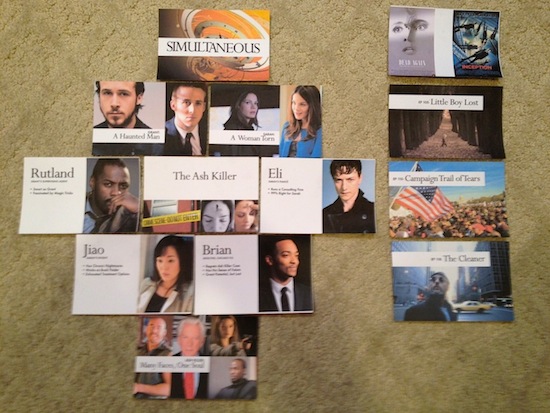
Here’s an example: I adapted the Popcorn Fiction story Simultaneous into a TV series concept, and then built the pilot structure as a modified procedural. When I designed my cards for the polished version, I made a title card (at top), my major characters, their supporting characters, and then the guest stars for that episode (at bottom). My villain/crime for the pilot episode is the card placed in the center; the Ash Killer card.

The right-hand column offers a card with two films as my thematic or tonal touchstone for this project, and then three sample episodes that I had developed. This particular layout of cards resembles a Tarot spread; the Celtic Cross. That was intentional, as one of my characters reads Tarot.

cards example

Again, at this stage there isn’t a lot of words on these cards, because all that content now lives in the Voltron document I built from my first round of index card collecting. These new cards go on my cork wall where I can see them as I write the script. They’re visual cues. They speak more to the characters’ motives than to story, because that can be my blind spot during scripting.

That was a terribly long tangent. Sorry. On to other hardware:

* **Sharpie pens.** For that first round of index cards. I like their fine-point retractable ones, but any will do as long as it’s black ink.

* **Office Depot 4×6 postcard sheets.** The fancy cards. There are other options; Avery makes some, but generic brand works just as well.

* **My Canon MP560 color printer.** For the fancy cards.

What software do you use?
—-

I use Photoshop and QuarkXPress for the card design process, because I worked in print design for many years, but they could just as easily be made in a word processing application. I’m just more familiar with Quark and Photoshop.

For the scriptwriting, I use Final Draft. I’ve worked in Movie Magic Screenwriter, too. Both get the job done.

What would you change?
—

Not to cheat off [Phil Hay’s answer](http://johnaugust.com/2011/workspace-phil-hay), but: I would write more.

I tend to abandon ideas before giving them the proper attention. I have a bad habit of expecting a reader or studio response long before I get one, and I can talk myself out of a good idea like a pro. I need to be better about silencing the voice who discourages new ideas and new hope with my work, because it is painfully easy to say “This won’t sell” or “This won’t survive production.”

There is a town full of people ready to say “No” to my projects. I can’t be one of them.

Workspace: Christine Boylan

December 2, 2011 Psych 101, Television, Workspace

Christine Boylan

Who are you and what do you write?
—

My name is Christine Boylan. Most of my day is spent writing and producing television — I started on [Leverage](http://www.tnt.tv/series/leverage/) (TNT), worked on the sweet but never aired alien invasion series Day One (NBC), then [Off the Map](http://www.imdb.com/title/tt1587694/) at ABC and now I’m a co-producer on [Castle](http://www.imdb.com/title/tt1219024/).

I occasionally write short stories (such as [Hoss](http://www.mulhollandbooks.com/popcornfiction/stories/Hoss_by_Christine_Boylan.html) at Popcorn Fiction) and plays. I’ve also written comic books for DC, Marvel, Boom, Tokyopop and NBC, including two of the Heroes comics.

On the Twitter, I’m [@kitmoxie](http://twitter.com/kitmoxie).

Where and when do you write?

—-

workspaceMost of the time I write in my home office, which is a stone’s throw away from my husband’s office, but, luckily for him, we have doors.

I can write anywhere if I can get the spirit to move me (or I have a heart-stopping deadline) — passenger seat of cars (no motion sickness), trains, planes (usually drunk), the middle of the jungle, etc.

I try to change locations during a long writing session to keep myself going — this might be as simple as moving up to the kitchen and sitting on the annoying bench that hurts my back but keeps me awake, or it might mean just lying on the floor in some kind of weird cobra-pose for an hour and writing there. My office has a giant wood desk that’s more like a table than a desk. I alternate using two different chairs: an Aeron I stole from my husband when I moved in and a [Swopper](http://swopper.com/www.swopper.com/index.html).

I had spine surgery when I was younger, so I try to move around and change positions as much as I can. I have yoga blocks and a foam roller, too. Also, a heating pad. And Vicodin. It’s a back-friendly office.

If left to my own devices, I’m a night person. When I was unemployed and writing my first spec pilot, I would sleep until noon, run errands, and then settle down to write from about 4pm to 8, then break, then 10pm to 4am. That was a very special, very Scotch-driven time in my career.

Now that I’m employed, I find that every TV writers’ room has its own culture and rules, so I adjust my schedule to theirs when the season starts.

John Rogers ([@jonrog1](http://twitter.com/jonrog1)) at Leverage is a productivity nerd, so he likes to use his writing staff to try out new processes. A lot of what we did there has stuck with me: working on a story for 48 minutes, then resting for 12. That one’s inviolable. You can’t fool around too much during a 48, you can’t discuss work on a 12. If caught, John would stop you — “Respect the 12!” — thus inculcating the idea of an earned rest period.

Speaking of rest, Mark Waid ([@MarkWaid](http://twitter.com/MarkWaid)) taught me the value of walking away for a few hours and letting something simmer. If I’ve put in the time, then sleep, then I shower or take a yoga class, an idea will come. Maybe the idea is for the next project, but hell, it’s an idea, and I’ll have it happily.

This has been my schedule since June: I’ll get up at 7, head to the gym for swimming or yoga, then to the Castle offices in Hollywood. We run writers’ rooms all day, usually 10 to 7, and we often have two going at once. Then in the evening I’ll spend two or three hours working on one of my own projects or, if I’m burned for the day, have a drink and watch TV or read.

Weekends are exercise, writing in the afternoons, socializing. If I really need to get a personal project done, I’ll get a hotel room in Malibu or Palm Springs and marathon — room service is very, very helpful.

What hardware do you use?
—-

I have a Macbook Pro at home and on the road, and I sometimes use the desktop Mac provided for me at the Castle offices. If I want a little extra crunch or manual exercise, I’ll hook up the [Das Keyboard](http://www.daskeyboard.com/) recommended to me by the lovely and talented Leverage writer M. Scott Veach ([@mscottveach](http://twitter.com/mscottveach)).

I use an iPad (first gen) for reading scripts and some books (GoodReader and Kindle for iPad, respectively) and watching shows on Netflix or the beautiful HBO Go. I have in the past written entire first draft outlines on my iPhone while on set. (I love being on set. Everyone knows what his or her job is. Boundaries are such a relief sometimes.)

I use index cards — something else I picked up at Leverage — to break story. I have cork squares on an entire wall of my home office, and it’s a nice, big wall space useful for everything from pilots to plays to features. We use white boards at Castle, which I admit I still dislike. I have the distinction of having really terrible handwriting on the board.

What software do you use?
—–

I handwrite my first drafts, which drives some of my colleagues crazy. I don’t know if it’s advantageous or not, but it’s just how my brain works. It’s good to be away from the computer (though I may use the dictionary/thesaurus on the phone or iPad); it’s good to feel the pen in your hand (I use a Libelle fountain pen, because the nib forces me to hold the pen correctly and not hurt my hand); it’s great to see the legal pads (letter sized) stacked up, full of scenes. They may be terrible, they may be marvelous, but they exist, and now you can rewrite them.

So then I type it all up — I use tall document holders from Fellowes (one at home, one at Castle) and I rewrite and edit to an extent while I’m typing that first draft. Then I print and go through it with the red or green pen — the pilot G2 works great. (I can’t stand ball points. Using one feels like scratching nails on a chalk board.) Then I re-type the changes.

If I’m in a real hurry — and on Leverage I had to write the first draft of one episode in a weekend — I’ll get someone in and dictate the script. My gorgeous friend Alex Engel can use all the software and can also read my mind. Unfortunately, he’s now a working writer and I can no longer take advantage of him for long dictation sessions. Sometimes I’ll dictate the boards in the writers’ room to our writers’ assistant at Castle, Adam Frost, and it ends up becoming a rough draft for the outline. Whether I dictate the script or not, I always have a step in the process where I read it through out loud.

Some people are visual, but I’m predominantly aural. I can hear if it’s wrong faster than I can see it.

For software, I use whatever the show uses. My first three shows used [Movie Magic Screenwriter](http://www.screenplay.com/p-29-movie-magic-screenwriter-6.aspx), and I still use it for comic books and stage plays. Castle uses [Final Draft](http://finaldraft.com), which I hadn’t picked up in four years, but I’m getting used to it again.

None of these programs feels particularly elegant to me, though. Hand writing helps me avoid any software frustration early in the process, so by the time I’m typing I feel enough urgency to learn the damn keyboard shortcut and move forward.

For notes and research archives I use [Evernote](http://evernote.com). I don’t know how I ever got along without it…except I do, and the evidence is scraps of paper in project-specific piles all over my office floor.

For organization purposes I swing insanely between [orthodox GTD](http://en.wikipedia.org/wiki/Getting_Things_Done) and [total chaos](http://thegloss.com/career/bullish-how-to-be-a-productivity-unicorn/), but I’ve been through [Things](http://culturedcode.com/things/) and [OmniFocus](http://www.omnigroup.com/products/omnifocus/) and now I use 3×5 cards in a [Levenger Circa PDA](http://www.levenger.com/PAGETEMPLATES/PRODUCT/Product.asp?Params=Category=326-339%7CLevel=2-3%7Cpageid=5654%7CLink=Img).

Sometimes I listen to music when I’m working, usually something without lyrics unless I’m desperately trying to evoke a tone. Then I can put the same song on repeat for a few hours. Otherwise white noise apps are great (I listened to a lot of Amazon jungle sounds while writing Off the Map), and a good, solid metronome helps me find rhythm.

What would you change about how you write?
—

I would eliminate some of the self-loathing that takes up a lot of the energy I need to write. Procrastination is both useful and deadly. Again, if I’m stuck on a problem and I go away for four hours to ride horses, I’ll come back with a solution and I can get to work. But if I’ve procrastinated all weekend and then my time is up, I’m going to go to bed unhappy and have five miserable wake-ups in the week ahead.

I’m a huge fan of Steven Pressfield’s [The War of Art](http://www.amazon.com/dp/0446691437/?tag=johnaugustcom-20) – I have it on my Kindle, I keep a copy on my desk at home, I have an audio version on my iPod. Those lessons unfold themselves every day.

A really good friend of mine, [Jacob Krueger](http://www.writeyourscreenplay.com/ ), instills some of this stuff in his screenwriting classes, acting classes and hypnosis sessions in New York. It’s not about removing blocks per se, but about embracing the part of yourself that puts up those blocks.

Or maybe it’s about needing another Scotch.

My daily writing routine

October 7, 2011 Workspace

A few weeks ago, I mentioned that I use [Evernote](http://evernote.com) as an all-purpose notebook for storing random ideas. Several readers mentioned that it was the first time they had ever heard of it, and wondered what other tools I was using.

So, in the spirit of [The Setup](http://usesthis.com/), I thought I’d give a breakdown of my daily work habits. In the weeks ahead, I’ll be asking other screenwriters to share their routines. I hope to make this a recurring feature.

workspace

Where and when do you write?
——-

I work in an office built over my garage. Until she was four, my daughter didn’t realize that I was approximately 100 feet away when I went “off to work.” She finally caught on, but we’ve been able to set pretty firm guidelines about when she is and isn’t allowed to interrupt me.

I’m “in the office” from 8:30 a.m. to 6 p.m., but I wander in and out of the house pretty freely.

For the past six months, I’ve been doing most of my “morning work” — reading and blog stuff, such as writing this post — while walking on the treadmill. I MacGyvered an old film festival lanyard to hold my iPad 2, and use an Apple bluetooth keyboard. I find I can think coherently up to about 3.2 miles per hour. (Beyond that speed, it’s genuine cardio and I can only listen to podcasts and such.)

When I’m really writing — that is, buckling down on a specific draft of a specific movie — I try to write five pages a day. Page counts tend to be a better measure of effort than time spent in front of the computer.

When I start a new screenplay, I generally go away for a few days. I find that barricading myself in a new hotel in a new city helps me break the back of a story. I hand-write pages, trying to plow through as much as possible; my record is 21 pages in a day. Writing by hand keeps me from editing and second-guessing. At the start, it’s crucial to generate a critical mass of pages.

Every morning, I send what I’ve written to my assistant to type up. I used to fax pages, but on this last trip I just photographed the pages with my iPad and uploaded them to a shared folder in Dropbox. It’s simple, and guaranteed backup.

If I’m writing something specific to a place, I’ll go there. For Preacher, I went to San Antonio. For Lovecraft, I went to Providence. I could sit in the exact spot Lovecraft wrote his stories. That’s a rare luxury.

Otherwise, I’ll go to Vegas. If you’re not drinking or gambling, Las Vegas is a surprisingly good city for writing: when you get stir crazy, you can walk somewhere new. There are lots of restaurants, and no one looks at you strangely for being alone.

I find I can generally get 40 decent pages out of a good barricading session. I won’t paste the scenes together until I’m more than halfway through a script.

What hardware do you use?
—-

When writing by hand, I like a white, lined, letter-sized writing pad with a very stiff back. It should barely bend. I’ve been using some generic Staples brand.

My preferred pen is the black Pilot G2 (.38 size). It’s cheap; it writes consistently; I never worry about losing one. For proofreading, a colored felt-tip pen is key. I like the Papermate Flairs. Again, cheap and losable.

I alternate between index cards and whiteboards for mapping out stories. If you’re going to be working in television, get comfortable with the whiteboard, because you’re going to be spending a lot of time staring at one.

My main computer is a five-year old Mac Pro. It’s overkill for screenwriting, but I do a fair amount of video editing on it. I have an SSD for a boot drive, and big hard drives in the other three bays (including one for Time Machine). I’ll definitely get a new Mac Pro when the Thunderbolt version ships.

I love bare hard drives. They’re amazingly fast and cheap. The [Voyager Q](http://www.newertech.com/products/voyagerq.php) toaster-style dock works great for making drive clones for off-site backup.

Years ago, I had horrible carpal-tunnel problems, so I changed my setup significantly. I use the SafeType keyboard and an [Evoluent vertical mouse](http://www.evoluent.com/). The keyboard is great, but command-key combos are a bear with it, so I’ve mapped a [Logitech G13 gamepad](http://www.logitech.com/en-us/keyboards/keyboard/devices/5123) to handle most of them. (I wrote in 2004 about my [keyboard setup](http://johnaugust.com/2004/my-new-keyboard-setup). It’s largely the same.)

I have a 30-inch monitor dating from 2004. I love it, but it’s easily overwhelmed with windows. I’m trying to use Mission Control on Lion to keep stuff sorted. I use Harman-Kardon [SoundSticks](http://www.harmanaudio.com/search_browse/product_detail.asp?urlMaterialNumber=SOUNDSTICKS3AM&status=) for speakers. I still use the original iSight camera, the one that looks like a stainless steel film canister.

For travel and kitchen duty, I have a 13-inch Macbook Air. It’s as great as everyone says.

I used to talk on the phone a lot more, and found a [Plantronics S12 headset](http://www.plantronics.com/us/product/s12) essential. I still use it, but phone conversations are not nearly as important as they were just a few years ago.

For podcasting, I’m using the [AT2020 USB microphone](http://www.audio-technica.com/cms/wired_mics/a0933a662b5ed0e2/index.html) and [Sony MDR-7506 headphones](http://pro.sony.com/bbsc/ssr/product-MDR7506/). When in doubt, just use whatever [Dan Benjamin](http://hivelogic.com/articles/podcasting-equipment-software-guide-2011/) recommends.

I adore the [ScanSnap S1500M scanner](http://www.fujitsu.com/us/services/computing/peripherals/scanners/scansnap/scansnap-s1500m.html). It’s a monster that eats paper and makes pdfs. I’ve happily gotten rid of most of my physical files with it.

What software do you use?
—–
I do most of my “real” screenwriting in [Final Draft](http://finaldraft.com). I don’t love it. My greatest frustration is usually with its Smart Type Lists, which invariably want to insert extraneous bits of parenthetical detail after character names, so I end up having to type more letters just to get past its unhelpful suggestions.

I’ve also used [Movie Magic Screenwriter](http://www.screenplay.com/p-29-movie-magic-screenwriter-6.aspx), and found it to be approximately as frustrating in slightly different ways. So it’s a case of the devil you know.

In no way am I slamming these two apps; I’m grateful they exist and afraid they might go away. Over the years, I’ve tried out every new piece of screenwriting software that’s come along and found them lacking.

There are small but important details that you have to get right, such as handling dialogue across a page break. ((Dialogue should break at the end of a sentence. Final Draft and Movie Magic Screenwriter are the only applications I’ve seen get it right.)) I’ve played around with two or three different applications built atop Adobe Air, all of which had unacceptable typing lag.

For the current screenplay I’m writing, I’m trying out [Scrivener](http://www.literatureandlatte.com/scrivener.php). It’s complex, but the underlying logic is consistent and smart and fits nicely with my workflow, since individual scenes can get stitched together quickly. I like that the developer keeps updating it.

On the other end of the complexity spectrum, [Freedom](http://macfreedom.com/) is a dirt-simple shell script that blocks your internet connection for a set period of time. It’s a lifesaver.

Other than screenplays, I write almost everything in [TextMate](http://macromates.com/). Yes, I’m worried it’s going to break one day and the developer won’t be around to fix it. Yes, I’ve tried all the alternatives. I’m so accustomed to how it works — and have set up so many macros and snippets — that the switching costs would just be too high right now.

[Dropbox](http://dropbox.com) seems like magic. In addition to storing my active projects, I keep a folder named Pending in the Dropbox with an alias on the desktop. Anything that would normally clutter up the desktop, I throw in Pending.

[Evernote](http://evernote.com) has become my all-purpose inbox. If I come across something interesting that pertains to something I’m writing — or think I might one day write — I’ll throw it in there. Some of my friends use Evernote for their to-do lists, but I’ve found it too unwieldy.

I’ve used a lot of GTD productivity apps over the years, including [OmniFocus](http://www.omnigroup.com/products/omnifocus/) and [Things](http://culturedcode.com/things/). Right now I’m using [Todo](http://www.appigo.com/todo), which has really good integration between the desktop app and its iOS apps. Before I made the switch, I was using [Listary](http://byportmanteau.com/listary) for the iPhone, which is a smart and fast little app I never hear anyone talking about.

Because it’s included with system software, Preview doesn’t get the attention it deserves. You can easily rearrange or delete pages in a PDF with it, or combine multiple documents. It’s amazing and overlooked.

I use Mail, but recently switched my Gmail-hosted addresses over to [Sparrow](http://sparrowmailapp.com/), which I like a lot. I use Google Calendar instead of iCal. I’ve found it works better for sharing.

I do all my RSS-reading on the iPad now, using [Reeder](http://reederapp.com/ipad/). I use the official [Twitter client](https://twitter.com/#!/download/iphonecom) for Mac and iPhone, but [Twitterific](http://twitterrific.com/ipad/) on the iPad. [Birdhouse](http://birdhouseapp.com) keeps me from drunk-tweeting.

What would you change about how you write?
——-

When I first got started writing, I had a lot of bad habits. As I’ve gotten older, I’ve stopped being so judgmental, so now I just call them “habits.”

The life of a screenwriter can be a lot like that of a college freshman. You screw around a lot, then burn the midnight oil to finish that assignment. You don’t necessarily outgrow that.

Ideally, of course, you work a set number of hours every day and deliver your best material. I’m at my happiest as a writer when I feel myself doing that — excited to sit down and write that next scene. But that doesn’t always happen. It doesn’t *often* happen. A lot of times, writing is just a slog.

I’ve fully accepted that it won’t get easier or more fun. But it can stay interesting, and there’s a lot to be said for interesting.

I’m trying to challenge myself to write projects outside of my comfort zone, either in terms of subject or form (e.g. the Big Fish musical). I find writing prose fiction exhausting, but rewarding, so I’ll probably do more.

And while I’ve resisted collaborating, I’m getting better at it. Once Big Fish hits the stage, I’ll probably try another TV show if I’m not directing a movie. Basically, there’s a lot I want to do. Prioritizing what to write is probably my biggest issue at this point.

« Previous Page
Next Page »

Primary Sidebar

Newsletter

Inneresting Logo A Quote-Unquote Newsletter about Writing
Read Now

Explore

Projects

  • Aladdin (1)
  • Arlo Finch (27)
  • Big Fish (88)
  • Birdigo (2)
  • Charlie (39)
  • Charlie's Angels (16)
  • Chosen (2)
  • Corpse Bride (9)
  • Dead Projects (18)
  • Frankenweenie (10)
  • Go (29)
  • Karateka (4)
  • Monsterpocalypse (3)
  • One Hit Kill (6)
  • Ops (6)
  • Preacher (2)
  • Prince of Persia (13)
  • Shazam (6)
  • Snake People (6)
  • Tarzan (5)
  • The Nines (118)
  • The Remnants (12)
  • The Variant (22)

Apps

  • Bronson (14)
  • FDX Reader (11)
  • Fountain (32)
  • Highland (75)
  • Less IMDb (4)
  • Weekend Read (64)

Recommended Reading

  • First Person (87)
  • Geek Alert (151)
  • WGA (162)
  • Workspace (19)

Screenwriting Q&A

  • Adaptation (65)
  • Directors (90)
  • Education (49)
  • Film Industry (489)
  • Formatting (128)
  • Genres (89)
  • Glossary (6)
  • Pitches (29)
  • Producers (59)
  • Psych 101 (118)
  • Rights and Copyright (96)
  • So-Called Experts (47)
  • Story and Plot (170)
  • Television (165)
  • Treatments (21)
  • Words on the page (237)
  • Writing Process (177)

More screenwriting Q&A at screenwriting.io

© 2026 John August — All Rights Reserved.