• Skip to primary navigation
  • Skip to main content
  • Skip to primary sidebar

John August

  • Arlo Finch
  • Scriptnotes
  • Library
  • Store
  • About

Search Results for: index cards

Workspace: The Wibberleys

October 11, 2012 Workspace

wibberleys

##Who are you and what do you write?

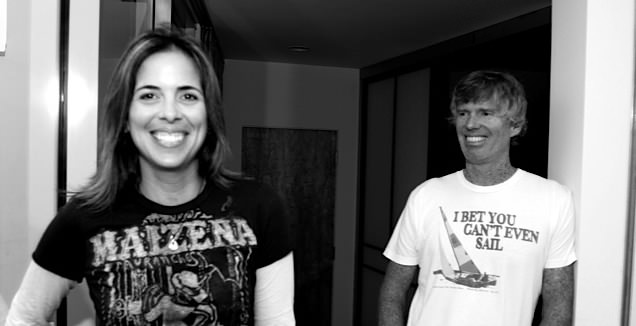
workspaceWe are Marianne and Cormac Wibberley (aka., “the Wibberleys” which is how we are now credited). When we first meet people in the business, sometimes they ask if we’re siblings. No, we are a married writing team. We’ve been married for decades and have been writing together almost as long.

Our most well known credits are the two [National Treasure](http://disneydvd.disney.go.com/national-treasure.html) movies, [Charlie’s Angels: Full Throttle](http://www.sonypictures.com/homevideo/charliesangelsfullthrottle/index.html) (with John August), and [Bad Boys 2](http://www.imdb.com/title/tt0172156/).

We are currently producing a project at Fox and writing the film adaptation of the video game [Uncharted](http://naughtydog.com/games/uncharted/) for Sony. Our daughter is a big fan of the game, so if we screw it up, we’re dead meat.

##Where and when do you write?

Everywhere. Anywhere. Because we’re married, there is no separation of work and personal life.

dogs

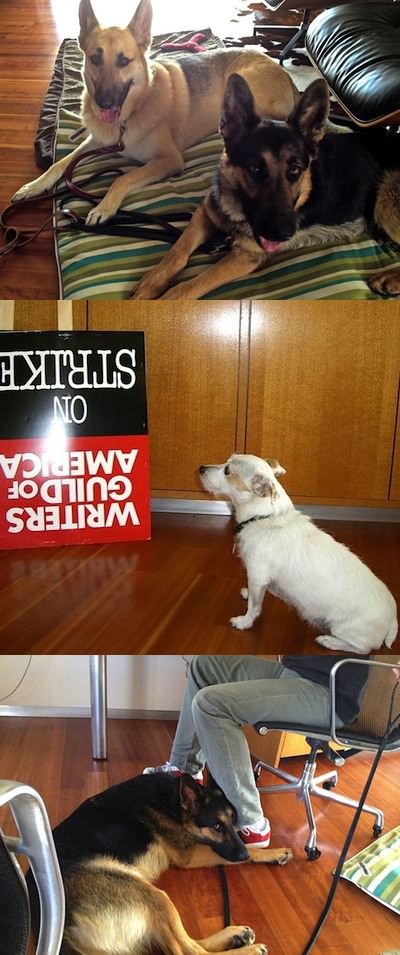
We have three dogs: a Jack Russell and two rescue German Shepherds. Our Jack Russell is easy, but the two German Shepherds run our lives.

They hang out in our office, and our writing schedule is geared around their schedule. We walk them at least two miles a day, and a lot of that time is spent spitballing and brainstorming while watching for cats, motorcycles, squirrels, skateboarders, other dogs, and the dreaded ninja cyclist.

Yeah, sure, they look nice, but they bite. If we’re on a deadline, we get stressed. And when we get stressed, they get stressed and then bad things happen in the house.

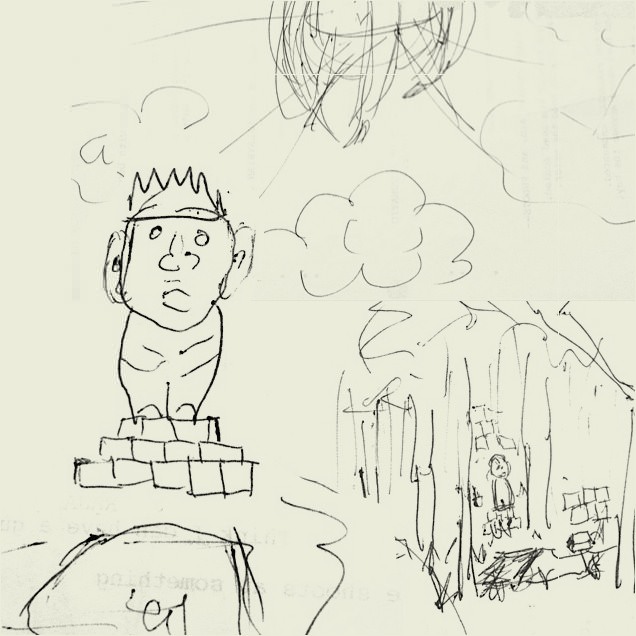
As for our process as a writing team, we do actually sit in our home office and write everything together. Not a word gets typed without us both agreeing on it. This means a lot of our time is spent trying to convince each other why his line of dialogue or her bit of action is better. We pitch feverishly, act out scenes badly, and when all else fails, we draw pictures to convince the other how awesome his/her idea is.

sketches

Here are some other things we keep around the office to inspire us.

A prop gun from our first big movie, [The 6th Day](http://www.imdb.com/title/tt0216216/).

gun

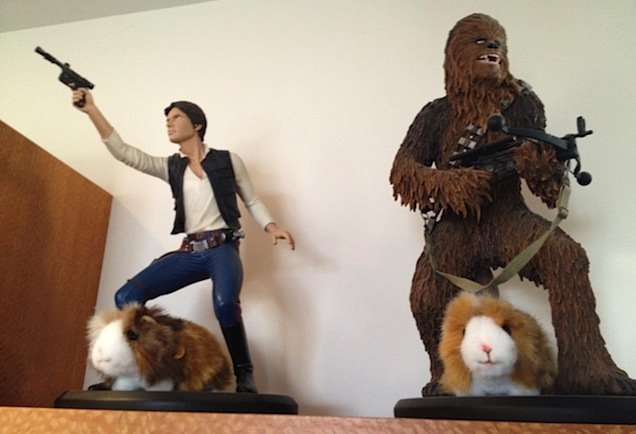
Han, Chewbacca, Sundance & Butch, and…a couple guinea pigs:

star wars

##What software do you use?

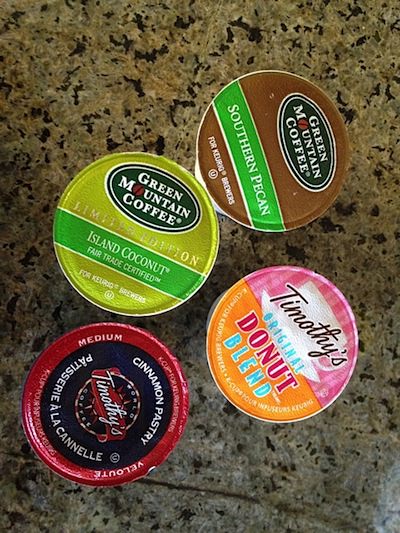
coffee keurigThe most important software we use is coffee. What is our favorite Keurig cup flavor? We have it narrowed down to four (but suggestions are welcome).
For screenwriting, we use [MovieMagic Screenwriter](http://www.screenplay.com/p-29-movie-magic-screenwriter-6.aspx) (but we know how to use Final Draft as well).

Other software: iBooks, Kindle, and Dropbox. We just started using [Pages](http://www.apple.com/iwork/pages/), which is a surprisingly easy yet powerful word processor that you can use on your iPhone and iPad. We also like it because it uses the iCloud without us having to think about it.

##What hardware do you use?

We are a Mac family. We have Mac laptops, a desktop, iPads, and iPhones.

post its

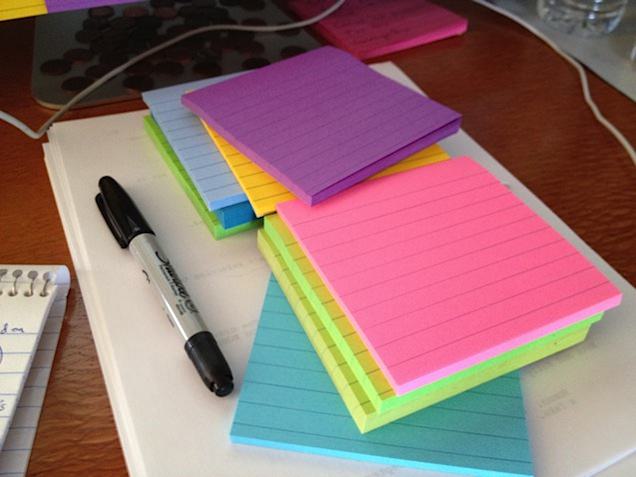
But really the best piece of hardware we use are [these giant Post-Its](http://www.amazon.com/dp/B000WUY67G/?tag=johnaugustcom-20). We started using them recently instead of index cards so we can stick our ideas and story beats to the wall, cabinets, and bookshelves. No corkboard necessary.

We outline using Post-Its and keep the three acts up on our wall while we outline and write the script. The cards are constantly changing, however. Most times, by the time we get to the third act, the story’s been rebroken a dozen times.

##What (if anything) would you change?

We’d like to be able to enjoy our time off, but instead, we just worry. If the phone’s not ringing, it means they hated the draft. And if we’re not trying to write something new, then we worry that like sharks who don’t swim we’ll die.

Scriptnotes, Ep. 41: Getting to page one — Transcript

June 14, 2012 Scriptnotes Transcript

The original post for this episode can be found [here](http://johnaugust.com/2012/getting-to-page-one).

**John August:** Hello and welcome. My name is John August.

**Craig Mazin:** My name is Craig Mazin.

**John:** And this is Scriptnotes, a podcast about screenwriting and things that are interesting to screenwriters. How are you, Craig?

**Craig:** Not bad. I’m a little tired. I’m bouncing back from my 20th college reunion which took place a few days ago.

**John:** And was it festivious? I mean, did you have a good time? Did you see people you haven’t seen for 20 years?

**Craig:** Yeah, for sure. There was definitely… — The nice thing about a 20th reunion is there’s absolutely no embarrassment whatsoever about not recognizing somebody or somebody not recognizing you. It’s been 20 years. What are you gonna do, you know? We’ve had kids. Kids make you dumber. Time makes you dumber. So, it was fine.

I had no shame whatsoever to say, “I’m so sorry, I don’t know, I don’t remember you.”

**John:** Reunions are a little bit different in the era of Facebook because there’s people who I wouldn’t otherwise see but now I do see because I see them on Facebook sometimes. So, I’m looking forward to seeing everybody again at my 20th, but it’s not as pressing as it would otherwise be.

**Craig:** Yeah.

**John:** Today I thought we’d talk about three things. I want to talk a little bit about screenwriting software, sort of where we’re at and where things seem to be going.

**Craig:** Very good.

**John:** Second, I want to talk about how you know when you’re ready to start writing that script, sort of like how you get to page one. That’s something we haven’t talked about. And finally, based on listener requests, they want to know what we thought of the season finale of Game of Thrones. And so I thought we could talk a little bit about that.

**Craig:** Oh good. Yeah.

**John:** First, we have some follow up. In a previous podcast we talked about the challenge of Disney — Disney needed to find a new chairman. It was fairly hard to figure out who the right person was for that job.

**Craig:** Right.

**John:** And so they went out and they found somebody, like a brand new person I’ve never heard of. His name is Alan Horn.

**Craig:** [laughs]

**John:** Oh, that’s right, he’s actually… — He’s done this before.

**Craig:** He’s the former chairman of Warner Bros. And I’ve got to say, I met Alan once at a test screening for Hangover 2. I had no professional relationship with him and generally speaking screenwriters don’t have professional relationships with the people that operate on that level. But from a purely outsiders point of view, kind of a brilliant choice I think on the part of Disney because even though they are not quite a full-fledged studio the way that Warner Bros or Universal is, because they get their Marvel product and Pixar movies and then they kind of just are going to do maybe six movies a year or something like that.

At least with Alan I go, okay, what they’re saying to everybody is we still are in the movie business. “See, we got a movie guy; we didn’t take the TV guy and put him in charge, or the cable TV guy and put him in charge. We actually went with the most traditional movie choice we could think of.” I have to feel encouraged by that. What do you think?

**John:** I think it’s a great choice. I knew Alan Horn from a couple times during Charlie and the Chocolate Factory, and some Corpse Bride stuff. He was great.

But mostly why I think he’s a good choice is really the reasons why we talked about in the podcast, why it was such a difficult job is you had to maintain these relationships with some really big, powerful, important people who are going to want their own things. So you have the DreamWorks deal. You have Stacey Snider. You have everybody there who they’re making movies for you. You have Marvel. You have Jerry Bruckheimer. You have these big producers who are creating a lot of your stuff and you need somebody who’s able to maintain those relationships, get what you need, make everyone feel like they’re being respected. And he has the experience to do that. So, it’s a good choice.

**Craig:** Yeah, sure. I was surprised. I mean, I guess I never even thought of it because he was retiring, you know? But why not? Sounds great to me.

**John:** Yeah. Second bit of follow up. Amazon Studios announced this week their first movie that they’re going to be making. It’s Zombies vs. Gladiators. Clive Barker directing it.

**Craig:** Mm-hmm. [laughs]

**John:** So what’s weird is I was looking through the news releases and they didn’t mention the writers at all. Well, who wrote this thing for it? And I kept looking through and I kept trying to find the original press release, and I still have not been able to find who wrote Zombies vs. Gladiators or if they announced it all.

**Craig:** [sighs] So, you know, Amazon, you guys frustrate me because you just come up with the dumbest program ever. John and I give you a big bunch of grief about it. You do the right thing, make a deal with the Writers Guild. You, more than anybody, were incredibly open about the fact that it all begins with a script. You finally make a movie and you don’t mention the writers. I mean, come on. Come on!

Now I’m angry. Hey, it’s gonna be a good podcast!

**John:** [laughs] Yeah, we’ve gotten Craig angry. I don’t know what to say to Amazon. It just feels like a really weird, dumb choice. Because if they’re going to trumpet their system and how they were able to get to this point based on their system of development then you should talk about the people who were involved in that system. And that feels like a frustrating choice.

**Craig:** Yeah.

**John:** So I can’t help but kind of wish Amazon well, because I want them to succeed, and I want them to be able to make movies and spend money in the industry because I think more people need to spend money in the industry. I’m just frustrated that they chose not to trumpet the right things in the press release.

**Craig:** I know. And just to be clear, this isn’t about ego. If it were just a matter of professional pride I would choke it down because I don’t really care about stuff like that. The issue here is when you don’t talk about the writer, and when you just go… — I mean, look, who’s directing? Clive…?

**John:** Clive Barker.

**Craig:** Okay, I mean, great. But it’s not like Clive Barker is Martin Scorsese.

**John:** Not a bit.

**Craig:** I mean, he’s a pulp novelist, and a fine one at that. But, I mean, come on. You know, when you don’t mention the writer what you are doing is by extension perpetuating the culture that sort of says, “Well, you know, but the script, who cares. The most important this is that we got Clive Barker to direct Zombies vs. Gladiators.” It’s actually not the most important thing. You wouldn’t have gotten there without it.

Why don’t you extend some respect and actually make screenwriting something more people want to do, especially if you’re running a business that is trading on screenplays? Argh! Come on. Stupid.

**John:** Next bit of follow up: Last podcast we talked about we’re going to do a live version of Scriptnotes at the Austin Film Festival and we’re very excited about that. But we’d love to do some live episodes here in Los Angeles. And so we solicited some listener feedback on places where we could do it, and we’ve gotten like a lot of really good suggestions. So, thank you for that. If you have further suggestions for a venue we could use we’ll certainly add them to the list.

Ideally we’d want some place that we could control for the night, have some people in there. It doesn’t have to be too many people, but enough that we could actually solicit some feedback. Drinks would be fantastic, but not required. So, if you have more thoughts, you’re always welcome to send them in.

**Craig:** And, of course, proximity to the Pasadena is always appreciated. [laughs]

**John:** Yeah, Craig doesn’t want to drive to the west side. And really I don’t either. [laughs]

**Craig:** And you don’t either. Yeah, I think, I would say sort of east of La Brea, north of Downtown would be spectacular.

**John:** I went to a really good video game little summit meeting thing that was done at Bergamot Station which is in Santa Monica. And so I was like, wow, Bergamot Station is fantastic. But I’d never want to come back to Santa Monica at night; I never want to fight traffic to get there.

**Craig:** Oh yeah. I was working for Bruckheimer for awhile. And those guys, I love those guys, but man every time they would do this to me. They were like, “Look,” they would always apologize, like it mattered. Like apologizing to me was going to fix what was about to come and then say, “We need you to come in tomorrow and the only time we have is 4 o’clock.”

So, you know, getting to Santa Monica from Pasadena by 4 isn’t the end of the world. But then you have an hour and a half meeting and it was always lengthy. And by the time you’re out it’s 5:45, or 6, and I would just make dinner plans ahead of time. I would just stay because you simply couldn’t get back from there.

**John:** Listeners who don’t live in Los Angeles can’t possibly understand the east/west divide, it’s not about territory or anything else, it’s just so hard to move east/west in this city that if you get stuck at the wrong place at the wrong time you’re in for a really hellish amount of sitting around.

**Craig:** And I should also mention it’s just as hard to move north and south. [laughs] Yeah, and there’s a diagonal that’s also brutal.

**John:** Yeah.

**Craig:** The 101 is sort of diagonal. And I don’t know if you guys have seen the sketch, the recurring sketch The Californians on Saturday Night Live; the running joke is that everybody in the midst of high drama is constantly advising each other what routes to take to avoid traffic. [laughs]

**John:** [laughs] It’s horribly accurate. What I will say about the north/south split is that most of the business of Hollywood sort of takes place on an east/west axis, and so you don’t have to go north or south that often. Unless you’re like shooting something down in Long Beach and then just god help you. Just god help you.

**Craig:** Well, the worst of it is, I remember talking to, there’s a… — Mark Vahradian, he works with Lorenzo di Bonaventura I think; they have a deal at Paramount, producers. But Mark was a Disney executive and the very first thing I did for Bruckheimer was way back in like 2000 or something like that. And Mark was the executive and he would have to go from Disney to — and Bruckheimer is like Olympic and 10th, or some horrifying Santa Monica location — and he’s like, “This is the worst possible… — because now I have to go west and south, and then I have to go north and east.” And we could only have meetings basically at 1 o’clock. It was the only time that would sort of save us all the grief.

It’s awful. Awful.

**John:** Yeah. Skype. Skype is really what you need. And the Bruckheimer people, if they’re going to have like hour and a half meetings, just get good at Skype. I have not seen Craig Mazin in person in months.

**Craig:** Right!

**John:** And I’m better for it and we’re able to make this podcast.

**Craig:** Right. If we can do this, I mean, can’t we just have a discussion via Skype? But it’s gotten to the point now where honestly I don’t, and this isn’t going to come as any — no despair will result at Sony by me saying this, but I don’t want to really work there. It’s too far away. [laughs] Not that they’re pounding on my door, but it’s far away! And then Bruckheimer is even more far away. Forget it.

**John:** Yeah. Nothing to do. Let’s move on to our big topics, our three things. First off I want to talk about screenwriting software and sort of where we’re at because, I don’t know if you can tell, I’m actually kind of floating a little bit today because I finished a script. I finished a script this afternoon.

**Craig:** Congratulations.

**John:** Thank you. And as we talked about on an earlier podcast, you don’t do anything special to celebrate. And I don’t usually do anything special to celebrate, but this was like a long time coming. You know what this project was. To actually be done with it is just a huge weight off my back. I can’t sort of talk about the project itself, but I can about what was different about this one — it’s the first thing I ever wrote in Scrivener rather than writing it in Final Draft or Movie Magic. I wrote it in Scrivener.

And so I wanted to talk a little bit about what that experience was like. Have you downloaded it? Have you ever played around with it?

**Craig:** I have. And I didn’t… — It was a little, um, because it’s not simply for screenwriting, it’s for outlining and idea collecting, whatever, it just…

It was too much.

**John:** It seems like too much. And they have really good tutorials that can sort of walk you through it, but still like that first window opens and you’re like, oh my god, there’s just too much on the screen. I can’t.

**Craig:** Too much. Yeah.

**John:** Yeah. And so you can get rid of a lot of that stuff. And, some of that stuff is really ingenious, but the short version of this review, if people want to fast-forward, is that Scrivener is an amazing application if you’re writing a novel because it can organize things in ways that are just spectacular. And you can do several little things for your character stuff. And it’s really smart about that, and keeps chapters separately, and I ended up keep scenes separately.

So, I’ll talk you through sort of my workflow on it, and the things I liked about it.

**Craig:** Okay.

**John:** So, as I’ve discussed before, when I start to write a project I usually go off and barricade myself someplace and I just write scenes by hand. And I send them through and Stuart, or whoever my assistant is at that time, types them up and puts them in a folder. And then at some point in the process I will gather together all those little typed up things and make the full script. But I usually won’t do that until I’m like 50 or 60 pages into it so that I’ve broken the back of it.

What Scrivener is very good about is how it will let you keep those files separate. And they gather in sort of like a notebook and then at any point you can sort of combine them or split them apart and they’re still there.

So, you can work on this one little scene, or the next little scene, and not see everything else that’s around it. When you’re working on a long and real full screenplay in Final Draft there’s that constant temptation to scroll up and scroll down, and scroll up and scroll down. And you’re just working on this little piece in the middle, but then you want to kind of look back at that thing there. This kept me really focused on this is the scene I’m writing. Each little scene is like a little slug line over the left hand side and I’m only working on that. And it’s all I’m seeing; I’m not seeing above it and I’m not seeing below it, unless I choose to go see something above it or below it.

And it was very good for helping me focus. It has a really good full-screen mode, which I’ve come to appreciate.

**Craig:** Yeah.

**John:** So, the sides go dark and you’re just seeing your main text. You can zoom in and get your text nice and big. And it does a pretty good job with the screenplay formatting. It does some of the same matting things that Final Draft does where you put the wrong name… — God help you if you type someone’s character name wrong. And it provides that 1,000 times and you have to go through and clear the smart type list.

**Craig:** Right.

**John:** It does a bit of that. A few times grabbing the wrong element. But on the whole it was fine. And so if someone has Scrivener and they say, “Could I write a screenplay in it?” Yeah, you could. That said, when I was done today, one of the first things I did is I exported to Final Draft and sort of — I made my clean up in Final Draft.

**Craig:** Yeah. And just to be clear: Scrivener’s composition area for screenplays, does it have essentially the same kind of function that Movie Magic or Final Draft does where it organizes it by action, character, dialogue, parenthetical?

**John:** Exactly. So, your basic elements that you’re selecting work largely the same way, little selectors at the bottom of the screen. It does a reasonably good job of guessing what the next element should be most times. A few times I got a little frustrated, but a couple is fine.

**Craig:** And it’s a tab-enter?

**John:** Tab-enter, that whole kind of thing.

**Craig:** All right, well, that’s a pretty good review. I mean, but then again, you went running back to the comforting bosom of… — Well, I don’t know how comforting that bosom is.

**John:** It’s not comforting.

**Craig:** The rocky, unsightly bosom of Final Draft.

**John:** I wanted to go out to Final Draft because I knew I would need to ultimately be there to do some stuff. I mean, down the road I’m going to have revisions, it’s going to be there.

**Craig:** Right.

**John:** And there wasn’t so much that was so amazingly better about Scrivener that I was going to want to stay there rather than be in Final Draft for the real stuff.

Oh, but I will say that the most illuminating thing about being in Scrivener for this whole script is Fountain, which is the other project I’ve been working on here, which is that plain text screenwriting format that we’ve been developing, I’m definitely going to write my next script just in Fountain.

So, Fountain is just text. There’s no formatting. It’s just character names are uppercase, dialogue is the line below a character’s name. That’s what we’ve been working on here and we have Highland which is the utility for it. And it wasn’t quite ready for me to start working when I was starting this draft, but I totally from now on would write a first draft in that.

**Craig:** That’s your plan?

**John:** That’s my plan. Because I feel like we focus so much on getting, like, the margins right and getting everything to look like a screenplay a little too early in the process. It’s like we’re picking out fonts for the book we’re going to publish back when we’re still typing it. And you can really type it without getting all of those margins stuff ready.

**Craig:** That’s right. I have become comfortable, I suppose, with my OCD in that regard. And I think I don’t have it any better or worse than the average screenwriter, you know. I do have a concern about how the page looks. I don’t like important revelations to be split up by a “more,” “continued,” and page break. You know, stuff like that.

**John:** Mm-hmm.

**Craig:** But, yeah, I mean some of it is just sort of fussy delay tactics to provide the illusion of control over something that you are hanging onto for dear life.

**John:** I would say that I’m actually OCD about all those same things, but I’m pushing back that OCD to the point that I’m really compiling the whole script together.

**Craig:** Right. When it matters.

**John:** When it matters. Because I shouldn’t be focusing on any of that stuff when I’m just pushing the words around on the page. And so a lot of my frustration with, like, “Oh it thinks that element is this when it should be this,” well I shouldn’t be worrying about that at all. It should be perfectly clear — I know that’s my character’s name, and I know that’s dialogue; I don’t need the program to do anything for me right now.

**Craig:** It’s funny. Sometimes what I do is I will take a walk and think the scene in my head, write in my head essentially. And then when I get back I will just email to myself in nothing but text, and almost no description at all, really just the flow of the dialogue, because I know what’s supposed to go around it. And then when I sit down and write I am essentially compiling it myself instead of having — but even then what I’m writing is an even more bare bones version of what you’re doing.

**John:** But honestly, what that bare bones you’re doing, that is essentially Fountain. Fountain can take an email and make it into a script. So…

**Craig:** But I don’t even write character names. So it can’t do that.

**John:** No, it’s can’t. It’s not psychic.

**Craig:** It’s not magic, John.

**John:** It’s almost magic, but it’s not magic. It can’t quite do that, but it’s very close to that.

**Craig:** It’s close to wizardry. I’ve been a little behind. You know, my secret hope for the future is Fade In, which is this wonderful piece of independent screenwriting software that Kent Tessman has authored. And I’m a little behind because I got a version a couple months ago and I started working with it and discovered three or four things that I knew weren’t right that needed to change. And I spoke with Kent about it and he finally agreed.

And I liked why he did them, because he was sort of saying the way that things are isn’t sort of normal. And I had to sort of explain that screenwriting isn’t really normal and it needs to be.. — You know, things like when you delete things, normally you would want to pull stuff up, but in screenwriting you don’t. You actually want to leave everything where it is. Kind of. I mean, not pull up, but like you don’t want to move elements up. You want to leave them in their box.

So, I haven’t had a chance to see the latest version. But I would love to write my script on Fade In. So, that’s where I… — Because it is cleaner, and prettier, and full-screen beautiful. And I like it.

**John:** Yeah. I didn’t sign a non-disclosure agreement, so I don’t think I’m violating anything weird by saying I had a chance to see Final Draft’s iPad Writer. So, they’ve announced that they’re going to make a writing app for the iPad. And you know what? It’s actually pretty good. I was actually kind of impressed by it. So, it’s really Final Drafty, but it seems really functional. So, it’s another choice that screenwriters will have down the road.

**Craig:** I don’t like writing on an iPad. It’s very slow.

**John:** Well, with a proper keyboard I’m sure it’s much better.

**Craig:** Yeah, I guess. But then at that point just give me my laptop. You know what I mean?

**John:** A case can be made for that.

Enough on screenwriting software. Let’s segue onto just the whole genesis of when do you know that you’re ready to start writing a script? This is a thing that came up in a discussion I had at the Outfest Screenwriters Lab yesterday, sort of how do you know that you have enough set and ready to start writing.

And it came up because there’s one guy who I was talking to who had a project that sounded really cool, incredibly ambitious, but he’d been sort of gathering his pieces and doing his outlines for more than a year. And I said, “No, no, no. You need to actually write because you are going to become one of those writers who never actually writes but is always planning for like the big thing.”

**Craig:** Yeah. That’s kind of the opposite of the more common problem which is the whole, “I find it as I go.” Yeah, that which I really don’t like.

**John:** There’s two reasons why writers, I think, often fail is that they started writing too soon, because they really knew how the story began, so they wrote that. And they were so excited and they had no idea what happened after that point.

**Craig:** Right.

**John:** So they lose their enthusiasm. They have ten interesting pages sitting there. Or the writers who just kind of never start because they’ve just been staring at it for so long and trying to figure out those little things that at a certain point they needed to just jump off the cliff and see what happens.

**Craig:** Yeah. And writers, of course every writer must be accountable to their own brain and what works best for them. You know, some writers require a kind of a scene-by-scene understanding. I have sort of over the years found myself basically using an index card system. I need to know what basically is happening in each scene and what the purpose of each scene is, all the way from beginning to end. And, you know, I don’t know; I’m looking at actually right in front of me are the index cards for ID Theft. And, you know, there’s about maybe 15, 16 cards in the first deck. There’s probably 20 cards in the second. And five cards in the third.

So it’s not a tremendous amount. But I know what all the scenes are. And more importantly, I know what the movie is. So everything is written with that purpose and unity. But once I have that I start.

**John:** Yeah. For me the issue is I don’t need to have all the cards, but I need to know what the movie is. And to me knowing what the movie is isn’t just knowing where the movie starts. I need to be able to picture several scenes in the middle of the movie that feel like, okay, I get what that movie is; I see what that thing is. I know how that’s… — I don’t necessarily need to know quite how I’m going to get to that thing, but I need to know what that thing is.

**Craig:** Right.

**John:** So, I need to be able to picture those moments. And this script that I just finished today, it sort of sat in my head too long because it got pushed back because of other stuff that came up. But by the time I could sit down I could really see what all those big moments were along the way, and I could see what sort of the reversals were with some characters, and I knew what was going to be fun. And I also knew that all of those moments were going to feel like they were part of the same movie, even though they were different colors and different textures, and things were going to change over the course of the movie, I knew it felt like one thing that wanted to stay together.

And I’ve found that at a certain point, this happened with The Nines, too, where like the ideas will say, “Okay, you either have to write me or abandon me.” Because it’s taking up so many brain cycles to sort of keep it alive in your head that you have to, “Okay, I’m going to sit down, and buckle down, and actually get this on the page.”

**Craig:** Yeah, you know, it’s funny. What you just described is sort of where I am right before I fill in all the other cards. And that’s a perfectly reasonable step to skip because I don’t start writing cards in sequence. The first thing I need to know is what is the idea, what is the premise, who is the hero, and how does it end because what is the theme? What is the argument of the movie on some level or another?

And then I come up with those big goal post moments that are in the very big, broad sweeps. You know, there’s probably only four of them in the movie, I think, you know. And then I start to fill in around them to connect them together. But I could also write from goal post to goal post. I don’t have to do index cards. It just makes me feel better. And, of course, as you start writing you realize, oh, my index cards are stupid now; I don’t need them.

But the other great thing about index cards I will say is that when I am done with the content that was indicated by the index card, then I draw a big red Sharpie across it. It feels so good.

**John:** Yeah. The satisfaction of knowing that you’ve done some part of it, that it’s finished. I don’t do a lot of that outlining stuff until I get pretty deep into writing the script, and then I can start to figure out, “Okay, what do I have left to write?” And then I make my list of like these are the scenes I have left to write, and then it’s incredibly rewarding to be able to scratch those through.

**Craig:** Yeah.

**John:** And for whatever reason I always end up at the right page length.

**Craig:** Always. I always do.

**John:** My friend Rawson who I love dearly but is like, “Oh, I got the first draft done. It was like 170 pages.”

**Craig:** Come on, Rawson!

**John:** Something did not work right there, because you should not be writing a 170-page script.

**Craig:** And that to me is, and I love Rawson, too — he’s a great guy and he’s a very good writer. So, you know, obviously he has his process. I mean, my whole thing is I don’t want to write 170 pages. I feel like I’m wasting everybody’s time, including my own. I want to kind of figure out the right 60 pages to cut before I write the 170 pages.

**John:** Mm-hmm.

**Craig:** So, I actually start to do that. One of the great things about outlining and index carding out your movie is that you can really just see where it suddenly starts to get sodden and limp. And then you compress and typically… — I actually don’t get scared when I see like, “Oh god, there’s like five scenes here, there should be one.” I just think, “Or there could be one really good scene that layers in a whole bunch of these things so it’s not so linear.”

And I routinely land between 107 and 119, like every time.

**John:** Yeah. I was 114 pages when I printed.

**Craig:** Look at that. I believe that’s right in the middle of my thing.

**John:** And so here’s the thing, because I was doing it in Scrivener I didn’t compile it until I was really all done. So, literally until this afternoon I had no idea how long it was.

**Craig:** Oh, that’s like, “What will our baby be? Oh, it’s a boy!”

**John:** Yeah. There were two choices. But, well, you hope there’s two choices.

**Craig:** Right. “Oh, it’s intersex!”

**John:** Yeah, the life became challenging, but potentially rewarding and maybe there’s a great narrative to be found there.

**Craig:** Oh, it’s a Rawson!

**John:** Oh, come now.

**Craig:** [laughs] I hope Rawson listens to this.

**John:** Yeah. Rawson’s busy. Rawson is going off to direct a movie. But he does listen to the podcast sometimes.

**Craig:** Oh, that’s right. We’re the Millers, right?

**John:** Yeah. Here’s how Rawson will find out about this podcast. I’m sure Rawson has a Google News Alert setup. And so when the transcript of this podcast is posted he will get a Google News Alert, and then he will know that we talked about him.

**Craig:** Right. So in that Google News Alert will it mention that Rawson is, and now we can fill in anything we want.

**John:** Absolutely. Because that will become part of his little Google profile.

**Craig:** Will it mention that Rawson is a synthetic life from?

**John:** [laughs] Yes. That’s already well established.

**Craig:** Yeah.

**John:** Craig, before we go to our third point, there’s something I meant to bring up earlier, because an amazing thing happened this last weekend. For the first time I got a script that they wanted me to read over the weekend, it was kind of a high priority project for these people, and I’m the company that makes Bronson Watermarker. So, I do understand people want to watermark their scripts so they don’t get circulated beyond places.

And I’ve dealt with, like Marvel, who’s really notorious for super watermarking all of their stuff. So, I’m pretty used to watermarking. This time what they sent over was not the script. They sent over an iPad with the script as a PDF in iBooks. And it’s a big old, well that’s not very secure. But, what they’ve done is they’ve turned on parental lock controls for the whole thing.

**Craig:** Ah!

**John:** And they have taken out all of the web accessibility and stuff. So, I’m sure there probably was a way that a person could get it off, but it would be really, really hard to get that script off the iPad. So in the end I was kind of impressed by it. That’s not a bad way, if you need to give a script to somebody and make sure they read it but don’t do anything else to it.

**Craig:** That is pretty smart. I did not, yeah, I’ll have to see. I mean, I’m sure within four minutes on Google we can figure out how to foil that. But, still, not a bad idea.

**John:** Pretty good.

**Craig:** Yeah. And, plus, it’s fun. If somebody sends me a script by email or messenger or something, then it’s on my pile of things to read. But if somebody sends me a script on an iPad, I just want to read it. [laughs] I want to read it right away.

**John:** So, Craig, I’m going to send you over this script on an iPad so that you’ll actually read it.

**Craig:** Oh, yeah, because I did read 30 pages of your script and just…[laughs]

**John:** Yeah, the one that I sent you before. You were like, “Oh, yeah, I’ll get to it.” Yeah, that was very helpful.

**Craig:** By the way, I, um…

**John:** Yeah, Craig is a little behind on reading something. But you know what, Craig? You can stop reading that for reasons that I’ll talk to you about offline.

**Craig:** Well you see then I really saved us both time. [laughs] But the truth is until you just said that I forgot. I totally forgot it! I feel terrible. Because I knew I had read 30 pages and was like, “I got to finish that,” and then it left my mind. And you, honestly, are either incredibly patient or you were just really setting a trap for me because you never mentioned it again. And so then I forgot. I’m sorry.

**John:** Yeah. It’s okay.

**Craig:** It was a good first 30 pages, though.

**John:** You know, a script that might circulate on an iPad because they certainly don’t want people to know spoilers is Game of Thrones.

**Craig:** Yes.

**John:** Segue into our last topic of the day. How about that season finale?

**Craig:** I liked it a lot.

**John:** Yeah, so again, spoiler alert here, because there’s sort of no way to not talk about spoilers for the season finale of Game of Thrones. But we had talked in an earlier podcast about how amazing the season was and my only one frustration was I felt like the Qarth plotline was sort of tap dancing around a bit because they clearly had a big reveal and they weren’t ready for it, so they were just sort of stalling to save that for the season finale.

But the stuff in the season finale was really good.

**Craig:** It was. Although I will still say, okay, so I mean I guess we should put the spoiler alert on for anyone who hasn’t caught up yet, bizarrely. The zombie army at the end was awesome. And everything, as always, with Dinklage was awesome. And Brienne had a great moment. That was sick. Loved that.

I mean, there was just a lot of great, great stuff in it. And, oh, a really funny moment, I mean a sad but funny moment with Theon and his guys clocking him and, like, “I thought he would never shut up.” That was great. I did not see that coming, so, well done as always with those guys.

The Qarth thing for me ultimately, I was like I just, I’m not sure if any of that was really worth it in the end because, you know, remember the first season ends with this amazing moment where this girl who had been kidnapped and sort of subjugated by her mean brother and then her rapist husband, sort of blossoms into this incredibly self-possessed woman who then at the very end survives fire and hatches dragons which — that’s quite an arc.

And this season she went to a town and then the dragons sort of lit a guy on fire.

**John:** Yes. What I will say is that if you take out what I thought were the placeholder moments that happened in a couple previous episodes, and you just took a look at what she did in this episode, yes, she goes into that tower, but then she also goes through that temptation sequence where she ends up at the Wall, she ends up back with her husband. She sees the throne, but like everything has changed around it. She has her temptation sequence. I thought it was very, very cool. It felt like it sets her up as a truly kind of mythical creature.

I like that she defended herself as like, “Well what about my magic?” And that defining kind of stuff. And the warlock saying, “You know what? It’s because the dragons are here that the magic is increasing in the world,” which is cool.

**Craig:** Right. I like that. I mean, it certainly made sense of why they were doing what they were doing, because for the life of me I couldn’t understand why until that moment, and that was good. And, in fact, because I always read the… — There’s a guy who does reviews for Wired and he reviews Game of Thrones, and he reviews it entirely from the point of view of somebody that has really obsessively read the books. And so he tends almost always to bemoan any deviation from the source material.

But, I actually don’t think that was in the source material. I think that’s something that Dan and David came up with. And even he begrudgingly was like, “I guess that’s pretty good.”

**John:** [laughs]

**Craig:** You know, I mean, he’s the grouchiest guy. I mostly read it because I just find it kind of ridiculous. It’s like the point is not to simply film every word you’ve read, sir.

**John:** Yeah.

**Craig:** But that aside, I mean, that’s a minor quibble. And she’s great. All the performances were great. But it’s hard to do a final episodes that is, and it’s the same thing they did last season. Remember, the penultimate episode was the huge one, where they chop off Ned’s head and they have the battle this season, and then this ultimate episode kind of just to tease you off for the madness to come.

**John:** What I thought was smart about the episode, just to praise it a little bit more, is even though they had to skip around to so many different plotlines, it all felt like they were part of one universe. And I felt like it was one bigger message, and that all these things were going to be coming back together. Because the two young princes have to flee the burned city. It’s like, we’re going to head north to the Wall for safety.

**Craig:** [laughs] Right.

**John:** And like the zombie army is coming!

**Craig:** The zombie army is heading south towards the Wall. Right.

**John:** And establishing the small new things in the world, like, oh, the assassin, well he’s actually magical. Like he’s some sort of changeling kind of creature. That was…

**Craig:** That was cool.

**John:** Those are all important things.

**Craig:** That was cool. And got to give credit to the director. I don’t know if it was Nutter who did this last one. But, I mean, all the episodes have been extraordinarily well directed. It’s hard to direct television like that because I would imagine they’re producing these things in huge chunks. They don’t do them episode by episode. They’ve got to do all the stuff in Iceland. They’ve got to do all the stuff in Ireland.

And, so, they managed quite beautifully over many directors and many different locations and completely out of sequence to maintain these wonderful transitions and hold everything together. The show is very well written and very well acted. And you talked about the cast, but the direction is also excellent.

**John:** Hooray for Game of Thrones.

**Craig:** Tech credits were astounding.

**John:** Yes. Craig, do you have cool stuff this week, like One Cool Thing?

**Craig:** I don’t. You know, you always do this to me. I don’t…

**John:** I would say that most of our listeners have an expectation that often there’s a One Cool Thing.

**Craig:** I don’t — nothing’s cool.

**John:** Nothing’s cool.

**Craig:** [laughs] My One Cool Thing is being bored. Bored. What do you have? Tell me something cool.

**John:** I’ll tell you something cool. I don’t know if you’ve… — You play games like Ski Racer, that thing I got you hooked on.

**Craig:** Ski Safari. That was cool.

**John:** Ski Safari. That was good. So, I was looking around and I wanted to see both for sort of my daughter who is starting to learn some basic kind of programming kind of stuff…

**Craig:** Nerd!

**John:** Nerd! Super nerd. Super geek dad. And so I wanted to see are there simple little game tools because I really basically want her to have HyperCard, but HyperCard doesn’t exist anymore. And the things that are like HyperCard are really far too complicated and big and huge.

And so I was like, well, is there a way to make little Flash games? And I found this thing called Stencyl that’s genius. And so what it essentially is is a development environment for creating little flash games or little iOS games, but it’s all little blocks of code that click together. So you’re not typing statements and functions. You’re just setting parameters on things that can move in the world. And it’s incredibly smartly done. I don’t have any real sense of how big the company is that’s making it, whether it’s one incredibly maniacal person behind it or a bigger team.

But the things that you’re able to do are really, really impressive. And they’ve very smartly leveraged, there’s a beginning programming system called Scratch that MIT had made that I had seen years ago. And it was a good idea that never sort of fully developed. And Stencyl has sort of taken that idea and run with it.

So, I would recommend Stencyl to anybody who’s interested in making little Flash games, or anyone who wants to teach their kids about moving stuff on the screen.

**Craig:** It sounds like something my son would love. Is it web-based?

**John:** Yeah, because your son does little animation stuff. It’s downloadable. It’s on the Mac.

**Craig:** Oh, it’s on Mac.

**John:** It’s on the Mac and PC. So it’s an actual application and so it doesn’t have all that sluggishness that web-based stuff tends to have.

**Craig:** Oh great. It sounds like something he would absolutely flip for because, yeah, I know my boy.

**John:** You know your boy.

**Craig:** I know my boy, and that sounds like…

**John:** And so it comes with a bunch of little demo games that you can play right there and then you can just open them up and change all the parameters and see how stuff works. And it’s smartly done.

**Craig:** Ah, all right. Stencyl.

**John:** Stencyl. And it’s spelled S-t-e-n-c-y-l.

**Craig:** C-y-l, so it’s like the stripper version of Stencil.

**John:** [laughs] Absolutely. Stencyl-Lynn would be the stripper name.

**Craig:** I do have One Cool Thing. I have One Cool Thing. The trailer for our friend John Gatins’ Flight.

**John:** I’m happy to link to that.

**Craig:** Yeah. Flight is a script that John Gatins wrote ten years ago, I think, maybe longer. And it’s a very interesting story and in part sort of inspired by his own life, not the part with the plain. But I’ve been listening to John talk about this script for a long, long time. And then it all sort of came together. Robert Zemeckis returned to live action directing, and Denzel Washington, and all that stuff sounds great. But I was always sort of nervous about it just because they’re making a movie, I think the budget is like $30 million or something like that, or $35 million. Very low budget considering what they had to do and who’s in the movie, I mean, Denzel, and Robert Zemeckis. Everybody is obviously working for the love of the movie.

And I just get tense when I see trailers and things for friends’ movies because sometimes they just don’t look good, and then what do you do? And it doesn’t mean the movie is not good, it just means that I start worrying for them because the marketing is off.

And then I see this trailer for Flight and I’m like, it’s just — it does everything right. And I would love to find out — if any of you out there know what trailer house and specifically what editor cut the trailer for Flight, I’d love to know. Because it does everything right. I mean, it’s so smartly done. This is a trailer where you start off with a pilot and he’s on a plane and there’s a plane crash in the movie, okay; I’m not giving anything away there.

And every other trailer would have just shown the plane crash and then said, “And then…” You know? And this thing, he’s just flying a plane, and the next shot is he’s waking up in a hospital. And you don’t see the plane crash at all. And then over the course of the trailer they give you drips and drabs of his plane crash. And then there’s one final shot.

**John:** That shot, I get goose bumps just thinking about that final shot.

**Craig:** Okay? Just thinking about it. And my deal is, and I wrote something for, you can dig it up for the links if you want, for WordPress [*sic.*] many years ago about marketing and how screenwriters can help marketers in one little tiny way. And that is for all of the goo-goo bananas silliness of trailers, if there’s one image or line moment in a trailer that is really astonishing, or surprising, or fresh in some say, sometimes it’s even just a little joke that grabs people, it will work. You will drive people to the theaters.

I think in that essay I wrote I refer to the moment in, you know, I saw the trailer for Pirates of the Caribbean, I’m like, okay, yeah, it’s pirates and guns and stuff. And then they turned into skeletons and I was like, “Okie dokie, that was cool.” [laughs] You know? Like I did not see that one coming. “You better start believing in ghost stories, you’re in one,” you know?

And in this there’s this shot at the end where you go, “Oh?! OH?!” And then you really want to see this movie. So, awesome trailer. I’m sure the movie’s gonna be fantastic. Very happy for John. And you should all go watch that trailer.

**John:** Yeah, I praised John for it and also said I’m really hoping that it becomes the continuing gift of The Nines that we could have our fourth Oscar nominee from The Nines. Because John Gatins has a small role in The Nines. Octavia Spencer is in The Nines. Melissa McCarthy is in The Nines.

**Craig:** Melissa McCarthy.

**John:** Jim Rash is in The Nines.

**Craig:** Jim Rash. How do I get myself retroactively inserted into The Nines?

**John:** That’s a really good question.

**Craig:** In the director’s cut?

**John:** In the premise of the next…yeah, that’s right.

**Craig:** Yeah, get me into the director’s cut as somebody. Anything.

**John:** [laughs] Here’s what we’ll do. We’ll film new scenes and then delete them and they will be deleted scenes from The Nines.

**Craig:** Hey, that’s a great idea.

**John:** Done.

**Craig:** Oh, yeah, now my odds of an Oscar have doubled from zero to zero. Yay!

**John:** Yay! Craig, thank you again for another fun podcast.

**Craig:** John, my pleasure. See you next time.

**John:** Take care. Bye-bye.

Scriptnotes, Ep. 34: Umbrage Farms — Transcript

April 26, 2012 Scriptnotes Transcript

The original post for this episode can be found [here](http://johnaugust.com/2012/umbrage-farm).

**John August:** Hola y buenos días. Soy John August.

**Craig Mazin:** Soy Craig Mazin.

**John:** Este es Scriptnotes, un podcast sobre la escritura cinematográfica y las cosas que se interesan los guionistas. ¿Cómo estás, Craig?

**Craig:** Bien. ¿Y tú?

[Sound effect]

**John:** Sorry, I had it set to Spanish. We’re good to go now.

**Craig:** Okay, great.

**John:** Craig, what does nepotism mean to you?

**Craig:** Nepotism means that favoritism, undue favoritism is shown to a familial relative.

**John:** When I think of nepotism I think of the boss who promotes his inept nephew up to a position that he should not be in, and he only has that job because his father is the boss.

**Craig:** Like Scooter from the Muppets.

**John:** Like Scooter from the Muppets.

**Craig:** Well Scooter turned out to be very good at his job, but I think he got it through nepotism.

**John:** Yeah. That’s fair. So, what nepotism isn’t is being related to somebody famous.

**Craig:** That’s right.

**John:** So, the reason I bring this up, and I sort of hesitate to bring this up because we are recording this on a Wednesday and this podcast will air on a Tuesday, so there is a gap of a week here. So by the time we actually bring it up, the zeitgeist may have moved far beyond this one little thing, but it enraged me so much that I am bringing it up.

So, the show Girls on HBO, I saw on Facebook somebody had done up a poster of like the one sheet that looked like Girls but they changed the word Girls to Nepotism. And then they had these little tags for each of the young actresses in the show, saying like their name and sort of which famous person they are related to, with the not-at-all subtle implication that… — Well it’s not even really implication. It’s pointing out that these women are related and saying nepotism, but it didn’t actually make sense to me, and it sort of enraged me because it’s as if these young women are only in the show because they are related to somebody famous, and not because they are talented actresses.

Or that somehow being related to somebody famous is the reason why you are going to be cast in the show.

**Craig:** Yeah, that was sort of, David Mamet’s daughter and Brian Williams’s daughter. And the strangest one was the daughter of the drummer of Bad Company. [laughs]

**John:** Because you know that the minute she walked into the room, they said like, “Well, oh my god, she doesn’t need to do an audition. Her dad was the drummer to Bad Company, so of course she has to be the person.”

**Craig:** I mean, the fact that they don’t know his name sort of undermines their point. [laughs] Doesn’t it? I mean, how famous is he? He doesn’t even get a name to them; he’s just the “drummer from Bad Company,” a band that last recorded I think in the early ’90s.

**John:** So, really, the actual incident at this point I feel is well passed us, and so that one silly Infographic and whatever — it moves on. But I think the idea of nepotism is sort of poisoning the well. And so I just want to talk a little bit about that, because the idea that this show is on the air, or that these women are cast in the show because of who they are related to I think is a destructive and bad idea. Because it implies that it is not through hard work that someone succeeds; it is through being related to somebody famous that someone succeeds.

And it oversells the importance of being born into the right family, and undersells the importance of hard work.

**Craig:** It’s kind of like an extension of what we talked about last time with this whole trust fund nonsense.

**John:** The Jamie Vanderbilt thing. And, of course, your wealth and your history from those illustrious public school teachers who are…

**Craig:** Right. My trust fund from my public school teacher parents. I mean, it’s the same spirit. All of it comes from a resentment. “I am not making it, and it is only because either my parents weren’t rich, or my parents weren’t famous.”

And I have to say, look, slightly different case. I mean, there is a difference between nepotism and what we were talking about last time, which was this whole trust fund thing. Money isn’t going to make you a good writer. And I don’t think your parent’s money is necessarily going to open any doors for you as a screenwriter.

It is a different story of nepotism — there is nepotism, it does exist. I do believe that if your mom or dad are well placed in the business that you will have opportunities that other people wouldn’t. I mean if my son, who is now ten, grows up and wants to be a screenwriter, I can get him read. And that’s more than the average guy sitting in Indiana can say. So, yeah, that’s real.

**John:** You look at Anne Rice’s son who has become a novelist. Or you look at Stephen King’s son who has become a writer. Ultimately they are going to be judged on their writing, but they had opportunities and access that they wouldn’t have otherwise had with a different name.

**Craig:** That’s right. And I always think about baseball, because I’m a big baseball fan. And three of the greatest hitters that I have seen play are Ken Griffey, Jr., Barry Bonds, and Prince Fielder. All of their dads played baseball. It’s obvious, I think, at first blush that those three kids had more opportunities when they were young than the average kid did, and certainly they had more access to scouts and to attention than the average kid did.

However, they were also — and they are also — really, really, really good. And so what’s interesting about nepotism is that it does sometimes create unfair opportunities, but also when we talk about talent, the whole point of talent is that you don’t learn talent. You’re not taught talent. You have it; that means it’s innate. And on some level there is something neurological going on. If it is music, or literature, or writing, or visual arts, these things are controlled somewhat by the brain. The brain is a function of your genetics. Genetics matters.

It’s not determinative, but it does seem — like it’s hard to discount the fact that a great writer just might pass along some useful genes to a child.

**John:** Yeah. Beyond genes I would also say that a great writer might pass along the chance to see the writer actually doing his or her work.

**Craig:** Yeah.

**John:** And so if your mother is a famous novelist, you were going to see your mother working day in and day out at a computer, typing up this novel, and you are going to see what that work is. You are going to see the editing; you are going to see what the whole process is. That is going to be an advantage.

But in many ways I think what was frustrating to me about this image or this idea that it is because of who these people’s parents were, well, I’m a product of my parents at least to the same degree. I had supportive parents. God bless them. And I think having supportive parents is a much bigger asset than having rich, or famous, or well-known, or well-connected parents.

**Craig:** I agree with you. I think we live in a time of resentment. I think we are in the middle of a time of resentment. And that’s normal. This is a bad economy and people are suffering. And it is good fertile soil for resentment. But anyone who makes a movie or a television show knows, particularly a television show where you are going to be — you are not casting an episode, you are casting all episodes.

The thought that you would poison your show with somebody because their daddy was somebody is insane and inane. I mean, I don’t know. I haven’t watched the show. Obviously you do, and you like it. I haven’t seen it yet. But they don’t cast David Mamet’s daughter because they think David Mamet is going to come in and do some polishes on the script to make it great, and they are just suffering her.

They cast her because they really liked her. This happens. It’s not the end of the world. Certainly being the daughter of the drummer of Bad Company affords no benefit to the show. The fact that the creator and star of the show’s parents were artists, is it shocking that artists had a kid that was artistic? I mean, really.

And then Brian Williams, who is not an artist, has a daughter who is on the show, and she is objectively beautiful.

**John:** She is objectively beautiful.

**Craig:** And so then, again, it’s like, “Oh my god, a beautiful person is on TV. Stop the presses.” I mean, really?! That’s what? It’s just dumb. And it’s just pointless resentment and I don’t get it. I don’t get it.

**John:** Yeah.

**Craig:** Look, I’m taking umbrage. Somebody on Twitter said, “Every podcast should be called Craig Mazin takes umbrage at something.” And that is absolutely true.

**John:** [laughs]

**Craig:** My natural state is umbrage. And I just took some.

**John:** Good.

**Craig:** Yeah.

**John:** Well let’s get on to some questions.

**Craig:** Great.

**John:** Nick in LA writes in with a question. “Some management companies refuse to send out writer’s scripts. One person writes about a particularly notorious case, in this instance…” I think it actually came from DoneDealPro that he was first talking about this.

“A well known management company apparently works this way. The sign tons of writers and get them all specing new ideas or rewriting scripts that they think have promise. If one out of twenty pan out, great, they take it out. The rest, the script never goes out, the manager tries to convince the writer to write a new spec. If the writer puts up too much of a fuss, oh well, there are ten more writers in the stable.”

And this is the idea of almost like a spec farm.

**Craig:** Yeah.

**John:** So this is a management company that is signing writers who are probably unproduced and having them work on a bunch of stuff, trying to get the best of that stuff and sending that out. The management company in success gets a percentage of that sale, or becomes attached as a producer to that project.

I’d never heard of this term “spec farms.” It sort of disgusts me.

**Craig:** Yeah.

**John:** But since this is new to me, I don’t know have specific advice to not being stuck in that management spec farm. But I think it leads to a better overall discussion of what do you do when you think your script is ready to go out on the town, and the people who are representing you don’t think it is ready to go out on the town, which is a case that happens to ever writer at every stage of his career.

**Craig:** I mean, I do think that even in this specific case here of the spec farms, there is some advice to give, and that is avoid them, because any management company that behaves like this isn’t a real management company that anyone gives a damn about.

There are only a few management companies that have any credibility whose imprimatur conveys some sort of legitimacy. And it’s none of them. It’s none of these so-called spec farms. I mean, that’s atrocious behavior. Part of the problem with the whole management business is that it is essentially unregulated agenting. Agents are regulated by the state. They have to be licensed by the state. They cannot produce material. There is a barrier, even a mild barrier for entry.

A manager is somebody that prints up a business card and writes the word manager under their name. And it is the most exploitative aspect of our business, I think. That, to me, low rent managers are where writers get hurt the most. And I know that the managers will say, “Incorrect. We’re the only ones willing to take a chance on these people.”

It’s no chance. You are not taking any chance on anybody. What, are you taking a chance on somebody by putting a stamp on an envelope? Get out of here. I’m taking umbrage again. [laughs]. But my point is I would avoid any management company that isn’t a real management company, or whose manager doesn’t represent real clients, and who seems to be in kind of a bulk business. It’s grotesque, to me.

**John:** Here’s my criteria for whether a manager is a real manager or somebody who is portraying themselves as a manager but isn’t somebody you should be in business with: Has this person produced any movies or TV shows recently? There are managers who have credits that are from ten years ago, but haven’t done anything meaningful in the last five or ten years. Those are not people you really want to be working with.

You need to figure out who their other clients are, and being able to talk to some of their other clients. You don’t sign with one of these companies unless you have talked to another client. And if they are not willing to let you talk to one of their other clients, they are probably not the right place to be doing business with.

**Craig:** I agree.

**John:** I know that a lot of times it is like, “Well, beggars can’t be choosers.” It’s like the only person who seems interested in you. It’s a fairly easily annulled marriage, but it is sort of a marriage. This person is going to be speaking on your behalf and you are going to be talking to them on the phone all the time. Don’t say yes to the first guy who proposes. That’s just not…

**Craig:** Yeah. I’m going to say something that may lead us down a dispiriting path, but it’s really important, I think.

You are not a beggar if your script is good. You are a chooser. If your script is good it will be noticed and it will be noticed by legitimate people, and you will be afforded some choices. If your script is bad, and yes, some of you have bad scripts, what ends up happening is there are these lint traps out there who just gather the substandard material and attempt to peddle it off for the value of the idea, so that better writers can come and rewrite it, but the manager accrues the benefit when the movie gets made, not the original writer. But it’s all a very cynical arrangement. It’s a meat market.

It is a marriage of the mediocre. Mediocre managers looking for mediocre writers to push mediocre material in the hopes of essentially profiting from the literary equivalent of junk bonds.

And if you believe that your script is good, you have to get out of the mindset that you are a beggar, because you are not.

**John:** Now let’s talk to the more general case, which is not necessarily working for one of these terrible management companies, but every screenwriter is going to be at a place with a project that says, “I think we are done here for now. I think we are ready to show this to other people.” This could be a spec that you are taking out on the town, or it could be, “I think we are ready to go out and look for a director.” And the other decision maker, or decision makers say, “No, let’s hold back a little bit. Let’s do a little bit more work.” That is a frustrating situation that you will never fully move on from in your career.

And so this will happen, this has happened on several projects I have been involved with over… — Some of which we are still debating do we take it out to people, do we not take it out to people? At some point you have to draw a line and say, “I am not going to be doing anymore work until we have some progress on going out to other people,” because you can rewrite something for forever.

**Craig:** Yeah.

**John:** And you just end up in this trap. So, how do you manage this conversation? I will start, but you may have some different perspectives.

**Craig:** Go for it.

**John:** First you tell your reps what you feel like. “I cannot rewrite this anymore. We have to go out and we have to get somebody else onboard.” And you get their support on this. And if they don’t support you on this, well then you have rep problems. But you have to get their support on this.

And then you make it clear that whatever the next batch of work is, you listen to them about what the next batch of work is, and you may agree, you may disagree, but you say like, “I don’t think we can do this next thing of work until either we go out to this list of directors,” or like, “let’s make this list of directors.” Or, “We need to take this out on the town because right now we are trying to write this to one imaginary buyer rather than sort of the people who actually may make this movie.

**Craig:** Yeah. This comes up all the time, and it comes up in every level. The first question I try and ask is, “Whose opinion do I trust more, mine or theirs?” And it is not always mine. There are producers who really do understand what is going to attract certain directors or certain actors. Oftentimes they have worked with those directors or actors before.

I’m thinking of, for instance, like Michael and Carla Shamberg and Stacey Sher. They have been producing for a long time. They know what is going to theoretically attract and what is not going to attract. And if they say, “Okay, you know, we need another pass,” I believe it. And if they say, “No, this is good enough,” I believe that too.

There is a negotiation that has to go on there where you are not just talking about what makes the best screenplay, but also what gets you close enough to the whole.

Now, the important thing to understand is everybody reacts differently to a screenplay. There are producers, and I call them just like — I think of them as just Nervous Nellies — who are trying to basically make the movie on the paper the way they see it. And suddenly you realize they are not actually producing at all. They are kind of shadow directing on paper, which is a fun game for them, and I understand that this is a very high stakes poker thing for them because they are not going to get paid if the movie doesn’t get made, whereas you will get paid if the movie sells.

But the truth is, that kind of picayune stuff gets blown out of the water the second somebody reads it and says, “I really like this. I see a whole bunch of different things I want to do with this.” And you realize, boy, you would have seen that five months ago. You would have seen that a year ago. And more to the point, I wouldn’t have ever stopped, looked at my screen and said, “I’m not really sure what I am doing anymore.”

If you get to that place where you feel lost or you are straying from your goal, or what you believe in, it’s done. Stop.

**John:** A lot of times what this hold up is is that there is some bigger decision maker they need to actually turn it into, and they don’t feel confident turning it into that decision maker. It could be the studio chief. It could be the head producer at the company. They are nervous to turn it in. And it may have actually nothing to do with your project. It may be their own insecurity about like how they are holding onto their job, or this other project which is going awry, or something that they know about that person’s personal life that makes it a really bad time for them to read it.

To a certain degree, you can give them some latitude there. If they say, “This is going to be a bad weekend to give it to him because of this reason,” trust that. But not every weekend can be a bad weekend. At some point they actually have to do their job. And people have to read the script and say what they are ready to do and what they are not going to do.

I always get nervous if people are unwilling to make a director’s list at all. That means they are not thinking about actually making the movie. They are only thinking about this stuff on the page.

**Craig:** Well, and this is a conversation that is useful to have at the very beginning of a relationship with a producer. Obviously they are interested in something, and the fact that they were attracted to it means other people will be attracted to it before a single thing has been changed, and a single asterisk is put on the page.

So it is important to say, “Okay, look. You have things that you feel need to be done for this to be ‘ready.’ Let’s have a discussion about what those things are right now. And let us memorialize this discussion, because I don’t want to enter into Vietnam. I really do want to make this script better.”

And if they have ideas and it is so important to listen with an open mind to anyone, if their ideas have great value and will make the script better, and are of the sort that you would think, “Oh god, I would hate to send the script out without addressing that suggestion.” Then do them. But, by laying the table at the start and saying this is what we are going to do, and that is what you feel is necessary, you won’t end up in this wandering mission creep, which is the worst feeling.

And now, I think, it has happened to me at least twice or three times where I can smell it coming from a mile away, and I just don’t go down that path.

**John:** Yeah, there are producers who I will not work with or for because I know that it is going to be that situation; or that you are going to have spent months on a project, then they will go into the room and they will have broken the whole thing down into cards again.

**Craig:** Yeah.

**John:** And there is nothing more dispiriting than that. Like, “No, no, you have a full screenplay; you don’t need to go back down to index cards again.”

**Craig:** Everybody’s anxiety needs to be respected. And everybody’s anxiety needs to be indulged to a point, but then if the process becomes about this other person’s anxiety, it’s just destructive and counterproductive. And they are supposed to be producers, not counter-producers, so best to avoid.

**John:** The one person who gets a bit of a pass is the director who has just now come onto a project. Because what I have realized as I have sat down with directors who are coming into something that I have been working on for six months, eight months, and they have been on it for six days, is they are figuring out how to make the movie. And they are figuring out what the movie it is to them. So you have to be patient and let them explore what the movie is. And sometimes they will be trying to change things that they shouldn’t be trying to change, but they are trying to figure out how they are actually going to make the movie. And they don’t really know how the movie works. And so it may be a process where you are like literally just sitting down and flipping a page, and flipping a page, and talking them through how this movie works so that they understand what it is that you did so that if they are going to do something different they understand what the ramifications of that is.

But, at a certain point if they are not going to direct the movie you have to get them off the movie so someone else can direct the movie. And some movies become saddled with a director who is attached to five different things, and that is not helping anybody either.

**Craig:** No. Then it’s just like having another producer. I mean, I love working with directors when I know we are making the movie. I do that with Todd Phillips. I just did with Seth Gordon. And I feel like, “Okay, now we are really progressing towards a start date.” Everybody has enormous interest on resolution as opposed to kind of a wandering process.

But I do know — you essentially pointed this out — that if I come in and I am asked to rewrite a script, a lot of times I have to absorb it and run it through my own head and spit it back out to do my job. There are going to be times when by the second draft I go, “You know what? The stuff that was before me was better than what I just did. But I needed to do it to get there.” And so I give the director the same latitude, because sometimes they will come around and say, “You know what? I get it now why you had it that way I just needed to arrive there naturally on my own so when the day came I understood what I was doing and I felt married to the material myself internally.”

Because we write a script, and in our minds we see everything. They read a script — it’s just words. And they are trying to build it fresh. So you have to let them build it.

**John:** You have to remember that as the screenwriter you are the only person who has already seen the movie.

**Craig:** Right.

**John:** One thing I will say if you are in a situation where you have had a director on board who has gone through multiple drafts, and you are replacing that director, and suddenly there is an opportunity to get a new director on board: Take a few days and make a “best of” draft, because probably the best version of the script is not the one that he left. It is some new version that incorporates the best of those ideas, and the best of what was there before. And I found often those “best of” drafts are really genuine progress, because it is all the stuff you learned with that director and all the stuff that was better before that director came on board.

**Craig:** Yeah. I happily haven’t faced that too frequently.

**John:** I’ve faced it too frequently. [laughs]

**Craig:** [laughs]

**John:** Next question. Clint asks, “I got notes back on a screenplay I wrote with a partner. One common criticism beyond ‘we are sick of zombies/zombies suck’ is that we introduce too many characters in the first two pages. The screenplay opens with a parade scene as a number of people march off to fight in the crusade. We were aware that naming so many people at the beginning might be an issue, but our rationale was that seeing it onscreen would be easier to follow, though reading it on page might be a little confusing.

“As the camera lingers for a few seconds on each person, if you were to think, ‘Okay, this person may be important later on.’ How would a more artful writer…” An artful writer.

**Craig:** Hmm.

**John:** “…handle such a scene?”

**Craig:** Hmm. How many characters are we talking about? Five? Ten?

**John:** He doesn’t say.

**Craig:** A little tricky. What would you do?

**John:** I would establish the parade, but I wouldn’t try to name the individual characters. And even if you know sort of who those people are who are going to be in the scene, for the first — just for the read — you cannot break those people out because the reader has limited buffers for holding character’s names, and holding character details. And you can’t shoot too many of us all at once.

You have to be very selective. And you have to be able to give enough meat to who that person is so that we can remember them. If you are introducing a character’s name as part of a parade, we are not going to be able to see them do anything that is going to help us remember who they are, or what their name is, or what was different about them than all of the other people who marching along in uniform.

So I say you have maybe two people you can single out, maybe three, but don’t try to do more than that.

**Craig:** Yeah. My suggestion is don’t introduce your characters in a parade scene. It seems like a really weird way to introduce characters. Introducing characters is such an important thing to do. The first time we see somebody tells us so much about the intention of the storyteller.

And to just see them walking along seems a little odd. Maybe if you wanted to zero in on one of them, you could do that. Sort of see 100 men marching in unison. All of them are alike, but the camera finds so-and-so. If I were directing I am not sure I would sort of introduce characters in that way. It almost seems sort of like an old TV movie style way of introducing people under credits or something like that. I just think it is a bad idea for introductions.

**John:** If you have like the one soldier who is trying to get his boot on and can’t get his boot on, and is having to race to catch up with the rest of the group, if you have the other soldier who like falls out of step with everybody else, or the… — Honestly, it’s the one who doesn’t fit in with everybody else is the one we are going to remember. And that’s a crucial thing, too.

**Craig:** Right.

**John:** If you were the kind of movie that had a voice over, then you might be able to land some specific details on individual people as we are panning across them. But just the camera slowing down and giving us a little bit of a linger on them is not going to help us that much, particularly if the guys, presumably if it is the crusade, the guys are going to kind of look the same anyway. So we are going to have a hard time knowing anything special about those people.

**Craig:** Yeah. The whole point of a parade is that it is a leveler. And one must presume that you are not going to have your cast of eight characters, or even if it is five characters, that they are going to be Brad Pitt, Tom Cruise. It’s going to be people that we might not now as actors, at which point we will just see guys.

**John:** Yeah.

**Craig:** Or girls. So, I think the problem is frankly the way you are introducing your characters is a problem.

**John:** Introduce your characters with some specific details, both things that are for the reader and things that are going to be for the audience. So, they are doing something, they are saying something, they are establishing themselves as being worthy of specific attention in this whole world.

You know, it’s a grocery store, and you have clerks and you have customers. Well, that’s great, but be specific about who this one person is and why we are seeing them at this particular moment versus any other point during that day.

**Craig:** Yeah. The whole point is that you are instructing the audience to notice something. Therefore it must be notable, especially when you are introducing a character, and that point of introduction has to be pregnant with specificity and intention. People just marching is not specific or intentional. So you have to really think about that.

**John:** Really the writer is creating the spotlight. If this were on a stage you would shine a direct spotlight on that person, and that would say that this person is important. This is who we are going to pay attention to right now.

You have to create in writing a spotlight that is going to shine on them for that moment, so you know out of all the people who live in Animal House, this is the one we are going to pay attention to right now.

**Craig:** Yeah. That’s why in ensemble movies you usually meet people sequentially, not at the same time. You meet somebody here, then you meet somebody here, then you meet somebody here. You see it in comedies all the time. Like the kind of the big institutional comedies that were around a lot in the ’80s, say like Police Academy, for instance.

**John:** Or Revenge of the Nerds.

**Craig:** Yeah. You would sort of get little vignettes where you would meet this person, learn something about them. Then you would go to a new place, meet them, learn something about them. And frankly, even though it seems hokey, in big ensemble dramas it usually works that way as well. It is just done somewhat more elegantly and with less goofiness.

But you don’t want to introduce people in a bland way, in a crowd. It’s weird.

**John:** And if for some reason you did need to establish that there was a crowd and they were in this crowd, you don’t have to single them out the first time they are in this crowd. Like let’s say you are at a concert, and everyone is at this concert; they are in the crowd of this concert. Just give us the crowd and then give us the individuals in a smaller situation, a smaller grouping, so that we can actually pay attention to them. Don’t try to introduce them as part of the giant…

**Craig:** Right.

**John:** Don’t introduce important characters in a wide shot.

**Craig:** This is a good question because it sort of goes to a simple truth. If something is hard to understand or follow on the page, it will likely be hard to understand and follow in the movie. It is not something you fix with formatting or tricks. It is something you actually fix with writing, if that makes sense.

**John:** It does. Third question. Jim writes, “My writing partner and I just did far better than we could have expected or hoped to at a script contest.” Well, congrats Jim.

**Craig:** Nice.

**John:** “We entered our first ever spec on a whim, just hoping for constructive criticism, but managed a place. We were shocked but ecstatic. The prize package included an email query blast that along with our own queries landed us some reads that have also pleasantly surprised us. That’s the good news.

“The less good news is we seem to be getting more interest from production companies than we are from management entities or agents. And when the production companies find out that we don’t have representation, the general response is, ‘We are interested, but we will need you to submit something through the proper channels for legal reason.’ And while I understand that completely, it’s still immeasurably frustrating.

“We are jammed in the middle of a Catch 22.” Eh, and a mixed metaphor. [laughs]

**Craig:** [laughs]

**John:** “Until we find reps, we are human risks, and our specs are radioactive from a legal standpoint. I have no idea what we are supposed to do now.”

**Craig:** I mean, maybe I am just naïve, but if the production companies are interested in the material, and have already looked at some amount of it that makes them interested, wouldn’t the natural response to their objection be, “Great. Do you work with managers or agents that you like, that you are fond of, that you could make an introduction so that we can then submit it to you so you can benefit from the work we have done?”

**John:** So you are suggesting that Jim write back to the production company…

**Craig:** Yeah. Great.

**John:** Great. I hope that would work. I can already hear a lot of listeners saying, “That doesn’t actually work. They won’t actually do that.”

**Craig:** If it doesn’t work, and they literally won’t take the time to email a manager or producer or agent and say, “Listen, we are interested in this script where we can’t accept it. Would you be interested in hip-pocketing these people or taking a look at it,” then really they are not interested. If you want to read something, if you are interested in material and you are not willing to do that, you are not really interested and this is a polite rejection.

**John:** It’s very possible that a lot of what we are seeing here is a polite rejection. I would say that even — let’s back up and say the reason why people have the blanket policy, like “we don’t accept submissions from unrepresented writers” is because they are worried about crazy people suing them, or crazy people just becoming a nightmare problem.

**Craig:** Right.

**John:** And that is kind of fair and reasonable. But what will sometimes happen is the company itself won’t accept the stuff, but if there is a junior exec at that company who really wants to read something, he will just ask for it on his own and he will read it on his own. And then he will look like a hero if he finds something that’s great.

So, I would say that’s a possibility as well. The other thing I think is sort of new in this new age is if you have a great script that has won this attention, I would put the first 30 pages up online so people can read it. And that is sort of a zero-risk way for someone to just take a look through something. And if they don’t like it, they don’t like it. If they want to read more, they will ask for more, and that’s great, too.

Famously, I think Diablo Cody was found in that kind of way. She was found through her online writing.

**Craig:** Yeah.

**John:** There’s other ways more so than ever that you can get that to happen.

**Craig:** Yes. The famous Robotard 8000 did that as well. And that was in fact…

**John:** Tell us more about the Robotard, because I don’t even know the full back story on Robotard.

**Craig:** The Robotard 8000 is either a dangerous psychotic robot that writes some of the most disturbing screenplay material known to man, or is two gentlemen [laughs] who write under the pseudonym the “Robotard 8000,” and who are working screenwriters and work both in features and in television.

They showed me this script they wrote called Balls Out and I thought it was hysterical, and smart, and inspired, and absolutely unproduceable and unpurchaseable for a thousand reasons. And I told them, “Put it online.” And they said, “Why would we put it online? Because then people can steal it, and they will…”

I’m like, “It’s never going to get made. It doesn’t matter. You put it online because it is going to get noticed and you will be hired. No one is going to make this movie anyway.” [laughs]

And I feel, by the way, it’s funny — I feel that way about most specs because of the way Hollywood works right now. They are so disinclined to make original material, particularly the sort of original material that a lot of people do spec. But what they are always looking for are writers who can write the stuff they want to produce. So specs almost become like a sample industry as opposed to what it used to be in the ’80s and ’90s which was a selling industry.

So, you are absolutely right. You put the 30 pages up. And I know everyone is going to say, “What if my idea is stolen?!” which is the… — If you say, “What if my idea is stolen?” just understand you might as well say, “I’m an amateur.” That is the mating cry of the amateur. “What if my idea is stolen?”

Ideas aren’t ownable anyway. They are not property. It doesn’t matter. Forget about it. So, put your 30 pages up. It is the writing that matters. It’s your expression. It’s your voice, it’s not the idea.

If it is a great idea, hopefully they will buy it anyway. But, I love that idea of putting 30 pages up, or the whole damn thing, by the way.

**John:** Or the whole damn thing, honestly. There’s very little cost to it. And that way… — These people have these rules about not accepting unsolicited material because they just don’t want that stuff showing up in their mailbox, and then all the follow-up calls, and all the other craziness.

If it is something where it is just a link, they can click on it. They can not click on it. Nobody really knows if they clicked on it. They can read ten pages while they are on a boring conference call. And if they like it, well they will read the whole thing. Or if it is only 30 pages that you are putting up online, they will ask for the whole thing, and that’s great.

**Craig:** Yeah. And just, you know what, register it with the US Copyright Office. When you put it online, you are protected. It’s yours. You still have the copyright. Anyone can steal your “idea” because it is not stealing. It’s not yours. Ideas are not possessable. But no one can steal your unique expression in fixed form.

So, you are protected from everybody. So put it out of your mind and get your career going.

**John:** Back when Craig and I were starting, scripts were still a physical thing. It was still 120 pages, and it was actually a significant expense to make a copy of a script. Either you were working some place where you could use their Xerox machine, or there was one place that was on San Vicente and Pico that had really cheap script copying.

So you would borrow somebody’s script, and then you would make a copy and then give it back to them.

**Craig:** I remember that.

**John:** It was still a very physical kind of thing. And there was that paranoia of like, oh, scripts were kind of a currency, “I will trade you this, I will trade you that,” because actually it had some literal value because you actually had to spend some money to make them.

And there was always that question of: how much do you let other people see your stuff, or not see your stuff? Well, you don’t show stuff that is not ready to be seen by people. If it is really just, you know, if it is something you are still working on, that’s great. But at a certain point you just have to give up and give it to the world and hope it lands on the right desks.

And at the best points of my career I had no idea who was actually reading my stuff. And someone said, “Oh, I read that thing.” And I had no idea that that thing was circulating, but, “Good, I’m glad you enjoyed that thing.”

**Craig:** Yeah.

**John:** And now that it is all digital that’s even easier. And if I were in these people’s position, I would have taken those first things I wrote and put them up and let people see them if they wanted to see them.

**Craig:** Absolutely. That’s great advice. And by the way, what was going on with the Spanish in the beginning. Was there really a problem? Did we really have the Spanish switched on? I was talking in English. I don’t know what you were doing.

**John:** No, I just found a great intro that happened to be in Spanish for this podcast. And so I figured, oh, that’s going to be in Spanish, so let’s just start the podcast in Spanish.

**Craig:** I like it. By the way…

**John:** I may cut this explanation out, so just to not spoil the joke.

**Craig:** Oh, yes, but the joke has already happened so I’m okay.

**John:** The joke’s already happened.

**Craig:** I believe in like the Penn & Teller school of magic. Do a trick, ooh, aah, and then explain it because it’s fun.

**John:** Yes, this trick is done with wires.

**Craig:** Ah, wires. And surely we have some Spanish speaking podcast listeners among the…how many people listening to this, John?

**John:** I think it was half a million. No, it wasn’t half a million.

**Craig:** But it was close.

**John:** It was a big number.

**Craig:** Are we allowed to say it?

**John:** I don’t know that we should say it. I think we are allowed to say it. There’s no rules.

**Craig:** It’s just weird if we say it?

**John:** I think it’s just weird if we say it. Because to me, right now, we can go, “Wow, that’s a huge number.”

**Craig:** Huge.

**John:** But then someone is going to say, “Well, the Nerdist podcast has five times that, or 50 times the listenership.”

**Craig:** This doesn’t make me feel bad. I’m amazed that anybody listens to this. [laughs]

**John:** [laughs]

**Craig:** So, if the number is bigger than 10 people, I’m just so impressed.

**John:** Yeah. I’m still pretending that my mom doesn’t listen to it, but I think she probably does.

**Craig:** Your mom listens to it?

**John:** Yeah, because it is on the website, so she doesn’t need any special software or anything to listen to it.

**Craig:** Hey, I have a question then about your mom.

**John:** Mm-hmm?

**Craig:** I’ve noticed, because obviously I want your mom to listen to a clean podcast, and I did check finally the iTunes listing of our podcast. Some of them are listed “clean” but a bunch aren’t. But I don’t think we are not clean.

**John:** So, it turns out the clean or not clean thing is a tick box we set when we are submitting the actual episode. They don’t check themselves. And so sometimes Stuart forgets to check it. So, again, it’s a Stuart problem.

**Craig:** Oh Stuart!

**John:** So I feel, and this is a valid thing to discuss: You and I decided that we were going to be a clean podcast, and that we would refrain from using the big words.

**Craig:** Right.

**John:** Just because we didn’t need them.

**Craig:** And because we are both Mormons.

**John:** Well that secretly, too. That’s a big factor.

**Craig:** Not a secret anymore.

**John:** Also, I have noticed that most podcasts, most technology podcasts end up talking about cars at some point. So I just bought a new car, so maybe close on a car topic. We just bought the Nissan Leaf. It’s great.

**Craig:** I have on pre-order the Tesla Model S.

**John:** Well this is going to be a great conversation because Tesla Model S people seem to love it as an idea. Here’s the reason why I am concerned about the Tesla.

**Craig:** Tell me.

**John:** That the company could go bankrupt in five years and then how are you going to check the car?

**Craig:** You can’t. That is an acknowledged roll of the dice. But, the one nice thing about Tesla compared to some of the other smaller independent electric companies like Fisker for instance, is that Tesla — and they don’t pay me, I swear — but Tesla sells their battery technology to Toyota, and I think maybe to Mercedes. So they actually have a revenue stream apart from the manufacture of their cars.

You’re right. I don’t even know if I am ever going to get this car. I put a $5,000 deposit down on it, and it is actually technically refundable unless the company goes belly up. But, I don’t know if I’ll ever get the car. I’m hoping I get the car. It seems like I will get the car.

And then, yes, I don’t know if the company will be around to fix it in five years. And it could just be a brick. But, I’m super excited about it anyway. I just feel that it is the only all-electric car I have looked at where I thought, “I like the way that car looks and I like the functionality they built into it.” It’s pretty amazing.

**John:** That’s great. I test drove the Leaf for a week before I went to New York for a month, and then it made no sense to buy the car right before going to New York. But now that I’m back, it’s good.

And you have to, at this point, plan a family — you have to have a family strategy for which car is going to be electric-only and which car can go a longer distance, which is basically the zombie apocalypse problem. What if you need to drive further than 100 miles from your house? You want a car that can go the distance.

**Craig:** Well, maybe you should get a Tesla Model S, because the Tesla Model S, the long extension model, goes 300 miles.

**John:** That’s a very long way.

**Craig:** 300 miles. Now, that’s probably 300 under optimal conditions, so let’s just knock it down and say it’s 250. I never drive 250 miles in a day. I mean, the only time I have ever done anything like that in years has been to go to Vegas, but I wouldn’t — all right, fine, I don’t take that car to Vegas. Although they actually do have a charging station, I think, in Barstow. So maybe I could do it.

**John:** Yeah. My range is 70 miles is optimal.

**Craig:** 70. Pah!

**John:** Which I very, very, very rarely would go further than. But on trips to LEGOLAND, that would be too far. So you have to have a car that can go to LEGOLAND.

**Craig:** That’s right.

**John:** That’s as far as we will ever go.

**Craig:** Yeah. I think that for the typical LA local driver, the Nissan Leaf makes a lot of sense. I just don’t like the way it looks.

**John:** I love the way it looks. It’s like a bizarre little bug.

**Craig:** Yeah, no, not for me. But that Model S…

Dude, put a link on.

**John:** I will put a link to both cars on so you can see.

**Craig:** So beautiful. It’s just really a beautiful looking car. I am not a paid promoter.

**John:** But you are willing to become a paid promoter if they were to offer you a bump up in the line?

**Craig:** I’m not saying no. [laughs]

**John:** All right, thank you, Craig.

**Craig:** Thank you, John.

**John:** Have a good week. Bye.

**Craig:** Bye.

What does a reality producer do?

February 29, 2012 First Person, Television

According to Google Analytics, one of the most popular articles on this site is one I was hardly qualified to write: [Formatting a reality show proposal](http://johnaugust.com/2004/formatting-a-reality-show-proposal). There appears an underserved need for good information about how reality shows are pitched and produced.

And with reality TV having become one of the stepping stone jobs in the film/TV industry, I’ve made it a goal to write more about it this year.

I asked my friend Matthew Watts to write up an overview of what a reality producer does. A Columbia film school grad, he served as a producer on both The First 48 and Swamp People.

—

first personFirst, a word about reality television. I like to think of reality television as an adaptation of reality. Essentially these shows take real events and manipulate them, often to extremes, so they fit into three or five acts of thirty or sixty minutes of thrilling dramatic television.

And here’s a fair warning: this post is laced with spoiler alerts about reality shows.

The first little-known secret about reality TV? Not much of it is really real. Okay, maybe that’s not a big secret, but it never ceases to amaze me how many people, even the critically savvy, believe everything they see on reality TV.

In truth, these shows are all “produced.”

matthew wattsTake [Swamp People](http://www.history.com/shows/swamp-people) on History Channel. Due to the treachery that is quite skillfully built into each episode, viewers are led to believe that alligator hunting is a dangerous, even deadly occupation. The truth is that in the history of alligator hunting there have been very few human deaths. (I haven’t found an account of a single serious injury — if you do, let me know.)

Alligator hunting is not a dangerous occupation. It’s a sport, like fishing. And alligators are very easy to catch. In fact, if the tightly regulated hunting season didn’t protect the prehistoric beasts to the extent it does, alligators would be extinct within a few years.

Don’t get me wrong. Alligators are dangerous and potentially deadly. If you scare one and it’s cornered or if you shoot it with a paintball gun or something, it can attack and do incredible damage to a human. An alligator can be deadly, but the fidelity between the reality of a random isolated incident every year or two and the adaptation of reality where these hunters can literally be eaten alive at any second, is incredibly low.

Of course, each show has a subtly different approach to how far the limit of adaptation can go.

If you’ve ever seen the opening credits to [Ice Road Truckers](http://www.history.com/shows/ice-road-truckers), you might be concerned that at any given moment an 18-wheeler will crash through one of the ice-covered lakes it is carrying vital supplies over. But in the history of ice road trucking, it’s never happened (again, if you can find an incident please share). Yet it’s the genius of the opening credit sequence — an impressive computer animated graphic shows an 18-wheeler sinking through ice and into the oblivion — that sets the stage for a gut wrenching hour-long trek through the most harrowing frozen paths on Earth.

It’s tricks like these and the ability of the producers to utilize storytelling to its maximum capacity that eke every bit of drama from reality. While these men are certainly doing extraordinary things, the events are not always as death defying as they may seem.

The facts that fit
—-

On crime shows where the subjects are homicide investigations, like [The First 48](http://www.aetv.com/the_first_48/) on A&E or [The Shift](http://investigation.discovery.com/tv/the-shift/the-shift.html) on Investigative Discovery, the producers do not change facts. It would be unethical, as these cases are literally about people’s lives and deaths. It could also lead to a lawsuit that could take down a show.

So the producing part comes with figuring out the best way to tell the story, and in exploring and highlighting compelling character traits in the homicide detectives and the other characters involved.

The goal in these types of programs is to hone down the actual events into their clearest, most concise and compelling form. It is a process and a skill to whittle down what can sometimes amount to hundreds of hours of footage into a straightforward 44 minutes of storytelling.

A friend of mine — a Series Producer — explains it like this: the goal of reality television is to “simplify and delay.” Tell the stories clearly and hold off on the resolutions for as long as possible. ((Maybe that’s the goal of storytelling in general? Please discuss and submit your answers.))

So, what does a reality producer do? There are a few types of reality producers, and of course quite a few genres as well. I’ll stick with Field Producers, Post Producers and Story Producers. And my experience is mainly in “docu-drama” or “reality/doc.” Depending on which coast one is on, job titles can vary, but the functions are fairly straightforward.

A **Field Producer** (aka Shooter/Producer or Director/Producer) is out in the field, either shooting or overseeing the shooting of the material.

With the less intrusive, vérité-style, fly-on-the-wall approach, the field producer is often a one-man-band, armed with a camera affixed with a shotgun microphone, and a wireless microphone affixed to the subject.

The field producer’s main job is to cover all the action on camera while identifying scenes and storylines as they’re occurring. It can get intense and takes a solid set of time management skills. These folks need to know when to shoot on-the-fly interviews (OTF’s), when to break away and roll on establishing shots of locations and B-roll, and when to get signed appearance releases from every person who may potentially wind up in the program — all while not disrupting the routine of the main characters.

Field producers often have discretion regarding what is suitable for a potential scene.

There’s a saying in the field: “If it didn’t happen on camera, it didn’t happen,” meaning if you missed something, it’s not worth regretting what you don’t have and will never be able to go back and get.

For a field producer, it’s exhilarating to be shooting a scene knowing without a doubt that what’s happening in your viewfinder is definitely going to be in the show (90% of shot material usually winds up on the cutting room floor). So it’s all about getting the coverage that the editors will need to eventually build out scenes in the most compelling ways.

A lot of repetition happens in normal everyday conversations, so a field producer needs to pay attention and be aware when to utilize these moments to get reaction shots. It’s as important to cover the person listening as it is to cover the person talking. Reality shows, you’ll start to notice, are built as much on reaction shots as they are on shots of people speaking. Reactions shots cue the watcher to what they should understand about the information they have just been given.

Concerned face on the detective? Must be some trouble. Excited face? The dude confessed.

On a crime show, a field producer must set up the investigative chronology on camera — that is, the beginning, middle and end of the case, which is the seed of the structure.

Who are the most interesting characters? Why do I care about what is happening here? At this point, the field producer should focus interview questions around those details and ask the detectives (in opportune times only) to clarify what is going on: “Tell me about such and such detail…” “What can you tell from this piece of evidence?” “What does that rap sheet tell us?”

More importantly for narrative purposes is considering these real people as characters in the story being told — setting up and tracking Hope vs Fear. “What’s the best thing that can happen right now?” “What’s worst case scenario?” “Tell me why it’s so important for you to…”

What makes reality shows work is getting answers to these questions on camera in the words of the characters in the moment. It’s the insider’s edge.

Creating stories out of events
—-

After the tapes are shot, field producers summarize their footage on paper. In some cases, these summaries are nothing more than tape logs, simply describing the factual elements of what’s occurred. A phone call with a Story Producer, Series Producer or Executive Producer back in the office can determine potential interesting story angles and plot points to follow up on.

The footage is sent to the post-production office where the **Story Producer** ((I’m using the east coast definition of Story Producer: the person who oversees the field and determines which stories are worthy of post-production.)) will read the summaries, screen various pieces of footage to see how well the outlines match the coverage.

Remember: “If it didn’t happen on camera, it didn’t happen” — so don’t include it in the summary.

They will then organize the stories into what’s suitable for potential episodes. When a storyline is deemed worthy of an episode, the Story Producer will construct a broad outline of how that storyline might potentially play out.

Outlines vary a lot from show to show, but on ours, the broad outline is usually written in Word as two to three pages of prose. We keep it fairly vague, and often base it more on conversations with field producers than actually watching all the footage. Transcription and time code are rare in these. Tape numbers are more common.

The Story Producer then hands the footage and the broad outline to a Post Producer, who will work directly with an Editor in producing the episode.

The **Post Producer** screens every piece of footage and writes a detailed outline of the episode. For our shows, detailed outlines can be five to seven pages with dialogue (sound bites with timecode) and act breaks (including cliffhangers).

These are signed off on by the exec producers, and if it’s the first season of a show sometimes the network needs to sign off on these outlines as well.

Scripts are often done as Excel sheets, with one column for audio (narration, vérité sound bites) and the other for video/text (subtitles, chyrons). We also use index cards to break down stories — on the grander series sense, and on each episode so post producers and editors can track characters and scenes.

Getting it on the page
—

The script writing process is where the different styles of reality shows become evident.

In shows where the goal is to stick closer to reality, narration is used sparingly, to either clarify events, state pure facts or bridge scenes. Generally, the more narration there is in a show, the more liberty the producers are taking with the footage. (The post producer generally writes the narration.)

For example, Swamp People contains quite a bit of narration. If the show were a hunk of Swiss cheese, the narration would be the cheese and the vérité sound bites (dialogue the characters actually uttered, unprompted, in the moment) would be the holes.

For example, a post producer locates a nice bit of vérité footage of one character yelling to another, “Look out…!” A piece of narration can be written that leads into the line like, “TROY NOTICES AN 800 POUND GATOR HEADING TOWARD THE BOAT.”

The editor can find a shot of a gator, cut it into the sequence and voila! Danger.

In actuality, Troy may have been referring to his son’s lunch pail falling into a puddle. The rest of that vérité line may have been, “Look out…your lunch is about to get wet!” But it plays so well regarding a gator. So why not adapt the line into a more dramatic fashion?

My example may be a bit extreme, but it’s not far off. Conversely, in a show that sticks closer to reality, you could say that the hunk of Swiss cheese is the vérité footage and the narration is the holes filling in the blanks. Either way, stories are being told. It’s just a matter of how much adaptation.

One of the more clever devices for hiding narration in reality shows is the video testimonial style in MTV’s godfather of reality television series, The Real World.

In a soundproof room somewhere near set, characters speak to the camera as if it’s a close friend or therapist. Most of the frothier shows use this format (Rachel Ray, Kardashians, etc). What is elegantly kept from viewers is that these testimonials are actually serving as narration. We’re hearing answers to written questions (and sometimes written answers) that the post producers have created to tell these stories in a clear and compelling way. We are not, as it may seem, hearing spontaneous reactions from the character’s deepest pools of forethought.

Sometimes the field producers do these interviews as they see a story developing. Other times, the interviews are filmed during post production when a story develops and needs to be filled in with the characters’ commentary. The genius of the reality testimonial is that they play to the idea that these events are all just happening, and the cameras are lucky to be there at the right time.

Ever notice how on The Real World, when one of the characters with a boyfriend or girlfriend back home starts sleeping with one his/her cast-mates, the boyfriend or girlfriend from back home flies in for a weekend visit? Drama inevitably ensues. Who do you think bought the ticket?

Humans love to be told stories. And Reality TV is a great medium for the storyteller. For all the “producing” and highlighting and editorializing, at the core these shows are just telling tales — tales with narrative arcs and heroes and journeys that scare us and thrill us and make us feel something. Which is why I think so many people are eager to believe what they are seeing.

Do people care that Troy may have been warning his son about his lunch getting wet and not an 800-lb gator? Probably not. People want to be told a story. They want to be entertained, to identify, to live vicariously.

It’s also why, despite the constructiveness of the tales, there is always something interesting to be found, something curious and/or beautiful about the people who have agreed to let us travel with them.

—

*Matthew Watts is now in post on the indie feature [Mutual Friends](http://www.imdb.com/title/tt2112209/), his feature directorial debut. Photo from the set by Michael Seto.*

« Previous Page
Next Page »

Primary Sidebar

Newsletter

Inneresting Logo A Quote-Unquote Newsletter about Writing
Read Now

Explore

Projects

  • Aladdin (1)
  • Arlo Finch (27)
  • Big Fish (88)
  • Birdigo (2)
  • Charlie (39)
  • Charlie's Angels (16)
  • Chosen (2)
  • Corpse Bride (9)
  • Dead Projects (18)
  • Frankenweenie (10)
  • Go (29)
  • Karateka (4)
  • Monsterpocalypse (3)
  • One Hit Kill (6)
  • Ops (6)
  • Preacher (2)
  • Prince of Persia (13)
  • Shazam (6)
  • Snake People (6)
  • Tarzan (5)
  • The Nines (118)
  • The Remnants (12)
  • The Variant (22)

Apps

  • Bronson (14)
  • FDX Reader (11)
  • Fountain (32)
  • Highland (75)
  • Less IMDb (4)
  • Weekend Read (64)

Recommended Reading

  • First Person (87)
  • Geek Alert (151)
  • WGA (162)
  • Workspace (19)

Screenwriting Q&A

  • Adaptation (65)
  • Directors (90)
  • Education (49)
  • Film Industry (489)
  • Formatting (128)
  • Genres (89)
  • Glossary (6)
  • Pitches (29)
  • Producers (59)
  • Psych 101 (118)
  • Rights and Copyright (96)
  • So-Called Experts (47)
  • Story and Plot (170)
  • Television (165)
  • Treatments (21)
  • Words on the page (237)
  • Writing Process (177)

More screenwriting Q&A at screenwriting.io

© 2026 John August — All Rights Reserved.