[ ](http://celtx.com)[Steve](http://johnaugust.com/archives/2004/new-css-template-for-screenplay-formatting#comments) wrote in to point out a new-ish screenwriting application under development called [Celtx](http://celtx.com), which seems to incorporate a lot of features I’ve [been clamoring for](http://johnaugust.com/archives/2004/screenwriting-software-survey-results-are-in) in terms of leveraging new technology. It’s certainly not a [Final Draft](http://finaldraft.com) killer yet, but it’s worthy of a look.
In many ways, this seems to be the screenwriting program I yearned to write. It’s open source, standards-based and well thought out. If I’d known I could get what I want by sitting on my ass and doing nothing, I would have not-done it sooner.
Celtx uses the Mozilla Application Framework, the same underlying technology as [Firefox](http://mozilla.org). That goes a long way towards making it platform independent, since Mozilla can run under Windows, Linux and Mac OS X. It’s a two-edged sword, naturally: for sake of compatibility, it can’t use some only-on-Mac features and eye-candy.
[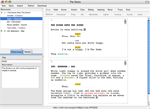 ](http://johnaugust.com/Assets/celtx-full.png)
Unlike Final Draft, which strives to keep the screen matching up exactly to the printed output, Celtx takes a more relaxed approach. All the standard formatting blocks are there (Scene Header, Action, Character, Dialogue, Transition), but there are no rulers or page breaks. That’s a reasonable choice; you shouldn’t worry about every (more) and (cont’d) as you write. The program generates .pdfs, rather than trying to print directly — again, a smart call. However, I suspect many writers will find they need more control when it comes time to print.
One of the biggest psychological hurdles with Celtx is how it handles screenplay files. Currently, they seem to reside on Celtx’s server, rather than staying local on a writer’s individual computer. (I say “seem” because each project shows a URL, and you’re not prompted where you’d like to save your file.) This client/server model makes a lot of sense for collaboration, but would make a lot of writers nervous, both in terms of access and security.
**Update:** The developer wrote in to say that files are indeed kept locally on your computer, unless published to the server. A “Save As…” feature is in progress, according to the support forum.
You can import an existing script from Final Draft or other screenwriting applications, but only by saving it first as a formatted text file. (Final Draft uses a proprietary file format; if any reader out there has figured out how to decode it, please write in.) My import test was a mixed bag. Most of the formatting came through intact, but it lost all of the character names at the head of dialogue blocks. I suspect that’s an easily-addressable problem, however.
More impressive than its importing function is Celtx’s ability to export. It generates .pdfs and HTML, which, if you look through the source code, is actually properly formatted with CSS, as opposed to Final Draft’s ridiculous wrapped text file.
I haven’t fully examined Celtx’s outline and resource capabilities, but you can flag elements such as characters and props, which can be useful for generating reports. (Not that I ever use this feature in Final Draft.)
Celtx is currently in beta. Right now, it doesn’t offer enough to get me to switch from Final Draft. But I’m certainly fascinated by it, and would encourage any interested reader to give it a try.
 I’m having a little trouble with this current script that I am writing. A character in my story is deaf and uses sign language to communicate. I have no idea what the proper writing format is for that and I was wondering if you can help me. That character also reads lips and I do not know how to incorporate that into my script as well. Please tell me the answer oh great one.
 First off, this is not a film review. If it were, I’d write about the performances, production design, music and all all the other factors that make or break a movie. Also, I’ve met the director and co-screenwriter, Joel Schumacher, who is every bit as nice as his reputation. So I don’t want it to be weird next time I say hello to him at some event. Rather, I just want to point out some story issues that stuck out to me — things I’d want to tackle if I’d gotten the script before it went into production.
 I’m in the midst of rewriting a short drama that is to be shot in about two months. I’m having trouble injecting character depth into it and I don’t know how to fix it. Everytime I try to make it more about the character it gets longer and longer, and it must be around 10 minutes (for university assessment).