• Skip to primary navigation
  • Skip to main content
  • Skip to primary sidebar

John August

  • Arlo Finch
  • Scriptnotes
  • Library
  • Store
  • About

Search Results for: characters

Giving credit where it’s due

May 31, 2007 Directors, Film Industry, QandA

questionmarkMy question is not about screenwriting per se, but rather about writing about films. Screenwriters, myself included, are not fond of essays about movies that ignore the contributions of writers. Do you have a stylistic preference for attributing authorship when writing about a movie, when each person’s individual contributions are not known? As an example, here’s a sentence from an essay I wrote about Armageddon:

In the real world, [a mission briefing] would probably happen in a briefing room. Michael Bay decided he wanted it to happen in the shuttle assembly building with a B-2 and 2 SR-71 Blackbirds.

Now I don’t know that this was Michael Bay’s decision — it may have been in one of the drafts of the script — or it may have been decided by Jerry Bruckheimer. But if I wanted to cover my bases, I would have to say:

Michael Bay, Jonathan Hensleigh, J.J. Abrams, Tony Gilroy, Shane Salerno, Robert Roy Pool, Jonathan Hensleigh, and Jerry Bruckheimer decided they wanted it to happen…

This seems incorrect. Alternatively, I could recast the sentence as:

“In the film, this happens in the shuttle assembly room…”
or
“In Armageddon, this happens in…”

But doing this consistently means treating the film as essentially authorless. This is probably truer of Armageddon than of most movies, but I don’t like it stylistically. What’s your preference? Say I was writing about Charlie and the Chocolate Factory, and specifically about something that happens in the film. Furthermore, assume I know nothing about the differences between the book, the script, and the finished film (which is usually the case when writing about a film). Would you prefer:

“Dahl, August, and Burton’s characters,”
“Dahl and August’s characters,”
“August’s characters,”
“Burton’s characters,”
“The characters in Charlie and the Chocolate Factory,”

Or some formulation I’m not seeing?

This isn’t entirely an academic question — I write about movies at [Criterion Collection](http://criterioncollection.blogspot.com), and recently someone in the comments criticised me for saying things like “Scorsese’s version of Jesus” when writing about [The Last Temptation of Christ](http://www.imdb.com/title/tt0095497/). So I revised the essay to be more precise — but that meant a lot of sentences that read “the film’s version of Jesus,” and I’m hoping you can think of something more elegant.

Thanks for your time. I enjoy your blog immensely. My little sister recently graduated from Trinity, and hearing you deliver your “[Professional Writing and the Rise of the Amateur](http://johnaugust.com/archives/2006/professional-writing-and-the-rise-of-the-amateur)” lecture was one of the highlights of her college career.

— Matt
Los Angeles

Normally, I lop off these thanks-for-your-blog comments, but I was feeling a little down, so that perked me up. Now, on to your question.

I don’t think there’s a perfect way to address authorship of a movie, but you’re right to be sensitive to the ambiguities. The characters in Charlie and the Chocolate factory are mine, and Dahl’s, and Tim’s, and the actors’. At every step in the process, choices were made by many people for many reasons. The same can be said for the sets, the music, the wardrobe, and the choreography.

If you’re writing about Tim Burton’s body of work, I think it’s absolutely fair to use a phrase like, “Burton’s characters tend to…”, since you’re pointing out a consistency across many different films. (You could do the same for characters in the films I’ve written, or the characters Johnny Depp has played.) Even if the person you’re talking about didn’t create these characters, the fact that there’s similarity between them indicates a certain mindset. An actor or a director might be consistently drawn towards artistic outsiders, for example.

It’s only when you’re looking at one specific film that you need to be careful not to hand out credit indiscriminately. Constructions like, “The characters in Burton’s film,” make it clear you’re not talking about the 1970 version.

I have no issue with the attributive apostrophe. It’s Tim Burton’s film; it’s Richard Zanuck’s film; it’s Warner Bros.’s film. Nor do I mind “A Joe Schmo Film” — it’s including the film in the director’s (or a star’s) canon. The only credit that sets my teeth on edge is “A Film By Some Director.” Both on-screen and in print, the “by” feels like an unwarranted grab for authorship. Even a writer-director is working with a crew of talented professionals to make the movie you’re seeing. That’s why I refused the credit on The Nines. But I know a lot of smart and good people who do use the credit, so I’m not slamming them for it.

In a [previous post](http://johnaugust.com/archives/2007/novel-or-script#footnote-2-771), I’d mentioned that the screenwriter’s name seems to be much more likely to show up in a negative review than a positive one. No one’s taken me up on the challenge to see if that’s really true, but the offer’s still out there. If anyone wants to do a statistical study of a few films on [Rotten Tomatoes](http://www.rottentomatoes.com/) or [Metacritic](http://www.metacritic.com/), I’d love to publish what you find.
The perils of coincidence

May 6, 2007 Genres, How-To, Treatments

Like several million people worldwide, I saw [Spider-Man 3](http://www.imdb.com/title/tt0413300/) this past weekend. And like a substantial percentage of these viewers, I got frustrated by the number of unlikely coincidences in the movie.

There’s nothing wrong with coincidence, per se. Almost every movie is going to have some incidents where one character just happens to be in the right place at the right time. In fact, many movies are built around a “premise coincidence.” In [Die Hard](http://www.imdb.com/title/tt0095016/), John McClane just happens to be in the building when the villains attack. That’s okay. McClane’s being there is part of the premise. Likewise, in the original [Spider-Man](http://www.imdb.com/title/tt0145487/), Peter Parker just happens to get bitten by the radioactive spider. No problem: it wouldn’t be Spider-Man otherwise.

The premise coincidence is one flavor of what I’ll call a Fundamental Coincidence: an accidental confluence of time, place and motivation which greatly impacts the story.

In a romantic comedy, when The Guy would have proposed to The Girl except that he just happened to overhear a conversation he interpreted the wrong way, that’s a Fundamental Coincidence. In the first Spider-Man, Norman Osborn just happens to be transformed into The Goblin just as Peter is becoming Spider-Man. That’s a Fundamental Coincidence, but we accept it because it feels true to the genre.

WARNING: MINOR SPOILERS FOLLOW. (Mostly things you’d glean the trailers or ads, but still.)

Let’s look at the Fundamental Coincidences in Spider-Man 3:

  • The asteroid carrying the symbiote (utlimately, Venom) happens to land near Peter Parker. Peter doesn’t hear it, doesn’t investigate.
  • The symbiote happens to attach itself to Peter’s scooter.
  • Flint Marko happens to fall into the sand pit at exactly the moment the scientists test their billion-dollar Dyson vacuum.It’s never clear what they’re supposedly doing, or why they wouldn’t have, say, a lid on the pit. Or a videocamera to monitor the experiment.
  • Flint Marko happens to have been the man who killed Uncle Ben. (A retcon.)
  • Eddie Brock happens to be the only person in the church at the moment Peter tries to get rid of the black suit.

Any one (or two) of these Fundamental Coincidences would probably go unnoticed, particularly in a superhero movie, where credibility takes a back seat to spectacle. But put together, they make the plot feel rickety, particularly when you factor in the large number of what I’ll call Minor Coincidences — things that don’t fundamentally change the story, but feel convenient all the same.

  1. The police chief decides to tell Peter about Marko now, even though he’s known the details for some time, apparently.
  2. Sandman’s first attack just happens to coincide with Spider-Man getting the key to the city.
  3. Eddie Brock is newly arrived at the Daily Bugle, and wants Peter’s job.
  4. Gwen Stacy happens to be Peter’s lab partner.
  5. Gwen Stacy happens to be in the skyscraper during the crane accident.
  6. And she’s the police chief’s daughter.
  7. And she’s Eddie Brock’s love interest.Revealing both of these points of information in one piece of dialogue was a particularly bold choice.
  8. And Gwen happens to be at the fancy restaurant on the night Peter wants to propose.

Again, you could have several of these coincidences in any movie and no one would mind. It’s largely expected that familiar faces will become imperiled in a summer action movie, so #5 feels right. Likewise, the eventual discovery of Venom’s weakness is accidental, but that plays into the genre. No foul there.

My point is not to rip on Spider-Man 3, but to urge readers to look at their own scripts with an eye towards coincidence. If you’ve written a treatment, search for the following phrases: “at the same time,” “accidentally,” “luckily,” “unfortunately,” and “meanwhile.” They’re often a tip-off that you have events happening by coincidence. There’s almost always a better alternative.

Causality trumps everything
=====
Given a choice, try to find cause and effect. One event happens because of something else we’ve seen — ideally, something the hero himself has done.

Instead of having the hero accidentally overhear a key conversation, get him actively trying to listen. Or have an interested third party steer him in that direction — perhaps for his own reasons. At every juncture where a reader could ask “Why did that happen?”, try to have an answer that isn’t, “just because.”

Although there are some convenient twists in the Harry Osborn plot (amnesia, for starters), the causality is clear: the New Goblin wants revenge on Spider-Man for killing his daddy in the first movie.I kept waiting for Peter to point out that Harry’s dad was a psychopath, but oh well. It doesn’t feel like coincidence that Harry is flying around on his hoverboard. With two other villains desperate for scenes, the timing might not be opportune, but it’s clear why it’s happening.

Look for correlation
====
Rather than ask an audience to swallow a bunch of little implausibilities, try bundling them together.

In [Heroes](http://www.imdb.com/title/tt0813715/), imagine if each character had a completely unique origin story: Claire got her powers from a shaman; Sylar is an alien; Peter has a magic ring. You’d get frustrated pretty quickly, because a lot of screen time would go towards explaining why and how. Instead, the creators wisely decided the characters all had some mysterious gene mutation activated by an environmental change. The audience is willing to make that one big leap,And a familiar leap, frankly, because of X-Men. because they’re not asked to make similar leaps each time a new character is introduced.Note that both the D.C. and Marvel universes do have multiple, often conflicting means of empowering their heroes and villains. This is good and fascinating, but I suspect it’s one reason it can be harder for a casual reader to pick up these titles. The time investment needed to get up to speed is significant. Quick: Is Scarlet Witch a witch? Ummm…[Sort of](http://en.wikipedia.org/wiki/Scarlet_Witch).

For Spider-Man 3, I don’t have any magic answers on how to correlate these disparate threads — other than trimming one out, which wouldn’t be a bad place to start. But had the script dropped on my desk a month before shooting, here are a few thoughts I would have put out there in terms of the many coincidences:

* Both Venom and Sandman are forms of disembodied consciousness that control their host subjects — people and sand, respectively. That seems thematically promising.
* One asteroid feels random, while a meteor shower feels like an event that needs a superhero.
* Could this meteor shower overlap with Marko’s transformation or escape? Even if it’s just in the background, it makes them feel more united.
* Could Spider-Man be pursuing Marko at the start?
* Could we see the symbiote choosing Peter, because he’s the strongest creature around?

Chop it out
====
Often, the best answer when faced with a nagging coincidence is just to remove it.

* Do we really need the Uncle Ben retcon? It doesn’t have a lot to do with Marko’s sick-daughter motivation.
* Couldn’t Eddie Brock already be a stringer for the Daily Bugle? If he and Peter already have history, great.
* Does Gwen Stacy need to be Peter’s lab partner?
* Do we even need the police chief?

Again, my point isn’t to rag on Spidey, but to urge reader-writers take a hard look at the role of coincidence in their own scripts.

Some coincidence feels genuine. In real life, we do accidentally bump into old friends at the mall. And surprise in general is a good thing — catching your reader off-balance is a worthy goal. But if a significant portion of your plot depends on chance, that’s a good indicator something’s not fully baked. The best time to tackle these problems is in the outline, asking yourself not only what happens next, but why.

A Captain Marvel Reader

April 6, 2007 Projects, Shazam

Hope CoverEver since I [announced](http://johnaugust.com/archives/2007/the-big-red-cheese) that I’m writing Shazam!/Captain Marvel, I’ve gotten some great questions and comments from longtime fans of the character, many with detailed pleas to include a specific cherished piece of the mythology.

But when I tell people face-to-face that I’m writing a Captain Marvel movie, I often notice a specific micro-reaction. Their eyes go up and to the left as they try to remember, who the hell is Captain Marvel? Half the time, they come up with Captain America instead.

So, in the interest of spreading general knowledge about Captain Marvel and why he kicks ass, I thought I’d share a reading list. Don’t worry; there’s no test. In fact, consider this a gentle education (or re-education) on why some of the best writing today is inked and colored.

Getting over comic anxiety

One reason adults can be scared off from comics is that the universes in which superheroes live tend to be incredibly complicated and interconnected. It’s the same reason I haven’t started watching Battlestar Galactica — I feel like I need to catch the first few seasons on DVD.

But it’s even more bewildering than that. You can think of any comic book series (Batman, Superman, JSA) as being roughly equivalent to a television series, with each issue serving much like an episode.Indeed, Joss Whedon is doing exactly that with his Buffy: Season 8. By this analogy, DC and Marvel Comics are like television networks — the difference being that *all their shows cross-over constantly.* Imagine if in order to follow Lost, you also had to keep up to speed with Grey’s Anatomy, Ugly Betty and According to Jim.

You’d want a guidebook. A cheat sheet.

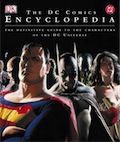
DC EncyclopediaFor the DC Universe in which Captain Marvel lives, the most helpful resource I’ve found is the [DC Comics Encyclopedia](http://astore.amazon.com/johnaugustcom-20/detail/075660592X/103-6872397-4470203).There’s a similar [Marvel Encyclopedia](http://www.amazon.com/gp/product/0756623588?ie=UTF8&tag=johnaugustcom-20&linkCode=as2&camp=1789&creative=9325&creativeASIN=0756623588) available as well. I just ordered it today, so I can’t vouch for it. It includes artwork and bios on pretty much every significant player (hero and villain) in the DC universe.Arguably, multiverse, but I don’t want to dip my toes into that debate. Suffice to say that Captain Marvel and his compatriots used to exist on an alternate Earth (one that didn’t have Superman et al.), but got folded in due to a massive cosmic event. Naturally, one consequence of the book’s breadth is its lack of depth. A few paragraphs can’t explain why a given character is important or relevant, and tends to overemphasize vintage characters who will never play a significant role in future storylines. (Old West gunslingers, I’m looking at you.)

Still, it’s invaluable. I’ve been paging through this book for the last two years,True confession: It’s my bathroom reader. constantly discovering new connections and relationships. The term “mythology” is overused in popular culture, but it really applies to superheroes. They’re our Greek gods and demigods, and their stories are just as tangled, fascinating and unlikely.Off topic, but what is the proper name for the religion that worships the classic Greek (or Roman) gods? Pan-Hellenism? That’s a church I’d like to visit.

Getting up to speed on Captain Marvel

Captain Marvel was originally published by Fawcett Comics, and for a time outsold Superman — in fact, it was a copyright infringement lawsuit that led to Fawcett ceasing publication.The lawsuit seems absurd today, because the two overlapping powers — strength and flight — are pretty much ubiquitous among today’s superheroes. DC Comics bought out the rights to the character in 1991, but for legal reasons can’t promote the comic book using the Captain Marvel name. From the [Wikipedia entry](http://en.wikipedia.org/wiki/Captain_Marvel_(DC_Comics):

Because Marvel Comics trademarked their Captain Marvel comic book during the interim between the original Captain Marvel’s Fawcett years and DC years, DC Comics is unable to promote and market their Captain Marvel/Marvel Family properties under that name. Since 1972, DC has instead used the trademark Shazam! as the title of their comic books and thus the name under which they market and promote the character. Consequently, Captain Marvel himself is sometimes erroneously referred to as “Shazam.”

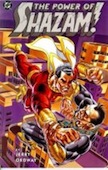
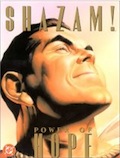
Power CoverA fairly classic genesis story for Captain Marvel can be found in Jerry Ordway’s [The Power of Shazam!](http://astore.amazon.com/johnaugustcom-20/detail/1563891530/103-6872397-4470203) It’s semi-period and kind of Mummy-like (a lot of Egyptian tomb business), but manages to evoke a vintage feel without the vintage dullness.

While he rarely has his own series, you find Captain Marvel sprinkled throughout the DC world. He’s particularly helpful when you need someone to go head-to-head with Superman. Captain Marvel isn’t vulnerable to kryptonite, and holds up better than the Man of Steel against magic.

First Thunder CoverA good place to start is Judd Winick’s [First Thunder](http://astore.amazon.com/johnaugustcom-20/detail/1401209238/103-6872397-4470203), which posits the first real encounter between these titans, and nicely contrasts not only the two heroes but their corresponding villains, Lex Luthor and Dr. Sivana. The book smartly moves beyond the smash-and-bash action to raise interesting questions: Is it fair to put this much responsibility on a young kid? Which identity is your “secret identity?” And what would Superman have done without the Kents to watch over him?

[Day of Vengeance](http://astore.amazon.com/johnaugustcom-20/detail/1401208401/103-6872397-4470203) (also by Judd Winick) features a very different Marvel/Superman matchup, as the Man of Steel finds himself possessed by the demon Eclipso. It’s a good battle, and it makes use of one of the Marvel family’s less-defined abilities: the magic thunderbolts which come when you call, “Shazam!” These thunderbolts can seemingly do anything. I keep waiting for some unhinged environmentalist to figure out he can use them to power the world’s electric grid — *but at a deadly price!*

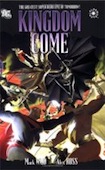
Kingdom Come coverIf you want bleak, look no further than Mark Wald’s [Kingdom Come](http://astore.amazon.com/johnaugustcom-20/detail/1563893304/103-6872397-4470203), in which the grown up Billy Batson is basically Lex Luthor’s pawn, a superpowered goon to protect the evil mastermind from Superman. Between this and [Watchmen](http://astore.amazon.com/johnaugustcom-20/detail/1401207138/103-6872397-4470203), one is left with the impression that superheroes don’t get better with age.

JSA and Black Adam

Captain Marvel can be found in many Justice Society of America books, but an even larger presence is Black Adam, who is sometimes an ally and often an adversary. Black Adam was the original champion chosen by the wizard Shazam, and is ostensibly as powerful as The Big Red Cheese. But he’s brutal and charismatic, which is why fans love him no matter which side he’s on.

Geoff Johns, who was gracious enough to listen to my pitch before we went in to New Line, has two books featuring Black Adam to check out: [Black Reign](http://astore.amazon.com/johnaugustcom-20/detail/1401204805/103-6872397-4470203) and [Black Vengeance](http://astore.amazon.com/johnaugustcom-20/detail/1401209661/103-6872397-4470203). The storylines continue into this past year’s [52](http://astore.amazon.com/johnaugustcom-20/detail/1401213537/103-6872397-4470203).

For a one-off making good use of the Rock of Eternity (home base of Captain Marvel), check out [Virtue and Vice](http://astore.amazon.com/johnaugustcom-20/detail/1401200400/103-6872397-4470203). Featuring both the JSA and the Justice League, it’s a sampler platter of powers and what-if scenarios, but well worth a look.

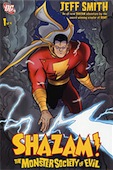
Monster Society CoverAmong current series, Judd Winick’s [Trials of Shazam!](http://astore.amazon.com/johnaugustcom-20/detail/1401213316/103-6872397-4470203) finds Billy Batson taking over for the wizard, and overseeing the training of his replacement. Meanwhile, Jeff Smith’s [Shazam!: The Monster Society of Evil](http://www.dccomics.com/comics/?cm=6829) is goofy and whimsical, a great alternative to the weary darkness of many comics today.

Why I’m not including the vintage collections

DC publishes hardcover anthologies that gather up decades’ worth of Captain Marvel comics. If I were writing a dissertation on the evolution of the Captain Marvel character, these would be invaluable. But I’m not. So every time I read one of these, I’m struck with the same realization I encounter trying to watch The Honeymooners or a black-and-white movie: Wow. Old things suck.

Yes, I know that will piss off the vintage comics fans, who insist that the original incarnations are the purest forms of a character. But what you quickly realize is that old-time comic books were awkwardly written, crudely drawn, and bewilderingly inconsistent with their rules. They were making up the art form as they went along, and today’s comic books are better for the accumulated wisdom.

Vintage fans are free to disagree. There’s a vast but finite amount of comic books to last them through their days.My brother is big into classic rock. I once pointed out to him that everything he will ever like has already been recorded. Which seems depressing, but will undoubtedly happen to most of us.

Beyond that, are there great books I’m leaving off, either intentionally or accidentally? Almost certainly. The comments are your chance to add to the reading list.

TV in movies

March 21, 2007 How-To, Words on the page

I just finished writing a scene where a television news report was playing in the background and it reminded me how hard it is to get these moments right. Unless you’re literally having the characters stare at the TV set, you’re basically dividing the audience’s attention between two planes of information. If you don’t do it carefully, the audience won’t know where to look, and the scene will be a disaster.

Off the top of my head, here are four (hopefully) helpful guidelines:

1. __The TV can only tell you one thing.__ It can say the big snowstorm is coming, but it can’t also say that mobster Carmine DeSomethingorother has escaped from custody.

2. __Use the naturally empty moments of the scene.__ If there’s information that’s important for the audience, but not necessarily the characters, start on the TV and let the characters enter the scene where it’s playing. If a character’s waiting on hold, or is looking for dijon mustard in the fridge, that’s another moment you could cut to the TV.

3. __Get the rhythm right.__ TV news in particular has a cadence, and you can’t just shove your exposition in to make it fit. Always think how the reporter would actually report the story and balance his goals with your goals.

4. __Don’t make it too convenient.__ Don’t have a character flip on the TV, only to find exactly the story about them — unless it really is reasonable that there’s 24-hour coverage about the situation. Perhaps the only thing worse than this cliché is when a character rushes in, saying, “You’ve got to see this!” before grabbing the remote.

On the whole though, it’s amazing how little television people watch in movies as opposed to real life.

« Previous Page
Next Page »

Primary Sidebar

Newsletter

Inneresting Logo A Quote-Unquote Newsletter about Writing
Read Now

Explore

Projects

  • Aladdin (1)
  • Arlo Finch (27)
  • Big Fish (88)
  • Birdigo (2)
  • Charlie (39)
  • Charlie's Angels (16)
  • Chosen (2)
  • Corpse Bride (9)
  • Dead Projects (18)
  • Frankenweenie (10)
  • Go (29)
  • Karateka (4)
  • Monsterpocalypse (3)
  • One Hit Kill (6)
  • Ops (6)
  • Preacher (2)
  • Prince of Persia (13)
  • Shazam (6)
  • Snake People (6)
  • Tarzan (5)
  • The Nines (118)
  • The Remnants (12)
  • The Variant (22)

Apps

  • Bronson (14)
  • FDX Reader (11)
  • Fountain (32)
  • Highland (75)
  • Less IMDb (4)
  • Weekend Read (64)

Recommended Reading

  • First Person (87)
  • Geek Alert (151)
  • WGA (162)
  • Workspace (19)

Screenwriting Q&A

  • Adaptation (65)
  • Directors (90)
  • Education (49)
  • Film Industry (489)
  • Formatting (128)
  • Genres (89)
  • Glossary (6)
  • Pitches (29)
  • Producers (59)
  • Psych 101 (118)
  • Rights and Copyright (96)
  • So-Called Experts (47)
  • Story and Plot (170)
  • Television (165)
  • Treatments (21)
  • Words on the page (237)
  • Writing Process (177)

More screenwriting Q&A at screenwriting.io

© 2026 John August — All Rights Reserved.