• Skip to primary navigation
  • Skip to main content
  • Skip to primary sidebar

John August

  • Arlo Finch
  • Scriptnotes
  • Library
  • Store
  • About

Search Results for: 3 page challenge

How Less IMDb came to be

January 5, 2011 Follow Up, Geek Alert

[Less IMDb Icon](http://quoteunquoteapps.com/less-imdb) [Less IMDb](http://quoteunquoteapps.com/less-imdb), our browser extension for de-cluttering the otherwise useful movie site, seems to have achieved good traction. In its first month, it was installed more than 8,000 times, and made it to the main page of Apple’s [Safari Extensions Gallery](https://extensions.apple.com/#entertainment).

It is now available for Safari, Chrome and Firefox. A quick break down by the numbers: ((These stats reflect downloads from our site, not any direct installs via the Safari Extension Gallery. As the extension updates, we should be able to pull more precise figures.))

  • Safari: 6,118
  • Chrome: 849
  • Firefox: 1,088

I’m not surprised the Safari version is way ahead of the others; it came first, and got a big boost from the Apple-centric [Daring Fireball](http://daringfireball.net) site. But I would have expected more love from Chrome, honestly.

I’ve asked Ryan Nelson, who did all the design and coding, to give a walk-through of our process building and deploying the extension. This recap has a fairly high geek factor, but you may find some of the decision points interesting even if the details whoosh over your head.

—-

Per Twitter, most people hated the newly-redesigned IMDb. When John first brought up the idea of reformatting it with a Safari extension, his direction was minimal and straightforward: move credits from below-the-fold to up near the top.

He even provided a mockup of how it should look. When working on a new design, it’s fairly typical for John to create a wireframe or rough as a starting point:
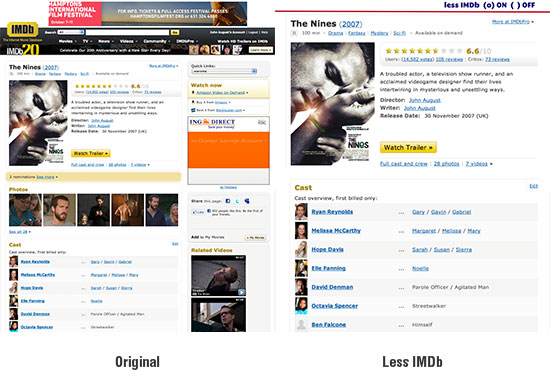
Original Less IMDb mockup

And how would the user control the extension? John’s original suggestion:
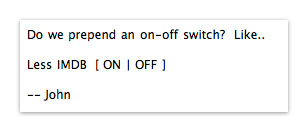
John's original control suggestion

John essentially decided what content Less IMDb would show, and what it would hide. But how would it deal with other bits of the interface, like IMDb’s ability to expand or collapse filmography listings?
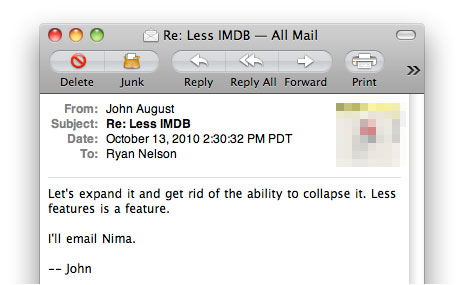
Less features is a feature.

The “less features is a feature” attitude informed the rest of the choices made when stripping IMDb to its bare bones.

[Read more…] about How Less IMDb came to be

Story is free

July 1, 2010 Indie, Story and Plot, Sundance

One of my frustrations with independent film — and in particular, micro-indies of the past few years — is a lack of narrative ambition.

Flip through the catalogs of any festival and you’ll see movies with fascinating characters and rich settings in which *nothing really happens,* as if the filmmakers took a Dogma vow to avoid plot.

My hunch is that it’s actually a consequence of thinking small. If you’re making a movie on a limited budget, it may put real constraints on your locations, schedule and cast size.

But that frugality doesn’t need to limit your story. Story is free.

Waiting around for things
——

I spent last week at the Sundance Screenwriters Lab, working with writer-directors on their next projects. I don’t want to single out any one script — I’m eager to see all of these movies made. These filmmakers are very talented.

But I often found myself pausing at page 45 asking “What’s happened so far?” and “What am I curious about?” And too often, the answer was *not much.*

Some of my red flags:

* Are characters waiting around for something?
* Do they take half-steps, then retreat?
* Do major events (death, abortion, incest) happen off-screen, or before the movie begins?
* Do people talk about food?
* Could you swap a scene from page 10 and page 34 without changing much?

A few of these projects would fall within the loose borders of the mumblecore movement, stories that focus on the sputtering interactions of a few well-educated characters. This is no ding on the genre; I like my Humpday just fine.

But I wonder if filmmakers are looking to mumblecore movies as an excuse for underwriting and avoiding character conflict.

A lot of story can happen even when you’re constrained to a few locations. Hamlet takes place in a few rooms. So does The Usual Suspects. Both Go and The Nines pack a lot into each of their three-part sections. And while Sex, Lies and Videotape might seem low-plot, the story keeps forcing characters to make choices and face the consequences.

In meeting with the screenwriters at Sundance, I challenged them to look for scenes in which characters were talking about things and show them doing those things. Often, the omitted scenes weren’t more expensive than what they would replace — but they were more difficult to write. The beginning of an affair is trickier than showing it mid-course. A trapped child is uncomfortable to write, but compelling to watch.

The writing is always going to be the least expensive but most challenging part of the process. Making a low-budget movie is a study in compromises. Story shouldn’t be one of them.

Why some folks got The Variant free

August 12, 2009 Projects, The Variant

When I published [The Variant](http://johnaugust.com/variant) for 99 cents, I anticipated some potential readers would have practical or philosophical reasons for not buying it. So I wanted to give them an out:
> If after reading the lengthy [free sample](http://ja-vincent.s3.amazonaws.com/variant_sample.pdf), you decide you want to read the rest of the story but don’t want to pay 99 cents -— or for some reason can’t -— send an email to sales@johnaugust.com.

> If you can present a coherent case for why the story should be free (to everyone, or specifically in your situation), I’ll send you the .pdf at no charge. Note: In doing so, you agree to let me print your email in part or in full.

I was prepared to be sending out a lot of free .pdfs.

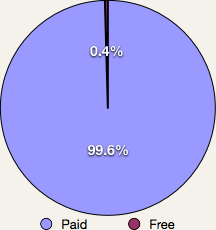
So far, I’ve only sent out 19. That’s out of 4,281 copies sold.

paid vs free

The longest request was 328 words; the shortest, a single sentence. I didn’t turn anyone down.

Flat broke
—-

The most common theme in requests was economic hardship. Ninety-nine cents is not a lot of money, but when you’re watching every dollar, spending cash on something unusual seems hard to justify.

Desiree writes:

> The New York Times article said that you would send free copy of your work to anyone with a good rationale. Well, times are tough. 99 cents may not be much money but I really do need the change. Thanks in advance.

Jim:

> I would love to get a copy of The Variant. I was very taken with The Nines and thought it didn’t get the attention it deserved. My case for not paying? I work in public radio and don’t even have enough funds to pay my credit card (right now I’m maxed out, so can barely cover groceries).

Johanna offers more detail than you might want:

> The sample pages I read were compelling enough that I wanted to at least ask if you could see it in your heart please to share the rest of the story with me.

> I’m disabled, on Social Security, I just left the hospital a few days ago and have still have a drain in my neck. My bones are infected. It is hoped I’ll recover. None of that matters, really, except that what little money I have now absolutely has to be used to pay for the many costs of daily washing pillow cases (which my home care provider does for me), buying extra supplies for rebandaging and cleaning the drain which they never give one enough of and expect somehow, actually, I don’t think they really expect anything afterwards. They don’t really think. Out of sight, out of mind.

> Anyway, your story was captivating and interesting and thank you for letting me read a sample of it. Should you choose not to share any more with me, I understand. It’s not my right to read your words.

Robert:

> Sparing you the details of my current circumstances, I will say only that I am broke, tapped out, sapped, impecunious, impoverished, rabbit-eared (picture the floppy white pockets pulled out from a pair of tight jeans), depleted, and so on.

> So, as I write to you on a borrowed computer, from a squalid hotel room, on an empty stomach, I ask for your kind pity, sir. Please allow me the pleasure of reading your work before my fading vision finally leaves me for good.

Trouble overseas
——

The second biggest group of requests came from abroad. Since the Kindle version only works in the U.S., I offer a downloadable .pdf for international readers. That still presents a challenge for some potential buyers.
[Read more…] about Why some folks got The Variant free

Same script, different day

May 19, 2009 Psych 101, QandA, Writing Process

questionmarkDo you ever get sick of working with the same script that you are loathe to even look at it anymore? If so how do you get a tenth wind to reset your perspective?

I’ve gone through six drafts and am still incorporating changes from someone’s notes. This script was my world for nine months and I’d like nothing better than to move on to my next project full-time, but I feel like Pacino in Godfather III.

Any suggestions?

— John
Kansas City

Here’s the thing: writing sucks. It’s difficult on a good day, and intolerable on most others. That’s why I’ll gladly answer your question rather than spend these 20 minutes of staring at the scene I ought to be writing.

First drafts are hard, but at least they’re exciting and new. Second drafts have the advantage of problem-solving, and feel like forward progress. Every draft after that is a slog. And I mean slog in the most onomatopoetic sense: boots sinking in mud to your ankles, a thick slurp with each exhausting footstep. Sure, you want the draft to be good, but you mostly just want it to be done.

When you’re getting paid for it, you can sometimes muscle through a rewrite by calculating how much you’re getting paid per page. Even imaginary income works for this. While I’m annoyed by the lottery mentality with which a lot of aspiring screenwriters approach the craft (spec sale as sweepstakes), let’s face it: your script isn’t worth anything until it’s finished.

If you’ve promised a new draft to someone whose opinion you value, picturing his or her face can be a motivation. Better yet, promise exactly when you’ll deliver it. Deadlines help, as do consequences.

Consider rewards. For every three pages you finish, you get to watch a Dollhouse on the DVR.

Beyond that, I can offer a few suggestions that are not of the carrot-or-stick variety:

* **Challenge yourself to remove one seemingly important scene.** Imagine what would happen if the actor you needed died during production, and that scene never got shot. Could you work around it? Could you make the movie better for its absence?

* **Push yourself to use better words.** Particularly in the back half of a script, there’s a tendency to get a bit sloppy and repetitive. Make that scene description on page 98 as sharp as it was on page 13. Here’s a test: Are you using “there are?” If so, you could do better.

* **Imagine a secondary plot that we’re not seeing.** Like [Rosencrantz and Guildenstern Are Dead](http://en.wikipedia.org/wiki/Rosencrantz_and_Guildenstern_Are_Dead), perhaps there’s an offscreen adventure taking place that a reader will never see. Only you as the writer will know it’s there. Dangerous? Sure. But on your fifth draft, a little danger may be what you need.

Will you reach a point at which it’s simply impossible (or self-defeating) to keep rewriting? Yes. But don’t confuse the standard difficulties of writing with true burnout. Here’s the difference: When you’re burned out, you simply don’t care. You’ll make a scene worse just to get it done. That’s when you need to quit and write something else.

« Previous Page
Next Page »

Primary Sidebar

Newsletter

Inneresting Logo A Quote-Unquote Newsletter about Writing
Read Now

Explore

Projects

  • Aladdin (1)
  • Arlo Finch (27)
  • Big Fish (88)
  • Birdigo (2)
  • Charlie (39)
  • Charlie's Angels (16)
  • Chosen (2)
  • Corpse Bride (9)
  • Dead Projects (18)
  • Frankenweenie (10)
  • Go (29)
  • Karateka (4)
  • Monsterpocalypse (3)
  • One Hit Kill (6)
  • Ops (6)
  • Preacher (2)
  • Prince of Persia (13)
  • Shazam (6)
  • Snake People (6)
  • Tarzan (5)
  • The Nines (118)
  • The Remnants (12)
  • The Variant (22)

Apps

  • Bronson (14)
  • FDX Reader (11)
  • Fountain (32)
  • Highland (75)
  • Less IMDb (4)
  • Weekend Read (64)

Recommended Reading

  • First Person (87)
  • Geek Alert (151)
  • WGA (162)
  • Workspace (19)

Screenwriting Q&A

  • Adaptation (65)
  • Directors (90)
  • Education (49)
  • Film Industry (489)
  • Formatting (128)
  • Genres (89)
  • Glossary (6)
  • Pitches (29)
  • Producers (59)
  • Psych 101 (118)
  • Rights and Copyright (96)
  • So-Called Experts (47)
  • Story and Plot (170)
  • Television (165)
  • Treatments (21)
  • Words on the page (238)
  • Writing Process (177)

More screenwriting Q&A at screenwriting.io

© 2026 John August — All Rights Reserved.