• Skip to primary navigation
  • Skip to main content
  • Skip to primary sidebar

John August

  • Arlo Finch
  • Scriptnotes
  • Library
  • Store
  • About

QandA

Two Writers, One Script

Episode - 155

Go to Archive

July 29, 2014 Film Industry, Follow Up, QandA, Scriptnotes, So-Called Experts, Transcribed, Writing Process

John and Craig look at the trend towards hiring two writers to work on separate drafts of the same project. Is it better to have writers in parallel than serially? Or does it end up with studios ordering off a Chinese menu: this scene, that character, that other set piece?

Both Craig and John just started new first drafts, so we talk about the difference between the Map and the Territory, and how outlines can’t always anticipate the discoveries made while writing.

Finally, we answer a bunch of listener questions ranging from the Peter Stark Program to loving your day job.

Links:

* John Gary on [spec sales, lightning strikes, and making the NFL](https://twitter.com/johngary/status/491658703821475840)
* [Hot Hollywood Trend: Two Scripts, One Movie](http://www.hollywoodreporter.com/news/hot-hollywood-trend-two-scripts-720224)
* [On Writing: A Memoir of the Craft, by Stephen King](http://www.amazon.com/dp/1439156816/?tag=johnaugustcom-20) and [Making Movies, by Sidney Lumet](http://www.amazon.com/dp/0679756604/?tag=johnaugustcom-20)
* [Screenplay, by Syd Field](http://www.amazon.com/dp/0385339038/?tag=johnaugustcom-20), [The War of Art, by Steven Pressfield](http://www.amazon.com/dp/1936891026/?tag=johnaugustcom-20), [Sex, Lies and Videotape, by Steven Soderbergh](http://www.amazon.com/dp/0571202896/?tag=johnaugustcom-20), and [The First Time I Got Paid For It](http://www.amazon.com/dp/0306810972/?tag=johnaugustcom-20)
* [The Peter Stark Program](http://cinema.usc.edu/producing/)
* [The Total Film-Maker, by Jerry Lewis](http://cinearchive.org/post/72674722317/the-total-film-maker-jerry-lewis-book-on) on cinearchive.org
* [What Writers Can Learn From Goodnight Moon](http://opinionator.blogs.nytimes.com/2014/07/19/what-writers-can-learn-from-good-night-moon/?_php=true&_type=blogs&_r=0) by Aimee Bender
* [Outro](http://johnaugust.com/2013/scriptnotes-the-outros) by Scriptnotes listener Sir Funkytown ([send us yours!](http://johnaugust.com/2014/outros-needed))

You can download the episode here: [AAC](http://traffic.libsyn.com/scriptnotes/scriptnotes_ep_155.m4a) | [mp3](http://traffic.libsyn.com/scriptnotes/scriptnotes_ep_155.mp3).

**UPDATE 8-4-14:** The transcript of this episode can be found [here](http://johnaugust.com/2014/scriptnotes-ep-155-two-writers-one-script-transcript).

Disney’s corporate synergy, 1957 and today

July 24, 2014 Film Industry

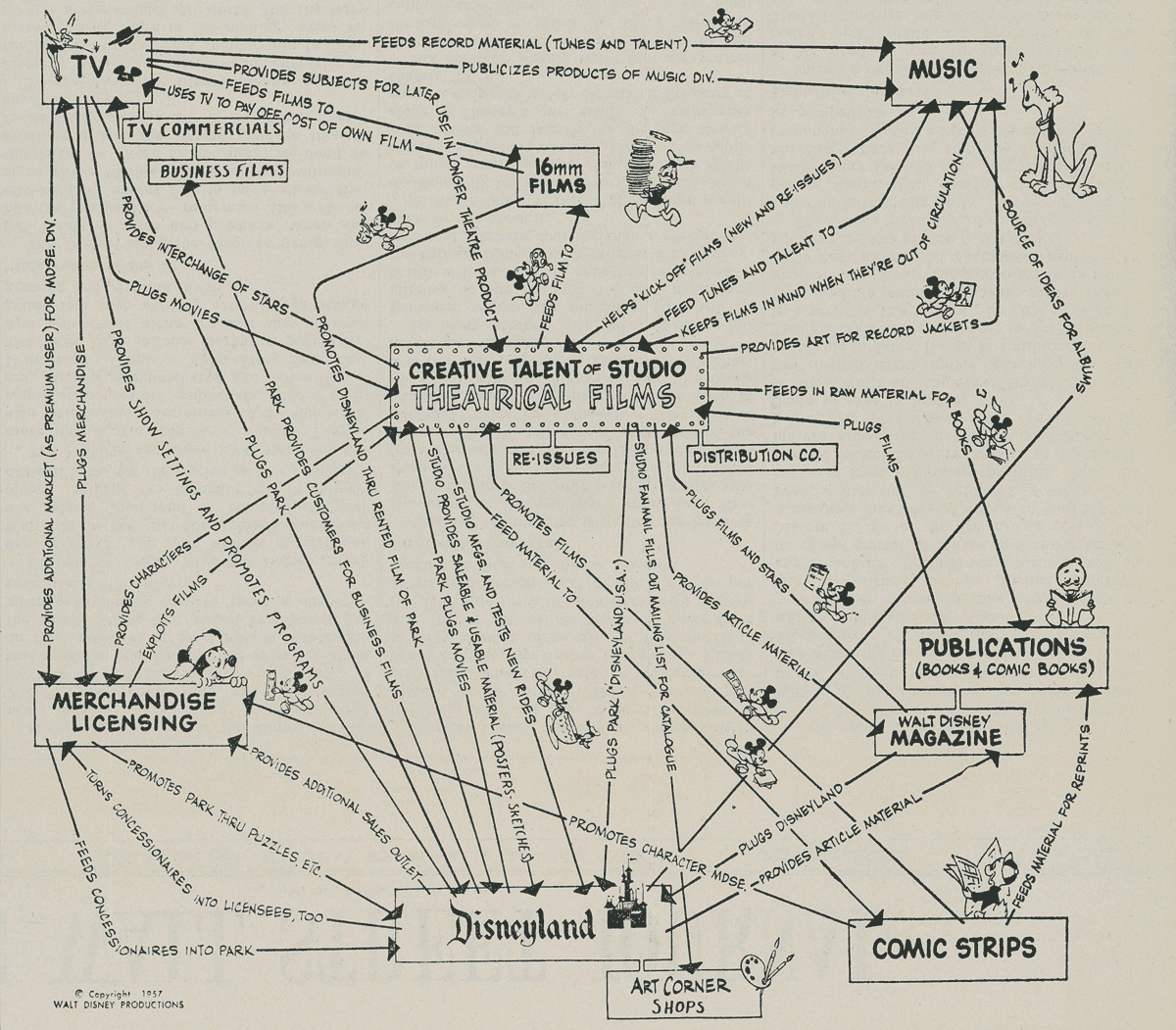
I love [this graphic](http://johnaugust.com/wp-content/uploads/2014/07/disney_chart.jpg) from 1957 showing how the various elements of the Walt Disney company fit together.

corporate chart

You could make the same chart today.

Here is a partial list of the properties Disney owns in 2014:

Features:

* Walt Disney Pictures
* Touchstone Pictures
* Disneynature
* Disney Animation Studios
* Pixar
* Lucasfilm
* Marvel
* The Muppets
* DreamWorks (distribution)

Music:

* Walt Disney Records
* Hollywood Records
* Disney Music Publishing

Destinations:

* Disneyland/Disneyworld worldwide
* Disney Cruise Line
* Disney Vacation Club

Theatrical Group:

* Disney Theatrical Productions
* Disney on Ice
* Disney Live

Consumer Products:

* Disney Store
* Disney Baby
* The Baby Einstein Company

Books:

* Disney-Hyperion
* Marvel Press

Broadcasting:

– ABC Television Network
– ABC Family Worldwide
– Live Well Network
– A+E Networks (50%)
– Disney Channels Worldwide
– Radio Disney
– Disney Television Animation
– ESPN Inc. (80%)
– Hulu (32%)
– A+E Networks (50%), includes Lifetime and History

Online/Interactive:

– Disney Infinity
– Disney.com
– Maker Studio

Comics:

– Marvel
– Disney Comics

Almost every one of these items is a huge business just by itself. Which raises the question: If one were to make a new version of the 1957 chart, would Theatrical Films still deserve the central marquee spot?

Yes.

I’d argue that in 2014, film properties are probably still worth keeping near the middle of any Disney flowchart. The company makes money in many ways, but feature films are still the key drivers. You don’t get Cars merchandise without the movie.

The success of Frozen is an example of how Disney can capitalize on a hit film by using it in other divisions: Disneyland attractions, TV tie-ins (Once Upon a Time), music, books, merchandise, and possibly a Broadway musical.

As screenwriters, there are pros and cons to this kind of corporate synergy.

Giant corporations like Disney will keep making movies because it feeds the engine — and the better the movies, the bigger the multiplier in success. You can criticize individual films, but the juggernaut franchises have sprung from well-executed movies, and all of these movies began with screenwriters.

The challenge for screenwriters is that it’s increasingly difficult to get momentum on any movie that doesn’t seem to have the potential to work across divisions. An R-rated blockbuster like The Matrix can’t become a theme park ride, so why spend $100 million to make it?

Looking at the list of [top-grossing R-rated movies](http://www.boxofficemojo.com/alltime/domestic/mpaa.htm), Warners and New Line made seven of the top 10. With talk that [Fox may buy Warners](http://www.latimes.com/entertainment/envelope/cotown/la-et-ct-time-warner-white-knight-fox-20140722-story.html#page=1), I wonder if they would still be making those movies post-merger.

Making Things Better by Making Things Worse

July 22, 2014 Scriptnotes, Story and Plot, Transcribed

John and Craig talk structure and escalation. Structure is simply what happens when. Escalation is how things get tougher.

In features, characters are usually going on a journey that can only happen once, so you need to make sure that the events in your story are constantly challenging your heroes in new ways so they can continue to grow.

In television, you’re often telling stories in which the character themselves don’t change much, yet the sequence of events within the episode (and in the season) needs to feel like it’s pushing forward.

Along the way, we discuss Intro to Journalism’s Five W’s, and what people mean when they say a two-hander.

John and Craig are headed back to the Austin Film Festival again this year for a live show and other special events. Use the code SCRIPTNOTES to get $25 off our Conference and Producers Badges.

Links:

* Badges for the 2014 Austin Film Festival [are available now](http://www.austinfilmfestival.com/shop/badges/)
* Scriptnotes archives are available on [scriptnotes.net](http://scriptnotes.net/) or at [the John August Store](http://store.johnaugust.com/)
* [Two-handers](http://screenwriting.io/what-is-a-two-hander/) on screenwriting.io
* Scriptnotes, Episode 152: [The Rocky Shoals (pages 70-90)](http://johnaugust.com/2014/the-rocky-shoals-pages-70-90)
* [The Five Ws](https://en.wikipedia.org/wiki/Five_Ws) on Wikipedia
* [John Robbins](https://en.wikipedia.org/wiki/John_Robbins_(illustrator)) on Wikipedia
* Scriptnotes, Episode 150: [Yes, screenwriting is actually writing](http://johnaugust.com/2014/yes-screenwriting-is-actually-writing)
* [In Dreams Begin Responsibilities and Other Stories](http://www.amazon.com/dp/0811206807/?tag=johnaugustcom-20) by Delmore Schwartz
* [The Answer to the Riddle is Me](http://www.amazon.com/dp/1907595163/?tag=johnaugustcom-20) by David Stuart MacLean
* [Outro](http://johnaugust.com/2013/scriptnotes-the-outros) by Scriptnotes editor Matthew Chilelli ([send us yours!](http://johnaugust.com/2014/outros-needed))

You can download the episode here: [AAC](http://traffic.libsyn.com/scriptnotes/scriptnotes_ep_154.m4a) | [mp3](http://traffic.libsyn.com/scriptnotes/scriptnotes_ep_154.mp3).

**UPDATE 7-24-14:** The transcript of this episode can be found [here](http://johnaugust.com/2014/scriptnotes-ep-154-making-things-better-by-making-things-worse-transcript).

Impostor Syndrome, and unknown unknowns

July 21, 2014 Psych 101

On the podcast, Craig and I have [discussed](http://johnaugust.com/2013/psychotherapy-for-screenwriters) [Impostor Syndrome](http://en.wikipedia.org/wiki/Impostor_syndrome), in which successful people secretly feel like frauds.

Apenwarr, who works for a major tech company, wonders if Impostor Syndrome is [actually a good thing](http://apenwarr.ca/log/?m=201407#01):

> The people with Impostor Syndrome are the people who *aren’t* sure that a logical proof of their smartness is sufficient. They’re looking around them and finding something wrong, an intuitive sense that around here, logic does not always agree with reality, and the obviously right solution does not lead to obviously happy customers, and it’s unsettling because maybe smartness isn’t enough, and maybe if we don’t feel like we know what we’re doing, it’s because we don’t.

> Impostor Syndrome is that voice inside you saying that not everything is as it seems, and it could all be lost in a moment. The people with the problem are the people who can’t hear that voice.

« Previous Page
Next Page »

Primary Sidebar

Newsletter

Inneresting Logo A Quote-Unquote Newsletter about Writing
Read Now

Explore

Projects

  • Aladdin (1)
  • Arlo Finch (27)
  • Big Fish (88)
  • Birdigo (2)
  • Charlie (39)
  • Charlie's Angels (16)
  • Chosen (2)
  • Corpse Bride (9)
  • Dead Projects (18)
  • Frankenweenie (10)
  • Go (29)
  • Karateka (4)
  • Monsterpocalypse (3)
  • One Hit Kill (6)
  • Ops (6)
  • Preacher (2)
  • Prince of Persia (13)
  • Shazam (6)
  • Snake People (6)
  • Tarzan (5)
  • The Nines (118)
  • The Remnants (12)
  • The Variant (22)

Apps

  • Bronson (14)
  • FDX Reader (11)
  • Fountain (32)
  • Highland (73)
  • Less IMDb (4)
  • Weekend Read (64)

Recommended Reading

  • First Person (87)
  • Geek Alert (151)
  • WGA (162)
  • Workspace (19)

Screenwriting Q&A

  • Adaptation (65)
  • Directors (90)
  • Education (49)
  • Film Industry (490)
  • Formatting (128)
  • Genres (89)
  • Glossary (6)
  • Pitches (29)
  • Producers (59)
  • Psych 101 (118)
  • Rights and Copyright (96)
  • So-Called Experts (47)
  • Story and Plot (170)
  • Television (165)
  • Treatments (21)
  • Words on the page (237)
  • Writing Process (177)

More screenwriting Q&A at screenwriting.io

© 2026 John August — All Rights Reserved.