Strange Horizons has a new interview with Daniel Wallace, the novelist who wrote BIG FISH. It’s definitely worth checking out his perspective on the movie, and how the original writer deals with seeing his work changed in the process of adaptation.
Writers Guild agreement reached
Suddenly, the five-month pause in negotiations between the Writers Guild and the studios has ended, with a tentative agreement announced today.
For those who haven’t been following the situation, film and television writers have been working without a contract since June 2nd. The Writers Guild walked away from the studios “last, best offer” because it didn’t address the principal concerns:
- Health plan funding
- DVD residuals
- Late payments
- Other creative issues, such as reality television writing
The idea was to wait until the Directors Guild started their negotiations, and piggyback on any advances they were able to make. (This isn’t as unfair as it sounds; the DGA traditionally goes last in the cycle after WGA and SAG, and benefits from increases the first two guilds win.) However, the DGA made their deal really quickly, and didn’t make any progress on DVD residuals. So there wasn’t a lot for the WGA Negotiating Committee to build on.
What did the writers get in this tentative agreement? Well, the health plan is the biggest thing, with about $37 million more pumped in to keep the fund solvent. There are also increases in pension and minimum writing fees. DVD residuals stay where they are, but there’s at least some token attention to late payments and reality television, which uses writers but calls them producers.
Also on the television front, there will be a new training program for educating writers about the business side of running a TV show. And to encourage wider viewing, networks can repeat the intial episodes of a series during the first two months without paying residuals. Both make sense to me.
Is it a good deal? Well, it doesn’t address the awful state of DVD residuals, but I really didn’t expect it would. You know how when something bad happens, people always say, “At least you have your health?” In this case, at least we have our health plan, which is certainly something to be happy about.
Where to find Natural Born Killers novelization
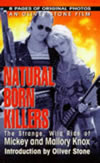 I was just reading your site in hopes of finding out more about your novelization of the film Natural Born Killers. It appears as though the book can still be found in some circles but at exorbitant prices. Do you happen to know of anywhere that I could order this book?
— MJD
The best advice I could give you is to save your money, because the book isn’t very good. You’re much better off reading Quentin Tarantino’s original screenplay. The only copy on the net I’ve found is an awkwardly-formatted HTML version, but it’s certainly better than nothing. [Update: A kind reader forwarded this link to a proper .pdf.]
The things you love can hurt you the most, and that’s certainly the case with Natural Born Killers. I first read Tarantino’s script in the fall of 1992, when I was in my first year of grad school at USC. His was probably the 10th screenplay I ever read. The moment I finished it, I flipped back to page one and read the whole thing again. It was that good.
So I counted myself incredibly lucky to get to work on the movie the following year. Oliver Stone had directed a heavily-rewritten version of it, and I was hired as assistant to the two producers while the film was in editing. Even though I was mostly answering phones and writing coverage, it was exciting to be one office away from a big motion picture in post. When I finally got to see the cut, I was disheartened: so much of what I loved about Tarantino’s screenplay had been changed. It was like waiting all year for Christmas and finally opening that big wrapped box to discover what you hoped was an Atari was actually Sears Pong. Same idea, but disappointingly different.
I know there are people who love the movie, and with good reason, but to me the film is too much of too little.
Then, remarkably, I got the opportunity to work on the novelization. Penguin had hired writers to do it, but the editor wasn’t satisfied with what they were producing. After reading my first script and talking with my bosses, she asked me to write a new book. It gave me a chance to go back to Tarantino’s original script and incorporate things that had been dropped from the movie, and add new sequences that detailed other pit-stops on Mickey and Mallory’s trail of terror.
I wrote the book in three weeks, while finishing my master’s thesis and working full-time. I slept three hours a night — but you can do that when you’re 23.
I was really happy with the book I wrote, but before the draft went to Penguin, one of my bosses decided to rewrite it. And rewrite it poorly. That’s not just my opinion; on a purely objective level, the text is a mess. Because there was no time for proper copy-editing, characters’ names are spelled different ways in different chapters.
It’s frustrating to have my name on a book that I hate. But I try to look for the positive: I was paid $7,000 to write the book, which was enough money to get by for six months before I got my next writing job. (That next job was HOW TO EAT FRIED WORMS, a charming kid’s book for which Natural Born Killers was a terrible, terrible writing sample. I owe Ron Howard a lot for even considering me.)
I can’t put my original draft of the novel in the Downloads section, because the publisher controls the copyright. But if anyone reading this post is an enterprising young editor at Penguin, I’d love to show you what the book could have been.
New Fox show announced
Both The Hollywood Reporter and Variety had stories today about the new one-hour drama that I’m developing for Fox with Jordan Mechner, the writer of Prince of Persia.
The show is about two guys, business partners, who work as private military contractors. They run their own startup firm. Week-to-week, they find themselves in the most dangerous parts of the world — Iraq, Africa, South America — trying to complete short-term contract jobs such as rescuing hostages, guarding facilities, or protecting diplomats. Of course, being a drama, things never go as smoothly as planned.
The idea sprang from research Jordan was doing about military corporations, the mercenaries of the 21st century. It could have been a feature, but the more we talked about it, the more excited we got about developing it for television. The show is sort of a procedural (the term for all the CSI’s and such), but instead of trying to find a killer, our heroes are trying to complete a mission.
Television moves fast, but as I have updates, I’ll try to keep them posted.