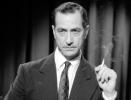
 Over the weekend, I went to see [Good Night, and Good Luck](http://imdb.com/title/tt0433383/) at [The Arclight](http://www.arclightcinemas.com/). I liked it a lot, not only for its strong performances, but also its complete disregard for anything approaching traditional narrative structure.
The screenplay, by [George Clooney](http://imdb.com/name/nm0000123/) and [Grant Heslov](http://imdb.com/name/nm0381416/), is full of good dialogue — much of it apparently drawn from transcripts. What it doesn’t have are other Syd Field essentials, such as character arcs, reversals, and clear motivations.
Stripped of such niceties as backstory and personal lives, the characters are left only with The Issue: challenging [Joseph McCarthy](http://en.wikipedia.org/wiki/Joseph_McCarthy) and his destructive campaign against supposed Communists. Much like [The Crucible](http://en.wikipedia.org/wiki/The_Crucible) can be read as an allegory about McCarthyism, Clooney’s movie draws parallels with the current between the media and the government (replace “Communist” with “terrorist” et voilà¡). But to the script’s credit, it works without this “meta” aspect. Execution matters, and it in this case, it’s executed terrifically well.
In its thematic austerity, it feels more like a play than a movie — and the fact that it’s entirely interiors adds to that sense. Some people may not like the film for that reason, and that’s valid. But the claustrophobia worked for me. Had it gone outside, I think I would have applied more “movie” expectations to it. By keeping it close and focussed, I never worried about what I was missing.
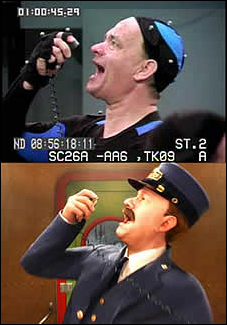 For those who missed all the stories about the motion-capture process when [The Polar Express](http://imdb.com/title/tt0338348/) came out, here’s my incredibly simplified explanation. Motion capture uses real actors, who wear special clothing (unitards, basically) outfitted with reflective dots. They have similar, smaller dots on their faces.
 The most annoying question came from a guy sitting behind me. I didn’t turn to look, but in my head, I immediately conjured the image of Comic Book Guy from The Simpsons. He took great umbrage at the presenter’s suggestion that one advantage of recording to P2 is that you can delete worthless takes in the field, freeing up more space on the card.
 Both the Zemeckis tour and Comic Book Guy’s misguided rant reminded me of a book I read a few months ago, [The Paradox of Choice](http://www.amazon.com/exec/obidos/tg/detail/-/0060005696/) by Barry Schwartz. As consumers, we’re conditioned from a young age to think that the more options you have, the better. But that’s not really the case. Study after study shows that the more choices you offer someone, the less happy they are with their ultimate decision.