• Skip to primary navigation
  • Skip to main content
  • Skip to primary sidebar

John August

  • Arlo Finch
  • Scriptnotes
  • Library
  • Store
  • About

Follow Up

More on the torrents

January 17, 2008 Follow Up, Projects, The Nines

There’s been a lot of feedback and reaction on this site and others about my [c’est la vie attitude](http://johnaugust.com/archives/2008/the-nines-on-bittorrent) towards The Nines showing up on BitTorrent. Some felt I was tacitly endorsing piracy (no), while others wondered if I’d feel the same if I had financed the movie, rather than writing and directing it. So I thought I’d address and clarify some of these issues.

I’m not bouncy with joy over my movie getting torrented, but I think it’s a stretch to equate unlawful downloading with traditional theft. As many commenters have pointed out, The Nines isn’t available in any legal form in many countries around the world, nor will it be in any foreseeable time frame. So I have a hard time arguing that a reader in Germany should pay for the movie when there’s no way he could. ((Several commenters have suggested the “tip jar” model, where motivated viewers could contribute to the filmmaker. I don’t know of any successful examples of this form of micro-patronage, but I’d happily be proven wrong.))

But I’d draw a distinction between an individual downloading an otherwise inaccessible movie and the business of piracy.

I get pissed off when I see blackmarket DVDs sold on the sidewalks of Manhattan, because those are literally discs we’re not selling. It’s organized crime. Even the big torrent sites are essentially profiting off others’ work, by selling ads. So yes, I’m mindful that even as I excuse the individual downloader, the system which allows the individual downloader is far less noble.

The pro-torrent argument, particularly for indie films which get limited distribution (like The Nines), is that a torrent allows a lot of people to see the movie who otherwise couldn’t. And yes, a filmmaker wants his work seen.

But he also wants to be paid for his efforts. No matter where you work — an office, a factory, a retail store — you do your job with the expectation of getting paid. If your employer decided he didn’t want to pay you, you’d be upset. If the employer said, “Well, the customers decided to take the products without paying for them,” you’d rightly tell him to get off his fat ass and hire a security guard.

That’s why I have no problem with Sony and the MPAA going after bootleggers and other merchants of ill-gotten films. It’s not just the studios’ right to see that the law is enforced; it’s their job.

But I’d steer the legal machinery towards stopping the true black market — counterfeit discs and camcorder specials — and spend more time coming up with legitimate, convenient alternatives to the torrents, so that’s it’s not any more difficult to find and download a movie legally. ((And legally worldwide. Given the dominance of American media, it’s especially frustrating that cinephiles in Australia and other markets have to queue at the back of the line for movies they’ve seen promoted 12 months earlier.)) Apple’s new rental deal with the studios sounds promising. That and a dozen other efforts could make the market competitive, which will be better for everyone.

On the money
—
The Nines was independently financed. And while the money came from various sources, it all streamed through me. I signed every check. I own the copyright through Confederated Products LLC, which in turn licenses the movie to distributors like Sony, Newmarket and Optimum.

So when I refer to The Nines as being “my movie,” I’m not just claiming artistic ownership as writer/director. It really is mine. So unlawful downloading has a much more direct effect on me for The Nines than it would for the other movies I’ve written, like Go or Charlie and the Chocolate Factory.

One of the things I hope to do with The Nines — sometime after the writers’ strike, when I can call Sony again — is work with them to release a low-res version of all the source material for The Nines, so budding filmmakers can try their hand at cutting (and re-cutting) a real feature. So I’m watching this first wave of torrents carefully, hoping the people who are downloading The Nines are doing it because they love movies, and not because they want to screw over some mythical The Man. Because to a very large degree, I am The Man in this case.

Not a word

November 8, 2007 Follow Up, Strike

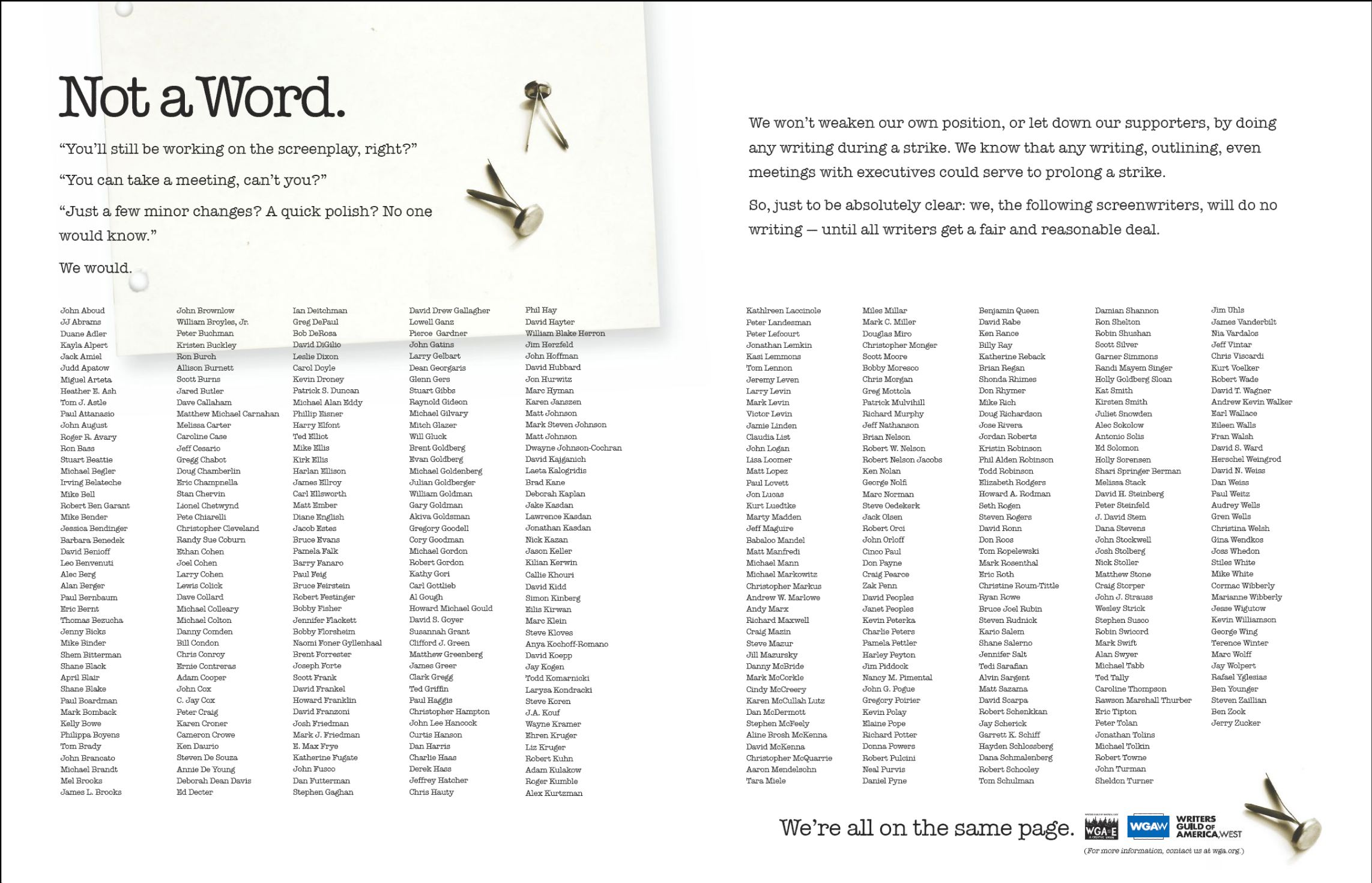
Last week, I [wrote how much I admired](http://johnaugust.com/archives/2007/pencils-down) the [Pencils Down](http://www.wga.org/subpage_member.aspx?id=2529) ad, in which TV’s top showrunners said they would be doing no writing on their shows during a strike. I said that I’d be delighted to sign a similar ad for feature screenwriters. I’m happy to say the WGA took me up on the offer.

This morning’s trades include this ad, signed by nearly every screenwriter you can think of.
((**UPDATE:** Note entirely true: If you think hard, you can come up with names of screenwriters not on this list. It was put together over the weekend, and some writers couldn’t be reached in time. So don’t think ill of someone whose name isn’t there. From talking with the organizers, not a single screenwriter said no.)) (Click for a bigger version.)

[screenwriter ad](http://johnaugust.com/Assets/not_a_word.jpg)

There was a lot of speculation that the flurry of deals made before the strike meant that feature scribes would be busy typing away on assignments between shifts on the picket line. Nope.

Personally, I’m not writing on three big movies: Shazam! for New Line, a Sam Mendes feature for Dreamworks, and my fourth collaboration with a certain director for Warner Bros. Today’s Variety just announced that Prince of Persia [signed a director](http://www.variety.com/article/VR1117975541.html?categoryId=1079&cs=1) — Mike Newell — but has no writer to work with him.

The blockbusters of 2009 are sitting unwritten. That’s an economic factor I’ve never seen reported in all of this. The next installments of Spider-Man, Harry Potter, and every other movie franchise are unwritten and unproducible until the strike is over.

If I were a theater chain, I’d be worried. If I were Wal-Mart, I’d demand answers. If I were a shareholder, I’d demand blood. The AMPTP’s refusal to return to the bargaining table is costing more than jobs, and will keep hurting the studios well into 2009 unless they get back to negotiating.

Heroes: Origins: Gone

October 31, 2007 Follow Up, Projects, Television

I can confirm that the plug got pulled on the six Heroes: Origins episodes, one of which I was slated to write and direct. The possiblity of a WGA strike ((I’m bucking convention by not saying “looming” in reference to the strike.)) made NBC hesitant to prep a series they might never be able to shoot.

I had literally just hit “Print” on my revised outline when I got the call from Tim Kring. So, yeah. I’m bummed. But I get it: It was a lot of money to spend in a very uncertain time. And if the labor situation resolves in an orderly fashion, the series could find itself out of the deep freeze for next season. ((One favorite topic of conversation is what will happen to this TV season if there is a prolonged break. It’s not unlikely we’ll get a second, shorter season to finish up the year.))

In case we never get to shoot it, my episode is/was called “Rehab.” Not everyone is good with their powers. Not everyone is good, period.

Authorship in the digital age

October 30, 2007 Follow Up

A few weeks ago, my friend [Howard Rodman](http://www.imdb.com/name/nm0734912/) was asked to give a talk at the 2007 Rencontres Cinématographiques de Dijon, speaking on a panel entitled “Copyright and Droit d’Auteur in the Digital Age.”

Being a reader of the blog, Howard asked if he might incorporate a few of the observations from my [Challenge of Writing in the Digital Age]() speech a few weeks earlier.

I said, “of course.” Especially if he would let me link back to his speech. It’s all very [Creative Commons](http://creativecommons.org/).

As I said at the time, I think my speech would have been improved by focusing on one or two issues, rather than the sampler platter I offered. Here’s a chance to demonstrate that fact.


Authorship in the Digital Age

**a talk by Howard Rodman**

howard rodmanAs the representative of what is, literally, a Writer’s Guild, I’d like first to talk about authorship. As someone who creates intellectual property that is licensed to others, I’d like second to talk about copyright. And ultimately, I’d like to talk about the disruptions, confusions, multiplications, collisions, perturbations, conflagrations, and weird opportunities wrought in both the areas by digital technologies.

Authorship
—

When someone painted on the wall of a cave in Lascaux, he—or she—was the author of that painting. The painter may have been doing it on behalf of a large group, expressing a grander vision. But the person who wielded the instrument, who left the mark—that person was the author.

This is clear. But anything after that—anything involving reproduction—begins to get fuzzy.

Let me throw out a bunch of questions:

* The person who takes pen in hand and writes an essay, is that the author? Well, yes.

* A medieval monk who copies a manuscript, is he the author? He’s the one wielding the instrument, he’s the one leaving the mark– But is he the author? Most of us instinctively would say, no. Because authorship involves more than the reproduction of a work—it seems to involve the creation of a work.

Each technological change brings about a new confusion of the concept of authorship.

Now, in the digital age, authorship is more and more diffuse. More fugitive. More difficult to locate.

Let me throw out some examples.

The American television personality Stephen Colbert, on his show on Comedy Central, stood up one night in front of a green screen and did this: “ZIP. ZAP.”

He challenged his viewers to use the material in creative ways.

Within less than 24 hours, versions popped up on YouTube. Colbert having a lightsabre battle with Star Wars characters. Colbert having a lightsabre battle with Dick Cheney.

Who is the author of these pieces? Is it Colbert? The writing staff of The Colbert Report? Comedy Central? The viewers who composited his image with new or found footage? George Lucas? Dick Cheney?

Last month the American screenwriter John August released his directorial debut, a film called The Nines. He also posted on his website some raw footage from The Nines, and encouraged the readers of his blog to download, remix, go wild. All manner of trailers for The Nines went up on the web: sad versions, funny versions, music video versions, poignant versions, violent versions, red kryptonite versions. This was John’s project, John’s vision. He wrote and directed the footage, he told his audience to edit. Is he the author? Are they the author? Is this a collaboration among authors who have never met? Is this, in a sense that the Surrealists would recognize, a cadvre exquis? Or is this a unique artifact of the 21st century, something that could not have existed prior to the specific technology that makes this strange new hybrid art form possible?

Now let me pose a more personal question about authorship.

I write a film. Meaning: I sit in my basement, and imagine characters, and imagine a story, and because there was nothing, and now there is something, I consider myself to be the author. I send it out, the screenplay attracts a producer, attracts actors, attracts financing. Now the film is made. Now I am in a theater, and the lights darken, and I am seeing on a large screen, and in the company of a large audience, the characters that three years previously I had dreamed up in my basement.

After the company logos, the first thing I see is a title that says “a film by.” But that name isn’t my name.

The last thing I see is small print which reads, “for the purposes of the Berne Convention for the Protection of Literary and Artistic Works and all applicable copyright treaties, the author of this work shall be considered to be TimeWarner Inc.”

So my work, the work that I wrote, is bookended by two statements of authorship, neither of which is mine.

There are two possible reactions to this. One is to descend into an abyss of self-pity. The preferred reaction, of course. But the other is to recognize that the changes brought about to concepts of authorship by technology, the changes brought about to concepts of authorship by copyright, make the old notions sentimental at best, and, most likely, obsolete.

Copyright
—

Let me now talk about copyright.

The concept of copyright didn’t exist until after the invention of the printing press. It didn’t have to. There was no need to protect things from being copied when there was no technology other than the pen for such copying.

In 1556 the Stationers Company maintained that once purchased, the rights to a manuscript belonged to the printer, and the author had no further say in its distribution, or stake in its revenues. So we see that the MPA has its roots in the 16th century.

Next, Charles II passed the Licensing Act of 1682, which established a register of licensed books.

Then in 1709 the Statute of Anne (not to be confused with the statue of Anne) named for Queen Anne. The first real copyright act. For the first time authors, rather than printers, are invested with the right to have a say in the reproduction of their work.

This was in sync with what was to become the French concept of droit morale, which began in many ways with the French Revolution (insert space for applause here) and the writings of Beaumarchais.

And so the principle of copyright, which in many ways still obtains today: you created it, you control its reproduction and distribution.

But there is another need, another social good: that of the free and unimpeded exchange of ideas. So the Statute of Anne also established a 14-year term of copyright (with a 21-year term for works already extant), as a way of balancing the author’s right to profit from his or her work against the public’s legitimate need to have works readily available.

Copyright law ever since has been a balancing act between these two competing needs, both legitimate, both reflecting desirable social outcomes.

But in the 20th century, as the drug manufacturers and the large intellectual property conglomerates became more powerful, they exercised more control over patent and copyright laws—and the balance has shifted.

In 1905, the patent holders went to Washington and essential bought themselves a new concept: work for hire. This was the first exception in American copyright law to the longstanding and intuitive concept that the legally-recognized author of a work is the person who created it.

Work for hire is what we do, as screenwriters, when we get an assignment. It means that we are creating something without most of the rights that typically inhere in the act of creation.

Now, with every re-enactment of the copyright act, the term of copyright grows longer and longer. See, for instance that part of the Digital Millennium Copyright Act called (and I’m not making this up) the “Sonny Bono Copyright Term Extension Act of 1998.”

The 1998 Digital Millennium Copyright Act (DMCA), and the extensions that most likely will be passed in our lifetimes, virtually ensure that neither you, nor I, nor most likely our children, nor, most probably, our grandchildren, will ever be able to draw a sketch of Mickey Mouse without fear of exposure to litigation.

And so of copyright, which was intended to balance the needs of the creator and the public, now primarily benefits the large intellectual property conglomerates. In many senses, we are heading back to the Stationers Act, to the 1500s—except now the stationery store has gone digital.

The DMCA, which, in response to the threat of piracy which Bob Pisano will talk about most eloquently and forcefully, now forbids specific forms of copying—whether the material being copied is copyrighted or not. If I have a DRM-protected DVD of *L’arrivée d’un train en gare de La Ciotat,* a piece of footage as old as cinema itself, and as classically in public domain as any moving footage anywhere, and if I circumvent the DRM to copy that footage, I am committing a crime.

But there are other, countervailing forces. My attorney, the intrepid Michael Donaldson, who plays in the fields of copyright and fair use, says that the copyright laws are in some respects more fair now than they were forty years ago. As he puts it, “In the past, the public’s voice has been absent from the drafting table for copyright legislation. Disinterest was rampant. This was not an area of the law that many people saw as touching their lives. In large part because of the egregiously aggressive behavior of RIAA and MPAA, the public has been alerted to the many ways that copyright touches their lives. And the public’s voice is now being heard.”

Regardless as to whether you see the law moving forwards or backwards, what is clear is that copyright is fluid. And just as the concept of what is an author changed as technology and social relations changed, so has the sense of what is a copyright, and what that copyright protects, and for whose benefit.

Digital Age
—

As Walter Benjamin pointed out in The Work of Art in the Age of Mechanical Reproduction, after the printing press, after photography, when you look at an object, you are often no longer looking, simply and straightforwardly, at an object. You are, instead, looking at the original of a reproduction—with all the associated loss of aura. Is that the Tour Eiffel? Or is that the original of a million postcards, T-shirts, shot glasses, keychains?

The digital age raises this confusion exponentially. For instance: in most previous history, the machinery used to create was distinct from the machinery used to copy. Think of the quill pen and the printing press. Think of the Remington typewriter and the Xerox machine. But now the laptop on which one creates is the laptop on which one copies. The two processes become conflated. And when cut and paste no longer involves scissors or library paste but is instant, is seamless, leaves the thing from which it was cut intact, is pasted without any trace into the new work– The distinction between original and reproduction becomes more slippery, more fugitive.

Even more tellingly, every previous reproduction differed from its original. The painting of the painting was distinguishable from the painting. The cassette tape of the vinyl recording of Pierre Fournier playing Bach’s Sixth Cello Suite was inferior to the vinyl itself. But now the copy is not just almost as good, or virtually as good, or three-places-to-the-right-of-the-decimal-point as good: the copy is indistinguishable from the original. Does it even make any sense, viewing two identical digital files, to speak of “the original.” In this digital age, can even the word “original” retain its original meaning?

Lautréamont famously said, “Poetry must be made by all, not by one.” Perhaps this is what he meant, and perhaps, were he with us at this moment, Lautréamont would be dancing in wild celebration. But then again: perhaps not.

Anyone who is young, or who lives in a house with anyone who is young, or who lives and breathes and drinks in the media of the 21st century, knows that the 20th century’s hallmark distinctions between what goes on a big screen, what goes on a small screen, what goes on a tiny screen, is eroded, perhaps lost. We know, too, the erosion and elision of what is owned, what can be accessed, what is borrowed, what is shared, what is stolen. This is a brave new world for authorship, and a brave new world for the protection of authorship.

And it’s not a worry for the future. As William Gibson famously said, “The future is already here. It’s just unevenly distributed.”

On behalf of the Writers Guild of America, which fights for authorship in this difficult and wonderful time, I thank you.

« Previous Page
Next Page »

Primary Sidebar

Newsletter

Inneresting Logo A Quote-Unquote Newsletter about Writing
Read Now

Explore

Projects

  • Aladdin (1)
  • Arlo Finch (27)
  • Big Fish (88)
  • Birdigo (2)
  • Charlie (39)
  • Charlie's Angels (16)
  • Chosen (2)
  • Corpse Bride (9)
  • Dead Projects (18)
  • Frankenweenie (10)
  • Go (29)
  • Karateka (4)
  • Monsterpocalypse (3)
  • One Hit Kill (6)
  • Ops (6)
  • Preacher (2)
  • Prince of Persia (13)
  • Shazam (6)
  • Snake People (6)
  • Tarzan (5)
  • The Nines (118)
  • The Remnants (12)
  • The Variant (22)

Apps

  • Bronson (14)
  • FDX Reader (11)
  • Fountain (32)
  • Highland (73)
  • Less IMDb (4)
  • Weekend Read (64)

Recommended Reading

  • First Person (87)
  • Geek Alert (151)
  • WGA (162)
  • Workspace (19)

Screenwriting Q&A

  • Adaptation (65)
  • Directors (90)
  • Education (49)
  • Film Industry (490)
  • Formatting (128)
  • Genres (89)
  • Glossary (6)
  • Pitches (29)
  • Producers (59)
  • Psych 101 (118)
  • Rights and Copyright (96)
  • So-Called Experts (47)
  • Story and Plot (170)
  • Television (165)
  • Treatments (21)
  • Words on the page (237)
  • Writing Process (177)

More screenwriting Q&A at screenwriting.io

© 2026 John August — All Rights Reserved.