• Skip to primary navigation
  • Skip to main content
  • Skip to primary sidebar

John August

  • Arlo Finch
  • Scriptnotes
  • Library
  • Store
  • About

Follow Up

How we record Scriptnotes

November 4, 2013 Follow Up, Geek Alert, Tools

scripnotes coverMany listeners have asked how Craig and I record our weekly podcast, so here’s a quick rundown of our standard operating procedure.

### When and what
By email, Craig and I figure out when we’re going to record. It’s usually a Thursday or Friday, late in the afternoon. In that email thread, we also decide what topics to cover. If it’s a [Three Page Challenge][3pc], I’ll ask Stuart to send each of us PDFs of the entries he’s picked.

About 10 minutes before we start recording, I make a sketchy outline in [Highland][highland] with reminders for myself: the episode number, today’s topics, housekeeping bits, and my [One Cool Thing][onecoolthing]. If there’s anything I need to read aloud — for example, a quote from an article — I usually copy-paste it into this document.

Since Craig works in Pasadena and I work in Hollywood, it’s not practical for us to be in the room together, so we record the podcast on Skype. This is the part many people can’t fathom — *we’re almost never in the same room together.*

It takes practice to keep up a conversation when you don’t have the normal physical cues. The first few episodes were rough. But I think the podcast is actually much better for Craig and I being apart. Like the audience, we’re only hearing each other’s voice, so everything we’re communicating needs to happen in speech.

### Editing
While Craig and I are talking on Skype, each of us has GarageBand running on our own computers to record only our side of the conversation. When we finish recording, we each copy our GarageBand project into the same shared Dropbox folder. From there, my assistant Stuart yanks out the audio and marries the two tracks in a vintage copy of Soundtrack Pro, which is where he does most of the real editing.

Many podcasts simply record the Skype call, saving the step of marrying the two tracks. But with all the fire trucks and street noise at Craig’s office, it’s very handy to be able to manage the two sides of the conversation separately.

One problem with recording two tracks separately is sync. We begin with a “1…2…3…go” so that we both hit record at the same time. We clap-sync as well. Despite all this, our tracks eventually fall out of sync, so Stuart has to nudge them a bit. I’m hoping Marco Arment will release his fabled [track-nudging utility][utility] to the world. We’d pay good money for it.

Once Stuart has finished editing a track, he’ll put it back in Dropbox. I’ll listen to it and write up the text for the post, along with links and outro. All that gets added into a new GarageBand project, where Stuart also makes chapter markers. He exports m4a and mp3 formats, then uploads them to Libsyn, which hosts the files.

Every Tuesday morning, Stuart throws the virtual switch to make the episode live.

###Nuts and bolts

For hardware, we started with Dan Benjamin’s really useful guide to [podcasting gear](http://hivelogic.com/articles/podcasting-equipment-software-guide-2011/), but ultimately made different choices.

Craig and I are each using Audio-Technica [AT2020 USB microphones][at2020] mounted on [Heil PL-2T booms][boom]. (When I’m traveling, I pack the [Blue Yeti USB microphone][yeti] instead. It’s really good, but really heavy.)

For listening, there’s nothing better than the Sony [MDR-7506 headphones][headphones], which not only sound great but seal well, keeping Craig’s audio from being recorded on my track. I like them so much that I’ll bring them with me on a trip.

For live shows, I record on the [Zoom 4N digital recorder][zoom]. Even if we’re using audio from a sound board, I’ll still aim the Zoom at the audience to gather crowd noise.

### Podcasting versus blogging

Several longtime readers have pointed out that I used to blog more. Now two or three weeks may pass where I won’t have posted anything but Scriptnotes.

But I really don’t think the podcast has taken my attention away from blogging; life has.

I’ve gotten much, much busier over the last two years, and it’s been hard to stop everything and blog about whatever screenwriting topic arises. The standing commitment of a podcast each week is easier to keep up. It’s like working out with a partner — you show up because of the social obligation.

And as much as I enjoy writing, a blog is essentially a monologue. It’s been rewarding to have a dialogue each week.

[3pc]: http://johnaugust.com/threepage “three page challenge”
[onecoolthing]: http://johnaugust.com/onecoolthings “one cool thing”
[highland]: http://apps.quoteunquoteapps.com/get_highland “highland”
[utility]: http://atp.fm/episodes/25-thrustmaster-joystick “slip sync”
[at2020]: http://www.amazon.com/gp/product/B001AS6OYC/ref=as_li_ss_tl?ie=UTF8&camp=1789&creative=390957&creativeASIN=B001AS6OYC&linkCode=as2&tag=johnaugustcom-20 “at2020”
[boom]: http://www.amazon.com/gp/product/B000SZVZ74/ref=as_li_ss_tl?ie=UTF8&camp=1789&creative=390957&creativeASIN=B000SZVZ74&linkCode=as2&tag=johnaugustcom-20 “boom”
[headphones]: http://www.amazon.com/gp/product/B000AJIF4E/ref=as_li_ss_tl?ie=UTF8&camp=1789&creative=390957&creativeASIN=B000AJIF4E&linkCode=as2&tag=johnaugustcom-20 “headphones”
[yeti]: http://www.amazon.com/gp/product/B002VA464S/ref=as_li_ss_tl?ie=UTF8&camp=1789&creative=390957&creativeASIN=B002VA464S&linkCode=as2&tag=johnaugustcom-20 “yeti”
[zoom]: http://www.amazon.com/gp/product/B001QWBM62/ref=as_li_ss_tl?ie=UTF8&camp=1789&creative=390957&creativeASIN=B001QWBM62&linkCode=as2&tag=johnaugustcom-20

Big Fish, Jimmy Buffet, and seeing shows on a budget

October 28, 2013 Big Fish, Broadway, Follow Up

Let’s start with the **TL;DR version**:

The producers have agreed to restore my SCRIPT discount code for Big Fish on Broadway, but only through December 22nd — and they might pull the offer at any time. Tickets are $85/$67 (versus $150/$85) at the box office, or on [Ticketmaster](http://www.ticketmaster.com/Big-Fish-a-New-Broadway-Musical-tickets/artist/1859083) for the same price plus a service charge.

Longer version:

Jimmy Buffett is one of the producers of Big Fish. He has legions of [Parrothead](http://en.wikipedia.org/wiki/Parrothead) followers, but since they’re not the classic audience for a Broadway musical, he asked for a discount code (JIMMY) he could send his fans as an extra incentive.

I love Jimmy. I love this idea.

But I too have followers I want to come see the show, especially students and over-educated/under-employed aspiring writers. My people came in surprisingly large numbers during previews, and I have a hunch many of them may be headed to the East Coast for the holidays. So I asked for my SCRIPT code back and got it.

It’s not quite the deal it was during the [first weeks of previews](http://johnaugust.com/2013/big-fish-broadway-unlock), but it’s almost certainly the lowest price you’re going to find for a guaranteed seat.

###It’s not a competition but yeah sort of it is

Every week, we get a report on the discount codes used, and it would honestly kind of thrill me to out-earn Jimmy Buffett.

And it’s a game you can play, too, because just like booking flights and hotels, you can manipulate the system to get a much better seat than you’d expect.

Big Fish sells out most performances, but here are some suggestions for getting a great seat. Most of these apply to any Broadway show:

1. Tuesday, Wednesday and Thursday nights generally have the best availability.
2. The first five rows of the mezzanine are terrific — arguably the best seats in the house. In the Neil Simon, the front mezzanine is better than rear orchestra.
3. Split up. You’re more likely to find two amazing single seats.
4. Talk to Louie or Eric at the box office. Use the code. Drop my name. These guys are awesome, and want you to have a good seat.
5. In the hours — sometimes the minutes — before a show, a great seat may become available because the producers release tickets they were holding back for media. So even if Ticketmaster says there are no tickets, it’s worth a visit to the box office.

For some performances, we sell tickets at the TKTS booth in Times Square. These are almost always seats at the back of the mezzanine, and availability is constantly changing. TKTS is great, but you’ll get a better seat by coming to the theater itself.

###Seeing shows for less

There are two ways to see a Broadway show for less than list price, but both of them involve some trade-offs.

**Student Rush.** If you’re a college student with more time than money, it may be worth waiting in line for student rush. First check out the [Rush Report](http://www.broadwayspotted.com/rush-report-october-27-2013/) to gauge when you’d need to be there and how likely you are to get a ticket. Big Fish is one of the more difficult shows to rush:

> Weekdays: 15 people in line by 9:20 AM. 26 tickets available. Weekends: 37 people in line by 9:15 AM. 1st person in line at 6:30 AM. 26 tickets available.

Student rush tickets are $27. These seats are generally at the edges of the orchestra, and are sometimes partially obstructed. But you’ll often be very close to the action, and if you’re a theater student, you may learn something extra just from seeing it so close-up. I’ve talked to some college students who’ve already seen Big Fish three times because of student rush.

**Standing Room Only.** At the back of the orchestra, there’s a railing with numbered standing room only spaces. At performances where absolutely every seat is sold, the theater will sell those spots. I’m not even sure of the price, but it’s more than student rush.

This is where I stand to watch the show most nights. I love it — but I work at a standing desk, so your mileage may vary.

There’s no guarantee you’re going to be able to get SRO tickets on any given night. That’s why I strongly recommend that if you want to see Big Fish, you use the SCRIPT code either at the box office or Ticketmaster as soon as you can. Heading into the holidays, supply will get constrained. I really want you to see Big Fish, and I want you to have a good seat.

Storing stuff in other people’s houses

October 17, 2013 Follow Up, Geek Alert

Last week, Stuart and I were talking about strategies for backing up the early episodes of Scriptnotes in case of fire or other calamity.

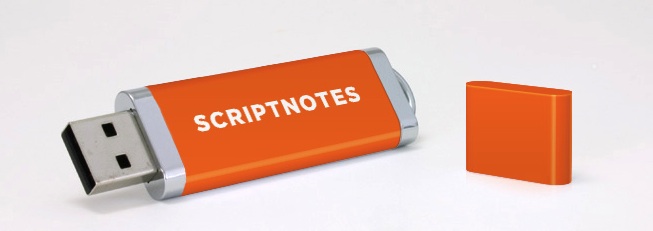
And then I remembered we effectively had. We shipped several hundred of the Scriptnotes USB drives, each loaded with the first 100 episodes of the show in both mp3 and m4a format.

scriptnotes drive

Even if LA got nuked, listeners in Prague and Peoria would be able to share these files. Craig and I actually talked about it in [Episode 103](http://johnaugust.com/2013/scriptnotes-ep-103-disaster-porn-and-spelling-things-out-transcript):

**John:** So, again, if a nuclear apocalypse happens and we’re all wiped out — or maybe zombies, it could be anything that actually wipes out all of humanity and our ability to access the internet — if you had one of these little drives and some sort of computer that was capable of reading them, like a laptop that you’re powering through some sort of pedal bicycle in a kind of Gilligan’s Island scenario, you would still be able to listen to [Scriptnotes]. And be able to follow along on the Three Page Challenge, which is I think really important as you’re rebuilding civilization. You have access to not just our words of advice but the words on the page that you can see why we were giving the notes we were giving about these Three Page Challenges.

**Craig:** I don’t know where it would fall on the hierarchy of goals, but it would probably be between procuring food and medicine.

We’re making another batch of the Scriptnotes USB drives if [you’d like to buy one](http://store.johnaugust.com/product/scriptnotes-100-episode-usb-flash-drive).

I truly believe in storing important things at other people’s houses. A good example is photos. We had all of my dad’s old photos scanned, then bought a bunch of [cheap hard drives](http://www.amazon.com/gp/product/B00834SJSK/ref=as_li_ss_tl?ie=UTF8&camp=1789&creative=390957&creativeASIN=B00834SJSK&linkCode=as2&tag=johnaugustcom-20) so we could give the whole set to relatives. It’s a kind of legacy insurance.

Google isn’t helping me find the exact quote, but in the age before refrigeration they used to say the best place to store food is in your neighbor’s stomach. If you have more than you need, throw a feast.

Podcasts aren’t parties and photos aren’t food, but sharing these assets is similarly communal — and mutually-beneficial. Often, the best backup strategy is giving it away.

Screenwriters hate cell phones

October 11, 2013 Follow Up

Back in May, I hosted a panel entitled Storytelling in the Digital Age. The Academy [posted clips](http://www.oscars.org/events/turning-page/index.html) of my discussion with the makers of Zero Dark Thirty and Star Trek Into Darkness, but I also wanted to share my introduction to the event.

And then I forgot. And then I got really busy. So here, now, is how it started.

My presentation began with a (http://www.youtube.com/watch?v=A7pT0AHsfzY), followed by some observations before I introduced my guests.

Tonight, we’re going to talk about technology. Usually when I come to see a panel about technology at The Academy, we’re discussing innovations like digital cameras and high frame rates and visual effects — we’re focussed on how we put images on the big screen.

But tonight I want to talk about how technology affects *storytelling* in movies. And this clip package is an example.

Twenty years ago, if you wanted to get a bunch of people stranded in the woods, it was pretty easy. Now these characters would almost certainly have cell phones, and as a screenwriter you have to address that. The last scene you saw there was from a movie I directed, and what Ryan Reynolds says is probably true: *It’s going to keep happening.* Technology is going to keep advancing, and our movies are going to have to change to reflect that.

It’s not just characters talking on cell phones. If I’m being honest, I don’t talk on the phone all that much. If I want to tell someone something, I text or email. And that’s really uncinematic.

We haven’t quite figured out a good way to show texting. Sometimes we’ll do a closeup on the screen of the phone, or we’ll superimpose what’s being texted on screen, like they do in the BBC version of Sherlock.

It’s not ideal. No one comes to movies to read.

We come to movies to see characters interacting with each other, doing things. And one of the things they’re often doing is trying to find out information. In a thriller, they’re trying to uncover the facts, and you send them into dark and mysterious basements. In a romantic comedy, they’re trying to find out about someone they have a crush on and wackiness ensues.

That becomes harder to do in an age of Facebook and Twitter and LinkedIn. We don’t want characters Googling things, but sometimes, that’s what they would realistically do.

Technology has changed things, and movies have had to change to reflect that.

But it’s not all bad news. Not at all.

To me, this clip package is an example what’s great. It was cut together by Zig, an editor at the Academy, inspired by a terrific 2009 [supercut by Rich Juzwiak](http://www.youtube.com/watch?v=XIZVcRccCx0).

A supercut is an amazing thing that could really only exist in a digital age. What he’s doing is going through hundreds of movies and snipping out just the parts where people’s cell phones fail them. As writers and as an audience, we might subconsciously know that characters’ cell phones get taken out of commission a lot in movies, but when you put them all together like this, it becomes blindingly obvious.

That’s one of my themes tonight. Storytelling in the digital age is about making the invisible, visible.

« Previous Page
Next Page »

Primary Sidebar

Newsletter

Inneresting Logo A Quote-Unquote Newsletter about Writing
Read Now

Explore

Projects

  • Aladdin (1)
  • Arlo Finch (27)
  • Big Fish (88)
  • Birdigo (2)
  • Charlie (39)
  • Charlie's Angels (16)
  • Chosen (2)
  • Corpse Bride (9)
  • Dead Projects (18)
  • Frankenweenie (10)
  • Go (29)
  • Karateka (4)
  • Monsterpocalypse (3)
  • One Hit Kill (6)
  • Ops (6)
  • Preacher (2)
  • Prince of Persia (13)
  • Shazam (6)
  • Snake People (6)
  • Tarzan (5)
  • The Nines (118)
  • The Remnants (12)
  • The Variant (22)

Apps

  • Bronson (14)
  • FDX Reader (11)
  • Fountain (32)
  • Highland (73)
  • Less IMDb (4)
  • Weekend Read (64)

Recommended Reading

  • First Person (87)
  • Geek Alert (151)
  • WGA (162)
  • Workspace (19)

Screenwriting Q&A

  • Adaptation (65)
  • Directors (90)
  • Education (49)
  • Film Industry (490)
  • Formatting (128)
  • Genres (89)
  • Glossary (6)
  • Pitches (29)
  • Producers (59)
  • Psych 101 (118)
  • Rights and Copyright (96)
  • So-Called Experts (47)
  • Story and Plot (170)
  • Television (165)
  • Treatments (21)
  • Words on the page (237)
  • Writing Process (177)

More screenwriting Q&A at screenwriting.io

© 2026 John August — All Rights Reserved.