• Skip to primary navigation
  • Skip to main content
  • Skip to primary sidebar

John August

  • Arlo Finch
  • Scriptnotes
  • Library
  • Store
  • About

John

Fountain for coders, or the joy of writing

April 15, 2014 Apps, Fountain, Geek Alert, Highland

Charles Forman, whose company OMGPOP developed Draw Something, is [writing a screenplay in Fountain](http://setpixel.com/writing/writing-a-screenplay-in-fountain/):

> I don’t work at a bank. However, I’m sure that on the first day of orientation, they teach you how to use an application written in 1999 in Visual Basic. It hasn’t been updated since 2001, it doesn’t work very well, everyone hates it, but it’s the way it is, and if you trick it, you might be able to do what you want, or wait until it’s 5 PM. It’s probably exactly what it’s like to use Final Draft.

> The joy of writing shouldn’t feel like working at a bank.

Forman offers a detailed look at writing in Fountain from the perspective of someone who’s written a lot of code. For his screenplay, he used both [Slugline](https://itunes.apple.com/us/app/slugline/id553754186?mt=12) and [Highland](https://itunes.apple.com/us/app/highland/id499329572?mt=12), but also built his own tools based on the libraries available on GitHub.

>”How many scenes do I have?” It’s a pretty simple question. Normally, in order to do this, you have to go through the whole script and count the sluglines. I used Javascript to parse my Fountain script. I looped through the sluglines and counted them. Then I was curious about the unique locations. How many times did person A talk vs. person B? I generated some basic stats and spit it out in the console by creating a tool in 20 minutes.

He also built a tool that [generates a word cloud](http://playground.setpixel.com/wordcloud/) based on a screenplay.

Here’s Big Fish:
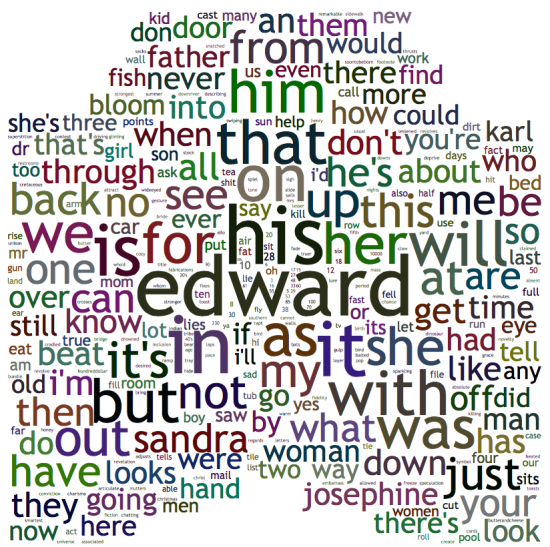
big-fish-wordcloud

Forman listens to the podcast, so he’s heard us discussing the possibilities of a new screenplay format. He argues that we already have it in Fountain.

> Because Fountain is pretty flexible, you could add metadata for anything you might want to extend the screenplay with. In my case, I have included storyboards. You could add metadata for the song that is playing. You could add metadata about which characters are in the scene, if its not totally clear. You could add metadata about what the purpose of a scene is. You could add anything. If I could make a small ask to the Fountain team, I would love a specific way to insert metadata. I am using notes. I’m thinking about putting curly bracket objects inside of notes going forward.

This kind of thinking is why I’m so bullish Fountain: not just what it can do today, but what it can be repurposed for in the future.

The Grimm side of marriage

April 11, 2014 Follow Up, Psych 101, Random Advice

This morning, I [tweeted](https://twitter.com/johnaugust/status/454629102142517248):

> Grimm’s fairy tales offer uniformly terrible marriage advice:
> 1. Endure supernatural hardship
> 2. Marry the person who rescues you

My observation was based on my nightly reading of a copy of Grimm’s that I got at Barnes and Noble last week, ((I’m reading one of those $20 made-for-Barnes versions, and it’s actually really nice.)) not any statistical analysis. But it sure feels true.

If someone has the time this weekend, I’d be curious to know which of Grimm’s tales actually fit this pattern. The book is free through [Project Gutenberg](http://www.gutenberg.org/files/2591/2591-h/2591-h.htm).

Obviously, fairy tales are simplifications of reality, so we can’t expect verisimilitude in them. But this pattern of marrying the first person who assists you seems an especially dangerous idea to instill in young women.

As I think about acquaintances with terrible boyfriends/husbands, almost invariably the girl came from a difficult background (abusive parents, poverty, illness), and this guy got them away from it.

But the fact that they rescued you once doesn’t mean they are the right person for you to build a life with. It doesn’t mean they’ll be a supportive spouse or a good parent. And it doesn’t mean that you’re right for them, either.

If the only requirement for marriage is saving you from peril, we should all marry firefighters.

Writing an album in two weeks

April 11, 2014 Big Fish, Writing Process

In an interview with Billboard, producer Patrick Leonard talks about [writing “Like a Prayer” with Madonna](http://www.billboard.com/articles/columns/pop-shop/5944767/madonna-producer-patrick-leonard-talks-like-a-prayer-at-25).

> I like to start really early in the day. She would come in about 11 and I would have the musical idea on whatever piece of gear I was using. I think it was just a Yamaha sequencer or something at the time. […]

> I would just put the track, the chord changes, some kind of drum beat, bass line — something simple — and say, “here’s the idea, here’s what I have for the day.” She would listen, then we would talk a little bit. Oftentimes I’d say, “here’s the verse, and here’s the chorus,” and she’d say, “no, it’s the other way around, switch ’em.” So I’d switch ’em. This thing is an hour old, it’s not etched in stone.

> Then she would just start writing. She’d start writing lyrics and oftentimes there was an implied melody. She would start with that and deviate from it. Or if there was nothing but a chord change, she’d make up a melody. But, a lot of the time in my writing there’s a melody implied or I even have something in mind. But she certainly doesn’t need that.

> She would write the lyrics in an hour, the same amount of time it took me to write the music (laughs). And then she’d sing it. We’d do some harmonies, she’d sing some harmony parts, and usually by three or four in the afternoon, she was gone.

> That’s how “Like a Prayer” was written, and then the next day we wrote “Cherish,” and then the next day we wrote “Dear Jessie.” And that’s how it was. We wrote the album in less than two weeks.

This recap demonstrates something I’ve often found to be true: a large part of making art is showing up to work.

As a writer, yes, sometimes you get flashes of inspiration and genius, but if you sit around waiting for them, you’re unlikely to get much accomplished. Most screenplays are written a scene at a time.

One of the great things about writing with a partner is the ability to hold each other accountable. When working with Andrew Lippa on Big Fish, we had limited days — sometimes hours — to get stuff accomplished. So we buckled down and tackled items one-at-a-time. This song. This moment. This transition.

That’s how you finish things.

Assembling the billing block

April 11, 2014 Film Industry

Ben Schott answers all your questions about those uppercase names at the [bottom of movie posters](http://www.nytimes.com/interactive/2013/02/24/opinion/sunday/ben-schott-movies-billing-blocks.html?_r=0).

> While it might look like a bar code of haphazardly packed type, it is in fact the product of detailed legal agreements and intense contract negotiation.

Note that the billing block is distinct from on-screen credits, whether opening titles or an end-crawl. And certain types of posters and ads may not require a billing block at all.

« Previous Page
Next Page »

Primary Sidebar

Newsletter

Inneresting Logo A Quote-Unquote Newsletter about Writing
Read Now

Explore

Projects

  • Aladdin (1)
  • Arlo Finch (27)
  • Big Fish (88)
  • Birdigo (2)
  • Charlie (39)
  • Charlie's Angels (16)
  • Chosen (2)
  • Corpse Bride (9)
  • Dead Projects (18)
  • Frankenweenie (10)
  • Go (29)
  • Karateka (4)
  • Monsterpocalypse (3)
  • One Hit Kill (6)
  • Ops (6)
  • Preacher (2)
  • Prince of Persia (13)
  • Shazam (6)
  • Snake People (6)
  • Tarzan (5)
  • The Nines (118)
  • The Remnants (12)
  • The Variant (22)

Apps

  • Bronson (14)
  • FDX Reader (11)
  • Fountain (32)
  • Highland (75)
  • Less IMDb (4)
  • Weekend Read (64)

Recommended Reading

  • First Person (87)
  • Geek Alert (151)
  • WGA (162)
  • Workspace (19)

Screenwriting Q&A

  • Adaptation (65)
  • Directors (90)
  • Education (49)
  • Film Industry (489)
  • Formatting (128)
  • Genres (89)
  • Glossary (6)
  • Pitches (29)
  • Producers (59)
  • Psych 101 (118)
  • Rights and Copyright (96)
  • So-Called Experts (47)
  • Story and Plot (170)
  • Television (165)
  • Treatments (21)
  • Words on the page (237)
  • Writing Process (177)

More screenwriting Q&A at screenwriting.io

© 2026 John August — All Rights Reserved.