• Skip to primary navigation
  • Skip to main content
  • Skip to primary sidebar

John August

  • Arlo Finch
  • Scriptnotes
  • Library
  • Store
  • About

John

In praise of flat adverbs

November 10, 2014 Geek Alert, Words on the page

Emily Brewster of Merriam-Webster offers a cogent defense of “drive safe,” “take it easy” and other cases in which adverbs seem to be [missing their -ly ending](https://www.youtube.com/watch?v=7epnfcHy5SA):

It’s not simply a matter of do-what-you-want. These words really are adverbs, they just look like their related adjective forms. A good example is “near.” It’s an adjective, a preposition and adverb — even though there is also an -ly form.

It was a near miss. [adjective]

I work near the train station. [preposition]

The deadline draws near. [adverb]

Christmas is nearly here. [adverb]

They’re all related, but you can’t use them interchangeably.

Last night, Stuart corrected something I wrote in a Kickstarter update. Instead of “look close,” he suggested “look closely.” Both work, but there’s something I really love about the flat form.

Thanks to [Bryce Edmonds](https://twitter.com/noophlogic/status/531270951099301888) for the link.
Development Emergencies

November 10, 2014 Follow Up, Producers, Story and Plot, Writer Emergency

[Vineet Dewan](http://www.imdb.com/name/nm0223528/), who was nice enough to co-star in the Kickstarter video for Writer Emergency Pack, decided to film his own version pitched at [development executives](https://www.youtube.com/watch?v=0z4judce0H0):

So, yeah. Sigh. I can imagine Writer Emergency Pack being used this way, as a shortcut to actual notes about an actual script. But these wouldn’t be the worst notes I’ve gotten in a meeting. ((The worst note I got was, “She should be a flight attendant. Women aren’t airline pilots. It’s unrealistic.” This was from a female producer.))

If pulling a card from a deck fosters a good discussion about the script, at least it’s about the story and not useless minutiae.

Meanwhile, the real Writer Emergency Pack is [roaring ahead on Kickstarter](http://kck.st/1obEMOQ). With 10 days to go, it’s fully funded, with 2,400 backers. Huge thanks to everyone who’s joined us.

Writer Emergency Pack, and the secret history thereof

November 4, 2014 Follow Up, Highland, Weekend Read, Writer Emergency

After four years of discussion, three complete do-overs and two print runs, we finally launched Writer Emergency Pack.

It’s a deck full of useful ideas to help get your story unstuck.

Here’s a video we made to explain it:

[It’s on Kickstarter](http://kck.st/1obEMOQ). It’s already fully funded. It’s been an exciting 24 hours.

## How we got here

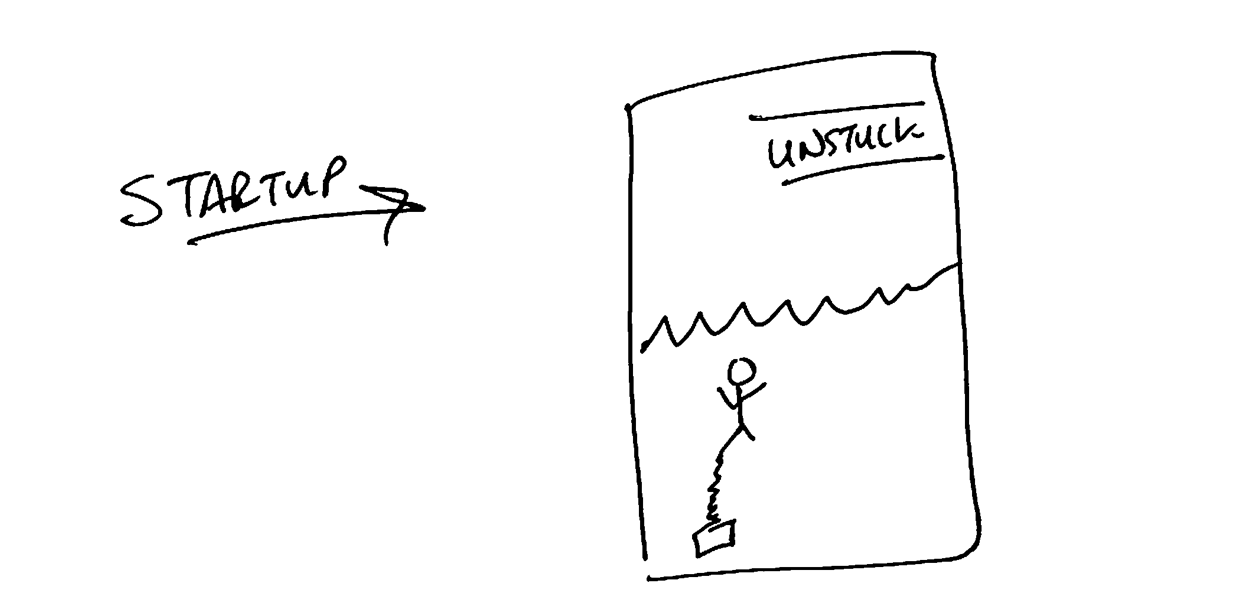
Writer Emergency Pack was originally called Unstuck, and it was supposed to be an iPhone app. In fact, it was our very first app, built by me and Nima Yousefi before I’d even met him in person.

Here’s an early drawing I did for the launch screen:

UI drawing

The original idea was that you shook your phone, Magic 8-Ball style, and a suggestion would appear.

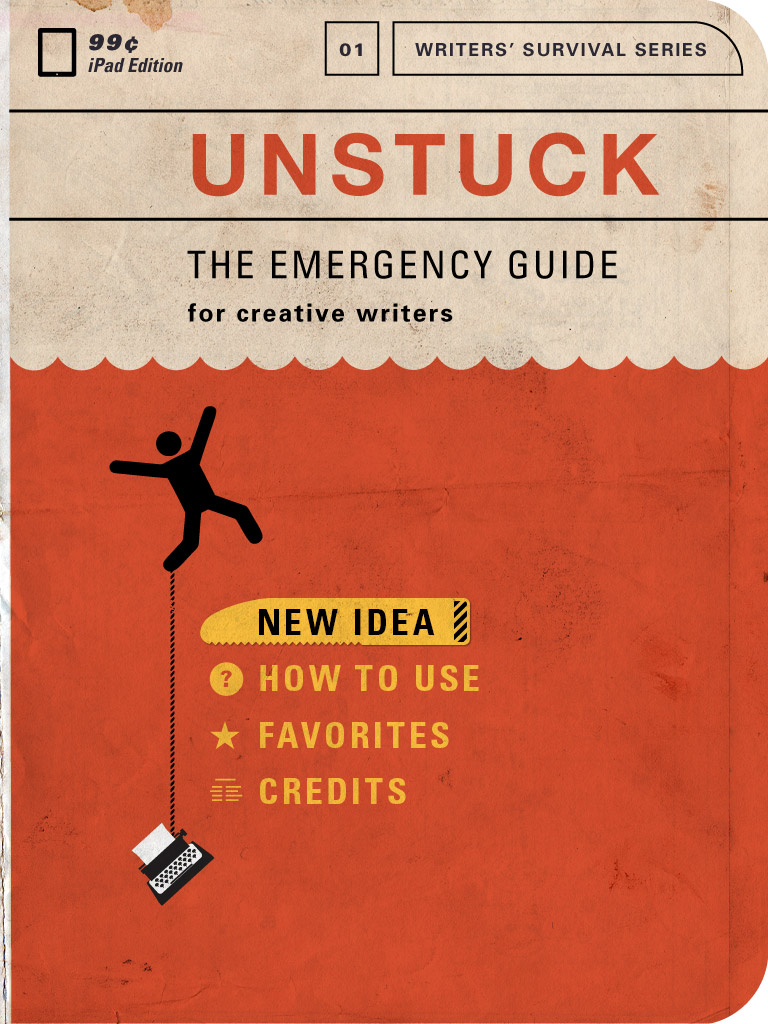
When I hired Ryan Nelson as my Director of Digital Things, we re-conceived the app, giving it a vintage survival guide vibe. Here’s Ryan’s mockup for the iPad version.

Unstuck iPad

We built it. We hated it.

It was sort of a book, but not really. Something about pulling out your phone to deal with story problems felt wrong. When you’re writing, the phone is a distraction, not a solution. Once you’re looking at that little screen, you’re tempted to check email, or Twitter, or play a quick game.

The iPhone was the wrong tool for the job.

So we never released it. Instead, we focused on the apps that would become [Highland](https://itunes.apple.com/us/app/highland/id499329572?mt=12) and [Weekend Read](https://itunes.apple.com/us/app/weekend-read/id502725173?mt=8).

But there were aspects of Unstuck we loved. Ryan Nelson had designed amazing artwork inspired by vintage Boy Scout handbooks. I’d written a bunch of the suggestions for the app. And we’d commissioned terrific illustrations by David Friesen.

unstuck illustrations

And then we lost the name Unstuck. Technically, you can’t lose what you never owned, but it still felt like a loss. A self-help project called Unstuck took the URL and started making apps and registering trademarks.

##Nameless = aimless

Our Unstuck was basically dead. Every week at our staff meeting, Unstuck would be at the bottom of our list of projects. “Yeah, that’s still kind of a good idea,” I’d say. Then I’d remember there were lots of other projects we were working on, and this one didn’t even have a name. So for three years, it was always the lowest priority.

But two ideas arrived together to make us look at the project again.

First, the idea of using playing cards. JJ Abrams’s company always sends cool holiday gifts, and one year they sent a deck of custom Bad Robot playing cards. A few months ago, I found the deck again and marveled at it. “How expensive is it to make custom cards?” I wondered aloud. Some googling led to the answer: playing cards are very expensive to print unless you’re printing a bunch at once.

Then at Jordan Mechner’s wedding, each guest received a limited-edition deck of cards. The design was terrific; the printing was extraordinary. More googling led me down a rabbit hole of card designers and collectors, many of them connecting through Kickstarter. There was a whole community making cards. If they could do it, we could do it.

Cards felt like an appropriately tactile solution to story problems. After all, screenwriters use index cards all the time. And unlike an iPhone, if you’re pulling these cards out, you’re focussed on writing, not Twitter. I started to think about how I could rewrite my suggestions to fit in a smaller format.

Then, on [episode 161 of Scriptnotes](http://johnaugust.com/2014/a-cheap-cut-of-meat-soaked-in-butter), Aline Brosh McKenna joined us and described how she’d recently solved a nagging script problem by deliberately upending her own expectations about one character. It was exactly the kind of suggestion I wanted Unstuck to provide.

If Unstuck existed. Which it didn’t.

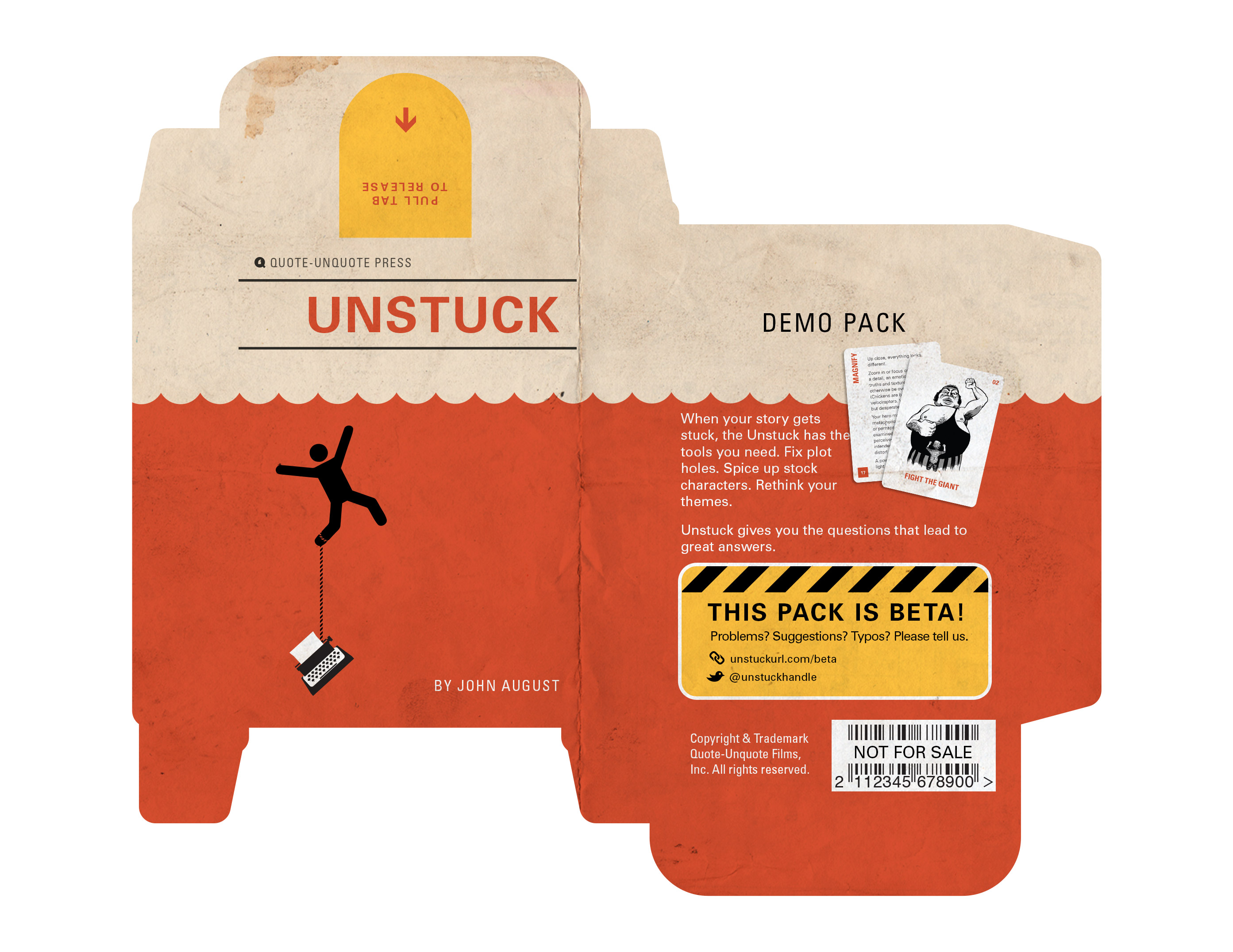
I asked Ryan to mock up his drowning-man artwork as a playing card box. He did. It looked great.

unstuck box

But of course, it couldn’t be called Unstuck, because there were a lot of other trademarks in the way.

The drowning man felt like a screenwriter being pulled underwater. He was a writer having an emergency, and this object was a pack of cards.

Putting it all together, we got Writer Emergency Pack. Once we had a name, we had a unifying concept: a survival kit for “writer emergencies” — stalled stories, confused characters, plodding plots, alliterative et ceteras.

header graphic

From there, it was still a tremendous amount of work to figure out how to actually do it. We printed demo decks. We showed them around. I rewrote everything. But we finally had a clear destination — something we were lacking for four years.

Quite appropriately, making Writer Emergency Pack has been a lot like writing a screenplay. When you’re trying to fix a broken idea, it’s a thankless grind. When you’re executing an idea you love, it’s a treat. It’s been tremendously fun to figure out how to make these cards.

And now that we’re funded, we’ll get to make a bunch of them.

The Kickstarter phase of the process is a very quick 16 days, so don’t miss out on the chance to preorder. There’s no guarantee we’ll have any extras, so this may be the one opportunity to get them.

You can find Writer Emergency Pack [exclusively on Kickstarter](http://kck.st/1obEMOQ). Choose “Back This Project” to reserve your deck.

Highland is great for novels

October 28, 2014 Apps, Fountain, Highland, Writing Process

macbook with highland

In addition to being a swell time to grow a mustache, November is [NaNoWriMo](http://nanowrimo.org) — National Novel Writing Month.

Over the next few weeks, aspiring Hemingways and Flynns will attempt to hit their target word counts so that by Thanksgiving they’re finishing a draft. Godspeed to them all.

While novels can be written in just about any word processor, more-sophisticated apps like Scrivener allow for notes and images and virtual corkboards. In my experience, the more bells and whistles an app has, the more time I spend playing with the bells and whistles, and the less time I spend actually writing. That’s partly why I made [Highland](https://itunes.apple.com/us/app/highland/id499329572?mt=12), a writing app that lets you focus on the words, not the formatting.

Because I’m mostly a screenwriter, Highland is largely tailored towards screenplays. But I also write fiction, and I didn’t want to give up any of my Highland comforts.

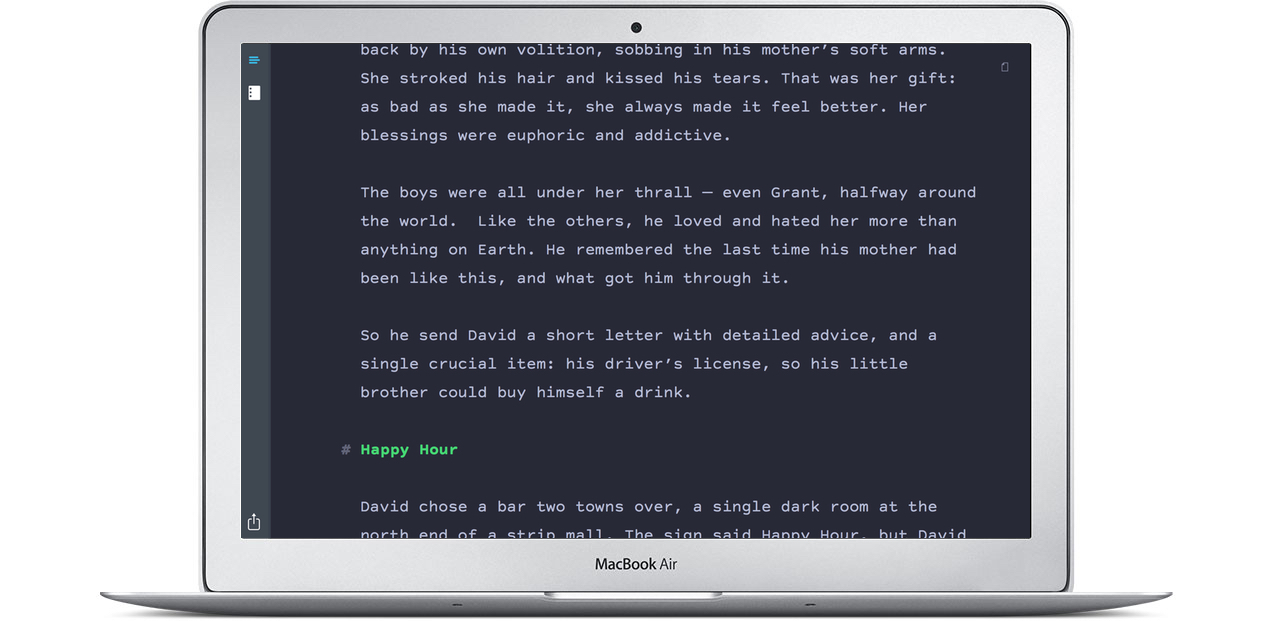
Since version 1.4, Highland has included a manuscript mode that strikes a good balance between helpful and distracting. Choosing Format > Document Format > Manuscript adds a single line to your file…

Format: Manuscript

…and with it, makes Highland a surprisingly good choice for writing fiction. When you print or export, you’ll find Highland double-spaces text to common publisher standards, perfect for paper editing.

For an example, compare [an original file](http://johnaugust.com/Assets/snake-people.fountain) to [the pdf](http://johnaugust.com/Assets/snake-people.pdf) Highland creates.

Highland 1.8.2, [new in the Mac App Store today](https://itunes.apple.com/us/app/highland/id499329572?mt=12), adds a few extra features novel writers can appreciate, such as on-the-fly word count. (Just click the page icon.)

Want to put a header on every page? Add it below the format line:

Format: Manuscript

Header: MOBY-DICK ORIGINS / Caswell Barthowly

Want to start a new chapter? Use a hashtag, such as

#Chapter Six: The Wailing Whaling

Highland will automatically insert the page break, and center the chapter heading on the next page. ((Fountain purists are likely scratching their heads at this choice. Truth is, this untitled manuscript format is actually more like Markdown than Fountain. It feels correct for section headers to be printed.))

Highland’s notes, synopses and omissions work the same as always. [[Text in double brackets]] won’t print. Same for a single line preceded by the equal sign =. And you can keep your scraps handy; select a range of text and choose Format > Omit. You’ll leave it in the file while hiding it from export.

In Preferences, you can adjust column width and line spacing, and set your favorite colors for Dark Mode.

If you’re tempted to give Highland a shot for writing your November novel, we have it marked **half-off through November 7th.** Give Manuscript mode a spin, and see whether its minimalism can maximize your page count.

As always, you can find Highland on the [Mac App Store](https://itunes.apple.com/us/app/highland/id499329572?mt=12).

« Previous Page
Next Page »

Primary Sidebar

Newsletter

Inneresting Logo A Quote-Unquote Newsletter about Writing
Read Now

Explore

Projects

  • Aladdin (1)
  • Arlo Finch (27)
  • Big Fish (88)
  • Birdigo (2)
  • Charlie (39)
  • Charlie's Angels (16)
  • Chosen (2)
  • Corpse Bride (9)
  • Dead Projects (18)
  • Frankenweenie (10)
  • Go (29)
  • Karateka (4)
  • Monsterpocalypse (3)
  • One Hit Kill (6)
  • Ops (6)
  • Preacher (2)
  • Prince of Persia (13)
  • Shazam (6)
  • Snake People (6)
  • Tarzan (5)
  • The Nines (118)
  • The Remnants (12)
  • The Variant (22)

Apps

  • Bronson (14)
  • FDX Reader (11)
  • Fountain (32)
  • Highland (75)
  • Less IMDb (4)
  • Weekend Read (64)

Recommended Reading

  • First Person (87)
  • Geek Alert (151)
  • WGA (162)
  • Workspace (19)

Screenwriting Q&A

  • Adaptation (65)
  • Directors (90)
  • Education (49)
  • Film Industry (489)
  • Formatting (128)
  • Genres (89)
  • Glossary (6)
  • Pitches (29)
  • Producers (59)
  • Psych 101 (118)
  • Rights and Copyright (96)
  • So-Called Experts (47)
  • Story and Plot (170)
  • Television (165)
  • Treatments (21)
  • Words on the page (237)
  • Writing Process (177)

More screenwriting Q&A at screenwriting.io

© 2026 John August — All Rights Reserved.