• Skip to primary navigation
  • Skip to main content
  • Skip to primary sidebar

John August

  • Arlo Finch
  • Scriptnotes
  • Library
  • Store
  • About

John

Bronson Watermarker gets a minor update

March 1, 2016 Apps, Bronson, Highland, Weekend Read

[Bronson Watermarker](https://quoteunquoteapps.com/bronson/), our app for quickly personalizing PDFs, has an update in the Mac App Store. Version 2.0.4 fixes a drawing bug.
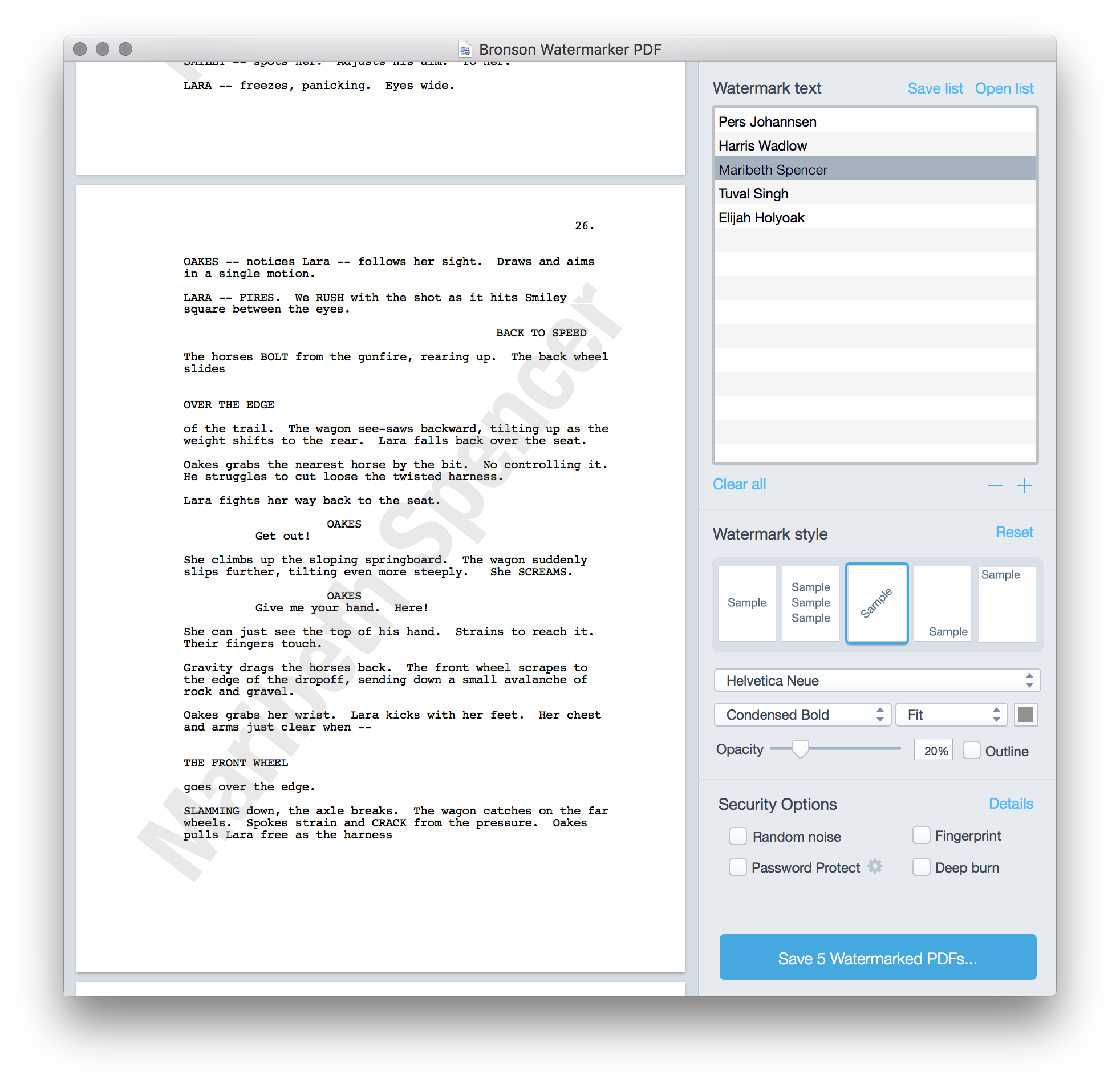
screenshot
I don’t mention the app as much as [Highland](https://quoteunquoteapps.com/highland-2/) or [Weekend Read](https://quoteunquoteapps.com/weekendread/), but Bronson has become the go-to app for a lot of productions in Hollywood. If you’ve received a watermarked script in the past few years, there’s a very good chance it was created with Bronson.

Bronson is available in the [Mac App Store](https://itunes.apple.com/us/app/bronson-watermarker-pdf/id881629098?mt=12).

To Kill a Mockingbird

February 19, 2016 Author, Books, Words on the page

Harper Lee, author of the Pulitzer Prize-winning To Kill a Mockingbird, died today at 89.

Everyone reads To Kill a Mockingbird in high school or college, right? For years, I recalled it being on a summer AP English reading list. I no doubt rushed through it to get to Heller or Dostoyevsky.

But last year, as the controversy over Go Set a Watchman started bubbling up, I began to wonder: did I actually ever read Mockingbird? Like a lot of great books, it had permeated American culture so thoroughly that I could fake my way through a conversation about Atticus Finch without first-hand knowledge the book he appears in.

Sadly, discussing things you haven’t read is an important skill in Hollywood.

I bought and read Mockingbird this year over the Christmas holiday. Spoiler: it’s terrific. Through cultural osmosis, I already had some sense of Atticus, Scout and Boo Radley, and the trial at the center of the book.

What I hadn’t anticipated was how smart and funny Lee’s writing would be. She manages the difficult feat of telling the story from the perspective of a willful six-year-old tomboy while vividly painting in the details of Maycomb, Alabama. As the reader, you understand the complicated lives of the adults even while the young protagonist is annoyed and baffled by them.

Lee’s scene work is terrific — a nighttime walk back from school is harrowing — but her transitions are remarkable. She can thoroughly document a moment down to each scowl and scrape, then zip through months in a sentence. This ability to stretch and compress time is so much harder than Lee makes it look.

To Kill a Mockingbird is usually studied for its themes and cultural issues, but I’d urge you to read it — or re-read it — just for the writing.

Tuesday Reviewsday, vol. 4

February 9, 2016 Reviewsday

Reviews let makers know how much you love their products, and encourage potential customers to give new things a shot. Every Tuesday I leave a few reviews on the applicable store, and encourage you to do the same.

Today’s picks are:

– [Bang! (4th Edition)](http://www.amazon.com/gp/product/B001RU7UNW/ref=as_li_tl?ie=UTF8&camp=1789&creative=390957&creativeASIN=B001RU7UNW&linkCode=as2&tag=johnaugustcom-20&linkId=U47A2NSLCPSS45LS) (Amazon) The original Spaghetti Western shoot-em up card game. While you can play it with four players, I find it’s best with five or more so the Deputy gets involved.
– [Bang! The Walking Dead](http://www.amazon.com/gp/product/B00K3EYT28/ref=as_li_tl?ie=UTF8&camp=1789&creative=390957&creativeASIN=B00K3EYT28&linkCode=as2&tag=johnaugustcom-20&linkId=R6XHTTZE3FLV3VWB) (Amazon) A very clever re-skin of Bang! using the characters from The Walking Dead series. In many ways, it’s easier to understand, both because the Italian is removed and some of the nomenclature is more straightforward (e.g. axes have a range of one, first aid kits heal one life, etc.). It’s not gruesome. I won’t let my 10-year-old watch the series, but I’d be fine with her playing this game.
– [Food52 Genius Recipes: 100 Recipes That Will Change the Way You Cook](http://www.amazon.com/gp/product/1607747979/ref=as_li_tl?ie=UTF8&camp=1789&creative=390957&creativeASIN=1607747979&linkCode=as2&tag=johnaugustcom-20&linkId=UWOPZNUX4AIIVBUT) (Amazon) A friend recommended this book — in particular, two unusual recipes for scrambled eggs. I found the whole thing great, with lively instructions and terrific photography. It’s the kind of cookbook you flip through on the couch, marking things you want to try.

If you’re looking for something to review, many readers are probably familiar with some of the things we make, including [Highland](https://itunes.apple.com/us/app/highland/id499329572?mt=12), [Weekend Read](https://itunes.apple.com/us/app/weekend-read/id502725173?mt=8) and [Writer Emergency Pack](http://www.amazon.com/gp/product/B00R6ZLIOY/ref=as_li_tl?ie=UTF8&camp=1789&creative=390957&creativeASIN=B00R6ZLIOY&linkCode=as2&tag=johnaugustcom-20&linkId=KG2OFS7AER67FMGO).

Podcasts are especially review-dependent, because they signal to the powers at iTunes to feature certain shows. A review for [Scriptnotes](https://itunes.apple.com/us/podcast/scriptnotes-podcast/id462495496?mt=2) would be much-appreciated.

The premise, or what’s the point?

February 8, 2016 Film Industry, Story and Plot, Writing Process

Michael Tabb takes a deep look at defining the premise of your story:

A premise is the core belief system of the script and lifeblood of the story. […] There can only be one premise per script from which all the ideas it contains serve, otherwise the script loses focus and its sense of purpose. Premise is hypothesis. It is the story’s purpose for existing at all.

For Tabb, premise is never explicitly stated. Rather, it’s the subtext for the piece as a whole.

It is not a word, theme, feeling, story, question, plot, or tone. It’s not about a person; it’s about the world in which we really live (even if your story is not set here). It is a strong statement with a point to make; it’s the theory the writer is trying to prove or disprove. This defines the author’s perspective.

Basically, it’s your personal answer to the central dramatic question you’ve raised in the story:

  • Do souls live on after us? / Souls are eternal and reincarnated.
  • Can you ever escape your fate? / No, and it’s foolish to try.
  • Is trust granted or earned? / Trust is only earned.

I agree it’s worthwhile to distinguish between “what I’m trying to say” and “how I’m saying it.” But I think premise isn’t the best word here.

Tabb is using premise the way a philosopher would, where it means something like “the proposition that forms the basis for a theory.”

In Hollywood, premise commonly means “what the movie is about.” It’s a very short pitch, basically interchangeable with logline. The premise of Die Hard is that a cop has to stop a band of robbers by himself in an office tower. The premise of Armageddon is that an asteroid is headed towards Earth, and a team of misfits has to stop it.

One could argue that we’ve been using “premise” wrong. But we’re not going to suddenly start using it to mean something else. You’re likely to just confuse people by using “premise” a different way.

A better choice would be to pick a different term for what Tabb’s describing. Maybe “the point.” Or “thesis.” Or “assertion.”

Whatever you call it, I agree with Tabb that it’s best kept to yourself. Characters generally shouldn’t speak it in dialogue, nor should you discuss it with executives. Rather, let it be a touchstone that focuses your writing for this particular story. Work to expose it through scenes with characters in conflict.

Lastly, do you always know the answer to this question when you start writing? Not necessarily. Writing can be a process of discovery. It’s a Socratic dialogue with yourself. What matters is not knowing the point, but finding it.

« Previous Page
Next Page »

Primary Sidebar

Newsletter

Inneresting Logo A Quote-Unquote Newsletter about Writing
Read Now

Explore

Projects

  • Aladdin (1)
  • Arlo Finch (27)
  • Big Fish (88)
  • Birdigo (2)
  • Charlie (39)
  • Charlie's Angels (16)
  • Chosen (2)
  • Corpse Bride (9)
  • Dead Projects (18)
  • Frankenweenie (10)
  • Go (29)
  • Karateka (4)
  • Monsterpocalypse (3)
  • One Hit Kill (6)
  • Ops (6)
  • Preacher (2)
  • Prince of Persia (13)
  • Shazam (6)
  • Snake People (6)
  • Tarzan (5)
  • The Nines (118)
  • The Remnants (12)
  • The Variant (22)

Apps

  • Bronson (14)
  • FDX Reader (11)
  • Fountain (32)
  • Highland (75)
  • Less IMDb (4)
  • Weekend Read (64)

Recommended Reading

  • First Person (87)
  • Geek Alert (151)
  • WGA (162)
  • Workspace (19)

Screenwriting Q&A

  • Adaptation (65)
  • Directors (90)
  • Education (49)
  • Film Industry (489)
  • Formatting (128)
  • Genres (89)
  • Glossary (6)
  • Pitches (29)
  • Producers (59)
  • Psych 101 (118)
  • Rights and Copyright (96)
  • So-Called Experts (47)
  • Story and Plot (170)
  • Television (165)
  • Treatments (21)
  • Words on the page (237)
  • Writing Process (177)

More screenwriting Q&A at screenwriting.io

© 2026 John August — All Rights Reserved.