• Skip to primary navigation
  • Skip to main content
  • Skip to primary sidebar

John August

  • Arlo Finch
  • Scriptnotes
  • Library
  • Store
  • About

John

Article about Rawson Thurber in the June issue of Premiere

May 11, 2004 News

[dodgeball](http://www.dodgeballmovie.com/)The June issue of Premiere magazine — *on newstands now!* — has a nice article on Rawson Thurber, who longtime readers will recall was my faithful assistant from ’99 to ’02. He wrote and directed this summer’s [DODGEBALL: A TRUE UNDERDOG STORY](http://www.dodgeballmovie.com/), which I’ve seen twice and highly recommend. If you watch television, you’ve already seen his work; Rawson created the [Terry Tate: Office Linebacker](http://www.returnofterrytate.com/) series of ads for Reebok.

DODGEBALL, which unfortunately couldn’t keep its original-and-better title of UNDERDOGS, began as a spec script Rawson wrote while he was working for me. In stark contrast to all the advice I give on this site, he wrote it specifically for Ben Stiller and Vince Vaughn. Since he wanted to direct it himself, he had the foresight to create a funny and award-winning commercial campaign (Terry Tate), so that people would take him seriously as a director. He got an agent, got the script to Stiller’s production company, and within a year had a movie in production. It’s a helluva story.

This same issue of Premiere also features the annual Power List, which is always entertaining. So pick up a copy.

Big Fish sells 2 million DVDs in its first week

May 9, 2004 Big Fish, Projects

Big Fish DVD coverAccording to The Hollywood Reporter, Big Fish sold 2 million DVDs in its first week of release. Many thanks to all of those who bought a copy. Or three. And if you haven’t bought one yet, you can click the pretty picture to buy one through Amazon.

The screenwriter averages about five cents in residuals for every DVD sold, so that works out to $100,000. That’s a solid amount of money — enough to convince otherwise rational Americans to humiliate themselves on reality TV shows, for instance. So before I launch into an explanation about why DVD residuals are too low, understand that I’m not so jaded as to think a hundred g’s is a pittance. It’s a lot, and I’m grateful for it.

The issue of DVD residuals (and video-on-demand, the technology that will one day supplant it) is one of the primary topics of the current WGA negotiations. I won’t go into a long history here, but the formulas used for home video residuals are based on videotapes, which are relatively expensive to produce, and sell for a fairly low price. Technology changes. DVDs are cheaper to produce, and sell for a higher price. But the formula for paying residuals is still locked into the old paradigm. Studios make a hell of lot more on each DVD they sell, but the writer (and actor, and director) still get the same amount.

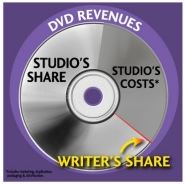
residualsA recent campaign by the WGA East does a graphical breakdown of the numbers, but let’s take Big Fish as an example. According to Video Business, its MSRP is $28.95, but most people will pay less than that. Let’s say $20, which is what you’d pay on Amazon. And Amazon is still pulling a 25% markup at that price; it buys the DVD wholesale at $16.

How much does it cost to manufacture, package, distribute and market each DVD? On average, $5.45. So the studio is making a profit of $10.55 on each DVD sold. For Big Fish, that means Columbia/TriStar has made $21.1 million _profit_ in just one week. Of that, the writer gets the “point-one.”

I’m certainly not faulting the studios for having found a great business model. I love DVDs. But whenever writers, directors or actors ask for a greater chunk of residuals, the studios cry poverty, which is absurd. True, fewer movies are earning their investment back in their initial domestic run, but that’s largely because of inflated production and marketing costs. The box office is still incredibly strong, and distributors have never had a cash stream like DVD.

The other arena in which DVDs are crucial is television. TV writers used to make their real money in syndication. Increasingly, series are sold on DVD, which greatly cuts down on the syndication life of a show. After all, who wants to watch an old Smallville at 6:00 p.m. with commercials, when they have a pristine copy sitting on the shelf? Since DVD residuals for TV shows are much lower than syndication residuals, the writer loses.

So how much _should_ the writer get for residuals? Per unit, one percent of the wholesale price. It’s a nice, easy-to-understand figure, which works out to 16 cents per copy. *This will never happen.* But it would be fair.

Using a different font for the cover page on a script

April 28, 2004 Formatting, QandA

On your posted drafts of Go and Big Fish, you have a different font on the cover page for the title of the script. Since you have made it widely known that you use Final Draft, I assume that you used the “export to PDF” feature in Final Draft to do this. When I try to export using a font other than a standard font for the title (e.g. Courier, Courier New, Times New Roman, Arial, etc.), it saves that particular font as Arial or Times New Roman. How do you go about having those different fonts on the PDF versions of your scripts?

–John Herzog
Gotha, FL

The problem is specific to Final Draft for Windows. On Mac OS X, any program can export to .pdf from the Print dialog box, so What You See really is What You Get. It’s absurdly easy. All of the .pdf’s I make are done that way, rather than with Final Draft’s export command.

Obviously, I don’t know Windows as well as I know the Macintosh, but here are some possible solutions:

  1. Adobe Acrobat. Making .pdf’s is its job. But it’s not cheap.
  2. Find a third-party utility for making .pdf’s. Any good Windows shareware/demoware site should have something. Hopefully someone will suggest one in the comments.
  3. Find a (free?) utility for combining .pdf’s. On the Mac, a good free one is Preview; Window should have something like it. Generate a cover page in some other program that lets you save .pdfs, then use the combining utility to smack it onto the first page of your screenplay .pdf.

Of course, option four would be to get a Mac. But that’s probably overkill for this situation.

Discover the basics of title page formatting here!

Survey up for screenwriting software

April 22, 2004 Formatting, News

The ongoing conversation about screenwriting software, prompted by the release of Final Draft 7.0, has gotten a lot of readers wondering why a better program isn’t out there. After all, compared with the complexity of editing video or managing a website, simply formatting a script should be cake. It’s just words, after all. And there’s no shortage of good ideas for what the ideal screenwriting software should do.

What’s missing from the discussion is any sense of the real numbers. How many writers use which programs and how satisfied are they? What features matter, and which could you live without? And most importantly, is there really a market for an innovative competitor? The only way to find out is to ask, which is why I set up a brand-new survey. (**Update: Survey was completed in 2004, and no longer online.)

It’s short — it should take five minutes, tops. Once we hit a critical mass of responses, I’ll post the results here for everyone to mull over. In the mean time, do your part.

« Previous Page
Next Page »

Primary Sidebar

Newsletter

Inneresting Logo A Quote-Unquote Newsletter about Writing
Read Now

Explore

Projects

  • Aladdin (1)
  • Arlo Finch (27)
  • Big Fish (88)
  • Birdigo (2)
  • Charlie (39)
  • Charlie's Angels (16)
  • Chosen (2)
  • Corpse Bride (9)
  • Dead Projects (18)
  • Frankenweenie (10)
  • Go (29)
  • Karateka (4)
  • Monsterpocalypse (3)
  • One Hit Kill (6)
  • Ops (6)
  • Preacher (2)
  • Prince of Persia (13)
  • Shazam (6)
  • Snake People (6)
  • Tarzan (5)
  • The Nines (118)
  • The Remnants (12)
  • The Variant (22)

Apps

  • Bronson (14)
  • FDX Reader (11)
  • Fountain (32)
  • Highland (75)
  • Less IMDb (4)
  • Weekend Read (64)

Recommended Reading

  • First Person (87)
  • Geek Alert (151)
  • WGA (162)
  • Workspace (19)

Screenwriting Q&A

  • Adaptation (65)
  • Directors (90)
  • Education (49)
  • Film Industry (489)
  • Formatting (128)
  • Genres (89)
  • Glossary (6)
  • Pitches (29)
  • Producers (59)
  • Psych 101 (118)
  • Rights and Copyright (96)
  • So-Called Experts (47)
  • Story and Plot (170)
  • Television (165)
  • Treatments (21)
  • Words on the page (237)
  • Writing Process (177)

More screenwriting Q&A at screenwriting.io

© 2026 John August — All Rights Reserved.