• Skip to primary navigation
  • Skip to main content
  • Skip to primary sidebar

John August

  • Arlo Finch
  • Scriptnotes
  • Library
  • Store
  • About

John

Macworld review of Montage

October 2, 2006 Software

Macworld has a [review](http://www.macworld.com/2006/10/reviews/montage1/index.php/?lsrc=mwrevrss) of Mariner Software’s [Montage](http://www.marinersoftware.com/products/montage/), which is pretty much right on the money. They give it two out of five mice, admiring its interface while pointing out that it doesn’t do nearly as much as it should: page locking, scene numbering and many other standard features are still on the drawing board. Which is fine for a beta, but not a shipping product.

I like the Montage folks, and have been in e-mail contact with them about an even more fundamental issue for me — the way it handles dialogue across page breaks. They’ve been responsive, and seem to genuinely want to make a great application. Version 2 — or even 1.5 — might be terrific. Right now, Montage is a program that looks finished but isn’t.

I’ve moved beyond hoping for a Final Draft killer — the next version of Screenwriter should do that, assuming it ever ships. But competition breeds innovation, so I’ll always be watching Montage, Celtx and the other upstarts. One of them might just change the game.

Does anyone actually use long division?

September 13, 2006 Rant

I was working on a scene today in which an adult admitted to a grade-schooler that in the real world, you’ll never need to use long division. It’s just something they force on kids to keep them from getting cocky after multiplication.

I nixed the joke because it felt kinda Full House. But it got me wondering if it was true. I doubt I use long division more than twice a year. Most of those times, it’s for want of a calculator, and halfway through the process, I realize I didn’t need an exact answer and should have just estimated.

Thus my question: Does anyone use long division on a regular basis?

Addition, subtraction, multiplication — they answer fundamental daily questions about how much, how often and how fast. Division is all about apportioning, figuring out how to split things up, which in the real world almost always involves some qualitative if not emotional decision-making. It’s all well and good to say that each child should get seven M&M’s, but since Ezekiel can’t eat chocolate, should he get an extra Jolly Rancher?

For the record, I’m not saying they should stop teaching long division. Not quite. Not without some study to show it won’t completely screw up later math education — which to my recollection, never involved long division.

Maybe I’m wrong, and there’s a non-teacher subset of the work force that actually uses long division. If so, write in. I’m curious to see who these Remainders are.

ControllerMate and automatic fingers

September 5, 2006 Geek Alert

geek alertI recently upgraded to a Mac Pro, which I justified to myself thusly:
1. I’m doing effects for The Movie, and Motion runs much faster on it. (In truth, I only did one effect in the final cut.)
2. My G5 was actually slower than my laptop.
3. As a writer, I needed a quieter computer.
4. I deserve to throw some of my Hollywood money around.

The new computer is great, and almost all of my software works perfectly on it. Unfortunately, I’ve had some hiccups with my input devices.

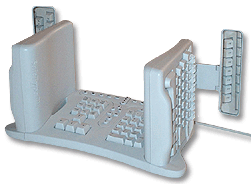
keyboardAs I’ve [blogged about](http://johnaugust.com/archives/2004/my-new-keyboard-setup), I have a strange keyboard. It looks impossible to use, but I’m actually much faster typing on it than a traditional keyboard, with the added bonus that my arms don’t go numb in the middle of the night.

The Mac Pro isn’t thrilled with my keyboard, which connects through a serial-to-ADB dongle. On restarts, the computer asks me to confirm the keyboard layout, suspicious that I’ve swapped in a Klingon model. Nevertheless, it produces the correct letters every time.

While my odd keyboard is great for typing, it’s singularly awful for key commands, like Copy, Paste and Undo. While one’s fingers can always find the right keys to form words, there’s something different about multi-key combinations. It just doesn’t happen consistently.

nostromo keypadThat’s why I’ve been using a little gaming keypad, the Nostromo N52 by Belkin. Using the software that came with it, I set up keys for Copy, Paste and all the useful shortcuts one is likely to use. With my right hand on the mouse, and my left on the Nostromo, I’m an editing machine.

But the software for the Nostromo refuses to work with the Mac Pro.

At first, I wondered if I could live without it. I thought my fingers would stop reaching for the non-functioning keypad, but they wouldn’t. Thinking I was copying something, I’d be left with a single lower-case g, which is how the computer decided to interpret the chatter from the orphaned device.

Belkin hasn’t upgraded the drivers in years, so I’m not holding my breath that there will suddenly be a new version for Intel Macs like mine. One guy has taken it upon himself to create his own drivers, but it looks like even he’s given up.

Fortunately, there’s a program called [ControllerMate](http://orderedbytes.com/controllermate/) which can handle the Nostromo. For $15, it’s almost as good as free, and can do a lot of things that the Belkin software couldn’t. Like confound the hell out of me.

ControllerMate has an elaborate flow-chart-style programming language which looks great but is almost impenetrable. How do you assign a keystroke to a button? It’s as easy as…

1. Pick the controller from the list.
2. Double-click it to open the available controller buttons.
3. Press the actual button on the device to indicate which virtual button it corresponds to.
4. Drag the virtual button to the programming area.
5. But first, you might want to make a new programming page. Or a group. Why? You won’t know until you need it.
6. Now, pull down the menu to outputs, and select “Keystroke” or “Single Key.” What’s the difference? I couldn’t tell you, except that Single Key seems to work and Keystroke locked up my machine in a beeping loop.
7. Open the virtual keyboard palette and drag the desired key to the well, then add any modifier keys.
8. Then drag the whole thing to the programming area, and attach it to the virtual button.
9. Test to see if it works.

Repeat for all of the other keys. Uggh.

To be fair, there’s a benefit to all this abstraction. You can create some pretty elaborate logic by nesting groups and pages, so that hitting one key while another key is pressed performs a special function. But it’s a lot of work to get to Copy and Paste.

My fingers are just happy to be back on autopilot. Just in the course of writing and posting this blog, they’ll have reached for the Nostromo fifteen times. Which is fifteen times less I’ve had to curse under my breath.

Test screening The Movie

August 6, 2006 Charlie's Angels, Film Industry, The Nines

Last Monday was the first time I put The Movie in front of an audience: thirty friends and colleagues recruited to help figure out whether the film was appropriately funny, dramatic, and comprehensible. (Answers: Yes, Yes, and Not So Much. We’re working on that last part.)

Screening a work-in-progress is just as nerve-wracking as it sounds. Going in, you know the film isn’t perfect. You’re projecting low-resolution video, with temp music, temp visual effects, and bad sound. But it’s a crucial step, because it’s impossible for filmmakers to see their movie with fresh eyes. You need an audience to laugh, gasp or murmur in confusion.

The thirty people who watched the cut were incredibly generous with their time and comments, not only staying afterwards to talk, but also filling out cards and emailing additional thoughts. They made the movie significantly better.

But as great as they were, the fact that they were friends and colleagues was a significant detriment. They had an emotional investment: they wanted to like it. They were also largely film-and-television people, hardly a representative cross-section of the movie-going public.

The obvious next step would be to put The Movie in front of a real recruited audience, i.e. strangers.

But I can’t.

The very same internet that makes this site possible makes a real test screening impossible. Or at the least, a very risky proposition.

Odds are, one or more of those recruited strangers would recognize my name, the producers, or the actors involved and decide it would be a really good idea to write in to Ain’t It Cool News or a site like it. Quite a scoop, after all, reviewing a movie where even the premise has been kept hush-hush.

Reviews of test screenings are frustrating for a big studio like Warner Bros., but they’re potentially ruinous for a little movie like ours. Keep in mind: We don’t have distribution yet. We’re hoping to sell the movie after a festival premiere. So if DrkLOrd79 trashes the movie, that sets a bad tone going in. Almost worse would be if DrkLOrd79 loved it and gushed on for pages. We’ve all experienced the disappointment that follows having our expectations set too high.

The friends and colleagues at last Monday’s screening were chosen for their insight and opinion. But more importantly, they were chosen for their discretion.

With one exception, every movie I’ve written has had a traditional recruited audience screening, with 200 or so demographically-mixed young filmgoers circling numbers with little golf pencils. After every screening, we learned important things which made the film better.

And after every screening, someone posted his thoughts on the Internet. It was annoying, but it was inevitable. For CHARLIE AND THE CHOCOLATE FACTORY, I stayed up until 2 a.m. waiting for the first test screening review to show up. Sure enough, it came.

The one film which didn’t have a traditional test screening was CHARLIE’S ANGELS: FULL THROTTLE. It was fear of internet leaks that kept the studio from bringing in a recruited audience. And let me be clear about the cause and effect: Full Throttle was not untested because it was a bad movie.

Full Throttle was a bad movie because it was not tested.

The premiere at Grauman’s Chinese Theatre was the first time I saw Full Throttle with a full audience. As the lights went down, there was palpable enthusiasm, and some real residual love for the first movie. By the time the lights came back up, it was pretty clear we really should have done a test screening.

Part of me fears the same could happen with The Movie. Our fear of internet leaks may keep us from giving it the test it deserves. Lord knows, I don’t want the first time I see it with a real audience to be at Sundance or some other festival. So I’m trying to figure out some middle ground, an audience of trustworthy strangers.

As always, suggestions are welcome.

« Previous Page
Next Page »

Primary Sidebar

Newsletter

Inneresting Logo A Quote-Unquote Newsletter about Writing
Read Now

Explore

Projects

  • Aladdin (1)
  • Arlo Finch (27)
  • Big Fish (88)
  • Birdigo (2)
  • Charlie (39)
  • Charlie's Angels (16)
  • Chosen (2)
  • Corpse Bride (9)
  • Dead Projects (18)
  • Frankenweenie (10)
  • Go (29)
  • Karateka (4)
  • Monsterpocalypse (3)
  • One Hit Kill (6)
  • Ops (6)
  • Preacher (2)
  • Prince of Persia (13)
  • Shazam (6)
  • Snake People (6)
  • Tarzan (5)
  • The Nines (118)
  • The Remnants (12)
  • The Variant (22)

Apps

  • Bronson (14)
  • FDX Reader (11)
  • Fountain (32)
  • Highland (75)
  • Less IMDb (4)
  • Weekend Read (64)

Recommended Reading

  • First Person (87)
  • Geek Alert (151)
  • WGA (162)
  • Workspace (19)

Screenwriting Q&A

  • Adaptation (65)
  • Directors (90)
  • Education (49)
  • Film Industry (489)
  • Formatting (128)
  • Genres (89)
  • Glossary (6)
  • Pitches (29)
  • Producers (59)
  • Psych 101 (118)
  • Rights and Copyright (96)
  • So-Called Experts (47)
  • Story and Plot (170)
  • Television (165)
  • Treatments (21)
  • Words on the page (237)
  • Writing Process (177)

More screenwriting Q&A at screenwriting.io

© 2026 John August — All Rights Reserved.