• Skip to primary navigation
  • Skip to main content
  • Skip to primary sidebar

John August

  • Arlo Finch
  • Scriptnotes
  • Library
  • Store
  • About

John

Silent Evidence

July 21, 2007 Africa, Books, Follow Up

A few weeks ago, while answering the [Grey’s Anatomy](http://johnaugust.com/archives/2007/she-was-mistaken) question which generated so much talkback, I found myself searching for a specific term I knew had to exist: the human tendency to consider only the samples presented, ignoring other relevant items.

It felt like a fallacy, but it didn’t quite match up to any of the contenders I found online. If you squint really hard, you can make it look like a special case of the [Fallacy of (Hasty) Generalization](http://www.fallacyfiles.org/hastygen.html), but that seems a stretch for something which feels fairly commonplace. I ended up coining, “Fallacy of Limited Sampling” — with a mental sticky note to replace it once I found a better term.

To my surprise, I found the one over the middle of the Atlantic, during the 20+ hour flight to Africa: “silent evidence.”

That’s the term Nassim Nicholas Taleb uses to describe this phenomenon in [The Black Swan](http://www.amazon.com/Black-Swan-Impact-Highly-Improbable/dp/1400063515). He introduces it with a story from Cicero:

Diagoras, a nonbeliever in the gods, was shown painted tablets bearing the portraits of some worshippers who prayed, then survived a subsequent shipwreck. The implication was that praying protects you from drowning.

Diagoras asked, “Where are the pictures of those who prayed, then drowned?”

Those “drowned believers” are silent evidence. You don’t take them into account because they can’t speak up for themselves. The cliché is that, “History is written by the winners.” In fact, it’s written by whoever happens to survive.

Following a discussion of the Phoenicians, and how their lack of literature is more likely due to the fragility of their paper rather than a failure of their culture, Taleb urges us to cast our nets widely:

Consider the thousands of writers now completely vanished from consciousness: their record did not enter analyses. We do not see the tons of rejected manuscripts because these have never been published, or the profile of actors who never won an audition — therefore cannot analyze their attributes. To understand successes, the study of traits in failure need to be present. For instance, some traits that seem to explain millionaires, like appetite for risk, only appear because one does not study bankruptcies. If one includes bankrupt people in the sample, then risk-taking would not appear to be a valid factor explaining success. [Link]

Taleb calls this overlooked bulk of information “silent evidence.” I assumed that was a term of art, but Googling it now, most of the references point back to Taleb’s book. It’s possible that he is its primary champion. Regardless, I like it, and intend to use it liberally.

I didn’t mean for this to become a book review, but since I started…

There are many things I liked about The Black Swan. In addition to silent evidence, I found myself nodding my head to his discussion of the confirmation bias (we tend to notice things that fit our theories), Platonicity (confusion of the model with what it’s modeling), and the narrative fallacy — our need to create a story which explains events after they happened, even if the causality is questionable (or impossible). Thus we write history books explaining how World War I started, when if you were reading the newspapers of the time, these “causes” wouldn’t have shown up.

Taleb’s central thesis is that there are unexpected incidents (Black Swans) which have enormous, disproportionate impact on our world: terrorist attacks, bank failures, iPods. By definition, we can’t predict them — which means any prediction about the future at all is extremely dubious. The best we can do is constantly remind ourselves of the limits of our knowledge, and make some contingency for the completely unexpected.Donald Rumsfeld took a lot of flack for his Yogi Berra-like koan about “Unknown Unknowns” at a Defense Department briefing in 2002, which Slate put in verse form. I’m scared to say: he’s actually kind of right. Acknowledging that there are “unknown unknowns” is important.

I’ve always been leery of statements like, “By 2075, the U.S. population will total 1 billion.” Taleb’s book helps justify my frustration at these seeemingly-scientific projections, which discount what we inherently know about the future: that we know much less than we think.

Despite these interesting points, I can’t honestly recommend Taleb’s book. Too much of it feels like being stuck next to an immodest guest at an interminable dinner party. I found myself skimming whenever I saw the words, “Lebanon,” “French,” or “Yevgenia.” It’s not [Freakonomics](http://www.amazon.com/Freakonomics-Economist-Explores-Hidden-Everything/dp/006073132X). My hope is that an ambitious editor convinces Taleb to let her cut it down to a book half as long and twice as readable.

My role in Transformers

July 19, 2007 Film Industry, Los Angeles, News, QandA

questionmarkAre you in TRANSFORMERS? There’s a quick shot of a soldier escorting someone away from a helicopter. On screen for two or three seconds. Looks EXACTLY like you.

Just curious.

— Ben
Los Angeles

I haven’t seen the movie yet, but as far as I know, I am not in [Transformers](http://www.imdb.com/title/tt0418279/). I have a somewhat ordinary face, and coupled with my big bald head, it’s not uncommon for someone at the gym to say, “You were really good last night on Law and Order.” (Apparently, my doppelganger was a white supremacist.)

But I can’t say definitively that I’m _not_ in Transformers.

Years ago, a friend called to say, “I saw you in ‘L.A. Doctors!'” That was a CBS show at the time. She described the scene: I was walking a pug on Melrose Avenue. Which was in fact my dog. I was probably walking home from Starbucks when a second-unit camera crew caught me. (Yes, they should have had me sign a release. No, it’s never worth pursuing.)

I guess it’s possible the filmmakers digitally put my face on some random soldier. They certainly had the technology; they put all those tentacles on Bill Nighy for the second and third Pirates movies. But [Occam’s Razor](http://en.wikipedia.org/wiki/Occam%27s_razor) would suggest it’s probably just a guy who looks like me.

Photos from Malawi

July 17, 2007 General

[Mulanje Mt](http://www.flickr.com/photos/johnau8ust/sets/72157600842360494/)I have all my photos from my visit to Mulanje, Malawi up on Flickr for the world to see. You can check them out [here](http://www.flickr.com/photos/johnau8ust/sets/72157600842360494/).
You may want to use the “View as slideshow” link. If you do, you’ll notice a floating lower-case “i” over the center of the main photo. (You may need to mouse over it to make it appear.) Click it, and you can see all of the captions.

Malawi is a land-locked country in southern Africa. A former British colony, it is now one of the poorest nations on Earth. It’s been especially hard-hit by HIV/AIDS, losing a huge portion of its 20 to 40-year olds. Young parents, especially. It’s now a nation of children and old people.

[FOMO](http://www.fomo.co.uk/) (Friends of Mulanje Orphans) runs 10 centers, providing services to 4,000 orphans. Ryan and I visited to help repair and repaint the Gulumba Centre, and to meet the kids who are doing remarkably well in remarkably difficult circumstances.

We also visited medical clinics, in the hopes of establishing a presence for [U.S. Doctors for Africa](http://www.usdfa.org/). Treatable diseases like malaria are a huge threat, and the lack of medicine and infrastructure is crippling.

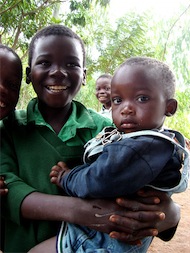
brothersFor all its challenges, Malawi is incredibly beautiful, as are its people. It’s like an island nation without an ocean.

So what now? I’m still figuring that out.

Obviously, FOMO will continue to need financial support, and I can help with that.As can you, obviously. It’s a registered U.K. charity. But to a larger degree, Malawi really needs to be put on the map of human awareness. There’s no hot story happening in Malawi: no civil war, no genocide, no pretty blonde tourist going missing. The country is isolated and easy to overlook. And its citizens are so invariably polite, it’s hard to imagine them demanding their fair share of the world’s attention.

But I think there are unique opportunities in Malawi. It’s stable and English-speaking. It’s infrastructure is lacking — its roads in particular are a mess — but the lack of embedded choices can be a blessing. If there’s any place perfect for leapfrogging to the Next Better Idea, it’s Malawi.The land-line phones (and with it, the internet) in the entire Mulanje region went out for three days, yet I got four bars on my cell phone almost everywhere. Wireless internet in the U.S. is handy. Wireless internet in Malawi seems essential.

The main reason I wanted to blog about the trip is that I’ve always been kind of uncomfortable-slash-terrified about the developing world and global poverty. And I suspect most readers are, too. It’s overwhelmingly macro.

But when you look at it in the micro scale, it’s not nearly so intimidating. I didn’t leave with any big answers, but I now know a bit about keeping kids fed. And how to install a corrugated metal roof. (You nail through the peaks, not the valleys, with capped nails.) I spent most of my time painting walls, and watching. Learning.

Obviously, not everyone is in a place financially to book a ticket to the other side of the world and just help out. (That’s what Ryan and I basically did.) But a lot of my readers are young — in college, or just after that — which is a perfect time to head out and explore the world. If any part of you is thinking about doing that, trust your instincts.Beyond university-affiliated programs, a quick Google search will reveal dozens of programs that specialize in a new kind of “voluntourism.” We considered programs in five African countries and South America before picking FOMO.

Her least favorite mistake

June 20, 2007 Film Industry, Genres, QandA, Rights and Copyright, Television

questionmarkLast year I wrote a spec episode of Grey’s Anatomy entitled “My Favorite Mistake” wherein platonic best friends, Izzie and George, hook up. I registered my script with the WGA and sent it in to be considered for the ABC writing fellowship. I never heard back from the fellowship (their loss, no biggie) but I was surprised to see that last Thursday’s episode shared a title (exactly the same) and a subplot as my spec.

I do not believe that Shonda and team copied my idea… but i do think it is possible that they could have inadvertently copied my title. They had the means, etc. So my question is a two parter: 1) should I do anything about this? and 2) where is the line drawn? Would my script have to be identical to the one broadcast to possibly be plagiarized?

— Jackie Honikman

I don’t watch Grey’s Anatomy, so I looked up an [episode guide](http://en.wikipedia.org/wiki/List_of_Greys_Anatomy_episodes) online. One of the first things I noticed was that every episode is named after a song — that’s their thing, just like the title of every episode of Friends begins “The One With…”.

Being a good spec script writer, you followed their style and picked a song title. You chose a Sheryl Crow song. So did they. What are the odds?

Huge. So absurdly huge that you’re going to feel foolish in about three paragraphs.

I know you didn’t write in expecting to be ridiculed, so I want to give you a few sentences to prepare yourself. It’s not that I dislike you, Jackie, or disbelieve you. I’m sure when you first saw the episode title, you were surprised, hurt, disappointed and angry. These are natural emotions. But then the dark engines of your brain kicked in. You convinced yourself that through some byzantine process, your idea had been appropriated. But it hadn’t. It wasn’t.

You wrote your email at the end of March.People ask how long it takes me to answer a reader-submitted question. Generally, I read them all within the week they’re sent in, and flag the ones I think will be interesting and applicable to the readership. But it’s not a first-in-first-out process. Sometimes, a question will land in my inbox that I’ll answer within the hour. There’s a big element of serendipity. But that’s not an invitation to submit the same question multiple times. That will almost guarantee that I won’t answer, since I’ll think, “Didn’t someone else just ask that?” So I’m hoping you’ve moved on, written other scripts, and laughed about how prescient you were. But in case you haven’t, I’m going to rip off the band-aid.

Let me restate your question:

I recently wrote a spec episode of Grey’s Anatomy. I worked very hard on making it exactly like the show, right down to the title. I was subsequently shocked — shocked! — to see that the writers of the show had the audacity to write an episode exactly like their own show. Who can I sue?

Put this way, your fallacy is clear — you’re confusing cause and effect. You think their “Favorite Mistake” is similar to yours because they somehow read and stole your idea, when in fact it’s similar because it’s frickin’ Grey’s Anatomy. You followed their conventions. You included their characters. You emulated their show as closely as you could.

You copied them, not vice-versa. Got it?

In terms of the title, given the show’s adult-contemporary demographics, it was pretty likely they were going to have a Sheryl Crow track sooner or later.In fact, the second episode was titled “The First Cut is the Deepest.” Sheryl Crow’s cover had topped the charts the year before. As far as I can tell from the promos (and parodies) I’ve seen, the show is about young doctors hooking up and breaking up. “My Favorite Mistake” sounds like a good fit. They didn’t need your script to come up with that idea.A while back, a screenwriting colleague was dealing with a guy who was claiming on messageboards that a certain blockbuster was stolen from his script. The “proof?” One of the characters had the same name. Basically, the guy was arguing that the screenwriter had changed the plot, the setting, the character’s motivations — pretty much everything but this one character’s name. It’s hard to claim that a conspiracy is both thorough and lazy.

In addition to the cause and effect problem, I think there’s also a fallacy of limited sampling. You’re looking at your script and the episode you saw. But if an independent reader had your script and 10 other spec scripts of the show to compare to the produced episode, would they really think yours was all that similar? I doubt it.I’m sure this “fallacy of limited sampling” has a more official name, but I couldn’t find it. (It’s not the fallacy of generalization, which infers about a large population based on a too-small sample.) If anyone can link to the proper term, I’ll be much obliged.

Or as another test, a reader could compare your script to 10 produced episodes of the show. Would he be able to tell which one your script “influenced?” Again, doubtful.

Unfortunately, this misguided conflation of “similarity” and “plagiarism” is not confined to spec episodes of TV shows. One woman claimed that both [The Matrix](http://www.imdb.com/title/tt0133093/) and [The Terminator](http://www.imdb.com/title/tt0103064/) franchises were stolen from her work. She managed to attract a fair amount of media attention before her case was [finally thrown out](http://www.snopes.com/politics/business/matrix.asp).

By targeting both The Terminator and The Matrix, this case helps point out what really underlies a lot of similarities between literary works: genre conventions. It’s one thing to put a killer robot in your script, but don’t claim you invented robots.The same goes for any variation of robot: friendly robot, suicidal robot, kleptomaniac robot, fatherly robot, existentially-angst-ridden robot. We can all think of other examples. Having a divorced cop who likes doughnuts is not original — and neither is having him hate doughnuts, or having him be psychic, or dead. Having two doctors hook up on a show about doctors hooking up doesn’t strike me as particularly original.

Again, Jackie, I’m not trying to belittle your feelings. It’s frustrating to spend weeks working on something, only to find a similar project already out there.

In my early days, I outlined a series that would chart the last years of Earth — a meteor was coming, and everyone knew it. So I was understandably disappointed when not [one](http://www.imdb.com/title/tt0120591/), but [two](http://www.imdb.com/title/tt0120647/) movies with essentially the same plot hit theaters. It forced me to look back and remember where the idea really came from: a bunch of popular-science articles at the time which mapped out what had likely killed off the dinosaurs, and what would happen if another such asteroid hit Earth.

I soon realized that my having the same idea as giant blockbusters was actually a good thing. It meant I had commercial taste. A writer isn’t one script. A writer is someone who can write. Forty scripts later, my meteor idea isn’t even a footnote in my career. Don’t let your Grey’s Anatomy spec be anything more than something you wrote.

« Previous Page
Next Page »

Primary Sidebar

Newsletter

Inneresting Logo A Quote-Unquote Newsletter about Writing
Read Now

Explore

Projects

  • Aladdin (1)
  • Arlo Finch (27)
  • Big Fish (88)
  • Birdigo (2)
  • Charlie (39)
  • Charlie's Angels (16)
  • Chosen (2)
  • Corpse Bride (9)
  • Dead Projects (18)
  • Frankenweenie (10)
  • Go (29)
  • Karateka (4)
  • Monsterpocalypse (3)
  • One Hit Kill (6)
  • Ops (6)
  • Preacher (2)
  • Prince of Persia (13)
  • Shazam (6)
  • Snake People (6)
  • Tarzan (5)
  • The Nines (118)
  • The Remnants (12)
  • The Variant (22)

Apps

  • Bronson (14)
  • FDX Reader (11)
  • Fountain (32)
  • Highland (75)
  • Less IMDb (4)
  • Weekend Read (64)

Recommended Reading

  • First Person (87)
  • Geek Alert (151)
  • WGA (162)
  • Workspace (19)

Screenwriting Q&A

  • Adaptation (65)
  • Directors (90)
  • Education (49)
  • Film Industry (489)
  • Formatting (128)
  • Genres (89)
  • Glossary (6)
  • Pitches (29)
  • Producers (59)
  • Psych 101 (118)
  • Rights and Copyright (96)
  • So-Called Experts (47)
  • Story and Plot (170)
  • Television (165)
  • Treatments (21)
  • Words on the page (237)
  • Writing Process (177)

More screenwriting Q&A at screenwriting.io

© 2026 John August — All Rights Reserved.