• Skip to primary navigation
  • Skip to main content
  • Skip to primary sidebar

John August

  • Arlo Finch
  • Scriptnotes
  • Library
  • Store
  • About

John

Whatever happened to litter?

January 11, 2011 Africa, Words

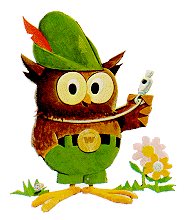
woodsy owlThis morning as I was walking the dog, I picked up a discarded McDonald’s bag from my neighbor’s lawn. As I carried it to the trash can, it hit me: whatever happened to litter?

Is there less of it, or are we just using the word less? ((Obviously, the third option is that neither one has declined, and it’s all my subjective experience. But a poll of my co-workers (Matt) suggests this isn’t the case.))

I grew up in the 1970s, and remember Woodsy Owl’s warnings to “Give a hoot, don’t pollute.” I remember my Cub Scout troop handing out plastic litter bags to hang over your car’s stick shift. I remember [that crying Indian commercial](http://www.youtube.com/watch?v=m4ozVMxzNAA).

Litter, and in particular the act of littering, was a cultural meme.

But I don’t see anything like that now. Did recycling replace it? Is there just less random trash, and thus less need to call attention to it?

I wonder if the anti-littering campaigns of the 1970s were successful enough that behavior genuinely changed, thus making litter less common. In 2011, if you saw someone throwing a plastic cup out the window of a moving vehicle, you’d think “asshole,” wouldn’t you?

But was that true in the 1950s or 60s? We could interview our parents, but asking people to report on their behavior a half-century ago feels unreliable.

Since we don’t have time machines, maybe the closest we can come is developing countries. From my limited experience in Africa and South America, I’ll say I definitely noticed more random trash blowing around, and no particular urgency in cleaning it up. Some of that has to be attributed to limited government services; if you don’t have regular trash collection, you’re going to have more garbage lying around.

But I also suspect there is a virtuous cycle that happens once you start noticing and removing litter: you’re less tolerant of it, and the people who generate it.

Giving up on Blu-ray

January 10, 2011 Film Industry, Tools

Khoi Vinh [doesn’t recommend the format](http://www.subtraction.com/2011/01/10/blu-ray-blues):

> Aside from the fact that Blu-Ray’s high definition picture is so ridiculously gorgeous, the whole format is demonstrably worse than what came before it.

> [Blu-ray] takes longer to load and menus take longer to navigate than on a stock DVD player. This is doubly frustrating because one of the early promises of the format was that users could pop in a disc and the movie would begin playing immediately, doing away with the interminable trailers that have opened DVDs for the past decade. Not only has that promise been essentially broken, but trailers are an even worse problem on Blu-Ray. Often the way a Blu-Ray disc is formatted, it’s harder to fast-forward through a bundle of trailers than it used to be on a DVD.

On friends’ recommendations, I bought a PS3 as my Blu-ray player. I’ve ended up really enjoying it as a game machine, but in two years, I’ve watched exactly two Blu-ray movies on it.

Remember the showdown between HD-DVD and Blu-ray? Streaming won.

What audiences know

January 10, 2011 Adaptation, Story and Plot

Discussing the very talky opening scene of The Social Network, Aaron Sorkin makes a key point about how writers [dole out information](http://www.hollywoodreporter.com/news/aaron-sorkins-writing-process-69586):

> We started at 100 miles an hour in the middle of a conversation, and that makes the audience have to run to catch up. […]The worst crime you can commit with an audience is telling them something they already know. We were always running ahead.

Figuring out what the audience needs to know — and when they need to know it — is one of the trickiest aspects of screenwriting. The novelist can suspend the action for paragraphs or pages to establish background information. Screenwriters can’t. We don’t have an authorial voice to fill in the missing details. Everything we want the audience to know has to be spoken by a character, or better yet visualized in a way that suits the big screen. ((As a trade-off for losing the authorial voice, movies get something good in return: the audience’s complete attention. You don’t skim a movie the way you might a 400-page novel. Tiny moments can have huge impact on the big screen.))

So we have to be clever. Sometimes, we use the form to our advantage: A lengthy sequence explaining dinosaur cloning techniques in Michael Crichton’s novel Jurassic Park becomes an animated film strip in David Koepp’s movie adaptation. In most cases, we do more with less, distilling the information down to a minimum effective dose to get the audience through the scene, sequence and story.

The frustration for screenwriters is that many of the decision-makers — directors, producers, studio executives — will have different opinions about that minimum effective dose. Directors will try to cut all the dialogue. Producers will focus on strange details, having read the script so many times that they’ve lost fresh eyes. And studio executives, having faced confused audiences at low-scoring test screenings, will want things over-explained to painful degrees.

But that’s politics. In terms of craft, Sorkin’s point holds: you engage the audience by making them work. One of the best ways is by understanding and controlling what they know.

On babies

January 2, 2011 Random Advice

random adviceSeveral of my friends have just had babies or announced they’re pregnant, so I’ve been thinking a lot about newborns.

It occurs to me that while relatively few of my readers will end up becoming professional screenwriters, nearly all of them will end becoming up parents. So in that spirit, I want to offer a few suggestions to file away.

**The fourth trimester is the toughest.**
Because of our large heads and small pelvises, humans are born partially-cooked. We should really be in there a little longer. Keep that in mind when your newborn does nothing but sleep, eat and cry that first month or two. Like bullying, It Gets Better.

**Babies want to be alive.**
The first few weeks with a newborn are mostly about not killing it. A little paranoia is healthy. It’s better to call your pediatrician about that weird cough than cavalierly assume everything will be okay.

But remember that human beings were originally savannah-dwelling hunter-gatherers constantly chased by predators. If newborns were the delicate glass ornaments we think them to be, humanity would never have survived. So yes, make sure infants’ car seats are installed properly and keep them away from sick children. But you don’t need to lock them away. In fact, getting out of the house with them will help restore your sanity.

**Newborns are highly portable.**
It’s easier to travel with a newborn than a two-year old. You can take them to restaurants, or to friends’ houses for dinner. They can sleep in pack-and-plays. So take advantage of these easy, early months. You’re not supposed to get them around little kids’ germs for the first bit, but breakfast out is a great idea.

**Everyone will have an opinion.**
Particularly about things related to sleep: swings, swaddling, binkies, etc. I say, if these things help your kid sleep, they help you be a less-stressed parent, and everyone wins. I found the five s’s from [The Happiest Baby](http://www.thehappiestbaby.com/) to be damn-near miraculous, but every kid is different.

**Eventually, every kid will sleep in his own bed.**
I don’t have a strong opinion about co-sleeping, but from my observation of other families, the transition from sleeping in the parents’ bed to the kid’s own bed is torturous. Like any habit, if you never start, you never have to stop.

**Teach your kid the difference between day and night.**
It’s the only way you’ll ever get a good night’s sleep. Part of it is light. Don’t darken the room too much during daytime naps, and keep the lights dim during overnight feedings.

But your activity level is just as important. Daytime Parent is happy and smiling, chatting and playing. Nighttime Parent is a robot who feeds and changes. Once the kid understands that waking up at night isn’t fun, they’ll stop.

**Breastfeeding is great.**
If you have milk-filled boobs, use them. But don’t feel guilty if it’s impossible or impractical. Lost in all the praise for breastfeeding is the fact that baby formula is also pretty damn good. Just because it’s a second choice doesn’t mean it’s a bad one.

**Diapers are always on sale somewhere.**
You should almost never need to pay full price. Find coupons. It’s worth it.

**Vaccinate.**
Seriously. [Don’t let junk science kill your kid](http://www.newsweek.com/2009/02/22/six-top-vaccine-myths.html).

**Don’t buy too much.**
With the exception of car seats, almost everything you get for your baby can be second-hand. If you have friends with kids, happily take all their old baby stuff. Get things off Craigslist or Freecycle. And pass it along when you’re done. Babies outgrow things so quickly that it’s better to think of just “renting” the stuff they’re using.

I’m sure readers have other suggestions for those first few months.

« Previous Page
Next Page »

Primary Sidebar

Newsletter

Inneresting Logo A Quote-Unquote Newsletter about Writing
Read Now

Explore

Projects

  • Aladdin (1)
  • Arlo Finch (27)
  • Big Fish (88)
  • Birdigo (2)
  • Charlie (39)
  • Charlie's Angels (16)
  • Chosen (2)
  • Corpse Bride (9)
  • Dead Projects (18)
  • Frankenweenie (10)
  • Go (29)
  • Karateka (4)
  • Monsterpocalypse (3)
  • One Hit Kill (6)
  • Ops (6)
  • Preacher (2)
  • Prince of Persia (13)
  • Shazam (6)
  • Snake People (6)
  • Tarzan (5)
  • The Nines (118)
  • The Remnants (12)
  • The Variant (22)

Apps

  • Bronson (14)
  • FDX Reader (11)
  • Fountain (32)
  • Highland (75)
  • Less IMDb (4)
  • Weekend Read (64)

Recommended Reading

  • First Person (87)
  • Geek Alert (151)
  • WGA (162)
  • Workspace (19)

Screenwriting Q&A

  • Adaptation (65)
  • Directors (90)
  • Education (49)
  • Film Industry (489)
  • Formatting (128)
  • Genres (89)
  • Glossary (6)
  • Pitches (29)
  • Producers (59)
  • Psych 101 (118)
  • Rights and Copyright (96)
  • So-Called Experts (47)
  • Story and Plot (170)
  • Television (165)
  • Treatments (21)
  • Words on the page (237)
  • Writing Process (177)

More screenwriting Q&A at screenwriting.io

© 2026 John August — All Rights Reserved.