• Skip to primary navigation
  • Skip to main content
  • Skip to primary sidebar

John August

  • Arlo Finch
  • Scriptnotes
  • Library
  • Store
  • About

John

Bossypants

April 20, 2011 Books, Rave

If you like 30 Rock and books, you’ll enjoy Tina Fey’s Bossypants.

The first few chapters are very funny in a self-deprecating David Sedaris anecdotal-memoir way. My theory: the key to becoming a comedy writer isn’t having a miserable childhood (she didn’t), but a good memory for specific shames.

Any aspiring TV writer should check out the later chapters, in which Fey makes clear her ambition and ambivalence about her career. The way we make television isn’t healthy. ((Granted, you could say the same for how we make food, energy or automobiles.)) Yet the success of one’s career tracks closely to the sacrifices one makes.

And there are great lessons to learn: Watch as Amy Poehler alpha-rolls Jimmy Fallon. Listen as Lorne Michaels defuses and disarms. Explore the right mix of Harvard and Chicago talent in the writers’ room.

Very much worth the read.

Fucking pilots, cont’d

April 19, 2011 Follow Up, Rant

Following up the [previous post](http://johnaugust.com/2011/fucking-pilots), several TV writers I’ve spoken with agree with commenter Nick:

> Network execs in 2011 cannot afford to scorn cable TV programming. Maybe ten years ago they could, but now they all want their own cable show. They want the same level of prestige and edginess, but they want to somehow make it within the confines of the usual network restrictions on language and sexuality.

> The easiest thing to do, then, would be to take an outstanding cable pilot script and strip the offending elements from it, leaving (in the network exec’s mind) a perfect product: edgy, yet safe; prestigious, yet nipple-free.

> A writer who hands in a network script laced with nudity and profanity and the like is playing right into the fantasy. It’s got the same TV-MA stuff you’d see on cable, so presumably the quality of the rest of the script must be right up there.

> On the other hand, if the same writer handed in the same script but without the naughty bits, it would look like just another network script. And the exec doesn’t want to make a network show; he wants to make a cable show. On a network.

What bugs me about this isn’t the swearing — I love all variety of curses, the filthier the better. What annoys me is the dishonesty. The bait-and-switch.

Imagine I wrote an ABC pilot that featured a scene in which Angelina Jolie plays poker with Jennifer Aniston, with Brad Pitt’s heart as the wager.

Maybe it’s a great scene. Family Guy could do it as animation. But for a live-action show, it’s completely fucking moot, because Jolie/Aniston/Pitt are never going to agree to play themselves in this pilot. I’ve wasted everyone’s time putting this scene in the script.

It’s the same with characters saying “fuck” and “shit.” It’s not going to happen on broadcast television, so including it is just jerking everyone around.

Fucking pilots

April 18, 2011 Rant, Television, Words on the page

I’m reading more network pilot scripts this year than in years past, so I can’t say whether this is a new trend or just something I was unaware of:

**What’s with all the swearing?**

These are network pilots, not HBO or even basic cable. You can’t say shit or fuck in any combination. But characters in several pilots say both of these words a lot — at least in the drafts I read.

What gives? Why write words you can’t say?

I know some shows have a house style where the scene description is loaded up with a lot of profanity to give it texture:

Wallace turns to see --

THE BIGGEST FUCKING MONSTER ever. Seriously, this thing eats Girl Scouts and shits Trefoils.

That’s fine. It’s amusing for the staff and crew, and makes for a better read.

But I don’t understand the instinct to use never-okay swearing in dialogue. You’re going to have to replace it later, and you’ve made your job more difficult by setting up a dialogue structure that seems to demand a certain word. It’s going to sound wrong to everyone who has read the dirty version.

On D.C., I chastised a writing team for doing this. Now I see bona fide showrunners doing it. And I’m stumped.

Sales figures for The Variant

April 15, 2011 Follow Up, The Variant

questionmarkJust wondering if you’d be willing to share sales figures on “The Variant.” How many copies sold? I’d like to get a gauge on how feasible using the digital market is over print copies.

— Jeremy W. Bouchard

answer icon[The Variant](http://johnaugust.com/variant), a Borgesian spy-thriller short story, was my first experiment with self-publishing on the Kindle platform. You can find it on Amazon [here](http://www.amazon.com/gp/product/B0029ZAPRW/ref=as_li_ss_tl?ie=UTF8&tag=johnaugustcom-20&linkCode=as2&camp=1789&creative=390957&creativeASIN=B0029ZAPRW).
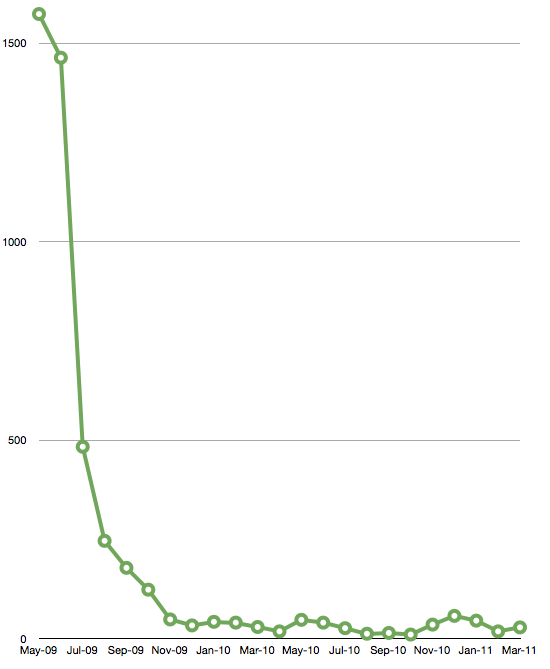
As of March 31st, I’ve sold 4,608 copies through Amazon at 99 cents. I get 35 cents on each, earning me $1,613.

The majority of these sales came in the first six months. I now sell between 10 and 45 copies per month.

variant sales chart

I also sell The Variant as a [direct download](http://johnaugust.com/variant), for which I give up only a small transaction fee. I’ve sold 740 copies, earning $732.

I haven’t tried selling The Variant through iBooks because, honestly, it’s a massive pain in the ass. As annoying as Amazon’s DTP scheme can be, Apple’s is byzantine. There are aggregators (like Lulu) that take some of the sting out of it, but for a surprisingly large cut of the action.

If self-publishing were more than a hobby for me, I’d definitely focus more energy on getting the maximum value out of both The Variant and its successor, [Snake People](http://www.amazon.com/gp/product/B004H8GF0U/ref=as_li_ss_tl?ie=UTF8&tag=johnaugustcom-20&linkCode=as2&camp=1789&creative=390957&creativeASIN=B004H8GF0U). (Which, by the way, is desperately in need of some reviews. If you’ve read it and liked it, I’d appreciate some feedback on its Amazon page.)

I have a few book-like projects I hope to put out this year, but I haven’t made firm decisions about what form they will take. They might be physical books like [A Book Apart](http://www.abookapart.com/)’s great little tomes, Kindle-able ebooks, PDF/ePub combos, or even iOS apps. Ultimately, it will depend on what’s best for the content, and which can best reach the audience.

« Previous Page
Next Page »

Primary Sidebar

Newsletter

Inneresting Logo A Quote-Unquote Newsletter about Writing
Read Now

Explore

Projects

  • Aladdin (1)
  • Arlo Finch (27)
  • Big Fish (88)
  • Birdigo (2)
  • Charlie (39)
  • Charlie's Angels (16)
  • Chosen (2)
  • Corpse Bride (9)
  • Dead Projects (18)
  • Frankenweenie (10)
  • Go (29)
  • Karateka (4)
  • Monsterpocalypse (3)
  • One Hit Kill (6)
  • Ops (6)
  • Preacher (2)
  • Prince of Persia (13)
  • Shazam (6)
  • Snake People (6)
  • Tarzan (5)
  • The Nines (118)
  • The Remnants (12)
  • The Variant (22)

Apps

  • Bronson (14)
  • FDX Reader (11)
  • Fountain (32)
  • Highland (75)
  • Less IMDb (4)
  • Weekend Read (64)

Recommended Reading

  • First Person (87)
  • Geek Alert (151)
  • WGA (162)
  • Workspace (19)

Screenwriting Q&A

  • Adaptation (65)
  • Directors (90)
  • Education (49)
  • Film Industry (489)
  • Formatting (128)
  • Genres (89)
  • Glossary (6)
  • Pitches (29)
  • Producers (59)
  • Psych 101 (118)
  • Rights and Copyright (96)
  • So-Called Experts (47)
  • Story and Plot (170)
  • Television (165)
  • Treatments (21)
  • Words on the page (237)
  • Writing Process (177)

More screenwriting Q&A at screenwriting.io

© 2026 John August — All Rights Reserved.