• Skip to primary navigation
  • Skip to main content
  • Skip to primary sidebar

John August

  • Arlo Finch
  • Scriptnotes
  • Library
  • Store
  • About

John

Workspace: Erin Gibson and Bryan Safi

October 18, 2011 Los Angeles, Workspace

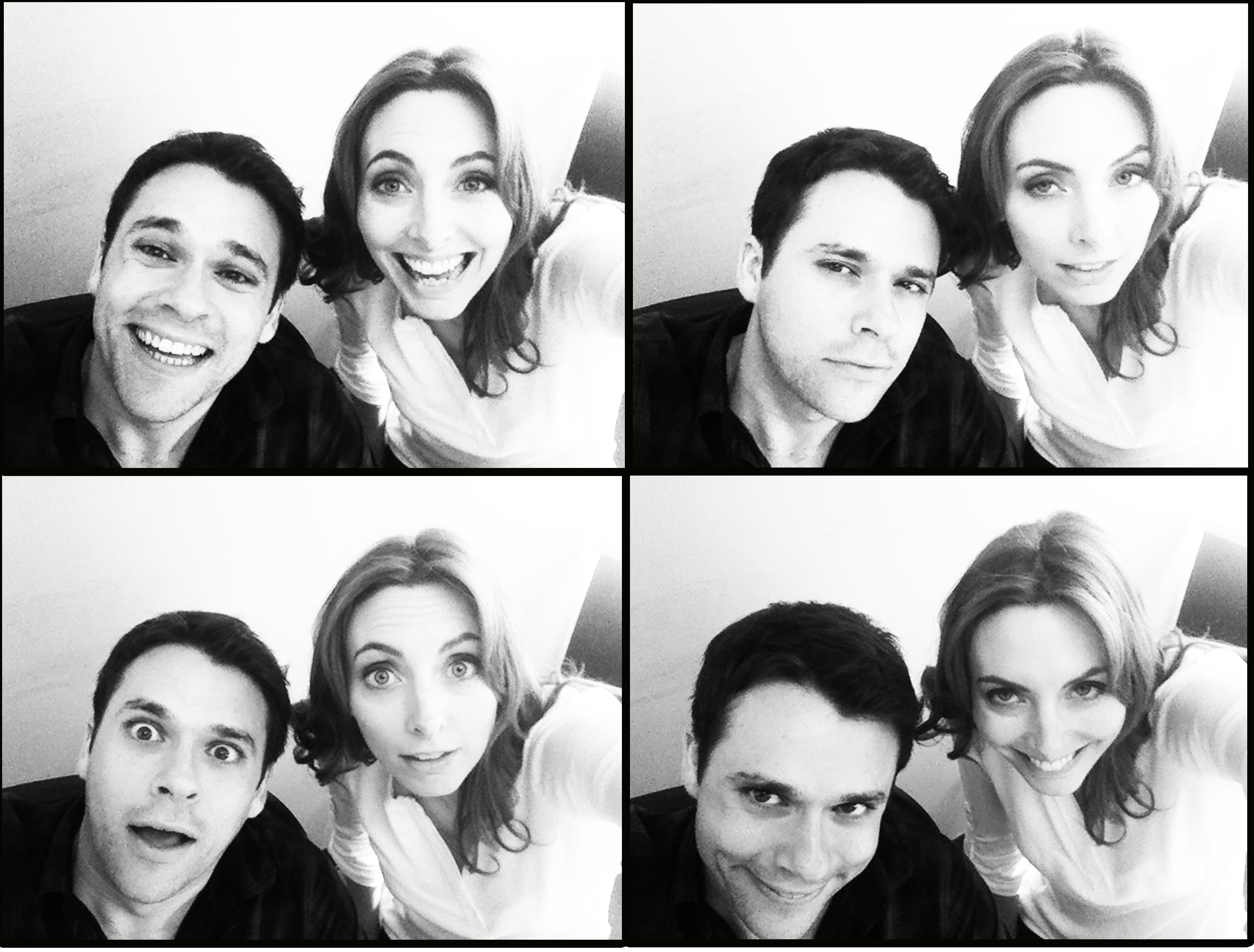
Erin Gibson and Bryan Safi

Who are you and what do you write?
—–
workspaceWe’re Erin Gibson and Bryan Safi, writing duo, Mariachi mini-band, and born-again virgins. We met two ways. First, doing comedy at [UCB Theater](http://losangeles.ucbtheatre.com/), then later we found ourselves working for the same show, Current TV’s [Infomania](http://current.com/shows/infomania/), where we wrote and hosted our own comedy segments. Bryan hosted “That’s Gay,” a weekly look at how the media treats gay people and issues, and Erin’s “Modern Lady” tackled the media’s portrays of women and their issues.

We used humor to talk about heated issues like Don’t Ask Don’t Tell, the de-funding of Planned Parenthood, and all the other awful things that women and gays have to deal with. The segments got us a lot of attention, but not a lot of action. So, we worked hard to get the show cancelled so we could start pulling in bucket loads of pussy.

When Infomania ended, we tried to figure out a way to have an outlet for our political comedy. We know people at Funny or Die and called them and pitched them Marcus and Michele Bachmann as recurring characters on the site. We’ve done [fives videos](http://www.funnyordie.com/search/a?q=bachmann+gibson&x=0&y=0) so far. We’ll write a draft, do two or three re-writes, then we punch up on set. They’re written, shot and edited sometimes in as little as two days, so there’s not a lot of time to mull them over.

We’ve found time in our schedules to do the following in the last four months: write two TV pilots, outline a feature, live tweet every GOP debate ([@gibblertron](http://twitter.com/#!/gibblertron) and [@bryansafi](http://twitter.com/#!/bryansafi)) and put on a monthly show at UCB called “[Entertainment Hollywood](http://losangeles.ucbtheatre.com/shows/view/2782),” a satire of those awful gossip shows, wherein we play two tan idiots with an irrational amount of confidence who cover important news like, what George Clooney’s favorite gelato bar is.

We don’t like to work separately, but we do because you have to have four million jobs in LA to pay the rent. Bryan writes for Joan Rivers on “Fashion Police,” and hopefully you can see Erin in a couple of commercials in the coming months.

We do it all. Well, we never hug. So, we do everything but hug.

Where and when do you write?
—-

We were taking turns at each other’s apartments, but the problem with that is, in the evening, when we’re all done, there’s no escape from the feeling of work. So, our new plan is to hit up fun places around town. West Hollywood just opened an amazing library with meeting rooms, and have you ever written at [Barnsdall Art Park](http://www.barnsdallartpark.com/)? What a treat!

All of our ideas seem to be generated on walks around LA. Erin lives in West Hollywood, and Bryan lives in Los Feliz, two heavily populated, walkable areas, full of the most ridiculous people on the planet. We’re fascinated by people. How they talk, how they cross the street, how they gesture. And we’re not afraid to stare.

For instance, we recently heard a woman in line for coffee in Los Feliz say, “I want a latte, but I’d like to eat it here.” Gold. When we hear stuff like that, we either email to it ourselves or write it down immediately.

Basically, all of our ideas seem to come from the fact that we love to walk around town, pointing and laughing. And don’t misunderstand us, we don’t just do it because we’re awful people. We do it because we’re awful people who hate ourselves.

As far as schedule, we treat it like a workday — a workday that starts after we’ve both gone to the gym at 10AM. But we work five days a week and put in around 40 hours. We take it very seriously. Also, we would like to not go crazy, and having a steady schedule sure does help!

What hardware do you use?
—

We both use MacBooks and sometimes Erin uses an iPad with a bluetooth keyboard. We also use our phones for notes, a lot. Bryan has an iPhone 4 and Erin has a GalaxyS. We use the native notes programs on those phones.

Both phones have been dropped several times. Sometimes in toilets.

What software do you use?
—

Up until we send our scripts out to prospective money-havers, we use [Google Docs](http://docs.google.com) all the way. It’s great. We can keep a notes doc and several versions and both be in the document at the same time.

Hey [Final Draft](http://finaldraft.com), how come we gotta be network admins to figure out Collabowriter?

But, I will say this about Final Draft — they might not be operating in the same technological age as the rest of the world, but it’s the best program for easy, precise formatting.

What would you change about how you write?
—-

We really wish we had an office so that we’re not distracted by phone calls or doing dishes or keeping the person we’ve abducted quiet. And again, if we could find the perfect software to use for collaboration, that would be brilliant. But, those seem to be the only things that we find ourselves longing for.

Fine, and an endless supply of boxed wine. The kind in the cube, not the rectangle. We have some class.

Dear Cindy in Blue Valentine

October 17, 2011 Random Advice, Story and Plot

blue valentine

So, hey, you’re pregnant. And it’s not welcome news, because you’re in college and hope to go to medical school.

You’re not sure if the champion sperm belongs to the scruffy-cute ukelele player or the asshole college wrestler. (But you kind of know it’s the wrestler.) Neither is exactly well-positioned for fatherhood.

You live with your parents. Let’s be frank; your family is not great. Your dad is an asshole. Your mom is a doormat. I doubt they’re much help right now.

We don’t see a lot of your deliberation process, but you decide to get an abortion. Then, just as the procedure is starting, you call it off. And that’s fine. Choice means choice. The doctor, nurse and everything about that clinic seemed appropriately sober and professional.

You decide to marry ukelele guy. I won’t offer any spoilers about how that turns out.

I’m actually writing to call your attention to one other undramatized choice: adoption.

Yes: it would have messed up the plot of your movie. But in terms of the plot of your life, I think it could have worked out pretty well.

Many young women in your situation would be wise to keep adoption in the mix. But I can’t blame them if they don’t strongly consider it. **Movies and TV shows generally do a crappy job portraying adoption,** either ignoring it as a choice or getting the details wrong.

For instance, maybe you watch Glee.

Quinn’s first-season pregnancy seemed fairly well-handled — given that it’s a show in which characters break into song without practice or provocation. But Glee whiffs it in the last minutes, sending the infant off to live with a troubled diva for thematic convenience rather than logical sense. That’s not how it works.

So, Cindy, I want to talk you through what would actually happen if you or another woman in your situation considered adoption.

And since this happens to be a site aimed at film and television writers, it might be a handy guide to how to portray such scenarios.

How it actually works
—-

First, you’d probably Google “adoption” (or “private adoption”) and quickly realize that there are a bunch of agencies that try to match up pregnant women with people hoping to adopt children. A lot of them are essentially attorneys who specialize in adoption.

They’re not attorneys in the scary sense. They’re attorneys in the getting-things-done-legally sense.

Clicking through the websites, you’d read the FAQs. You’d realize that a pregnant woman has her pick of families, each of which has written a letter to potential birth mothers explaining who they are and why they’re hoping to adopt a child. They’re not strangers. There’s no mystery. And in order to adopt, they all had to go through state screening.

If you called the number on the site, you’d speak to a case worker who would talk you through the process and answer your questions.

And you should ask a lot of questions. Let’s be clear: the agency and the case workers are getting paid by the prospective parents. Strictly speaking, that’s who they’re working for. But you hold all the cards. The agency’s job is to match pregnant women with prospective parents so that everyone has a good experience.

If you get a bad vibe from an agency, keep looking. You have your choice of places.

If you decided to go ahead with the process, you’d read a big pack of letters from prospective parents (all addressed “Dear Birth Mother”) and pick one who seemed like a good fit. Depending on the situation, you might hang out with them for a while before giving birth. Or not. There are a lot of ways it can work, and it mostly depends on how you want it to work.

Adoptions in the U.S. are increasingly open adoptions, which means that there’s no mystery about who the birth parents are. (That’s another thing TV and movies tend to get wrong.)

In addition to private agencies, there are public agencies, plus adoptions arranged through clergy, doctors and other groups. Basically, there are a ton of people who will find a family for this kid if you decide to continue the pregnancy.

I don’t want to sound Pollyanna here, Cindy. Nine months of pregnancy is a big fucking deal. But all the choices in front of you are big choices, so I want to make sure you give them all a fair shake.

Screenwriters: same advice.

Motion picture film cameras, 1888-2011

October 17, 2011 Film Industry, Tools

Matt Zoller Seitz looks at the [end of an era](http://www.salon.com/2011/10/13/r_i_p_the_movie_camera_1888_2011/singleton/):

> [T]he three major manufacturers of motion picture film cameras — Aaton, ARRI and Panavision — have all ceased production of new cameras within the last year, and will only make digital movie cameras from now on. […]

> What this means is that, even though purists may continue to shoot movies on film, film itself will may become increasingly hard to come by, use, develop and preserve. It also means that the film camera — invented in 1888 by Louis Augustin Le Prince — will become to cinema what typewriters are to literature. Anybody who still uses a Smith-Corona or IBM Selectric typewriter knows what that means: if your beloved machine breaks, you can’t just take it to the local repair shop, you have to track down some old hermit in another town who advertises on Craigslist and stockpiles spare parts in his basement.

Typewriters are a tempting but imperfect analogy. Motion picture cameras have traditionally been a rental rather than a retail business, which means Panavision will have the parts and expertise to repair its cameras for quite a long time.

And film isn’t going away tomorrow. It’s still a better choice than video in many situations, for both technical and artistic reasons. A few weeks ago, I visited the set of R.I.P.D in Boston, where they were happily shooting digitally. But director Robert Schwentke told me there were still film cameras on set for high-speed work.

Other filmmakers will choose film for its look or its ruggedness. And they’ll keep having that choice. Film cameras last a long time. Part of the reason Aaton, ARRI and Panavision can stop making new ones is that they already have plenty, and can keep them running.

Still, it’s a moment worth noting. In an [article at Creative Cow](http://magazine.creativecow.net/article/film-fading-to-black), Debra Kaufman observes that we’re not talking about something that *will* happen; it’s already done:

> “Someone, somewhere in the world is now holding the last film camera ever to roll off the line.”

Workspace: Beth Schacter

October 14, 2011 Workspace

beth schacter

Who are you and what do you write?
——-

My name is Beth Schacter. I wrote and directed an indie called [Normal Adolescent Behavior](http://www.imdb.com/title/tt0790721/). My next film is called [A Virgin Mary](http://www.imdb.com/title/tt1874400/) and stars Abigail Breslin.

I’ve written for TV and theater and recently adapted my Popcorn Fiction story “[Break Up 5000](http://www.mulhollandbooks.com/popcornfiction/stories/The_Break_Up_5000_by_Beth_Schacter.html)” for producer Lynda Obst. On Twitter, I’m [@bethshax](http://twitter.com/bethshax) where I rarely tweet about anything professional.

Where and when do you write?
—-

workspaceOur office is downstairs, in a space I share with my husband, Ben, when he is working from his edit bay at home. When he’s not I have the space to myself — which isn’t good when you need to be shamed into concentrating. I have a narrow wooden desk made from reclaimed wood that discourages clutter — in theory.

My work day hopefully starts between 8:30 and 9:30. I get up early and try and get out for at least a 40-minute walk with the dog (for both our sakes) and then eat breakfast because you have to eat breakfast. That whole “most important meal of the day” thing is no joke.

The first thing I do is open whatever I have to work on. I may not touch it for an hour but at least it is there, nagging me, reminding me that it needs attention. I’ll check emails, deal with production things that need to be dealt with and probably spend a little too much time on social networks. You know you are in trouble when people greet you at parties with “I love your Facebook status updates!”

On days when I write in my office I usually play NPR on a volume a little too low for me to actually hear it. I just need a little white noise. I have music sometimes, but for some reason I find music more distracting.

I also leave my phone upstairs and turn on [Freedom](http://macfreedom.com/) as much as I can.

But honestly, when a draft needs to get churned out I need to be anywhere else but in the office. I need to forget the dog, the house, the laundry, the six recipes I’m dying to make.

I usually head to a library (Silverlake is great) for the first couple of drafts and then I’ll lock myself in a hotel room for 24-48 hours, sit on the bed, order inappropriate amounts of room service and gut it out. And usually I have to change locations three or four times a draft; sometimes I write in bed, sometimes on the couch, sometimes in a coffee shop.

If a place has been unproductive I change the place; it’s not superstition, it actually works.

Because I run at least five times a week, a lot of days I have to pack up by 5:30 or so (that’s also when the dog starts his campaigning, an endearing and annoying series of cute maneuvers that includes sighing, laying down dramatically and sighing some more). So my writing day is really 10 to 5.

Once or twice a year we go someplace completely off the grid and work for at least a week. Someplace with no TV, no cell phone reception, no internet. Our favorite place is [Sheep Dung Estates](http://www.sheepdung.com/) in Boonville, CA. Don’t let the name fool you. It’s heaven on earth.

What hardware do you use?
—-

I do all my notes, ideas and brainstorming in graph-ruled composition books. I use black ball point pens because I do…habit I guess.

I shot-list and storyboard in them as well. My shot list/storyboards are pretty sad, but they work for me. I describe the scene and then either sketch the frame for proportion or floor plan the sequence. I tried fancy notebooks but I felt like I was ruining them with mediocre ideas and bad sketches. Cheap quadrilles never judge me.

I have a Mac Mini that absolutely cannot run any sort of game or play movies and a large Dell monitor I inherited when Ben upgraded to HD monitors. I use the standard keyboard and sit in a knock-off Aeron chair.

I use a footstool because I’m super short and my feet don’t exactly touch the ground. And I use a Logitech gamer mouse that has a trackball that I love.

For middle of the night ideas I use my iPhone’s notepad feature. However terrible my text input is on the phone it is far more legible than my scribbles in the dark.

I have a MacBook that I use when I’m not at my office. Don’t tell the MacBook, but he’s getting replaced by an Air later this year.

What software do you use?
—-

I write on [Movie Magic](http://www.screenplay.com/p-29-movie-magic-screenwriter-6.aspx). I hate Final Draft because I don’t know how to use Final Draft. Most times I outline in Movie Magic, syncing everything using [Dropbox](http://dropbox.com). Dropbox is a miracle. I have a redundancy with a 1TB hard drive (LaCie usually) where I dump drafts once every few days.

I also rewrite everything in revision mode. Once you get used to the asterisks you really grow to love them.

I am a Post-It note user when I have to do a pitch. I put all the cues for the pitch on Post-Its, stand in front of them and practice while walking around. And then I type it up and drive around practicing. My carbon footprint for pitching is relatively big.

I used to use [Scrivener](http://www.literatureandlatte.com/scrivener.php), but I found it was too easy to spend my time resizing cards and reformatting the outline, so low tech is the way I go. Also I like to write inside my outline document, re-dating it every day, so that I can keep the first draft as loose as possible. I take notes inside drafts as well.

My one complaint about Movie Magic is that it doesn’t have a graveyard function, or at least I can’t figure it out. I send a lot of stuff to a graveyard using TITLEMOVIE_GYARD but that’s cut and paste and I’d like to be able to reference it — it’s an editing habit that I wish was more easily translatable to screenwriting software. I suppose I could drag and drop the scenes to the end of the script and tag them a different color, but that feels like way too much work. Plus it will give you a false sense of page-accomplishment.

What would you change?
—

I would turn on [Freedom](http://macfreedom.com/) more. Maybe get a fancier chair.

When we buy a house and move we will probably put together a RAID drive with 2 or 3 TB that we can access over the network, but I’ll still use Dropbox. I’d finally settle on a keyboard upgrade.

I’m amazed by how many different ways there are to work. I know teams that work off of IM, people who only write in public, people who only write in longhand, people who can have the internet on all day. You find what works for you and you stick with it until it stops working. So far this method works, but if it ever stops, I’ll change almost everything.

« Previous Page
Next Page »

Primary Sidebar

Newsletter

Inneresting Logo A Quote-Unquote Newsletter about Writing
Read Now

Explore

Projects

  • Aladdin (1)
  • Arlo Finch (27)
  • Big Fish (88)
  • Birdigo (2)
  • Charlie (39)
  • Charlie's Angels (16)
  • Chosen (2)
  • Corpse Bride (9)
  • Dead Projects (18)
  • Frankenweenie (10)
  • Go (29)
  • Karateka (4)
  • Monsterpocalypse (3)
  • One Hit Kill (6)
  • Ops (6)
  • Preacher (2)
  • Prince of Persia (13)
  • Shazam (6)
  • Snake People (6)
  • Tarzan (5)
  • The Nines (118)
  • The Remnants (12)
  • The Variant (22)

Apps

  • Bronson (14)
  • FDX Reader (11)
  • Fountain (32)
  • Highland (75)
  • Less IMDb (4)
  • Weekend Read (64)

Recommended Reading

  • First Person (87)
  • Geek Alert (151)
  • WGA (162)
  • Workspace (19)

Screenwriting Q&A

  • Adaptation (65)
  • Directors (90)
  • Education (49)
  • Film Industry (489)
  • Formatting (128)
  • Genres (89)
  • Glossary (6)
  • Pitches (29)
  • Producers (59)
  • Psych 101 (118)
  • Rights and Copyright (96)
  • So-Called Experts (47)
  • Story and Plot (170)
  • Television (165)
  • Treatments (21)
  • Words on the page (237)
  • Writing Process (177)

More screenwriting Q&A at screenwriting.io

© 2026 John August — All Rights Reserved.