• Skip to primary navigation
  • Skip to main content
  • Skip to primary sidebar

John August

  • Arlo Finch
  • Scriptnotes
  • Library
  • Store
  • About

John

Bronson Watermarker 1.6 gets customized

July 27, 2012 Apps, Bronson

The new version of Bronson Watermarker — in the [Mac App Store today](http://itunes.apple.com/us/app/bronson-watermarker/id481867513?mt=12) — adds our single most-requested feature: customization of the font, size and transparency of watermarks.
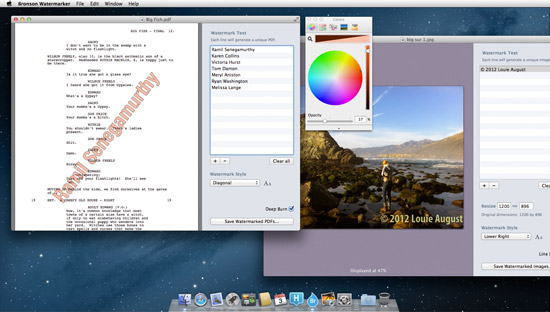
It’s one little button, but it lets you spend a dangerous amout of time tweaking and futzing with your watermark.

That potential time-suck is why we made it easy to ignore. You don’t *have* to choose fonts and colors and opacity. In fact, you probably shouldn’t. After all, the default styles are good enough for [Ron Howard’s Arrested Development script](https://twitter.com/RealRonHoward/status/228261666234707969/photo/1).

[bronson icon](http://itunes.apple.com/us/app/bronson-watermarker/id481867513?mt=12)

But if you need to customize the watermark — perhaps on a dark photo — now you can.

Bronson 1.6 also includes Mountain Lion support, Retina graphics and the ability to drag in images directly from iPhoto.

All this, plus a refreshed icon that looks great on your dock.

Bronson Watermarker is a [steal at $9.99](http://itunes.apple.com/us/app/bronson-watermarker/id481867513?mt=12) in the Mac App Store.

Why the story doesn’t work in Diablo III

July 24, 2012 News

Last week, I [tweeted](https://twitter.com/johnaugust/statuses/225996660445151232):

> Finished Diablo III. Writing credits are pretty deep in the end crawl, consistent with how little they cared.

Yes, I was trying to kill two birds with 140 characters. The writers weren’t given very good placement in the hierarchy of credits, and the storytelling in Diablo III is pretty damn weak.

Many folks have asked me to elaborate my story gripes, so here we go. There are very minor spoilers within. Trust me, I’m not really ruining anything.

##I didn’t come here to watch NPCs talk to each other.
In Diablo III, you encounter most of the plot by listening as other characters talk to each other. Leah talks to Deckard Cain. Tyreal talks to Adria. They’re having an exclamation point party, and you’re welcome to quietly observe.

Every once in a while, your character chimes in, but it’s generally to say, “I’ll do it!”

The decisions have been made and you’re sent off to do/get/kill whatever they’ve decided upon.

##Shouldn’t my character be in charge?
I’m a witch doctor. I’ve got an intelligence of 235, and later in the game I’m revealed to be a unique supernatural being. ((*cough* Preacher.)) So why am I taking marching orders from you?

I’m apparently the only one who can save heaven and earth, so maybe you should shut up and let me talk.

Note that I’m not actually demanding choice or free will as a player. Look, I’ve played Diablo. I’ll go kill the next thing. But I’d love to feel like my character was making the choice, rather than being a lackey.

##I don’t know or care about any of the NPCs.
At several points in the game, major NPCs betray you and/or die. And you shrug.

It doesn’t have to be that way.

Remember Raynor and Kerrigan from StarCraft? I became invested in those characters, not because of their cut scenes, but because *I got to play as them.* I kept them alive through zerg rushes, and watched as they made sacrifices that transformed them. So even when I wasn’t playing those characters, I knew them.

The only NPC I cared about a little was my sidekick/meatshield, Kormac the Templar. He had a limited set of phrases, but he made an effort, and our canned conversations felt at least a little humanizing. Here’s the test: When I could have switched to a different hireling, I didn’t, because I would have missed him. A little.

##I was way ahead of the plot.
Gee, nothing bad could happen from sucking all those demon lords into a fiery black soul stone.

##The sepia-toned character interludes feel like band-aids.
At several moments in the game — generally at act breaks — the game goes to a completely different animation style. Your character gives voiceover to recap what’s just happened and where they’re headed next. It’s oddly repetitive and tacked-on.

My hunch, though I have no proof, is that these interludes came very late in the development of the game, when someone at Blizzard realized that the player/plot relationship was non-existant. It very much feels like voiceover added to a movie that’s not working.

To be fair, I liked a few story and character elements.

I dug the character introductions, which are done in that same sepia style. No matter which character class you choose, your hero is racing to get to Tristram to investigate a falling star. I love characters who run towards danger. Their backstory details are interesting and specific — and sadly irrelevant, because you’re never going to refer to them again.

I liked the environments — although I wish more interesting things were happening in them. Fairly late in the game, there’s a spider queen who tortures chained giant *somethings*. Are they gods? Titans? I wish they weren’t just set dressing.

I played through the first boss with each of the character classes before settling on the witch doctor. ((I like having a lot of minions. Psychoanalyze that as you will.)) To their credit, each of the character concepts felt distinct, with nice voice acting and interesting animation. I liked the female barbarian a lot, and if I decide to keep playing, I’ll probably give her a shot.

But I’m probably hanging up my mouse on Diablo III. Like its predecessor, it ultimately becomes a game of optimization, and that’s just not my thing.

Writing better bad guys

July 24, 2012 Story and Plot

Chuck Wendig has 25 things [you should know about antagonists](http://terribleminds.com/ramble/2012/07/24/25-things-you-should-know-about-antagonists):

> Antagonists who do evil just to do evil are basically big fucking cartoons. They’re Snidely Whiplash. They’re Cobra Commander. They’re Pageant Moms, Nancy Grace, Rush Limbaugh. In other words: boring, unbelievable, and totally untenable. Give them motivations beyond “being the biggest dick I can be.” Yes, you can in certain modes and stories get away with this (see: Batman’s Joker, or nearly any killer in slasher films), but it’s hard, and it puts an even greater weight on the shoulders of the protagonist.

One of the challenges of screenwriting is finding the sweet spot between two opposing needs:

– You want your protagonist to be pushing the story, and not just responding to problems.
– You want your antagonist to keep making life as difficult as possible for your hero, constantly raising the stakes.

Basically, your protagonist and antagonist each want to drive the plot. They’re fighting for control of the steering wheel.

If you remember that [every villain is a hero](http://johnaugust.com/2009/every-villain-is-a-hero), it’s often helpful to look at the whole story from the other guy’s point of view. Don’t just ask what the villain wants. Ask what the villain needs. Look for an arc so that he can change as well.

That doesn’t mean you ultimately have to split your time evenly between hero and villain. You almost certainly shouldn’t. But knowing what that guy’s movie would be can help you find the best story overall.

Writing screenplays with Scrivener and iA Writer

July 20, 2012 Apps, First Person, Fountain, Highland, Screenwriting Software

A reader named Gerry wrote in to share his screenwriting workflow, which uses [Fountain](http://fountain.io) as a bridge between Scrivener, iA Writer, Dropbox and Highland.

—

first person[iA Writer](http://www.iawriter.com/) is my favorite application to write in because of its minimalist UI and Focus Mode. I just wish it had features similar to [Scrivener’s](http://www.literatureandlatte.com/scrivener.php) Binder and Compile. I love the flexibility of having one scene or one sequence per document and organizing them within Scrivener’s Binder — as was [described so well](http://prolost.com/blog/2010/6/17/the-state-of-screenwriting-software.html) by Stu Maschwitz on Prolost.
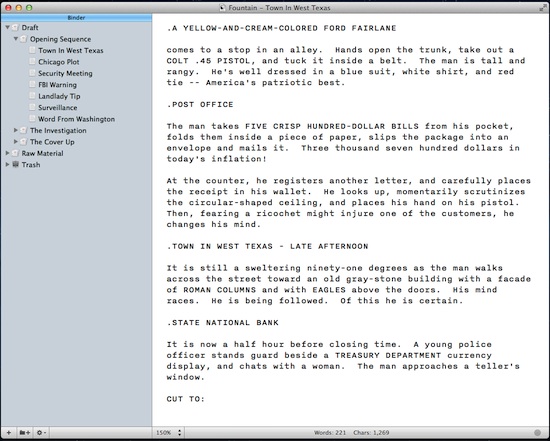
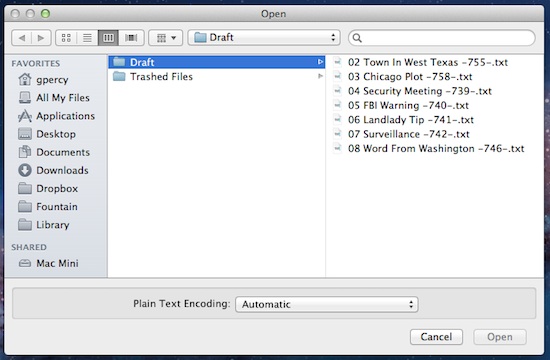
Fortunately, Fountain lets me leverage both iA Writer and Scrivener.

I write scenes in iA Writer using Fountain syntax, saving them as plain text files in a [Dropbox](http://dropbox.com) folder. I can then work with them using iA Writer on a Mac, iPad, or iPhone, which is handy.

iA Writer is perfect for scenes, while Scrivener is great for the bigger script.

Because Fountain files are plain text, Scrivener is happy to handle them. I use Scrivener’s “Sync > with External Folder…” command to build a binder for the script, which maintains a link to those original files.

scrivener screenshot

(I prefer working with a minimized Scrivener UI. I “borrowed” icons from the Storyist application to customize Scrivener’s Binder.)

Meanwhile, iA Writer still sees the individual files. If I edit them, those changes appear within Scrivener after the next “Sync > with External Folder…”

iawriter screenshot

Using Scrivener’s “Compile…” command, I can then export a group of Scene and Sequence documents as a single plain text Fountain file.

With [Highland](http://quoteunquoteapps.com/highland), I can then convert that Fountain file to PDF or Final Draft.

—

Gerry’s workflow is more complicated than many screenwriters would prefer, but I like that he’s using the tools he wants for each part of the process. Rather than being boxed in by one monolithic app, he’s taking the best of various apps.

With Fountain, we’ve worked hard to keep the format as agnostic as possible. Scrivener and iA Writer didn’t have to add support for Fountain, because they’ve always had it.

Some upcoming apps will do more with the format — using its built-in notes and sectioning, for example — but even the most basic text editors can do 90% of what you’d want.

For now, Highland helps complete the loop by letting you convert to and from Fountain easily. The free public beta is still going, so if you’re curious, by all means [try it out](http://quoteunquoteapps.com/highland).

« Previous Page
Next Page »

Primary Sidebar

Newsletter

Inneresting Logo A Quote-Unquote Newsletter about Writing
Read Now

Explore

Projects

  • Aladdin (1)
  • Arlo Finch (27)
  • Big Fish (88)
  • Birdigo (2)
  • Charlie (39)
  • Charlie's Angels (16)
  • Chosen (2)
  • Corpse Bride (9)
  • Dead Projects (18)
  • Frankenweenie (10)
  • Go (29)
  • Karateka (4)
  • Monsterpocalypse (3)
  • One Hit Kill (6)
  • Ops (6)
  • Preacher (2)
  • Prince of Persia (13)
  • Shazam (6)
  • Snake People (6)
  • Tarzan (5)
  • The Nines (118)
  • The Remnants (12)
  • The Variant (22)

Apps

  • Bronson (14)
  • FDX Reader (11)
  • Fountain (32)
  • Highland (75)
  • Less IMDb (4)
  • Weekend Read (64)

Recommended Reading

  • First Person (87)
  • Geek Alert (151)
  • WGA (162)
  • Workspace (19)

Screenwriting Q&A

  • Adaptation (65)
  • Directors (90)
  • Education (49)
  • Film Industry (489)
  • Formatting (128)
  • Genres (89)
  • Glossary (6)
  • Pitches (29)
  • Producers (59)
  • Psych 101 (118)
  • Rights and Copyright (96)
  • So-Called Experts (47)
  • Story and Plot (170)
  • Television (165)
  • Treatments (21)
  • Words on the page (237)
  • Writing Process (177)

More screenwriting Q&A at screenwriting.io

© 2026 John August — All Rights Reserved.