• Skip to primary navigation
  • Skip to main content
  • Skip to primary sidebar

John August

  • Arlo Finch
  • Scriptnotes
  • Library
  • Store
  • About

John

Fountain for Sublime Text

September 10, 2012 Fountain

Jonathan Poritsky has whipped up a [Fountain syntax highlighter](http://www.candlerblog.com/2012/09/10/fountain-for-sublime-text/) for [Sublime Text](http://www.sublimetext.com/), an increasingly popular text editor.

I love to see this kind of itch-scratching. It’s why we made Fountain. We want people to be able use it with whatever tools they prefer, and to whatever extent they find helpful.

Here’s a screenshot:
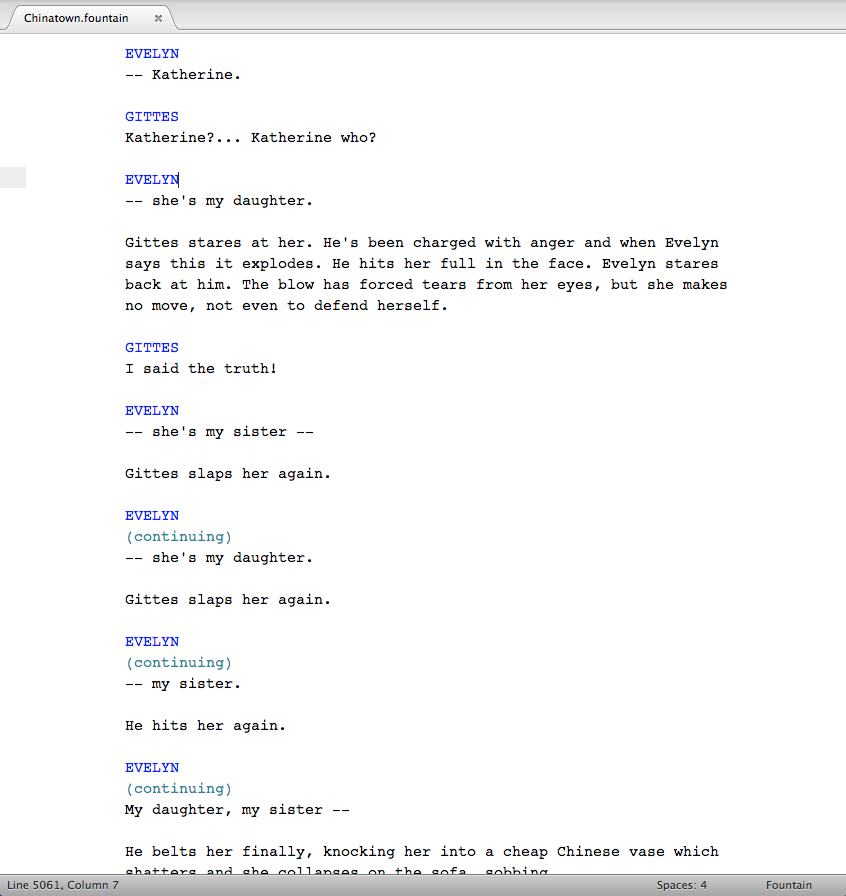
sublime fountain screenshot

Personally, I don’t find this kind of syntax highlighting all that useful for Fountain.

We designed the markup so elements would be defined by whitespace — both visually and logically. Character names already feel unambiguous to me, so making them a different color doesn’t do much. Putting notes and other meta info in color, on the other hand, seems potentially great. So maybe that will come in a future incarnation.

Regardless, there’s no right or wrong way to use Fountain. I love to see people making it their own.

**UPDATE:** Jonathan has already put out an update that adds in syntax coloring for Notes, Boneyard and other helpful meta-things. Totally worth a look.

Some voting suggestions for the WGA board

September 3, 2012 WGA

By now, WGA members should have received their ballots for the 2012 election. This year, I’m a little more connected the process than usual, because I served on the nominating committee, helping to choose the 15 candidates running for the eight open seats on the board.

Actually, “helping to choose” wildly misrepresents the function of the nominating committee. The process is really more like this:

1. Identifying possible candidates. “Hey! Who can we can we convince to run for the board? What if we begged and promised them candy?”
2. Weeding out crazy people through a 20-minute interview.

There weren’t any crazy people this year. Really. I was impressed by all the candidates who came in. Many brought interesting perspectives on issues facing writers and the industry.

You can read about their specific goals and plans in the candidates’ statements booklet. If you have any questions, I’d encourage you to come to Candidates Night, this Wednesday, September 5th. (You should [RSVP](https://my.wgaw.org/content/subpage_secure.aspx?id=2872) if you’re going.)

Among the many talented candidates, I have two friends running this year.

I met [Barbara Turner](http://www.imdb.com/name/nm0877399/) on the picket lines, and had no idea she’s been a member since 1966. She has experience in both features and made-fors, and specific ideas about how to ensure participating writers are properly notified about possible credit arbitration. It’s the kind of small detail that could change a writer’s life, and is absolutely worth getting right.

I strongly encouraged [Jordan Mechner](http://jordanmechner.com/wga/) to run. In addition to his screenwriting work, he has invaluable experience creating videogames and graphic novels — intellectual property in which he owns the underlying rights. The WGA represents writers as employees, but we’re also entrepreneurs, and Jordan’s insight into ownership could be very helpful as the industry changes.

I haven’t filled out my ballot yet — they’re due September 20th — but my priorities will be making sure we have a range of experience (TV, features, new media) and an abundance of smart people. I’m not worried about whether each candidate has a clear vision for an esoteric pension/health issue, but rather that he or she has the curiosity and diligence to find the right answers. On these criteria, I think we have great choices.

John August, balloon acrobat of the early 1900s

August 27, 2012 Meta

It turns out I had a [daring namesake](http://www.baltimoreorless.com/2011/04/baltimore-balloon-aeronauts-deadly-final-performance-1905/):

> Sunday, September 9, 1905: A half mile above the row houses of East Baltimore, 25-year-old John August twisted in the air and pulled himself to a sitting position on the trapeze bar. It was a pleasant day, the last of the Industrial Trades Exposition.

> Below August, nearly 10,000 spectators jammed Highlandtown’s street to watch the “aeronaut.” Others sat in chairs on rooftops or craned their necks from streetcars. As far away as the upper floors of the Belvedere Hotel, people gently nudged each other aside to obtain a better view of the man’s athletic skill and derring-do.

> “Just before coming to Baltimore,” explained Calvin Raglan, treasurer of the Industrial Trades Exposition Company, “I advertised for a balloonist. There were several applicants, but John August was the only one who promised to do acrobatic stunts in the air. He was the best aeronaut I ever saw.”

And…

There’s a reason I hadn’t heard of his later exploits.

(Thanks to MK Sansom for the link.)

A few words on passwords

August 27, 2012 Geek Alert

Earlier today I [tweeted](https://twitter.com/johnaugust/status/240167329038741505):

> Spoiler: Your password is a lot less secure than you think :: howsecureismypassword.net

Several followers wrote back, asking some variation of “why would you willingly type your password into a website for no reason?” Subtext: “You idiot.”

Two points:

1. No one says you have to type your real password. Try something with similar parameters. If your password is “dogDOGrep33t,” you could try “catCATrep33t.”

2. All of the testing is client-side, happening in your browser. Don’t believe me? Save the site as a web archive, turn off your internet, and launch the web archive. Still works.

Could nefarious people hack the site, injecting a script so that it records all the passwords typed into it? Theoretically, sure. Almost any site you visit could be hacked, including this one.

But what would hacking this site actually get someone? It’s not hard to find lists of actual passwords people use. Without being able to match passwords to user names, there’s not much benefit.

And anyway, refer back to #1. Stop panicking.

The site is a useful way to figure out what kinds of passwords are more (or less) secure. For example, did you know “fidelio” and “kubrick” are in the top 10,000 passwords, and would be cracked instantly?

This site doesn’t obviate the usefulness of 1Password or two-step verification or any of the other technologies designed to keep data safer. But trying out various options encouraged me to use a better login password for my MacBook Air, something which actually needs to be a plain old string of characters.

« Previous Page
Next Page »

Primary Sidebar

Newsletter

Inneresting Logo A Quote-Unquote Newsletter about Writing
Read Now

Explore

Projects

  • Aladdin (1)
  • Arlo Finch (27)
  • Big Fish (88)
  • Birdigo (2)
  • Charlie (39)
  • Charlie's Angels (16)
  • Chosen (2)
  • Corpse Bride (9)
  • Dead Projects (18)
  • Frankenweenie (10)
  • Go (29)
  • Karateka (4)
  • Monsterpocalypse (3)
  • One Hit Kill (6)
  • Ops (6)
  • Preacher (2)
  • Prince of Persia (13)
  • Shazam (6)
  • Snake People (6)
  • Tarzan (5)
  • The Nines (118)
  • The Remnants (12)
  • The Variant (22)

Apps

  • Bronson (14)
  • FDX Reader (11)
  • Fountain (32)
  • Highland (75)
  • Less IMDb (4)
  • Weekend Read (64)

Recommended Reading

  • First Person (87)
  • Geek Alert (151)
  • WGA (162)
  • Workspace (19)

Screenwriting Q&A

  • Adaptation (65)
  • Directors (90)
  • Education (49)
  • Film Industry (489)
  • Formatting (128)
  • Genres (89)
  • Glossary (6)
  • Pitches (29)
  • Producers (59)
  • Psych 101 (118)
  • Rights and Copyright (96)
  • So-Called Experts (47)
  • Story and Plot (170)
  • Television (165)
  • Treatments (21)
  • Words on the page (237)
  • Writing Process (177)

More screenwriting Q&A at screenwriting.io

© 2026 John August — All Rights Reserved.