• Skip to primary navigation
  • Skip to main content
  • Skip to primary sidebar

John August

  • Arlo Finch
  • Scriptnotes
  • Library
  • Store
  • About

John

My Mac Pro problem, revisited

August 22, 2012 Follow Up, Geek Alert

Last month I wrote about my [Mac Pro problem](http://johnaugust.com/2012/my-mac-pro-problem). Short version: my 2006 Mac Pro tower couldn’t be upgraded to Mountain Lion, so I needed to get a new computer.

After weighing the various options, I decided to buy the new retina MacBook Pro for Ryan Nelson — who does all the graphics for us — and use his 2011 MacBook Pro as my main computer.

So far, it’s worked out pretty well.

I was already using a 2.5″ SSD as my main hard drive, so it was simple to swap that into the MacBook. Everything boots fine, and the machine feels as snappy as my tower did. With a new cable, I’ve been able to keep using my old 30″ Apple monitor. I’ve seen occasional striping and artifacts, but nothing terrible.

On the whole, it feels almost exactly like my old rig. I wouldn’t notice that anything had changed except that the MacBook Pro is completely silent — unless the fans need to spin up, which they do during podcasts, frustratingly. It’s odd having a laptop that operates only in clamshell mode, sitting on an milk crate under my desk. But not bad.

The biggest challenge has been figuring out what to do with the additional drives in my tower, which had all four bays filled, with drives for Projects, Media and Backup (which did all the Time Machine magic).

My first instinct was to just keep these drives in the Mac Pro and use it as a server. With FireWire 800, I was able to network to it and mount the drives. But it felt janky and unreliable, plus it meant a lot of power (and fan noise) to keep the Mac Pro running 24/7.

I wanted a dumb box that could just hold the bare drives. Not as a RAID array, but Just a Bunch of Disks (JBOD). So I tried a [4-bay unit by Icy Dock](http://www.amazon.com/gp/product/B003CNQPGU/ref=as_li_ss_tl?ie=UTF8&camp=1789&creative=390957&creativeASIN=B003CNQPGU&linkCode=as2&tag=johnaugustcom-20) designed to do exactly that. It worked, but the attached fan was much louder than I wanted, even on its low setting. There was also no easy way to make it sleep, and the best connection for it was USB 2.

Ultimately, I returned the Icy Dock and opted for a conventional external drive, the [3TB My Book by WD](http://www.amazon.com/gp/product/B004QGXOP2/ref=as_li_ss_tl?ie=UTF8&camp=1789&creative=390957&creativeASIN=B004QGXOP2&linkCode=as2&tag=johnaugustcom-20). It’s not totally silent, but I don’t hear it. It has FireWire 800, with an extra port for daisy-chaining. And it happily sleeps when the computer does.

3TB is enough that I could set aside a partition for Time Machine and consolidate Projects and Media down to the drive. I back up both the internal SSD and the external drive to a toaster-style dock, the [Newer Voyager Q](http://www.amazon.com/gp/product/B0026S7HP0/ref=as_li_ss_tl?ie=UTF8&camp=1789&creative=390957&creativeASIN=B0026S7HP0&linkCode=as2&tag=johnaugustcom-20), which has also proved handy for bringing in all the data from my old drives.

I’m still hoping for a real Mac Pro tower than can hold a bunch of drives. But for now, this setup seems fine.

Meanwhile, Ryan loves the retina MacBook Pro. He’s encountered oft-reported software inconsistencies — new apps are breathtakingly sharp, while old apps look blurry — but the art he’s been able to make has been terrific. You’ll be seeing the results very soon.

Selling a script, but holding on to the characters

August 16, 2012 QandA, Rights and Copyright

questionmarkI’m a first time writer in the UK, who is in the process of having an original movie script picked up by a start-up production company. Everyone who has read the script loves it and they all say it’s wide open for a sequel or maybe even a spin-off TV series.
I’m obviously thrilled to have the script picked up, but I was wondering of there is a way I can legally retain the rights to the characters so I can write a sequel at some point in the future? Because the company is a start-up they don’t have much money to spend, so I’m willing to take a much reduced payment for the script, provided I can somehow retain the rights to the characters I created.

Is the answer simply a carefully drafted contracts, to include reference to the rights reverting to me after one production?

— Andy
Derbyshire, England

Short answer: Yes.

Longer answer: In most cases, when you’re selling (or optioning) a screenplay to a production entity, they want absolutely everything, including the right to make sequels and spin-offs. Contracts will often have built-in payments for these derivative works.

But it doesn’t have to be that way.

If you’re willing to take less money upfront — perhaps because the production entity can’t afford to pay you more — you can often negotiate terms that make sense for you, including holding on to some rights you’d otherwise give up.

Bottom line: You need an entertainment attorney. This isn’t standard boilerplate language, and will require significant negotiation. You want to protect yourself in case of disaster or wild success, and small glitches in the contract could cause huge problems.

Keep in mind that the buyer has a very good reason for wanting those sequel and spin-off rights. They want to be able to sell the movie to a larger buyer, and a possible franchise is worth more than a one-off movie.

Related trivia: My first spec sale, Go, was a similarly small deal with special terms, including my becoming co-producer. While there was never serious talk about a sequel, there was a TV spin-off. I wasn’t involved, but Sony TV did develop a show based on it. I think they shot a pilot — [The Malloys](http://en.wikipedia.org/wiki/The_Malloys) were involved, if I recall correctly — but it never went to series.

Death and advertising

August 13, 2012 Rights and Copyright

In his will, Beastie Boy Adam “MCA” Yauch left instructions that “in no event may my image or name or any music or any artistic property created by me be used for advertising purposes.” Wendy S. Goff looks at why that [opens a legal can of worms](http://www.forbes.com/sites/deborahljacobs/2012/08/13/part-of-beastie-boy-adam-yauchs-will-banning-use-of-music-in-ads-may-not-be-valid/):

> In a sentence that referred to publicity rights, the words Yauch added introduced the matter of copyright. The two are very different legal animals.

> Publicity rights refers to Yauch’s interest, while he lived and in some states after he died, in protecting his image and his name, which had value because he was a celebrity. Legally, they couldn’t be used in advertising without his permission (or that of his heirs). Someone who violated this right could be required to pay a fine for the value of the damages they caused, and turn over any profits they made as a result.

> Contrast that right with copyright — the federal law that covers a literary, artistic, musical, or other creative work. Copyright owners have the right to control the use of their work and get paid for it. In the music industry, it covers not only the written composition (sheet music and lyrics), but also sound recordings. To make things more complicated still, the composer of the music and the lyricist are both considered authors.

Yauch and his heirs clearly control his publicity rights. But most of his music copyrights are likely shared with his bandmates and others; his estate can’t constrain what it doesn’t own. Music is especially hard to pin down:

> When songs have been distributed to the public under certain conditions, the owner of the composer’s copyright cannot prevent other artists from “sampling” or making “covers” of the song.

> The mandatory license right forces the owner to license the rights to others who may make their own recordings and sell them for a profit. (Whether Monster Beverage exceeded the rights afforded by a mandatory compulsory license, and therefore infringed on the Beastie Boys’ copyrights is the subject of a lawsuit.) Therefore Yauch’s heirs may be forced to license his work, whether or not the terms of his will allow them to derive any profit from it.

Philosophically, it’s easy to see what Yauch was going for. Practically, this was a situation that needed more-nuanced legalese to avoid unintended consequences.

Link via [Jen Pollack Bianco](https://twitter.com/lax2nrt/status/235019303383080960).

Lego story rules

August 13, 2012 Story and Plot

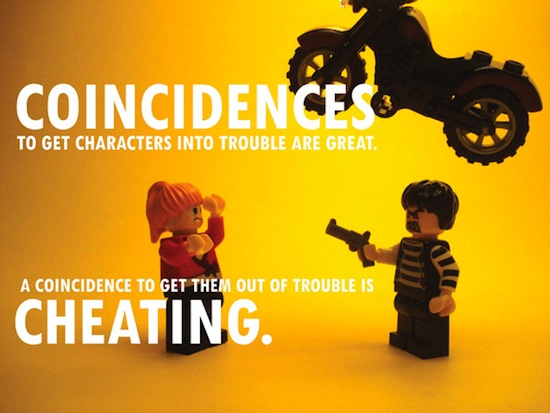
Emma Coats’s list of [22 story rules](http://www.pixartouchbook.com/blog/2011/5/15/pixar-story-rules-one-version.html) moves from useful to delightful when
[illustrated with Lego](http://slacktory.com/2012/07/pixar-story-rules-illustrated-by-icanlegothat/):

pixar coincidence

(I’ve written about the [perils of coincidence](http://johnaugust.com/2007/perils-of-coincidence) as well.)

Illustration by Alex Eylar, link via [David Anaxagoras](http://davidanaxagoras.com).

« Previous Page
Next Page »

Primary Sidebar

Newsletter

Inneresting Logo A Quote-Unquote Newsletter about Writing
Read Now

Explore

Projects

  • Aladdin (1)
  • Arlo Finch (27)
  • Big Fish (88)
  • Birdigo (2)
  • Charlie (39)
  • Charlie's Angels (16)
  • Chosen (2)
  • Corpse Bride (9)
  • Dead Projects (18)
  • Frankenweenie (10)
  • Go (29)
  • Karateka (4)
  • Monsterpocalypse (3)
  • One Hit Kill (6)
  • Ops (6)
  • Preacher (2)
  • Prince of Persia (13)
  • Shazam (6)
  • Snake People (6)
  • Tarzan (5)
  • The Nines (118)
  • The Remnants (12)
  • The Variant (22)

Apps

  • Bronson (14)
  • FDX Reader (11)
  • Fountain (32)
  • Highland (75)
  • Less IMDb (4)
  • Weekend Read (64)

Recommended Reading

  • First Person (87)
  • Geek Alert (151)
  • WGA (162)
  • Workspace (19)

Screenwriting Q&A

  • Adaptation (65)
  • Directors (90)
  • Education (49)
  • Film Industry (489)
  • Formatting (128)
  • Genres (89)
  • Glossary (6)
  • Pitches (29)
  • Producers (59)
  • Psych 101 (118)
  • Rights and Copyright (96)
  • So-Called Experts (47)
  • Story and Plot (170)
  • Television (165)
  • Treatments (21)
  • Words on the page (237)
  • Writing Process (177)

More screenwriting Q&A at screenwriting.io

© 2026 John August — All Rights Reserved.