• Skip to primary navigation
  • Skip to main content
  • Skip to primary sidebar

John August

  • Arlo Finch
  • Scriptnotes
  • Library
  • Store
  • About

John

Save to Dropbox

October 17, 2013 Apps, Geek Alert, Software

On the topic of storing data, an upcoming project at [Quote-Unquote Apps](http://quoteunquoteapps.com) involves heavy use of Dropbox, so we’ve been experimenting with their developer API.

Today, we added “Save to Dropbox” for all the scripts here in the [Library](http://johnaugust.com/library).

Dropbox is one way of addressing the intractable problem of handling files on mobile. I’m not sure if we’ll keep using it in the library — those buttons are a bit much — but at least on iOS, the integration is pretty slick.

I’m curious to hear how it’s working for readers on various devices. Let me know what you think on Twitter: [@johnaugust](http://twitter.com/johnaugust).
Storing stuff in other people’s houses

October 17, 2013 Follow Up, Geek Alert

Last week, Stuart and I were talking about strategies for backing up the early episodes of Scriptnotes in case of fire or other calamity.

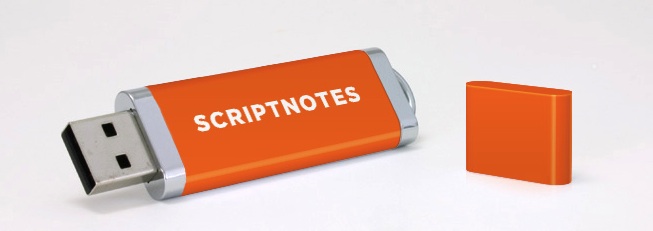
And then I remembered we effectively had. We shipped several hundred of the Scriptnotes USB drives, each loaded with the first 100 episodes of the show in both mp3 and m4a format.

scriptnotes drive

Even if LA got nuked, listeners in Prague and Peoria would be able to share these files. Craig and I actually talked about it in [Episode 103](http://johnaugust.com/2013/scriptnotes-ep-103-disaster-porn-and-spelling-things-out-transcript):

**John:** So, again, if a nuclear apocalypse happens and we’re all wiped out — or maybe zombies, it could be anything that actually wipes out all of humanity and our ability to access the internet — if you had one of these little drives and some sort of computer that was capable of reading them, like a laptop that you’re powering through some sort of pedal bicycle in a kind of Gilligan’s Island scenario, you would still be able to listen to [Scriptnotes]. And be able to follow along on the Three Page Challenge, which is I think really important as you’re rebuilding civilization. You have access to not just our words of advice but the words on the page that you can see why we were giving the notes we were giving about these Three Page Challenges.

**Craig:** I don’t know where it would fall on the hierarchy of goals, but it would probably be between procuring food and medicine.

We’re making another batch of the Scriptnotes USB drives if [you’d like to buy one](http://store.johnaugust.com/product/scriptnotes-100-episode-usb-flash-drive).

I truly believe in storing important things at other people’s houses. A good example is photos. We had all of my dad’s old photos scanned, then bought a bunch of [cheap hard drives](http://www.amazon.com/gp/product/B00834SJSK/ref=as_li_ss_tl?ie=UTF8&camp=1789&creative=390957&creativeASIN=B00834SJSK&linkCode=as2&tag=johnaugustcom-20) so we could give the whole set to relatives. It’s a kind of legacy insurance.

Google isn’t helping me find the exact quote, but in the age before refrigeration they used to say the best place to store food is in your neighbor’s stomach. If you have more than you need, throw a feast.

Podcasts aren’t parties and photos aren’t food, but sharing these assets is similarly communal — and mutually-beneficial. Often, the best backup strategy is giving it away.

Screenwriters hate cell phones

October 11, 2013 Follow Up

Back in May, I hosted a panel entitled Storytelling in the Digital Age. The Academy [posted clips](http://www.oscars.org/events/turning-page/index.html) of my discussion with the makers of Zero Dark Thirty and Star Trek Into Darkness, but I also wanted to share my introduction to the event.

And then I forgot. And then I got really busy. So here, now, is how it started.

My presentation began with a (http://www.youtube.com/watch?v=A7pT0AHsfzY), followed by some observations before I introduced my guests.

Tonight, we’re going to talk about technology. Usually when I come to see a panel about technology at The Academy, we’re discussing innovations like digital cameras and high frame rates and visual effects — we’re focussed on how we put images on the big screen.

But tonight I want to talk about how technology affects *storytelling* in movies. And this clip package is an example.

Twenty years ago, if you wanted to get a bunch of people stranded in the woods, it was pretty easy. Now these characters would almost certainly have cell phones, and as a screenwriter you have to address that. The last scene you saw there was from a movie I directed, and what Ryan Reynolds says is probably true: *It’s going to keep happening.* Technology is going to keep advancing, and our movies are going to have to change to reflect that.

It’s not just characters talking on cell phones. If I’m being honest, I don’t talk on the phone all that much. If I want to tell someone something, I text or email. And that’s really uncinematic.

We haven’t quite figured out a good way to show texting. Sometimes we’ll do a closeup on the screen of the phone, or we’ll superimpose what’s being texted on screen, like they do in the BBC version of Sherlock.

It’s not ideal. No one comes to movies to read.

We come to movies to see characters interacting with each other, doing things. And one of the things they’re often doing is trying to find out information. In a thriller, they’re trying to uncover the facts, and you send them into dark and mysterious basements. In a romantic comedy, they’re trying to find out about someone they have a crush on and wackiness ensues.

That becomes harder to do in an age of Facebook and Twitter and LinkedIn. We don’t want characters Googling things, but sometimes, that’s what they would realistically do.

Technology has changed things, and movies have had to change to reflect that.

But it’s not all bad news. Not at all.

To me, this clip package is an example what’s great. It was cut together by Zig, an editor at the Academy, inspired by a terrific 2009 [supercut by Rich Juzwiak](http://www.youtube.com/watch?v=XIZVcRccCx0).

A supercut is an amazing thing that could really only exist in a digital age. What he’s doing is going through hundreds of movies and snipping out just the parts where people’s cell phones fail them. As writers and as an audience, we might subconsciously know that characters’ cell phones get taken out of commission a lot in movies, but when you put them all together like this, it becomes blindingly obvious.

That’s one of my themes tonight. Storytelling in the digital age is about making the invisible, visible.

The challenge of filming inside a theater

October 11, 2013 Big Fish, Broadway

The [new 30-second spot](http://www.youtube.com/watch?v=1k6mdCcYpcQ&feature=youtu.be) for Big Fish features a lot of footage from the show. Filming it was much more complicated than I would have guessed, so I thought a rundown of the process would be interesting for both film and theater folk.

Because I know my way around cameras and film sets, one might assume I had my hands all over this commercial. I didn’t. I was strictly an observer.

The production team, led by David Kane, shot footage for the spot from 1pm to 4pm on Friday, September 13th, in lieu of normal rehearsal. (We had a show that night at 8pm.)

Actors wore their normal costumes, but no microphones — we didn’t want to see those little dots on foreheads, or microphone packs. The editors would be using separately-recorded audio anyway, and cutting is so quick that lip-sync isn’t a high priority.

Theater always plays in a wide shot. Video needs closeups, which means you have to rethink some things.

First, theatrical makeup is more extreme than movie makeup. Everything needed to be notched back.

Second, close-ups often require different lighting. Fortunately, modern theatrical lighting is amazing. On demand, the lighting team could bring up or dial down lights on any section of the stage. Between that and color correction, the team was able to create something that felt better than most Broadway production footage you see.

Broadway theaters are not camera-friendly. The stage is too high and too far away, plus all those rows of seats get in the way. So a huge help was the jib arm, the giant swooping apparatus the team constructed on a platform in the middle of the auditorium. With it, you can sell the feeling of meeting Karl the Giant (at :04) and keep the camera moving during ensemble dance numbers. (You can see a lot more of it in the [longer video](http://www.youtube.com/watch?v=uIdOx3xJBU8&feature=c4-overview-vl&list=PLNQf8FoGA4_LOB-UQNMZBoLNErx51rfb-) that plays out front of the Neil Simon Theatre.)

In the end, shooting a commercial for a Broadway show feels like a weird hybrid of theater and film. You’re trying to capture and edit something that by its very nature wants to be live and raw. But you also want audiences to come see your show, and commercials are a key way to do that.

« Previous Page
Next Page »

Primary Sidebar

Newsletter

Inneresting Logo A Quote-Unquote Newsletter about Writing
Read Now

Explore

Projects

  • Aladdin (1)
  • Arlo Finch (27)
  • Big Fish (88)
  • Birdigo (2)
  • Charlie (39)
  • Charlie's Angels (16)
  • Chosen (2)
  • Corpse Bride (9)
  • Dead Projects (18)
  • Frankenweenie (10)
  • Go (29)
  • Karateka (4)
  • Monsterpocalypse (3)
  • One Hit Kill (6)
  • Ops (6)
  • Preacher (2)
  • Prince of Persia (13)
  • Shazam (6)
  • Snake People (6)
  • Tarzan (5)
  • The Nines (118)
  • The Remnants (12)
  • The Variant (22)

Apps

  • Bronson (14)
  • FDX Reader (11)
  • Fountain (32)
  • Highland (75)
  • Less IMDb (4)
  • Weekend Read (64)

Recommended Reading

  • First Person (87)
  • Geek Alert (151)
  • WGA (162)
  • Workspace (19)

Screenwriting Q&A

  • Adaptation (65)
  • Directors (90)
  • Education (49)
  • Film Industry (489)
  • Formatting (128)
  • Genres (89)
  • Glossary (6)
  • Pitches (29)
  • Producers (59)
  • Psych 101 (118)
  • Rights and Copyright (96)
  • So-Called Experts (47)
  • Story and Plot (170)
  • Television (165)
  • Treatments (21)
  • Words on the page (237)
  • Writing Process (177)

More screenwriting Q&A at screenwriting.io

© 2026 John August — All Rights Reserved.