• Skip to primary navigation
  • Skip to main content
  • Skip to primary sidebar

John August

  • Arlo Finch
  • Scriptnotes
  • Library
  • Store
  • About

John

Final Draft, software and people

January 23, 2014 Rant, Screenwriting Software

On a recent episode of Scriptnotes, Craig Mazin and I discussed Final Draft 9. Short version: while I was disappointed by the update, Craig went Full Umbrage, because well…Craig.

Craig hates Final Draft — the app, and some of the company’s business practices, but not the people themselves. He doesn’t know the people. In my experience, Craig doesn’t actually hate anyone (except maybe his college roommate). Craig has strong opinions but a friendly nature.

Today I got on the phone with two of the people who run Final Draft and learned that since the episode aired, their customer service reps have gotten abusive calls and emails from listeners apparently motivated by Craig’s tirade. According to Final Draft, some of what folks were saying was so alarming that people working there felt unsafe.

That’s never acceptable. Never.

As Craig [tweeted](https://twitter.com/clmazin/status/426479055244771328) [today](https://twitter.com/clmazin/status/426479379460263936):

> clmazin: Not liking software is one thing. Making threatening or harassing calls to human beings is entirely another. It’s not cool.

> clmazin: Please don’t treat fellow human beings (many of whom are just working an hourly gig) poorly because you don’t like the company or product.

The Final Draft folks have agreed to come on a future episode so we can talk about this incident, their app, and the state of screenwriting software. I’m excited to dig in and discuss.

But I didn’t want another day to go by without making it clear that Craig and I never mean to give cover to assholish behavior.
Getting paid on time

January 22, 2014 WGA

Under the terms of the WGA minimum basic agreement, studios are required to pay screenwriters within seven days after delivery of a script (or other contracted literary material). In practice, however, studios often drag their feet. It can take months to get paid.

Today, the WGAw launched a [new initiative](http://click.email.wgaw.org/cp/onlinePreview.php?t=NDMzOHwyODIzNnxqb2huYXVndXN0QGdtYWlsLmNvbXw4MjYxNDJ8MjA5NjkxNTAwfDExMTc4NTU=&n=ghyHTi0oIvg-1117855) aimed at getting writers paid on time by focusing on talent agents.

Under the new system —

> [Agents will] voluntarily provide notice to the Guild when screenwriters deliver their literary material to the Company. Agents will be able to choose among three methods to keep the Guild informed. An agent may copy the Guild on invoices, complete a Script Delivery Notice form that is available on the Guild’s website or email the Guild at a dedicated email address.

> Once the Guild has received delivery information from an agent, the Guild will track whether the writer has been paid on time. If the agency confirms that payment was made, no further action will be taken. If payment is late, a Guild representative will contact the Company to demand the payment, including accrued interest.

We’ll see how it works in practice.

Agencies have a vested interested in getting their clients paid; ten percent of that money is theirs. But individual agents are often reluctant to complain too much about late payment because of ongoing relationships. Transferring the burden of where’s-the-money calls to the WGA may take the pressure off and get writers paid sooner.

A second possible boon: better data. By aggregating payment data, writers can get a better sense of which studios are systematically late.

As before, any WGA writer facing late pay can always contact the [Late Pay department](http://www.wga.org/ContactUs/LatePayContactUs.asp).

What it’s like to nominate movies

January 16, 2014 Awards, Film Industry

This morning, the Oscar nominations came out. Like every year, I was excited to see some of my favorite films nominated. Like every year, I was disappointed by which films — and which filmmakers — got overlooked.

Like every year, I asked myself: *How could the Academy be so bone-headed?*

The truth is, I am the Academy. I’m an Oscar voter. Two weeks ago, I logged in and submitted my nominating ballot. So I thought I’d spend a few paragraphs talking through what the mental process is like.

As a member of the Writers branch, I get to nominate films in three categories: Best Picture, Best Original Screenplay and Best Adapted Screenplay.

Let’s start with the writing categories. I often get asked whether I read all the scripts. I don’t. I couldn’t. Any given year, there are thirty to forty films that could conceivably be up for a screenplay nomination. No one reads all of them. I read the ones I’m most curious about.

I used to complain that they should retitle the screenplay awards, “Best Movie that Probably Had a Good Screenplay.” You can listen to dialogue and feel the storytelling, but you can’t really tell what was on the page.

The truth is, you could make the same argument about almost any category. “Best Performance by an Actress in a Role that was Probably Reshaped in the Editing Room.” “Best Sound Mixing — or wait, is that Sound Editing?”

In the end, you make your decision about what you saw on the screen, and hope that you’re awarding the right person.

When nominating films for writing, I’m asking myself which films had great stories and great storytelling. Which ones had incredible characters that I remember independent of the actors in the role. Which ones I really, really wish I’d written.

I don’t make a huge distinction between originals and adaptations, because every script is tough to write, no matter its source. If a screenplay is based on a great book I’ve read, I’ll be looking for what the screenwriter brought that really made it a movie.

Some movies have multiple screenwriters. I generally don’t know or care much about the backstory of who wrote what. Famously, Shakespeare in Love won best screenplay for Marc Norman and Tom Stoppard, screenwriters who didn’t work together on the project. That’s fine. We give awards for the product, not the process.

For writer/directors, I ask myself, “Does the writing merit an award independent of its direction?”

I never vote for a screenplay as a consolation prize. If I like a movie but it’s not quite Best Picture calibre, I won’t throw it a screenplay vote just to spare its imaginary feelings.

## Best Picture

Every studio wants a Best Picture nomination, so during awards season they spend a lot of money buying ads and throwing parties.

I’ve seen the ads. I’ve been to some parties. No offense to all the very hard-working publicists, but I really don’t think it influenced my choices at all.

The single most important thing for me was screeners. I try to see as many movies as I can on the big screen, but with a young kid and a Broadway show, screeners were the only way I could see some of these films. If I were a studio, I would take the money I spend on For Your Consideration ads and invest it in hand-delivering a screener to every possible voter.

For Best Picture nominations, I’m asking myself two questions:

1. Which of this year’s movies were exceptionally good?
2. Which of this year’s movies absolutely have to be on the list, because to exclude them would be madness?

The first question is about my feelings right now. Which films moved me emotionally, inspired me, impressed me? Which films constantly had me saying, “You absolutely have to see it.”

The second question imagines my future self looking at the nominations ten years from now and being bewildered that an incredibly influential movie was overlooked.

As much as possible, I want the function of Future Me to be advocating for films, not disparaging them. It’s tempting to think, “Yeah, that movie was good but in ten years no one will care.” I try not to do that. If a movie is great right now, it deserves acclaim right now. If a movie is great and future-worthy, it deserves acclaim both now and for the future.

Basically, I give a few bonus points for movies I suspect I’ll still be talking about ten years from now.

For Best Picture nominations, you rank your choices. The advantage to this system is that you can feel secure putting your top choice at the top. You’re not “wasting your vote” for something that doesn’t have a shot.

This year as I filled out my ballot, I felt confident in my choices. And I suspect most voters did. On some level, the Oscars are a [popularity contest](http://prolost.com/oscars), but I honestly believe that voters are thoughtful when making their picks.

The nominations aren’t quite what I wanted. Yet had the nominations been exactly what I wanted — had they been exactly what any one person wanted — they would have seemed bone-headed to everyone else. The inevitable result of collective list-making is that no one thinks you made the right list.

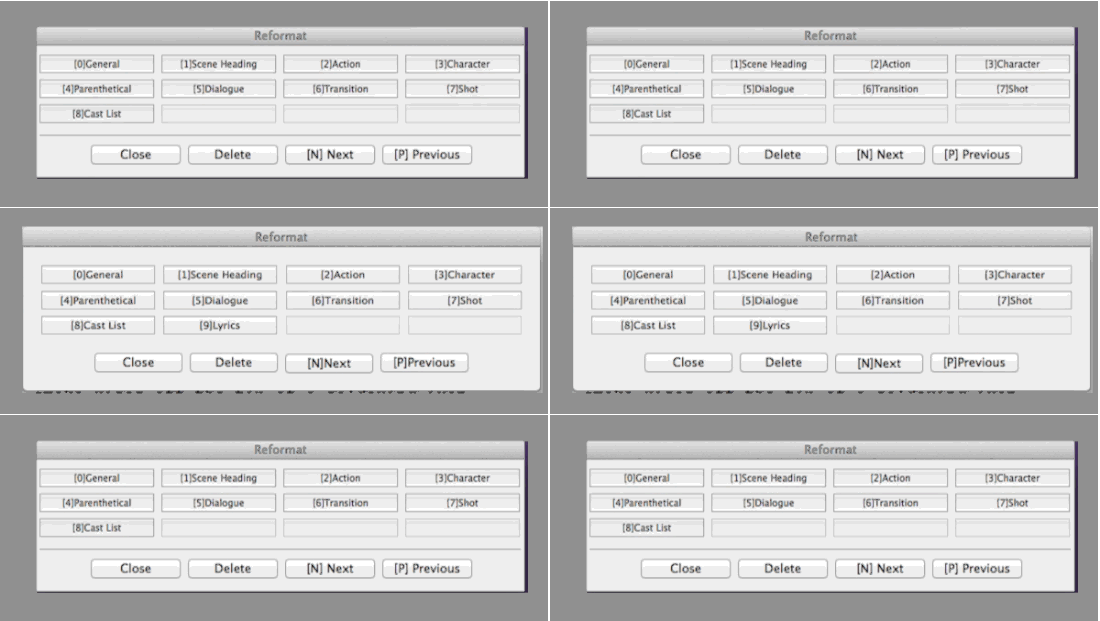
Final Draft’s Reformat dialog box

January 13, 2014 Screenwriting Software

Final Draft has long had a Reformat dialog box. I’ve long [hated it](http://johnaugust.com/2013/why-i-like-writing-in-fountain).

For Version 9, Final Draft made small revisions:
FD_reformat

Can you tell which is the old one and which is the new one?

Hint: In the new one, there’s no space between the bracketed letters.

« Previous Page
Next Page »

Primary Sidebar

Newsletter

Inneresting Logo A Quote-Unquote Newsletter about Writing
Read Now

Explore

Projects

  • Aladdin (1)
  • Arlo Finch (27)
  • Big Fish (88)
  • Birdigo (2)
  • Charlie (39)
  • Charlie's Angels (16)
  • Chosen (2)
  • Corpse Bride (9)
  • Dead Projects (18)
  • Frankenweenie (10)
  • Go (29)
  • Karateka (4)
  • Monsterpocalypse (3)
  • One Hit Kill (6)
  • Ops (6)
  • Preacher (2)
  • Prince of Persia (13)
  • Shazam (6)
  • Snake People (6)
  • Tarzan (5)
  • The Nines (118)
  • The Remnants (12)
  • The Variant (22)

Apps

  • Bronson (14)
  • FDX Reader (11)
  • Fountain (32)
  • Highland (75)
  • Less IMDb (4)
  • Weekend Read (64)

Recommended Reading

  • First Person (87)
  • Geek Alert (151)
  • WGA (162)
  • Workspace (19)

Screenwriting Q&A

  • Adaptation (65)
  • Directors (90)
  • Education (49)
  • Film Industry (489)
  • Formatting (128)
  • Genres (89)
  • Glossary (6)
  • Pitches (29)
  • Producers (59)
  • Psych 101 (118)
  • Rights and Copyright (96)
  • So-Called Experts (47)
  • Story and Plot (170)
  • Television (165)
  • Treatments (21)
  • Words on the page (237)
  • Writing Process (177)

More screenwriting Q&A at screenwriting.io

© 2026 John August — All Rights Reserved.