• Skip to primary navigation
  • Skip to main content
  • Skip to primary sidebar

John August

  • Arlo Finch
  • Scriptnotes
  • Library
  • Store
  • About

John

How do you define television?

February 18, 2014 News

House of Cards creator Beau Willimon wonders if “television” is a good word for describing what we’re seeing in [long-form storytelling](http://www.theatlantic.com/entertainment/archive/2014/02/is-em-house-of-cards-em-tv/283805/):

> If you start thinking, well a TV show is a half-hour to an hour long and it’s in chunks, and a [movie] is an hour to two hours and it has a beginning, middle, and end and then it’s done—those are pretty weak definitions, right? It really just comes down to formal, structural things. It’s like if I said to you there’s no fundamental difference between a sonnet and a haiku. Like, they have different meter structures. But they’re both poems. They’re both trying to express something. The words within them don’t know that they’re a haiku or a sonnet. If a television show has an episode that is 90 minutes long, could that episode in itself constitute a film? And what if you have a movie that’s 45 minutes long? We typically call that a short. But how different is that than a standalone episode of TV?

I’d argue that the Marvel franchise is essentially a mega-budget series. Both narratively and financially, these movies are designed to fit together in a way that’s unusual for something not based on a book like Harry Potter or The Hunger Games. The actors who signed on to Marvel committed to far more films (episodes) than typical.

Willimon says the biggest freedom he felt with House of Cards wasn’t the length of the episodes, but the length of the run:

> There are still certain fundamental parameters. Our show still generally has to be around an hour because we still sell internationally to networks that will traditionally air it week-to-week with commercials sometimes. But I didn’t think about commercials or act breaks or anything like that.

> I guess the biggest thing that affected the writing of our show was not releasing all 13 [episodes] at once—we didn’t know we were going to do that until about halfway through production of Season One. It was always a possibility, but a traditional week-to-week release was a possibility as well. So were other permutations between those two extremes. The biggest thing was knowing we had two seasons guaranteed. Because it meant I could think about something layered in early in Season One that might not boomerang back till the end of Season Two. It meant a much broader canvas, and not having to force arbitrary cliffhangers or frontload Season One for the sake of jacking ratings for the fight for one’s survival. It makes you think about story in a totally different way.
The trap of being good at something

February 14, 2014 Psych 101

Megan McArdle wonders if procrastination stems largely from a [fear of failure](http://www.theatlantic.com/business/archive/2014/02/why-writers-are-the-worst-procrastinators/283773/):

> Over the years, I developed a theory about why writers are such procrastinators: We were too good in English class. This sounds crazy, but hear me out.

> Most writers were the kids who easily, almost automatically, got A’s in English class. […] At an early age, when grammar school teachers were struggling to inculcate the lesson that effort was the main key to success in school, these future scribblers gave the obvious lie to this assertion. Where others read haltingly, they were plowing two grades ahead in the reading workbooks. These are the kids who turned in a completed YA novel for their fifth-grade project. It isn’t that they never failed, but at a very early age, they didn’t have to fail much; their natural talents kept them at the head of the class.

I’ve seen this in myself and my daughter: when something is comparatively easy, it’s bewildering when it gets difficult.

With age, we begin to realize that everything we write isn’t perfect. Most of it isn’t even good. Procrastination becomes self-defense. The scene you haven’t written yet can’t be terrible.

Long takes and realism

February 12, 2014 Directors, Education

Last night, I had the pleasure of hosting a Q&A with Alfonso Cuarón for Film Independent, part of a [five-week series](http://www.filmindependent.org/event/directors-close-up-2014/#.Uvv5SXnZdBU). I looked at it as an opportunity to get all my questions answered from a longtime talent crush — and if people wanted to listen in, swell.

Between clips, we talked about music and color and collaboration. I also wanted to know about Cuarón’s lengthy, technically-sophisticated shots.

Even before Gravity, Cuarón was known for very long takes. Children of Men has a stunning car sequence that plays like one continuous moment, and a wide shot with Michael Caine that continues for quite a long scene.

But it’s not showing off, and it’s not just because he has access to great technology and master technicians. Watching clips from the much more down-and-dirty Y Tu Mamá También, it’s clear that Cuarón loves these uncut scenes regardless of the genre or budget level.

So I asked him why.

His answer spoke to the relationship of the character and the environment. It was a revelation for me. I suspect the audience could see the lightbulb over my head.

So what I’m about to say isn’t quite what Cuarón said, but my reaction to what he said.

###Foreground and background

In film, whenever you cut, the audience has to re-establish where the character is in relationship to the environment. Sometimes you’re cutting to a new location, a new scene, so that re-establishing is significant. But even if you’re just cutting within a scene, the character’s relationship to the background is different. There’s a (subconscious) process of figuring out where Kathy is in the space, and her relationship to it.

It’s unnatural — in real-life, things aren’t jumping around — but audiences have gotten really good at handling it. We’re all sophisticated viewers now, so many of the old rules about cutting are less crucial than they used to be. We can cut fast. We can jump cut. We can cross the line. Aggressive cuts have given us some of the most thrilling sequences in cinema.

Cutting is a powerful tool. But it has a cost, too.

Think of it from the audience’s perspective: each cut requires us to find our character against the background. It’s not a huge burden, but it’s work. If there’s a lot of cutting, we prioritize the character and start paying less attention to the background. We don’t explore the setting because we’re worried we’re going to miss what the characters are doing. The Who is almost always more important than the Where.

But in a long take, we can shift our focus from the character to the background and back again. We can notice things we otherwise wouldn’t. Scenes shot in long takes feel “more real” not just because of the continuity of time and performance, but also because we have the time to really invest in the backgrounds.

In the case of Gravity, most of those backgrounds are completely computer-generated, which is testament to just how good Cuarón’s work is. Space in Gravity feels so real in part because we get to see it in such long stretches. And because it feels so real, we invest even more deeply in Bullock’s performance and the reality of her predicament. We believe that she — and we — are really there. The long takes are a huge part of why.

Most of us won’t be making movies in space, but it’s a lesson I’ll be taking with me. I love the power of a cut, but I’ll always ask what could be gained by not cutting.

Introducing Weekend Read

February 11, 2014 Apps, FDX Reader, Fountain, Highland, News, Weekend Read

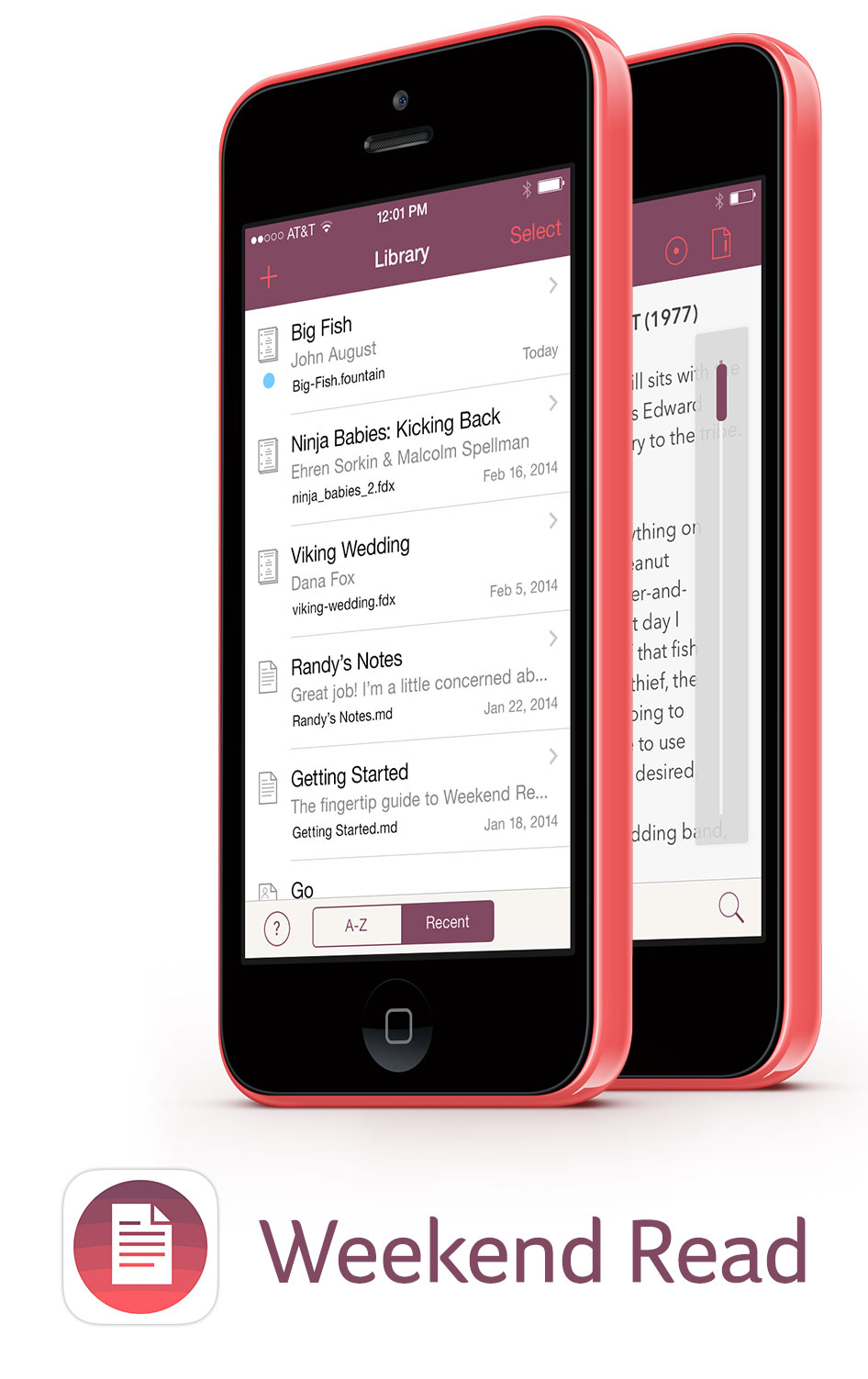
[product photo](http://highland.quoteunquoteapps.com/wr-blog)We have a new app. It’s called [Weekend Read](http://quoteunquoteapps.com/weekendread). It’s for reading scripts on your iPhone.
It’s [free in the App Store](http://highland.quoteunquoteapps.com/wr-blog).

Up until now, reading screenplays on an iPhone has been *terrible.* It’s all squinting and pinching.

Weekend Read takes screenplay PDFs, Final Draft and Fountain files and reformats them to look terrific on your iPhone.

Weekend Read is only for the iPhone.

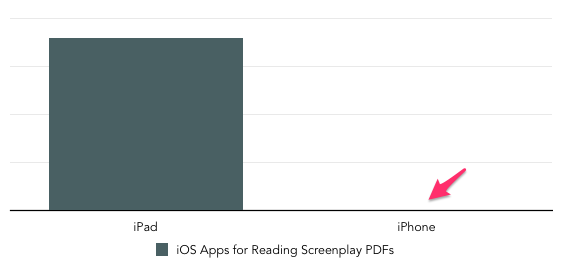
Why only the iPhone, and not the iPad? Numbers.

chart

Our sophisticated market analysis revealed that there were zero good apps in this category.

###New yet familiar

If you’re acquainted with our other apps, you may be saying, “Well, it sounds like they took the ‘reader’ part of [FDX Reader](https://itunes.apple.com/us/app/fdx-reader/id437362569?mt=8) and the PDF-melting parts of Highland and put them together in one app.”

You’re right. That’s exactly what we did.

But we didn’t stop there. We built in search, new fonts, Dark Mode, a new page jumper, character highlighting and full-screen mode.

We added Fountain and Markdown, including images.

And because a reader needs something to read, we beefed up Dropbox support and gave users a hand-curated (and continually-updated) list of For Your Consideration scripts and Project Gutenberg titles.

The Weekend Read library holds four scripts at a time. If you choose, you can unlock the app to store hundreds. It’s a single in-app purchase.

###The present and the future

**(updated 2/12/2014)** We launched yesterday afternoon. The response has been terrific. We shipped more copies of Weekend Read in twelve hours than we did of FDX Reader in its whole life.

We didn’t nudge people to leave reviews on the App Store, but a lot of users chose to. Thank you.

A couple of common questions on Twitter:

**”Why hasn’t someone done this before?”**

We actually tried to. The hardware just wasn’t fast enough. ((The iPhone 4 is still debatably not fast enough. One advantage to making the app free is that users can decide for themselves whether the lag is acceptable.)) So we owe a huge debt to Apple and all the clever silicon engineers who make it possible to build apps like ours.

**”Can you make an Android or Kindle version of Weekend Read?”**

Unfortunately, no. Weekend Read relies on a lot of special iOS 7 stuff, and shares quite a bit of code base with Highland for Mac. We’d have to start from zero to make an Android version, and that would pull us away from all our current products.

**”Could you add notes?”**

We could. At a certain point, we had to decide where to stop for version 1.0.

Every feature you add has the potential to increase complexity in a way that compromises the purpose of the app. So I want to make sure that if we add notes, they feel just right.

**”Will this free-then-upgrade business model work?”**

We’ll see. For me, it was important that users have the chance to try Weekend Read with their own scripts. Happy users are likely to keep using Weekend Read, and many will eventually decide it’s worth it to pay for the bigger library.

But if they don’t — if they keep deleting files to stay under the limit — that’s okay too. My goal with Weekend Read was to make the experience of reading scripts on the iPhone better. Emotional profits are worth something, too.

###Speak up

We already have David Wain, Rawson Thurber and Dan Etheridge singing Weekend Read’s praises, but I’m actively seeking one more blurb.

So if you like the app, tweet a blurb with the hashtag [#WeekendRead](http://twitter.com/home?status=%23WeekendRead). Over the next few days, I’ll be picking out my favorites to add to the official [App Store description](http://highland.quoteunquoteapps.com/wr-blog).

To celebrate Weekend Read’s launch, we’re also offering [Highland at 50% off through Friday](http://highland.quoteunquoteapps.com/highland-fifty-percent). Now that you have an app for reading Fountain files, it’s time to start writing them.

« Previous Page
Next Page »

Primary Sidebar

Newsletter

Inneresting Logo A Quote-Unquote Newsletter about Writing
Read Now

Explore

Projects

  • Aladdin (1)
  • Arlo Finch (27)
  • Big Fish (88)
  • Birdigo (2)
  • Charlie (39)
  • Charlie's Angels (16)
  • Chosen (2)
  • Corpse Bride (9)
  • Dead Projects (18)
  • Frankenweenie (10)
  • Go (29)
  • Karateka (4)
  • Monsterpocalypse (3)
  • One Hit Kill (6)
  • Ops (6)
  • Preacher (2)
  • Prince of Persia (13)
  • Shazam (6)
  • Snake People (6)
  • Tarzan (5)
  • The Nines (118)
  • The Remnants (12)
  • The Variant (22)

Apps

  • Bronson (14)
  • FDX Reader (11)
  • Fountain (32)
  • Highland (75)
  • Less IMDb (4)
  • Weekend Read (64)

Recommended Reading

  • First Person (87)
  • Geek Alert (151)
  • WGA (162)
  • Workspace (19)

Screenwriting Q&A

  • Adaptation (65)
  • Directors (90)
  • Education (49)
  • Film Industry (489)
  • Formatting (128)
  • Genres (89)
  • Glossary (6)
  • Pitches (29)
  • Producers (59)
  • Psych 101 (118)
  • Rights and Copyright (96)
  • So-Called Experts (47)
  • Story and Plot (170)
  • Television (165)
  • Treatments (21)
  • Words on the page (237)
  • Writing Process (177)

More screenwriting Q&A at screenwriting.io

© 2026 John August — All Rights Reserved.