• Skip to primary navigation
  • Skip to main content
  • Skip to primary sidebar

John August

  • Arlo Finch
  • Scriptnotes
  • Library
  • Store
  • About

Archives for 2014

On trust, drama and corporations

August 20, 2014 Psych 101, Words on the page

The project I’m writing centers on trust. The more I think about the word and the concept of trust, the more complicated it becomes.

Most definitions of trust contain some combination of “confidence” and “reliability,” both of which often include trust in their own entries. Circular definitions are not especially helpful, so let’s try to pull them apart.

**Confidence** is an inner conviction, a firmly-held belief often (but not always) supported by facts or prior experience. *I have confidence that it will not rain today, because it’s below zero outside.*

**Reliability** is the quality of being able to depend on something to consistently perform as expected. *They’re expensive, but the reliability of these hard drives is unmatched.*

Combining these two ideas, we can arrive at a pretty good definition of trust:

**Trust is confidence in the reliability of someone or something.**

Or, in longer form:

**Trust is the inner conviction that someone (or something) will do what you expect.**

When you look at trust this way, you see several fascinating characteristics:

1. Trust is something internal, a personally-held belief.
2. The focus of trust is something external. ((In a phrase like, “trust my own eyes,” the eyes are not the person speaking. Even in phrases like, “trust yourself,” it’s still a transitive verb. I’d argue the “you” you’re supposed to trust is a projection of an idealized person.))
3. The focus of trust is something that can take its own actions. You can trust your neighbor or your dog. But it’s weird to talk about trusting a chair or a newborn. ((Can you trust a robot or a zombie? The answer depends on the degree to which you believe it’s making its own decisions. If it’s just following its coding or brain-chomping instincts, the best you can do it predict it, not trust it.))
4. Trust is a prediction about the future. Even in the past tense, it’s referring to the then-future: “I trusted him, but then he slept with a barrista.”

Trust has many thematic cousins — faith, hope, belief, honor — all of which can be explored in fiction. But for the screenwriter, trust is better.

### Trust is dramatic.

Trust works well on screen because it’s about a relationship between two characters, and can be explored with actions rather than just words.

The rival soldiers who find themselves stranded behind enemy lines? Trust.

The husband whose wife snoops through his email? Trust.

[The scorpion and the frog](http://en.wikipedia.org/wiki/The_Scorpion_and_the_Frog)? Trust. ((And overdone. Can we please stop referencing the scorpion and the frog?))

Like faith, hope, belief and honor, there’s an internal aspect to trust, but it manifests outwardly. You don’t just trust; you trust someone. And the process of one character growing to trust another character lends itself to interesting scenes and conflicts. Often, late-story actions reveal whether that trust was well-placed.

We often speak of trust when it’s broken. Or shattered. Or destroyed. Worth noting: when we lose trust in someone, it’s rarely described gently. It’s almost always smashy and violent. In fact, we often discuss trust using crystalline metaphors:

> Trust is like a mirror, you can fix it if it’s broken, but you can still see the crack in that motherfucker’s reflection. (Lady Gaga, Telephone)

Trust means drama.

### Impersonal trust, and corporate anthropomorphization

Trust is also supposedly at the heart of the [sharing economy](http://www.wired.com/2014/04/trust-in-the-share-economy/) we live in, but what does it mean to trust Facebook, or Amazon, or Uber?

In the case of Uber and Lyft, the companies have a human face: the driver who picks you up. You have a pact of unspoken trust between you. You trust the driver to deliver you to your destination; she trusts you not to vomit in the back seat. ((My last Uber had paper bags, much like you’d find in airplane seatbacks, ready for drunken Saturday night customers.)) Both of you trust the service to handle all the money details.

But with Amazon or Google, there’s no person in front of you to trust or distrust. When Stuart says he “trusts Google Maps,” what is he actually trusting?

I’d argue he’s trusting an anthropomorphized entity he’s created in his head. He’s already granting it a sort of consciousness: “Google Maps wants me to take the 10, but that’s crazy, right?”

The Supreme Court was criticized for [recent decisions](http://en.wikipedia.org/wiki/Burwell_v._Hobby_Lobby) that treated corporations like individual persons, but the truth is we do it all the time. It’s a useful shorthand (“Apple fears Android growth”), and allows us to distinguish the employees of a corporation from the corporation itself. “I admire the engineers at Google, but not Google.”

And we’ve always done it with countries. (“France wants a carbon tax.”)

In personifying abstractions like countries and corporations, we’re able to talk about whether we trust them. But I’m not sure that’s a good thing overall.

Maybe if we looked at them for what they are — a collection of moving pieces, more like a swarm than a single entity — we’d be more prudent. Can you trust something that is constantly changing and reassembling itself?

That’s a good dramatic question. I call dibs.
Less IMDb gets unbroken

August 19, 2014 Apps, Less IMDb

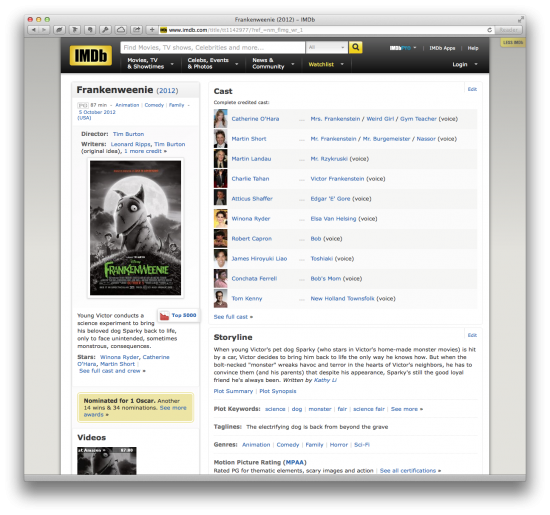
We love IMDb, but man, there’s a lot of clutter on those pages. That’s why one of our very first coding projects was [Less IMDb](http://johnaugust.com/2010/less-imd), a browser extension that rearranges IMDb pages to emphasize credits and minimize everything else.

screen shot

For the past four years, Less IMDb sat in the righthand margin, quietly doing its job. Occasionally it would encounter an odd IMDb page that didn’t play nicely — often a themed page with oversized ads — but for the most part it worked as intended.

Then last month Less IMDb broke altogether. So Ryan Nelson dusted off the code and got it working again.

The Safari version of Less IMDb has been updated to 1.3.1 and is available [here](http://quoteunquoteapps.com/less-imdb). He’s working on the Chrome version now.

Unfortunately the auto-updaters for both Safari and Chrome won’t work properly, so you have to download and install it yourself.

For best results, uninstall your existing version of Less IMDb first. (After all, you don’t want More Less IMDb.)
You can find it in Preferences > Extensions.

Then [download the new one](http://quoteunquoteapps.com/less-imdb) and follow the instructions. (There is also a (https://www.youtube.com/watch?v=Nv0A5XUOpBg).)

What’s New:

– The sidebar is back when Less IMDb is turned on.
– Fixed formatting of release date, genre, and runtime information.
– Added retina display support to Less IMDb controller icon.
– Fixed bug that hid ratings even when Less IMDb was set to off.
– Changed extension permissions to allow Less IMDb to run on any subdomain for better international support.
– Fixed bug that prevented video from playing.
– Fixed bug that prevented ratings from working.
– Future versions will automatically update once 1.3.1 is installed.

Known issues and notes:

– Older versions of the extension will not automatically update to the latest version, and should be deleted before using the updated extension.
– Pages with heavily-branded content may look funky, particularly those using dark backgrounds.
– Photos and video thumbnails don’t always load when Less IMDb is turned on.
– Apple’s Safari Extension gallery doesn’t yet link properly.
– The Less IMDb page is old and FAQ is out of date (update coming).

Once Ryan get the Chrome version finished, we’ll be open-sourcing the whole project. We’d love for coders to springboard off what we’ve done to build a Firefox version, for example, or incorporate it into some of new WebKit goodness announced for Yosemite.

Less IMDb continues to be a useful little utility, something you don’t notice until it’s gone. If you haven’t tried it, [give it a shot](http://quoteunquoteapps.com/less-imdb).

Putting a price on it

Episode - 158

Go to Archive

August 19, 2014 Film Industry, Follow Up, QandA, Scriptnotes, So-Called Experts, Transcribed

From Amazon to animation, there’s drama this week about prices for books and movies and even internships. John and Craig take a look at what happens when companies wrestle over how much things cost, and the effect it has on people trying to make a living as writers.

We recorded this episode with a live audience listening in online. It went well enough that we’ll try to do it occasionally.

Craig won’t be able to make to this year’s Austin Film Festival, but never fear: Kelly Marcel will take his place at the live Scriptnotes show.

Links:

* This episode was broadcast live [on Mixlr](http://mixlr.com/scriptnotes/)
* Come see Scriptnotes live with John and Kelly at the [Austin Film Festival](http://www.austinfilmfestival.com/)
* Brian Koppelman’s The Moment Podcast [with guest Craig Mazin](http://grantland.com/hollywood-prospectus/the-moment-podcast-brian-koppelman-and-craig-mazin/)
* [Sparknotes: Goodnight Moon](http://www.mcsweeneys.net/articles/sparknotes-goodnight-moon) on McSweeney’s
* Slate on [How Gobbledygook Ended Up in Respected Scientific Journals](http://www.slate.com/blogs/future_tense/2014/02/27/how_nonsense_papers_ended_up_in_respected_scientific_journals.html)
* Christopher Wright [on Amazon vs Hachette](https://www.eviscerati.org/articles/2014/08/Amazon-v-Hatchette-Everyone-Wrong-Me), and Dave Bryant’s follow up [on the true costs of publishing a book](http://dave-bryant.livejournal.com/21544.html)
* John’s blog post on how [no one cares about manufacturing costs](http://johnaugust.com/2014/no-one-cares-about-manufacturing-costs)
* LA Times on [Amazon vs Disney](http://www.latimes.com/business/la-fi-amazon-disney-20140811-story.html)
* The Weinstein Company is [auctioning off an internship for charity](https://www.charitybuzz.com/catalog_items/597305)
* [Court docs show role of Pixar and Dreamworks Animation in Silicon Valley wage-fixing cartel](http://pando.com/2014/07/07/revealed-court-docs-show-role-of-pixar-and-dreamworks-animation-in-silicon-valley-wage-fixing-cartel/)
* The Anonymous Production Assistant’s Crew Call Podcast [with guest Stuart Friedel](http://www.anonymousproductionassistant.com/2014/07/31/personal-assistant-stuart-friedel/)
* Robin Williams’s obituary from [The New York Times](http://www.nytimes.com/2014/08/12/movies/robin-williams-oscar-winning-comedian-dies-at-63.html?_r=0)
* The [National Suicide Prevention Lifeline](http://www.suicidepreventionlifeline.org/) and [National Alliance on Mental Illness](http://www.nami.org/)
* [Outro](http://johnaugust.com/2013/scriptnotes-the-outros) by Scriptnotes listener Brian Shane ([send us yours!](http://johnaugust.com/2014/outros-needed))

You can download the episode here: [AAC](http://traffic.libsyn.com/scriptnotes/scriptnotes_ep_158.m4a) | [mp3](http://traffic.libsyn.com/scriptnotes/scriptnotes_ep_158.mp3).

**UPDATE 8-22-14:** The transcript of this episode can be found [here](http://johnaugust.com/2014/scriptnotes-ep-158-putting-a-price-on-it-transcript).

Texting in film and television

August 18, 2014 Follow Up, Television, Words on the page

Craig and I may have [taken umbrage](http://johnaugust.com/2014/scriptnotes-ep-147-to-chase-or-to-spec-transcript) at his video about comedy directors who aren’t Edgar Wright, but Tony Zhou’s [newest video](http://vimeo.com/103554797) looking at how filmmakers handle texting and the internet on-screen is all good.

Zhou’s underlying point is that we still haven’t settled on conventions for showing texting or the internet. And that’s good! Filmmakers can and should experiment to see what works best for their needs.

In ten years, some of our choices will look quaint and foolish, but that’s the fun and challenge of making new things.

« Previous Page
Next Page »

Primary Sidebar

Newsletter

Inneresting Logo A Quote-Unquote Newsletter about Writing
Read Now

Explore

Projects

  • Aladdin (1)
  • Arlo Finch (27)
  • Big Fish (88)
  • Birdigo (2)
  • Charlie (39)
  • Charlie's Angels (16)
  • Chosen (2)
  • Corpse Bride (9)
  • Dead Projects (18)
  • Frankenweenie (10)
  • Go (29)
  • Karateka (4)
  • Monsterpocalypse (3)
  • One Hit Kill (6)
  • Ops (6)
  • Preacher (2)
  • Prince of Persia (13)
  • Shazam (6)
  • Snake People (6)
  • Tarzan (5)
  • The Nines (118)
  • The Remnants (12)
  • The Variant (22)

Apps

  • Bronson (14)
  • FDX Reader (11)
  • Fountain (32)
  • Highland (73)
  • Less IMDb (4)
  • Weekend Read (64)

Recommended Reading

  • First Person (87)
  • Geek Alert (151)
  • WGA (162)
  • Workspace (19)

Screenwriting Q&A

  • Adaptation (65)
  • Directors (90)
  • Education (49)
  • Film Industry (489)
  • Formatting (128)
  • Genres (89)
  • Glossary (6)
  • Pitches (29)
  • Producers (59)
  • Psych 101 (118)
  • Rights and Copyright (96)
  • So-Called Experts (47)
  • Story and Plot (170)
  • Television (165)
  • Treatments (21)
  • Words on the page (237)
  • Writing Process (177)

More screenwriting Q&A at screenwriting.io

© 2026 John August — All Rights Reserved.