• Skip to primary navigation
  • Skip to main content
  • Skip to primary sidebar

John August

  • Arlo Finch
  • Scriptnotes
  • Library
  • Store
  • About

Archives for 2011

Get a manager

May 31, 2011 Film Industry, First Person

[Justin Marks](http://www.imdb.com/name/nm1098479/) is a screenwriter who has worked on feature films ranging from the geek-driven to the way-too-serious. I first met him on the Film France [trip to Paris](http://johnaugust.com/2008/paris-days-1-and-2) in 2008, when his career was in its early stages.

Last week, Justin [tweeted](https://twitter.com/#!/Justin_Marks_/status/73791695103332352):

> Protip: Get a manager. A great manager. The best manager. It’s the difference between having a career and having no career.

> On that last note: there are pros who disagree with me. But they came up in a different generation. So be mindful of that.

I mildly disagree, but: I came up in a different generation. I may be wrong. It’s entirely possible that the experience I had coming of age as a screenwriter in the late 90s is enough different that some of my reflex opinions (e.g. managers are useless) should be questioned. I asked Justin to write up his experiences and opinions. He has has graciously agreed.

You can follow Justin on Twitter [@justin_marks_](https://twitter.com/#!/Justin_Marks_).

——-

first personjustin marksHello, my name is Justin Marks, and I’m a working screenwriter.

Feels great to say, doesn’t it? It’s not the kind of job description that happens overnight. It was born of more than a decade of frustration and hard work. Good scripts and bad scripts. Good advice and bad advice. Good days and bad days. Easily the most satisfying and unnerving years of my life.

But when exactly did I become a screenwriter? Was it the first time I wrote a screenplay? The first time I got paid to do it?

No.

For me, the moment I became a screenwriter was when I met my manager. He taught me the fundamentals -– how to build a career in a competitive and at times impossibly frustrating business.

Which is why, with John’s permission, I’d like to speak about this thorny issue of literary managers.

So let me come out and say it: if you want to make it in today’s business, I believe you need a manager. It’s as simple as that.

Strangely, among the community of established writers, you’re not likely to find a strong consensus on this topic. Opinions range everywhere from “they’re awesome” to “what kind of moron are you for giving up ten percent to someone who does nothing?” And while I won’t pretend to be some kind of ultimate authority on the issue, I think my insight can be particularly helpful to other young writers looking for a way to get their start.

Here’s the thing about the writers who say you don’t need a manager: chances are they “broke in” during a very different era. As early as five years ago, there were better DVD sales, a writers’ strike that hadn’t yet happened, and far more studios willing to spend far more money on the development of scripts.

Today, not so much. There are fewer screenwriters being paid to do what they do. Even if you’re an established writer, it means doing a lot more work for free, competing with a lot more writers for assignments, and accepting significantly less than your quote for the assignments you get.

And if you’re not yet an established writer…oh boy. The window of entry has narrowed to a pinhole, and your margin for error is nearly non-existent. Write a bad script, slip it to the studios, and your name will be in that computer system for years to come. Every time someone looks you up, you’ll have the stink of negative coverage tied to your name. It puts ever-more precedence on starting with your best foot forward.

Not to mention the agent issue. Say you’re lucky enough to score one. Congrats! They’ll look out for your best interests, right? Sure. There are great agents out there. But they’re also looking out for the best interests of a thousand other clients their agency now represents –- the result of mergers necessitated by the shrinking job market.

How do you get the attention you need when your agent has to handle hundreds of phone calls from dozens of clients, many of whom are competing with you for the same job?

Enter the manager.
—–

A lot of people wonder what a manager does. After all, an agent gets you jobs. A lawyer negotiates them. So who is this other strange person collecting ten percent in the middle of all that?

Let me answer your question by telling you what my manager does. Or rather, what he did to get me where I am.
[Read more…] about Get a manager
We made an app

May 24, 2011 FDX Reader, News

fdx reader iconBack when the iPad was first announced, I [predicted](http://johnaugust.com/2010/how-screenwriters-will-use-the-ipad) it would become the go-to device for reading screenplays. That’s proven correct.

Most agents and execs I know have one. The weekend read, which used to involve heavy stacks of printed scripts, is now digital. The iPad is good for a lot of things, but it’s great for reading screenplays.

Correction: It’s great for reading *other people’s screenplays.*

If you’re a screenwriter working on your own stuff, the iPad can be frustrating.

Thanks to Dropbox and Mail, the iPad will let you *see* the script files you’re working on. That revision your writing partner just emailed you? It’s there, attached to the message. You just can’t *read* it. Same for all those drafts in Dropbox. They’re tantalizingly close, but inaccessible unless you first remember to convert them to PDFs on your computer.

It shouldn’t be this way.

We need an app that lets you read Final Draft files on the iPad. So my compatriots and I made one.

Does what it says on the tin
—-

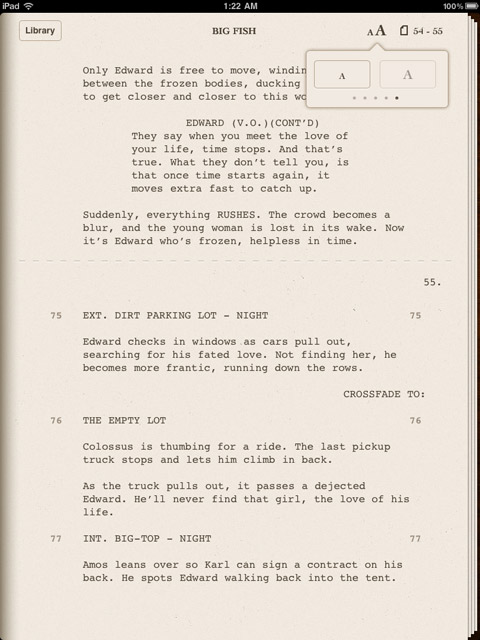
FDX Reader lets you open Final Draft (.fdx) files, and makes them look nice. It’s not an editor. It’s just a reader, like iBooks or the Kindle app.

big fish page

It’s [available in the App Store now](http://itunes.apple.com/us/app/fdx-reader/id437362569?mt=8&ls=1).

FDX Reader is a collaboration between me, [Nima Yousefi](http://nimayousefi.com) and Ryan Nelson. Beta testers have been kicking it around for the last two months, and have found it really useful.

Rob Thomas, creator of Veronica Mars, Cupid and Party Down:

> I throw all my active script files into Dropbox already, so FDX Reader is incredibly convenient. For me, two steps have been eliminated: conversion to PDF and syncing those files to my iPad. My active scripts will always be available now.

> I read a hundred scripts this staffing season, and they were all PDFs. Sure, I’m able to read them on my iPad, but without the ability to change type-size, I find the print is slightly too small for me to be totally happy. Life would’ve been much better if I’d had this app.

We’ve incorporated a lot of feedback from film and television writers, such as a new UI for act breaks. We have a lot of ideas for the future, but the app fits a real need right now.

You can find out a lot more information about the app — including a video with me and a special guest — at the [official site](http://fdxreader.com).

Watch this space

May 23, 2011 News

Something new is coming tomorrow today.

sneak peek

blur

woodgrain

The only ache should be in your soul

May 19, 2011 QandA, Writing Process

questionmarkI write six days a week, four hours a day. I’m putting together a portfolio for when I move out to L.A. next year. I’ve finished a musical comedy, am in the middle of a comedy drama, and have two children’s films outlined and in the queue. (One of which I’ve already written as a 35,000 word children’s novel.) So I’m on a surprisingly strict writing schedule considering I have no “real” deadlines.

My question to you is: Do your hands hurt?

Mine definitely ache. I stretch and ice them and beg for hand massages from friends and loved ones. I take ibuprofen, etc. I’m trying to determine if this is normal or if I should be freaking out?

Athletes live with a certain amount of pain for what they love. Same for professional writers?

Do you do anything special to take care of your hands?

— Asher Noël

answer iconTake it seriously. I’ve had problems in the past, and regretted waiting as long as I did to do something about it.

At my worst, not only would my hands hurt, my arms would go dead every night. Beyond pins-and-needles. I’d wake up with zombie appendages attached to my body. I’d have to flop over to get blood flowing into them.

I’m better now.

A Google search on ergonomics or carpal tunnel syndrome will give you a ton of information — too much information, probably — but I can synthesize it down for you thusly:

1. __You need to check your setup.__ Feet on the floor, arms at a comfortable 90-or-so degrees. I strongly believe in arm rests, but different things work for different people. Your typing surface probably needs to be a lot lower than you think. My desk lowers to just two inches above my knees. Everyone has different opinions on chairs. I’ve found the expensive ones aren’t necessarily better. Try a bunch.

2. __You need to change your keyboard.__ I use [this one](https://www.amazon.com/SafeType-Keyboard-Black-Color-V902/dp/B0049PFYWQ/ref=cm_cr_arp_d_product_top?ie=UTF8), which rightfully scares people, but I find works great. You may need to try a bunch of different ergonomic keyboards before you find one that works.

3. __You need to take breaks.__ A lot of them. Walk around. You’ll actually get more done if you’re not staring at the screen the whole time.

4. __Like crutches, gloves can help, but they’re not fixing the problem.__ These [Handeze support gloves](http://www.amazon.com/gp/product/B00009LI88/ref=as_li_ss_tl?ie=UTF8&tag=johnaugustcom-20&linkCode=as2&camp=217145&creative=399349&creativeASIN=B00009LI88) saved my life, but I’m happy not to need them now.

When it was really bad, I considered surgery. I’m glad I didn’t do it. I didn’t need it.

You won’t always be writing as much as you are now. But try to get into good habits now.

« Previous Page
Next Page »

Primary Sidebar

Newsletter

Inneresting Logo A Quote-Unquote Newsletter about Writing
Read Now

Explore

Projects

  • Aladdin (1)
  • Arlo Finch (27)
  • Big Fish (88)
  • Birdigo (2)
  • Charlie (39)
  • Charlie's Angels (16)
  • Chosen (2)
  • Corpse Bride (9)
  • Dead Projects (18)
  • Frankenweenie (10)
  • Go (29)
  • Karateka (4)
  • Monsterpocalypse (3)
  • One Hit Kill (6)
  • Ops (6)
  • Preacher (2)
  • Prince of Persia (13)
  • Shazam (6)
  • Snake People (6)
  • Tarzan (5)
  • The Nines (118)
  • The Remnants (12)
  • The Variant (22)

Apps

  • Bronson (14)
  • FDX Reader (11)
  • Fountain (32)
  • Highland (73)
  • Less IMDb (4)
  • Weekend Read (64)

Recommended Reading

  • First Person (87)
  • Geek Alert (151)
  • WGA (162)
  • Workspace (19)

Screenwriting Q&A

  • Adaptation (65)
  • Directors (90)
  • Education (49)
  • Film Industry (489)
  • Formatting (128)
  • Genres (89)
  • Glossary (6)
  • Pitches (29)
  • Producers (59)
  • Psych 101 (118)
  • Rights and Copyright (96)
  • So-Called Experts (47)
  • Story and Plot (170)
  • Television (165)
  • Treatments (21)
  • Words on the page (237)
  • Writing Process (177)

More screenwriting Q&A at screenwriting.io

© 2026 John August — All Rights Reserved.