• Skip to primary navigation
  • Skip to main content
  • Skip to primary sidebar

John August

  • Arlo Finch
  • Scriptnotes
  • Library
  • Store
  • About

Archives for 2009

How I Became a Famous Novelist

August 4, 2009 Books, News

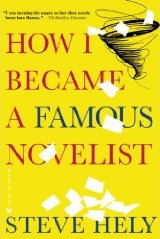
book cover
Add this book to your late-summer reading: How I Became a Famous Novelist,
by Steve Hely. It’s fast, funny, and will likely become the next movie I write and direct.

Here’s the official press release, with additional commentary:

> LOS ANGELES, CA (August 3, 2009) – Filmmaker John August has optioned How I Became a Famous Novelist by Steve Hely through his company Quote-Unquote Films. August optioned the hilarious novel with an eye to adapt and direct. The novel, published by Grove/Atlantic, has garnered excelled reviews across the board and was Amazon’s July 2009 title of the month.

The great reviews include one by [Janet Maslin in the NY Times](http://www.nytimes.com/2009/07/13/books/13maslin.html), who quotes so many funny lines from the book that you might worry she’s spoiling it. She isn’t. She can’t.

Hely’s book has an unbelievably high joke-to-page ratio, the literary equivalent of a 30 Rock episode. (Which seems fitting, since Hely is now a writer on that show.)

> The book tells the story of Pete Tarslaw, an ambitiously underachieving college grad who writes a shamelessly maudlin and derivative Great American Novel for the sole purpose of upstaging his ex-girlfriend’s wedding. When the book becomes a bestseller, he finds himself sucked into a strange coterie of mega-authors and their attendants.

I wrote that summary, but it omits something that makes reading the book so worthwhile: excerpts from all the other mega-authors’ books, such as *Teeth of the Winged Lion* by Nick Boyle. It’s hard to write well, but writing badly well is a special talent.

The book also features special publishing-related miscellany, such as this [fake New York Times Bestsellers list](http://g-ecx.images-amazon.com/images/G/01/marketing/abna/Hely-NYT-list.pdf), which even includes “Great Fish.”

> On the title, August said “It’s the funniest thing I’ve read in a really long time. Like Go, it’s about thinking you have the system all figured out, realizing you don’t, then faking it. Characters who do the wrong things for misguided reasons are the heart of comedy.”

Let’s break down my quote.

First, I restate that the book is funny, in case that gets dropped out of any stories based on the press release.

Second, I refer back to an earlier comedy I wrote, because a lot of folks might think of my credits as being more funny-peculiar than funny-ha-ha.

Finally, I try to restate the premise in a way that seems more universal: it’s not a funny book about books; it’s a funny book about a guy on a journey.

> Why he bought it himself: “It’s the kind of book I could hear studios saying is too smart. I knew I’d spend many meetings convincing them that it wasn’t nearly as smart as they thought it was. So I’d rather just give them a script so they can see what it is.”

There’s stuff in the book that’s funny only because it’s in a book, such as those great excerpts. The danger is that a studio exec reading it says, “Well, that part’s not cinematic.” And it’s true, some parts won’t translate as a movie.

But the premise, the characters and the plot of the book all translate really well. It’s better for me to show what I *can* do in a script than focus on what I can’t bring over from the book.

> Ken Richman, Esq, negotiated on behalf of August with Anna DeRoy of WME handling the novel.

It’s the first book rights I’ve bought since Big Fish in 1999 — and technically that was Sony buying it for me.

In case you think that this was all Hollywood-insider dealmaking, let me talk you through the process.

In May, I was in New York, working on a yet-to-be-announced project. The hotel I was staying at had USA Today, which I don’t normally read. But I happened to spot [this article](http://www.usatoday.com/life/books/news/2009-05-06-summer-books-hely_N.htm) describing Hely’s soon-to-be-published book, and thought it sounded funny.

So I tracked down Pete Tarslaw’s blog on Google, figured it was probably Hely, and emailed asking for an advance copy:

> hey steve hely, can I get an advance copy of your book?

> By description, it sounds very, very great.

> — John August, the screenwriter

> ps. I will also pester you on Facebook.

He sent me the book. I read it the next day. A week later, I met with him at Susina, the coffeeshop featured in The Nines. Lawyers started talking, and eventually we got a deal in place. (So yes, there was Hollywood dealmaking. But it came very late in the process.)

As far as making a movie, that process is just starting now. I’ll be writing a draft, and then figuring out the how/when/where/who.

In the meantime, read his book. It is available pretty much everywhere, but it’s [cheap on Amazon](http://www.amazon.com/gp/product/0802170609?ie=UTF8&tag=johnaugustcom-20&linkCode=as2&camp=1789&creative=390957&creativeASIN=0802170609) ($10.98), and only [$8.80 on Kindle](http://www.amazon.com/gp/product/B002DR48HY?ie=UTF8&tag=johnaugustcom-20&linkCode=as2&camp=1789&creative=390957&creativeASIN=B002DR48HY).

Quoting books in a script

July 31, 2009 QandA, Rights and Copyright, Words on the page

questionmarkIn my script, characters quote from several articles and textbooks to reinforce the validity of their discourse.

My question is: Besides in-text quotation marks, how should I go about crediting the books referenced? Are bibliographies fairly common or allowable in the screenplay format? Or is this only necessary in academic-type publications?

I’ve searched myriad style guides but I find little regarding endnotes/references/bibliographies for screenplays. And I’d like to get it right.

— Dave
New York City

Do you hear that? That BEEP BEEP BEEP sound? That’s a metaphorical truck carefully backing out of the wrong alley you’ve driven it into.

Screenplays don’t need to cite references because they don’t quote things. Or at least, they shouldn’t. Remember: a script is really a transitional document on the way towards creating a movie. Is your film going to have footnotes? Will a bibliography be printed on the popcorn bag?

Sure, you could have a character reading aloud from a textbook:

MARY

Maybe the enthalpy was increasing?

Todd grabs a chemistry textbook off the shelf. Flips through to find a dog-eared page.

TODD

No, see, it says here on page 56 that “exothermic reactions result in higher randomness -- or entropy -- of the system as a whole. They are characterized by a decrease in enthalpy.”

But this would be terrible. *Terrible.*

In fact, I believe this can be generalized into a rule:

**Any scene in which a character quotes from a real or imaginary text will be awful.**

I will quickly add the Whedon corollary:

**”…unless the unlikely existence of the text is part of the joke.”**

Dave, the reason you’re tempted to quote articles or textbooks is that you’re desperately looking for some authority to support your ideas. But the authority needs to come from within your script, not outside. Some examples:

* In The Matrix, anything Laurence Fishburne says has authority.

* In Iron Man, Tony Stark’s suit works because the movie says it does.

* In Up, a bunch of helium balloons can lift a house because it’s charming, damnit.

Cut those quotes. Let characters say what they need to say in their own voices.

Setting is not story

July 28, 2009 Film Industry, Genres, Pitches

[This article](http://www.latimes.com/news/nationworld/world/la-fg-paradise-prison26-2009jul26,0,3103335,full.story) from Sunday’s LA Times makes a great case study in the difference between an interesting setting and an actual movie idea:

> Pagasa may be a 75-acre speck of sand and rock, but that hasn’t stopped a swarm of countries from battling over the hundreds of specks of sand and rock that make up the Spratlys, which may be the most disputed island chain on Earth.

> So, in 2002, the Philippines decided to establish a small colony of hardy civilian settlers on the island, augmenting the two dozen military workers who earn special “loneliness pay” to live on the far-off spot — and bolstering its claim that possession is nine-tenths of the law.

> The result is sort of “Cast Away” meets Plymouth Rock.

It’s worth reading John Glionna’s entire article, because it’s quickly clear that Cast Away is only one of many different kinds of movies you could set on the island.

Here are some elements I found compelling:

* **Isolated, together.** The “volunteers” are far from home, but never alone. In fact, the island is so tiny you can’t get away from someone.

* **Primitive and modern.** Despite the airstrip, most of their food comes from fishing. A bad typhoon can destroy them. Yet they keep blogs.

* **An international dispute over an unimportant piece of dirt.** Is it really the airstrip the Philippines wants to protect, or its ego?

What is a Pagasa movie?

Is it a thriller? Most thrillers rely on something to isolate the protagonist, either literally (Panic Room) or figuratively (The Bourne Identity). Islands work well for this. In 2002, I pitched a version of Alien v. Predator set on an island in Maine during a massive storm; Pagasa could work similarly.

Is it a comedy? Pagasa is a military installation, so it’s not hard to envision a version of Stripes, cast with a bunch of funny younger actors.

Is it a romantic comedy? Given its isolation and lop-sided male-female ratio, it’s a natural and cinematic setting.

My point is that there’s a big difference between the world of a movie (the setting, the rules, the background color) and the movie itself. And that bridging that gap is what screenwriters do.

When you’re a newish-but-working writer in Hollywood, you get sent articles like this all the time. The producer or creative exec will say, “We think there’s a movie here. Come in and pitch your take.” Generally, they’ll give you some kind of direction, like, “We see it as The Piano, but, you know, funnier.”

As the screenwriter, your job is to come up with the characters, conflicts, goals, themes, reversals and set pieces that make the story worthwhile. (In TV, you call this breaking a story.) You’re not getting paid for this, even though it may take a week of your time. Rather, you’re auditioning for a job. You want them to hire you to write it.

Most of the time, you won’t get the job. But breaking story after story is amazing practice, and each pitch helps you figure out not only how plot works, but how the movie industry works.

Popcorn Fiction

July 27, 2009 Follow Up, The Variant

Back when I released [The Variant](http://johnaugust.com/variant), I mentioned that it was originally written to be part of an oft-delayed anthology of screenwriters-writing-fiction.

On Friday, that anthology emerged as [Popcorn Fiction](http://popcornfiction.com), with its first story penned by the estimable Scott Frank. Featuring murder, sex and trapeze artists, “The Flying Kreisslers” is a great read.

Popcorn Fiction should have a new story up every two-to-four weeks. I’ll be writing one of the future installments, a tale much shorter than The Variant.

« Previous Page
Next Page »

Primary Sidebar

Newsletter

Inneresting Logo A Quote-Unquote Newsletter about Writing
Read Now

Explore

Projects

  • Aladdin (1)
  • Arlo Finch (27)
  • Big Fish (88)
  • Birdigo (2)
  • Charlie (39)
  • Charlie's Angels (16)
  • Chosen (2)
  • Corpse Bride (9)
  • Dead Projects (18)
  • Frankenweenie (10)
  • Go (29)
  • Karateka (4)
  • Monsterpocalypse (3)
  • One Hit Kill (6)
  • Ops (6)
  • Preacher (2)
  • Prince of Persia (13)
  • Shazam (6)
  • Snake People (6)
  • Tarzan (5)
  • The Nines (118)
  • The Remnants (12)
  • The Variant (22)

Apps

  • Bronson (14)
  • FDX Reader (11)
  • Fountain (32)
  • Highland (73)
  • Less IMDb (4)
  • Weekend Read (64)

Recommended Reading

  • First Person (87)
  • Geek Alert (151)
  • WGA (162)
  • Workspace (19)

Screenwriting Q&A

  • Adaptation (65)
  • Directors (90)
  • Education (49)
  • Film Industry (489)
  • Formatting (128)
  • Genres (89)
  • Glossary (6)
  • Pitches (29)
  • Producers (59)
  • Psych 101 (118)
  • Rights and Copyright (96)
  • So-Called Experts (47)
  • Story and Plot (170)
  • Television (165)
  • Treatments (21)
  • Words on the page (237)
  • Writing Process (177)

More screenwriting Q&A at screenwriting.io

© 2026 John August — All Rights Reserved.