• Skip to primary navigation
  • Skip to main content
  • Skip to primary sidebar

John August

  • Arlo Finch
  • Scriptnotes
  • Library
  • Store
  • About

Archives for 2009

Habits, heavy lifting, and the possibility of suck

August 18, 2009 Charlie's Angels, Video, Writing Process

[MakingOf](http://makingof.com/insiders/media/john/august/john-august-on-personal-writing-habits-and-process/99/283) has part two of my interview up on the site. (You can see part one [here](http://johnaugust.com/archives/2009/interview-with-about-adaptions-and-picking-projects).)

Some notes on certain sections:

0:07 Writing process
—-

In [How to Write a Scene](http://johnaugust.com/archives/2007/write-scene), I go into a lot more detail on “looping” and “scribble versions” of scenes.

0:49 How scripts have evolved
—-

My hunch is that the modern era of writing action begins with James Cameron. Every screenwriter I know read and devoured his scripts for Terminator, Aliens and Point Break. We’re all probably channeling him a bit.

1:30 When I write
—-

I really do try to do most of my work during “office hours.” But during crunch times — which has been a lot more, recently — I find myself going back to work after dinner, or setting the alarm for 5 a.m. to get stuff written before breakfast.

Writing is an inherently selfish act: you’re shutting the world out to live in a fantasy. You don’t really appreciate that until you have a family.

2:18 This could possibly suck
—–

One of the main reasons we procrastinate is to give ourselves an excuse for why things might be terrible: “I know it’s not great, but I wrote it in three days.” Suck early and fix it.

3:30 Writer’s block
—–

You know who gets writer’s block? Non-writers. They think it’s cool and romantic to struggle to make Art. They make sure everyone knows how torturous the process is, so when they finally squeeze something out, it won’t be judged on its merits but rather the emotional anguish involved in its creation.

Writers write. Hacks Posers whine about how hard it is. ((“Hacks” was really the wrong term, because there are some very prolific hacks. There are also some genuinely talented writers who go through spells of low productivity. I find stories glamorizing their travails really tedious, however.))

4:09 Heavy lifting
—-

The twenty minute timer actually works. Do twenty minutes of solid work, then give yourself ten minutes of freedom.

Ideally, you want finesse: a combination of strength and dexterity that uses a scene’s natural momentum to make everything look effortless. But sometimes, that’s not possible: there isn’t time, or there’s some major impediment. With enough craft, an experienced screenwriter can often muscle a scene that shouldn’t otherwise work.

4:35 You can always cut something
—-

I’m obliquely referencing a meeting for Charlie’s Angels, during which the studio president ripped ten pages out of the script and told me to write around what was missing.

5:10 Most people aren’t screenwriters
—-

If you want to work in film or television, you need to work on films and television shows. Screenwriting is mostly writing, but without experience in how stuff is actually made, you’ll never be very good at it.

Groundhog Day and Unexplained Magic

August 15, 2009 Genres, Story and Plot

An observation made halfway through a five-hour meeting in Beijing: in the movie Groundhog Day, it is never explained why Bill Murray’s character is stuck in a time loop.

Yes, the emotional reason is clear: he’s a selfish asshole, and needs to learn to be less of one. But the actual supernatural mechanism is never part of the movie. There’s not a magic clock, or a nuclear wristwatch. Punxsutawney Phil isn’t secretly a wizard.

Rather, weatherman Phil Connors is stuck in a time loop because, well, he is. We buy it, and we don’t demand further explanation. ((According to Wikipedia, at least one draft of Groundhog Day did include an explicit reason for the time loop — a voodoo spell cast by a coworker. Not only did the movie not need it; I’d argue that being so specific would have hurt the premise by focusing attention on her rather than him.))

Most movies would make a point of singling out some physical object or act that brought about the situation. The hero would find something, break something or do something (an accidental birthday wish, pissing off a witch) as an inciting incident. It wouldn’t just happen.

But maybe it should.

You can often get rid of magic items and explicit wishes/curses, even in stories that seem to require them.

* Dorothy doesn’t do anything to summon the tornado that takes her from Kansas.

* Clark Kent doesn’t wish he could fly; he can fly because the story says he can. ((Or more broadly, the universe put baby Kal-El on a world with a certain color of sun.))

* The Connor family is marked for death not because of something they did or said, but because evil computers from the future worry about a threat. (Ditto for Neo in the Matrix.)

As the audience, we don’t demand proof. We accept the magic as part of the premise, and don’t require a prop to ground it.

To be clear: I’m not arguing to ban all magic props. Let Frodo have his ring. The Pevensie children can climb through a wardrobe into Narnia. And once in Oz, Dorothy should feel free to grab some dead woman’s shoes.

But when developing a story with a supernatural premise, fight the temptation to embody it in a thing. These MacGuffins ((A MacGuffin is a thing or idea that serves as a focal point to the plot, but is not what the movie is really about, and could easily be substituted with something else. TV Tropes has a long list of MacGuffins, which it considers “plot coupons.”)) get added with the aim of keeping things simple, but too often distract from the character’s real journey.

In your romantic comedy, Misfire, does your hero need to break up two ill-suited lovers, or get Cupid’s bow and arrow back? The former is funnier. The latter has more props and rules.

Always explore doing it the way Groundhog Day did: by letting magic questions go unasked and unanswered.

Why some folks got The Variant free

August 12, 2009 Projects, The Variant

When I published [The Variant](http://johnaugust.com/variant) for 99 cents, I anticipated some potential readers would have practical or philosophical reasons for not buying it. So I wanted to give them an out:
> If after reading the lengthy [free sample](http://ja-vincent.s3.amazonaws.com/variant_sample.pdf), you decide you want to read the rest of the story but don’t want to pay 99 cents -— or for some reason can’t -— send an email to sales@johnaugust.com.

> If you can present a coherent case for why the story should be free (to everyone, or specifically in your situation), I’ll send you the .pdf at no charge. Note: In doing so, you agree to let me print your email in part or in full.

I was prepared to be sending out a lot of free .pdfs.

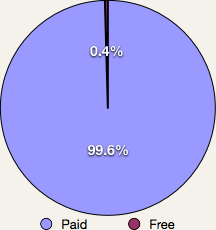
So far, I’ve only sent out 19. That’s out of 4,281 copies sold.

paid vs free

The longest request was 328 words; the shortest, a single sentence. I didn’t turn anyone down.

Flat broke
—-

The most common theme in requests was economic hardship. Ninety-nine cents is not a lot of money, but when you’re watching every dollar, spending cash on something unusual seems hard to justify.

Desiree writes:

> The New York Times article said that you would send free copy of your work to anyone with a good rationale. Well, times are tough. 99 cents may not be much money but I really do need the change. Thanks in advance.

Jim:

> I would love to get a copy of The Variant. I was very taken with The Nines and thought it didn’t get the attention it deserved. My case for not paying? I work in public radio and don’t even have enough funds to pay my credit card (right now I’m maxed out, so can barely cover groceries).

Johanna offers more detail than you might want:

> The sample pages I read were compelling enough that I wanted to at least ask if you could see it in your heart please to share the rest of the story with me.

> I’m disabled, on Social Security, I just left the hospital a few days ago and have still have a drain in my neck. My bones are infected. It is hoped I’ll recover. None of that matters, really, except that what little money I have now absolutely has to be used to pay for the many costs of daily washing pillow cases (which my home care provider does for me), buying extra supplies for rebandaging and cleaning the drain which they never give one enough of and expect somehow, actually, I don’t think they really expect anything afterwards. They don’t really think. Out of sight, out of mind.

> Anyway, your story was captivating and interesting and thank you for letting me read a sample of it. Should you choose not to share any more with me, I understand. It’s not my right to read your words.

Robert:

> Sparing you the details of my current circumstances, I will say only that I am broke, tapped out, sapped, impecunious, impoverished, rabbit-eared (picture the floppy white pockets pulled out from a pair of tight jeans), depleted, and so on.

> So, as I write to you on a borrowed computer, from a squalid hotel room, on an empty stomach, I ask for your kind pity, sir. Please allow me the pleasure of reading your work before my fading vision finally leaves me for good.

Trouble overseas
——

The second biggest group of requests came from abroad. Since the Kindle version only works in the U.S., I offer a downloadable .pdf for international readers. That still presents a challenge for some potential buyers.
[Read more…] about Why some folks got The Variant free

Our Magnificent Bastard Tongue

August 10, 2009 Books

book cover
Over the weekend, I read John H. McWorter’s book Our Magnificent Bastard Tongue: The Untold Story of English
, which I’d recommend for any reader interested in language history, grammar, or why [English is Not Latin](http://johnaugust.com/archives/2005/english-is-not-latin).

McWhorter quickly recaps the standard story of how English came to be. You had Angles, Saxon and Jutes coming to Britain with their Germanic language, which over time shed most of its noun cases and verb conjugations. When the Normans came, they brought French — and with it, a ton of words that we already had in slightly different forms. Thus we end up with both *royal* and *regal*, plus a lot of other words pulled in from Latin. Swedish Vikings brought words too, particularly words related to the sea. As a result of all this in-mixing, English has a very, very large vocabulary.

McWhorter’s central thesis is that English is actually a lot more peculiar than commonly thought, and that by glossing over its idiosyncrasies, linguists have missed some tantalizing history.

He examines our thoroughly weird “meaningless do” — *Do you like eggs?* *I love eggs, but my wife does not.* — which is so atypical that you need to look for an explanation. And you don’t have to look far. The Celtic languages, Cornish and Welsh, do much the same thing with “do,” and were already on the island.

Standard history has the Celts getting wiped out pretty quickly and thoroughly, but McWhorter argues they co-existed for a significant time. Celts may have also given us our unusual present tense, which is more commonly the progressive *I am talking* than the straight *I talk.*

Notably, they’re not always interchangeable:

MAN

I write a book.

WOMAN

Wow, you’re not a native speaker, are you?

(I’ve written about the [progressive tense](http://johnaugust.com/archives/2009/present-tense) as it relates to screenwriting.)

McWhorter’s a witty writer, but he has a habit of going on a bit too long after his point is made. I found myself skipping pages in the section on Sapir-Whorf hypothesis. (Disproved. Got it. Move on.) But on the whole, I recommend it for any fan of language.

« Previous Page
Next Page »

Primary Sidebar

Newsletter

Inneresting Logo A Quote-Unquote Newsletter about Writing
Read Now

Explore

Projects

  • Aladdin (1)
  • Arlo Finch (27)
  • Big Fish (88)
  • Birdigo (2)
  • Charlie (39)
  • Charlie's Angels (16)
  • Chosen (2)
  • Corpse Bride (9)
  • Dead Projects (18)
  • Frankenweenie (10)
  • Go (29)
  • Karateka (4)
  • Monsterpocalypse (3)
  • One Hit Kill (6)
  • Ops (6)
  • Preacher (2)
  • Prince of Persia (13)
  • Shazam (6)
  • Snake People (6)
  • Tarzan (5)
  • The Nines (118)
  • The Remnants (12)
  • The Variant (22)

Apps

  • Bronson (14)
  • FDX Reader (11)
  • Fountain (32)
  • Highland (73)
  • Less IMDb (4)
  • Weekend Read (64)

Recommended Reading

  • First Person (87)
  • Geek Alert (151)
  • WGA (162)
  • Workspace (19)

Screenwriting Q&A

  • Adaptation (65)
  • Directors (90)
  • Education (49)
  • Film Industry (489)
  • Formatting (128)
  • Genres (89)
  • Glossary (6)
  • Pitches (29)
  • Producers (59)
  • Psych 101 (118)
  • Rights and Copyright (96)
  • So-Called Experts (47)
  • Story and Plot (170)
  • Television (165)
  • Treatments (21)
  • Words on the page (237)
  • Writing Process (177)

More screenwriting Q&A at screenwriting.io

© 2026 John August — All Rights Reserved.