• Skip to primary navigation
  • Skip to main content
  • Skip to primary sidebar

John August

  • Arlo Finch
  • Scriptnotes
  • Library
  • Store
  • About

Archives for 2006

How do I break into Hollywood?

May 15, 2006 General

Short answer: You don’t.

Slightly longer answer: The question is meaningless.

I recently co-hosted a series of panel discussions for the USC School of Cinema-Television aimed at helping current students and recent graduates think about the first years out in the real world. “How do I break in” was the unspoken question in almost every session, so much so that I had to call it out in the wrap-up.

Here’s why it’s an invalid question: there is no “breaking in.”

For people just starting their careers in the film industry, it often seems like there’s a wall keeping them out, or at least a velvet rope, manned by a burly guy with a clipboard and a bad attitude. But the wall, the rope and the bouncer are all illusions. There’s no systematic effort to keep newcomers out of Hollywood. (On the contrary, in many categories there’s a disturbing tendency to favor the young at all costs.)

So if there isn’t a wall, why does it feel like there’s a wall?

Well, okay. There’s a wall. But it’s not a keep-out-the-infidels kind of wall. Rather, it’s a keep-the-roof-from-falling-down kind of wall. There’s a structure to Hollywood, a kind of ramshackle mansion that’s always teetering on collapse. The front door isn’t so much jammed as inaccessible, stuffed full of take-out menus and other solicitations.

So if there isn’t a front door, how does one get inside? You look for a window, a side entrance, a dusty chimney.

That’s what the seminar was about: looking for windows.

A sizable number of attendees were aiming for the below-the-line trades (such as editors, DPs, and visual effects), where there’s a pretty clear career path, roughly approximating the apprenticeship of the old-tyme trades. Basically, one works countless hours for middling pay while learning from experts, then eventually strikes out to shoot, light, edit or visually effect on one’s own. I’m not saying it’s easy — it’s exhausting. But it’s comfortably predictable.

Not so for the writers, or the writer-directors. One panelist, explaining her search for an agent, described her incredibly focused campaign to win every writing award imaginable and target very specific agents whose clients were already working on the TV shows she was suited for. But she didn’t talk about “breaking in,” because once she was staffed on a show, it was clear that there was never really an inside. She was a working writer, but could just as easily find herself a non-working writer by the end of the season. There was no wall, fence or other boundary metaphor dividing those two states.

So I’d ask everyone to disabuse themselves of the idea of “breaking into Hollywood.” It’s not like pledging a fraternity, losing one’s virginity, or pulling off a heist. It’s just getting a job, which is boring and real, and difficult enough without any inflated imagery.
Are you somebody?

May 5, 2006 Film Industry, First Person

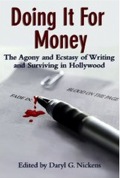
doing it book coverThe Writers Guild Foundation has a new book out, Doing It For Money, in which working screenwriters contribute short pieces about the pleasures and pitfalls of working in Hollywood. I’d feel bad about giving my essay away for free, except that pretty much every entry in the book is at least its equal. Buy the book. You’ll like it.

* * *

There are no famous screenwriters.

There are rich screenwriters with houses in Malibu. There are acclaimed screenwriters with awards on their mantels. But none of them are actually famous. Your aunt in Pittsburgh can’t name a single screenwriter — except for you, her little champ, working so hard to make it in Hollywood.

She’s proud of you, but worries. Who wouldn’t?

True, there are the hyphenates: writer-directors can be famous, not to mention actor-writer-directors, whose many hats only add to their publicity value. But no one gets famous just for writing 120 pages of 12-point Courier. You should know this going in, because if you have any interest in becoming “a household name,” your best bet is to pick a pseudonym like Crisco or Clorox.

Here’s an example of someone who is actually famous: Drew Barrymore. A few years ago, paparazzi took pictures of us having lunch. In the caption, I was the “unidentified companion.”

I wasn’t offended, honest. By this point I had fully accepted that I would never be recognized. The more time you spend with actual famous people, the more you realize that it pretty much sucks to have random people taking your picture, or asking for autographs while your dog is pooping at Runyon Canyon Park.

Well-paid anonymity is a luxury, frankly. I came to enjoy it.

And then one day, someone recognized me.

My boyfriend and I were at LAX, flying to Colorado for Christmas vacation, with both our dogs in carriers. Out of nowhere, a young guy on crutches came up to me and stuck out his hand: “I just wanted to say, I’m a big fan.” I stammered and thanked him, then went back to my dogs.

At the time, I was busy promoting Big Fish, so I figured that Crutches Guy had been at one of the countless Q&A screenings. He’d seen the film, liked it, and remembered me as the guy sitting next to Danny DeVito. I was flattered, and enjoyed the little jolt of adrenaline, but quickly wrote it off as a one-time thing.

But it wasn’t.

As I’ve done more publicity, and talking-head interviews on various DVDs, I’ve found that random people are recognizing me and saying hello with increasing frequency. It’s once a month or so — nothing alarming — but it always comes when I least it expect it: shopping for strollers, in line at the movies, at breakfast with the woman carrying my baby.

The hand-shakers are invariably polite, so I can always genuinely say, “It’s nice to meet you.” But what’s fascinating is how everyone around us reacts. Remember: as a screenwriter, I’m not actually famous. Yet suddenly someone is treating me like I am. I love watching that double-take as bystanders try to figure out who I could possibly be.

Once a nearby woman actually asked me, “Are you somebody?”

Almost apologetically, I said I was a screenwriter. Her face showed a combination of confusion and disappointment that would have been devastating at another point in my life.

While I stand by my no-famous-screenwriters rule, I need to issue a clarification. It is apparently possible to be recognizable among the subset of “aspiring screenwriters living in Los Angeles.” That’s far short of famous, but quite a bit better, in my opinion. Screenwriters are commendable folk. (Except for one guy who asked me to sign his hat, then dissed me in his blog.)

If there’s a downside to being recognized, it’s that occasionally I get half-recognized. At a restaurant, someone will see me and know that they know me from somewhere. Throughout the rest of their meal, they will steal glances, wracking their brains to figure out who I could be. A musician? A contestant on The Apprentice? The Neo-Nazi from last night’s West Wing? By the time salads arrive, I can feel their growing frustration.

So I take off my glasses.

With 18 inches of vision, the rest of the world blurs out, leaving me alone in my happy anonymity. Unless that guy comes over and asks if I am somebody. Then I don’t know what I’ll say.

Why I don’t have Google ads, part 432

April 27, 2006 Rant, Television

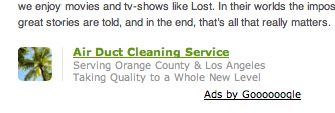
While checking out the Technorati feeds, I noticed that the good folks over at [LostBlog](http://www.lostblog.net/lost/tv/show/air-vents-are-for-air#comments), mentioned my recent rant “[Air vents are for air](http://johnaugust.com/archives/2006/air-vents-are-for-air).” Naturally, the Google ad that followed the story was perfect for readers who wonder why cinematic air ducts are not only unrealistically large, but also surprisingly tidy:

Google Ad

Air vents are for air

April 25, 2006 Rant, Treatments

air ventOn a recent episode of “[Lost](http://imdb.com/title/tt0411008/),” a character climbed through air ducts to get past heavy blast doors, which had trapped him and another character. By narrative standards, this sequence would seem unremarkable. Except for one thing:

“Lost” takes place on a freaking magical island.

You’ve got polar bears, black smoke monsters, and a cabal of mysterious Others. There’s no shortage of dramatic opportunities, which is why it’s so disheartening to see the show reach for that lowest-hanging fruit: a guy in an air duct.

I’ve lived a fairly adventurous life. I’ve travelled to five continents. But the only time I’ve seen the inside of an air duct is television and movies, when a character — generally the hero — has to be clever enough (and small enough) to climb through a conveniently-accessible air duct.

Be it action-adventure, comedy or horror, the air duct has become the hack screenwriter’s go-to passageway. In fact, it’s rumored the season finale of “[Yes, Dear](http://imdb.com/title/tt0247144/)” will take place entirely in air ducts.

Ladies and gentlemen, screenwriters, it’s time to stop.

Let’s back away from the keyboard and look at the situation with fresh eyes.

1. Most air ducts are not nearly large enough to hold a grown man.
2. Even if large enough, they’re not built to support a grown man’s weight.
3. “Secure” facilities — where characters are most likely to climb through air vents — are exactly the places that wouldn’t have hero-sized air vents.

Thanks to continuous bombardment in television and movies, the idea of characters shimmying through air ducts has become not just a cliché, but almost a given. The moment a hero finds himself stuck someplace, we expect his eyes to drift north to that spot just below the ceiling, where an oversized grate is beckoning: “Just yank twice! I’m not screwed in or anything!”

Here’s what I’m proposing: **The Screenwriter’s Vow of Air Vent Chastity**.

I, John August, hereby swear that I shall never place a character inside an air duct, ventilation shaft, or any other euphemism for a building system designed to move air around.

One day, I’d love to win an Oscar. An Emmy. A Tony Award. But if all I accomplished in my screenwriting life were reducing the number of times characters climbed through air vents, I’d consider my work successful.

So if you’re on board, please sign in the comments section and tell all your screenwriting friends. Remember, only you can prevent clichés.

« Previous Page
Next Page »

Primary Sidebar

Newsletter

Inneresting Logo A Quote-Unquote Newsletter about Writing
Read Now

Explore

Projects

  • Aladdin (1)
  • Arlo Finch (27)
  • Big Fish (88)
  • Birdigo (2)
  • Charlie (39)
  • Charlie's Angels (16)
  • Chosen (2)
  • Corpse Bride (9)
  • Dead Projects (18)
  • Frankenweenie (10)
  • Go (29)
  • Karateka (4)
  • Monsterpocalypse (3)
  • One Hit Kill (6)
  • Ops (6)
  • Preacher (2)
  • Prince of Persia (13)
  • Shazam (6)
  • Snake People (6)
  • Tarzan (5)
  • The Nines (118)
  • The Remnants (12)
  • The Variant (22)

Apps

  • Bronson (14)
  • FDX Reader (11)
  • Fountain (32)
  • Highland (73)
  • Less IMDb (4)
  • Weekend Read (64)

Recommended Reading

  • First Person (87)
  • Geek Alert (151)
  • WGA (162)
  • Workspace (19)

Screenwriting Q&A

  • Adaptation (65)
  • Directors (90)
  • Education (49)
  • Film Industry (489)
  • Formatting (128)
  • Genres (89)
  • Glossary (6)
  • Pitches (29)
  • Producers (59)
  • Psych 101 (118)
  • Rights and Copyright (96)
  • So-Called Experts (47)
  • Story and Plot (170)
  • Television (165)
  • Treatments (21)
  • Words on the page (237)
  • Writing Process (177)

More screenwriting Q&A at screenwriting.io

© 2026 John August — All Rights Reserved.