‘Wherefore’ does not mean where
A headline in today’s Hollywood Reporter: “Wherefore art thou, ‘Juliet’? It’s at Uni.” The story is about a book set up at Universal. The headline is incredibly frustrating.
Wherefore isn’t a fancy way of saying where. It’s a fancy way of saying why or therefore:
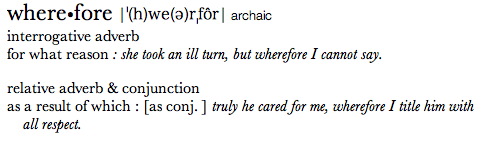
As longtime readers will know, I’m generally not Mr. Stickler when it comes to word usage. I’ve gotten several terms wrong over the years, including “begging the question.” I fully understand that words change meaning over time as languages grow and adapt. English is particularly nimble in this regard, and that’s a good thing. English is not Latin.
So why my beef with “wherefore?”
Wherefore isn’t a modern word in any sense. Its only use is in lame callbacks to the balcony scene in Shakespeare’s Romeo and Juliet. So every time it’s misused as a synonym for “where,” the writer reveals a fundamental misunderstanding of the iconic scene.
JULIET
O Romeo, Romeo, wherefore art thou Romeo? Deny thy father and refuse thy name; or if thou wilt not, be but sworn my love and I’ll no longer be a Capulet.
ROMEO
(aside)
Shall I hear more, or shall I speak at this?
JULIET
‘Tis but thy name that is my enemy: thou art thyself, though not a Montague. What’s Montague? It is nor hand nor foot, nor arm nor face, nor any other part belonging to a man. O be some other name!
She’s not asking where he is. She’s asking why this hot guy she’s in love with has to be Romeo, a Montague, member of the rival gang. If we were writing that line now, it would be something like:
JULIET
O Romeo, Romeo, why must thou be Romeo?
But the where/wherefore mistake is so fundamentally entrenched that we now expect Juliet to be straining at the edge of the balcony, looking out in the night with hopes of seeing her true love. It sets up the idea that she knows he’s coming, that a rendezvous has been set. It changes the scene in fundamental ways.
I’m a realist: this fight will never be won. I’m certain I’ll go to my grave having just read a headline on the Mentalinet which makes the exact same mistake. I’m calling it out simply in hopes that some of my readers might join the fraternity of people who know that it’s wrong, and will bristle when they see it.


January 7th, 2009 at 12:09 pm
I’m bristling like a muthafucka.
January 7th, 2009 at 12:11 pm
exactly!!! I remember when my drama teacher told us that, too….arrgghhhh
the HR should have known better.
that Romeo-Juliet scene should be easy to understand. Juliet NEVER asked “where” he was, but rather, crying over why he himself is Romeo Montague, who comes from the family that the Capulets hate.
January 7th, 2009 at 12:19 pm
I’m still annoyed when people don’t know that Romeo and Juliet both kill themselves at the end.
Oh, spoiler alert. Oops.
January 7th, 2009 at 12:23 pm
Thanks for the education. I never knew.
January 7th, 2009 at 12:28 pm
And if I’m not mistaken, ‘thou’ has always been pronounced ‘you’. Which is something that has always frustrated me when people tried talking archaic.
January 7th, 2009 at 12:33 pm
I first learned that in an old Peanuts strip, where Linus walks up to Lucy as she’s watching TV, and says:
LINUS: When Juliet asks “Wherefore art thou Romeo,” she is not asking where he is. Rather, she is referring to the fact of his being named Romeo.
Linus immediately leaves, and Lucy looks puzzled and says to herself: “Now that I know that, what do I do?”
January 7th, 2009 at 12:34 pm
Juliet was 13. I’m afraid that if we wrote that scene now, it would run more like this:
MILEY O Nick where y r u a Jonas? omg yer p’s r l0zErs. txt me bak! luv u
NICK wtf jobroz rock
MILEY dude u name is stoopid but u r mad sick hot. txt me bak!
January 7th, 2009 at 12:40 pm
That editor should be fired based solely on the fact that (clearly) he/she lied about graduating from high school.
INCONTHEIVABLE!!
January 7th, 2009 at 12:41 pm
Amen, John. This is right up there with the mis-use of ‘of’ instead of ‘have’ (as in ‘could of’ instead of ‘could have’). Shudder…
January 7th, 2009 at 12:43 pm
Well, according to the Hollywood Reporter’s interpretation of “wherefore”, Hamlet then obviously keeps misplacing emotional states now. “I have of late, wherefore I know not, lost all my mirth”…
But seriously, I’d expect someone who writes about movies to have read and understood at least one Shakespeare play.
January 7th, 2009 at 12:45 pm
@kip:
Wait, I thought it turned out at the end that Romeo wasn’t really Maeby’s cousin.
January 7th, 2009 at 12:45 pm
@John: I put my full email in the name field by accident, would you mind deleting it? Thanks and sorry for the trouble.
January 7th, 2009 at 12:58 pm
Mentalinet? OK, I’ll go with it. Personally, I get all my Shakespeare from headlines, so it makes perfect sense to me. As does “There’s the rub, now from Mrs. Dash!”
January 7th, 2009 at 12:59 pm
You’d think pro newspaper writers and editors would collectively manage to avoid such frustrating mistakes.
January 7th, 2009 at 1:20 pm
Grammar trivia: The style book for the British paper The Guardian says that if you don’t know whether to use ‘whom’ or ‘who’, use ‘who’ – because it’s better to be wrong than wrong and pretentious.
January 7th, 2009 at 1:24 pm
The only time this is allowed is in that old Looney Toons short, where Bugs leaps out and replies, “Herefore I am!”
January 7th, 2009 at 1:27 pm
John, you missed the worst part.
The book is actually about someone who discovers they are descended from Romeo and Juliet’s love child.
Work that one out!
January 7th, 2009 at 1:29 pm
There are some words that drive me crazy, too. Like when there’s a small problem with something, and someone says “let’s circumvent the situation”. Meaning to work our way around it. Drives me crazy.
January 7th, 2009 at 1:31 pm
We bristle as one.
January 7th, 2009 at 1:35 pm
My bigger problem with this mistake is that I associate it with a seemingly endless series of sitcom/cartoon scenes where it is so HILARIOUS that Juliet does not know where Romeo is, when HA!, he’s right there under the balcony.
The set up being, usually, that the high school where the sitcom is set and/or which its characters attend, are doing a production of Romeo and Juliet and this one excerpt, with this one gag, are the only portion we ever see.
I suspect the ur-wherefore-as-where scene might be from a Looney Tunes, and of course, I will forgive Chuck Jones anything. However, the rest of the offenders — and they were legion during the mid-80s Facts of Life/Silver Spoons/Differrent Strokes era — are on my s#*% list now and for all time.
January 7th, 2009 at 2:20 pm
“Wherefore” always made sense to me as it is practically the same word in Swedish: “Varför” (meaning “why”). Oh, I’m Swedish, btw. :)
January 7th, 2009 at 2:38 pm
this reminds me of The Mother Tongue by Bill Bryson. In addition to all the goods on Thou/You, hear-ed/heard, and other fake archaic sounding words and anachronisms, he does a pretty good job of explaining some of the more interesting differences between British English and American. And puts the strict grammar prescriptives in their place.
January 7th, 2009 at 2:41 pm
err, prescriptivists too :)
January 7th, 2009 at 3:17 pm
Oh, it just brightens my day when I see someone else being driven mad by the things that drive me mad. Makes me feel less alone in the world.
Two others that really get to me are “bemused” as synonymous with “amused” and “penultimate” used to mean “really really ultimate.” Those bug me because they’re both usually used in an attempt to appear more intellectual, when, in fact, you’d look a hell of a lot more well educated if you used a smaller word and used it correctly.
Re: “thee” and “thou,” I believe there used to be a character in English writing that represented the “th” sound, but looked something like a contemporary “y.” (Just as there used to be a character for a double “s” that looked quite a bit like a contemporary “f.”) That’s where all those “Ye Olde Ale House” signs come from. The character was orginally pronounced “th,” (as in “THE Olde Ale House,” but because it looked like a “y,” the later interpretation was that it was pronounced as a “y.” So I think that “thee” and “thou” have always been pronounced with their “th,” and any thoughts of their pronunciation as “yee” and “you” come from that misinterpretation of that one character.
(I think a lot of people think “thou” devolved into “you,” but actually “thou” was a less formal version of “you,” not the other way around. Sort of like “tu” and “vous” in French, or “du” and “Sie” in German.)
I once saw a review in the Weekender for “Zorro” with the headline, “The Gentile Art of Swordplay.” I briefly considered shooting them an email with a list of Famous Jews with Swords, courtesy of the Old Testament, but decided it wasn’t worth the trouble.
January 7th, 2009 at 3:24 pm
“If we were writing that line now…”
If we were writing it now, we likely wouldn’t use “thou”, right?
January 7th, 2009 at 3:26 pm
Thank god you spoke up about this atrocity. I’m only being partially facetious. This was an awful way to start the morning, thinking someone, a group of people, could be so dumb as to let this pass by without catching it!
January 7th, 2009 at 3:31 pm
@Jill and others:
The Apple dictionary has a nice paragraph on the you/thou situation:
January 7th, 2009 at 3:35 pm
Grrr!
January 7th, 2009 at 4:20 pm
Thanks. I really needed another reason to get self righteous over grammar.
January 7th, 2009 at 4:49 pm
hahaha…I hang my head in shame.
http://uninflectedimages.blogspot.com/2007/05/wherefore-art-thou-darin-morgan.html#links
January 7th, 2009 at 5:09 pm
Yes, I’m rankled, but more than that I’m saddened by the use of the tired old joke. It’s a headline so bad it’s lazy twice.
January 7th, 2009 at 5:16 pm
Really, the descendant of Romeo and Juliet’s love child? And someone wrote a whole book about that and didn’t notice? And then someone edited it and didn’t notice? Then it was published and the film rights were sold and no one noticed? Wow. That is truly amazing. I suppose that explains a thing or two.
January 7th, 2009 at 5:25 pm
A couple of my grammatically incorrect favorites:
Irregardless – Not a word, regardless does the job just fine.
“I could care less” – Makes absolutely no sense. The point of using that phrase is to make the point you don’t care about something. If you could care less you do care for that something to some extent. Now if you “couldn’t care less” well then I guess you really don’t care about something.
January 7th, 2009 at 5:35 pm
John,
Thanks for the “thee” and “thou” stuff. My info (on the formal vs. informal issue) came from Bill Bryson’s excellent book, “Mother Tongue,” and I just knew that he also had something about plurals in there in relation to “you,” but I couldn’t find it, as it was in a completely different part of the book. Glad you had the other resource; it was nagging at me that I couldn’t remember the specifics!
January 8th, 2009 at 7:43 am
You would probably really enjoy A Phrase a Week. There’s an RSS feed and/or an email. The author investigates and discusses the derivation and transformation of phrases, debunking many popular beliefs but sometimes confirming them. If you google A Phrase A Week, you’ll find the site easily.
Great post, by the way. I share your outrage.
January 8th, 2009 at 8:06 am
“Really, the descendant of Romeo and Juliet’s love child? And someone wrote a whole book about that and didn’t notice? And then someone edited it and didn’t notice? Then it was published and the film rights were sold and no one noticed? Wow.”
If you actually read the article, the film rights were sold in advance of the book’s publication, which is scheduled for next year. So nobody outside this deal knows the specifics of the story.
The article describes it as “a story about a woman who discovers she may be descended from the people who inspired one of the most popular and tragic love stories of all time” which is pretty vague. The “love child” thing is a paraphrase from one of the posters here.
January 8th, 2009 at 8:40 am
I use the word irregardless ironically, and when people call me out on it, I say “Irregardless is a perfectly cromulent word that embiggens the English language.”
And– I’m not joking here– my co-worker, whom I recently taught how to use a program, just left me, saying to me “You learned me well.”
Buh.
January 8th, 2009 at 8:49 am
Grammarphiles unite!
January 8th, 2009 at 9:59 am
I have been bristling over this one since sophomore year of high school, when I used to advocate that when casting for a Shakespeare play, everyone should be required to deliver this line. If they put the emphasis on the word “art,” it could be assumed that they did not understand the meaning of the line, and should not be considered for a part.
January 8th, 2009 at 10:38 am
LOL Patrick Stephens’ #7 comment.
Pardon the ignorance, but what’s wrong with “begging the question”? I don’t use it, but I thought I’d heard it before…
January 8th, 2009 at 6:33 pm
“Irregardless” is, most lamentably, a real word.
“I could care less” is used incorrectly. Those among us more erudite would say, “I could care less, but I’m not sure how.” :)
January 9th, 2009 at 1:44 am
John, which dictionary did you scan that entry from?
January 9th, 2009 at 8:19 am
@Silvana:
That’s a screengrab from Apple’s built-in dictionary, which uses the New Oxford American dictionary.
January 9th, 2009 at 5:48 pm
My understanding of the word “irregardless” is that it has been accepted as a common word much like “ain’t”. It’s overusage caused the world to relent. But the word in and of itself is, by its very definition, a double-negative.
January 9th, 2009 at 7:39 pm
I remember writing a bit about “wherefore” several years ago when a big name blogger misused it in that common way. It was the only post I ever wrote that got a significant amount of comments. That scared me, since I didn’t expect people to be reading what nonsense I write.
January 10th, 2009 at 8:06 pm
Think you got problems?
Sincerely, Edgar Wherefrum
January 13th, 2009 at 10:56 am
I find it interesting that many words and terms in the English language have indeed evolved over time, both in how original definitions have become slightly altered as people change, and in the inclusion of once non-words due to their increasingly popular useage.
However, the term “marriage” must remain intact in its bizarrely limited definition, for reasons known only to the stubborn and ignorant. Or both.
January 22nd, 2009 at 6:18 pm
I’m surprised no one has mentioned “literally” like “I was literally freezing my butt off.” Sounds painful.