Spelunking the Kindle market
How many books does Amazon sell on Kindle each day? How closely does it follow the 80/20 rule, in which a few top sellers account for a huge percentage of total sales? Is there a classic long tail — and is it even worth being on it?
Amazon is incredibly opaque with the details, even when you’re publishing on their system.
The day after its debut, my story The Variant briefly reached #18 on the Kindle bestsellers list. While that was exciting, I still don’t know exactly what it means.
Like other Amazon statistics, it seems to get recalculated hourly, but there’s no indication whether it’s a pure number of sales that hour (which would make for very erratic swings) or some sort of sliding average over time. Based on how it’s handled for physical books, it’s probably a combination:
Only the top 10,000 books are updated every hour and the ranking does not depend upon the actual number of books sold, but rather, on a comparison against the sales figures of the other 9,999 books within that same hour. Simultaneously, a trending calculation is applied to arrive at a computerized sales trajectory. So, hypothetically, a book that held a ranking of 2,000 at 2pm and 3,000 at 3pm, might hold a 4,000 ranking at 4pm, even if it actually sold MORE books between 3-4 than it did between 2-3.
All I really know is that the day I hit #18, I sold about 500 copies. So my hunch is that titles around that spot in the list (say, 15 to 25) might sell around 500 copies per day. That is, they probably sell 500 as opposed to 50 or 5,000. I’m only try to get a sense of how many zeroes are involved.
Stephenie Meyer is rich
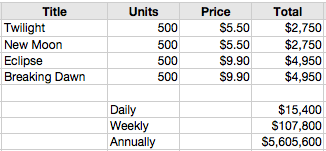
As it happens, all four of Stephenie Meyer’s Twilight books fall into this range, and have been here for quite a while. They’re priced at $5.50 (for the first two) and $9.99 (for the second two).
If each is selling around 500 copies each day, that means the four of them are generating $15,400 per day, or $107,800 per week. Granted, that 500 is a guess, but it’s probably a number with two zeroes.
We don’t know the split between Meyer, her publisher and Amazon — it’s possible that the retailer is deliberately taking a loss on the Twilight books in order to woo Kindle buyers — but it’s clearly a nice bit of money with no paper, shipping or inventory costs.1
Worst bestsellers
Unlike the iTunes App Store, Amazon doesn’t distinguish between free and paid content on their Kindle bestseller list. In fact, 19 out of the top 50 books are free. There’s nothing wrong with free, but it’s a semantic and tactical mistake to include them on a “bestseller” list.
The current system keeps Serial in the #1 slot for no real reason other than being free. I envision many brand-new Kindle owners powering up their devices for the first time, and wanting to download a book to test out the service.
Where do they find a book? The bestseller list. And look! The bestseller is free!
This isn’t a knock on Serial or its authors. In fact, one of the writers has a useful post of his experiences with publishing on the Kindle. He notes that…
The freebies are being downloaded and read. There isn’t money changing hands, but branding and name-recognition — two essentials for every successful author — are happening.
Free should always be a choice. But I’d argue the free preview feature on every Kindle title is designed for exactly this sort of try-before-you-buy. If after forty pages you haven’t convinced a reader to pony up at least 99 cents, I don’t know that “branding” is really the issue.
By letting bestsellers be free, Amazon also makes it easy to game the system. The Cook’s Illustrated How-to-Cook Library got into the top 20 as a free book, then jacked up the price to $9.99. 2 Letting author-publishers change the price is smart; letting them monkey with your bestseller list is dumb.
I’d propose Amazon keep the zero-price option, but move free titles to their own list. After all, nothing else in Amazon’s ranking system has to compete with free.
But until they make that change, I’m considering organizing an online flash mob for The Variant. For one predetermined hour, I’ll set the price to zero and invite everyone I know to “buy” it. I’m curious how high I could get on the list.
Overall impressions
As I noted in my earlier post about formatting for Kindle, getting a book published on Amazon’s platform is surprisingly straightforward. But I really hoped for better reporting. Should one raise or lower the price? Do ads work? Do reviews help?
Without better information, it’s tough to make any of these decisions.
The Kindle isn’t currently the (mythical?) indie goldmine the iTunes App Store has become. Despite Amazon’s first-mover advantage, there is clearly opportunity for competitors, like Google, Apple or Sony.
More pressingly, there’s a need for better international ebook distribution. The Kindle is U.S.-only, likely due to do rights issues. A European solution would be great; a global version would be better. My e-Junkie/PayPal system for pdfs and ePubs is just barely workable. If I could graft it onto a trusted store like Amazon or iTunes, everyone would feel more comfortable.
- Yes, clearly Meyer and her publisher are making great money off the printed versions of the books, which probably account for 95%+ of sales. But the Kindle sales aren’t insignificant. ↩
- Indeed, many of the reviews are some variety of “I can’t believe it’s free!” ↩

June 2nd, 2009 at 5:28 am
But until they make that change, I’m considering organizing an online flash mob for The Variant. For one predetermined hour, I’ll set the price to zero and invite everyone I know to buy it. I’m curious how high I could get on the list.
Me too. Do it!
June 2nd, 2009 at 6:37 am
I’m SO in favor of the flash mob! :P
June 2nd, 2009 at 7:31 am
“If after forty pages you haven’t convinced a reader to pony up at least 99 cents, I don’t know that “branding” is really the issue.”
But how are you going to get them to read those forty pages in the first place without having a brand? As you said, a lot of people are probably getting Serial simply because it’s free. Would they do the same if the book was moderately priced, or would they prefer to go with a “proven” brand? Of course they could try and read the first forty pages, but if you’re going to have to pay for a book anyway, why risk wasting half an hour or so instead of going with what you know? I think that regardless of the objective merits of the free trial system that’s a psychological hurdle you underestimate.
Speaking of the iTunes App Store, I don’t know if you’re aware of this story. I have some objections to his sales strategy, but still I think it suggests the indie goldmine theory belongs into the realm of fiction.
June 2nd, 2009 at 8:42 am
Reality check – it’s not a goldmine. There’s a gold rush as people with no programming knowledge or experience throw anything at it in the hopes of making millions. Those big stories you see reported are big news since they are very rare. They also make the mistake of using the highest figures in a day to calculate the yearly profits. Not going to happen.
If a Kindle book makes news you’ll see thousands of people copying the dictionary and re-printing it as their own. Personally I’m not looking forward to iFart, the Novel.
Most developers of real apps (not the one day hacks) are not making back the time they put into it. At over 35,000 apps now your app gets lost. The App Store search function is terrible and unfortuantely Apple treats apps as if they are songs or movies. (i.e. hot listed now but forgotten next week)
The other issue with the App Store is 95% of people buy based on the App Store. As a developer if your app is chosen by Apple to be featured your sales will be 100-1000x it’s normal sales. Notice that this is controlled by Apple so with a few exceptions most of the winners are those Apple has deemed to be featured. Featured doesn’t necessarily mean great, it just means it’s a shiny object that caught the eye of someone at Apple. They have a Staff Favorites section but everythign on the pages have been staff selected. There’s a what’s hot section that duplocates most of the top 100 lists and there’s the What’s New that actually isn’t. There’s not really much point in having a top 100 list anyway for an application store. The better apps aren’t cultural items like songs and movies. You should be buying them based on the usefulness to you, not based on the fact that a lot of other people have purchased it.
Apps don’t really experience much of a increase from most press releases or web reviews. Almost everything comes to being featured.
Apple at least has reduced some of the gaming of the system. Some apps started at free to get a high ranking and then switching to a paid app. These are now reset at least.
I agree that Amazon should split the free and paid apps into separate lists.
June 2nd, 2009 at 9:03 am
John, you’re too smart. Jeff Bezos is going to hunt you down and delete you if you keep up this kind of talk.
June 2nd, 2009 at 9:19 am
“My e-Junkie/PayPal system for pdfs and ePubs is just barely workable.”
How so? It worked fine for me. (And I really enjoyed the story; thanks.) I set up a Donate button with PayPal so clients could pay me via credit card, and that was easy, too.
June 2nd, 2009 at 10:10 am
Thought this article re: games iPhone apps might peak your interest. http://www.gamasutra.com/view/feature/4038/persuasive_games_i_want_my_99_.php
June 2nd, 2009 at 10:16 am
Amazing post, John. Have you checked out the free “Nurse Jackie” script from Showtime yet? I’m looking forward to hearing your thoughts at their success/failure on the formatting. I need to come here more often.
June 2nd, 2009 at 10:21 am
you are definitely earning your geek cred.
love it!!
June 2nd, 2009 at 10:49 am
The Amazon Kindle is a more level playing field for books than Big NY Print Publishing is. Theoretically, because all books are available at one location, they all have an equal chance of finding readers.
Obviously name-recognition, branding, and price point come into play, but publisher involvement isn’t necessary to the extent it is in the print world. In print, distribution and marketing dollars push sales. On Amazon, not so much.
Not that there isn’t any marketing. Blake Crouch and I tried to put SERIAL up as a freebie ourselves, but Amazon won’t let authors do that. We had to work through my publisher. This turned out to be the smart way to go, because my publisher was able to get SERIAL a big launch, which included sidebar placement, and that went a long way toward making it #1. So did the fact that my recently released novel, Afraid, did very well on Kindle a few weeks earlier.
So now SERIAL is being downloaded at an alarming rate, and that can only help sales of my other books.
But I’d argue the free preview feature on every Kindle title is designed for exactly this sort of try-before-you-buy.
In this case, the freebie leads to branding because being on a bestseller list makes people aware we exist. Point of purchase and product placement work the same way on Amazon as they do in bookstores, and the books that are displayed sell more copies. Had we charged for SERIAL, chances are we wouldn’t be a bestseller, making it harder for people to discover the book.
So this isn’t a case of a freebie being equal to a free preview. This is a case of having your book face-out next to the register at Borders, instead of spine-out in section.
Just like the NYT Bestseller list, it becomes a self-fulfilling prophecy. Being on the List makes more people aware of you which sells more books.
My goal, as an author, is to be read. Some of the readers become fans, some fans become buyers. But the first step is getting readers aware of my work. The Kindle is a terrific platform for that.
The current system keeps Serial in the #1 slot for no real reason other than being free.
Sort of. There are dozens of free and thousands of cheap Kindle books, but not all of them reach the bestseller lists. Marketing, name-recognition, timing, and ultimately content all help.
The Kindle is U.S.-only, likely due to do rights issues.
Actually, Kindle is US only because of Wifi issues, not rights issues.
Should one raise or lower the price? Do ads work? Do reviews help?
In my personal experience, and in polling Kindle owners, a price point of less than $2.00 seems to be the way to sell the most books and make the biggest profit, unless you’re already a bestseller.
Reviews do help, but not necessarily what the reviews say, or even the rating. But the more reviews a book gets, the more attention it gets, the more downloads it gets, the more reviews it gets, etc.
As for ads, yes, they help. But at this point, only publishers can advertise on Amazon.
Internet Billboards (all the sites that mention and point to your Kindle book) also help a great deal. Authors who post on Kindle forums, and participate in Kindle newsletters, sell more copies.
Is it a way to get rich? Not yet.
But let’s see how things play out in the coming years…
June 2nd, 2009 at 11:27 am
This series on your Amazon/Kindle experiences has been wonderfully instructive. Thank you so much. ~jon
June 2nd, 2009 at 11:39 am
John, I’ve been surfing around today looking at how other folks handle online sales, and I wonder if you’ve seen scribd’s new store feature, and if so, why you decided against it. From what I can tell, it offers authors a change to put up original works that are both readable online and downloadable as PDFs, set prices, AND get analytics. You’re also working within a store format where people are searching for titles, rather than posting solo.
They say the profit split was 80/20 author/scribd. I got all excited, thinking perhaps that this was an alternative to the $5 a month e-Junkie charges for listing items…until I also read somewhere that scribd takes another .25 off the top as a surcharge on each thing that sells. Cancel enthusiasm. For a $1.00 item (that’s the lowest amount they’ll let you charge) you’d end up making .55 after they take their 20% cut and their .25 surcharge. That surcharge really kills the lower price points!
A few larger publishers are selling e-book versions of dead tree tomes (O’Reilly is a prominent vendor on the site) and they are charging what–insanely–looks like full hardcopy price or close to full price for their books. Meanwhile, you have professionally published fiction writers selling novels for $2. Two dollars for an entire novel! Would that automatically price short stories out of that market? I don’t know. I’m going to do more snooping on their site.
June 2nd, 2009 at 11:42 am
I should have added that, even though they end up taking almost 50% of the one dollar a story would earn, there is no listing fee and no membership fee, so the problem of dropping $5 a month for e-Junkie’s cart is avoided. Which is better–a $5 flat fee per month, or earning .55 per $1 item sold on scribd with no overhead? The answer, of course, lies in the number of sales you generate…for me, scribd might be the best option. For someone like you, e-Junkie.
June 2nd, 2009 at 3:42 pm
@Markus and Scott:
Thanks for the App Stories.
@Dave in DC:
I think people are skittish about PayPal-based solutions, because they don’t have a working model of how the transaction is supposed to go. “What happens after I push this button?”
At least with Amazon and iTunes, there’s confidence in What Happens Next.
@Jack Kilborn:
Thanks for commenting, and for your post. I wasn’t sure which name to use for you.
I’d forgotten that “free” wasn’t an option for self-published books. Good that you had a publisher who could swing that.
Does your publisher get more information than the DTP manager provides? Because without some way to handle tracking information, I don’t know how they gauge the effectiveness/conversion of banner ads and whatnot. Glad to hear you think they help.
Please keep updating your site with info about how it’s going.
@Alan Gratz:
I did look at scrib’d, but it doesn’t seem ready for what I want. But more solutions are better, so I’m hoping something comes of it.
One thing to point about e-junkie: it’s $5/mo for up to 10 products, so the scaling works better for people with multiple titles. (Right now, I have two: the pdf and the ePub.)
June 3rd, 2009 at 2:05 pm
John, have you looked at, and formed an opinion about, Issuu? (http://www.issuu.com) It strikes me as a classier Scrib’d, maybe only because I’ve never had any of my books turn up there as unauthorized giveaway copies yet, but certainly also because Issuu’s interface and design is a step higher.
It’s embeddable Flash previews are reason enough to look at them. They’re pretty nice.
June 9th, 2009 at 8:13 pm
This is terrific John & guys – thanks for posting it!!
June 29th, 2009 at 2:32 pm
I just gotta say I love my kindle and the cheap books.
My taste is a bit rough but I enjoyed “The Misogynist” by Emily Downs.
It can be a bit vulgar at times. Be warned. But it’s cheap.
http://www.amazon.com/The-Misogynist/dp/B001V5J4VO/ref=sr_1_2?ie=UTF8&s=books&qid=1246301307&sr=1-2
She is the bestselling author of “Lisa Loves Girls”
http://www.amazon.com/Lisa-Loves-Girls-ebook/dp/B002EZZJ4Q/ref=sr_1_7?ie=UTF8&s=books&qid=1246298800&sr=1-7
2 books for under 2 bucks. THe kindle will own publishing.
July 29th, 2009 at 7:50 pm
My humble little title, Down the River Up the Road, is on Amazon as a Kindle title. It is a serial title which I am releasing one chapter at a time. Sales are not brisk for all the reasons described above.
There is no such thing as a free lunch, or whatever the saying is. I prefer “all things be equal, you tend to get out as much as you put in”. Translated, this tends to mean big dollars and a big push (usually by a publisher) equals big sales. Small dollars and guerilla marketing tends to get you small sales. Not because it is ineffective, it simply tends not to scale as well as what the big boys and girls can do.
btw, my same title is also on Scribd with less results, which I attribute to a smaller population of shoppers/browsers.
It’s all good though, I wrote my book simply to tell a story which I enjoy. That story is about a hidden corner of the West, river rafting, fatherhood, and healthy normal teenage daughters. Sharing with others is nice and even gratifying if they like it. Time will tell!