A week of The Variant

My short story The Variant has been on the market for a week. As promised, here’s an update on how the 99-cent experiment has gone.
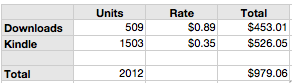
variant sales table

Short version: I sold more copies than I expected, with fewer technical issues. I had picked the Friday of Memorial Day weekend precisely because I hoped it would be slower-paced, allowing me to fix whatever disasters struck without a crush of weekday traffic. But I could have been more ambitious, and a mid-week launch would have made more sense.

I get 35 cents on each Kindle sale, versus 89 cents on each download.

I’d be less grumbly about Amazon’s 65 percent cut if their reporting were better. Their DTP publisher tells you almost nothing about your sales. It only shows how many total units, with no breakdowns at all — not by day, not by state, nothing. Fortunately, I had embedded my Amazon tracking number in links from my site, so I do know that 458 of my Kindle sales came from people who clicked through from the launch page. That’s only a third of the Kindle sales, so many people were getting it in one of three alternate ways:

  • Following a direct link from an outside site, such as Daring Fireball.
  • Buying it through Kindle itself, either the device or the iPhone app.1
  • Finding the book on the Kindle bestseller list.2

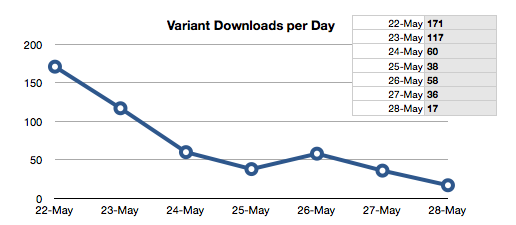
Downloads provide a lot more data. I’ve already written about the international readers, but the numbers also help show the falloff over time. It sold ten times more on the first day than the seventh.
variant downloads chart

(Note: I grabbed data at different times, so this total is 12 units shy of the table above.)

Today’s NY Times article about The Variant may provide a bump, but an esteemed colleague (Ze) cautions that he’s never seen a real spike from stories in traditional media.

At this point, I don’t have any big sense of What It All Means.

It’s a fine number of sales for a short story that would have likely been buried in some specialty magazine. But I’m not sure I can offer any meaningful analysis of the publishing model, partly because I started with a higher profile than many fiction writers might.

Could an established novelist duplicate (or exceed) these results? Probably. Could a talented but unknown upstart? Not as likely.

This kind of self-publishing certainly reduces the barriers, but literary brand recognition is still a huge asset. It is reading, after all. People would rather do almost anything than risk reading something bad. Free previews and a 99-cent price tag help, but the reputation of the author is likely a major factor in deciding to buy.

  1. I have a hunch that a lot of readers tried out the iPhone app for the first time buying the book.
  2. I’ll have more to say about the bestseller list in another post.
  • Digg
  • Facebook
  • Reddit
  • SphereIt
  • StumbleUpon
  • Twitter
May 31, 2009 @ 10:20 pm | Comments (15)
Filed under: Follow Up, Projects, The Variant

15 Responses to “A week of The Variant”

  1. Erik Harrison

    Thanks for this John.

  2. Brett

    Thanks John. It was a great story I’m disgusted that Amazon takes 65%. If I’d known that, I wouldn’t have purchased through them.

    I know this was an experiment, but would a writer of your stature have made more by publishing it in a literary magazine? How many units sold would it take to really pay off in your mind? You obviously took a severe pay cut to write this.

    Successful experiment, though. I hope more authors do this.

  3. Joshua

    Is Amazon’s 65% cut just because the sale price is so (relatively) low (and there are certain fixed costs per sale/download)? Or do they really take that much out of every sale?

  4. Ryan Stauffer

    THE VARIANT was fantastic, more than worth the 99 cents. I went with PDF download, partly because I don’t have an eBook reader, and partly to help you dodge the 65% gouge.

    I didn’t buy the story right away for three reasons. 1) Wasn’t sure I could justify the $0.99 to my wife, since we are on a tight budget. Seriously. 2) I didn’t have time to read it when you announced it. 3) Vague feeling that the inconvenience of signing in to Paypal seemed incongruous to the price I was paying for the book. Seems silly, but there it is.

    1) Isn’t relevant to you, but hopefully 2) and 3) provide some insight. I knew I wanted to buy the story, because it was you, but those two things held me back from doing it right away.

    Hope that helps. I might add that I also would like to know about the methods you used to promote the book.

    Great work.

  5. Fred

    Hi John!

    Like Brett, I would like to know how much it would paid had you submitted it and had it published by a “The Atlantic” or similar magazine. Do you know? Also, does your agent get a part of the proceeds from this story? If you had published it with a paper periodical, would you have given a cut to an agent?

    Fred

  6. Anthony Peterson

    Its early days. The old saying “the medium is the message” leaves me thinking that a successful business model will eventually be establish BUT not with an identical product. I suspect online reading will take off when the value proposition for the consumer improves by offering them something you can’t get anywhere else. Think about what the internet CAN do that other mediums CANT (or at least not as well). Full color? Interactivity? Flash based stuff. The novel simply didn’t not exist before the industrial revolution because paper was not cheap enough. Does porting the same experience to the web make sense? Mmmm I think there’s got to be something more, and I’m still racking my brains.

  7. Will Mahoney

    What about Stephen King’s trial with online publishing a few years back? I think it was in 1999 or 2000, he wrote a short play, something about a vine that took over an office. I never ended up buying it, but I followed the posts on his site. I remember really big numbers being discussed (he posted the details, like you are doing.)

  8. Rob in Denver

    Mystery author JA Konrath has a wrap up of his ebook experiment today, too.

    http://jakonrath.blogspot.com/2009/05/more-on-amazon-kindle.html

  9. Alan Gratz

    Great stuff, John. Thanks for posting this, and congrats on the sales. I totally agree with you about branding. I mean this in absolutely the most respectful way possible when I say that many of your sales probably came from people buying on your name alone. (Which I think is a good thing.) I didn’t know you well before a Tweet about your Variant experiment brought me here, so I’m one of those who read the sample and thought, “Yeah. This is good. I’ll chip in a buck to see how it ends.” So that part of your strategy worked on me, at least.

    Would this work for an established novelist with a large following? Absolutely. Would it work as well for a writer like me who has four books out but no really unified, mobilizable fan base? Not in numbers like you report here. What I would have to rely on is Chris Anderson’s idea of “the long tail,” and hope that, over time, I made a profit as my scattered, irregular audience found my stories and bought them. I’m down with that–except for e-Junkie’s $5 a month fee for posting the item. Will I make $60 in sales over a year’s time to pay back the investment in the cart I’m using to sell the product? Seems silly to talk about such small numbers in light of yours, but I think that would be a real consideration for me.

    There is, of course, always the option of just making my stories available as Kindle downloads, which would be free to me–but at just .35 a pop profit, that’s a LOT of long tail I’d need to see before it was anything but chip in allowance for my daughter. I’m also not a fan of the fact that once you buy a story for your Kindle, it’s tied to that device. But that’s a decision the end user made, not me, so I can’t really deny myself sales for the sake of principle–particularly in light of the numbers you post above. More $$ earned through Kindle sales, at .35 each, than PDF sales at .89 each? I suppose I shouldn’t be stunned, but I am.

    The other factor in all this as relates to e-Junkie of course is that the $5 a month they charge you is good for selling up to 10 items…so if I have ten stories for sale, I’m maximizing my potential for earning back that $5 a month I’m laying out in expenses for the venture.

    But then I have to figure that one person who wants to buy stories from me is probably not going to buy all ten stories from me at once…

    I have a lot of thinking to do, but you’ve given me lots of great stuff to mull over. Thanks again!

  10. Caleb

    After reading info on the wrap ups from you and Konrath I’m just wondering how much amazon advertises kindle fiction and how much work would have to be done by the author just to be noticed?

  11. Scott

    Great story. I have recently been reading 50 Great Short Stories and have to say the quality of your story is much higher than most of those (and they’re from The New Yorker and some well known authors)

    I downloaded it for the Kindle for the iPhone. Sounds a bit like the App Store in terms of drop off but hadn’t realized Amazon took such a large cut. Apple only takes 30% and it’s certainly harder to deal with apps than ebooks. (they have to test them, deal with updates, etc) Surprised publishers are accepting that. And yes, unless you have a ‘name’ I suspect it’s very hard to sell. If you’re covering a niche area and have an active blog that your target market is already reading then it might be ok.

    Curious how the payment of a big magazine compares to your sales. I’m assuming the magazines only buy first serial rights and so you could sell after it was publish. I wouldn’t think they’d be interested in publishing a short story after it was released on the internet.

  12. Jeff

    I wonder if this is the beginning of a new “episodic” publishing model like is happening in video games.

    Some video games are now being published in short chapters or episodes. Each chapter costs less than a full game. You can keep buying chapters and follow along, or stop if you get tired of the game. The benefit to the player is cheaper initial investment. The benefit to the publisher is basically the same: less initial investment on a game that may not be successful, and a quicker return.

    The opportunity to do the same thing with a book is obvious. A chapter a month at $1 a chapter. Initial investment is low for the reader.

    Additionally, there’s no reason a successful story would ever have to end. In that respect, it would be more like TV show.

    Not that this would replace traditional books, but I can see this kind of thing catching on, especially with mobile devices as the primary interface.

  13. Alan

    Very interesting – thanks for sharing!

  14. Henry Baum

    Great that you did this. Seriously helps the cause of self-publishing – but, yeah, writers like you and Wil Wheaton are primed to reach this kind of audience very quickly, so it’s not a sure bet for everyone else. But the more high-profile writers see the advantages of self-publishing, the better it will be for everybody else.

  15. A. Lizard

    Tried http://www.fictionwise.com for distribution? They have a much higher profile for non-Kindle e-book distribution than ejunkie.com, which I’d never heard of before seeing a mailing list post about your article.


About

This site is run by screenwriter John August. Mostly, he answers reader-submitted questions about the craft, but occasionally he goes on tangents that run far afield of writing and filmmaking. You'll also find info on past, present and future projects.

Follow Me

On Twitter: @johnaugust

Ask a Question

If you have a question about screenwriting or my movies that hasn't been answered, by all means ask. There are a few guidelines to follow.

Featured Articles

101: Some screenwriting basics


There are more than 900 articles on the site. You can find category archives at the bottom of every page.

Read Me

  • The Variant
  • A new short story available for download, Kindle and iPhone.

Feeds