Money 101 for screenwriters

Most of the questions I answer on this site are from readers who hope to become professional screenwriters. A small percentage of these readers will succeed, and suddenly face a new category of questions about What Happens Next. Having watched former assistants and other young writers cross the line into professional work, I’ve noticed that one of the biggest mysteries is money.

I want to offer a brief financial education for the newly-employed screenwriter. For most of you, this won’t apply — yet, if ever. But for others, this may be worth a bookmark, because there are some specific, unusual things you need to know. Screenwriting is a strange profession, and handling the money it generates is more complicated than you’d think.

1. Don’t quit your day job — until you have to.

Before writing this post, I asked a dozen working writers for their recommendations, and this was by far the most-often made point.

The natural instinct is to immediately quit your crappy day job once you’re hired to write something (or sell a spec). After all, isn’t that the dream? Isn’t this why you came to Hollywood? Every waiter and barrista in Los Angeles considers himself a screenwriter, so quitting your day job is an important way to distinguish yourself as a True Screenwriter, the kind who gets paid actual money to push words around in 12-pt Courier.

But don’t. Don’t quit your job right away.

Even if you sell a spec for $200K, it will be months before you see a cent. The studio will sit on your contract as lawyers exchange pencil notes about things you can’t believe aren’t boilerplate. When I was hired for my first job,1 it took almost four months before I got a paycheck. I was living off of money from a novelization, but when that ran out, I had to ask my mom for help paying rent.

Nearly every screenwriter I speak with has a similar story — you’re never as broke as when you first start making money.

Beyond the initial delay in getting paid, keep in mind that there’s no guarantee you’ll have a second writing job. I haven’t seen numbers, but my hunch is that a substantial portion of new WGA members aren’t getting paid as screenwriters two years later. A career is not one sale. As one writer friend says, “I always think of myself as six months away from teaching community college.”

If all goes well, the needs of your career will eventually force you to give up your day job. You’ll have meetings at 11 a.m. on a Wednesday, and no more excuses to offer your boss. Or you’ll be hired on a TV show, which is at least two full-time jobs. So don’t panic when it comes time to quit. Just try to leave on good terms, with back-of-mind awareness that at some point you may need to get a normal job again.

Here’s how the transition happened for my former assistants:

  • Rawson finally quit working for me because the movie he was directing (Dodgeball) was in preproduction. He went from being an assistant to having an assistant in less than a week.

  • Dana had a movie greenlit and another script under a tight deadline.

  • Chad met with Aaron Sorkin on a Tuesday morning — and got hired in the room. He had to start working on Studio 60 that afternoon.

Each of them left, but only after the needs of their writing career made it impossible not to. In the meantime, they had regular hours and health insurance. That last part is especially worthy of attention, because it may take months to get WGA health insurance started after making a sale.

2. It’s less money than you think.

We’re used to getting paychecks that have all of the taxes and expenses taken out. Maybe you’re bringing home $850 per week. The math is relatively straightforward: you know how much you need for rent, food, utilities and whatnot. And next week, you’ll get another check.

Screenwriting is nothing like that. You get paid in chunks, from which you have to pay taxes and percentages to all the people working for you. The money shrinks at an alarming rate. Worse, you have limited ability to predict when you’ll get paid again.

As an example, let’s say you and your writing partner sell a spec script to a studio for $100,000. That seems like pretty good money. But how much of it do you get to keep? Let’s run the numbers.
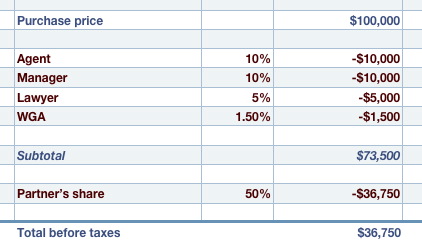
100k grid

Out of all that money, you have less than $37K, and that’s before you’ve paid a penny of taxes. So don’t buy your fractional Net Jet just yet.

Some points while we’re here:

  • Not every writer has a manager. I never did. Many beginning writers find managers helpful in making contacts and working on pitches. Your mileage may vary.

  • While most managers get 10%, that’s not fixed by law the way it is with agents.

  • You can also pay attorneys by the hour — but they’re well worth the 5%.

  • You generally don’t write a check for your agent and attorney — that money is deducted by the agency when they collect from the studio for you.

  • The WGA sends you a form every quarter on which you list what you’ve been paid by signatory companies. It’s your responsibility to pay dues.

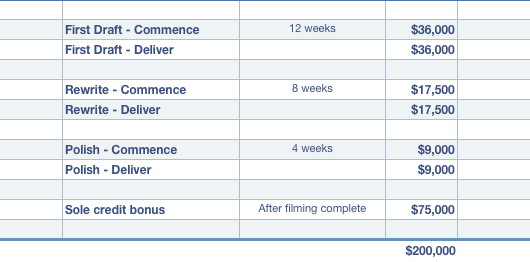
Flipping through Variety, you might think that all screenwriters are rich. For instance, you might read that Sally Romcom sold a pitch for “low six figures.” That’s slanguage for $100 to $250K — still a lot of money. But if you actually looked at her deal, you’d see that the money is structured in a way that she’s unlikely to get it all at once, or even in the same year.
deal steps

Sally is getting paid in three steps: first draft, rewrite and polish. For each step, she is being paid half at commencement, and half when she delivers. Each step has a time frame, ranging from 12 weeks for the first draft to four weeks for the polish. There is generally a four-week guaranteed reading period between each step, which means that the fastest she could expect to be paid for these three steps is 32 weeks (12 + 4 + 8 + 4 + 4).

She’ll get $125K for these three steps. The $75K sole credit bonus only happens if (a) the movie gets made, and (b) she’s the only credited writer on it. 2

In order to pay her bills, Sally needs to be able to predict when she’s going to be getting more money. For years, I kept a spreadsheet tracking projects and expenses across upcoming months, to make sure I’d have enough cash to pay rent six months down the road.

3. WGA membership happens automatically

One day, you’re an aspiring screenwriter who hopes to join the Writers Guild. The next, you’re a working screenwriter who must join the guild by law.

The first time you sell a script to (or are hired to write by) a signatory company,3 you need to join the Guild. Odds are, the guild will contact you as soon as paperwork crosses the right desk, but you can also jumpstart the process by calling the Los Angeles office.

You’ll have to pay a fee of $2,500 to join. 4 Ask nicely, and they’ll let you spread out the payments.

The most immediate benefit to joining the guild is the health insurance. The plans and benefits are confusing but extensive, with trade-offs for Preferred Providers versus HMOs. It’s worth spending a few hours getting it set up correctly. Once you’re in the plan, you’ll need to keep working in order to maintain eligibility.

4. Splurge on one thing

Once you start making money, there’s a natural instinct to upgrade every aspect of your lifestyle, which has probably stalled out in a post-college, heavy-Ikea phase. Don’t. You’ll burn through your money and wonder what you spent it on. Instead, buy one thing you really want and can afford. Make that your reward.

For me, it was getting a dog. I’d wanted one since I was 10, and I was determined to move to an apartment that allowed dogs. I found a duplex off Melrose and got my pug. Twelve years later, he’s still sleeping at my feet. He’s a good dog and a good reminder of how my career started.

Your dog equivalent may be a car, a painting, or a 30-inch monitor. Buy it and enjoy it.

But don’t feel any pressure to act rich. I drive a six-year old Toyota. We buy store brands and clip coupons. We fly coach.5

Over time, you will probably start spending more on housing, clothing, travel and food as your standards rise. That’s okay. But spend your mad money on those few things that actually make you happy.

5. Don’t rush to pay off your student loans

Everyone wants to be debt-free, but classic federal student loans are some of the cheapest money you’re ever going to find. Until you feel confident that you’ll have enough money to last you a solid year, keep paying your normal amount.

Instead, pay off your credit cards and private student loans, which tend to have much higher interest rates.

6. Sock it away

Whether you’ve made a bunch of money at once in a spec sale, or carefully grown a nest egg through steady assignments, you’ll want to put your money in two virtual boxes. In the first, stash enough to live on for six months (including taxes). In the second box, put all the rest of the money you make — and pretend it doesn’t exist.

I’m not qualified to talk about investments, pensions or retirement, but I feel absolutely certain giving you this financial advice: save your money. Get financial advice about about smart places to put it, and then leave it alone. Except for rare occasions — buying a house, for example — you should never need to touch it. Your living expenses should be more than covered by new money coming in the door.

7. At some point, you’ll incorporate

When a studio hires me, they actually hire my loan-out corporation, which provides both tax advantages and liability benefits. I didn’t become a corporation until after Go, at which point my agent and attorney told me it was time. 6 It’s a lot of paperwork to set up — your attorney will do most of it — and a fair amount of responsibility, with quarterly taxes and other filings.

Like heart surgery, it’s smart to ask a lot of questions, but you ultimately want it handled by professionals who do it every day.

Before becoming a corporation, I was managing my money easily with Quicken and Excel. The added complexity of the corporation led me to hire a business manager and accountant. The best resource for finding a good business manager is other writers. You want someone responsible, reachable and thorough. Keep in mind that a business manager is not an investment guy. A business manager is writing checks to keep the lights on. The only financial advice you’ll be getting from your business manager is to spend less money, which is always worth hearing.

  1. I adapted the kids book How to Eat Fried Worms for Imagine.
  2. The shorthand for Sally’s deal would be “125 against 200.” The first number is what she’s guaranteed to make, while the second represents what she’ll get if the movie is made.
  3. There are a few indie companies which are not under the WGA deal, but every major studio is.
  4. WGA East costs $1,500 to join. No, I don’t know why it’s cheaper.
  5. Though we’re pretty canny with upgrades. Get a credit card that pays you either frequent flier miles or hotel points, and use that for everything.
  6. I’ve often heard $200K/year as being the threshold at which point incorporation makes sense, but it may be higher or lower depending on circumstances.
  • Digg
  • Facebook
  • Reddit
  • SphereIt
  • StumbleUpon
  • Twitter
December 18, 2008 @ 11:02 am | Comments (57)
Filed under: Film Industry, How-To, WGA

57 Responses to “Money 101 for screenwriters”

  1. UGLY PUNK GURL!

    that was a great helpful guide, thanks for writing this.

    but, due to the bad economy, I doubt that some of us aspiring screenwriters are going to make our first sale at this time….

  2. Heather

    You are always so good for real information about this stuff. Thanks for all the practical real-world stuff. I really appreciate it.

    I am barely striving to be a screenwriter at the moment, but I do have a question for you. I was commissioned to write a script for an indie producer who wanted to make a (basically) vanity movie – he had never directed a feature before, but has directed nonfiction tv shows. I wrote his script (his idea, his story to his specs). It wasn’t great because it was what he wanted, not what I wanted, which is fine with me. I know how to create for a client, having done design work.

    He shot the movie, and sold it to Starz on demand, which is now streaming on Netflix. The movie’s showing on Netflix Watch Now, which is awesome.

    So, I’m glad it got made, and I had a hand in writing it, and it’s out there in the world. The dilemma is, I don’t want anyone to know I was involved because I had NO say in the story, etc. I just got the producer’s idea from his mind to paper. I’m kind of embarrassed about the movie, honestly. I would be glad to get more work or opportunities from it, but I don’t want to promote it to anyone because it’s embarrassing.

    There’s not a real question here, I guess… but what do you think?

  3. Christian H.

    Great post. I especially was struck by Number One. I have some interest in a few commercial scripts and I admittedly could quit my job, move to LA and get another one – with a raise – but that would crimp my savings.

    Plus I make more than the WGA average.

    I knew it was possible to incorporate as a writer and have the studio hire your corp. Thanks. As you say it is more trouble but thee are tax benefits at a certain income level.

    I’m confident that I can become paid to do this but until then I need to have a paycheck. Hell, I may even get something part time even after I make a sale or get a job. I’m so used to working everyday I’d have to keep it up.

  4. Bob

    Thanks for the great write-up John, very informative! This business sure is wacky.

  5. Earl

    John –

    This post is terrific. It’s exactly the kind of thing I’ve been working through right now.

    print to PDF

  6. Craig

    Plenty of people not becoming writers could use a primer like this as well. Sure, not all of it is applicable, but even as someone with a completely different career I can certainly relate many points, including “you’re never as broke as when you first start making money.” I can still remember finishing grad school (which paid poorly, but at least paid), and starting my first “real” job. There was a gap between the two and waiting for that first check was really painful and also involved asking for parental help with rent.

  7. Johnny

    Great advice John. Hopefully the masses will find this post.

  8. Jonathan

    You don’t need to make 200k to incorporate — any amount is ok under the law; however, no one is going to seriously recommend it after your first $1 (one dollar) option. Or your second, either.

    Frankly, taking on clients that don’t make money isn’t a winning plan for a business manager, lawyer, or accountant. The 200k figure gets thrown around a lot as a result.

  9. Andreas Climent

    Very helpful article. Thanks for the tips, I’ve bookmarked it and promise to read it again once the money starts rolling in.

    Really appreciate all your advice John, you’re awesome!

  10. Ernesto

    I inspired this article with an arrogant question I sent to Mr. August regarding my imminent seven figure sale. Thanks, Me. You too Mr. August

  11. Rusty Hann

    Follow-up question about taxes: Does the studio withhold taxes as if you were an employee (I’m talking about non-loan-out writers)? Do they withhold it at a higher bracket than they should (basing your bracket on that $200K in 32 weeks), and if so is there a way to avoid that (short of incorporating).

    Thanks for a great article

  12. Patrick Sweeney

    Great information. I’m interested in the example of a payment being broken down by first draft, rewrite, and polish – not the money part, but the writing breakdown. The first draft you send to the studio’s not your literal first draft, full of long, flawed, talky scenes, is it? I’d be interested in a follow-up post on what the studios expect to see at each stage, and what generally happens between stages. Thanks again!

  13. sandofsky

    Even if you aren’t incorporating, make sure you have a real acccountant. TurboTax won’t tell you that if you’re an actor you can write off cosmetic expenses such as haircuts.

  14. kip

    I like reading this blog because I learn all about Hollywood, which is far from my profession (computer programming). However, one of your side-comments brought up something I’ve been wondering ever since I saw a Seinfeld script as a DVD extra: why are scripts done in 12-pt Courier?? And why are the lines so narrow? Is it just tradition? Monospace fonts are generally considered to cause much more eye strain on longer passages (say, a 100+ page movie script), and narrow margins mean lots of page-turning. I know the intended audience is different from that of a newspaper or novel, but I still don’t see what monospaced fonts add that couldn’t be done just as easily with Microsoft Word.

    And if monospace is required, there are some more readable monospaced fonts out there (like Consolas, which comes with Vista and Office 2007).

  15. Dale

    Thanks for the info. It all doesn’t apply to me (since I’m a game developer), but I’m expecting a decent amount of royalties (my first ever), and I wasn’t sure how to handle my student loan debt. This helps.

  16. Nick

    As always, John, you’re my best window into the real life of a screenwriter. Thanks for this.

    (I, of course, plan to obviate many of these issues by selling my first screenplay for at least $1 million.)

  17. John

    @Rusty Hann:

    If you’re working through a loan-out corporation, then no, the studio doesn’t withhold taxes, and you’re responsible for all the state and federal taxes — which is why you end up needing an accountant and/or business manager. You have to pay taxes every quarter.

    If you’re hired as an individual, as I was before Go, it’s more like being a fry cook in that you get to list exemptions in an attempt to control how much is withheld.

    @Patrick Sweeney:

    The first draft is the first version script you’d be willing to show the studio. You obviously have many drafts of your own before you’re handing them anything.

    @Kip:

    12pt Courier started because scripts were typed on typewriters. The format stuck because no one has come up with something so much better than everyone is willing to forsake the familiar. You could probably get away with Consolas, but readers would still be a little wary.

  18. Kel

    Rule # 1 My first gig as a staff-writer on a prime time show…I had to ask for a loan from the petty cash fund so I could pay my rent that month. Yes, it can take a long time before the money kicks in.

  19. Ellen Simonetti

    Thanks, John! I’m working with a Canadian production co, so I wonder how that will work. I guess I will find out soon enough. BTW, if anyone has a spare moment and a soft spot for dysfunctional flight attendants, pls check out my blog and let me know what you think of my TV pilot outline: queenofscreen.com It’s based on my book that’s based on my career-ending blog.

    Much obliged!

  20. Justin

    This was perfect – thanks for this. I was recently hired by my company to do a re-write for Guild minimum. It’s not quite enough to get into the Guild but I’m eligible for “Associate Member” status. When I contacted the WGAW, they said it was $75 a year (for two years) and I would get the same benefits as full members but I couldn’t vote or run for office. This seemed weird to me (mainly – I can’t get health insurance through this, can I). Do you or anyone on this post know what the full extent of the Associate Member is? Should I keep my fingers crossed for another writing job and just wait to become a full member or should I jump on this? In terms of loans, I have quite a bit of both federal and private. My thought was to throw close to half of what I’m getting at a private because I couldn’t earn enough interest at a bank via savings account or CD to keep up with the interest of the loan. Would you advise against this? Sorry for all the questions. I’m a little green with it all.

  21. Dave

    Some mention of Excel, but from the looks of things, you might be more of a Numbers guy, huh?

  22. Max

    Such a fabulous post — which I could’ve used three months ago when I got my first job. It’s worth repeating: studios take FOREVER to pay. They will use anything as an excuse not to pay you.

    And though it will take you a few years before you are able to incorporate, it’s quite easy to lead a frugal lifestyle on one assignment a year.

  23. Ranielle

    Your assistants have health insurance? I am green with envy. The greenest kind of green.

    Thanks for the info. I hope I have to use it some day.

  24. Ayz

    This was REALLY informative John, so thanks a lot. wow.

  25. emily blake

    Thank you.

    You’re a good man, Charlie Brown.

  26. Bobby Blue

    Thanks for such an informative post.

  27. John

    @Justin:

    I honestly don’t know anything about Associate Membership. Sorry.

    @Dave:

    I really like Numbers, but I rarely find I need a spreadsheet these days.

  28. Sweeny

    @ Justin:

    Unless something has changed in the few years since I shifted from Associate WGA Membership to “Active Current” status, you wouldn’t be eligible for health care coverage as an Associate. The minimum earnings threshold for health care coverage in any given year is also the minimum threshold for full membership eligibility.

    Something else to look out for: you can accrue enough earnings over the course of multiple years to be eligible for full membership, and still not qualify for health benefits. That’s because, for health care, you need to earn the minimum during one year-long window in order to get coverage.

  29. Gary

    You are a generous guy. Grateful to you. Merry Christmas. G

  30. Brett N

    Rather excellent.

    And great advice re: lawyers. I’ve had a few friends pass through that magical transition (from aspiring pro to first time pro) and it’s a little unnerving to see how every one of them has had some (ahem) “bumps” in the way agreements and contracts have been interpreted and honored. Get the best legal team you can comfortably afford, as it always seems worth the investment.

    B

  31. daveed

    John, you need to be awarded a Nobel Prize for all that you do for us screenwriting hopefuls. Or at least a month’s worth of Starbucks. Thank you (as always) for the very informative post.

  32. Jules

    This is great, John. All true. Everyone in my small hometown thinks I’m rich because I’ve had some big movies, but I’m still driving a 10 year old Toyota. It’s amazing how much agents, managers, lawyers, accountants, and WGA dues chomp away at the pie. I’ve gone through long stretches (my longest is a year) of pitching, having projects fall apart, etc. before the next check. Oh… and don’t forget about the lovely 3 1/2 month long writer’s strike. I almost lost my health insurance during that time.

    If you like working from your bed, not brushing your teeth until after lunch, and taking important phone meetings naked, this might be the job for you. If you like stability, however, seek employment elsewhere.

  33. Alice Cooper's Stalker

    Great post. Great insights. Appreciate you sharing them. While we are talking money and hollywood, do you have any insights into how the economy is impacting or projected to impact hollywood? Are fewer movies being made? I’m assuming that the unions protect some salaries.

  34. eve

    Thanks for taking the time to post all this info. This is an amazingly helpful site in terms of putting things into perspective for people like me, who are still outsiders – or as you put it, not yet sitting at the table with the grown-ups.

    On the other hand, I am disappointed to hear that writers don’t just go out and buy a new 911 when they get their paycheck, like Hank in Californication.

  35. Karen

    You’ve mentioned it in the past, and most people know this already, I’m sure, but new screenwriters should also be aware that the cost of living in LA is very high. A “six figure” salary in SoCal is really the minimum you need to be mid-middle class (to own a home and car, let’s say), no matter the career you’re in.

  36. Cherilyn

    It’s barely applicable; full of stereotypical scenarios intended to discourage possibly talented screenwriters so we can see the same crap that is out there over and over.

    Write, submit and keep your day job. Fortunately I have a day job that doesn’t get in the way of my artistic efforts. Try to find one yourself.

    You don’t need a manager AND a lawyer AND an agent to sell a script(I know that was mentioned; but I think you only need a one time sit down with a lawyer). There are so many scenarios under which a screenplay is sold that it’s impossible to pinpoint what will happen, so instead of allowing naysayers that plague these sites to squash your dreams, merely continue writing, submitting and acquiring contacts. I live in LA(very comfortabley, and NOT on six figures) so that helps; and haven’t experienced the discouragement that these sites pour our. AND…I’ve never met another person who says they are trying to sell a screenplay; “Every waiter and barrista in Los Angeles considers himself a screenwriter, so quitting your day job is an important way to distinguish yourself as a True Screenwriter…blah,blah,blah.” EVERYBODY isn’t doing it, okay? So please keep writing, and don’t use these crap sites as an excuse to quit. I need to see better movies, please.

  37. Greg

    Excellent stuff, John–reminiscent of the other great writing blogger John (Scalzi’s) posts on writing.

    Heather–if you got a PAID WRITING GIG for a movie that ENDED UP BEING PRODUCED, this is not only very, very good news–congratulations!–but the first thing you should drop into conversations w/ people involved in the biz. I’m not someone who divides the world into paid and unpaid writers, but other people are, and it gives you instant credibility with many people–people who may not want to be the first person to hire you, but are more than happy to be the second.

    After you’ve mentioned the fact that you got paid and the fact that it got produced, mention a couple of things you like about the movie… and then you can talk about your reservations or what you would have done differently. Luckily, most people understand that writers don’t traditionally have final say when it comes to making movies, so it’s not a hard thing for most people to grasp.

    But yeah. You’re a paid writer with a produced credit. Say it loud, say it proud, and shout it to the skies.

  38. Crystal Diane Stevens

    Another piece of advice might be to keep on churning out more material. Odd how so many screenwriters, once they get an option or an outright sale, suddenly decide to rest on their laurels. A couple of years later, their money is long gone and they have written another industry ready script.

  39. Kevin

    very cool. thanks and merry xmas!

  40. Mahalo

    I hope that friend that’s always “6 months away from teaching community college” won’t think life is over if it does happen. Some of my fondest memories are of those long days with my screenplay writing professor. :D

  41. nyc/caribbean ragazza

    This was great advice. Especially regarding how long deals can take to close.

    I have seen many a tyro scribe sell a spec then a year later they are broke and can’t get an open writing assignment.

    Living below your means is the way to go.

  42. Leroy Brown

    I’m glad you wrote this and pointed out something that most people who get into the business don’t even realize until it might be too late. I spent 6 years trying to make it as a screenwriter and it wasn’t until after 4 years where I realized how easy it is not to make money in this business.

    At that time I decided to start my own company. Now my screenwriting career has started to take off and I”ve had 2 nice spec sales over the last 2 years.

    But the only reason I am doing really well financially is due to the fact that I still have my business. No one in Hollywood knows it’s going on, but my company has turned out to be more profitable than screenwriting and since I am my own boss I get to work my own hours.

    Right now my company is just me so I can pick up and leave for weeks at a time and just do a minimal amount of work.

    I can’t say I have much of the screenwriting money left, but I’ve got a great job, that pays well, and has a lot of flexibility.

    And the greatest thing is I never have to worry about when my next check is going to arrive in the mail…I already know when it will.

    And I have actually seen former classmates of mine sell scripts for a decent amount of money only to never be heard from again.

    So my recommendation to all up and coming screenwriters would be to find an alternative source of income. Ever since I have done this, my life is so much less stressful, I am very happy and I get to do what I love most.

    Sure one day I hope to be able to cash checks like David Koepp, but until then I’ll just keep moving forward until I get there.

  43. Kristan

    I think #4 is valid for anyone in any industry. I’d even argue NOT following #4 is a serious problem in America / for most Americans.

    Thanks for this insight! I think the basic financial principles (plan for short-term and save for long-term) are universal, and wise. But that’s just one poor writer’s opinion. ;)

  44. Passerby

    I always wanted to know more about the positive’s and negatives of being “incorporated” I’ve done some research, couldnt figure out which one screenwriters use. S-Corp, LLC? If it’s a straight corporation than I guess that makes sense? Thanks for the info. You are a saint :-)

  45. David Kassin Fried

    Lots of great advice here. Thanks!

  46. James

    great post…helps to keep things in check with a dose of reality, especially after last years strike, to show that not every screenwriter is bringing in millions, and a 100 grand can quickly shrivel up after the ten percenters and others get their cut…

    writers (and all other freelancers who keep their own investments and retirement funds), should also make sure they know exactly where the money they do get to keep is going…

    http://www.nypost.com/seven/12272008/news/nationalnews/bilkedofallhisbenjamins_146064.htm

    this truly sucks for mr. roth

  47. Christopher Robin

    Great advice. I used to write screenplays, but somehow someway transitioned into writing television pilots. Have written 2 so far, and working on a 3rd. From everything I learned at the Screenwriter’s Expos, through these blogs, as well as other industry peeps over the last 8 years or so, seems TV is a more promising career when it comes to finding stable work, unless you’re someone as notable as John August of course. But I like TV writing better anyway, but that’s just a taste of mine. But thanks for the heads up, it really is interesting to see how things work with the money aspect. How does it work with back end money? or points? I am still fuzzy on al of that.

    And, what kind of dog did you get?

  48. malice

    brilliant post. would’ve been good for me to read it about two years ago, but at least it’ll serve the noobs.

    i’m friggin starving here!

  49. Sarah

    Are there any film / screenwriting fundings in America such as we have for example in Germany or are you completely dependent on a decent producer?

    The screenwriter’s funding for example is partly comparable with a social benefit. It’ll support the 100% writers to cover the time they don’t earn any money. If you’ve got success, the funding needs to be returned, if not, then the sponsers did the wrong investment – as simple as that! Of course, they’ll check your idea and spendings in detail, so that you cannot simply make a lot of money for nothing!

    Same applies to the film funding. You can apply for this particular funding in a particular federal state where the film is supposed to be shot. E.g. Valkyrie has just been sponsored with 4 Mio. Euros in Berlin. In an interview Tom Cruise naively said that our country was so kind to actually “sponsor” the film with 4 Mio. Euros, but he probably didn’t know that it was just a temporary funding and needs to be paid back (if the film is a success).

  50. Jake

    One last point on WGA health care. While a spec sale does earn you membership in the guild, it does NOT qualify you for health coverage. Only work you are HIRED to do by a signatory company goes toward your health care qualifying minimum (something around 36K?). So if you’re not hired to do rewrites on your spec, you’re out of luck until you get (a check for) another gig.

  51. Miss Julie

    Dear Mr. August,

    In Spain (Europe) there are many professional screenwriters, from TV and cinema, read your blog frequently, which it is a reference for us.

    I am a membership of ALMA (Litherary Authors of Audiovisual Media), a screenwriters sindicate (the only one at the moment here in Spain). Even if we are just at the begining of our way, we are starting to have a big importance in between script professionals, but we still have a lot to do. For this reason, I have made a summary (always mentioning you as the author and your blog as the source) of the really very interesting post I have posted this summary in my own blog for it to be accesible for all the visitors who can read Spanish.

    See you in the next visit, and thank you very much for your marvelous blog.

    Yours faithfully,

    Miss Julie

  52. Scott

    I have recently been writing a screenplay with a couple friends ands its actually turning out somewhat good. Just was wondering if there is any advice for finding an agent should you just send your script into a few different ones and see what one likes it best and you get the best deal out of or just go with one thats lower down to get started off. Also is there any advice as to any important things that should be in or kept out of a script. Thank You

  53. Coop

    Really great post. However, having just read through the comments from your readers, I’m struck by how many of them have no grasp on something as basic as sentence structure, (and don’t get me started on the use of ‘it’s’ vs ‘its’). One would assume these are aspiring writers. Makes me want to scratch my noggin.

    Irregardless, for all intensive purposes this was a helpful post. LOL.

  54. carcar

    Teaching at LAFS and looking forward to hearing you speak on Friday. I’m not sure how much time you have to speak, but I think this topic and the Rise of the Amateur are two of the most useful articles a graduating student could read. Hope you’ll get some new fans and that they’ll get as much out of this website as I have.

  55. Eva

    Thanks for sharing some great insights, very applicable to many professions. Given that you are sharing from your own experience, your expertise is very valid — one doesn’t have to be a professional financial wizard to enlighten us about what to expect in the business since you are a working professional. So I don’t get the “sour grapes” comment(s). People, or actually “person” John is sharing his knowledge to help all of us. It’s downright fact that MOST, for a host of various reasons, won’t make it in this business. That’s reality, but if you love writing and feel you have something to say, you’ll keep on writing. If you just want to make a “quick buck” as delusional people sometimes erroneously believe you can by just “writing a screenplay”, then you’ll surely shrivel up and die in terms of being a productive writer.

    Which leads me to a question — does anyone know, on average, how long it takes for someone to break through into this business? Lew Hunter I believe advocates that you write at least five original scripts before you consider your work to be ready for the industry. Any thoughts on this?

  56. MAHolm

    This was one of the links I got when I googled “should I give up screenwriting.”

    It answered me question perfectly and addressed my real problem without my knowing what that problem was. I was hoping for the big payoff (money, fame, happiness). It ain’t coming.

    Thank you.

  57. zeugirdor

    thanks for sharing this informative article,..thumbs up!


About

This site is run by screenwriter John August. Mostly, he answers reader-submitted questions about the craft, but occasionally he goes on tangents that run far afield of writing and filmmaking. You'll also find info on past, present and future projects.

Follow Me

On Twitter: @johnaugust

Ask a Question

If you have a question about screenwriting or my movies that hasn't been answered, by all means ask. There are a few guidelines to follow.

Featured Articles

101: Some screenwriting basics


There are more than 900 articles on the site. You can find category archives at the bottom of every page.

Read Me

  • The Variant
  • A new short story available for download, Kindle and iPhone.

Feeds