The sky is not falling
To me, one of the most annoying non-stories of the summer — trumping even items involving Britney Spears — has to be the “crisis” caused by the box office slump.
For those who’ve somehow missed the articles, here’s the quick summary: weekend-by-weekend, the total box office was less than it was for 2004. This slump lasted from February until July, a total of 19 weekends. Along with the numbers, every Monday brought new speculation about just what was causing the downturn, and What It Really Meant. Could the problem be the poor state of movie theaters, the growth of DVD, the price of gasoline? Fingers were pointed everywhere, but most often at the movies themselves.
The movies stunk.
Whew! Glad we got that settled. You hear that Hollywood? You have to start making better movies! Movies people want to see!
Thank God we have the conventional wisdom. All we have to do is keep repeating it, and everything will be okay. Just this morning, the Los Angeles Times had a front-page story on the issue: “This Just in: Flops Caused Box Office Slump.” In the article, various studio big-wigs take responsibility for how badly the summer movies fared:
After months of hand-wringing and doomsday forecasts about the permanent erosion of moviegoing, the lunchtime chatter at Mr. Chow in Beverly Hills and other industry haunts has turned decidedly inward. Now, four straight weekends of crowded theaters have forced moguls and creative executives to admit in public what they have spent months avoiding: They were clueless about what audiences wanted.
The story has quotes from the likes of Amy Pascal and Brian Grazer. I can imagine how those conversations went:
Journalist: “Would you say the slump was caused because the movies were awful?”
Executive: “Umm, maybe. I guess.”
Journalist: “No, seriously. Say it.”
What makes this self-flagellation so annoying and unwarranted is that the “box office slump” is basically a myth. The Los Angeles Times included a chart which ostensibly shows the crisis, but in reality disproves it.
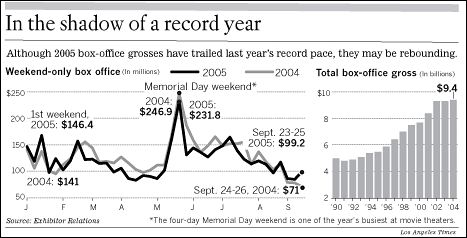
Week by week, the black line is a little below the gray line — except when it’s above it. More importantly, it tracks very closely. A more honest chart would have also included a line for 2001, which was at the time the pinnacle of box office grosses. This summer had that beat.
An analogy: Let’s say one year you have record rainfall. If you’re a journalist covering the weather, you write about how much above average it is.
The next summer, you’re back to a more typical rainfall. That’s not interesting. That doesn’t merit a story. But if you write about the “shortfall” compared to last year, well, now that’s worrying. And fallacious.
To their credit, buried deeper in the story, the LA Times writers do reveal the less-exciting truth: “Ticket sales lag behind 2004’s numbers by only 6%, with attendance off 8.7%.” Since Labor Day, the numbers have been running significantly ahead of last year, so by the time January rolls around, the year-end totals may not be very far from the $9.4 billion that movies brought in last year.
Which leaves an open question: did this summer’s movies really stink? There were some outright bombs (Stealth, Bewitched) and some quality misfires (Cinderella Man). But I think trying to correlate a quantitative measure (how much movies make) with a qualitative one (how good they are) is pseudo-science at best. Case in point: Fantastic Four made a lot of money, but it won’t end up on any best-picture lists.
Let’s ask the question: What if one of the late-spring movies had made a fortune? Say, xXx 2: State of the Union. Just one mega-hit would have erased the supposed slump, and the week-to-week numbers would be higher. Which brings up two points:
- Is there really an industry crisis if just one movie would eliminate it?
- If the numbers were better, would you still write about how bad the movies were this summer?
The final apples-to-oranges comparison in the story is perhaps the most annoying. Bennett Miller, a talented documentarian whose first narrative film Capote opens soon, is asked to comment on the state of the box office. What he says is less revealing than the fact that they asked him at all. It’s like writing a story about the auto industry and interviewing a guy who makes bicycles.
I hope Capote is great. But I’m not counting on it to save the film industry, which, for the record, I don’t think needs to be saved.
Hollywood makes some shitty movies. It always has, and always will. But trying to conflate popular sentiment with specious data does a disservice to everyone.


October 1st, 2005 at 11:25 am
Hey John-
Thanks for instilling some sense into this debate.
Unfortunately, journalism is nothing more than a reality entertainment outlet that thrives on fear and uncertainty.
–cheers Sam
October 1st, 2005 at 12:19 pm
Another non-issue I’d like to see put to rest is the one about the ’70s (pick your era) being the last time good movies were produced.
We just forget all the bad ones that were made and watch Chinatown, the Godfather, and Jaws till we’re sick in the head. Time has always been the best measure for judging art; who’s to say we won’t be extolling the virtues of Cinderella Man in 10 years? And who will remember Stealth?
Box office success and cinematic quality: not often the twain shall meet. Office Space made pennies in its first run, but look at it now. Even Oscar hardware doesn’t guarantee longevity. Think Gandhi.
There are some good movies out there, and people just aren’t going to see them.
October 1st, 2005 at 12:40 pm
Although, to be fair, merely being “as good as last year” is actually something of a decline – not just because of inflation but because of population increases, etc.
The rainfall analogy breaks down because you don’t expect you have more rain in each successive year. You do, barring external factors, in films.
But I do think things have been a little overhyped.
October 1st, 2005 at 1:02 pm
John:
I can’t link to this fast enough. Bless you for speaking the truth. The great box office slump of ‘05 is nothing more than a meme.
October 1st, 2005 at 1:21 pm
Great article. I live in Spain (I’m spanish) and I have been reading every monday about your box office slump. It’s great to have read your article because I also thought it wasn’t such a crisis in your film industry (I wish in Spain we had a film industry).
Sorry for my english, it was good a few years ago but now… I will probably link your page from my own blog cause your blog is great and I think your download page is quite useful. Congratulations.
October 1st, 2005 at 1:56 pm
I’d like to see last year’s numbers without “Passion of the Christ.” I think it’s a little unfair to compare this year with last and think something’s wrong when everyone, their mother, and the kitchen sink went to see that frickin’ movie.
October 1st, 2005 at 2:45 pm
Ron –
Really good point about how growth is expected in box office, but not rainfall. I actually had a disclaimer about that after my analogy, but cut it because it got too off-the-point.
Looking at the right-hand chart of the two in the LA Times, it’s pretty clear that box office has increased at a pretty good clip, then plateaued last year. This year probably won’t beat it, but won’t be a big decline. I think it’s valid to ask, “Has the box office stalled?” It’s meaningless to ask, “Why is the box office tanking?” when clearly it isn’t.
Mr. Crumpett –
You point out what I like to call The Myth of the Golden Age. It’s the way that everything used to be better way back when. Not so surprisingly, “way back when” generally tends to coincide with the speaker’s childhood. I’m convinced that today’s bad movies are no worse, nor more plentiful, than those of the 60’s and 70’s. They’re just more recent, which is why we remember them.
October 1st, 2005 at 3:27 pm
Crumpet and John,
Sorry, but you are both nuts. Nuts, I say! The 70s were head and shoulders better than any other era in Hollywood history. The top 4 movies from 1975, for instance, were better than any movie that has come out in Hollywood this entire decade by far.
Nashville Jaws One Flew Over the Cukoo’s Nest Barry Lyndon
And you could say the same about 76, ‘74, ‘73, ‘72, and ‘71 as well.
I will agree movies are better now than they were in the 80s, and the 90s was a pretty damn good decade, better than the 60s I think. But the 70s was truly the Golden Age of Hollywood.
October 1st, 2005 at 3:39 pm
In the meantime, back in June…
Slump & dump to the markets.
Where’s quality? Numbers stack worldwide about tent-pole films of our usual summer times.
It has everybody worried for the aftermath of a cyclic variation. Looking for reasons or explanations seem to be a convenient way to let some steam out on the products themselves. When all they had to think is this…
1) Flood a market with something and anything, it must absorb the pattern. 2) Moviegoers want better, faster and value. 3) Medium ways; Screenings, Rentals, DVD, Data streamings.
Are we to believe the artforms are on a serious path to find an alternate process? And if so… should they be altered to answer “modern” needs or expectations?
Back to the drawing boards, i guess.
Where there’s evolution, the mind reacts. The magic of it being, the present forms are morphing into a new process. As interactive or pro-active it could have been for years!
Bring it on, we’ll anticipate and factor in those slumps only if we CAN control people’s hopes for a change so fundamental, it makes celluloid and binary look pale compared to what can really be produced. And, then… dump it. For cinema’s sakes and the creativity we cashed out instead of letting it happen.
We’re on the edge and we will brake all the limits. Entertainment follows us or fails.
Yup, us other co-bloggers have actually reacted to this issue right when it mattered most; Summer!
How strange to keep finding out statistics can stir that much mindsets of so many people, indeed.
October 1st, 2005 at 3:44 pm
I’m sorry, Gary, but there is no way Jaws is better than Van Helsing. That movie was so cool, Dracula walked up a wall ‘cuz he felt like it. Let’s see Jaws do that.
/sarcasm
October 1st, 2005 at 3:52 pm
Sylvain, I have no idea what you just said. None. Where’s Craig Mazin when you need him :)
October 1st, 2005 at 4:31 pm
I’m not in the movie industry, but I am in the stats industry. Looking at the number at boxofficemojo, there seems to be a direct correlation between the number of movies released and total box office.
Here are the number of movies tracked by year:
1995 – 271 1996 – 298 1997 – 291 1998 – 318 1999 – 376 2000 – 361 2001 – 349 2002 – 471 2003 – 507 2004 – 551
2005 is on track to release 520 movies, 9% below last years total…hmmm.
October 1st, 2005 at 4:56 pm
Once again, gary, you’re seeing what you want to see. You pick a handful of movies that are good, then ignore the one’s that are bad. Do that for every decade and John’s right, you can make an argument for ANY decade. We all do it. It speaks to our tastes.
The 70’s had a some good movies. But hollywood’s golden era… please.
October 1st, 2005 at 5:28 pm
I wonder if total risk-aversion is itself a risky venture. Remakes and comic books may seem like the least risky path because of their established nature, but I think when you have too much of it you end up with audience fatigue. Maybe HW needs a more diversified RISK portfolio?
October 1st, 2005 at 6:28 pm
If they push DVD releases back to nine months after the initial theatrical release, I’ll bet they will see at least a five percent increase in box office receipts. Whatever the reasons or excuses for the box office decline, this the worst era for quality adult dramas since the early to mid-60’s.
October 1st, 2005 at 6:48 pm
I think the biggest con that the media have spun out is the one about “March of the Penguins� dominating the box office or saving Hollywood.
It never reached No. 1. Its screen average was consistently less than many other films that received far less attention. $67 million for the most hyped-film of the year is hardly spectacular. It cost $8 million, so it was low-but-hardly-zero budget.
If there is a slump at the box office I think its less to do with the films (the number of good to bad has remained the same for years, and this summer produced some pretty good films) than the whole cinema-going experience. It costs more to see a movie once at the movie theatre than to purchase a DVD and watch it as many times as you like, in pleasent surroundings where you can pee when you want to. In theatres you’re stuck with people talking, heckling “amusingâ€? comments at the screen (which are, obviously, way funnier than anything the filmmakers can spend years working on), smelly food, uncomfortable seats, commercials, etc.
October 1st, 2005 at 10:21 pm
Derek, “once again” would presume a first time? It’s not just me, man. Ask any film critic, theorists or film geek, and they will concur. I promise :)
While I agree, there are just as many bad films released then as there are now, but the great films of that era dwarf anything getting made today. Every year there were 5-10 masterpieces being released; in this decade there are about 4 truly spectacular Hollywood films period.
October 1st, 2005 at 11:13 pm
I suspect that whatever decrease in revenue the studios suffered at the box office was more than offset by an increase in DVD and VOD revenues.
Cry them a river.
October 1st, 2005 at 11:24 pm
Which 4 Hollywood movies made this decade are “truly spectacular,” Gary? Is there a consensus?
October 1st, 2005 at 11:51 pm
Nail on head. Reminds me of the freakout ’sharks attack serious’ of a few years past, you get one big splashy story, get people’s senses heightened and then conform it to fit some pattern, and find some underlining cause behind it all. But that’s fool’s gold, as things are more complex and always absurd.
Bad movies? Accelerated DVD cycle? Internet downloading? Limited theater releases to stoke DVD sales (aka ‘Crash’)? International slump and mismarketing? Direct-to-video? Changing societal demographics? Home theater quality now so much better? Finicky dulled-dry fans? High ticket prices? Netflix and ilk? Endless copycats, sequels and TV-show remakes? In-theater advertising? Disruptive audiences, and jerks that never turn cell phones off? Boring cookie-cutter Megaplex hardtops…why everyone needs to be a Palm Beach Muvico? Pick your poison, then gather enough data to form a sweeping overgeneralization, and bingo, a journalistic theme.
October 2nd, 2005 at 8:46 am
Sorry, I meant “once again” as in I was reiterating what John had said. While I think this decade is by far one of the weakest, I wouldn’t use it as a comparison. If I had to get in the ring with the 70’s, I’d use the 80’s. Pound for pound a worthy contender. But again, it depends on what you like. I thought the 80’s brought some of the best in action movies (but most people look back now and wouldn’t agree). But then again, most of the “classics” that the 70’s holds I’ve never liked. I personally hate the Godfather. But that’s just me.
As for DVD’s, movie sales have actually dropped drastically. It’s a concern almost on par with this “slump.” Amazingly, the one thing that’s saved it is TV on dvd. They’re accounted for the offset, actually boosting sales. So maybe that’s why we’re getting so many TV remakes on the big screen.
October 2nd, 2005 at 4:18 pm
I remember as a small child loving “The Way We Were” so much I then went to every subsequent Robert Redford movie all by myself. This was before they starting making movies for kids hoping that parents would like them, too — but rather vice versa. If you ask me, when the youth tail started wagging the dog, it all started to go south. Not only for the movie biz, but also for society at large. Since the whole industry started being driven according to the unrefined tastes of your average eleven year old, we’ve seen several generations of kids who truly believe they’re the center of the universe. Trust me on this on both fronts — I’m not only a failing screenwriter, but also a failing college professor.
October 2nd, 2005 at 4:38 pm
maybe because they open on 6,000 screens opening weekend, that the same number of people are going, but they all just went the first weekend… the rest of the low totals can be contributed to the dead or incarcerated
October 2nd, 2005 at 4:42 pm
I’m just curious, Derek, what 20 films of the 80s holds up these:
The Godfather The Godfather II Chinatown French Connection Clockwork Orange Barry Lyndon Nashville MASH McCabe & Mrs. Miller Taxi Driver Jaws Paper Moon Last Picture Show Deliverance The Conversation One Flew Over the Cukoo’s Nest Apocalypse Now Kramer vs Kramer Network Annie Hall
….and we haven’t even gotten into some of the real big “hits” of the decade like Rocky, Star Wars, Deer Hunter, The Exorcist, nor the small auteur masterpieces like King of Marvin Gardens, Fat City, Bad Lands, Days of Heaven, Mean Streets, Heartbreak Kid, etc etc…
October 3rd, 2005 at 6:32 am
I’m not worried. Snakes on a Plane is sure to save the industry.
October 3rd, 2005 at 6:43 am
What’s with all the 70’s era bashing? The films from that period ARE head and shoulders above today’s crap. That’s because the 70’s were a transition from the studios not knowing to them knowing only too well what the audience wanted. Films such as THE LAST MOVIE and STEELYARD BLUES never would have been greenlit today. Everything after the 70’s is just repeating what they established. It’ll never get that good again. And I’m not giddy over that period because of my childhood. I was born in ‘76, so I wasn’t aware of what was happening. Like somebody said, “Nobody ever knows that they’re living in a golden age.”
October 3rd, 2005 at 7:39 am
I’m not bashing the 70’s movies, just the idea that they were the best. I don’t think any era’s necesarily better than another, my point it it has to do with what you like and how you think.
Like in Gary’s list, I’d rather hit myself in the head with a hammer than watch some of the movies on that list. But that’s me. And for arguements sake, here’s a list of some 80’s classics:
E.T. Blade Runner Glory Amadeus Raging Bull The Shining Full Metal Jacket The Empire Strikes Back Stand By Me The Terminator Back to The Future Platoon The Princess Bride Ran All the Indiana Jones movies Die Hard Gandhi The Right Stuff Rain Man Scarface Brazil
And that’s just a quick list. How many of them were nominated for Oscars? Point is, good stuff is there if you want it. Just like today. Anyone seen “The Baxter”? If we’re willing to wade through the crap and our own biases, hollywood hits it right sometimes.
October 3rd, 2005 at 7:46 am
Yes, but the 70’s broke through. Therefore that particular period where studios took chances on first time directors is different and resulted in many brilliant films and a share of flops as well. And RAGING BULL is a 70’s film and released in 80. Not a true representation of 80’s cinema.
October 3rd, 2005 at 8:10 am
You got me on that one, I was going by the date on imdb. And I think you’re right about the 70’s being a breakthrough decade, just not necessarily the best. I mean, how can you argue against the decade that gave us Purple Rain? ;)
October 3rd, 2005 at 9:50 am
The 70’s were great but I think 40’s and 50’s were better (though I think this is not so important to argue about it).
Greetings
October 3rd, 2005 at 9:56 am
The 70’s were great but I think 40’s and 50’s were better (though I think this is not so important to argue about it).
Greetings
October 3rd, 2005 at 10:40 am
it’s more than the quality of the movies.
I’ve talked to more and more people who are getting less and less patient with the condition and carelessness of movie theaters and those who run the projectors, maintain the screens, etc.
which is exactly why i started the website to do a little part in letting the theaters and others know that it is not acceptable. especially considering the constant increase in ticket prices, despite an improvement in theater conditions.
October 3rd, 2005 at 10:43 am
A toast to Allan!
Snakes On A Plane will not only save the box office, it may very well revolutionize cinema.
October 3rd, 2005 at 10:54 am
Oh, you really have no idea, Gary?
Hollywood (read American made cinema to this, would you) couldn’t plug a generation with plenty of money to spend (aka; boomers’ era) even if they tried hard enough. The gaming world entertains, that’s why they have a pseudo-slump at the wickets.
1) Price hikes 2) Quality of the products, themselves 3) Obsession with remakes, sequels, franchise, stereotypes, fast-food pubs, etc. 4) Piracy 5) Economies recession 6) War abroard 7) Wealth and greed 8) Take over of MGM by Sony 9) Miramax and Disney (or anyone else, btw) stacking ups of investors’ dividends rather than tally it on creative staff
In the meantime, back in different decades where population actually had the cash to afford leisures.
You just read what you want, gary. Go blow a gasket and try to figure dumping is as simple as SOMEONE’s market shares, free or limited to an elite stuck on a recipe for success which is obsolete, already.
October 3rd, 2005 at 10:57 am
1939, people. 1939. :-)
October 3rd, 2005 at 12:47 pm
Sylvain, I’m really not trying to be a jerk, but seriously, I STILL have no idea what you’re saying. Can someone translate this please:
“Go blow a gasket and try to figure dumping is as simple as SOMEONE’s market shares, free or limited to an elite stuck on a recipe for success which is obsolete, already.”
October 3rd, 2005 at 1:03 pm
Maybe it’s just because TV’s are bigger, better, and cheaper then a night out!
TV taking more of our time The amount of television Americans are watching increased again last season, according to Nielsen Media Research. By CHASE SQUIRES, Times TV columnist Published September 30, 2005…
article here: http://www.sptimes.com/2005/09/30/Artsandentertainment/TV_taking_more_of_our.shtml
October 3rd, 2005 at 5:17 pm
The box-office being in a “slump” is irrelevant, as it makes very little different to profits of the industry as a whole.
Tickets sales are a loss leader.
The other revenue streams (DVD, cable, syndication, merchandising, etc) make several times more than the box-office, and though the industry didn’t plan it that way originally, they sure as heck know that’s how it works now.
So crying about low box-office figures is silly. If all revenue streams dipped, then they would have something to talk about.
October 3rd, 2005 at 7:44 pm
I disagree, Konrad.
Without the big screen, movies are just TV. And let’s be honest, TV is better at TV. “Deadwood” is better drama than any recent movie. “Family Guy” is funnier than any movie comedy. The new Battlestar Galactica is better Sci-Fi than anything Hollywood has cranked out since “Blade Runner.”
No box ofice, no more Hollywood…
October 4th, 2005 at 6:03 am
I’m always surprised at how upset Sylvain gets that no one understands what he’s trying to say. You’d think he’d be used to it by now.
October 4th, 2005 at 6:57 am
One thing that’s funny about the quality argument of the “slump” is that most of the movies that don’t seem to find and audience here, that take in little money and are labeled “flops” tend to make most of their money (often a profit) overseas. The Island was a big loser here (though I liked it) but is doing remarkably well overseas. So can we still say quality is a valid argument? Any thoughts?
October 4th, 2005 at 12:04 pm
Me, upset by now? Okay, Vlad and Gary… i “wanted” to share my thoughts on the now infamously stupid slump. It’s all in the attitude against others or deserved ignorance. Translate all you want, both of you are provocative and that’s too bad for JA’s blog.
I might not fit your definitions of proper englo-slang but i know how to detect insults or idiocy from total strangers.
For anyone else reading this, sorry i HAD to defend myself.
Who cares anyway, right?
October 4th, 2005 at 1:50 pm
The Hollywood crisis that isn’t Everyone panic – that’s an order!
http://www.theregister.com/2005/10/04/hollywood_crisis_no_crisis/
Barely a week has gone by without reports of Hollywood’s great box office slump of 2005. So our thanks go to screenwriter John August for pointing out that on closer examination, the ’slump’ is as elusive as missing Weapons of Mass Destruction.
October 4th, 2005 at 4:11 pm
Monkyboy, you missed my point. Studios are well aware that few movies will break even from just box-office revenues. Box-office revenues represent less than 20% of major studio revenues.
The box-office share of revenue has been going down since movies started screening on TV. People now watch many more movies on DVD and TV than at the theatre. Studios earn from all of this (remember they own the TV networks too).
You’re confusing Hollywood with the box-office. Even if ticket sales dropped by 50%, movies would still get made, because people still buy and rent them on DVD. It’s just a matter of which revenue stream the income comes from.
October 4th, 2005 at 4:40 pm
I know the studios are just cogs in giant conglomerates now, Konrad, but “Hollywood” will always mean big movies with big stars playing on big screens to me. But I still think box office revenue is far more important than other revenue streams for movies.
What you are suggesting is analogous to NASCAR, seeing that most of its revenue comes from sponsorships and licensing fees, decides it’s not that big a deal whether they actually race their cars around the track or not…
October 11th, 2005 at 8:35 am
I’m coming late to this discussion, but as someone pointed out earlier, ticket prices have not stayed the same – they have increased in cost. As a result, using gross sales as the measure for movies is probably not the best approach – we should be looking at attendance numbers to get a sense of current trends in movie viewership.
From CBSNews site, via AP:
(AP) Box office receipts soared to a new record in 2004, although the actual number of moviegoers declined for a second year in a row.
Movies took in $9.4 billion in 2004 at the domestic box office, according to tracking firm Exhibitor Relations. Revenue for the year was lagging last year going into the final weeks, but “Meet the Fockers,” the sequel from Universal Pictures, propelled gross revenues with total ticket sales of $162.5 million in the last two weeks of the year.
But the record gross was due more to rising ticket prices than attendance.
Factoring in the nationwide average ticket price of $6.22, attendance fell about 1.7 percent in 2004 to 1.51 billion. Attendance in 2003 was 1.54 billion, down 4.3 percent from 2002. The average ticket price last year was $6.03.
Banner Year At Box Office
This article is about 2004, and as we know so far 2005 has been a disappointment in terms of attendance – so what we have is a decline in the general public’s participation in movies (obviously could be and likely is due to a large number of factors). Bottom line I think is that movies in theaters are increasely a shrinking business.
October 11th, 2005 at 9:47 am
You industry insiders are kidding yourselves. The movies matter less and less to Americans….and you’re recycling the same cliches. But your fat paychecks will keep you in the dark. My advice? Move out of LA and live among regular people. Then maybe you’ll see a world that should be reflected in your writing.
March 5th, 2006 at 1:33 pm
It would seem that everything is a matter of perspective. Sort of like the blind men describing an elephant with each having taken hold of a different part of the elephant. When I was in school, which is so long ago, I don’t even want to think about it, I was taught that, “Necessity is the mother of strange new inventions.” In today’s perspective, evolving technology is solving the problem of content selection. Those in control of content, and what will be offered the movie going audience, have come face to face with a reality that the world of technology has forced upon them. They made conclude that the marketplace wants to see movies dealing with the issues of homosexuality, lesbianism, racism, adultry, and fornication, and create content accordingly. Their content may even make money; maybe not as much as they would have made if they would have broadened their effort to include a larger market, but they seem satisfied with their decision. We might also add that the porn industry serves a market, and its income is probably larger than most people realize. Technology will soon change everything as the Internet, even now has the capability to have someone watch the movie of their choice on their computer, or even have it played through their computer and watch it on their televisio set. As we evolve into this new arena, producers may choose to bypass traditional channels of distribution, and instead make their content available to the massive audience on the web that is growing day by day. Then, that audience that is currently being ignored, will have a choice to watch the content of their choice. In the end, it will make little difference to the producer of content whether their product is seen in a theater, DVD, on your computer, or going through your computer and watching it on your television set. The market will always drive an industry, and in the case of the movie industry, the market will watch the content they want to watch. Television did not put radio out of business, but it did offer a new option. We can learn from history, or we can ignore it, and suffer the consequences. We can benefit from our perspective, or we can be hurt by it. There are many reasons why the movie audience is declining, and that audience will resolve its own issues.
February 6th, 2007 at 3:29 pm
When they start releasing movies for download on the Internet the same day as they come out in theatres, they’ll see a HUGE increase in sales.
It’s just less comfortable and more expensive for me to go out than it is for me to stay in and watch something at home or just surf the ‘Net.