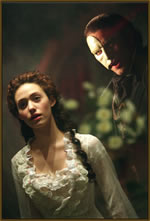
Phantom of the Opera

phantomFirst off, this is not a film review. If it were, I’d write about the performances, production design, music and all all the other factors that make or break a movie. Also, I’ve met the director and co-screenwriter, Joel Schumacher, who is every bit as nice as his reputation. So I don’t want it to be weird next time I say hello to him at some event. Rather, I just want to point out some story issues that stuck out to me — things I’d want to tackle if I’d gotten the script before it went into production.

I saw Phantom of the Opera last night. This was my first exposure to it — I never saw the stage musical, nor read the book. I can say I’m glad I saw it. There were things that really worked, and things that didn’t. What was interesting, and frustrating, is that a lot of the film’s biggest issues were on the page.

Be advised that everything from this point forward is full of spoilers.

Phantom is essentially a love triangle. You have Christine, the gifted chorus girl. Raoul, the unaccountably hot viscount. And The Phantom, a deformed genius who lurks around the Paris opera house where the story is set.

Christine is an orphan, natch, who was raised by Madame Giry in the opera dormitory. Before he died, Christine’s father promised an Angel of Music would watch over her. And in fact, that’s what the Phantom has been doing. He’s the voice in the darkness who’s been giving her singing lessons. So far, it feels like Beauty and the Beast.

Here’s where the movie gets into some very un-Disney territory. The Phantom has been essentially a surrogate father to this girl, and in fact pretends to be the spirit of her father at times — and yet he wants to marry her and, well, ravage her. Don’t get me wrong: I love that it’s kind of sick and twisted. But the movie never really does anything with this idea. No one calls him on it, or points out that Madame Giry has essentially been pimping out Christine to an evil lech who lives in the sewers.

I can understand the urge to downplay the Lustful Father angle — it makes the Phantom less sympathetic. But by letting it dangle there, you leave the audience frustrated that no one on-screen is acknowledging just how creepy it is that the Phantom wants to bone his pupil.

Half-Developed Idea #2 is the darkness in Christine’s soul. In “Music of the Night,� the Phantom presents his case for living in the shadows, and how she’ll be living there with him. Christine becomes less innocent girl and more slutty vixen during this and a few other moments: you see it in her performance, and her eye make-up (I swear).

This is quite a good idea, to look at how the sweet and chaste virgin maybe doesn’t want to be sweet and chaste, but Christine’s never given anything to say, or sing, that lets the audience get inside her head. On the rooftop, she sings with Raoul about the sunny life they’ll lead together, but we don’t know if she’s conflicted or not.

In fact, Christine never really has to choose between her suitors. Whenever she’s with the Phantom, she’s a captive.

Obviously, these are pretty significant things to address, and are probably evident to some degree in all versions of the story, on stage and screen. But there were also some smaller things that clunked in this version which wouldn’t have been difficult to address:

A. Time Lapses

It’s really unclear how long Christine stays underground with the Phantom when she first visits his lair. It feels like only one night, but when we meet up with the opera managers, enough time has passed for them to open an entirely different show and woo back their former diva.

Likewise, there’s a three-month gap between the rooftop number and the masquerade ball. The Phantom has evidently been writing his Don Juan opera during this hiatus, and Christine has become secretly engaged to Raoul, but all the tension we’ve built up is deflated when we learn that things have been inexplicably peachy for the past 90 days.

B. Convenient exposition

Yes, sometimes a character has to explain something just so the audience knows it. That’s exposition, and as a writer, you do everything you can to make it feel natural. Christine is saddled with an impossible burden when she has to quickly explain how she knows Raoul in the opening scene. She’s given two or three lines to spurt out to a friend we’ve never met.

Later in the story, Madame Giry explains to Raoul how the Phantom came to reside at the opera house. The story itself is interesting, and does a lot to explain various characters’ motivations. The timing, unfortunately, feels forced. Madame Giry has spent twenty years hiding this secret, but she’ll gladly tell a near-stranger who asks. (One can imagine a better version in which Madame Giry tries to reason with the Phantom to back off, and that becomes the impetus for the flashback.)

C. Let him go! Set a trap!

Near the end of the second act, Raoul defeats the Phantom in a graveyard sword fight, but spares his life at Christine’s pleading. Fine. It’s a movie. But instead of, say, tying him up, the happy couple simply rides off on their white horse.

Yet in the very next scene, Raoul plots with the opera house managers to trap the Phantom. The very same Phantom he could have caught, say, thirty seconds ago. Grrr. What’s worse, Raoul’s ingenious plan to trap him is to stage the Phantom’s Don Juan opera, with Christine in the lead role. That’s like trying to catch an arsonist by dousing your house with gasoline.

Sigh.

There are certainly other nits one could pick. Horseback rides? Romantic. Underground horseback rides that go twenty feet, before climbing off to board a gondola? Less romantic. But a fair amount of this stuff just comes with the territory. If you believe a guy with a mask and cape can mysteriously stalk around a Paris opera house, and live in dismal splendor beneath it, you have to take the short horse rides that come with it.

Again, this isn’t meant to be a proper review of the movie, which had many good points I’ve neglected to mention. But just as a cinematographer would notice poor lighting choices, a screenwriter can’t help but recognize moments where the movie he’s watching isn’t all it could be.

  • Digg
  • Facebook
  • Reddit
  • SphereIt
  • StumbleUpon
January 27, 2005 @ 11:13 am |
Filed under: Rant

63 Responses to “Phantom of the Opera”

  1. Johnny says:

    Nice. Now I actually want to see the flick. Just to see if I agree w/your suggestions. Will you do more SNOFS (”Script-Notes-On-A-Finishedpicture”) reviews? P.S. How do you format when a character stutters? I need to know! - J.

  2. John says:

    I doubt I’ll do many of these. I probably got the urge to blog my thoughts because I saw it alone, and thus didn’t have someone handy to rant my thoughts.

    Re; Stuttering characters, only do the “I-I-I was w-w-wondering…” stuff the first few times he talks. Then scale back. Drop one in every once in a while so we remember.

  3. Johnny says:

    Gotcha. Thanks. Your site is great. So is your writing. What’s next after CATCF…?

  4. gary says:

    A producer once asked me if I liked a current release and when I suggested the film should be considered for a couple Razzies at year’s end, his face went sour. No, the movie in question was not one of his own — it was produced by his son! The lesson for non A-list screenwriters? Keep thou opinions to thou self :)

  5. Johnny says:

    Who’s Gary calling a non A-list writer?

  6. Rob Workman says:

    I especially like your use of the word “bone”.

  7. gary says:

    Myself, but of course.

  8. Johnny says:

    That’s what I thought. Great anecdote! ouch.

  9. Ian Hamet says:

    If thou knowest not thine mother tongue, thou ought keep thy opinions to thyself. :P

  10. Thom Phillabaum says:

    Yes, but would you have improved “Van Helsing”?

  11. Thom Phillabaum says:

    Er… Yes, but HOW would you have improved “Van Helsing”?

    (That’ll teach me not to proofread.)

  12. John says:

    Never saw Van Helsing. I’m a fan of a lot of the people involved, but it sounds like it never really came together.

  13. Richard says:

    Yes is what I say, I totally agree with you. The story was a little confusing, considering I’ve seen the stage play. It was a beautiful and wonderful film, but at parts you just want to say, “Make up your mind”.

    One second the Phantom is angry and the next he’s in love and happy.

    I see a lot of film alone. Well depending on the film. A critical drama, well I like to enjoy that on my own. A chick-flick, well you get the picture. I like to look up and see what elements are in a film before I see it with someone. Nudity - I hate that intolerable uncomfortable tension, especially if you’re with a parent. I saw Million Dollar Baby second time around with a friend. Just to rant my thoughts to them.

  14. Americo says:

    I honestly haven’t enjoyed a film that Schumacher has done since Flatliners (Phone Booth was ok, except they really didn’t know how to end the movie, and he butchered Batman). Which is really disappointing cause I really liked Flatliners. But I did hear good things about Phantom.

  15. Jo says:

    Perhaps the issue with the screen writing in the movie, was the same as the stage play?

    As far as i can tell, the film is really just the play fitted for a smaller screen.

    The songs are the same, the dialogue seems to be too.

    Maybe the discrepancies in the plot were orignally created by Mr Webber himself?

    In which case, John, do you think the screen writer should have solved them for the movie version? Rather than pretty much adapting the play verbatim.

  16. Whitney says:

    I had the same problems with the script, mainly the “exposition” scene you describe between Raoul and Madame Giry. The most cringe-worthy moment for me was when Raoul leans in dramatically towards Madame Giry and says, “Clearly the genius has turned into a madman.” I also got the sense that they just didn’t know what to do with the camera 90% of the time. I wanted to see some brilliant camera movement to match the brilliance of Webber’s music, and more use of those sets.
    There was however one scene between Raoul and Christine, right before the Don Juan play, that took place in front of a stained glass window that I thought was absolutely breathtaking. The color was fanastic. Even though it seemed out of place with the rest of the movie, it was beautiful just by itself.

  17. John says:

    I’m a big fan of Flatliners, too. At least I was when I saw it lo these many years ago. The characters were largely hateful, which was refreshing.

    In terms of Phantom, I agree that certain moments felt awfully stage-bound. In “Music of the Night,” the poor phantom gets to walk about five feet over the course of a long song. But that’s not a cinematography problem — it comes down to priorities, and what they had to work with.

    Not a story point, but one moment early on that I thought was particularly nice was when the dusty chandelier swings back up to the ceiling, and the movie goes color. During that transition, I got excited to see a movie that it never really became.

  18. Devon Lehr says:

    Hmmm. Not to mention all that damn singing!

  19. Bri says:

    “The Point of No Return” is just haunting. But I didn’t appreciate the prima donna bits with Minnie Driver at all.

    I’d never seen the musical or heard a cd or read the book.

    You must read ‘Phantom of the Opera in 15 Minutes’…the author makes some good points, like why Christine wasn’t all freaked out about the creepy dungeon, but oh, to see the dress, the horror.

    http://www.livejournal.com/community/m15m/6231.html

  20. RC says:

    Schumacher gets points if for no other reason than directing “Batman Forever” — which finally yanked the lid off the whole Man/Boy love thing. But then he did ‘Flawless’…

  21. Harcourt says:

    Saw the play twice: once with road company and once on Broadway. While the movie was okay it doesn’t measure up to the stage production. From what I remember, John, most of the problems you had with the film version didn’t exist on the stage. And I had a number of criticisms beyond yours. But enough is enough. Just add this to one more Hollywood version of a stage hit that doesn’t quite make it.

  22. Ern says:

    John, I’m afraid I have to disagree with just about everything you’ve said here, as I feel you’ve misunderstood the form. Phantom is the realization, in film, of an opera. Opera developed out of court plays and pastorales, which were called “drama in musica.” When I was in music school, we were taught that this meant “music first, drama second.” If you look at most operas or stage musicals you’ll see many, many inconsistencies. You simply can’t apply screenwriting rules and character theory to these pieces. Opera consists of recitative and aria. In recitative the story is pounded out, sometimes very awkwardly. (Example - Les Miz - “It is true there’s a child and the child is my daughter. And her father abandoned us leaving us flat. Now she lives with an innkeeper man and his wife and I pay for the child, what’s the matter with that?” Substitute “and that is the plot” for the final line interchangeably.) But recitative is basically a “resting point” for the audience who are waiting (emotionally and musically) for the next big aria. In fact, in old operatic audiences, people would often wander in and out of the theatre, only coming in to hear their favorite arias. I don’t feel you can apply conventional screenwriting theory to this sort of piece. It’s an opera, it ain’t Chinatown.

  23. John says:

    Ern:

    Phantom of the Opera may be about the opera, but it’s not an opera. It may have been trying to use the devices and elements of opera to tell its story, but it’s simply and unequivocally a movie, projected at 24 frames per second in front of a popcorn-munching audience.

    Just because a film has its roots in another literary medium doesn’t give it a free pass from film criticism. A bad movie about Japanese Noh theatre is still a bad movie, even if it gets all the Noh stuff right. Likewise, a Bollywood movie might use conventions I’m not familiar with. But if I don’t find the story engaging, and choose to explain why, I’m certainly justified in having an opinion.

    The “you just didn’t get it” quality is even less likely here. From Warner Bros., to Joel Schumacher, down through every department head and technician, the goal was to make an excellent motion picture. Not an opera. Some of the people involved probably knew as much about opera history as you. Most didn’t. Rather, they are all craftspeople who specialize in making commercial movies. And if anyone involved with the project had said going in, “Music first, story second,” they would have been reprimanded. And probably fired.

    Don’t get me wrong: I think your assessment of how operas and musicals have historically worked is probably right on the money. But to imply that Phantom’s movie deficiencies were a deliberate nod to The Opera strikes me as a rationalization. I’m not qualified to discuss Phantom as an opera, but I know it could have been a better movie. And it was a movie they were trying to make.

  24. Ern says:

    Hi John,

    I’ll try not to be a rude visitor to your site, but I’m afraid I still have to disagree. How can you say that Phantom is not an opera? It’s based on the stage show, written by one of the inventors of the “rock opera.” Lloyd Webber is very knowledgable about classical music and it shows in his work. And it’s set in one of the world’s most famous opera houses. Looks like opera to me.

    What I don’t get is your discussion of plot and character items that have their origin in the Lloyd Webber piece. How could Schumacher have possibly changed any of those and kept all the millions of people happy who’ve already seen the stage show? I think he did a remarkable job putting this on film.

    I mean, just look at the film version of Chicago. This stays very true to the stage show, and has some very subtle touches added by the screenwriter, such as the introduction of Roxie’s POV in the opening. But these are subtle touches, they’re not the reinvention of major plot points.

    Anyway, I’ll shut up now. Probably worn out my welcome already! I just can’t see how Schumacher could have addressed the items you discuss without major changes to the original work.

  25. John says:

    Ern:

    Of course you’re welcome to disagree. But I don’t want to drop this until you’ll concede one point: Joel Schumacher directed a movie called Phantom of the Opera.

    Yes or No. (circle one)

    What I’m saying — and I thought I said pretty clearly — is that if you’re talking about the experience of going to see an opera (sung-through, with the audience in the theatre, the characters walking on-and-off stage, etc.) then yes, it would be unfair to apply movie expectations. Same with rock opera. Whatever.

    My comparison isn’t with the genre, but the experience of seeing it. Schumacher’s Phantom may have been set in a Paris opera house, but it was seen on exactly the same screens that showed The Aviator, Sideways, and yes, Chicago. These are movies. Regardless of their subject matter they are all movies. And it’s well within any viewer’s right to look at their strengths and shortcomings as movies.

    Chicago proves the point. It has a screenplay by Bill Condon, who made a lot more than subtle changes. Most notably, it dropped the entire concert staging of the popular revival, staged every musical number as an advancement of Roxie’s emotional journey (the one filmed number that didn’t feature Roxy was dropped), added new logic to the courtroom sequence, and wasn’t afraid to let characters talk when needed.

    None of the problems I had with Phantom involved radical restructuring. You could have kept exactly the same songs, in the same places. I just wanted the stuff in-between to be better, and smarter. Maybe Andrew Lloyd Webber was the stumbling block there. But I doubt anyone else was saying, “This exposition is pretty crappy, but we better not change a word, lest the audience revolt.”

  26. Ern says:

    Hi John,

    It looks like we’re going to remain at odds on this. In answer to your question, circle “Yes,” or course. But, you see, it’s not the medium of film that I have an issue with. What I’m saying is that you’re pointing out things in the story that were there in the original stage version. Moreover you seem to be very confident that you’re on the right track in regards to your analysis of how you could have “fixed things.” This is what I find surprising, because opera works in a different way to ordinary drama. It works on emotion, repetition, leitmotif. Ironically, Lloyd Webber’s lyrics highlight this, and it’s the very point he makes in the phantom’s words, e.g. “close your eyes for your eyes will only see the truth…” He’s telling us to suspend disbelief for a little while and simply give in to the music, to emotion.

    And many would regard Phantom as a finished piece the way Lloyd Webber wrote it. To tamper with this, with a mind to making it “more acceptable to an unknown audience” may have had the exact opposite effect, alienating the legion of loyal fans who already know it. Are you telling me that you’d change this piece to please an unknown audience at the expense of 80 million who are already familiar with it? Surely, in the interests of economics, you’d keep the bird in the hand.

    I couldn’t stand Phantom when I saw it on stage. I was dragged to see the darned thing twice in London. I was even given the tour backstage and made to “ooh” and “ahh” at all those tiny trap doors in the floor. It left me cold. I’m not the sort of person to run around defending Lloyd Webber musicals.

    But Schumacher’s film moved me in a way I couldn’t explain. That in itself is a remarkable achievement, to take a hostile viewer, someone who didn’t want to see the film and make them enjoy it. I think it indicates a certain sensibility in matching music and image that Schumacher clearly possesses and is obviously the reason why Lloyd Webber chose him to work on the film version. And that’s a rare gift, one that I don’t think can be distilled into plot points and character critique.

  27. John says:

    Ern:

    Agreeing to disagree is fine. You liked the movie — and so did I, in parts. If I thought it was dreck I wouldn’t have bothered to comment on it.

    Where I think we agree to disagree most is whether making some changes would have alienated the faithful. Because, frankly, the faithful didn’t propel the movie to spectacular grosses ($50M here, $94 overseas), nor terrific critical response (34% rotten tomatoes), nor major award consideration. My instinct is that a better screenplay with the exact same songs would have led to more success on all three fronts.

    But we disagree.

  28. patricia seites says:

    Call me old-fashioned, but I fell asleep watching PHANTOM on Broadway and haven’t even tried to watch the film. Have you seen the Lon Chaney version? Now that I can watch. I think it’s already grossed more than the more current colorized musical version. Oh, why can’t anyone capture me more than dead actors?

  29. Crystal says:

    Wow… I can’t believe I just stumbled on this! I have been looking for a place to tell my ‘”Phantom” story since I saw the film when it first came out. I went with my mother and my sister and I think my mother would have moved a few seats away from us in embarassment if she hadn’t been brought to tears of laughter along with us. Was that Meatloaf playing the phantom or what?

  30. rebecca says:

    ok, personally, i understand where you are going with how it dragged in certain places and that it wasnt all it could have been, but then again, the majority of the people who go to see this movie didnt go to see it to compare it to the play or the book they went to see a love story, and that is what they got. I personally loved it, i am reading the book as of now so i can get how people are saying it sucked, because as i said earlier it was what people wanted. and all movies have forced dialogue in parts just for background info, whats new there? respect your opinion john, but definately dont agree with all of it.

  31. Susan says:

    i’m ashamed that there hasn’t been more mention of madame giry in this! as a “hardcore” giry fan, i am convinced that madame giry plays an undeniably huge and important role in all versions of Phantom. she is the one who holds the secrets within her, whether she is a box keeper, or a ballet mistress. and she is the only one with a french accent. Je prévois que le crédit être donné où le crédit est dû, et giry de madame est le caractère mystérieux qui ajoute une petite épice au movei/la pièce/le livre! au revoir, Susan

  32. Jessica says:

    I can’t help but note that in everyone’s assessment of this musical-turned-movie, there has been few mentions of the fact that the musical itself is based on a book…. And I’m sure everyone on this site understands the delicate nature of transforming a monstrous novel into, well, anything else. So that is actually where your inconsistencies really arise, John. It was in first converting the really long novel into the really long but not as long musical that forced bad exposition and the like. ;-)

    And I agree… I really enjoyed the music, and the opening had me excited, but I was let down in a lot of places.

  33. Kevin says:

    I just finished reading all the comments that “ERN” had for John. I wish I could say that I was amazed at how Ern just could not understand the difference between an Opera and a movie that was adapted from an Opera. Adaptations are a major, major medium for the film industry. Considering that nowadays a lot of screenwriters don’t write on spec anymore, adaptations are HUGE. I mean, we’re adapting videogames for chrissakes. But my point is this: You must adapt a work for the new medium you wish to work in. That’s probably why it’s called “Adaptation” not “Exactly as Writtenation” (Sorry, couldn’t help it). There are numerous examples of this but just take The Graduate. Would it have been just as successful if they stuck to the “Blond haired, football type” as it was in the book? Who knows? But my guess is, probably not. So my question is this: If you want to see The Phantom of the Opera exactly as it was on stage…why not just go see it on stage?

  34. Ang says:

    Help!!! I just saw Phantom for the first time, never seen the play. I am soooo confused. The old man who purchases the cymbol monkey music box is Raoul (The Count??), and the lady bidding against him was the matron (Giry) of the Opera House?? How can she be as young or younger than Raoul, and why on earth would Raoul be purchasing that monkey box for Christine’s grave? Do I have all the characters wrong? I thought at first it must be the Phantom, cured, buying the box. PLease give me some help in understanding why Raoul would ever purchase that monkey and put it on his wife’s grave. Thanks!

  35. Anonymous Coward says:

    The lady bidding against him is not Madam Giry, but Meg Giry.

  36. JD says:

    I think Raoul purchased the monkey music box because he loved Christine so genuinely, that he even accepted her captivation of the Phantom. I noticed that every time she was in a daze, lost to the Phantom, Raoul never got angry with her. He only rushed to snap her back to reality and take her away from the Phantom.

    I’m no movie critic or expert, but I have to say that absolutely love the movie. I never like watching movies twice but I love this one so much that I bought it right after I watched it (on DVD). I think the singing was amazing and the actors (especially the Phantom) showed so much emotion and longing.

  37. Ang says:

    Thank you both for writing, I guess your explanations and a good nights sleep, help it make more sense. I too enjoyed the movie, it at least was not inane stupidity (like so many movies). You had to pay attention and it was entertaining. I did find it a bit choppy and thought perhaps that was why I did not ‘get’ the whole monkey box. Still, it was filled with symbolism, which I enjoyed pointing out to my children.

  38. Steve says:

    I love your write up on the Phantom of the Opera. You stress some of the exact same downfalls that my wife & I were pointing out to each other. Let him go/tie him up, etc. I’ve seen the live theatre in London 3x, Chicago 1x, and saw the movie last night for the 3rd time. Another thing that frustrated me is that I didn’t really understand who the two old folks in the very beginning actually were until my latest viewing. Was this ever really clear? Why don’t they speak at the auction and reminice about old times and Christine?

  39. Sarah Zielenieski says:

    Hi,I am doing a report on The Phantom of the Opera. I was wondering if you guys know what the opera that Christine is proforming the the Phantom helps her sing it.I played all the phantom of the opera songs on the piano my favorite is Think of Me:-) When I went to NYC i saw it on dvd and then we saw All Shook Up and stomp.The Phantom of the Opera soooo powerful everyone should watch it.(even small kids) Love ya Sarah

  40. Tamworth Wilson says:

    Very good review and excellent points all around. I loved this movie overall, and I think the music was great.

    Here’s my take on it, and I had to see the movie three times to come up with this as it haunted me night and day. Christine is the real villain of the movie. She is an immature goober, who is afraid of life and wants somebody to guide her through everything. (I mean come on, she thought an angel of music was singing to her through her entire childhood.) She jerked both men around constantly. Its clear how she yanked around the phantom, but think of poor Raul. When she goes down to the phantoms lair, Raul is knocking at the door - she could have easily turned and fled to him. It goes on and on, culminating in the scene where she kisses the phantom at the end (a second time even.)

    As in real life, wether the phantom knows it or not he really won. Imagine how this flight immature woman would have really driven him really insane if they had stuck together. As is, she only gets to rip his heart out a couple times, live and learn. Poor Raul is stuck with her forever.

    The first time I saw this movie, I thought the phantom cutting raul to pieces and taking christine would have been the perfect ending. Now, I think the perfect ending would have been the phantom and raul saying thats it we’ve had enough, and going out on a drinking binge swapping stories: while christine reluctantly waits to be rescued while pining away for her father to care for her.

    Also, “Keep your hands at the level of your eyes.” What the heck does that mean? Its become my new phrase to use whenever something completely inexplicable occurs. It was said real dramatically as though it was important - yet makes no sense to me whatsoever.

    Maybe I have issues.

  41. Monica says:

    Hi :) when they said “Keep your hand at the level of your eye”, it was like a warning…since the phantom liked to use the noose to kill, keeping your hand at the level of your eye would keep the noose from tightening around your neck…at least thats what I understood it to be. I’ve seen the movie 8 times and I just love it …flaws and all… it is just so nice to watch, the singing especially. my kids give me a bad time tho when I watch it…they go “oh no..not again” hehe…I enjoyed reading all the comments tho, lots of interesting things you’ve all said. Have a good day all !

  42. Mayra says:

    Phantom of the Opera has been playing on HBO — I’ve watched it twice and plan on watching it again at least another two times. I just love it. I wish I had seen the play (but perhaps it would have ruined the movie for me). I love heat between the phantom and Christine when they finally meet on stage the tension is palpatable! I think Raol also does an great job, and I love that he gets the heat between Christine and the phantom but loves her anyway — perhaps because he feels the music between them and does not deny that that is a strong bond. And finally, the music … i can’t get it out of my brain!

  43. Tanith Aphriman says:

    A lot of these comments are railing on how they didn’t understand certain things, like a monkey playing cymbals, or other such tidbits. I mean the critique of the movie is just what it is, a critique. No movie can be perfect and it’s ridiculous to pretend like it could be, not that the author is attempting to insinuate that. I’d just like to point out that behind the movie lay a play, and beyond a play lay a book, a book by a very old dead guy. Gaston Leroux. I personally love this book and have read it numerous times, I’ve also seen the play, and watched the movie about fifty million times. A tad obsessed.

    Just remember that the director of this movie wasn’t only having to base his screenplay off of a play, but a book, and I have to say that it follows the book damn close. Certain events are switched in the times of their occurences but the whole thing is in there (except the Persian whose role is combined with Madam Giry as in the play). On top of the fact that he was faced with producing a movie that millions of play and book lovers would have a cow over he had to back his support as far back as old French dudes. To fit all this into a couple hours, I don’t really think that we can blame him for the mishaps listed above that may or may not be entirely true.

  44. a Phan says:

    Don’t get me wrong, i am obsessed with POTO, but this guy had some pretty good points, like the time lapse part about how long was Christine actually with the phanto. that always bugged me. and how Madame Giry told Raoul all about Erik(the phantom), but she never told anyone before, not even her own daughter. and section C, let him go, set a trap! had great points, too. although, i understand that the movie could not go on if Raoul killed or captured Erik then.

  45. Christina says:

    I have watched the Phantom of the Opera 126 times and i have read almost all the books and i have watched all the movies and i have listend to all the music. !!!!!!!!!!!!!!!I AM THE PHANTOM PHAN!!!!!!!!!!!!

  46. jill says:

    Who is the old man at the beginning? I love the movie and I love the play. My daughters are just as big fans if not bigger.

  47. Richard says:

    Re: discussion between Ern and John.

    I would note that in 1975 Ingmar Bergman produced Mozart’s Magic Flute. Now if there was ever an opera that has holes in the plot and literary inconsistencies - not to mention racism and sexism - it’s Schikaneder’s libretto.

    Yet Bergman does not change the libretto if I recall correctly. I think he has Sarastro waving goodbye at the end and leaving the kingdom to Tamino and Pamina, which is new and sort of resolves Sarastro’s dispute with the Queen of the Night - i.e., neither of them wins, the future is left to a new generation.

    Changing the Magic Flute would have been easier than changing Phantom, because there is no recitative - it’s spoken word in the Singspiel tradition. Changing Phantom would likely have required at least some new recitative, and perhaps permission from Lloyd Webber and Hart?

    Bergman’s Magic Flute is essentially a filmed production of the Opera at an opera House - done in Swedish, from the perspective of a young girl watching it.

    I loved the film though I haven’t seen it in ages.

    http://www.bergmanorama.com/films/magic_flute.htm

    Perhaps someone can comment on the film version of Carmen with Placido Domingo. Was it changed?

    Ultimately, I agree with Ern - Opera is all about the music. If you want to film it, you live with that. If you don’t like it, film something else.

  48. keely says:

    Loved the movie and the book.

  49. Rich says:

    We’ve seen Phantom at least 20 times - The first three were live in London and Tampa; the rest were on the DVD at home. I must say that I’ve learned more about the complexities of emotional and psycholical interaction from the DVD than from the stage productions. I won’t go too far with this, but the juxtapostion and conflict presented between good and evil permeates the movie/play: through appearances, manners, singing styles, and actions. I’ve resolved most these issues in my head, but still want opinions about what “keep your hand at the level your eye” means. Monica, on 2/12/06, is the only interpretation of this I could find; I would appreciate more input, thoughts, opinions, conjectures, and ideas.

  50. Kara says:

    I liked the movie, but the ending was confusing. I still don’t understand why madame giry told raoul to keep his hands at eye level. It doesn’t make sense, could anybody explain?

  51. Dana says:

    Ok, first of all I have to say: The Phantom of the Opera IS NOT A FLICK, I’m just saying this cause the very first reply, calls it a flick which was very annoying to me. I’m not a crazy Phantom fan defending the “honor” of the movie, but I’m just saying, flicks are one thing and films are another and Phantom is definitly a film. Incidentally it’s a film that I really enjoyed, although I wasn’t planning on seeing it. I totally agree with all the things that were said in the “review”, but I find them amusing rather than annoying, especially after reading movies in 15 minutes:The Phantom of the Opera.

    At the end of the day, I give both thumbs up for The Phantom of the Opera.

    Oh, and about what “hand at the level of your eyes means”, I’ve read the book and I can say for certain that what Monica said on 2/12/06 is true. In the book, before setteling in the Opera, The Phantom travelled to India and learned how to kill people using the Punjab lasso. The victims’ only way of escapeing was placing the hand at the level of the eyes thus stopping the lasso from closing completely and strangling him or her. In the book the Phantom is much more scary (he even has a torture chamber), and has made many victims with his lasso.

  52. Chicken-legger says:

    Hey guys, Firstly, I’m afraid I have to agree with Ern. John, I can see your point, but POTO is essentially a musical on film. Same as with Jesus Christ Superstar (although to criticise that is a little un-PC :P). The time-lapse you talk about could (conceivably) be explained by a) the fact that as was seen before, it didn’t take much to ‘woo’ Carlotta, and b) perhaps (and I know this is very shaky but maybe someone can help me) they opened another show the next night? You do have a point about convenient exposition - it is one of the most irritating things IN THE WORLD (although I am a massive Doctor Who fan and the Doctor is the king of explanations). However, like Ern said, you couldn’t really change it without changing the plot and Madame Giry’s relationship with the Phantom (which oddly enough doesn’t seem to be that close). And last but not least, if they had tied him up, he would have died of cold! Much better to shoot him in front of a large number of people. But still, did they even have any rope? “Here Christine, you stay and I’ll go look for some rope” “Dammit he took her again!”

    Anyway, I’m doing a musical analysis of POTO, so any information anyone wants to give me that could help would be much appreciated.

    Thanks (and sorry for ranting a bit), Spring Chicken.

  53. Asia says:

    I loved this movie! However, i do agree with what you have pointed out in the “review”. There were alot of things in the movie that could’ve been changed. Thanks for the “review”. lol!

  54. Roberta says:

    I’m not much of a musical fan, but I loved this movie. I read the book years ago. The singing was great, the acting great, the costumes beautiful. My granddaughters and I watch it every weekend. I would have chosen the Phantom over Raoul any day, but then I like dark things.

  55. Lizzi says:

    I’m so gald that someone else can see the sick side of the Phantoms love for Christine! not so apparent in the stage version though. Also I agree with the time laspes, it lets the film down beacuse it becomes confusing. Musical-amazing, film-actually fell asleep!

  56. jerry says:

    All of the above, while intriguing to a mind with a theatrical background, is exciting due to the simple fact that so many people are moved to express his/her feelings about a piece of theatre.

    Hats off to all of you!

  57. Tricia says:

    Thanks a million for explaining “Keep your hands at the level of you eyes”. I guess I should have read the book, but I couldn’t understand if Raol had held his hands at the level of his eyes it would have kept him from falling through the trap door in the stairs????? I have seen the POTO on DVD several times and also saw the play on Broadway. Loved the play, words can’t explain the feeling. My favorite part is when the Phantom and Christine sing “Point of No Return”, sometimes I just fast forward to that part.

  58. Kayzie says:

    In the past four days I have watched the Phantom of the Opera (2004 version) six times. I think I’m officially obsessed. I think that “Keep our hand at the level of your eyes!” is supposed to remind everyone not to go looking for the Phantom. It’s like saying, “Hold your hands in front of your eyes. Keep away from him. Don’t go looking for him.” I think it’s almost unnecessary though, to say it over and over again when it never seemed to help. Also, when Madam Giry tells Raoul about the Phantom’s past, I think she told him too easily. I can understand where now is the best time, for he is indeed going mad with his passion for Christine and all, but still. That secret right there she’d probably kept for at least 30 years. Another thing that I was also confused by was why did Christine faint when she saw the life size mannequin thing? I mean sure it would be weird to have this guy you don’t know really have this weird statue thing of you, but honestly, isn’t it just as freaky to be going down into this crypt place with a guy who is obviously a pervert? Also, why did Christine not recognize the Phantom’s voice in the graveyard? Why did Madam Giry keep watch for the Phantom when he locked Christine’s dressing room door? Another important thing I noticed was this. The dressing room formerly belonged to La Carlotta, no? Well then how would the Phantom then talked to Christine that whole time when she was little. Why did she not tell anyone until her friend Meg talked to her. It’s like Madam Giry’s secret, she let it out to easily.

  59. Ana says:

    I read the book before i heard the music or seen the film. And i loved it! the musical kind of changed some important things. like excluding the MOST important character aside from the 3 … The Persian! in the book HE was in fact the one who “discovered” the phantom, helped him to escape a death penalty by faking his death and repeatedly tried to talk him out of captivating Christine. Also, the sick obsession Erik (the phantom’s name) had towards Christine is so much more visual in the book, and Christine isnt this crazed victim the whole time, infact she is quite rational but feels such pity towards Erik. Madame Giry’s pimping is rediculous and annoying how someone could be so immoral, knowingly giving a girl to a madman, though thank God, that isnt even in the book. these things shouldnt have been kept from the theatrical and big screen adaption. (sigh) but then again, it IS an adaption of a book, so it cant be perfect, it would be an eighthour film, and the music is fabulous, and the scenary and the costumes and the cast… the THING everybody is complaining is missing is the heart of the story which Gaston Leroux captured perfectly, captured I say, because his book is an adaption of a true story. So, yes the phantom actually existed and yes, the count and viscount and choir girl mysteriously dissapeared and yes it happened in today’s Opera Garnier in Paris. proof of this is within the walls of the opera. Just read the book! ciao

  60. Echo says:

    Most of the plot problems in the movie could have been fixed if they had looked at Gaston Leroux’s original book. I read the book first, so I understand the movie. So, I’ll try to reply to some of the problems you pointed out. A: Time Lapses Christine probably appears to have only been down in the lair for a short time so that the movie doesn’t come to a standstill. Also, Raoul knew that something odd was going on when he found her door locked, not to mention the notes they received. The three month time lapse should increase the tension. For the viewer at least. Erik (the Phantom) has been using his time to plot revenge. Any revenge that takes three months to plan must be pretty frightening.

    B: Convenient Exposition It shouldn’t matter that we haven’t met Meg. In fact, Christine’s explanation of Raoul to Meg should be her way of telling the viewers that Meg is her closest friend. Christine has not seen Raoul in years. What else should she say? Their childhood relationship is explained in the song “Little Lotte.” Madame Giry’s explanation is a little misplaced, but it can be explained. Erik has just attacked. She is probably shocked by what has happened and is thinking about her attachment to him when Raoul starts asking questions. The story has been bottled up inside of her for years and years. She is trying to explain to Raoul the Phantom’s motives.

    C:Let him go! Set a trap! I can only agree with you on the first portion of this. Maybe they didn’t want to kill the Phantom? Alright, I get how Erik could live in the opera house for so long. First of all, he is protected by Madame Giry, who seems to be the only other person who knows the way to his hideout. Second, he uses only hidden passages to get there. The thing that threw me off was the horse. How can you keep a horse alive in a basement. Better yet, how do you get it there in the first place?

    Other comments Christine isn’t really supposed to have a choice. Her part is to try to escape Erik, save Raoul, and show normal human emotions and problems along the way.

    A lengthy response I know, but I’m pretty much obsessed with The Phantom of the Opera. Anyone can email me about it if they want at strawberry_sunset520@yahoo.com

  61. Jennie says:

    You know, I sort of found this thread by accident. I was skimming the net,this page popped up, and I simply had to comment after reading through the posts.

    I have been an avid Phan since I was introduced to the book and musical in 7th grade (almost 12 years ago) — I have seen the play several times, read (and own) nearly every adaption of the story that has come to print, and know all sorts of (useless) trivia about the musical/history/opera house/etc. too.

    … I absolutely loathed the movie Schumacher put out.

    From a technical standpoint, the sets were pretty, most of the costumes were relatively true to the stage show from which the movie was based, but the singing (on most parts) was sub-par and the whole movie was entirely over-sexed.

    The story is about a deformed man (who is supposed to be around the age of 50 or so, occasionally older in some adaptions) who lives underground. His deformity is supposed to be so hideous that he’s supposed to look like he’s dead. So, I ask you, why was the Phantom tan-looking and his “deformity” looking like he had a simple case of a bad sunburn? My husband had sun poisoning once that looked worse than that sorry excuse for a makeup job! It’s sad when the stage version of the make up exceeds the million dollar movie version. Schumacher said in an interview that he didn’t want to make the Phantom too ugly becuase then he’d be unlikeable.

    Um.. What? Isn’t that the point?

    The whole reason we’re supposed to sympathize with the character is that he’s been forced to run to ground to avoid society. He’s supposed to be that ugly. Granted, in older days they were a lot less understanding about deformities; a crooked nose was enough to land you a reputation for being a witch in some places, but the book is VERY specific when describing how sever his deformity is. They honored it in the stage show, why not the movie?

    Secondly, while I do give Butler credit for his effort, his voice was not a good fit for the role. It certainly did not have the etherial quality that it was supposed to have. The Phantom is supposed to have a voice like an angel; hypnotic and unearthly. It’s why he’s refered to as the Angel of Music. It’s supposed to hypnotize Christine to the point that she’d follow it anywhere — If I heard Butler rasping and straining to hit notes like he was at me, I’d honestly run for cover. You can’t listen to that voice and tell me that it honestly sounds like something heavenly. Would you follow it blindly? I think not.

    What I don’t understand about Butler’s singing is why they didn’t simply dub him over. They did that for Minnie Driver’s character because she didn’t have the voice for the role of her character, why didn’t they do that for Gerard when the Phantom’s voice is the backbone for the whole show? Butler didn’t have the range for the songs — a good chunk of the songs were transposed or he had to take an octave down because he couldn’t hit the actual note he was supposed to. Take ‘Music of The Night’ for example.. That was an absolute atrocity towards the middle and the end. Granted that is a very hard song, and I felt he did alright with it for having no real training (I have to give credit where it’s due), but they should have simply dubbed him over because he didn’t have the power to support the vocal demands of the role any more than Minnie did.

    Emmy Rossum was passible as Christine, but far from fabulous. For more than half the movie she has this inexplicable ‘deer in the headlights’ expression. By the end of the book and the musical, Christine is supposed to have grown some sort of a spine; the experience of being torn between these two men, who both are asking more than she’s able to give, is supposed to make her transition from child to woman. I didn’t feel that transformation happen with Emmy. While her voice wasn’t entirely unpleasant to listen to, I wish they could have gotten someone with a wider range of acting skills for the role.

    Patrick Wilson, who played Raoul (a character which I’ve never liked because, like any Phan, we ultimately fantasize about Christine and Erik (the Phantom) widing up together and Raoul messes that up. LOL.) was the only character out of the main three who I felt was justifiably cast. His singing was decent for the part, he fit the description of the character, and his acting was alright.. I can’t complain about him too much, honestly.

    I suppose, over all, my biggest beef with the movie were the singing and Schumacher’s want to ’sex things up’. The Phantom was supposed to be pale, skeletal, and deformed.. Schumacher had him young, fit, handsome, and half-dressed for the entire end of the movie.

    Give me a flippin’ break.

    (.. But, again, we are talking about the man who put nipples on the Batman suit. I suppose that should have been a warning sign from the beginning. LOL.)

    All in all, I’m glad that the movie at least introduced people to the story who were not familiar with it beforehand; it’s a great story when told correctly, but I do get irritated by some of the fan girls when all they can say for the movie is “OMG.. Erik (the Phantom) is soooooooooooooo hot!”

    Honey, you’ve missed the entire point. And so did Joel Schumacher.

    So sad.

    In reference to this last post — The Paris Opera, like with many other houses, did use live animals in their performances on stage. There are animal stalls located on one of the lower levels of the house where they often kept horses or sheep that might be used in a production. (Not that they were kept in great quantities, but a few were used here and there.) The horse in the musical is actually a reference to the original novel by Leroux — The Phantom basically stole the horse and brought Christine down to his place on it. The horse’s name is Caesar. Random trivia.

    As for Christine not having a choice — I partly agree with that statement, but I also disagree. I think she did have a choice, but the outcome of either choice had rammifications that I don’t think any of us would really like to have to deal with either.

    To really address this question, we have to go to the novel.. Not the musical (which sort of simplified the matter to save for time, I think.) In the book, Christine was faced with, not only a choice between two men, but a choice of life and death. Not only was the Phantom going to kill Raoul if she didn’t choose him, but also a character called The Persian, and Erik was also intending to blow up the entire opera house. If she chose Erik, everyone was free to go, but she would be trapped underground with him forever. It wasn’t necessarily just a choice as simple as ‘who do I love more?’ Either way, it was her own death (even if it wasn’t necessiarly Erik’s intention to hurt her by keeping her with him forever). So, she thought by sacrificing herself and staying with Erik.. She would save everyone else. Such was her love for Raoul, she wanted him safe. But I think she agreed to stay with Erik in the end because, while she would be parted from Raoul, it wasn’t as if she didn’t feel something for Erik too. While it was a different sort of love than that she felt for Raoul, it was love nonetheless. So, it was definitely the lesser of two evils — her main squeeze goes free, everyone lives, and she’s stuck with Erik (whom she does love on some level) until she dies. Or he dies (which is far more likely given the age gap between them).

    I think that Erik lets her go in the end because he realizes how unfair he’s being to her.. A little lightbulb goes off over his head and he figures out that, if he loves her, he can’t doom her to the same hell he’s created for himself.. Living below ground, being hounded like an animal (because, despite what we’d like to believe about society back then, she probably would have been shunned just as much as he was if she married him).. He didn’t want that for her and he releases her along with everyone else.

    Anyway, enough of my tirade.

    Quick summary for those who don’t want to read my entire post: Butler wasn’t a good Phantom, Joel Schumacher overlooked the aspects of the story he thought would turn off the millions of teenage girls he was trying to turn on so that he could make money off them, and the book is complicated and (obviously) a great souce to reference if you’re having trouble understanding elements in the musical.

    My two cents. Heh.

  62. Shelley says:

    Although I do agree that the Phantom’s makeup could have been done to be more appalling, let’s remember that the general viewing public can often be unsophisticated thus only able to look at the Phantom superficially. Therefore Schumacher did what was necessary for the general viewing audience (those of us who have posted on this board are obvious exceptions) to feel empathy towards Erik. Had he been made to look as monstrous as that of the book, the audience would have been revolted and only want Christine to be with Raoul.

    In regards to the age of the Phantom, I think having him in his 50s or older would not have been fitting considering we live in the time of “To Catch a Predator�. The audience would have been grossed out. He couldn’t make Christine older as that would take away from the fact that she was supposed to be innocent and naïve. Some assume the Phantom is the same age as Madame Giry but he could have been a couple of years younger than her. In the movie, she could be let’s say 40 and the Phantom maybe 38. Assuming that Meg is the same age of Christine (18) that would mean Madame Giry had her when she was 22 which obviously would not be unusual especially during that time. She could have even had her at 18. I think this works for the film.

    I personally liked Gerard Butler in this movie. Not just for his “hotness� but for his acting. He is very good at acting with emotion. Considering part of the Phantom’s face is covered by a mask it makes it difficult for any actor playing the part to convey the emotions the Phantom is feeling. I think Butler did a great job at doing this. One scene in particular would be after he interrupts the Masquerade song and dance and walks toward Christine. The look in his eyes says it all. This is even with just the whites of his eyes showing since around the eyes is colored black. His singing, I agree is not the best but I don’t think it is so horrible that I would run away from it. Butler is not a trained vocalist and Andrew Lloyd Webber knew this. It has been noted in interviews that Webber always wanted the Phantom to sound rough and more like a rock singer. I’m sure Michael Crawford fans find that offensive.

    I agree that Emmy Rossum was okay in the film. The “deer in the headlights� look got to me too.

    As for all the other posters’ complaints about the timeline etc., let’s remember that this was a movie adaptation of Andrew Lloyd Webber’s stage version of the Phantom of the Opera. It is basically an adaptation of an adaptation – with a few extra tidbits thrown in.

    Well that’s my opinion and I’m sticking to it. Thanks for reading. Have a wonderful day!

  63. Shelley says:

    One more thing, I think it is only fair to say that Webber, not Schumacher is the one who originally “sexed it up”. Just listen to the lyrics of Point of No Return.


About

This site is run by screenwriter John August. Mostly, he answers reader-submitted questions about the craft, but occasionally he goes on tangents that run far afield of writing and filmmaking. You'll also find info on past, present and future projects.


For photos, blurbs and uncomfortable self-promotion, you can check out his Facebook fan page.

Ask a Question

If you have a question about screenwriting or my movies that hasn't been answered, by all means ask. There are a few guidelines to follow.

Featured Articles

101: Some screenwriting basics


There are more than 900 articles on the site. You can find category archives at the bottom of every page.

Watch Me

Now available on Amazon, iTunes, Netflix, and in stores.

More movies in the Store.

Feeds