Digital filmmaking and the paradox of choice
So there’s no confusion: I’m a digital guy.
I’ll take a CD over vinyl, cameraphone over Polaroid. When it comes to life, and filmmaking, I’m largely pro-technology, anti-Luddite. In fact, I have very little patience for aesthetes who blather on and on about the infinite advantages of the analog world, be it $10,000 turntables or Maxivision projectors.
Give me some ones and zeroes, and I’m happy.
But in the same week, I had two experiences that pointed out the downside of my digital zeal. As things get faster, cheaper and more flexible, it becomes harder and harder to make “final” decisions.
I recently had the good fortune to visit the two motion-capture films Robert Zemeckis is making: Monster House and Beowulf. (The former is directed by Gil Kenan; the latter by Zemeckis himself.)
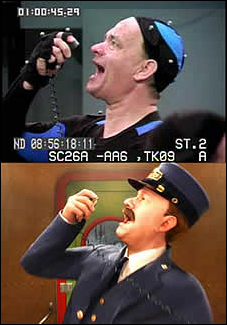
For those who missed all the stories about the motion-capture process when The Polar Express came out, here’s my incredibly simplified explanation. Motion capture uses real actors, who wear special clothing (unitards, basically) outfitted with reflective dots. They have similar, smaller dots on their faces.
(Compared with this picture of Tom Hanks from The Polar Express, it seems the dot-to-skin ratio has shifted greatly. On the set of Beowulf, you could scarcely see the actors beneath all the mo-cap dots.)
Rather than filming with traditional cameras, the crew uses special sensors that record the location of each dot in space, from multiple angles.
Computers then transform this data into 3-D models. The actors are performing on an empty stage; there are no sets or props or costumes until later in the process, when animators map this information onto the wireframes. So “motion capture” means just that — you’re capturing every movement made by the actors, from big (swinging a sword) to small (a sneer). Special sensors even record each eye-blink.
While he’s on the set, working with the actors, all the director has to worry about is the performances. It’s more like directing theatre than a movie. It’s only afterwards that he sits down to “shoot” the movie.
At first listen, this sounds a lot like how George Lucas shot the last three Star Wars movies, with actors working against green screens. But it’s actually quite a bit different. Lucas is filming the actors; Zemeckis is simply capturing the information. Most notably, Zemeckis doesn’t even have to decide where to put the camera. Sitting at a computer months from now, he can pick any angle. He could play a scene in close-ups, or wide shots, or have the “camera” do impossible moves. He could decide to make the movie 3-D. There are really no limits.
And this is the biggest potential problem with motion capture. With nearly infinite options, how does the director decide what he wants? Is there such a thing as too much choice?
These thoughts were on my mind as I went to ResFest at the Egyptian theatre in Hollywood. The film festival, which visits five cities each year, focuses on digital filmmaking, be it video, animation or hybrids of the two.
I specifically wanted to see the presentation about Panasonic’s new hi-def camcorder, the AG-HVX200. Rather than recording to tape, it records to P2 cards, which are basically four SD chips arranged in an array, with the form factor of a PCMCIA card. The cards are expensive, but they’re not really for long-term storage. The idea is that you immediately dump the footage onto your hard drive, wipe the card, and re-use it. In that way, it’s very much like using a digital still camera.
It’s definitely the camera I wish I had in film school. For a certain level of independent film, I think it will be a godsend.
I’d rate the audience for the presentation at about Geek Factor 7, with a fair number of nines and tens. During the Q&A, the second question was about the “true” resolution of the recording chip, which the presenter somewhat snippily declined to answer. I guess I sympathize. That’s sort of a “When did you stop beating your wife?” question. The raw numbers will never match the processed result, which leads to inevitable grumbling about how the camera doesn’t live up to its potential.
Anyway.

The most annoying question came from a guy sitting behind me. I didn’t turn to look, but in my head, I immediately conjured the image of Comic Book Guy from The Simpsons. He took great umbrage at the presenter’s suggestion that one advantage of recording to P2 is that you can delete worthless takes in the field, freeing up more space on the card.
That’s heresy, he said, and irresponsible. You might need one of those 18 flubbed takes. I was alarmed at the passion of his conviction. He went on to say that he owned a post-production house, with several terabytes of storage at each workstation. So he would transfer everything.
Dude, I’m so happy you have so much storage. Maybe it can hold your ego. But I don’t think you understand how real filmmaking works.
We’ve all heard stories about how a director will shoot 20 takes of the same scene. What’s less often reported is the director doesn’t bring all 20 takes with him into the editing room. To understand why, we need to explain a little about film.
Film is expensive.
Okay, that was a short lesson. But that’s really the gist of it. When you’re shooting with film, you’re not only paying for the celluloid that runs through the camera, but also the processing of the negative, and the transfer (telecine) that lets you bring it into the editing system. All of that costs money.
So when he’s finished shooting a scene from a given angle, the director tells the script supervisor, “Print 3, 5 and 7.” That is, tell the lab that we only want takes 3, 5, and 7. The rest of the film negative will be processed and stored, but the other 13 takes won’t be given to the editor. (In case of emergency, such as an unforeseen glitch in the printed takes, the editor may occasionally have the lab go back and print alternate takes. But this is rare, and costly.)
Note that directors will sometimes say, “Print everything.” This will incur the wrath of the producer, who watches the film processing budget soar.
So what Comic Book Guy failed to understand is that filmmaking traditionally hasn’t transferred everything. Many decisions are made in the field. Permanently deleting a take from the camera may be more extreme, but it’s not sacrilege. In many cases, it makes sense. Anyone who’s ever snapped a self-portrait with their cameraphone knows that the delete button gets almost as much use as the shutter.

Both the Zemeckis tour and Comic Book Guy’s misguided rant reminded me of a book I read a few months ago, The Paradox of Choice by Barry Schwartz. As consumers, we’re conditioned from a young age to think that the more options you have, the better. But that’s not really the case. Study after study shows that the more choices you offer someone, the less happy they are with their ultimate decision.
That’s because we have a desire to optimize: we want to know we’ve made the best pick. But we psych ourselves out. The more options there are, we know it’s less likely that we’ve made the ideal choice. A restaurant is a good example. If the menu only has eight things, there’s a pretty good chance you’ll know which one you want. It’s a quick decision. But if the menu has eighty things (think Cheesecake Factory), it’s a much more complicated decision-making process. Schwartz would argue you’d be less happy with the exact same meal in the second scenario. I think he’s right. The restaurant patron who says, “I want a salad” before he opens the menu is likelier to have a good meal.
I was a vegetarian for seven years. At most restaurants, there was exactly one thing I could order. And I was happy.
Coming back to digital filmmaking, I think this paradox of choice is one of the biggest challenges facing the industry.
Zemeckis has made a lot of movies, so I’d assume he’s able to make up his mind pretty quickly and decisively about what angles he wants to use. But a filmmaker with less experience could find himself paralyzed — or worse, beholden to outside influences (like the studio) pushing for more close-ups, new shots, or whatever. It’s hard to turn someone down when they ask, “Why not give it a try?”
I’ve already seen this happening in the editing room, where the rise of non-linear editing systems like Avid and Final Cut Pro has made it possible to work much more quickly. As the guy sitting at the right hand of the editor, I’ve definitely benefited, but it’s had a dispiriting effect on the editors themselves. They’re no longer the arbiters and gatekeepers they once were. Ironically, they’re a lot more like screenwriters now, where nearly everyone can offer an opinion on what should be changed — and too often, does.
So what’s the solution?
Self-discipline is a start. The director who only prints the takes he actually intends to use is making his life much easier. I think the Dogma philosophy is just an expansion (or, reduction) of that instinct. By depriving yourself of certain things, you can focus more closely on what’s left.
But the bigger need is to properly value the most precious resource in filmmaking: creative thought. It doesn’t show up on any budget, but it’s the single biggest factor in whether a film will be great.
Presenting a filmmaker with 100 options isn’t a help, but a hindrance. It means she has to consider 100 possibilities, or devise some system for winnowing them down into categories. That’s creative brainpower she could spend on some other, more important aspect of the film. Worse, the 99 unchosen possibilities will still weigh on her mind. In many ways, she was better off not knowing what she was missing.
Again, I’m a digital guy. But I think one of the best aspects of digital is its binary nature: yes or no, black or white, one or zero. To flourish, I think digital filmmaking needs to embrace some of this discipline.
We shouldn’t use technology simply to push back the decision-making process. Rather than cheering, “Anything is possible!” we should celebrate that “New things are possible.” The groundbreaking movies of the next decade won’t be the ones that use the most technology, but rather the ones that use it most intelligently.


October 13th, 2005 at 4:00 pm
Well said, John.
October 13th, 2005 at 4:06 pm
Script and casting issues aside (ok, those are big asides admittedly), I think this issue was Lucas’s biggest problem with the prequels. With a new digital toybox that allowed him to literally go everywhere and do anything, the set pieces just became sprawling, cluttered, and did little service to the story. It just seemed to be George saying, “Okay, I want this to be the biggest [space battle, chase scene, robot war] the computers can spit out.” Consequently, double the speed and whiz-bang of the original trilogy FX but none of the dramatic urgency. Sound and fury signifying nothing and all that.
October 13th, 2005 at 5:34 pm
“The groundbreaking movies of the next decade won’t be the ones that use the most technology, but rather the ones that use it most intelligently.”
Tell me about it. I’m getting real sick of seeing horrible CGI.
October 13th, 2005 at 5:35 pm
You said it, mon.
October 13th, 2005 at 6:29 pm
Excellent post, John.
Ultimately, it doesn’t matter how many bells and whistles you have at your disposal. You still have to know how to tell a good story.
October 13th, 2005 at 7:08 pm
As a screenwriter, is the change in technology benefiting you creatively or limiting you to write stories that push the latest in digital FX?
October 13th, 2005 at 9:17 pm
Hey John,
I enjoyed the little rant. In fact, I’m sending it mass out to the rest of the florida state university film students because I think it applies wholeheartedly to novice and advanced filmmakers alike. The catch for us though, is that it is actually cheaper to print in our post case all of the takes for super 16mm film. That and well the budget is drastically smaller with a limited source of available film.
anyways, thanks.
October 13th, 2005 at 9:27 pm
First, a gritch: Being pro-analog isn’t anti-technology or Luddite. I find that view just as elitist as the esoteric analogistas’. Analog systems are simply another aspect of current technology. Digital is convenient and better for some things, but it’s not better inherently. It will never have all the information that analog has; digital can only ever approach it. Perhaps to the point of imperceptibility yes, but it only takes a sound system costing less than the $10,000 turntable you mention to reveal that vinyl sounds demonstrably, often shockingly better than CDs. If you don’t believe me, come to my house. We can talk writing after.
Second, I find the question of whether one can have too many choices an interesting counterpoint to the point Joss Whedon makes in the article to which you linked yesterday or the day before. Specifically:
“Whedon made it a point never to ask for more than he needed. ‘People would say, “You’re going to need this and that,” and I’d be like, “Not so much.” If I only needed three walls, we only built three, and if someone asked, “Well, what if you want to do this other shot?” I said, “Well, we just won’t.”‘”
I’m reminded of the creative choices filmmakers had to make while operating under the Hays Code. While today’s films are certainly more realistic than films of the past (usually), I seldom find them as original or inventive, and I think much of that is due to the creativity they had to exercise to make their point under a restrictive system. (Though I ascribe at least as much to the fact that writers and directors of the early and mid-20th century simply had a more literate background than their successors.)
My .03 cents.
October 13th, 2005 at 9:34 pm
Hi John,
Great website. I’ve been reading you for a while but this is my first post. Also, congratulations on all your success!
That’s the first I’ve heard of the “Paradox of Choice” idea, where too many options lower one’s ultimate satisfaction. I’ve had that feeling for quite a while, but I didn’t know there were actual studies to back it up.
The scary thing is when you apply it to our 52 flavor society in general. The choice of careers, the choice of mates, the choice of which of the thousand stations to watch on TV…
I remember shopping for a satellite dish a few years back. The sales girl told me I’d have access to over 400 channels. And she smiled like it was a good thing. Ultimately, I bought one of those huge dishes, after which I subscribed to an ala carte programming service. I ended up with 14 hand-picked channels and never missed a thing I wanted to see.
The real problem is when you factor everything in with our corporate-fueled, consumer-driven society where we soon will be able to buy a six-bladed shaving razor. (I’m not kidding.)
I went looking for a multivitamin at the Mega Mart the other day and was nearly blinded by the hundreds of tiny, colorful boxes. I just stood there a while and let my eyes go out of focus like you do on one of those funky “art” posters. I swear after a few mintues I saw “Buy More Stuff” in big 3D letters…
It’s no wonder the Amish always score the highest “happiness” ratings in America. I imagine their to-do lists are fairly straight forward. And I bet they don’t suffer through much of the “I have nothing to wear” syndrome, either.
Doug
October 13th, 2005 at 11:35 pm
Kind of reminds me of the way George Lucas is going back and modifying his own films, updating them with more modern visual effects, yet he vehemently denies old black and white films and shorts (including The Three Stooges) to be colorized. I suppose, it’s up to the individual director of the film; don’t go editing someone elses’ film without their permission.
Wait. . . what point was I trying to make again?
Anyway. Nice analogies for the digital technologies. One or zero. Alive or dead.
October 14th, 2005 at 9:30 am
“People will say, ‘There are a million ways to shoot a scene,’ but I don’t think so. I think there’re two, maybe. And the other one is wrong.”
– David Fincher (according to IMDB).
[One of my fave quotes about filmmaking ever, I think :)]
I work in VFX [ok, mb not for that long] but, like everyone else, harbour dreams of directing one day. So I can understand why people likehaving options and certainly, a lot of VFX work is about providing options. Don’t want an actor in a scene anymore? Gone! Want the scene to take place at a different ime? Done! Want the action of a scene to go a little quicker? Done!
Often, these choices are about helping the story… and in the end, I think they work best when they’re filtered through the director’s instincts. For me (and this is only as a wannabe), directing is about having a worldview and shaping it through that funnel. Otherwise, what are directors for? Its not like they actually -make- the film - all the amazin artists that work on a film (aka crew) do that for them. No. The director provides context and makes decisions.
Perhaps, the digital revolution by empowering directors to do more than simply direct (oooh, i can edit my own film, oooh, i can operate the camera myself, oooooh, i can light it myself, oooooh, i can do my own sound mix) has, inadvertendly, shifted their attention away from the actual craft of screen directing to a more generalistic craft of filmmaking.
Just my 1c.
October 14th, 2005 at 9:38 am
I’m a complete techodolt so I don’t know what the AG-HVX200 is all about and what the market for it is. From the price ($6000) I surmise that this camera is good enough for low budget feature filmmaking and at the same time cheap enough for, say, local TV reportage.
But I agree with Comic Book Guy.
When it comes to shooting feature films with digital camera it definitely makes sense to preserve, log and store everything that’s shot. Terabytes come relatively cheap and get cheaper by the month, so storage is not a problem anymore.
When movies are shot on film all the footage shot is develeped and preserved as negatives, as you say. Bad takes as well as good ones. The material is always retrievable.
In the production (principal photography) of feature films time is very valuable (large crew, cast, sets etc). It’d be totally crazy to erase what you’ve spent precious time shooting. Even if you decide on the spot that said takes are not good enough and will never be used.
But when it comes to reportage, documentary filmmaking, home videos etc, it’s probably very useful to be able to erase takes in the field.
All the same, I agree with the main thrust of your argument, about choices.
October 14th, 2005 at 11:05 am
John, totally agree with you. There is a reason why single camera filmmaking has tended to create the most memorable films: preparation, thought, and artistic approach are so absolutely required before ever opening the shutter that the results can’t help but be… well… better. Show me a film shot in “coverage” and I will show you the loss of art (even if it’s a little). With the new technology, it’s the same conundrum multiplied by a thousand. When a scene is conceived to take advantage of a specific shot/angle/etc. it will work so much better than when you just willy nilly shoot the scene and try to “find” something.
Then you get into the time on set. I recently produced and directed a digital feature, and because we had the ABILITY to replay the scenes, the actors constantly wanted to review their performances. And that can also be a bad, bad thing. It burns daylight, leads to actors tweaking their performances (without the guidance and eye of the director), and potential arguments over whether a setup is wrapped. It sounds like such a good idea (unlimited creativity), but in implementation it can lead to bad, bad news.
Just because you can do something doesn’t mean that you should.
October 14th, 2005 at 12:04 pm
More choice = more possibilities = more likely to come up with something better, IMO. So I disagree, but wouldn’t know from experience, just opinion.
October 14th, 2005 at 12:08 pm
“But a filmmaker with less experience could find himself paralyzed — or worse, beholden to outside influences (like the studio) pushing for more close-ups, new shots, or whatever.”
I went to film school with Gil Kenan (Monster House) and never saw anything before (or since) like his short, “The Lark,” which he hand animated over live action sequences, frame for frame. It took him a year to do, spread out in his kitchen subsisting on Ramen. It’s hard to picture him bending to studio influences in part because I can’t even see them speaking the same language. But maybe this is just some film school fantasy, that your strange new voice is truly the reason they hired you. Though personally I’m not picky either way. Ask anyone. JGTH “Things They Won’t Tell You In Film School”
October 14th, 2005 at 12:31 pm
On second thought, I agree with your sentiment but not your argument.
The film industry has always embraced technological advances, and with every technological advance come more choices and more creative decisions have to be made (in effect this means that the film industry is always generating more and more jobs).
But good old capitalism sees to it that the choices aren’t endless, there actually are limits. For financial reasons.
You say (of the motion-capture process):
“While he’s on the set, working with the actors, all the director has to worry about is the performances. It’s more like directing theatre than a movie. It’s only afterwards that he sits down to “shootâ€? the movie.”
Like I say, I’m a technodolt but I seriously doubt this is how things are done. I think that practically all the conceptual work is done beforehand, in preproduction (storyboarding etc). The filmmakers only get x many months in preproduction and all the major directing-decisions are made at that stage.
“Most notably, Zemeckis doesn’t even have to decide where to put the camera. Sitting at a computer months from now, he can pick any angle. He could play a scene in close-ups, or wide shots, or have the “cameraâ€? do impossible moves. He could decide to make the movie 3-D. There are really no limits.”
I think “no limits” is neither economically nor conceptually feasible. I think that Zemeckis must be working according to some sort of a master plan he made during preproduction.
(But then I don’t really know. I’m not much interested in motion-capturing so it’s not as if I’m an authority on this)
In Snow White (1930’s) they used this technique called rotoscoping (I think) for some scenes. They shot actual footage of a dancer dancing (from various angles), cut it together and used the scene as a kind of “motion guide” for the animators, when they did a Snow White dancing scene. To me, the motion-capture process sounds like an economy-version of rotoscoping. For one thing, they don’t have to bother with putting up cameras all over the place (like they had to do when they shot the original dancer for Snow White).
Of course, the motion-capturing digital data provides Zemeckis with next to infinite possibilities when it comes to picking angles, lenses etc. But like I say, I think the choices have mostly been made beforehand, in preproduction.
October 14th, 2005 at 1:00 pm
I saw a demonstration of the new Panasonic at the IFP Conference a couple of weeks ago. It looks like a great camera but the downside is that when shooting in HD each card only holds 8 minutes of footage and the cards cost $2000 a piece. Anna, the $6000 price doesn’t include those two cards. You’d have to shoot on mini-DV without the cards, which is a nice option but not exactly the benefit you’re hoping for. And there is also the option of connecting an external hard drive to the camera and recording straight to that, which is also a nice option, but it seems to me that it wouldn’t be that difficult to create the same camera that would dock to an external hard drive, instead of having it sit off to the side. A 250 GB external hard drive is only about $200 so why is a 2 GB P2 card so expensive? I think they also need to add a keyboard of some type so you can set up the clips to be labeled automatically. For instance, if your first scene is shot in a kitchen, you type in “Kitchen” or “Scene 127″ (or whatever) at the beginning of the shoot so every clip in that scene is labeled with that prefix. That way when you transfer to your editing program it’s easier to organize. What would really be awesome is some sort of Bluetooth/wireless transfer ability so you would just record straight to a lap top or to your main hard drive with no cables. That would rock.
October 14th, 2005 at 2:43 pm
Thank. You. Clint.
Thank. You. John…Again.
October 14th, 2005 at 3:17 pm
Yeah, I’m with Comic Book Guy too. Permanently deleting captured data is a terrible idea, IMO. Right now, we’re shooting Scary Movie 4 on HD. We “print” takes to keep our dailies running efficiently and to help guide the editors, but the thought of erasing takes really freaks me out.
Why?
Because inevitably, at some point in the editing room, David and I are going to look at a scene and say, “Shit. The character really should be smiling in response to the other character, and he’s not. We just didn’t get it. Let’s go run the tapes from the video tap and see if we ever got a snippet of a smile in the right angle before the slates or after cut…”
And 9 times out of 10, there it is. Then you go dig it up, print it (or in the case, upload it into the avid), and voila…your smile is there in the right location and the right angle.
There’s simply no excuse to delete capture motion images. The cost of everything in front of the cameras during the duration of the shot (actors, lights, sets, wardrobe, etc.) so vastly greater than the cost of storage…
…Christ, now I’m getting worked up.
Normally I agree with you, John, but this was (ahem, clears throat, prepares for imitation…):
Worst
Opinion
Ever.
C.
October 14th, 2005 at 5:52 pm
I favor the idea that restrictions on creativity help to focus creative effort. I do believe Wordplay has a column about it, although I can’t find it now. For the ultra-geeky TCG players among you, Magic: The Gathering’s head designer, Mark Rosewater (also a former screenwriter back in the day), is big on the idea that limitations, rather than restricting creativity, focus it. (Article here if you’re interested.)
I’m kind of a data packrat, although long experience has taught me that 99% of the data that I save because “I might need it someday” ends up never getting looked at again. On the other hand, it’s nice to have it when I need it, and costs almost nothing to store it. More specifically, the cost of storing one more piece of data is marginal, with modern technology.
JA points out that with film, every take is saved just in case, but you only print takes 3, 5, and 7 for the editor. If you want take 4, you need to get it from the lab, and they have to process it, yadda yadda money money. With digital storage, the step of getting take 4 is trivial, but it seems that a wise director will still only “print” takes 3, 5, and 7 to give to the editor.
So the difference then becomes that directors with insufficient self-discipline will be harmed by the digital age, and those with more self-discipline will be as well-off as they were before. Better off, even, since they have more access to the other takes but will only take advantage of it when needed.
I can foresee a period of digital filmmaking where people make lots of bad movies because of flailing about, trying to make sense of the multitudinous new choices available, but I think it’ll settle down in short order. And the really good directors and editors will twig the fastest and be least affected by it.
October 14th, 2005 at 7:01 pm
What I think Craig is overlooking (and I’m not just picking on him) is that all movies aren’t Scary Movie 4. A student filmmaker who’s borrowing a camcorder has different priorities, and deleting botched takes might make a lot of sense for him.
Over the last decade, many independent films have been shot on “short ends,” which is film left over from other features. It’s a bit of a gamble shooting on short ends, because there’s no guarantee the film has been properly handled. There could be damage, which would mean your negative itself is flawed at best, useless at worst.
Is it irresponsible to shoot short ends? For Scary Movie 4, yes. For a scrappy independent, no.
Just to be clear, I don’t believe most feature films of any budget should be deleting takes in the field. But a lot of what you’d use these cameras for isn’t narrative features. If you’re taping an intro for a news story, do you really need the four botched takes where you couldn’t pronounce someone’s name right?
Just because you can delete something, doesn’t mean you should. But the reverse is true as well: just because something can be saved, doesn’t mean it should be.
October 14th, 2005 at 8:45 pm
As I was reading your opening I was preparing to comment that you should read ‘Paradox of Choice’, glad to see you already have. Wonderful concept that is going to become more and more important to people. Just finished ‘The Search’, the history of google essential and their are some good insights in there about how people might leverage search technology to reduce the choices. Knowledge management is becoming a more and more important field.
There are people playing with the idea of using stories as a way to manage the information overload as well. Have you don’t any looking into those concepts?
October 14th, 2005 at 10:18 pm
“Worst. Opinion. Ever.” lol nice Craig. John August has made an (entertaining/ridiculously well written) mess of this one.
October 14th, 2005 at 10:21 pm
Actually no, wait, John August wrote too much of a good come back, I don’t agree with Craig anymore. Questioning him on his own site, disgraceful! Ban Craig!
October 14th, 2005 at 11:41 pm
Yeah, I think new acquisition technologies get us reconsidering current acquisition processes. But I think the conclusions we draw aren’t as revolutionary as the tools inspiring them.
When I was in film school at NYU in the late 80s, one of my teachers said, “Creativity is born from the limitation of options.” I’m pretty sure he didn’t make that up. Maybe though; the man had some creative hair, to put it politically.
Anyway…
Sooner or later, when creating something, you have to make a decision and commit to it. It doesn’t matter if the tool used is digital and analog. A vault full of film reels, a drive full of terrabytes. In both cases, some poor fool has to parse through someone else’s scribbles. It also behooves everyone if the dictates are dictated as early and clearly as possible.
Personally, I find the quantity of option proportional to my quantity of boredom.
It’s dilution. Give me concentration.
For what it’s worth, I’ve worked in film/tv post-production for over twelve years, most of which has been spent wrangling zeros and ones. Exorbinant quantity of footage of any ilk is almost always more bane than boon. “Fix it in post” is largely a rationalization used to quell fizzy emotions. “Try not to break it in principle” is a more quality-assured philosophy. “Try not to suck” is even better.
October 14th, 2005 at 11:56 pm
Ban me! Ban me!
Heh.
Having directed a movie using nothing but short ends, I can certainly see the value in taking money-saving risks (and wouldn’t you know, we did have to reshoot one scene because of a mongo neg scratch…).
One of the benefits of digital is that even if, for a short while, storage is pricey, in the long run digital film-making will make storage of everything you shoot possible, and once it’s possible and cost-effective, I do think the responsible…
Hmm. I was going to say “filmmaker”, but I think the proper word here would be “producer”…
…the responsible producer ought to insist on total storage of all filmed images. Even for little movies. It’s simply prudent filmmaking. If you’re not making a film, but rather, say, producing a news piece like John’s describing, then sure. Go nuts. But I guess if I were teaching a class in digital guerilla filmmaking, I’d probably preach a “no delete” mantra.
And now…”I must hurry back to my blog, where I dispense the insults rather than absorb them.”
I love that character so much.
October 15th, 2005 at 9:10 am
Wow. As a semi-aside from this entertaining discussion…
There’s a great story about Kurosawa. He was a big believer in the ‘creative restriction’ of single camera shooting, but he was also wise. So he shot his film single camera, but he got an operator shoot a B Camera. This operator was given free reign to shoot whatever he wanted and Kurosawa never processed that footage until he got really stuck, and often looking at completely different ways of shooting the scene opened up the scene to reinterpretation in the editing room.
I thought it was a nice example of finding the balance between creativity via choice and creativity via playfulness.
October 15th, 2005 at 9:20 am
Eric –
Panasonic’s P2 cards use chips, which are a lot more expensive gigabyte-for-gigabyte than hard drives, but are a lot more rugged. You’re right in that shooting at highest HD (1080i) yields eight minutes per card, but apparently 720p24 (which is what a fair amount of HD television is shot at) is about 20 minutes per. The workflow is supposed to be: fill the card, dump the card to disk, reuse the card. They actually have field hard drives that automatically grab the footage when you slide the card in, but you can also dump it to a laptop if you want. (The cards fit into the card slot on almost all laptops.)
This workflow has its challenges. You might have a camera assistant whose job on set is just to dump-and-swap cards. But that’s analogous to the camera 2nd on a film shoot, who is reloading magazines. The great advantage over tape is that you’re never going through the capture/digitization phase. Your clips are already clips when you bring them into the editing system.
October 15th, 2005 at 10:49 am
Pixar.
Pixar, being all CG, has absolute creativity of angles, movement, everything. Brad Bird tweaked the hell of Incredibles (as seen on the DVD specials) as a means to really tap the most out of every scene. There were other people involved with all aspects, but the free form creativity and lack of restrictions is, in my opinion, what makes Pixar the best in the industry.
Also, I’d argue that the “digital revolution” is about creativity and speed. Creativity in that a digital film is truly an artist’s canvas where every aspect is under control. And speed in that, hell, film just takes forever! Instant dailies is killer and the flexibility not to be bound to film is what makes digital something special.
Moreover, using mo-cap is analogous to a painter sketching. In film, there really is no sketching format — what is shot is the final version with editing being a weak attempt to fix problems. A truly flexible format like Pixar uses allows various versions to be worked over and over again. If a whole act doesn’t work, cut it and make a new one. Then when a solid version is created, run it through the render farm, put on the textures and print. But to have honest-to-god sketching in film is the holy grail.
As for the Panasonic tapeless cam, for $5k, the JVC HD100 is awesome and includes interchangeable lenses. The P2 card thing is just a gimmick — if you really want to dump to disc, just hook your camera via firewire to your lap top and direct record that way. Why cripple yourself in the beginning?
Artistic creativity has never been about artificial restrictions, but taking the vast possibilities of a medium and creating a singular expression. Pixar proved it works and the rest of the industry is starting to wake up.
October 15th, 2005 at 9:30 pm
John,
I don’t mean to sound like I’m dissing the camera. I think it’s a great leap forward. It sort of reminds me of the significance of the XL-1 when it came out, but I don’t think the technology is quite there to make the HD aspect much of a selling point. Downloading the P2 cards every eight minutes would be a big hassle. I teach film and video production to high schoolers and I’ll probably purchase that camera for classroom use as soon as we can scrape some extra funds together, but I’ll get it without the P2 cards and just shoot on mini-DV until they come out with bigger, cheaper cards. The Panasonic rep I spoke to said they were in the works. (Up to 32 gigs I believe.)
October 16th, 2005 at 11:40 pm
Analog vs. Digital, a pointlessly needless war. No need for an either/or zero-sum game. Give unto Analog what is Analog’s, and unto Digital what is Digital’s.
Film is expensive? Sure, but getting better takes be more the issue, as the expense-factor should lead to better pre-planning and good disciple. I guess I side with Craig, I wouldn’t delete anything, esp. with digital (i.e. cheaper), as even the unused bits, can show up on the Collectors Edition DVD or Extra Special Edition Super-Fan DVD or 10 Year Anniversary collection. And “deleted scenes” themselves are quite a popular DVD feature. Doing pre-production ‘editing’ of only selecting certain shots, might not always play out — say you took shots 3 and 8, but that momentary directorial decision might not prove to be the final decision. Had you framed it in terms of editing, ok, but deleting? Maybe such is acceptable for the average Wal-Mart user digital-camera-toter, who takes 350 shots of the kid in the park, but for a major film production? Well “delete” shouldn’t even be in the vocabulary.
As far as the more choices argument, well were we happier with 3 TV Networks, or 500? One HBO or 8? One computer OS or many? One video game system or 3? More choices, most of the time makes us happier. Where it falls down is when choice, leads to confusion. But educating yourself about the choices themselves, brings you back around to happiness. And you are only happy, if you don’t know what is out there, as the theory of rising expectations plays out here — the more choices we become aware of, the more discontent you are with your present state. And in ‘The Cheesecake Factory’ example, if some small town diner only ever had Apple Pie, but you liked Blueberry Cheesecake, which choice would make you happier? More choices only allows you to narrowcast in on what TRULY interests you. For some that is too much to process, so they fall back on what worked for them — no need for Final Draft or Movie Magic, why the typewriter served me in the day…etc. etc. Choices is education and awareness, and once you realize and accept such, you are indeed happier.
“I want a salad�? Ahhhh, but what salad dressing do you want?
October 17th, 2005 at 5:04 am
John (and, to an extent, Craig Mazin) how much are pre-visualisation tools (like http://www.frameforge3d.com) used ?
They seem to be a great tool for reducing the amount of filming as much as possible, by basically making it possible to make all the ‘camera angle’ decisions well before the expensive time of being on set.
No - I’m not a shill for them. It just seems like such a great tool (and cheap - compared to Final Draft!), but whenever I’ve been on set on low budget films around here, nobody seems to have heard of these kind of tools - let alone considered using them ! Are they just not mentioned in film-making school?
Would you have any idea why not?
Mac
October 17th, 2005 at 7:00 am
Great great great post John. Lots of thought-provoking stuff. And a bunch of comments are quite interesting too. My three-pence contribution: (re-)read Nietzsche’s 2nd Untimely Meditation about memory and History (the historical science of then bears some similarities with the economic and technological ineluctable global highways of our times). There’s one bit I love in there about our knowledge building up towards a receding but ever-widening horizon and our power getting comparatively nearer and nearer to zero. “[Science] lives in a profound antagonism towards the eternalizing powers of art and religion, for it hates forgetting, which is the death of knowledge, and seeks to abolish all limitations of horizon and launch mankind upon an infinite and unbounded sea of light whose light is knowledge of all becoming. If only man could live in it!” (p.120 of http://www.amazon.com/exec/obidos/tg/detail/-/0521289270/ )
October 17th, 2005 at 7:16 am
Brilliant article, and very insightful. Thanks!
October 17th, 2005 at 10:47 am
Mac (to an extent):
A lot of pre-vis done is still by hand. Storyboard artists work up boards for scenes and then go through them with the director. However, for scenes involving heavy visual effects, you will want to use some kind of animatic or video pre-vis. I suspect that as more and more storyboard artists become familiar with the pre-vis tools available, they’ll start moving towards all-video pre-vis.
October 18th, 2005 at 1:00 am
Charlie and the Chocolate Factory was very heavily pre-vized, all of the songs pretty much had their edits locked down before shooting even began. Because they often had the main plate plus 30 different plates of Deep Roy for one shot, they had to know exactly what they needed to shoot.
This also helped us out, in that we had a whole sequence (well, 4) that we knew exactly how it was going to cut together. Of course, we still worked with 8-frame handles on every shot, but the cut wasn’t often changed (and when it was, as far as I know, it was only very small tweaks)
Other solutions have been used…. People said (although I never heard this confirmed) that Steven Spielberg used Unreal Tournament to pre-viz parts of AI…
VFX is probably where pre-viz is most commonly used - there are that many more people who need to know pretty much exactly what is going to be in the shot, and it helps the director and supervisors figure out exactly what is going to be needed for the shot.
October 18th, 2005 at 7:52 am
JOHN:
Deleting or erasing footage when filming a movie is quite possibly the worst thing you could possibly do ever. Ever.
I can not stress how important it is to have as much footage as possible. Remember the old adage:
There’s the movie you write, the movie you shoot, and the movie you edit.
I apologize for the quote, or paraphrase, or whatever, but that statement is scarily true. You may have the entire movie in your head, perfectly dictated script notes, and all the print indications in the world but you never know what you might need when you’re sitting in that editor chair. Once a film is ready to be edited, it becomes fair game, so to speak. Remember that ridiculous shot of a dog taking a dump next to a fire hydrant that your DP shot when no one was looking? Well guess what, it’s now a crucial cut-away used to illustrate the meaning of life. Or maybe it’s just a shot of a dog shitting–either way, you may need it.
I agree that the age of digital filmmaking has opened the door to a flood of so-called directors who just point and shoot and poof!, out comes a movie. It’s a scary thing when filmmaking is no longer…special. And I think that’s what scares us most. Forget all the arguments about digital versus analog versus post house geeks. It’s really about what this: “Hey, who invited you?”. As much as we won’t or don’t admit it, that is a factor. But you know what? Thank God. Thank God for all these new filmmakers who pick up a camera and try to make their Blair Witch Project. Because out of every 100 shitty films, there’s 1 that has that certain–insert French word for “A Little Something”. God bless them (Ha!, I’m an atheist) for knowing at least one fundamental rule of filmmaking. NEVER ERASE ANYTHING. NEVER. EVER.
And as for Craig, we all know how frucked up he is.
October 19th, 2005 at 11:15 am
John et. al.
I sort of agree with your premise, but for different reasons.
Kevin Arbouet comes closest to the issue when he talks about the democratization of filmmaking and the growing crop of new film makers, all armed to the teeth with the latest low cost digital tools. The younglings see things differently.
We (I’ve seen your picture, and you’re as long in the tooth as I am) treat digital assets differently then the next Gen. We see them as an extension of the tangible object they represent. The JPEG is a replacement for a snap, a MP3 for an album, a QuickTime for a movie. And we carry forward the worth of the tangible object to the digital asset. And so we horde the digital files, clogging up our hard drives and worrying about what will happen if we lose the works.
But the next Gen doesn’t see it that way. They don’t associate the same worth to the digital asset. Lose a photo? Fine, take another picture or better, grab another just like it off the Net. Lose all your MP3s? No problem, there’s a digital ocean of music available for downloading.
So, while I agree that there’s really no need to save everything, it’s because it has little or no worth not because it engenders confusion.
One more thought dealing specifically with filmmaking.
The days of a single work being published by a single Auteur are disappearing. In the future, those 100 clips of a scene will be used by interactive viewers to create 20 different versions of the “same� movie.
On the Net, as opposed to the more passive viewing venues like TV and theatres, people need to be able to interact with the product. Features like enabling alternative endings will expand. Don’t like that character? Zap! They’re goes JarJar. Like a happy ending? Fine, pick option #7. Want to watch the film with a different sound track? Select the “Country and Western� version.
Sacrilege? Maybe – but people love it! http://www.ps260.com/molly/SHINING%20FINAL.mov
Thanks.
mgk Celtx.com
October 24th, 2005 at 4:59 pm
John - I agree wholeheartedly. I think that waaaaaay too many people fall in love with the WRONG “benefits” of digital choice. Folks trying to figure out workflows can be overloaded by technical choice, and a smart assistant can guide them through to something at least close to a One True Path (IMHO). : )
Creatively, however, it is sooooo easy to get lost in the choices. I’m beginning to feel, more and more, that the best use of digital tech in the field is to adopt a lot of methodologies developed for film shooting, such as the DISCIPLINE on a film shoot. Rather than half assed cranking away some footage of everyone kinda sorta rehearsing, have the discipline to have “real” takes, and a limited number of them. For all of the folks saying “yeah, you can do all the takes you want!” that isn’t a realistic possibility in the field. Doesn’t your production need to finish this scene and move on? Aren’t you planning on a 18-26 day shoot anyway? Are you actors really capable of 10 good takes anyway without getting fatigued, or focusing on some ludicriously tiny detail they saw in the playback instead of the overall zen of their performance? Woops, I’m getting off topic from what you suggested by this post, but these issues pop up into my mind too.
With mocap and other animation technologies, it is still just a matter of getting performance, and then referring back to your pre-pro work - go with your storyboards etc. as you had envisioned. And if that doesn’t work, or somebody has a GOOD reason to try something else, then try it. But in general, put your time in up FRONT on solving technical and creative variables, and focus on executing to plan unless something suggests otherwise. In much the same way, once Zemeckis gets to the point of chosing camera angles in animation, he should be referrring to boards no differently than he should be referring to boards on the day of an actual, literal, humans on set with props shoot.
Otherwise, yeah, you can doodle your time away and not get it done.
Just my $0.02.
-mike
October 30th, 2005 at 7:26 am
This reminds me of a parallel argument by Alejandro Adams in a long essay at http://www.braintrustdv.com (it meanders but comes around to the same conclusion that “digital freedom” is bad for the artist):
What I have referred to as the “perennial malleability” of digital video [48] is quickly becoming synonymous with a perennial malleability of individual works created with these new tools. We tend to think of literature as being amiable to editing and emendation, but even in this case, I think of Lawrence Durrell, one of the best English-language prosateurs the world has known, and his ability to write without revision. On the other hand, there is Paul Bowles, whose policy of inserting the “perfect adjectives” only after having the “skeleton constructed,” seems to be responsible for the stodgy quality of his prose. [49] But why make analogies to literature in the first place? The visual arts have rarely supported revision. Often, a painter would make a series of studies while cultivating his vision for a painting, but these studies were in no way a surrogate for the final product…
The distinction between a “study” and a “version” or “draft” is simply this: the study is an entity unto itself which does not vie with the final product for which it served as a preparation. The study is used to supplement or guide the artist’s vision as it escalates to the level of vigorous application required for the commencement of the greater work. If digital video enables us to revive the institution of the preliminary study, which has been integral to visual arts such as painting and sculpture, its perennial malleability will have been put to appropriate use. If, however, it is used merely to issue version after version of a single work, it will merely have retarded our impetus to create anew.