• Skip to primary navigation
  • Skip to main content
  • Skip to primary sidebar

John August

  • Arlo Finch
  • Scriptnotes
  • Library
  • Store
  • About

Search Results for: storyboard

Scriptnotes, Ep 206: Everything but the dialogue — Transcript

July 17, 2015 Scriptnotes Transcript

The original post for this episode can be found here.

John August: Hello and welcome. My name is John August.

Craig Mazin: My name is Craig Mazin.

John: And this is Episode 206 of Scriptnotes, a podcast about screenwriting and things that are interesting to screenwriters.

Craig, it’s great to be back on the air with you. Last week was a strange episode because it was the first time in the Scriptnotes history where I had not actually listened to the episode before it was aired. So the interview with Alec Berg, I had heard none of it, and suddenly it’s there in my ears as I’m on the treadmill. And I thought it was delightful.

Craig: Well thank you. I was a little worried just because we were winging it technologically. I mean, we were just basically sitting around my laptop because I had stupidly forgotten the microphone and all that other stuff. But, you know, it’s proof that content is king. It doesn’t really matter what it sounds like as long as what people are saying are interesting. And Alec, as always, was fascinating.

John: He’s a great guy. And so thank you for doing that interview. We are back at our real microphones on Skype. We are on different coasts, but it’s more like a normal show this week. This week on the show we’re going to be talking about revenue sharing. We’re going to talk about scene description. And we’re going to talk about reshoots. These are three kind of cool topics. So, I’m eager to get into it.

But first, follow up. On last week’s episode of the show I talked about the USB drives that have all 200 episodes of Scriptnotes on them. I said that you could use the special promo code — what was the promo code, Craig?

Craig: Singularity.

John: I said you could use that promo code and save 20%. I was wrong. It’s 10%, which is $2. I just got math — math is hard for me in my head as I speak. So many people used the code Singularity that we’re almost sold out. So, it may be moot by the time you’re hearing this podcast. We may be sold out of those USB drives. But thank you to everyone who purchased one of those.

Craig: That’s great. I’m glad that people are picking those up. You know, it is our contention that if you don’t have the money to go to film school, but you do have — how much does this thing cost?

John: $20.

Craig: $20, minus ten percent.

John: Yes.

Craig: $18, plus tax, not a bad option. It’s certainly cheaper than the cheapest film school is per day.

John: Yes.

Craig: So, give it a shot.

John: Give it a shot. This week we want to talk about revenue sharing. And this was a topic that got sent into us by a friend on Twitter. I’m sorry, I didn’t look up who actually sent us the link to the article, but I thought it was really interesting because I had not heard about this kind of plan before. So, what’s happening is Paramount Pictures, AMC Theaters, and Cineplex Entertainment are cutting this new deal for two movies that they’re going to be releasing.

First is Paranormal Activity: The Ghost Dimension, and then there’s also Scout’s Guide to the Zombie Apocalypse. And when they release them into theaters, very shortly after being released in the theaters they will be coming out on home video. Now, we’ve seen other movies before that have done sort of day and date, a lot of indie films will do the same weekend they’re out in theaters they’ll be available on iTunes. But this is sort of a special case where it’s going to be wide releases of these movies and then at whatever point it drops below 300 screens it goes out on home video very shortly thereafter.

Craig, what did you make of this?

Craig: Well, it was very interesting. It’s smart, but I want to get into why it’s a very specific targeted strategy. Let’s walk back for a second to the history of this situation. There’s a natural push and pull between the studios and the exhibitors. The studios understand that they make most of their money from the first couple of weeks in exhibition, and then following that they get less and less coming back to them.

The theaters continue to take a pretty healthy piece of the ticket sales, but of course a bucket of popcorn costs just as much on week five of a movie as it does on week one. What concerns the movie theaters is, look, if you give us a movie and then you turn around four weeks later and put it out on digital, people just aren’t going to come to the theater. They’re just going to wait the four weeks because it’s maybe easier than driving to the theater. They’ll just wait and they’ll see it at home. They won’t feel like they’re missing out on an experience. They won’t feel like, you know, oh my god, everyone around me has seen this movie except for me and I’m waiting the three months before it’s available on video.

So, the studios naturally want to shrink the window between theatrical release and digital release. And the exhibitors want it to be as long as possible. So, here’s what Paramount does. They say, look, on these two films what we’re saying to you guys is let us release this thing on digital way earlier than we normally would. We’re going to really shrink that window. But to compensate you for this we’ll give you a piece of what we make on the digital following three months after the initial theatrical release. So we put it out in theaters, 17 days go by, and now it’s still running in your theaters, but you can also watch it digitally at home.

For those people who watch it digitally at home, from that — up until 90 days from the start of the theatrical release — we’ll kick back a little piece of it to you guys. And when I say a little piece, it could be a big piece. We don’t know what the actual percentage is.

And it’s fascinating because, of course, the exhibitors, the theater owners, they have nothing to do with you at home buying the movie. It’s basically the studio buying the right from the theaters to run the movie in the theater and then allow them to sell it to home video. Of course, look at the movies that they’re doing it with, and there’s where it gets —

John: Yeah. So, the two films are Paranormal Activity: The Ghost Dimension and Scout’s Guide to the Zombie Apocalypse. And those are genre movies and there’s a really telling quote from one of the theater owners. Ellis Jacobs says, “Some films generate 99% of their gross in the first four to six weeks of release, followed by a two-month window where they’re completely unavailable to the legitimate marketplace.” And that term “the legitimate marketplace” is really what’s underlying all of this discussion.

When movies are released in the theaters, people go see them in the theaters because that’s the only place to see them, until they show up on torrents. Until everyone is just illegally downloading them. And so there’s always been that period of time where people could download those movies and watch them at home. It just wasn’t legal.

And the studios are saying, listen, we want to actually capture some of that money and be able to make money off of these movies during this time when people are just streaming them, or illegally downloading them.

Craig: That’s right. So, the studios want to shrink the window in part because they want to make more money, and in part because they want to defeat piracy. On these two movies, the exhibitors understand that when they say — I think the quote you said, “99% is within the first four to six weeks of release.” He’s being really generous with that number. My guess is that on a movie like a Paranormal Activity title, 99% of the theatrical gross is within the first three weeks.

Because it’s such an opening night business. It’s very teenage driven. It’s also — they have a high Latino turnout. They have a high African American turnout. We know that Latinos and African Americans are big drivers of early movie-going, like first week of movie-going. They are right on those releases.

So, on a movie like a Paranormal Activity, everybody, Paramount and the theaters, they know that, meh, after 17 days of a theatrical run, a lot of that juice has been squeezed out of the orange anyway. So, this way the theaters are kind of saying, well, we probably weren’t going to make that much money off these movies anyway after 17 days. And since you guys are willing to kick back to us some of that sweet digital money for another 73 days, why not? What you won’t see are any arrangements like this with movies that theoretically play in a more traditional way.

John: Agreed. I think it’s important to understand that the relationship between studios and exhibitors, exhibitors being the theater chains, they are contractual, but there’s also some governmental influence underneath this. Because once upon on a time these used to be vertically integrated companies. And so Paramount used to own its theaters. And if we still were setup that same way, Paramount would have done this a long time ago. Paramount would have recognized that like, listen, why bother with a window. Just get it out there, get a big push, and like next week we should put it on digital.

But they have to have this complicated relationship with their exhibitors now because they’re not allowed to own them, so they have to have a negotiation. And that negotiation has been sometimes favored towards the studios, sometimes favored for their exhibitors, but they need each other, because they’re not allowed to own each other.

And so exhibitors quite reasonably are worried that if the average theater goer understands that a movie is going to be available two weeks after it’s on the big screen, they’re just going to wait and see it at home. And that is really their worry and that’s why they don’t want most films to go this way.

Craig: Yeah. I mean, the theaters and the studios do this interesting dance. It’s a dance of negotiation where the exhibitors desperately want the big movies. The studios want them to take all of their movies, right? So, there’s that whole negotiation. Yeah, you can have The Avengers if you also take this. Right?

Okay, so there’s that part. Then the theater owners obviously want as much time as possible in the theaters exclusively, because that’s why people go to the movie theaters. The companies, of course, want to make money however they can, as fast as they can. Then, the studios really want the exhibitors to make movie theaters as awesome as they can. The studios want movie theaters to be all digital, and have great seats, and to be clean.

They don’t want movie theaters to charge too much for tickets to drive people away, unless it’s a really great movie, then they would love that. If the movie theaters had their druthers, popcorn would be free, because they don’t make any money off of it. And they know that movie goers are annoyed by the high prices of concessions. All these interesting things are going on here. So, far so good — both businesses seem to be okay. It’s a weird thing.

I’ve always felt that the nature of the exhibition arrangement is one of the reasons why you see this remarkable permanency in Hollywood studio corporate history. You have these big five studios and they’ve always been the big five studios and they pretty much always will be because they’re the ones that have the libraries and the negotiation clout with the exhibitors.

John: Yeah. It’s one of those kind of weird oligopoly/olinopsony, what is the equivalent of the oligopoly for the buyer side? There’s a very limited number of buyers. There’s a very limited number of sellers. In this case you have two of the buyers, if you want to call them buyers, the exhibitors, dealing — cutting a deal with one of the big sellers. And it’s an experiment that I think everyone is going to be watching because a lot of studios are making movies that are in this window. A lot of Lions Gate movies feel like they’re kind of in this window.

Craig: I agree. And if it works out mutually to everyone’s success, now, of course, it creates a whole other channel of negotiations because if this works then the next thing that happens is the studios say, well, we’ll do it again, but we’re not going to give you quite as much of the digital. You know, this will always be the way that corporations deal with each other. It is fascinating.

I think from a screenwriter point of view, this is a good deal. Because all of our residuals are for what we call ancillary markets. So the primary or what they call secondary exhibition. Primary exhibition covers theatrical release and curiously enough releases on airplanes.

John: Yup.

Craig: So, we don’t get any money from the run in the theater. We only get money from sale to television, downloads, rentals, etc. This is good for the writers of Paranormal Activity: Ghost Dimension, and the writers of Scout’s Guide to the Zombie Apocalypse because they should get a nice boost on the digital sales. So, from a writing point of view, all of us should be very much in favor of this.

John: Fast forward to the next negotiation and how much do you want to bet the studios want to put a clause in there that defines ancillary markets as being markets that are encountered within like a 90-day window after theatrical. I just feel like there’s going to be some way that they’re going to claim that, well, this is still part of the theatrical release because we’re still sharing the proceeds back with the exhibitors.

Craig: I think they may ask. I mean, the obvious response is —

John: No.

Craig: You can share with anybody whatever you want. But we get a piece of your grosses, period, the end. That’s it. You can give it all to charity. We don’t care what you do with your end.

John: Mm-hmm. But I would not be surprised if this becomes — if this is successful and other studios try to emulate this model — I would not be surprised if we see this kind of hybrid approach being a factor in upcoming negotiations.

Craig: It may very well be. We’ll see. We’ll see. I hope not. Because to me it feels like kind of a big strike issue, unless we can show that this is a minor, minor deal. Like, okay, if you’re giving away 1% and you want to take away 1% of our residuals during that 67 days, I suppose there’s a negotiation there. Maybe. Because it’s minor. But, you know, but — ah…eh…

John: I don’t want us to put a dark cloud over what I think is overall an interesting idea and an interesting experiment because everyone who goes to see these kinds of movies recognizes that there’s something really weird and broken about sort of how long that window is between these kind of movies and when you can find them legally online.

Craig: Yeah.

John: And honestly, all screenwriters want — we’re not getting paid any residuals on those stolen movies, so —

Craig: That’s right.

John: We want those to be converted to legitimate sources.

Craig: That’s one of my beefs with the Writers Guild is that they — we should be as aligned as possible with anti-piracy efforts. Sometimes I feel like we’re not quite there the way that the DGA is. But, yeah, no question. The system is old in a new era. And these sorts of creative solutions will happen more and more, but I do think that they will happen in this way, in a very a la carte way. Because this is not a model that applies to most movies I would even argue. It just applies to some.

John: Yeah. So far we’ve only seen this applied to these kind of special genre movies and as we’ve talked about in previous episodes the day and date releases, home video, and theatrical for indie films, sort of like the Sundance movie —

Craig: Right. Because those movies tend to only be running theatrically in a few cities anyway.

John: Exactly. Cool. Our next topic is something we’ve never actually done before, which is, you know, we’ve done Three Page Challenges where we’ve looked at three pages that listeners have sent in and gone through them. We end up talking a lot about the scene description, but we’ve never really talked about scene description just by itself. And so I thought this week we would go through and take a look at seven examples of produced screenplays, movies you’ve seen, and what those looked like on the page.

And so if you want to read along home with us, there are little snippets that are available. You can follow the links in the show notes at johnaugust.com. And they’re just little graphics that take a screenshot of a piece of the page so that we can talk about what those words were on the page that became the scenes that you saw. So, the six movies that we’re going to look at are Aliens, Erin Brockovich, Ocean’s 11, Unforgiven, Wall-E, Wanted, and Whip It.

So, these are just a random sample I picked this morning of different movies, some of them are what we consider action movies, others are just dramas or comedies. But just a sense of what those words are like on the page and by scene description let’s just talk about our terms here. I’m really referring to everything that’s not the character’s talking.

So, it’s everything that would be on the page to help describe what the movie actually is, but isn’t a character talking. And so those are the action lines, those are how you are moving across the page. What punctuation you’re using. What nouns you’re choosing. What verbs you’re choosing to sort of show how things look.

Craig: Mm-hmm.

John: So, let’s take a look at Aliens. Aliens is really one of those movies that screenwriters of my generation sort of go back to, because it’s one of the first scripts we just read and loved and kind of tried to copy James Cameron’s style.

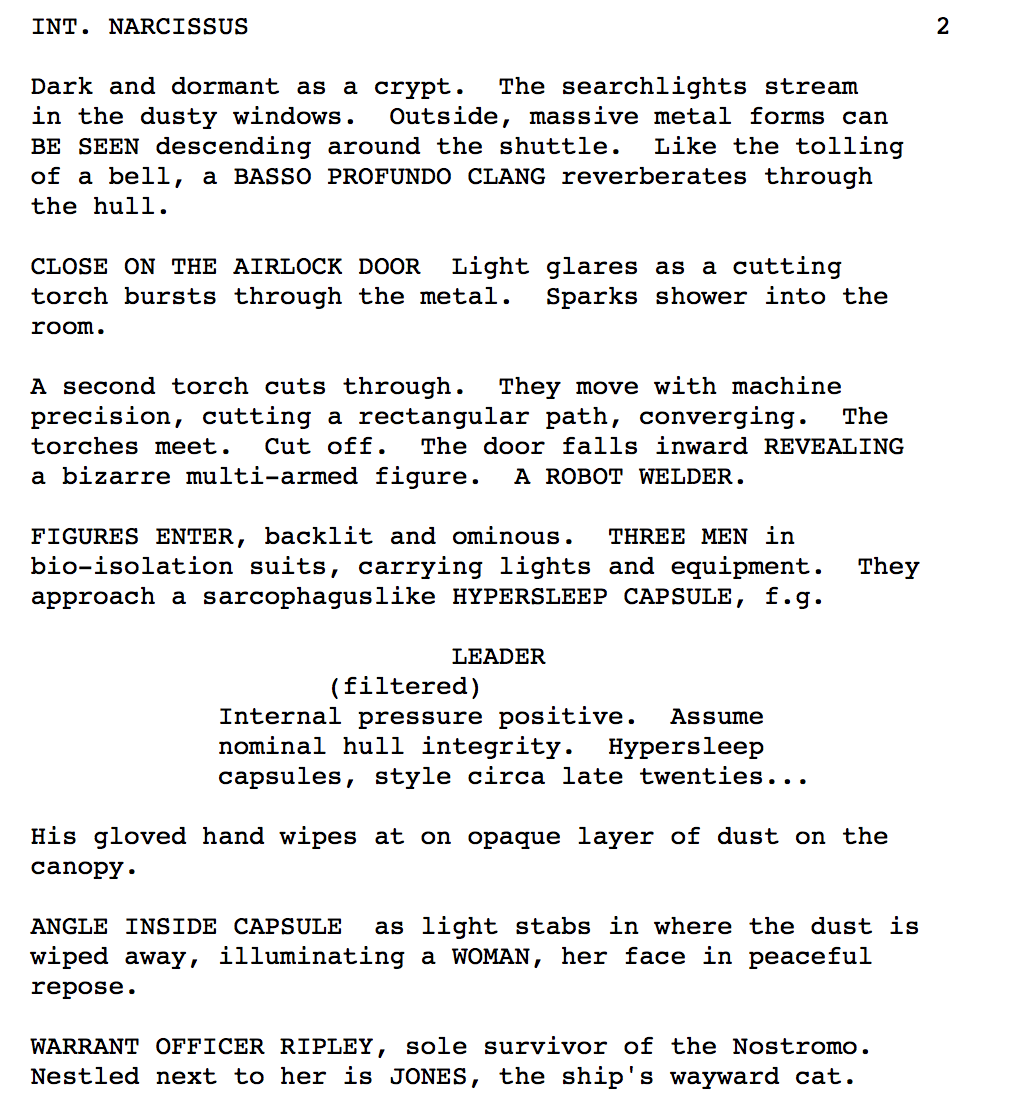
This is an example from the start of Aliens. This is him describing the Narcissus. I won’t go through all of this, but I’m just going to give you a sense of what it feels like on the page.

INT. NARCISSUS. There’s no day or night. Just INT. NARCISSUS.

Dark and dormant as a crypt. The searchlights stream in the dusty windows. Outside, massive metal forms can BE SEEN descending around the shuttle. Like the tolling of a bell, a BASSO PROFUNDO CLANG reverberates through the hull.

CLOSE ON THE AIRLOCK DOOR. Light glares as a cutting torch bursts through the metal. Sparks shower into the room.

A second torch cuts through. They move with machine precision, cutting a rectangular path, conversion as the torches meet. Cut off. The door falls inward revealing a bizarre multi-armed figure. A ROBOT WELDER.

So, that’s the very start of Aliens. This is coming to find Ripley in her spaceship. And I remember what that looks like when I saw it in the movie, but this would have given me a very good sense of what this movie felt like. Craig, how do you react to this?

Craig: Well, this to me, I think of this, and I’m not sure if it’s because the script was so influential, or if it’s simply within a tradition that’s longer, this feels like a very typical way of doing things. And I don’t mean to say boring at all. I mean to say this is sort of how you do it. Like when I think of like a good classic way of writing description, it is a little bit prosy, right? He doesn’t shy completely away from prose. “Dark and dormant as a crypt” is evocative.

But he’s using — he’s not writing full, complete sentences. He’s doing a lot of little bursts. Like, “Sparks shower into the room” is a technical sentence, but it’s not like a full, or like the words “Cut off” is a sentence. That obviously is a little bit of a fragment.

So, he kind of goes fragmented at times. Mostly the action description is focusing you on the visuals and on the audio, which is important. So, to me, this is a very classic way of doing things. There’s not a lot of stuff in here — there’s nothing cute. There’s nothing clever or referential to the reader. There’s nothing that you wouldn’t know if you weren’t watching or listening to the movie.

This, frankly, is pretty much the way I like to approach things. Also interesting is his use of capitalization which is very much the way I use it. And it’s when I feel like it.

John: Yeah.

Craig: So, you know, sometimes he’ll say, like he’s using it in a typical way when a new character enters. ROBOT WELDER. THREE MEN. Sometimes he uses it to call out a specific prop. HYPER SLEEP CAPSULE. Sometimes he uses it for a sound, or even an action. Like he says, “Outside, massive metal forms can BE SEEN.” And it’s there just to help you. It’s almost like you can see the camera swinging to it, you know what I mean?

John: Mm-hmm.

Craig: So, this is very classic. I think you could not go wrong if you adopt this as your style.

John: Absolutely. Let’s talk about the literary techniques he’s using. So you have metaphor and simile in here. So, “Dark and dormant as a crypt.” “Like the tolling of a bell.” So, obviously you can’t see metaphor and simile up on a screen, but that’s how you’re trying to create the image in the reader’s head, or create the sound in the reader’s head.

He’s not afraid of referencing the camera. So, it does say, “ANGLE INSIDE CAPSULE,” “f.g.” for foreground, which is not common, but you totally get what’s happening there. This feels like a script that was both written to be shot, and written to be read. He actually has a great appreciation for the person who is spending the time to read the script and is trying to create on the page as close to the experience as what he wants to create on the big screen down the road.

Craig: Right.

John: So, this is terrific on that level.

Craig: Yeah, I agree. And it’s one of the reasons I get so frustrated when so-called script whatevers say, “Don’t do…script…” because what he’s doing here isn’t so much writing a script like, oh, I’m just writing directorial notes for myself. What he’s doing is helping the reader watch a movie. Everything he writes in here, everything, is essentially him describing to you the movie that’s running in his head. So, “Dark and dormant as a crypt” is evocative and I can see it. And then I see, “Searchlights stream in the dusty windows.”

I see all of it, and it’s — even “Like the tolling of a bell, a BASSO PROFUNDO CLANG.” So, some people might not know what a Basso Profundo Clang is, but they know what the tolling of a bell is. So, we’re good.

John: Yeah.

Craig: “Light glares as a cutting torch bursts,” I can see it. It’s all about helping me see, and the angles help me see.

John: The next last paragraph, “ANGLE INSIDE CAPSULE as light stabs in where the dust is wiped away, illuminating a WOMAN, her face in peaceful repose.”

So, here we go. This is a long sentence for what this. So, “Inside the capsule, light stabs.” Great. I totally get what the stabbing is in that case. “As dust is wiped away.” So here it’s like we’ve moved to passive voice kind of here for a second. You know, dust is wiped away. But we’re inside and he’s using the whole sentence to sort of let us know this is a longer shot. We’re inside something. It’s meant to be mysterious and it’s meant to be a little bit more serene inside here. It’s just terrifically well done.

Craig: It’s so good. It’s so good. And it’s so purposeful. Like this is my favorite kind of description, frankly, because it is both creative and utilitarian. I’m a big fan of this sort of thing.

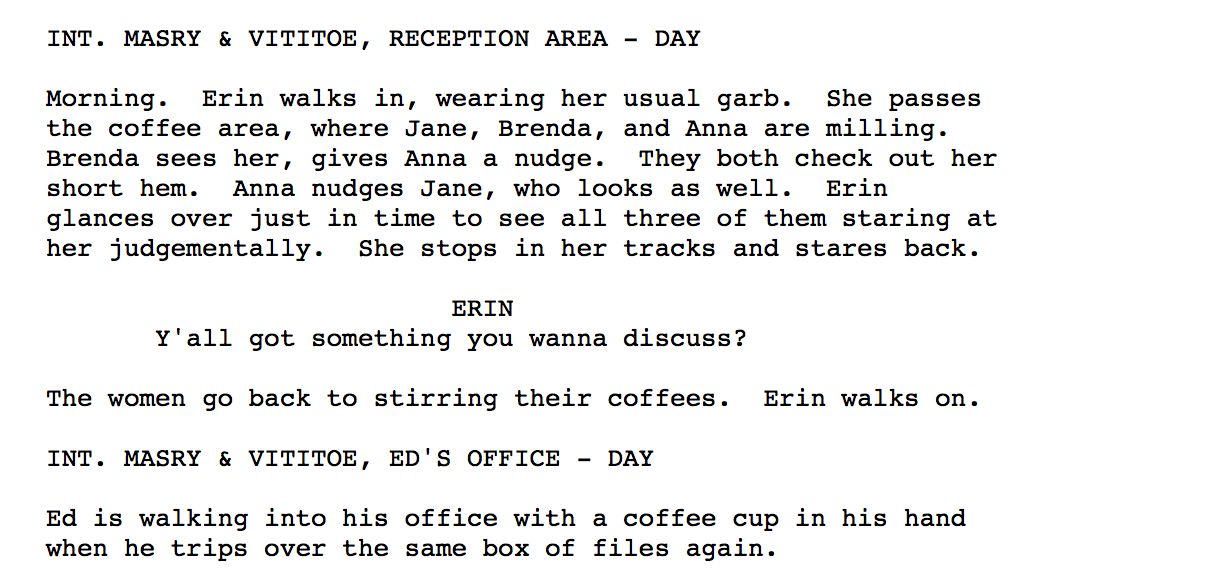
John: Great. Next up we have Erin Brockovich, and here’s a snippet of the script by Susannah Grant.

INT. MASRY & VITITOE — lord, I have no idea what the name is — RECEPTION AREA — DAY.

Morning. Erin walks in, wearing her usual garb. She passes the coffee area where Jane, Brenda, and Anna are milling. Brenda sees her, gives Anna a nudge. They both check out her short hem. Anna nudges Jane, who looks as well. Erin glances over just in time to see all three of them staring back at her judgmentally. She stops in her tracks and stares back.

Y’all got something you want to discuss?

The women go back to stirring their coffees. Erin walks on.

Next scene.

INT. ED’S OFFICE — DAY

Ed is walking over to his office with the coffee cup in his hand when he trips over the same box of files again.

So, a very different style here. This first paragraph, all the scene description before Erin talks is just one block. And yet it works really well for me because it gives me the feeling that this is a oner, that basically this is all happening in a single shot. This is all sort of one idea is them looking at her. And then we’re going to circle back around to what her reaction is to them looking at her.

Craig: Yeah. This is a very common way of describing scenes that are not about the camera. The camera should not be noticed here at all.

So, when we look at James Cameron’s opening, it’s incredibly visual because there is no dialogue and it’s entirely about telling the story of the mystery of a space that’s being illuminated and exciting things are going on.

This scene is about people and what’s going on in their heads. And about what looks mean and what looks don’t mean. And looking away and looking at. And in that case this is appropriate because I don’t need to know the angles on that, at all. The angles, frankly, will be incredibly boring and obvious.

It’s entirely about the performance, so in this case I like the fact that the action takes a back seat to the performance. And all of the action is now actually describing what’s happening inside people’s heads, so that when Erin says, “Y’all got something you want to discuss?” and then they go back to stirring their coffees, I know exactly what happened.

You could have done this in dialogue. You know, it could have been whispered. “You see what she’s wearing?” “Y’all got something to discuss?” “No, no, no.” Right?

And so I like that in this case you go, no, no, I don’t want to do that in dialogue. I want to do it in action. Well, this is how you do that in action.

John: Yup. I mean, if you didn’t understand English, you would still understand this scene. And you would understand that they are looking conspiratorially and reacting. And that she says something back that shuts them up. That’s all you really need to know. So, honestly the line of dialogue isn’t especially important for making the scene work.

Craig: Yeah. This is one area where — I don’t want people to think that just because I say you’re allowed to use camera angles means you should always use them. This would be a place where it would be very clunky to suddenly say, “Angle on Erin. She stops in her tracks and stares back.” You just don’t want that. Because it’s a boring shot.

John: Yeah. This makes it seem easy and sort of thrown off in a way that’s just right. I wanted to talk about that last line before we go to the next scene. “The women go back to stirring their coffees. Erin walks on.”

It’s a great example of just varying your sentence length to create a good rhythm on the page. So, those were some long sentences beforehand. It was a big long block. Here we just have two short sentences. “The women go back to stirring their coffees. Erin walks on.” A three-word sentence that lets us know that that scene is done and we’re on to the next thing.

You don’t need a Cut To when you have Erin walks on. That short sentence is your cut to.

Craig: That’s correct. And I would also say that let’s say your intention was that she would say, “Y’all got something you want to discuss?” and then you just for whatever reason wanted to cut away to something else, sometimes I’ll read in scripts where people end a scene on a dialogue line. It’s just a bad idea I think in general. Because you do want the line to land somehow.

Now, here you clearly need it to land, plus Erin is leaving. But I think in action it’s best to begin and end a scene with action.

John: Yeah. And of course you’re not making a blanket —

Craig: No.

John: Recommendation.

Craig: No, it’s just a good —

John: Yeah, so I’m sure you have scripts where you’ve deliberately ended on a line of dialogue and I’ve done it, too, but it’s a very sort of unique special case where you definitely want to leave the feeling that the camera is ending up on that person as they say this line, and you’re not supposed to be getting the reaction. That the next shot is the reaction to what they just said.

Craig: Yeah. I probably even in those circumstances, I’d probably pull a Cut To in there because I want some sense that I know what I’m doing. That it’s intentional.

John: Yeah. I think the Cut To is almost required for doing that technique.

Craig: Yeah. Ooh, I want to read this one.

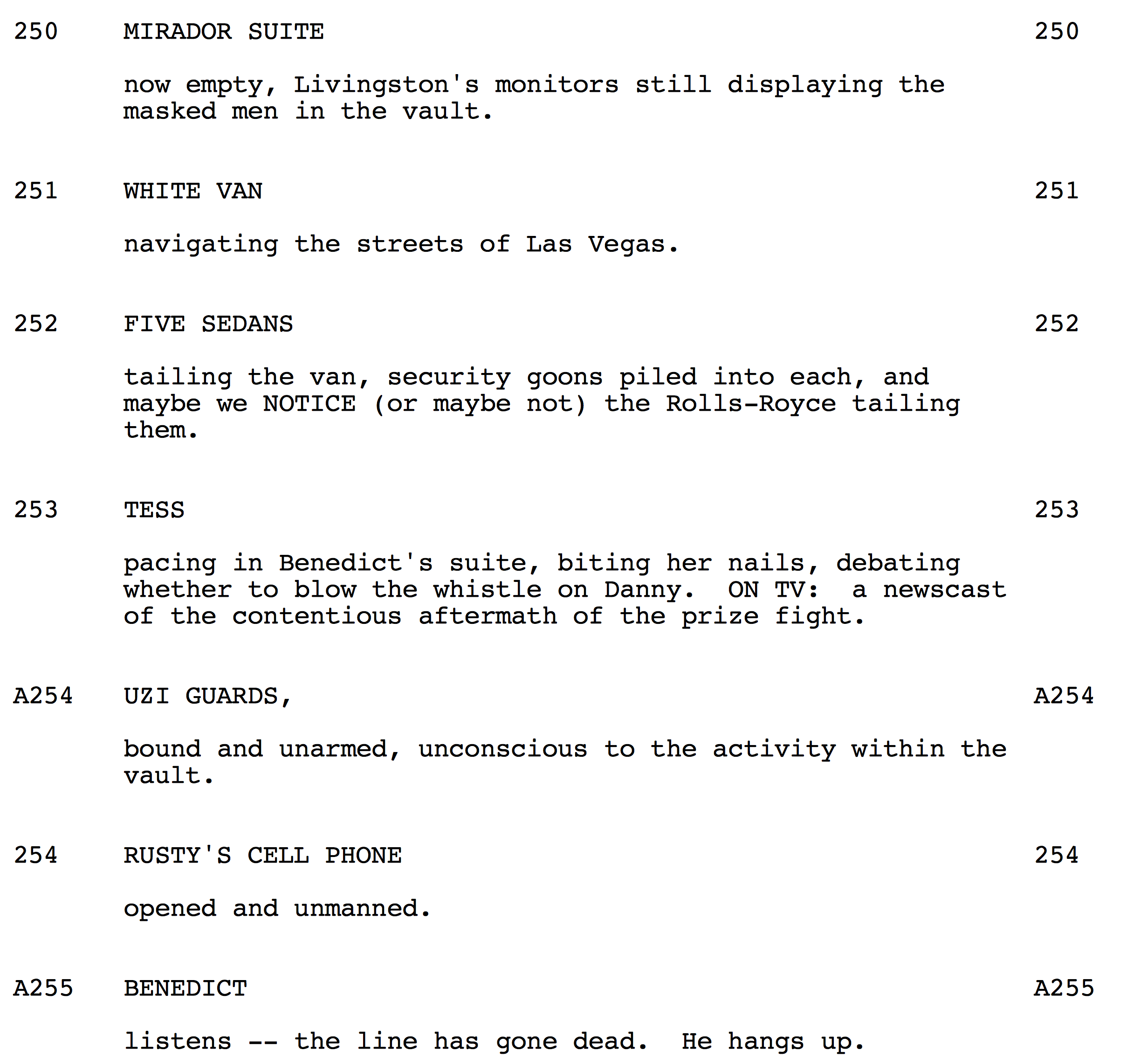
John: You can read this one. This is Ocean’s 11 by Ted Griffin.

Craig: Right. And here in this little snippet you’ll see that these are all called out as individual scene numbers. So, this is from a production script where everything was numbered. So, I’ll sort of emphasize where things are capitalized.

MIRADOR SUITE. Now empty, Livingston’s monitors still displaying the masked men in the vault.

WHITE VAN. Navigating the streets of Las Vegas.

FIVE SEDANS. Tailing the van, security goons piled into each, and maybe we NOTICE (or maybe not) the Rolls-Royce tailing them.

TESS. Pacing in Benedict’s suite, biting her nails, debating whether to blow the whistle on Danny. ON TV: a newscast of the contentious aftermath of the prize fight.

UZI GUARDS, bound and unarmed, unconscious to the activity within the vault.

RUSTY’S CELL PHONE opened and unmanned.

BENEDICT listens — the line has gone dead. He hangs up.

Ooh, good job.

John: So good.

Craig: Good job, Ted.

John: Good job, Ted Griffin. I wanted to include this because so often you see like, well, the question is like well how do I do a montage, how do I format a montage and, you know, sometimes you do it with bullet points, sort of you quickly go through a list of shots. But this is more commonly what you’re really needing to do in a montage which is you’re moving between different people and different places and they all have to build up to sort of one greater sequence. And this is great example of how you actually do that.

So, you notice that the start of each one he’s in all caps in uppercase doing the where we’re at. So, MIRADOR SUITE, WHITE VAN, FIVE SEDANS, TESS. And then the description right after that is set up in a parallel structure, so it’s always navigating, tailing, pacing. He’s coming with an adjectival, participle phrase to sort of give you a sense of what the action is, but not really the verb. So, it could be, “White van navigates the streets of Las Vegas.” But instead it’s, “White van, navigating the streets of Las Vegas.”

It’s a continuous action that we’re just catching a glimpse of it while it’s going on.

Craig: Yeah. This is all about creating the sense of flow across things that otherwise would be considered fragmented. So, let’s just go right off the bat here. Ted gets rid of INTs and EXTs. Doesn’t need them. Doesn’t want to bother with them. And I don’t blame him at all, especially when you have so many of these in a row. It would be just like word salad to have all these INTs and EXTs, and we don’t need them. We know that the white van navigating the streets of Las Vegas is outside. And we know that Tess in Benedict’s suite is inside.

We’re getting all of that. So, he says, eh, screw all that formality. Don’t need it. I also love that the way it’s running here, there’s a rapidity to it. We can feel the pace of these scenes. We can see — there’s a motion going on to all of this.

And then there’s this interesting — this would fall — I would put this in the school of extreme utility. But, then there are these little twists. For instance, “FIVE SEDANS tailing the van, security goons piled into each, and maybe we NOTICE,” and in parenthesis, “(or maybe not) the Rolls-Royce tailing them,” which is great, because that’s different than what Cameron does. Cameron probably would never write that, because what do you mean, maybe not? Well either we do or we don’t, right?

But actually that is something. Like the instruction there is a careful viewer who is paying attention to that will see it, but otherwise they won’t. We’re not making a deal of it.

John: In the script I just turned in, there’s some scene description of an apartment that we go to the first time. And I call out that there’s some memorabilia from an earlier scene in the set decoration, but it’s not crucial. It’s like it’s a useful thing that’s there that helps sort of connect it to an earlier thing, but it’s not an urgent thing that the viewer doesn’t see it that the world comes crashing to an end.

And so that “or maybe not” is a useful thing. It’s not saying like throwing up your hands like you don’t care. It’s saying that it’s like it’s there and it’s interesting, but it’s not essential.

Craig: Right. Similarly, there’s a thing that probably I don’t think Cameron would do in his description, but I like that Ted does it here. On Tess, “Debating whether to blow the whistle on Danny.” Well, can you film that? Yes, you can.

As long as the screenplay has made it clear that she’s in a position where she would be debating that, what you’re saying there is act like you’re debating that. And I’ll see it. I should be able to see — that’s something that an actor can act. So, I like that that’s there. And then you see that on TV there’s this prize fight going on. So there’s all these layers of stuff.

I love that Rusty’s cell phone is his own scene. It’s just great. Because that — here’s the other thing. Once you start down the road of a pattern for a montage, you’re in that pattern.

John: Yup.

Craig: So, you can’t just suddenly go, okay, now here’s a bunch of things all together in one scene. No. Uzi guards and now Rusty’s cell phone is his own scene, just sitting there, all good, and then you go back to Benedict. “The line has gone dead.” Great. Great. Great.

Just a really good way to move you through this moment. It’s fun. You can feel — like you can almost feel the music through this which is great.

John: Absolutely. Probably a good sign for almost any montage is that you should be able to sense the underlying audio, which is generally music, that’s going to be the bed that’s going to tie all these things together.

And each of these shots feels about the same length, even though they consist of very different material in them.

Circling back to what you said about Tess, “Pacing in Benedict’s suite, biting her nails, debating whether to blow the whistle on Danny.” In all these examples, these are scenes that were already set up someplace else. And so if you’re coming back to something you don’t have to sort of do all the work again to establish who that person was, what they were doing. We had an earlier scene where we saw her. We saw or we knew what her situation was, so we don’t have to do the full recap here. It’s just like, you know, remind us like, oh, she’s debating what she’s going to do.

Craig: Right.

John: Great. We got it.

Craig: Yeah. And it’s really underscoring also how much work the screenplay has done well, because there’s a simplicity and a clarity. There’s no confusion at this point what her pacing is about. That means the screenplay has done its job. So, excellent work there. Ooh, can I read this one, too?

John: You can read this one, too.

Craig: Only because it’s like my favorite and I just feel like maybe I’ll get smarter for having read it. [laughs] So this is a little bit from Unforgiven by David Webb Peoples. Obviously one of the great, great screenplays ever.

BAH-WHOOM! Munny fires and smoke belches out…

Skinny is blown back against the wall and falls to the floor a bloody mess and…

Little Bill is reaching for the Spencer which is leaning against the bar near his leg but he freezes because…

Munny has turned the shotgun on him and Munny sees Ned’s Spencer there and his eyes show how feels about it.

For a moment while the smoke clears the bar is silent and there are nervous glances cast at the bloody body of Skinny but Little Bill keeps his eyes on Munny.

Little Bill says, “Well sir…You are a cowardly sonofabitch because you have just shot down an unarmed man.

Actually, I think in the movie they flipped that. Regardless.

Then….It has become a very formal moment and there are, figuratively speaking, only two people in the room, Munny and Little Bill…and WW Beauchamp is watching them, scared to death, but this is it, what all those Easterners dreamed about, the showdown in the saloon.

John: So much to love here. And so different than some of our other examples. And that’s why I thought we would include it.

Craig: Yeah.

John: So, let’s talk about dot-dot-dot and dash-dash. So, here David Webb Peoples is sort of continuing the continuity of the action by ending each line on a dot-dot-dot. So, and…, and…, because…. So, there’s a cause and effect to each time that we’re cutting.

You know, you don’t necessarily have to believe that each one of these paragraphs is its own shot, but it kind of feels that way.

We’re always in the present tense, and yet look at the choices he’s making about present tense. Skinny is blown against the wall. So, rather than saying the shot blows Skinny back, he is blown back, so we’re seeing the effect of that shot from a previous cut.

Little Bill is reaching for the Spencer which is leaning against the bar near his leg, so we are — so often in screenwriting books they’ll talk about like oh don’t use —

Craig: Get rid of I-N-G. Wah!

John: Yeah, exactly.

Craig: Blech.

John: But here twice in a row, because we’re establishing geography and location and sort of the continuity of a person’s action.

Craig: Right.

John: It’s so fascinating here, I think, where Munny has turned the shotgun on him. So rather than saying Munny turns the shotgun on him, like it has already happened, so we’re coming into a moment that has just happened, so we’re seeing the effect of what has just happened.

Craig: It’s so great. It’s so great. And, you know, this is where these, again, these screenwriting knucklehead gurus out there, I just want to put them all on a spaceship and send them into the sun, because they don’t even understand, ooh, here it comes, they don’t understand —

John: Yup. I knew it was coming.

Craig: They don’t understand the point of verbs. This is a — this is masterful. What peoples is doing here is masterful. And if you pay attention you can see the movie happening because of the verb tenses, right? Little Bill is reaching for the Spencer means when the camera cuts to Bill he’s already in motion. Not reaches for, which means he makes a decision to reach and then reaches. He’s already moving. The thing is already there. And then, but he freezes because Munny has turned the shotgun on him.

Munny has turned the shotgun on him means that Little Bill is discovering something that has happened off-screen that he didn’t realize happened, and that’s so impactful for the audience. Because it means that he’s going to see something first and we’re going to see in his eyes fear. And then we’re going to reveal what he’s scared of.

This is how verbs work, you enormous pile of [laughs] of exploitative —

John: You’re not talking to me. You’re talking to some strawman —

Craig: You exploitative mother-f’ers. “Don’t use I-N-G verbs.” You idiots. Right? So this is what it’s about.

And I love it!

John: Mm-hmm. This last paragraph is so fascinating to me, because “It has become a very formal moment and there are, figuratively speaking,” so it’s a huge long paragraph. This phrase, “it has become a very formal moment,” doesn’t that feel like a slow pullback to you?

Craig: Mm-hmm.

John: It’s like you’re just like you’re recognizing like, oh, we’ve been in these little moments and then suddenly we’re getting bigger and wider and we’re sort of seeing what exactly has happened here.

So, it’s like it’s taking stock of the last few moments and sort of like what the scene is like now. And you don’t have to do this, but in some ways to write to Unforgiven you have to do this, because that’s what the movie feels like.

Craig: Absolutely. And, by the way, I think wrong. I think that this is exactly the order that Little Bill said it in. It’s just maybe he fiddled with a couple of words. But, no, of course, it’s exactly right. So, here’s the deal, right, I love dot-dot-dots. I’m a huge fan of them because what dot-dot-dots do for me is they kind of imply you’re holding your breath. You know, like Walter Murch wrote this great book called In the Blink of an Eye where he talks how the audience will naturally blink where you kind of want to cut, you know.

And that’s just the way our brains work. And similarly, when things like this are happening, it’s common for people to say, “Oh my god, I finally breathed. Like I was holding my breath through that whole thing.” That’s what dot-dot-dot is doing. It’s saying hold your breath. Hold your breath. Hold your breath. And then Little Bill says this, and the way that David Peoples writes this last paragraph it implies you’re breathing now. In fact, we’re going to take our time to breathe and discover this tableau, that it’s now formal. Now, all the action is over and we have entered this new weird thing where two gods among men have dropped all the pretenses and are cutting to the truth.

And then I love this, “And WW Beauchamp is watching them, scared to death that this is, what all those Easterners dreamed about, the showdown in the saloon,” which is something that is acted beautifully in that moment. It’s just great. And there’s nothing wrong. It’s not too wordy, as far as I’m concerned. I feel like this is really bursty, like quick bursts, and exciting, and then when the movie becomes a little bit languid, the action becomes languid.

So this is poetry to me. The use of action is helping imply the pace of the scene itself.

John: Great. Our next example is from Wall-E, which has a similar sort of strange style to it, like sort of not conventional style. But completely suits the movie that Wall-E is. So, Wall-E, if you remember, so much of Wall-E takes place like a silent film. And if you read the script, it sort of feels that way.

So, I’ll describe this to you and if you look at the actual sample, these single sentences are all their own line. So there’s no paragraphs here. They’re all just given their own line. They’re blocked together in some ways to sort of imply a bit of more continuity of action, but they’re all single sentences.

EXT. TRUCK — NIGHT

Wally motors outside.
Turns over his Igloo cooler to clean it out.
Pauses to take in the night sky.
STARS struggle to be seen through the polluted haze.
Wally presses the “Play” button on his chest.
The newly sampled It Only Takes a Moment plays.

The wind picks up.
A WARNING LIGHT sounds on Wally’s chest.
He looks out into the night.
A RAGING SANDSTORM approaches off the bay…

Unfazed, Wally heads back in the truck.
It Only Takes a Moment still gently playing.

…The massive wave of sand roars closer…

Wally raises the door.
Pauses.
WHISTLES for his cockroach to come inside.
The door shuts just as the storm hits.
Obliterates everything in view.

Craig: Well, I love Wall-E. Love Wall-E. I would not recommend that people write traditional screenplays this way. I wouldn’t even recommend people write animated screenplays this way, because this document feels like a notes documents for people who are all working on a movie.

This document feels like it’s in support of reams and reams of storyboards and story art. And on its own is simply not going to do the job. Like, I read this and it doesn’t make me see the movie at all.

It feels like a support document. So, I think that this is a more technical way of doing things within a framework of a storyboarded process, but I don’t think that this would be advisable for a movie where somebody didn’t know your story at all and was going to read it.

John: I disagree with you. I think I could read this document and have a really good sense of what the movie felt like.

And it would take me a little while to get into this strange spare style, but honestly it does feel what certainly the first half of Wall-E feels like to me, which is a bunch of individual shots where he is a small figure against a large landscape or, you know, just he’s center frame and there’s just this giant emptiness around him.

I really dug it. And so even if you were to try to apply some of these lessons to a more conventionally written screenplay, I want to talk about trimming off subjects of sentences because you don’t need them a lot of times.

So, let’s imagine these first couple of sentences where in a more conventionally formatted script. “Wally motors outside. Turns over his Igloo cooler to clean it out. Pauses to take in the night sky.” You don’t need the He’s, you don’t need the It’s, you don’t need Wally’s, as long as you have parallel structure between those sentences, we get it.

And particularly if you’re writing action sequences, you’re very often going to trim off those subjects because we know who’s doing it, so just give us the verb and let’s keep going.

Craig: Yeah, I agree. I do that all the time, and I obviously write in a more traditional sense. Where this doesn’t work for me, if I weren’t familiar with Wall-E, if I didn’t see artwork, I hadn’t been looking at storyboards is things like, it says, “A raging sandstorm approaches off the bay…” but that’s it. It’s just a raging sandstorm. Okay.

And then it’s a “massive wave of sand.” And then it says, “The door shuts just as the storm hits.” It’s so flat and I’m not excited. And I want to be excited in things like that. He says, “Whistles for his cockroach to come inside.” I’m not sure if a cockroach does come inside there, or not. I don’t know. And it says “obliterates everything in view.” It’s all so flat and it feels very much like Wally himself, like Wally is writing this script. But I don’t want Wally to be writing the script. I want somebody like Pete Docter to be writing the script to make me feel for Wally, which is in fact what was going on.

I think it was Pete Docter who did this one, right?

John: Yeah. Pete Docter, Andrew Stanton.

Craig: Oh, Stanton.

John: Other credits were Jim Reardon, yeah.

Craig: I’m just fascinated by this. You know what I’m going to do? I’m going to ask our friend Emily Zulauf like what the deal is with this, because I can’t imagine that they would give this to somebody that didn’t know anything else and say what do you think of this movie we’re making. So, I’m in a different place than you are on this one.

John: Yeah. For sure you could imagine this document along with the artwork, or the sense of like each of these lines became one panel of a storyboard. And maybe that’s sort of how their internal process works. But I really do think this is a way you could write a script and have it be quite successful. So, all right, next is a much more conventional thing but also quite delightful thing from our friends Derek Haas and Michael Brandt. This is from the movie Wanted.

THWAP! A bullet finds its way through the space and hits the Electrician in the back of the shoulder, spinning him around.

CLOSE ON: Cross’s gun. Another shot and we follow the bullet, across the dock, and dipping low into the next space in the paper stack — right where Electrician is now leaning…

…the bullet buries in his eye, sending him to the floor.

Wesley sees Cross race for a set of stairs. Just as Wesley is about to cut him down, Cross fires at a wooden beam holding back some massive rolls of NEWSPAPER. The rolls tumble over and Wesley has to dive out of the way, allowing Cross to escape up the stairs.

Wesley, Fox, and the Waiter all race for the stairs.

Craig: Yeah. To me, this is, again, very traditional way of doing action. One thing that the guys do here is they’re not shying away from violence, right, so the action — when we write action, you can say like, “He’s shot, falls to the ground.” And the action is telling you this is a movie about the ballet of violence. When it’s “THWAP! A bullet finds its way through the space and hits the Electrician in the back of the shoulder, spinning him around,” we understand that we’re doing ballet now. First of all, we know that we’re actually following the bullet, which tells us, again, about pace.

When “the bullet buries in his eye, sending him to the floor,” it’s underlined. They’re like, hey, this is what we’re about here. This is a movie in which violence is supposed to be operatic.

And people running and dancing around, like I don’t know what these guys are thinking, and I don’t need to. I don’t know what their characters are in this moment. It’s not about that. So, contrast this with say like in Unforgiven we can see like, oh my god, he turns and then there’s this moment of dread. And then we reveal this. This is more pure action.

And this is a very typical way of writing pure action. High energy. And use the action to let us know exactly how lurid we’re going to be.

John: Yup. Also, the use of underlining is part of the reason why I chose this section of the script. Action scripts will tend to use underlining as like an extra form of punctuation. It’s like a way of sort of visually indicating what the key crucial beats are. And so you will underline the things that you want to make sure the reader doesn’t miss, but also it’s just going to give you a sense of this is already a very loud scene, so what are the loudest parts within this loud scene.

And sort of what do you need to make sure you’re focusing on. Even within the uppercase, like that NEWSPAPER still gets capitalized because — it’s not just because it’s a key prop, but because it’s a big thing you need to make sure you don’t miss. It’s a thing that’s going to be causing the action in the next section.

Craig: Right.

John: It’s essentially its own character for the rest of this paragraph.

Craig: Yeah. And so like if you don’t capitalize newspaper and so everything is just underlined there, you’ll notice it, but massive rolls of newspaper you’re like, well, okay, so massive rolls of newspaper. Newspaper doesn’t seem very massive to me. Massive rolls of all capitalized newspaper, I’m just already imagining lots of newspaper, like a massive amount of newspaper, which is what they want. So, they’re smart that way.

I thought this was done really, really well. And, by the way, just side note, love this movie. Love — so entertaining. I was so entertained by Wanted.

John: Yeah. Wanted is a movie that knows what it is in a way that so many movies don’t. It never shied away from being its own true self, and that’s what I really appreciated about it. It was nutso.

Craig: Yes, it was.

John: And wasn’t Chris Pratt in that? Chris Pratt plays like —

Craig: Yes, he plays like his jerk buddy at work who is screwing his girlfriend.

John: Like on a copy machine. There’s some crazy —

Craig: Yeah, exactly. He hits him in the face with the keyboard and the keyboard letters spell out F-U I think, or, I’m trying to keep it clean. But it was very cool. I don’t know, Timur is nuts, man. That guy — I love that movie.

John: Yeah. I love it, too. Whatever happened to Chris Pratt?

Craig: I don’t know. I don’t know. For a moment there, uh, you know, I think he’s just mostly doing that role, like he plays that guy, the jerk.

John: The jerk. Yeah.

Craig: Like the jerk who is in a movie for a scene to make the hero look good.

John: Yeah. Sometimes you get typecast because it’s really who you are.

Craig: Yeah, well he gained a ton of weight. He’s like 300 pounds now.

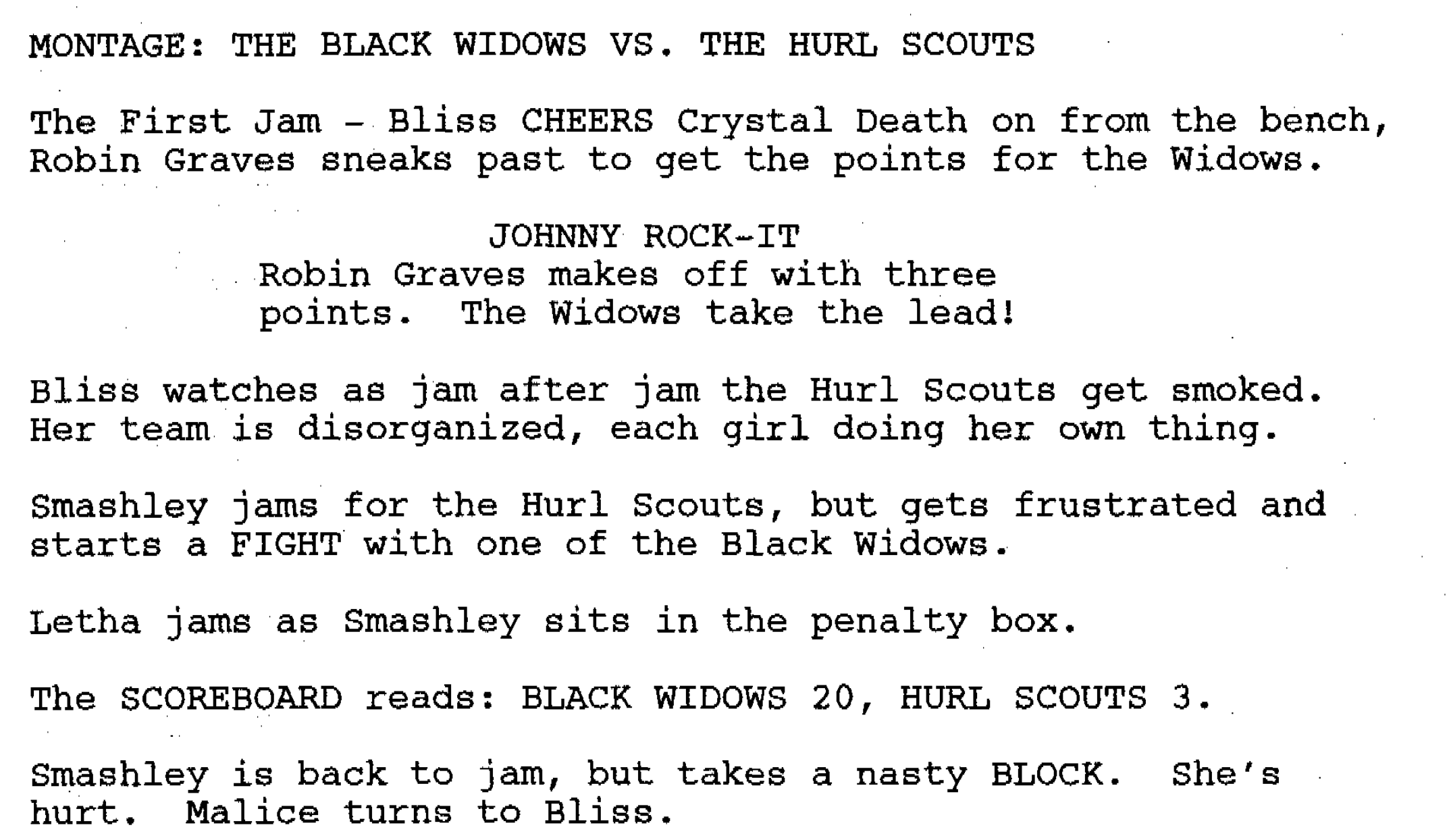
John: It’s rough. Our final example is from Whip It. And I wanted another example of a montage. And this is a movie that has a lot of montages because like most sports movies there’s time where you’re really trying to summarize down what a match feels like, what a game feels like, to sort of those key moments. So, here is one of the matches in Whip It.

MONTAGE: THE BLACK WIDOWS VS. THE HURL SCOUTS.

The First Jam — Bliss CHEERS Crystal Death on from the bench, Robin Graves sneaks past to get the points for the Widows.

Johnny Rock-It says, “Robin Graves makes off with three points. The Widows take the lead!”

Bliss watches as jam after jam the Hurl Scouts get smoked. Her team is disorganized, each girl doing her own thing.

Smashley jams for the Hurl Scouts, but gets frustrated and starts a FIGHT with one of the Black Widows.

Letha jams as Smashley sits in the penalty box.

The SCOREBOARD reads: BLACK WIDOWS 20, HURL SCOUTS 3.

Smashley is back to jam, but takes a nasty BLOCK. She’s hurt. Malice turns to Bliss.

Craig: Yeah, I mean, it gets the job done.

John: Absolutely.

Craig: Yeah, this is pretty spare, actually. I mean, I’m kind of a little surprised, because I’ve seen the movie which is so much fun, and these things are such high energy. I mean, I guess I am being a little critical. Like I kind of want sound. I want sound. I want crunching. I want like, you know, like starts a fight, like how? Like punches her?

John: Punches her? You know, I feel like I actually got some of that sound and some of the feel just by the use of the verbs she did choose. So, “jam after jam they get smoked.” Picking the fights. Takes a nasty block. I think this scene comes from later on in the movie, so this may be after we’ve had quite a few examples of like what these matches feel like, so this may be one of the shorter matches in the movie overall.

Craig: Right. Okay, well that’s a good point. Because there is a real fatigue that can set in. It’s one thing to do the ballet of the bullet smashing into eyes, and people smashing into each other, but if this is the ninth or tenth of these at some point in the movie, then I guess short-handing makes sense, because one thing that does happen — and everybody knows this as you’re reading a script — is you read faster. It’s like faster, faster, faster because if the script has done its done its job right, you want to see what happens

John: Yup.

Craig: You want to see what happens. So, you start to go faster and faster. You don’t want quite as much really painstaking detail in here. And perhaps, you know, if Smashley has started a fight before, then — and it’s been spelled out really clearly, then starts a fight here, I kind of get how she’s doing it.

So, that makes sense to me.

John: Cool. I hope this was helpful for people. So, you can find all of the examples that we talked about here. There’s little images that you can download on the Internet. Just go to johnaugust.com/Scriptnotes and in the show notes for this week’s show you’ll see all of these images that you can read along with us. Thank you, Craig.

Craig: You know what? That was great. I feel like we’ve got a pretty big show here. Maybe we should push reshoots to next week?

John: I think we’re going to push reshoots to next week. So, in next week’s episode we will talk about what are reshoots, why do movies have them. How do writers get involved with reshoots? What happens if the original writer is not the writer on the reshoots? And we’ll talk through some of our own examples with our films that have gone through reshoots and what has worked well and what has not worked well.

But there is time for One Cool Things if Craig has a One Cool Thing.

Craig: Uh, my One Cool Thing is your One Cool Thing.

John: All right. My One Cool Thing is A World Without Work. It’s an article by Derek Thompson in The Atlantic. And I thought it was just a really good think piece overall about what is the future of America and other western economies going to be like as more and more of our work gets replaced by technology. And so to date we’ve seen like factory jobs being replaced, but as clerk jobs and transportation jobs and other things get replaced, there may just not be a place for some people to have jobs in the classic sense that we’ve had jobs.

And what does the world look like, not just in terms of how does the economy work, but psychologically how do we deal with a society where not everyone is going to be employed or needs to be employed. And so I thought it was interesting for everyone to sort of take a look at.

Also, the kind of work that you and I do, Craig, is sort of kind of weird luxury work. And we’re not kind of crucial or fundamental to any part of the economy. And we could easily, while we’re not going to be replaced by computers tomorrow, it just got me thinking about sort of what my life would be like and what my identity would be like if it weren’t the job that I had.

Craig: You know, artists have never been essential to society the way that people that grow food are, or doctors are, but we’ve always been in demand. I mean, well, not all of them, but a bunch of them.

So, the nice thing is I always feel like what we do at least, there’s always a place for it. People will always want to be entertained. It’s just innate to the human condition. So, yeah, I don’t think we will be replaced by computers.

I think I could be replaced by a computer. [laughs] That’s just me.

John: I think it does, and this article does lay out, is that it does allow for a greater number of people who have artistic ambitions to sort of fulfill those artistic ambitions because there’s no fundamental need for them to be working.

And so I think it may create a class of people who were never kind of looking for a job, or just decided to have sort of the minimal jobs and just become artists in whatever capacity they wanted to be because there’s no pressure to define yourself by making a certain amount of money.

Craig: All right.

John: We’ll see.

Craig: Yup.

John: Craig, thank you so much for another fun podcast. Our show, as always, is produced by Stuart Friedel. It is edited by Matthew Chilelli. I’m not sure who did the outro this week, but if you have an outro for our show, you can write into ask@johnaugust.com. That’s also the place where you can send your questions, long questions are the place for that.

Short questions are great on Twitter. I’m @johnaugust. Craig is @clmazin.

If you would like to subscribe to our show, you should subscribe to it in iTunes. Just go to iTunes and search for Scriptnotes. Also in iTunes you can find the Scriptnotes App which lets you get access to all the back episodes of the show. There’s also one for Android.

If you would like a USB drive, there’s a small chance that there are still some left in the store. So you could go to store.johnaugust.com and get one of those. There’s a 10% discount if you use the code SINGULARITY.

And that’s our show this week. Craig, have a fun week.

Craig: You too, John.

John: Bye.

Craig: Bye.

Links:

  • Scriptnotes 200 Episode USB drives are available in the store while supplies last
  • Paramount, AMC and Cineplex try new revenue-sharing initiative on The Wrap
  • Excerpts from Aliens, Erin Brockovich, Oceans 11, Unforgiven, Wall-E, Wanted and Whip It
  • A World Without Work by Derek Thompson
  • Outro by Stuart Neville (send us yours!)
Scriptnotes, Ep 187: The Coyote Could Stop Any Time — Transcript

March 13, 2015 Scriptnotes Transcript

The original post for this episode can be found [here](http://johnaugust.com/2015/the-coyote-could-stop-any-time).

John August: Hello and welcome. My name is John August.

Craig Mazin: My name is Craig Mazin.

**John:** And this is episode 187 of Scriptnotes, a podcast about screenwriting and things that are interesting to screenwriters.

Today on the podcast we will be talking about Road Runner rules —

**Craig:** “Beep, beep”.

**John:** The WGA Diversity Report, living in your car and we’ll have three new entrants in the Three Page Challenge.

**Craig:** Big show today.

**John:** Big show.

**Craig:** Big show.

**John:** Big show of little things.

**Craig:** We are — I have to say we are on a roll. Again, thanks to the Redditors over there at the screenwriting subreddit who helped us out with all those wonderful bad rules last week. We’ve gotten a lot of really good feedback on the Malcolm Spellman episode and then that episode last week, so we’re on a roll.

**John:** Yeah.

**Craig:** Let’s keep it going.

**John:** Absolutely. That’s the goal of this episode. So let’s dig right into it. This is something that was just randomly in my Facebook feed. I think Howard Robin had posted and this was a bunch of rules for the Road Runner cartoons. So essentially, Chuck Jones in his book Chuck Amuck: The Life and Times of Animated Cartoonist Chuck Jones claimed that he and his artists and writers had a set of rules that they went back to when they were writing the Road Runner cartoons. And having just been through an episode where we talked all about the rules of screenwriting, I thought it was so interesting to look at the rules and limitations that a group of writers put on themselves when creating something as iconic as the Road Runner cartoons.

**Craig:** Yeah. You want to go through some of these?

**John:** Let’s alternate here.

**Craig:** Okay.

**John:** So first rule. The Road Runner cannot harm the Coyote except by going “beep, beep” to scare or surprise him off a cliff.

**Craig:** Yeah, that’s right. He never touches him.

**John:** No.

**Craig:** Yeah. No outside force can harm the Coyote; only his own ineptitude or a failure of Acme products. Trains and trucks were the exception from time to time.

**John:** Absolutely. And trains and trucks are sort of like natural forces that he was, you know, he was always too close to them anyway, so. And generally, they were like a follow-up punch line. And basically, like, everything would have failed and then he gets run over by a truck.

**Craig:** And the trains and trucks in this area of the desert would appear out of nowhere without warning of any kind. [laughs]

**John:** [laughs] The Coyote could stop anytime if he were not a fanatic. To repeat, a fanatic is one who redoubles his effort when he has forgotten his aim as George Santayana said. So there’s no reason why the Coyote has to do it. I mean, I guess, sometimes they motivate it through hunger to some degree but it’s more that he’s driven to pursue the Road Runner. That’s just his function in life is to try to get the Road Runner.

**Craig:** Yeah, he’s a mono-maniac as we say.

**John:** Yeah.

**Craig:** Dialogue is strictly forbidden except “beep, beep” and yowling in pain.

**John:** Yeah, it’s absolutely true. And I don’t think I realized that when I was a kid watching them in the morning. It was like, that was what was so special about them, are these little silent movies. And, you know, even when he’s going to fall off a cliff, he just holds up his little sign that express his dismay.

**Craig:** Yeah, the little sign thing was, you know, they were like silent movies basically, you know, the old style and they forced these guys to be incredibly physical and everything. So I love that. What’s the next one here?

**John:** The Road Runner must stay on the road for no other reason than that he’s a Road Runner.

**Craig:** Which, by the way, you know, okay, so [laughs] I saw a roadrunner once, I wouldn’t have known it except that my wife who is a bird watcher, she said, “Oh, my god, that’s a roadrunner.” And I guess it’s actually kind of rare to spot one. They don’t look anything like the Road Runner and —

**John:** No at all.

**Craig:** Not even. I mean, the Road Runner looks more like an emu or something in the cartoon. But, yeah, they’re actually — I didn’t see it on a road. [laughs] They don’t actually follow the road but man, if you’d asked me that when I was a kid, I would have thought, no, no, it’s what Road Runners do.

**John:** Well, again, we always talk on this podcast about specificity. But like, you know, we’re talking about the specificity of this one unique bird and the one thing he does and it’s not trying to do anything else. It’s just he’s this one bird doing his one thing and all he does is run and he runs on this one road and it seems to be, just like the Coyote is a fanatic about catching him, the Road Runner just wants to run.

**Craig:** He just likes running. All action must be confined to the natural environment of the two characters, the southwest American desert.

**John:** Yeah, and again, very specific and I know that intuitively like, oh, that’s right, they’re always falling off cliffs and stuff like that but it hadn’t occurred to me until I was an adult that like, oh, yeah, it’s always in the exact same place.

**Craig:** Mm-hmm. That’s right.

**John:** It’s the backlot.

**Craig:** I know, yeah. But it was actually quite beautiful, I mean, and they made real use of the rock formations that he would always fall off of. I mean, I always loved the ones where, you know, the Road Runner goes out on that little separated ledge of rock —

**John:** Oh, yeah.

**Craig:** That’s a mile in the air and — but the huge rock falls [laughs] that the Coyote is on, I mean, they’re very smart about that.

**John:** Well, and also, I think, in its time the American Southwest obviously wasn’t new but I think it was the westward sort of migration of America towards, you know, the Southwest but also towards California. So it was like, it was the right kind of imagery for that generation. That was a place where people hadn’t seen and people were going to the Southwest for the first time to explore it.

**Craig:** You know what’s cool about these rules is that David Zucker and Jim Abrahams and Jerry Zucker had a similar set of rules. And rule number 15 is there are no rules. But in comedy, when you can confine yourself like this, what you’re essentially doing is forcing a certain amount of a degree of difficulty. And you get rewarded for it because everybody knows that you’re stuck in this desert and you’re stuck not talking and you’re stuck with these same motivations. Coming up with new variations on a theme becomes a little more impressive when you actually successfully do it.

**John:** You’re also, you’re taking away all those other choices. And so, it allows you to really focus in on who are these characters, what is their predicament because all the rest of the world is stripped away from it. And that’s a lovely thing in most cases.

**Craig:** Yeah, I agree.

**John:** Example here, all or at least almost all tools, weapons or mechanical conveniences must be obtained from the Acme Corporation.

**Craig:** Of course, I mean, that’s just the coolest company in the world. And I know that Warner Bros is always trying to figure out new ways to revive these cartoon characters. And Acme, I mean, it’s just such a great — you have to use Acme, I mean.

**John:** Oh, it’s the best.

**Craig:** It’s the greatest. And they really did make some very dangerous stuff.

**John:** [laughs]

**Craig:** So I’ll just do, I’ll do a couple of here quickly. Whenever possible, make gravity the Coyote’s greatest enemy which we’ve already discussed. And the Coyote is always more humiliated than harmed by his failures, which, you know, frankly, has to do with squash and stretch, I mean, he was terribly, physically harmed but he didn’t seem to feel that much pain. I mean, I would imagine that if we walked through life able to survive being hit by trucks and falling from the sky, we also would feel more humiliation than harm. Just sort of an extension I guess.

**John:** And related to these, the audience’s sympathy must always remain with the Coyote because even though he’s kind of the villain, he is also your hero. You’re the one — you relate to his struggle.

**Craig:** Yes.

**John:** The Coyote is not allowed to catch or eat the Road Runner unless he escapes up the grasp.

**Craig:** So he’s not allowed to catch or eat the Road Runner unless he can catch him and then the Road Runner gets away.

**John:** And really, I’m trying to remember instances where he really got the Road Runner for any more than three seconds. It’s mostly like, he’s held on to him and suddenly the Road Runner is smoke in his hands and the Road Runner is gone.

**Craig:** Yeah, I don’t really remember him actually holding the Road Runner but I will say that the Coyote, Wile E. Coyote, people sometimes struggle with the concept of what is an anti-hero. Wile E. Coyote is an anti-hero. He’s somebody that is doing something that you know is wrong. By the circumstances of the drama, he is the villain and yet we are rooting for him.

**John:** Yes.

**Craig:** Anti-villain. I mean, anti-hero. Sorry.

**John:** Is there such a thing as anti-villain?

**Craig:** No. I don’t believe there is.

**John:** Yeah.

**Craig:** Well, I guess, maybe you could say, like, Gru from Despicable Me —

**John:** Oh, yeah.

**Craig:** Is an anti-villain. Yeah.

**John:** That’s true. Yeah, because he’s identified as a villain but he ultimately is forced into heroic deeds.

**Craig:** Yeah, anti-villain.

**John:** That’s a lovely thing. So the reason why I wanted to bring up these Road Runner rules is that we were talking in the previous podcast about how all these prohibitions that people put on screenwriters saying, like, “Oh, you can’t do this. You can’t do this. You can’t do that.” And most of those cases, there’s a good reason why that thing sort of seems like a rule or like why generally it’s a good idea but it should not be a blanket rule.

And these are examples of rules that you’re placing on yourself that really should be iron-clad rules if you’re going to make a very specific thing. They are how you focus your story, you focus your art into a very unique frame. It’s providing boundaries for yourself that’s really helpful. Unlike the things we talked about in the previous show which were in many cases I thought destructive rules.

**Craig:** Yeah, I mean, the big distinction is rules that you put upon yourself as opposed to rules that you accept from someone else. You can place any rule you want on yourself for any reason whatsoever. If you feel that that’s going to make your work better or more interesting, do it, absolutely do it. And you’ll hear, there are rules that are specific to a piece of work, which is again different than the rules we were discussing last week which are meant to be these blanket bits of orthodoxy that apply to everyone. So every script, somebody sooner or later will say, “Well, what…” you know, if you have a script where somebody is magical, inevitably a studio executive will say, “Well, can we talk with the rules of the magic?” “Okay, sure.”

**John:** Yeah.

**Craig:** So, yeah, big distinction there. You’re allowed to put any rules on your work that you’d like, just don’t necessarily go follow blindly other people’s rules.

**John:** I had a meeting today with an executive and we were talking about sort of the writing process and she works in animation. And she was describing how over the course of the screening process they’ll screen thing multiple times. There inevitably hits a point at which everything just completely falls apart. And you end up sort of fundamentally questioning the assumptions you’ve made about what this project is. In some cases you are taking a character who you thought was a subsidiary character and that now becomes your main character or you’re doing either just these massive overhauls.

When we had Jennifer Lee on the show, we talked about, you know, the massive overhaul of Frozen where you just really reconceived how everything works. But these kind of rules that you’re setting for the Road Runner cartoons are that kind of massive reshaping and you might be well down the road in a feature length project, whether you formally codify these rules or haven’t codified these rules, you may find yourself like, you know what, these are the wrong rules. These are not the rules that are getting us to where we need to be and we need to write some different rules or just restructure our story based on some different underlying assumptions.

**Craig:** Yeah, it’s amazing how animation goes to, I mean, part of the benefit they have is that they can reimagine their movie and look at it.

**John:** Yes.

**Craig:** You know, through storyboards. They also have the time, generally. Because everybody is so frightened of actually animating something they don’t want, and I mean, animating, like full animation of something is super expensive.

**John:** Yeah.

**Craig:** So they give themselves the time. They also don’t have to worry about actor availabilities. That’s the other thing that —

**John:** That’s a lovely thing.

**Craig:** Huge flexibility for them.

**John:** So her question to me this morning was like, “Well, do you think there’s a way to sort of speed through that process or to get to the breaking point sooner?” And I had to say, no.

**Craig:** No, I don’t think —

**John:** I think the process is the process and the process is just, it’s kind of always terrible. And in live-action features, that breaking point is generally when you see the first assembly of your feature and you want to kill yourself.

**Craig:** Yeah.

**John:** You pray that the movie can never be released. And I remind myself every time before I watch it that, okay, that’s going to happen. And every time I forget.

**Craig:** Yeah. No, no question. There is a, you know, I’ve been talking about built-in inefficiencies. There is a built-in inefficiency to the system. It is impossible to achieve something even good, much less great without going through an inefficient process. Sometimes there are inefficiencies we can avoid that it’s just that the business won’t let us avoid them. But a lot of them, they’re just part of being human. And, I mean, you simply can’t see the story in its totality before you can see it in its totality. I don’t know how else to put it, you know.

**John:** Absolutely. And so the kind of thing where you recognize that your subsidiary character is actually your main character, you wouldn’t know that until you’ve written, you know, scenes with her and sort of heard her voice and saw what was possible. That’s just the reality.

The challenge I think in animation often is that the teams are so much larger. Whereas, making a live-action feature, you have your writer. You have your director. You have your producer. You have your studio executives. In some cases, you have a very powerful actor. In the case of animation, you often have a much bigger brain trust to go through and that can be really beneficial because you have more brains to apply to it but is everyone looking at the same movie, you don’t know. So it’s challenging.

**Craig:** Indeed.

**John:** Indeed. Let’s go to a much simpler challenge to solve which is diversity within the ranks of the Writers Guild of America.

**Craig:** Yeah. It’s a breeze.

**John:** It’s a breeze. I mean, honestly, Craig, I’m just so happy that it’s been solved.

**Craig:** We solved it.

**John:** It’s all good and done.

**Craig:** We solved it.

**John:** We’re talking of course about the diversity report that the WGA published this week that details the numbers for employment. And this was TV and features or was this just the TV report?

**Craig:** I think we will eventually get TV and features but for now it’s the TV report since that’s frankly where the majority of writers are employed.

**John:** Absolutely. So we’ve discussed this before in previous episodes and we’ll have a link to the earlier episode and I honestly wonder if we could just clip the audio from —

**Craig:** I know.

**John:** The previous show and talk about it again. The headlines on the story were, you know, numbers are down. Diversity is worse than it was before. If you actually look at the report, you see that it’s largely a flat line and there are cases where numbers have dropped or numbers for white men in their 40s have risen slightly but it’s not — it’s good news for no one.

**Craig:** Yeah, I mean, part of what I struggle with at times is that the Writers Guild, if their argument is that things are bad for racial minorities, for women, for people over a certain age as their argument should be, well, the data supports them. It supports them so sufficiently that they don’t need to exaggerate and yet they do anyway.

**John:** Yeah.

**Craig:** So, for instance, they’ll say things like, “Well, we’re really down from 2000 and they’ll pick a number, like, they’ll pick a low point but then, you know, you don’t realize, well, yeah, but we’re also up from the year before. So, you know, for instance, women writer’s share of TV staff employment is actually up incredibly slightly from 2013 over 2012, but down ever so slightly from 2011. So they’ll pick that 2011 number. Either way, I’m looking at this and I’m just seeing, this is the most dispiriting graph ever because it’s charting female writer’s share of television staff employment from 2001 to 2013 and the line is flat. I mean, yes, it’s true, in 2001, it was only 26.8 and in 2013 it’s 29, whoopty doo.

It was also 29 in ’07. It was down 27.4 in 2004. It’s basically hovered between 26.8 and 29 for 12 years and this is despite all of the talk and all of the reports. It’s just, like, I look at this and I just think, well why are we spending money on this report? Just keep reprinting the number from last year. If you’re not going to do anything different, why even do the report?

**John:** Yeah.

**Craig:** It’s just the same. Anyway, same deal. Minority writer share of TV staff employment here, there’s a slight uptrend, ever so slight. When you look at 2001 and 2013, you’re looking at actually somewhat steady growth from 8.8% in 2001 to 13.7% in 2013.

**John:** But that’s over the course of 12 years to have, you know, minimal. Yeah.

**Craig:** It’s the same old story there.

**John:** Yeah. The chart we’re looking at actually shows the percentage of US minority population, you know, as a sort of midpoint of sort of like, you know, you’d think you would be able to get somewhere near that and of course it’s nowhere near that.

**Craig:** Yeah.

**John:** And for women, you could — I can even just tell you that about half of Americans are women.

**Craig:** Yeah. That’s right. That’s the way biology works. In fact, if you want to feel really bad about the minority writers’ share of TV staff employment, here’s the saddest thing of all. Yes, there has been a slight uptrend. There’s also been a slight uptrend in overall minority population. Basically, the hiring line has sort of risen ever so slightly along with the actual line of racial minorities in the country.

**John:** Yeah.

**Craig:** So just terrible news there in terms of just the incredible stagnation. Now, here’s the one interesting chart. Here’s something that’s changed, like an actual change. And it’s what they call older writers’ share of TV staff employment. Back in 2001, 40 and under was at 58.2% and over 40 was at 41%. This was sort of viewed as an ageism issue. Those lines —

**John:** That’s flipped.

**Craig:** They have diverged and then they have converged. They converged and diverged, so we have an X. So now it’s flipped, exactly. Over 40 writers are now at 57% and under 40 are at 43%. So I guess now we should be concerned about the employment of younger writers frankly. [laughs] I’m not really sure what this means.

**John:** Yeah. It’s always a problem and it’s always a crisis. Do we need to be mindful of older writers? Yes. Is 40 years old a good barrier for us to be thinking about? I’m not sure it is. You know, as a person who is in my 40s, you know what, this is a gainful time to be employed. I am very much mindful though, as I hit my 50s and my 60s and beyond, that employment may not be as possible.

**Craig:** Yeah. I think 50 probably makes more sense. I mean, obviously people are, you know, life expectancy and so on and so forth. But I think there’s something else going on here. And this is entirely conjecture. It’s just a theory.

The business used to do a much better job of cultivating new talent. And so it is not surprising to me that in 2001, there were many more writers under the age of 40 because the business was generating the farm system, taking care of the younger writers to some extent, and encouraging them and there was frankly more business to do. I think over time that started to fade. And so a lot of the people that were in their under 40s in 2001, well, they’re still there working.

**John:** Yup.

**Craig:** But they have not been replaced, there isn’t that churn, which isn’t a bad thing. You know, we talked about this last year, the segment of population that’s been hit the hardest in terms of age are the 20-somethings.

**John:** Yeah.

**Craig:** And to me, that’s a sign of bad news. Moving forward, just as an interesting stat, this is something, a trend that continues that the distribution of minority TV writers is weighing more and more heavily toward hour-longs as opposed to half hours. I don’t know if that’s — what they don’t do is correlate this data with the actual number of hour-longs versus half-hours in script —

**John:** Yeah, because I have a strong suspicion that there are a lot more hour-longs than half-hours these days.

**Craig:** Right. So this is an area where I think the statistics are either leaving stuff out on purpose or just leaving stuff out because they haven’t really thought it through. God, look at this. Women’s share of staff writing positions and other programming in the 2013-14 season, 18%.

**John:** Yeah.

**Craig:** 18%. Embarrassing. Minorities’ share of staff writing positions, 3.5%. So whatever the numbers are overall, it gets much, much worse when you start looking at actual staff writing positions as opposed to, I guess, freelancing coming in or, you know, part-timers.

**John:** Or the showrunners.

**Craig:** Right.

**John:** So it’s that question of sort of like maybe there’s women who are at that sort of higher level but like staff writers are the people you need because they are the ones who become the showrunners of the future.

**Craig:** And they also are a decent indication of new people coming in.

**John:** Yeah. So, are there any things to be hopeful about? Well, when we had Malcolm Spellman on the show, he was convinced that something had broken in a good way and that there will be more black shows than ever. That would hopefully be good news for African-American writers and for minority writers overall. He’s on a show that has, you know, women running the show. That’s good too.

**Craig:** Yes. Yes. I mean, we’ll see.

**John:** We’ll see.

**Craig:** Right now, all I can say from this data is nothing has really changed. Based on this data, it’s the same old same old. Hopefully, because this is essentially an echo report of, you know, so this is a delayed snapshot. So it may have already changed. The number at the next report, hopefully, is better.

I do want to draw your attention to some of these. [laughs] This is what I call the WGA pointless spin. Percent of shows with no women staff writers, which is obviously a bad thing, they do two charts. They showed that in ’11, ’12, it was at 10%. And ’13, ’14 it went all the way up to 11% which is not a significant growth but —

**John:** Yeah. This chart is amazing. So we’ll have a link to this in the show notes. So we’ll have a link to the whole report in the show notes. But this is figure 12 we’re talking about. And so let me just try to describe it to you.

**Craig:** [laughs]

**John:** It’s a bar chart. And so if I’m looking at it, on the left-hand side, it’s 2011-2012 and it’s a very low bar, it says 10%. On the right-hand side, it says 11% and it’s a very tall bar chart. And then you look at the Y-axis and you realize it starts at 9.4% and it goes to 11.2%.

**Craig:** Yeah. So they have broken down these incredibly tiny increments to make the bars —

**John:** Fox News would be so proud.

**Craig:** [laughs] This was very Fox Newsy but that was nothing compared to figure, oh, this is my favorite, yeah, figure 14, percent of shows with no staff writers over 50. [laughs] So obviously you want that number to be lower. Well, in 2011-2012, it was at 31.1%. In 2013, the bar is literally three times taller at 31.5%.

**John:** Yeah.

**Craig:** It’s gone up 0.4% and they now, the Y-axis is divided in increments of 0.1% each.

**John:** Yup.

**Craig:** That’s just silly.

**John:** It is very, very silly.

**Craig:** Don’t do that.

**John:** Yeah.

**Craig:** Why do they do that? I know why they do it, obviously. You know why they do it? Because they think we’re dumb. And frankly, a lot of people are just going to go, “Oh my god, look at the two huge blue blobs here. [laughs] One is so much bigger than the other.”

**John:** I think if I wanted to visualize this though, I kind of want to see — I want a picture of like what a group of people is. And sort of like, you know, in this room, let’s just say that you have a writer room of like 20 people, how many would be, you know, over 50. If you represented it that way and you would actually see like the little people showing there that essentially, you know, whatever number of little people figures out of the whole group would be, you know, white men in their 40s or a woman or something like that.

**Craig:** Right.

**John:** Something that would actually make it feel more what it’s actually like there because this little bar chart doesn’t tell me anything.

**Craig:** I agree. And I would actually say to the Writers Guild that the value — so this report is put together by Darnell Hunt who is the director of the Ralph Bunche Center for African-American Studies at UCLA and he’s a professor of sociology. And he is the guy that they’ve gone to for almost all of these reports, I think.

**John:** Yeah.

**Craig:** Here’s the deal. The collection of the data is the collection of the data. What is I guess proprietary for somebody like Mr. Hunt is — or Professor Hunt I should say — is the analysis of the data and the presentation of the data. I don’t actually think this data has been analyzed and presented particularly well.

I actually think that there are ways to portray what is very bad news in a more impactful manner. And I also think that there’s a way to be a little more honest about the news that isn’t so bad or at least doesn’t become kind of laughable in its overstatement. I don’t love the way this report is done. Now that we’ve had a bunch of years to look at it, I think the Writers Guild should actually think about maybe switching it up here and seeing if somebody else can do a better job because I’ll say this much, if the report is supposed to be influencing anything, it is a failure.

**John:** Yeah.

**Craig:** If the report is just here to say, “Yup, it’s still bad,” well, success.

**John:** Success.

**Craig:** Yeah.

**John:** All right. So that was some familiar dispiriting news. Another thing that came up this week was a blog post by Todd Farmer who is a screenwriter. And that was sort of a new sobering kind of story —

**Craig:** Yeah.

**John:** Which is Todd Farmer describing how he went from writing two movies, big feature movies, Jason X and Drive Angry, to living in his car and being homeless.

**Craig:** Yup.

**John:** And so we’ll link to the blog post and he does a really great job sort of talking through what all happened and he’s sort of come out the other side of that. But I thought it was a really interesting look at — we always talking about breaking in and there’s this sort of myth of breaking in. Just because you’ve broken in and you’ve had two movies produced doesn’t mean everything is going to go remarkably well. You know, Craig and I both know writers who have found themselves struggling in their careers. And it’s a challenging career to be sort of working at if you’re not actually working.

**Craig:** For sure. You know, a lot of people tweeted you and me about this particular article. And so on the one hand, it is a very sober look at how things can go very wrong, that there are no guarantees attached to selling a screenplay or even getting a movie made or even having a hit movie, frankly. There are no guarantees that things will go well for you and we also saw that unfortunately with the very tragic death of Harris Wittels.

But I also think that, you know, in any population, things are going to go wrong for some people in a dramatic way. I don’t know if there’s any larger conclusion to draw from this. This felt like a very individual circumstance but it was a very good reminder to people that there is no breaking-in nor is there a making-it.

**John:** Yeah.

**Craig:** There is no line over which you are safe until you have actually put together a career and enough resources that somebody independent of you can look at and say, “Yes, at this lifestyle, you are now fine.” [laughs]

**John:** Yeah. [laughs]

**Craig:** But until that day, and, you know, we’ve broken this down before on the podcast. It sounds great. You sell a movie, “I’m making $300,000.” No, you’re not, not even close.

**John:** Not at all.

**Craig:** Yeah. Go ahead, give your managers money, give your agent their money, give your lawyer her money. Now, give the government their money, give the Feds, the state, the city. And then in this case, the writer in question had been divorced and now there’s child support and child. When all is said and done, you know.

**John:** Yeah. The thing for people to keep in mind is that unlike other jobs in which you might be unemployed, employment for a screenwriter is very come and go. And so you are working for yourself. And you don’t necessarily know when that next paycheck is coming and that can be really challenging.

So on the blog, I’ve often done first person reports. And going back many years, I’ve done first person blog posts where I have writers talk about their sort of early adventures in the business and sort of how they got their first jobs. And there were people who like just, you know, got off the boat to Los Angeles and are just figuring out how they’re starting their careers and really talking through what it’s like to just start it out here. What you don’t see so often reported is those, what I think Todd did a huge service to us all by writing about it, is what is life when things go wrong.

**Craig:** Yeah.

**John:** And the realities of things don’t always work out so well. And you may have IMDb credits but you may have no place to live, and that’s a reality.

**Craig:** Yeah. It turns out that hard times in this business look a whole like hard times in every business. All the glamour and all that baloney, it’s just an illusion business. In the end, everybody goes home and they’re still — they need a roof over their heads and they need to be able to pay their rent and put gas in their car. And I do worry.

I mean, look, it goes back to the discussion we had with Malcolm a couple of weeks ago, that feeling of heat and how reality-warping it can be and you think that it will last forever and then suddenly it just stops dead, you know. And then the cold wind blows, not good.

**John:** Not good.

**Craig:** Not good. Yeah.

**John:** So let’s go on to our main topic today which are three new entrants to the Three Page Challenge. So I sent Stuart to finding us three things we could talk about today and he read through 60 different Three Page Challenges yesterday.

**Craig:** Oh, yeah, Stuart.

**John:** And so without even my asking, he slacked over his common patterns he noticed in the different things he was reading. So I’m going to read aloud. These are Stuart Friedel’s observations from the 60 scripts he read yesterday getting ready for the segment.

So things he saw very often. Opening on a night sky or space, zooming in on a town or a house.

**Craig:** Yup.

**John:** Opening with pronouns as character names to hide who the characters are. Opening on a speech/presentation/awards ceremony in a large lecture hall. Opening on breakfast, so not the opening on an alarm clock cliché but very close.

**Craig:** Yup.

**John:** War movies, either ancient like Game of Thrones, fantasy style or real stuff or modern. Common errors he spotted. Opening on an event describing the event in general but giving us no indication of what the camera is actually looking at.

**Craig:** Mm-hmm, interesting.

**John:** Bad children dialogue, like these people were born 30 [laughs] and never bothered to listen to what children sound like. So it’s all cliché of what children-haters imagine children must sound like.

**Craig:** I love that.

**John:** Yeah. It’s Stuart editorializing here.

**Craig:** Children-haters.

**John:** Bad uses of we see or we hear. And in parentheses he says, “I have no problem with those, but when they’re unnecessary, interrupt the flow of the writing.”

**Craig:** Sure.

**John:** Unnecessarily flowery age-defining, an example being, “Stephanie who is currently 16 years old” instead of “Stephanie, 16.”

**Craig:** Yeah, [laughs] is she currently 16 years old? I love that.

**John:** And here’s the reason why I think people sometimes do that is that they’re going to age up the character. But you don’t need to tell us if you’re going to age up the character later on, just give us her age.

**Craig:** Yeah. Just do it.

**John:** And Stuart’s last observation, “Multiple spaces between sentences like three or four. I’ve seen this five times today. Maybe it’s a problem with the form used to submit or something but I don’t see why that would mess up a PDF. So I’m going to assume the problem isn’t on our end.”

So the people who are submitting to the Three Page Challenge, and this is a good reason for us to bring it up. People submit to the Three Page Challenge by going to johnaugust.com/threepage, and there’s a form you fill out and you click a button and you attach a PDF. So the answer, no, Stuart, we couldn’t possibly be changing their PDF —

**Craig:** No.

**John:** But for some reason, people are sending in stuff with like crazy returns and things. And while there are no hard and fast rules of screenwriting, random white space, not your friend.

**Craig:** Well it’s just sloppy. Just don’t be sloppy.

**John:** Nope.

**Craig:** Well, what do you say? Should we crack one of these open?

**John:** Go for it. You can decide which one we hit first.

**Craig:** All right. I’m going to go with Theo & Rabbit.

**John:** All right.

**Craig:** Theo & Rabbit was written by Mark Denton. So you guys all have the screenplay at home, but I’ll do a quick summary.

We open on a sun-baked desert. A Baja Bug, which is a kind of off-road vehicle is traversing the landscape. And in the vehicle, we see Theo Meeks, in his 30s, driving. And next to him is Rabbit, a robot, who’s actually a pleasure bot. Imagine the Iron Giant but six feet tall and painted off-white. And Rabbit is reading a porno mag.

The engine seems to be suffering from a problem, which Rabbit knew about but didn’t mention. And the car dies. Theo discovers that the car’s been tampered with, in fact. And then the two of them are attacked by men in the distance with rifles and Gatling guns. Theo and Rabbit both hide behind the car while they’re being shot at. And they have a discussion about who might be doing this, and it turns out it’s probably bandits.

**John:** All right.

**Craig:** Theo & Rabbit.

**John:** Theo & Rabbit. And I should say, if you want to read along at home with us, all of these scripts are available in the show notes. And so there’s PDFs, you click them open. Read along with us because that will really help you out because we’re going to get very specific because there’s a lot of things I specifically liked about this.

The onomatopoeia in the script was really great. And basically, the use of words to describe the sounds that we’re hearing, which is really fun. So page three, “We see flickers of fire from the gun before we hear anything. Then whump-whump-whump-whump-whump.”

We have some “tunks”. We have, you know, the little bits of sound information that are showing us what kind of thing is shooting at us. It’s really cool.

**Craig:** Yes.

**John:** I liked, overall, the environment of this. I like the overall style of it. I was more enjoying the idea of Rabbit as a character than sort of how he manifested quite on the page so far. But I was going to read page four if page four had been there.

**Craig:** Yeah, for sure. I really enjoyed this. I’m going to talk through some of the things that stopped me or things that I wanted to be different, but then I’m going to say what I like. Because in general, there’s much more here that I liked than there was a problem. And the problems were minor.

First, Theo Meeks is described as a ruggedly handsome man. Don’t do that.

**John:** No, no.

**Craig:** That is the sort of Swiss coffee paint of descriptions. It’s just the most bland overused thing. Also, Rabbit is a pleasure bot. Well, we have no idea of that.

**John:** So I thought he was a robot that you have sex with. But then it made me really confused about the relationship between him and —

**Craig:** Right.

**John:** Yeah.

**Craig:** And we may discover that. And I would much rather discover that. I’d rather have Rabbit explain to somebody at some point, “Oh, no, I’m a pleasure bot. Yeah, yeah, I’m here to give pleasure.” And somebody looks at him like, “Well, you don’t look very pleasurable.”

I really love the reveal. He’s reading a porno magazine. I loved it so much the idea of a rabbit, I’m sorry, a robot reading a porno mag that I wanted that to have its own line. There’s nothing wrong with adding a little line break there for that just to give me that kind of vibe.

**John:** Yup.

**Craig:** Rabbit says, “I was trying to be positive.” Next action line, “He tries the ignition, it turns over.” If you’re going to follow a dialogue line from one person with action by another, don’t use the leading pronoun. Use the name. It just makes it easier to read. You don’t get stopped and wonder.

**John:** Yeah. I would also say, look for not repeating the verb. So Rabbit just says, “I was trying to be positive.” Next line, “He tries the ignition.” If you can avoid, you know, saying “try” twice, do it.

Also, I would say Rabbit’s line, “I was trying to be positive…” dot, dot dot, I don’t know if the dots are helping you in any meaningful way.

**Craig:** I agree with that. Further down on the page, “Theo pops the hood to be met with a cloud of steam.” Now, I had to read that a couple of times to get it because there are sentences where a collection of words could lead our minds in one way. “Pops the hood to be met.” “The hood to be met,” that’s not good.

**John:** Yeah. Did the hood hit him? Yeah, it’s like it implies a change or a relationship between his head and everything else that I didn’t like.

**Craig:** Yeah. I mean, you could say, “Theo pops the hood,” comma, “only to be met with a cloud of steam.” You know, just something to not make that. There was I think maybe an error here on page two. Middle of the page, they’re, “Clipping a belt of bullets into a mounted Gatling gun. Two drivers behind wheels,” no punctuation. I think that there was probably something you meant to get rid of.

Larger note here. I don’t like it when things happen in a movie and I immediately know what those things are and the characters don’t, unless they’re in the dark. Clearly someone’s shooting at him. We’ve seen this before where someone’s talking and suddenly there’s a red dot on them or there’s a bullet hole. And we’ll give them a chance to be surprised, but then they got to get it pretty quickly.

Well, Theo sees this hole, “Tunk!” Then he turns. He sees a bunch of guys, he sees them with guns, he sees them with Gatling guns, that’s what the movie’s telling us, I see. But now, he’s shielding his eyes, going, “Huh?” Like he doesn’t see, but we see him see because that’s the way cameras work. And then he figures that after another shot. I think he needs to see that much quicker.

I did like Rabbit being confused. Because, you know, Rabbit , we didn’t have his POV there. And I just like a robot shielding his eyes. That’s hysterical to me. There’s a very clever bit that Mark does on page three. I’m just not sure it’s working exactly the way he wants it to.

The idea is that when Rabbit, the robot, gets scared, his nose which turns, like, along with his processing, freezes the way that like a Mac pinwheel freezes and then restarts again. I’m not sure any of us would quite know what that turning disk was on his nose because we don’t get that. If in fact he had a display on his nose or something that was a more precise copy of the freezy icon, I think maybe then we would get it. But if it’s an actual analog disk turning, I’m not sure we would know that that’s what that is indicating.

**John:** Yeah. So here’s the description that he puts. And he puts it in italics. I might put a similar kind of thing in parenthesis rather than try to italicize it. He writes, “It’s the physical equivalent of the Mac pinwheel or the Microsoft Hourglass, denoting the fact that there’s too much information for his central microprocessor to handle.” There’s a shorter version of that. “He’s locked up like a Mac pin-wheeling.” I mean, it’s something like that just gives you the sense of what it is without stopping us for, you know, three whole lines.

**Craig:** Yeah, yeah. It’s not quite working. I mean, the bigger issue to me is that a physical equivalent of a Mac pinwheel is a new thing for everyone. No one has seen that before. And now you’re adding it on top of this action. So that’s part of the problem with that.

And then finally, at the end of their conversation where they’re being shot at, Theo, you have a rhythm of Rabbit, the robot, being a little sort of deadpan-ish, “That was a gun.” And Theo, angry, you know, “Yeah, why’dya think?” Right?

And then it turns and flips where suddenly Theo says something and then Rabbit flips out. And there was something a little odd about that last line there because he was kind of being weirdly while they were being shot, or at least his comment was. And then at the end, after they’ve stopped being shot at, he starts to get crazy. So there are some issues with that.

But overall, what I really liked about this was, A, I absolutely want to keep reading it. I’m already interested in this very unique pairing. These pages are very confident. They just present a man and his robot hanging out. They’re not worried about making us believe any of it. There’s not a whole bunch of overdone stuff about what the robot looks like.

The robot has a terrific voice, I think, for most of this. It’s very unrobot-like. And we’re immediately into action. And I don’t know what’s going on or why. I know that they kind of know what’s going on, and that’s good enough for me. So good job.

**John:** I agree. Good job. The thing I want to point out at the top of page three, here’s the sentence that I highlighted. “We see flickers of fire from the gun before we hear anything. Then whump-whump-whump… It’s aimed too low,” comma, “and 50 caliber bullets kick up giant spades of dry earth fifty feet in front of the car, heading right towards them!”

Way too much happens in that second sentence. Just like, “whump-whum-whump… It’s aimed too low,” period. “Bullets kick up giant spades of earth heading right towards them.” In attempting to over describe things, and attempting to sort of make all that into one sentence, it was actually more confusing than it needed to be. And it actually took away the action.

And so this is a moment in which, you know, big stuff is happening and it’s meant to happen fast. Short sentences are going to help you a lot when you’re trying to describe bursts of things.

**Craig:** Yes. And in general, the actual caliber number of the bullet will be undetectable to us.

**John:** Yes.

**Craig:** For many readers, they simply won’t know what a 50 caliber bullet means.

**John:** I really don’t, so.

**Craig:** And we’ll get it. It’s a machine gun. It’s dangerous. So, good.

**John:** Cool.

**Craig:** All right, well, which one would you like to proceed to, Mr. August?

**John:** I will read “This is Working” by K.C. Scott.

**Craig:** I love that title.

**John:** Yeah. I do, too.

**Craig:** Such a good title.

**John:** It does feel like an Albert Brooks movie.

**Craig:** Well, I just like it, you know, it’s one of those titles where I looked at it and I went, you know, ambiguous titles seem kind of corny, you know. But yet I get like, I’m looking at them and I’m kind of fascinated by a title like “This is Working” like “This is working.” But really more, “This is Working.” I think there’s something really interesting about it.

**John:** This is working.

**Craig:** Yeah, I liked it.

**John:** Yeah. A Judd Apatow’s movie could be also called “This is Working.”

**Craig:** Right. [laughs] This is 40 Working.

**John:** [laughs] And I think Judd Apatow would do a good job with this movie. I think Judd Apatow would like this movie. That’s my hunch. So we don’t know if K.C. Scott is a man or a woman. So I’m going to say she’s a woman. I’m going to say K.C. Scott is a woman.

**Craig:** Let’s do it.

**John:** All right. We open in an elegant San Francisco apartment where we see Byron and Jane. And it’s breakfast time. Byron is African-American, chubby, in his 30s. He’s drawing a good illustration of a hummingbird. His girlfriend, Jane, who’s Chinese-American, sets down a bowl of berries beside them.

Byron wants a waffle. Jane says, “You had a waffle on Sunday.” And he’s trying to bargain for a waffle. And she says nope, he’s going to get berries. We move to a busy diner where Byron is working on another drawing. This time, it’s the same illustration, but sort of a more graphic version of it.

And the waitress, Carol, and he have a conversation, and he asks for a waffle. And she has a conversation with someone else there and was like, “You know what, we talked about this. You’ve had a waffle before. Let’s get you something healthier like a parfait.” And they’re talking about how African-American men, diabetes is a big factor, and so basically lecturing him on this.

Amanda, who’s sitting in the next booth over, argues she should just give him the waffle. If he wants a waffle, he should have the waffle. They go back and forth. Carol says, the waitress says, “I’m trying to be a friend.” There’s a whole discussion of like would a friend really intercede there, what is the nature of the relationship between a patron and a waitress. And, ultimately, it becomes sort of a heated moment. And then Byron still wants a waffle as we end page three.

**Craig:** Right. So, K.C., really good. I really enjoyed this. Because generally speaking when I like stuff, I like to talk about little problems first and then just say what I liked. So let’s talk about some little problems, then we’ll talk about the good stuff.

Top of the first page, “His girlfriend, Jane, Chinese-American, sets a bowl of berries beside him. After a long sad look at the berries…” Who’s looking at the berries? These are little things that I find come up all the time when I’m writing, too. This is not just you or anyone. We all do this because we see it so clearly in our heads that we elide certain things. But the readers often get confused.
And in fact, I read this as Jane was looking sad. I made that mistake and then I realized, “No, it’s not possible.” It must be him. So anyway, just make that a little clearer.

**John:** So let’s talk about ways you could actually implement that. So —

**Craig:** Sure.

**John:** Honestly, if you’d broken that, “After a long sad look at the berries,” dot dot, and then Byron says a line, I would’ve described that that he was looking at the berries. But it’s because it’s in the same paragraph where you just introduced Jane and she’s the last person we’ve seen, I’m thinking it’s that.

But honestly, just say, “Byron looks at the berries.”

**Craig:** Or “he”.

**John:** Yeah.

**Craig:** Yeah. “He takes a long sad look at the berries.”

**John:** Yeah.

**Craig:** Right? Okay.

**John:** Yeah. And honestly, if there’s any possibility of confusion, just repeat the character’s name.

**Craig:** Yeah. And, you know, we’re not being pedantic about this although it is pedantic. But we’re not being pedantic about it because the truth is, these little stupid confusions really do impact people. And you’d be amazed how often it comes up professionally. You know, you’re making a movie and somebody will say, “I got confused. Who are we talking about here?” It happens all the time. It’s just normal, so, but no worries. It’s little stuff like that.

Here’s something that I think. At the end of this little first conversation where he’s trying to get this and he’s bargaining for it and he says, “What if I make it myself?” Jane, more sternly, “Byron.” And Byron says, “I know. Sorry.” “He goes back to drawing.”

I would argue that in moments like this where people are apologizing, it’s more natural for us to delay apologies. If we give quick apologies, they feel insincere. And it is a little insincere here, but not. I mean, he is sorry. He knows that he’s doing the wrong thing. And in a very simple way, K.C., what I would recommend is just floppiness.

“Byron. He goes back to drawing.” Byron, “I know. Sorry.”

**John:** Yup.

**Craig:** You know, it just feels a little more natural.

**John:** Yeah, you’ve bought yourself a beat and therefore, you know, it changes that last little bit of the scene.

**Craig:** Right.

**John:** Yeah.

**Craig:** All right. Let’s talk about page two. First off, I’d love to know if the waitress is black or white. Only because you’ve pulled out everyone else’s race, but also because the waitress is going to talk about race. And it’s just a different vibe. If she is a black woman who’s saying to a black man, “Hey, this is our problem,” it’s one thing. If she’s a white lady lecturing him about the problems of African-American men, it’s another thing. So I kind of want to know what the vibe is supposed to be here.

**John:** I went back and forth about whether the waitress should be named, should be titled “Waitress” or “Carol” because we’re ultimately going to learn her name.

**Craig:** I would’ve said “Carol”.

**John:** But she’s a waitress —

**Craig:** Yeah.

**John:** Yeah. Here’s the pros and the cons. If you make her Carol, then suddenly three women’s names we’d have to remember in the first two pages of the script, that’s a lot. So “Waitress” just gives her a functional title. But because we’re going to refer to her as Carol throughout, you can think about sort of whether you want to do it again.

Obviously, if this waitress character ever appears again in the script, you should’ve named her.

**Craig:** Absolutely.

**John:** You should always be using by her name. But if she’s a one-scene character, maybe stick with just “Waitress.”

**Craig:** And maybe also not say her name, you know, it may not that be that interesting or maybe just say, put her — we can see her name as Carol from her nametag, you know. People generally speaking don’t announce each other’s names, you know, so already that’s an issue.

**John:** Yeah. So it becomes a plot point. I mean I think it was actually a really well handled plot point here. So we get into page three, midway through page three. Amanda and waitress are having a little showdown here in which she says, “Are we friends, Byron?” And Byron isn’t exactly convincing when put on the spot, “Sure, when you see me and you say, ‘Hey, Byron’ and I say, ‘Hey, Carol’.” See?

**Craig:** Right.

**John:** So that’s the only reason her name sort of gets dragged into the scene. So I go both ways in whether she should be named.

**Craig:** I’m okay with it either way. But I would love to know if she’s black or white because she’s going to talk. And if she’s black, it just changes the tone of what’s going on with that line about diabetes is the number one killer of African-American men which is really funny by the way that she’s — I mean, I love that. This is all very funny.

I don’t understand this parfait thing. To me a parfait is a sundae, it’s not healthy at all.

**John:** Yes, I agree with you. And, you know, it’s meant to be as berries and yogurt. But I didn’t believe that it’s enough better than sort of like, you know, if it was oatmeal then I’d buy that.

**Craig:** Yes. A traditional parfait is actually an ice cream dessert. So I understand that they’ve kind of, you know —

**John:** So if it’s specified like how about the yogurt parfait?

**Craig:** Right, exactly. That would help. So let’s talk about what’s working here which is just about everything. I really enjoyed this.

**John:** I think the characters’ voices are really clear.

**Craig:** Yes.

**John:** Byron is meek but still goes back for what he wants. I think the characters are really well named and Byron is just a terrific name for this guy who’s, you know, African-American, chubby an artist. I like that a lot. Amanda, we don’t know as much about but she feels good. Jane, I can totally believe as the Chinese girlfriend.

**Craig:** Well, you know, this is — these three pages are a great example of lots of different kinds of conflict, you know, going back to our conflict episode. The unfulfilled desires and the arguments and the negotiations. All this is coming through here.

And you can tell that K.C. is a smart — we decided that she’s a woman, so she’s a smart woman. I really thought this was great. This is the kind of stuff frankly folks at home, sorry can’t teach it.

**John:** Yeah.

**Craig:** She says, “Amanda is challenging the waitress on this, challenging the fact that the waitress really isn’t the friend.” And Amanda says, “I’m a stranger and I just undermined her. Now you have to order the parfait out of loyalty, that’s what a friend would do.” What’s great is that this character has excellent insight into the way this scene is working.

And what’s great is the scene didn’t overdo that. It’s just that this one person suddenly pulls the plug on her baloney, on the waitress’ baloney. And what I like is K.C. is very confident to just presume that we’ll get it and we do. So really good job, I like this a lot.

**John:** Yeah. What’s so smart about the exchange that you’re talking about with Amanda because I highlighted it too is that Amanda sort of flips on Byron too. So the first is like a challenge to the waitress and then she’s like challenging Byron again. So like, “Oh, no, we have to order it because, you know, only a friend would do that.” And so poor Byron is just sort of stuck in the middle here and then she challenges him again. So it was just really smartly done.

So if these pages crossed my desk, if the whole script crossed my desk, I would be fascinated to read it. And if this were a sample, I think it would do really well. If this were in a competition, I could see it doing really well. Granted, I have no idea where the actual story is going.

**Craig:** Me neither.

**John:** And so I don’t know that K.C. has the ability to tell a two-hour movie but I know she can write characters and scenes. And lord knows that’s a lot of this job.

**Craig:** Yeah. K.C. can do this, she knows how to write.

**John:** Yeah.

**Craig:** And here’s something else you can’t teach. When the waitress calls him on his waffle thing, “I know I just I have a big morning at work” and then she starts lecturing about diabetes. And then at the end of the scene when Amanda challenges him and says, “Or do you want the one effing thing you came in here for, a waffle.” After a tortured beat, Byron renders his decision. “The thing is Carol I just have a really big morning at work,” [laughs]. That’s perfect, right.

**John:** Yes.

**Craig:** It’s perfect. It’s the worst way to render a decision. It’s passive, it tells us a lot. And it’s funny because there’s just a rhythm to it. K.C. understands rhythm. If you understand scene structure like that, I’m pretty sure you understand story structure.

**John:** Yes. Another little example of rhythm. Top of page two, waitress, “What can I get you?” “Um, a waffle please.”

**Craig:** [laughs]

**John:** And I highlighted the um. The um is exactly right, you know —

**Craig:** [laughs] Because he knows.

**John:** Yes.

**Craig:** He’s trying to pull a fast one but he doesn’t have the skill to pull a fast one. See all this stuff that we’re pulling out of this guy that isn’t on the page is on the page but not on the page. That’s the job, is to just start to pull stuff out from people that isn’t there. It’s all the good stuff in between the words. So very good, very, very good.

**John:** Nicely done.

**Craig:** All right. Here comes Seven Secrets written by Chris French who also maybe a man or a woman. I think this time we’ll say man just because we gave K.C. — we’re just flipping coins here.

**John:** Yeah.

**Craig:** Okay. So it’s called Seven Secrets. We open on a girl’s dark bedroom. Clara who is nine is hiding in bed listening to her parents argue outside of the room. The mother is saying very cryptically that, “It could be over the ridge by sunrise.” The father is saying, “We’re not leaving until I say it’s okay.” And then the mother says, “Let me out. Please. John.” The dad says, “No, you’re staying put until I get back.”

Then Clara, the little girl, leaves her room, waits for the sound of her dad leaving, then finds a key in a potted palm tree in the house, unlocks the bathroom door and finds her mom trapped inside. Her mom makes sort of an excuse about how she locked herself in. Clara uses the bathroom, then tells her mom to get back into the bathroom and locks her back in again.

Then she goes back to her room and looks outside and sees flickers of flame in the distance, a forest fire. Her mom yells for her, “I need you let me out right now. We need to go.” Clara apparently does, off-screen. The mom starts packing stuff, tells Clara to pack up her things. And Clara packs up her favorite childhood items.

Next thing Clara is in her mom’s car, they are driving. There are fire trucks, they’re in a California suburb, there’s a fire nearby, clearly. And she’s on the phone with somebody saying, “I can see the fire from here and you know something it’s — believe it or not it’s beautiful.”

**John:** Yeah.

**Craig:** All right.

**John:** So of all the Three Pages Challenge we’ve done, I can’t think of an example of three pages in which I found the moment so compelling and what was happening was so compelling and yet the writing is so frustrating to me.

**Craig:** [laughs] Couldn’t agree more.

**John:** Because, I mean, let’s just talk about the situation, just the story situation that was being described here is that clearly the dynamic between the husband and the wife, the mom and dad, what is that and like it’s so intriguing. And is he locking her away sort of her own safety because she’s going to do something rash and stupid. Is she dangerous?

**Craig:** Is she a werewolf?

**John:** Is she a werewolf? And I think my gut was like she’s prone to making really bad choices, that he was doing it for a right reason and not for sort of just being an asshole reason. But I don’t know. And to have, you know, it felt very weirdly I want to say Australian to have like this Clara character who was like, who seemed kind of independent and yet was really a little girl and, you know, didn’t want to disobey her father. It was all those dynamics were so fascinating and then to have a fire coming was great. It started off with, you know, just a lot stakes and it was just great.

**Craig:** And mystery, lots of mystery.

**John:** And mystery. There’s so much mystery. And I was actually genuinely really fascinated about what’s going to happen. And yet, I had a lot of problems with the actual writing on the page.

**Craig:** Me too. I mean. So, yeah, because the summary it’s hard to kind of get this across. We have a situation where there is a fire. There’s a large fire near a suburb. For whatever reason this feels like this has happened before, by the way the discussion feels like the same old discussion in a weird way. The father seems to be somebody who either fights fires or goes out and looks at fires for some reason. He is acknowledging that this situation is serious that in fact there’s a 10% chance the house will be gone by morning. But this is what you always do, you get hysterical is what he says to her. And he locks her in a bathroom.

The daughter is quite familiar with this because she knows exactly where the key is and she knows exactly where her mom is. The mom doesn’t get that Clara knows all this, so she lies about the circumstances. Clara makes her mom get back in and locks her in again which is really weird. And then they both leave and Clara’s mom is on the phone with somebody who we don’t know, she’s crying, she’s so excited that she’s leaving. I couldn’t begin to tell you what happens with the story, what’s going on. But it’s obviously it’s like cliffhanger galore.

**John:** Yeah. And honestly that weird stutter stopper where like, she locks the mom back in and then like, you know —

**Craig:** Well, that’s the biggest —

**John:** But then like three lines later you’re like you’re letting out here again. It’s really strange but I kind of love it because it feels like we’re living in sort of like this no time kind of thing where it’s just like, you know, you don’t know what to do. And that felt very real and very true. And yet, I had a hard time getting through these pages. So let’s go down to actual words on the page.

**Craig:** Absolutely. All right.

**John:** So interior girl’s bedroom, night. We will never see the face of the adults, only the kids.

**Craig:** Oh, you already added a word that should’ve been in there. We will never see the faces of the adults, only the kids. Yeah.

**John:** Yeah.

**Craig:** So you added it in because it needed to be there.

**John:** Okay. So that’s the very first line of the script. It shouldn’t be there because we’re not going to see them in the scene anyway.

**Craig:** Correct.

**John:** But I also, I’d forgotten that by page two and I don’t understand how it is supposed to work like through this whole thing, was I never supposed to see the mom’s face?

**Craig:** I think what Chris was going for was the idea that this section where Clara’s mom and dad are talking off-screen, they’re not on-screen, [laughs], right. That’s what OS means.

**John:** Yes. Well, you know what, OS means that.

**Craig:** Right exactly.

**John:** So get rid of that sentence.

**Craig:** Right. Also it says only the kids, there’s only one kid.

**John:** Yes. So, yeah. So don’t say kids.

**Craig:** Right.

**John:** So let’s imagine that line was not there. So our next sentence would be “A door slams, a nine-year-old girl who’s lying in bed, Clara, blinks with a jolt.” Just an awkward sentence. Clara, nine, blinks with a jolt, she rolls over in bed, just move the bed to the next sentence, do something different there because that was a stopper of a sentence for me.

**Craig:** Yes. By the way I’m just, now I’m hung up on this. I mean, do think that Chris does what he means here is that truly through the movie no adults face?

**John:** That we’re in Peanut’s land?

**Craig:** Yeah. Like if that’s the case, Chris you got to make that like — you got to billboard that like crazy like —

**John:** Yes. That’s where you actually put like a whole separate page or before we get to the first scene because —

**Craig:** Yes. Like there’s a page in-between the title page and this that says throughout the movie, “No adults’ face will be seen, all their dialogue will be framed in such a way that we will never see their faces.”

**John:** Yes. If you’re going to do that, you got to pull that out and make that.

**Craig:** Yeah.

**John:** Because it can’t happen within a scene.

**Craig:** That’s not going to happen.

**John:** That’s going to happen for your whole movie.

**Craig:** That’s not a casual thing. We’ve literally never seen a movie like that before.

**John:** Yeah.

**Craig:** So, I mean, it’s interesting but, okay, so.

**John:** It’s interesting. So then we go into the off-screen dialogue. The parentheticals for off-screen dialogue feels really weird. So Clara’s mom on edge but quiet and Clara’s dad reasoned, calm. I would say before you get into that off-screen dialogue, just give us a sense of who those characters are talking with before they start talking. And then you can keep all their dialogue together.

**Craig:** I mean, frankly the stuff in the parentheticals were essentially baked in to the lines anyway.

**John:** Yeah.

**Craig:** I don’t think he needed either of those. I mean there’s, “Let me out, please, John,” was really cool like, okay, I was nice and surprised and happy by that. I like the description of Clara’s face and what she did I was so like I got to the bottom page one and I’m like, great, we’re going to find out something. Really interesting moment I thought between her and the mom in the bathroom and the way that played but —

**John:** But at the start of page two, so, as she opens it up her mom has been trapped inside. And then you go into Clara’s house bathroom that moment, don’t — if you’re already in a scene, don’t give us the slug line for that.

**Craig:** Right. Just move us through, exactly. You don’t have to worry about that so much like what you find is eventually when you get to production and you’re nowhere near it now, somebody will just go ahead and add something to that or literally say, where her mom has been trapped inside, they’ll turn that into a slug line and give it a scene number. It’s totally — you don’t have to kill yourself over that now.

I have a huge problem with this swing around thing that happens. I found it fascinating that Clara, a nine-year-old, pushes open the bathroom door, a silent command for her mother to go back in, after a moment’s hesitation she does and Clara uses the key to relock the door. Okay, that just told me an enormously crazy thing: not only does the father go ahead and lock the mother up in a bathroom, the daughter does too. And has so much authority over the mother that the mother just agrees to do it.

**John:** Yeah.

**Craig:** That is then completely thrown out the window when just moments later the mom says, “You got to let me out.” Well, why didn’t you say that before you walked in voluntarily, [laughs], back into the bathroom, right, it just makes no sense.

**John:** Yeah. So Clara sees the fire coming more closely, if we had a cut away with the mother seeing it’s coming closer or the mother has a dialogue that’s like, “Clara it’s over the hill, we got to go, we got to go.” Then I would believe it. But not enough had changed for me to necessarily understand why —

**Craig:** No.

**John:** Clara simply agreed.

**Craig:** Well, also remember Clara’s mom has been nervous about this fire since the beginning of the scene. So why is she suddenly, and why a girl, why her nine-year-old daughter can order her back into a lockup, why Clara feels that’s a good idea to begin with? Very strange.

**John:** So some confusing language through here too. So Clara gets in the bathroom she’s going to pee. But it says, “As Clara relieves herself, she looks out the bathroom window.” And then relieves herself is like, okay, you’re not saying pee but just say pee because relieves herself like I sense there’s that weird thing of like she’s giving herself relief. I wasn’t entirely clear that she was sitting on the bowl peeing.

**Craig:** Well, yes, also —

**John:** Let’s be literal here.

**Craig:** Where is this bathroom where a little girl is sitting on the potty and there’s a window, [laughs], at that height straight out right next to her. That’s a little —

**John:** That feels weird.

**Craig:** Yes. It feels weird. Normally, windows aren’t staring directly at a toilet for good reason.

**John:** [laughs] A few sentences later, “As she opens the door, her mother’s feet, in trendy sandals, pace the hall.” So, again, we’re seeing mother’s feet, so maybe we really aren’t seeing faces.

**Craig:** Maybe. But what’s this OS stuff then, it’s like sometimes it’s OS, sometimes it’s not.

**John:** I don’t know.

**Craig:** I don’t know.

**John:** I mean, she’s on-screen but you’re not seeing her face. “She sweats through fraying cargo shorts.”

**Craig:** Like that is a sweaty ass.

**John:** That is a sweaty ass.

**Craig:** Like your ass is so sweaty we’re watching it sweat in real-time.

**John:** But again, we’re having problems with pronouns because this paragraph opens with, she opens the door but the she sweats through fraying cargo shorts is the mother, so, you know, again I was unclear whether we’re looking at Clara’s cargo shorts or her mom’s. It’s probably her mom’s and I’m like I’m now 80%, I but I had to think about it, and I should never have to think about that.

**Craig:** Also, I mean nobody sweats through their cargo shorts unless, just like pacing, that’s like a medical problem.

**John:** Yeah.

**Craig:** And we would laugh at that. We would think that she was peeing. I mean that’s a weird choice. You can show that’s she’s sweaty or, you know, her t-shirt is soaked in sweat, that I believe. Then we get to this final page and there’s some very nice writing here, I really liked the choices of, again, by the way Clara sort of, suddenly innocent “Dad said the red powder planes” that sounds like a normal nine-year-old hopeful child, not the kind of child that Twilight Zone style orders their own mother back into a bathroom for a lock-up.

**John:** [laughs]

**Craig:** But Clara goes to her room and chooses all of her favorite stuff to take with her and it was very nice. I like the specificity of all that, I like the specificity of “strips two Barbies of their outfits leaving the dolls.” That shows that, you know, that Chris has thought through this character and I really like this line “years of childhood smooshed into a pink pleather bowling bag” like I could see that, you know?

**John:** Yup.

**Craig:** But then following, we’re in Clara’s mom’s SUV. Clara’s mom’s SUV. I’m already suffering from the fact that mom doesn’t have a name because I hate the blanks, blanks, blank. Clara shudders in the back seat. I do not think that word means what you think it means. Shivers? Trembles?

**John:** Yeah.

**Craig:** Shudders, that’s pretty big time.

**John:** That’s not the right verb.

**Craig:** No, no ,no. Also, this sentence is no bueno. “With flashing lights and sirens, firemen coordinate the evacuation of a California suburb,” so they’re using the lights and the sirens to [laughs] herd people like cattle?

**John:** Yeah. So, if you wanted to keep that sentence structure, you could do amid or a sea of flashing lights and sirens.

**Craig:** Right.

**John:** Firemen coordinate the evacuation.

**Craig:** I mean, also, “Her mom weaves between police cars and fire trucks. Flashing lights. Fireman coordinate, or flashing lights and sirens.” You don’t have to like —

**John:** Yeah.

**Craig:** This is almost like bad poetry, “With flashing lights and sirens, firemen — ” yeah, so anyway that sentence is not doing at all what you want it to do. So I’m with you, I felt like, “Oh, my gosh, here’s three pages full of these really interesting ideas. I don’t know if Chris is entirely in control of his or her script here or her story. There’s multiple confusions going on and character wonkities but hey I mean he gave us a lot to talk about.

**John:** Absolutely. The last thing I want to talk about is just scene headers, so you can call them scene headers or slug lines, but the INTs and the EXTs and so just look at the ones on page three here, “Int. Clara’s House – Parent’s Bedroom – Moments Later” we’re going to assume that were going to be in Clara’s house no matter what. Unless you tell us we’re someplace else, we’re going to assume that we’re going to continue the space, so I don’t think you need to necessarily repeat the Clara’s House. Parent’s would be the apostrophe at the end of parents’ for ownership.

**Craig:** Right.

**John:** Let’s look at that line you said for Clara’s Mom’s SUV.

**Craig:** Yeah.

**John:** So “Int./Ext. Clara’s Mom’s SUV. Int. SUV, you know, we’re going to assume that it belongs to the person who’s driving the car unless you give us some reason not to think it, so just, you know, always think, you know, specific but simple with these headers so we don’t need to read them.

**Craig:** And we don’t need the “Int./Ext.” there because it’s fine. I mean look, on this page you got Int. — like kind of an over specific Int. Clara’s house — parent’s bedroom — moments later, where it should just read “INT. Clara’s parents’ bedroom” or “parents’ bedroom” then you have “Back to Clara’s bedroom” not slug lined.

**John:** Yeah, that’s odd.

**Craig:** So, pick one or the other and then “Int./Ext.” unnecessary, “Clara’s Mom’s” unnecessary, “SUV – Night” and then in brackets “driving”. “Her mom weaves between police cars” I think we’ll get it from that.

**John:** Now, I am a bracket driver. If I do have a car that’s driving versus not driving I will tend to single that out in scene headers, it’s not a must, it’s a style. And I will tend to do that for driving and for raining and that’s just something I do but it certainly is not a must.

**Craig:** Do you do it even if like the action makes it clear right off the top the car is driving?

**John:** I will tend to do it even if it makes it clear, particularly if I have scenes in cars where they are moving and where they aren’t moving. I think sometimes, the script I finished up today I do that very specifically because there’s times where you’re on the road and times where you’re not on the road.

**Craig:** Well, all right. I mean I know what my comment is on your three pages.

**John:** So our general comment on all these pages is thank you so much for sending these in, it’s so amazing that — certainly these three people who sent in their pages for us to look at, but the other 50 to 60 people who Stuart read through, you’re all awesome for sending in your pages. If you would like to send in your own three pages for us to look at, you can go to johnaugust.com/threepage and submit on a little form there and occasionally we will look through there and Stuart will burn his eyes out by looking at all those different submissions.

**Craig:** Good.

**John:** Yeah.

**Craig:** Good, I hope he goes blind. [laughs]

**John:** You’re the worst, Craig.

**Craig:** [laughs] I just, I really like the runner of me being mean to Stuart for no reason whatsoever. I hope he gets sick, I hope he goes blind.

**John:** Yeah. Stuart’s parents listen to the show, by the way.

**Craig:** I know. Well, I love Stuart’s parents. His parents are great.

**John:** Oh, they’re the best.

**Craig:** Oh, my God. Stuart’s dad is the greatest. He’s the greatest. No, we love Stuart of course, it’s just that Stuart’s adorable and he’s like our Muppet so I have to go dark.

**John:** All right. It is time for One Cool Things. My One Cool Thing this week is a video by Joss Fong and Alex Abad-Santos done for Vox and they’re looking at Kevin Spacey’s accent in House of Cards. And so Kevin Spacey’s character in House of Cards is a South Carolina — I guess he starts as a senator but he moves up. If he were to pronounce the name of his show he wouldn’t say, “House of Cards,” he would say, “House of Cahds,” and he would get rid of the R and so the video very specifically talks about Spacey’s character and his choices in trying to portray his specific Southern accent and essentially he has gone non-rhotic and rhotic is whether you’re pronouncing your Rs or you’re not pronouncing your Rs.

The video talks through sort of how that non-rhotic style came to be, that it was really an affectation and it’s really an affectation that’s passed. You don’t see current Southerners doing it, so like you’ll see Jimmy Carter doing it but not a lot of modern day Southerners do it. So from that perspective you’d say, “Well, Kevin Spacey you’re wrong,” yet at the same time he’s making a character choice and for that character choice it may be kind of right and delicious. The Foghorn Leghorn kind of thing that people complain about Kevin Spacey’s.

**Craig:** It is. Yeah, I mean the problem is that in fact Southern dialect in the United States, it’s broken up into many, many, many sub-dialects, but for the most part it’s incredibly rhotic, I mean it’s like they’re super R R R, you know?

**John:** Yeah.

**Craig:** And that whole, “I say I saw a man who was driving a car.”

**John:** Yeah.

**Craig:** That feels like a cartoon character old school plantationy kind of guy, it doesn’t seem like — I’ve literally never heard anyone actually speak that way. No one in my life.

**John:** Yes and when you find actors trying to do a Southern accent, they’ll often go there. And so when we were doing Big Fish which is set in Montgomery, Alabama, both when we were doing the movie and when we were doing the Broadway musical, we brought in dialect coaches to talk through what the sound was supposed to be. And one of the things I was very specific about is like we are rhotic. We do pronounce our Rs and so when Edward he goes off he fights in a war, not a wah.

And what you do find which is consistent, you know, certainly in the Alabama accent but really all Southern accents is a degree of vowel shifting and this video talks about sort of how the vowels shift and sort of why they shift, but, you know, that’s why pens become pins and most vowels have a pretty logical shift, particularly based on whether the consonants that are near are voiced or if they’re not voiced. And, you know, actors can do it, they can get it and they can sort of learn how it all is supposed to be.

From a writer’s perspective, sometimes you do need to point out certain things that need to go a certain way. And so for the show notes for Big Fish with all the other productions we’re doing, I very clearly point out that we are rhotic, that we are pronouncing our Rs and that certain characters have exceptions and so, you know, Sandra is always pronounced Sandra, it’s never Sondra. And Jenny Hill is always Jenny, not Ginny, even though naturally her name should switch to Ginny. We always say Jenny Hill so you can always recognize we’re talking about the same person.

**Craig:** Yeah.

**John:** So a fun video.

**Craig:** Have you ever met anybody that says, “I was in the wah”?

**John:** “I was in the wah”? I’ve seen so many people in movies do it.

**Craig:** I know, but have you ever actually met a human being that talks like that? No.

**John:** No, I don’t think so.

**Craig:** That’s why I don’t get it. Weird.

**John:** Yeah, I find people talk more like Adele than I would ever imagine could be possible.

**Craig:** Adele the singer?

**John:** Adele the singer. I don’t know any other Adele’s, do you?

**Craig:** They — but — what? [laughs]

**John:** The strange — the F shifting, yeah the VF shifting —

**Craig:** Oh, that. Oh, that thing. You know, that actually does happen. That’s a very Englishy thing.

**John:** Yeah.

**Craig:** But it’s also a very Northeastern thing. For instance in Boston or around Boston you’ll hear that sometimes. There’s an area of Boston called Fall River where I believe our friend Nancy Pimentel is from.

**John:** Yeah.

**Craig:** And my wife is from near there and she said a lot of people from Fall River call it Fall Vivah.

**John:** Yeah. That and sort of the TH frontings are the Britishisms that you hear and I think we’re only going to hear more of them as young people, you know, love their British people and try to imitate the way they speak.

**Craig:** Is TH fronting is that the after erf syndrome?

**John:** Yes.

**Craig:** Erf.

**John:** That’s where the TH has become “fa” sound. Or a V sound after certain vowels, so “My brova.”

**Craig:** Brova. My brova. Right. Well, if that wasn’t dorky enough, watch this One Cool Thing folks. I was a contest winner.

**John:** Congratulations.

**Craig:** Yeah.

**John:** Did you win best co-host of a podcast about screenwriting?

**Craig:** They didn’t have that award.

**John:** I’m sorry.

**Craig:** While everybody else was worried about nonsense like the Oscars, I was hard at work attempting to win the Enigma Variations Crossword Puzzle contest. So around the movie The Imitation Game, a lot of puzzles were sponsored by the movie to just drum up some publicity type stuff but they were good puzzles and I actually did one of them with David Kwong which he won and then because we did it together and then he just put his name down because that’s the kind of person he is. But I did one on my own and it was a really cool puzzle and, you know, there were a bunch of people that won but I was one of the grandmaster level winners.

**John:** So this is a puzzle you designed, not a puzzle you solved?

**Craig:** No, it’s a puzzle I solved.

**John:** Okay.

**Craig:** So it was a crossword puzzle that then you had to kind of find a meta-theme from and then from that meta-theme you actually have to figure out how to get one key word as the ultimate answer which turned out to involve using a replacement code like an Enigma code.

**John:** Well, fantastic.

**Craig:** Yeah. So, my prize, I had a choice of prizes and what I chose was what they call a vanity puzzle. It was a custom crossword puzzle that was done for me by a proper crossword puzzle maker named Tom Pepper who has been published in the New York Times before. And what I did was I helped him because I have a little Twitter crew that does the New York Times crossword puzzle.

**John:** I know I see you tweeting each other. I find it annoying.

**Craig:** Yeah, of course you do because you’re not part of it and you’re jealous.

**John:** I am a little bit.

**Craig:** You’re jealous. Hey, start doing the puzzle. So David Kwong, Rian Johnson, Steve Asbell who is an executive VP at Fox, Megan Amram who was a writer for Parks and Rec. And Shannon Woodward who was on Raising Hope and is about to be on Westworld, we’re all like little crossword puzzle buddies. So I had each of their names built in as answers and I helped clue those and made a little private crossword puzzle for our friends, but Tom Pepper helped me with that, so he — Tom Pepper and the Enigma Variations Puzzle are my One Cool Thing of the week, because it was super nice that they did.

**John:** That’s fantastic. Having a puzzle maker make a puzzle for you and your friends is maybe the most sort of bespoke kind of thing you could do, which is like it’s just so — it’s fancy, it’s fun.

**Craig:** It’s artisanal, it’s bespoke, [laughs] it’s all of that stuff. Incredibly dorky in a way that I like, but you know how dorky I am.

**John:** Yeah, I do.

**Craig:** We play D&D together, we both know how dorky we are.

**John:** We do.

**Craig:** Oh, I should tell people that last week we played D&D, John wasn’t there so I piloted his character.

**John:** And how did Bao do?

**Craig:** Great and I really tried to stay in character, so we did encounter some undead and they were —

**John:** And did you kill them all?

**Craig:** Not only did we kill them all and Bao killed a bunch of them but they were in a room. We opened a door and they were in a dark space and everybody was like, “You know, we could lure them out one by one,” and Bao said, “No,” [laughs] and just walked in and started killing them because he doesn’t wait.

**John:** No.

**Craig:** He’s a paladin and he doesn’t wait.

**John:** Yeah. The dead must die.

**Craig:** The dead must die, so I was very John Augusty about it.

**John:** Well, thank you very much.

**Craig:** You’re welcome.

**John:** Cool. And thank you all for listening. So, this was an episode of Scriptnotes but there are many more episodes of Scriptnotes you could find. You look for us on iTunes and you’ll find the most recent 20 episodes. The episodes before that you can find at Scriptnotes.net. It is a subscription service, it’s $1.99 a month. If you subscribe then you get all of those back episodes and bonus episodes, the dirty show, some other interview episodes.

**Craig:** So dirty.

**John:** So dirty. There’s also an app that you can install for your Android phone or your iOS phone or other device. You can find that on the applicable app store. If you’re on iTunes, leave us a rating, leave us a review because that helps some people find the show.

**Craig:** Come on. Just do it.

**John:** It’s so nice. If you go to johnaugust.com, you will find the notes for this episode and including the Three Page Challenges that we talked about today, links to the different articles we talked about and other great information. You’ll also find a transcript for this show and many other shows, basically all the other shows that we’ve ever done. So we’re one of the very few podcasts you will find that has transcripts dating back to episode 1. So I want to thank our producer Stuart Friedel who puts those transcripts together. Our show is edited by Mathew Chilelli and we have an outro this week by somebody awesome but I don’t know who is it going to be this week.

**Craig:** Oh, by somebody awesome.

**John:** Somebody awesome.

**Craig:** Great.

**John:** Craig, I will be talking to you next week from Boston where I will be there for two weeks doing Big Fish, but we’ll keep it going.

**Craig:** Yeah, we’ll keep it going. Good luck out there. I will hold down the fort here and the entire State of California.

**John:** That’s what you basically always do. All right. Thanks.

**Craig:** Bye.

**John:** Bye.

Links:

* [Chuck Jones’ Rules for Writing Road Runner Cartoons](http://mentalfloss.com/article/62035/chuck-jones-rules-writing-road-runner-cartoons)
* [2015 WGAw TV Staffing Diversity Report](http://wga.org/uploadedFiles/who_we_are/tvstaffingbrief2015.pdf)
* [Scriptnotes, 141: Uncomfortable Ambiguity, or Nobody Wants Me at their Orgy](http://johnaugust.com/2014/uncomfortable-ambiguity-or-nobody-wants-me-at-their-orgy)
* [From Hollywood To Homeless](http://badassdigest.com/2015/03/02/from-hollywood-to-homeless-the-writer-of-jason-x-and-drive-angry-on-screenw/), Todd Farmer tells his story
* [Submit your Three Pages here](http://johnaugust.com/threepage)
* Three Pages by [Mark Denton](http://johnaugust.com/Assets/MarkDenton.pdf)
* Three Pages by [K.C. Scott](http://johnaugust.com/Assets/KCScott.pdf)
* Three Pages by [Chris French](http://johnaugust.com/Assets/ChrisFrench.pdf)
* Vox’s video on [Why Kevin Spacey’s accent in House of Cards sounds off](https://www.youtube.com/watch?v=mgCeH3xovDw)
* [Enigma Variations contest](http://www.chem.umn.edu/groups/baranygp/puzzles/enigma/index.html)
* [Outro](http://johnaugust.com/2013/scriptnotes-the-outros) by Scriptnotes listener Rajesh Naroth ([send us yours!](http://johnaugust.com/2014/outros-needed))

Scriptnotes, Ep 176: Advice to a First-Time Director — Transcript

December 29, 2014 Scriptnotes Transcript

The original post for this episode can be found here.

John August: Hello and welcome. My name is John August.

Craig Mazin: My name is Craig Mazin.

John: And this is Episode 176 of Scriptnotes, a podcast about screenwriting and things that are interesting to screenwriters.

Today on the show we will be talking about advice to a first-time director. We’ll be talking about the perfect director, part of our Perfect Series. And, finally, we will be looking at the Logic Police and why the Logic Police are our friends or our foes as it comes time to get our stories in their best shape.

But, we could not go into this week without talking about the big story which is Sony pulling The Interview and all of that madness.

Craig: Yes.

John: So I should say that we are recording this on Friday. And by the time this episode comes out on Tuesday who knows what will have happened. As fast as the story has moved, it’s very likely that some of what we’ll be talking about is out of date. So, I think we can only talk in sort of our general fears and frustrations and wonderings as we’re recording this on Friday.

Craig: Right. So, let’s sum up what we know. What we know is that Sony was hacked. We now know from at least according to the United States government that the hack was perpetrated by individuals backed by the State of North Korea. We know that it was done in retribution for Sony’s production and imminent release of the movie, The Interview, in which the North Korean dictator is assassinated. And we know that the movie is not coming out.

John: Yes. I want to stipulate that we don’t know some of these things. We know that the US government is claiming that North Korea is behind it, but we also know that in previous instances where the government has said this is what is actually happening was real, later on we find that not to be true. So, we know that as of today the US government is saying it was North Korea. So, we do know that to be true.

Craig: Yeah.

John: I would also say that an event that happened this last week that changed it from a story about embarrassing leaked emails to the movie being pulled was that there were direct threats about like if the movie comes out there will be violence in theaters.

Craig: Correct.

John: It shifted from a like, oh, here’s embarrassing information to there is now danger. And it was the theaters who said we’re not going to show your movie.

Craig: Correct. That is all true. And what has been manufactured by the Internet outrage machine is some form of the following out of conventional wisdom. Sony is a bunch of cowards, they just capitulated to terrorism. This is the death of creative expression.

John: Yes.

Craig: Now, permit me if you will, John, to fashion my own umbrage which is not outrage but rather umbrage about the situation and what I think should happen and what I think did happen. First of all, I do think it’s North Korea. I’m just going off of a gut feeling here, plus the federal government telling me it was North Korea. You know, I tend to believe them on stuff like that. Color me naïve.

I do think this was state-sponsored terrorism. I think that Sony was in a nearly impossible situation and currently they’re being blamed for something that really we should be putting at the doorstep of the exhibitors. So, the hackers threatened violence in theaters that show The Interview. There are only four or five major theater chains in the United States. If they drop out, you essentially have no real movie release, or certainly not one you can support with a marketing campaign and expect to ever make money back and so forth.

Those big exhibitors said we’re not showing this movie. Well, let me step back. Sony said, hey look, if you don’t want to show it, we won’t hold you to your commitment to show it. And they all said, gee thanks, we’re gone.

So, the primary act of cowardice if you want to call it that came from them. But, of course, from their point of view also understandable because, hey, we live in a society where if you get a warning that there is going to be violence in your theater and you run the movie and there’s violence in your theater, count the lawsuits that will emerge. Whether they’re justifiable or not, whether they’re winnable or not, this is the world we live in, at least here in the west. Lawsuit phobia.

And it’s Christmastime. A lot of these things are in a mall. It’s just a mess, right? So, they all say we’re out of here. Sony then looks at the situation and says well we can’t release the movie because it doesn’t make any sense. How are we supposed to release a movie when there aren’t theaters to put it in?

And furthermore we don’t want to release a movie and then, again, some theater blows up somewhere and now we look like, I mean, write the headlines, right? So, either you’re a coward or you’re callous profiteers who think that the ticket sales are more important that human lives. You can’t win, right?

John: Yeah.

Craig: So, I want to say this, and I think this is important. What just happened here in Hollywood with this hack is the most significant thing that has happened in our business since I’ve been in it, by far, as far as I’m concerned. This is a huge disaster. And it’s a disaster in part because information was leaked. It’s a disaster in part because people were embarrassed. But primarily it’s a disaster of the community of the Hollywood studio business.

The real cowards, if you ask me, are the other studios. Because if I were one of these other studios, I would get everybody together as a consortium and say, look, this is not Sony’s problem. This is all of our problem. We’re all scared, okay, and we all have problems here and we’re all desperately afraid that we’re going to be exposed like poor Amy Pascal who, oh my god, if you saw my email — Amy Pascal is a saint compared to what’s in — by the way, compared to what’s in anyone’s email inbox.

John: Yeah.

Craig: She’s a saint! Anyone, all these people out there that are pointing fingers at her or even Scott Rudin — Scott Rudin who by the way basically talks in email the way he does to your face as far as I understand it. I think almost everyone complaining about this has far, far worse in their private correspondence with people. So, what a joke that is, okay.

But that aside, the studios — and I still believe there is time for this — should come together and say, look, what does this movie cost, $40 million? Everybody chip in. We all own this movie now. Everybody kick in $5 million which we won’t miss. Now we all own the movie. And then put it out on the Internet for free for the world. This is not something where we can pretend that it’s our responsibility to hide the movie. It is our responsibility to do the opposite.

And George Clooney wrote something about this recently which I largely agreed with, except for the part where he called it a “dumb comedy,” which I thought was just egregious and pointless considering that many comedies that have been called dumb are far more culturally important than a number of George Clooney films.

This is what I think the studio should do. I think Hollywood needs to band together now and do this together because if any of these studios think that they’re not next, they’re wrong. All that happens if they let this continue this way is that they are individually asking for someone to do this to them. They’re begging. So, that’s my position.

John: I’m in thorough agreement that the studios need to band together. And it’s tough for the studios to work together because they perceive themselves as being at odds with each other. But they’re 100% in the same camp on this. They cannot allow this to happen. And it was foolish for them to stand back when the emails were getting released, but now that it’s come to this they need to stand together.

The releasing on the Internet is actually complicated because they could just put it out as a torrent, which they could basically put it out in the same way that all movies have been pirated and that would be probably in many ways the cleanest way to do it. Because if they try to go to Amazon or Netflix or anybody else, one of those companies can say like, “You know what? The hackers come after us next and our entire business is digital.” So, you don’t want to be Amazon or Netflix and be the next target of that.

And this is what I think is the most dangerous thing about this whole thing that’s happened is that I don’t know whether six months from now I’m going to be looking at this event as being sort of the next 9/11, where basically the entire world changed because of this incident that happened. And how we do business had to completely change because of how this happened. Where everybody is running scared of a perceived attack from, you know, some foreign power, some international cabal and so the movies we make and how it gets released, television shows we make, and how everything works could fundamentally change because of this event. That’s what frustrates me the most is that I just don’t know.

And I don’t know whether I am overreacting or under-reacting to what has actually happened.

Craig: I think you are reacting appropriately.

John: So, the one thing that hasn’t been as acknowledged is that Sony, when you think of Sony as being like, oh, that studio in Culver City, but they’re also a Japanese corporation. And so it’s very easy for us to say here in Los Angeles like, oh, come on, North Korea could really not do anything, but North Korea could do something to Japan which is right next door. And so I think there is a national/international response that probably looks a lot different if you are Sony in Japan versus Sony here.

And it’s just a mess. And I’m so frustrated for everybody. I’m frustrated for our guest on Scriptnotes, Dan Sterling, who wrote it. He was at our Austin show. And so I’ve been thinking about him through this whole experience of like, oh congratulations, your movie is coming out. Oh wait, your movie just no longer exists.

Craig: I know.

John: And it no longer exists because of some person probably in North Korea who decided, you know what, we’re going to do everything in our power to keep this movie from coming out.

Craig: Well, look, I think that your 9/11 analogy is apt. And that’s saying something because I’m the person that thinks all 9/11 analogies are inapt. But this time it’s apt, because everyone is absolutely taking this deadly serious — every company is taking this deadly seriously. And by way, it’s untenable for Netflix or Amazon or Apple to take the position that they can’t put this on their service because then they’ll be hacked next, because if that’s true they’re getting hacked next anyway.

John: Absolutely.

Craig: So, I think that, you know, in 1993 Islamic terrorists attempted to blow up the World Trade Center. And they failed. And everyone went, huh.

John: Phew.

Craig: What a bunch of idiots. Couldn’t even blow up the World Trade Center. Ha-ha-ha. And lo and behold eight years later they did it. That is a very governmental kind of reaction. Governments tend to be that way, but not business. Business is focused autistically focused on making money, on protecting its shareholder value. And I think the response from every major corporation that is reliant on information services, and that means every major corporation, right now is in crisis mode. Every major organization is going through their cyber security with a fine tooth comb. If they’re not, they are organizationally mentally ill.

So, I do think that there is going to be a point where we are protected against this. It doesn’t seem like this was unavoidable. It seems like this was a collision of aggressive action and lax security. But you can put it on the Internet. You can create a — buy a host somewhere, you know, in freaking Sweden where all the piracy is hosted, [laughs], and just create a website that’s nothing but The Interview streamed online.

John: Yeah. Maybe you could. Maybe you could essentially put it out on just the normal kind of torrents and stick like a tip jar for people to put in their money for it and sort of buy their virtual tickets. Maybe that’s possible. Here is where I’m worried about sort of for the future is that in this case this was this movie that specifically made fun of North Korea and that’s what the focus of the outrage is. But like what happens when it’s George Clooney says something inflammatory and so therefore they say like, oh, Warner Bros, you are not going to release that George Clooney movie or else. I mean, it just becomes this cycle —

Craig: Exactly.

John: Where it becomes impossible to get things made. And it also becomes impossible to get those movies insured, because one of the things we don’t know quite yet as we’re recording this on Friday is Sony has said like, oh, we’re not releasing the movie at all. That’s what they’re saying right now. But it is entirely possible the reason why they’re doing that is they’re declaring a forced measure on it and they’re basically going to make a big insurance claim for $40 million or whatever that they cannot release the movie.

Craig: I don’t think that’s going to work. I’ve read that, but I don’t understand how you can make an insurance claim based on a decision you make. You know, if the movie had been literally obliterated from existence by a cyber attack, that’s one thing. But if you say, you know what, I could release the movie but I’m scared to. I don’t see how that’s an insurance claim at all. I think that’s a red herring honestly.

John: Maybe so. But I think insurance will be more difficult now than ever and more expensive than ever to get insured on a movie, even because if they’re stopping a movie from being released they can also stop a movie during production.

Craig: That’s right.

John: They can do things to derail a studio trying to make a certain kind of movie.

Craig: That’s right.

John: And so if you are a person who has to make the decision which movie to green light and you’re like, oh god, I don’t know if I can even get insurance for this movie. I think it’s going to be just not worth my time and my hassle, then you’re just going to only make the really, really safe movies and that’s a recipe for everything getting worse and worse.

Craig: As if that weren’t already the tendency.

John: Exactly.

Craig: In fact, we’ve seen it happen already. Steve Conrad has written a movie called Pyongyang and that has been — that was green lit with Steve Carell to star at Fox, I think New Regency. That has been un-green lit because of this. And this is precisely why the response has to be so defiant, because if it’s not — I mean, everybody knows this from the playground. Either you fight back or you’re the one that gets bullied every day. There is no reason for them to not do this again. There is every reason for them to do it again. How obvious is that? So, the Hollywood community, the business community, which by the way comes together very effectively to fight their prior terrorists of concern — the Writers Guild, the Directors Guild, the Actors Guild — they have no problem joining together to do that.

They must join together right now and be incredibly defiant about this, over defiant. They need to go beyond. That’s why I think honestly they need to have this movie out to the world for free, including ways for it to get in to North Korea, because if they don’t, they are asking someone else to do this again. They’re begging for it. This is why you don’t negotiate with terrorists, right? Everybody knows that. You negotiate with terrorists, you’re just asking for more terrorism.

This is not rocket science, or brain surgery, or rocket surgery.

John: All these surgeries which are so difficult because you keep adding variables.

Craig: Because I keep adding variables! Anyway, I do honestly think that everybody — that the studios need to gather around Sony as a brother or sister, however the studios relate to each other. They need to own this together. They must. This was not an attack on Sony. This was an attack on Hollywood. And if they’re smart —

John: Yeah. And I think don’t stop at the studios. It has to be the studios coming together. Theater owners have to come together and recognize that, you know what, if you stop this then you’re going to eventually stop all movies and they have nothing to show in their movie theaters, and the guilds need to come together with them, too.

Craig: Well, you know, listen, the theater owners, they’re also terrorists by the way. They are. Anybody that works in Hollywood knows that theater owners are the problem. And I think you go to the theater owners and say, hey guess what you guys, you pull this again and you’re just going to see a whole lot more day and date. You’re going to see a lot more, because you know what, everybody thinks you’re dying anyway. Either we’re in this together or we’re not.

And it just has to be that way. This is war. This is war. We don’t mess around in war. I take this incredibly seriously. And if we don’t — if we can’t figure out as a community and particularly the business community, how to achieve solidarity on this and not turn this into a — oh god, I hope I’m not next, then we’re doomed. Then we’re doomed.

And, honestly, I don’t care. Here’s the god honest truth: I don’t care what any of these people write in their emails. If there were a thousand emails about me and they were brutal, I still wouldn’t care. Because I don’t care what people think. I don’t care what people say to each other in private. I only care about what people do, what they say to me and what they do.

Unfortunately, the press — this miserable excuse of a press that we have in this country — delights in this baloney. Delights in it. So, you know there is no way to avoid this. If it happens again it’s not like The New York Times is going to change their bizarre and stupid policy of we won’t do it until somebody else does it and then we’ll publish it because, blah, blah. Pathetic. So it’s inevitable. I’m saying to Paramount and Disney and Universal and Warner Bros and Fox: it is inevitable that they will come for you unless you guys band together and put The Interview out for free to the world.

Hmm.

John: All right. Done.

To our real topics. Our first is a question that comes from Matthew Chilelli who is the person who edits this podcast. So, he wrote this question and I said, you know what, we’ll answer your question on the air and you’ll get to hear it first because you’ll edit the episode that has the answer to your question.

So, Matthew Chilelli and his writing partner are directing a movie that they raised money for on Kickstarter. And his question was what advice would you give to a first-time director of his own script. And I’m like that’s a great question. And so I had some thoughts and I’m sure Craig will have some thoughts, too, because we both directed and we both learned a lot.

My quick bullet points of advice are to remember that you’re not there to throw a party. And one of my sort of first real worries about directing a movie is I wanted everyone to be happy. And I wanted to make sure that the set was comfortable and that everyone was having a good time. And then I realized, you know what, this isn’t a party. It’s not my job to make sure everyone is having a good time. It’s my job to make sure that everyone has the information they need so they can do their jobs really, really well.

And so once I stopped thinking about myself as host and started thinking of myself as the person who is directing the movie things got much happier and better and everyone was happier.

You will be facing a thousand questions. And I was terrified of the thousand questions. Should it be a green shirt or a red shirt? Like this? Like this? Do you want a wider lens, a tighter lens? Here are some things: you will usually have an answer. And just pick an answer. And answers are great. Although you can also say, “I don’t know.” And you can solicit their opinions. You can figure out sort of what the choices really mean.

You can also say, “None of the above.” And if the none of the choices that are presented to you are the correct choices, say none of the above and let them come back to you with more choices.

While you’re directing, always remember what the intention is of the scene and what the intention is of the moment. Because when you’re in the middle of directing a scene and things are going crazy and you’re turning around shooting from one side to the other side and things are just nuts, it’s so easy to forget what the scene is actually about. And so making notes to yourself before the day starts, like the scene is about this is incredibly useful. Like the minimum viable scene will be about this, rely on that.

If you are directing actors, directing actors I find works best with verbs. So, it’s very hard for an actor to be happy, be sad, be angrier. Give an actor a verb to play. So you can say don’t let him walk through that door. Or, you can sort of give them a simile. Can we try that same moment but as if he’s just said the most horrifying thing imaginable to you? That’s something an actor can do. An actor can’t be an adjective. So, those are my quick run throughs of advice.

Craig: All spectacular suggestions. I agree with every single one of them.

John: Cool.

Craig: I’ll only add the following.

John: Please.

Craig: When you’re directing a movie that it’s your first time and you’ve written the script, you will have a natural tendency to want to be the person that is defending the guy that came before you, the screenwriter. So, in other situations where we’ve written a script and somebody else directs it we go, oh my god, what are you doing to my screenplay, and it’s bad. And you think, well, when I get in there I can defend this.

However, that’s not the person you should be worrying about. When you direct, the person that you should be solely concerned with is the you in the future who is in the editing room. That’s the person you’re taking care of. That is the person who needs you right now to figure this out.

So, give that person options. When you’re a first-time director, you may think I’ve figured out, I know exactly what I want to do with this. And you may think that’s the name of the game. But sometimes the name of the game is collect options. And then you’re going to find this movie and write this movie in editorial. And Matthew is an editor, so he understands this better than most. To that end, I believe in shot-listing, particularly for a first-time director, and especially if you’re dealing with limited time which typically a first-time director is.

You don’t have a lot of days where you can go, “Yeah, we didn’t figure it out today, I’ll figure it out tomorrow.” It doesn’t go that way for you. You’ve got to get the day’s work done. So, shot-list.

As a writer we are obviously absorbed with all writerly things: character, dialogue, theme, scenario. As a director, take a moment to just think about aesthetics. Think about your color palette. Think about movies that look the way you want this movie to look. Think about how you want to move the camera. Do you want long lenses, wide lenses? By the way, if you’re not sure what those things are, pick up a book. There are all sorts of instructional things online now so you can learn.

But really think about how you want it to look, how you want the camera to move and feel, because that is essentially the directorial equivalent of theme for the screenwriter. And without theme as a screenwriter we tend to just wander without some sort of unifying visual concept as a director. You’re just collecting footage and making a big TV show.

So, work on all of those things, but most importantly really, really care for your future self who will be in editorial because that future self is the one who is going to — every director, first-time, 20th time, at some point in editorial will curse themselves for what they didn’t do. So, you want to try and limit the amount of cursing of yourself you end up doing.

John: I think that’s fantastic advice. Let’s talk about what shot-list is, because I think sometimes people get confused about that term. So, there is storyboarding, and storyboarding is when you are sort of sketching out what you think the shots are going to be like to build a sequence. A shot-list is a much more practical thing. It’s literally a thing you’re probably holding in your hand, which is like a bullet point list of these are the shots I need to make this scene.

Craig: Right.

John: And that’s something you probably would do in preproduction. You’d figure out like what the shot-list would be for a scene. But honestly it’s a thing you might do in the morning before you’ve started that day’s work and you’re going to hopefully have people you can trust and talk through that shot-list with.

The people who are so crucial are your first AD. And your director of photography. And I found it to be so useful to like walk through with Nancy Schreiber, my DP, and my line producer, like these are the shots I need in this scene. And she could tell me like, “Okay, well let’s prioritize this and prioritize this because of light.” That was so useful.

Also, when you’re making your shot-list, prioritize within that. Because there are going to be some shots you’re just not going to get. And so you need to be able to tell the scenes, even if you never got that second close-up that you really wanted, okay, but that’s why you put that at the bottom of your list. So, no matter if you’re making a tiny movie or a giant movie, there is going to be stuff that you just don’t get. And protecting that future editor self, you want to make sure you get as much of the stuff you do need and this extra stuff is just gravy.

Craig: That’s absolutely right. That is a perfect description of a shot-list. And what you find as a first-time director is that directing — whatever you thought about directing is wrong. And that a huge amount of what directing is is breaking moments down geometrically. It is literally figuring out how to capture a moment through angles. And the angles could be moving and they could be different sizes, but ultimately you’re fracturing a moment into various geometric angles that will be repeated so that you can edit them together.

And understanding the geometry of your scene is really important before you shot-list, because sometimes if you think about it you’ll say I don’t want to break this down. I actually think this is a one-er. I think that’s how this works. I don’t want coverage here. I want this to be about these two people playing something in the moment together. And if it’s a one-er and you know it’s a one-er, no problem. Everything is a tradeoff, right? You’ll probably do nine takes of that, but there’s no more coverage, so you’re done with it, right.

If you’re doing traditional coverage with two people talking, you’ve got yourself a master, and overs, and closes. Okay. So, you don’t have to do as many takes of each one, but there’s a lot more setups.

So, one thing to do as the first-time director of your own screenplay is to go through your screenplay and start asking yourself this question: how would this moment be best broken down geometrically? What do I want to see and how? It will help you make your shot-list. And then as you said your DP and your first AD will have all sorts of great ideas to add to it and to make it more efficient.

John: One last thing, thinking about that future person you’re going to be when you’re in the editing room, a lot of times as you’re watching a shot happen before you you say like, oh, that was good, but this thing wasn’t good, that thing — like it was almost right, but this wasn’t quite right. If you know you’re going to be cutting it, it doesn’t have to be flawless all the way through. It would be great if it were flawless, where you had that one take that’s fantastic, but pushing for that eighth take to try to get one perfect take through on one person’s coverage is almost never worth it.

Craig: Yeah.

John: If you know you have the moments, if you know that I can see and feel what this is like, then you’re wasting a lot of your day to try to get to that perfect eighth take when you have the stuff you need in those earlier takes.

Craig: It’s why you need — before you direct anything you must have experience editing something. You must. You need to know where the scissors come in and where the scissors can’t come in. You need to know when something is married to something else so if one half of it is no good and one half of it is good, it’s no good.

But Matthew happily has that experience, so that’s a huge part of it. It’s how you figure out how to break a moment down very often.

John: Yup. So, a great segue to our next topic which is our Perfect Series. And this time it’s the Perfect Director. So, I want to take a look at the perfect director from the writer’s point of view since we’re a mostly a writer’s podcast. But also from what a perfect director looks like from an actor’s point of view, from different department heads’ point of view. Because how does a director do her job the best and what are the tools and techniques she’s using to make the best movie. So, obviously a very wide topic, but Craig how should we start?

Craig: Well, let’s start with what we’re most comfortable with, I suppose, which is how — what we want from a screenwriting point of view when we work with a director what do we want. And I’m going to dispense with the obvious ones. We want them to be good. [laughs] We want them to know how to shoot. We want them to be visually interesting. We want them to know how to work with great actors. We want them to be really specific, make terrific choices. But, of course, what a lot of screenwriters will say is we want them to shoot the script.

Well, I don’t want the director to shoot the script. I want the director to shoot the movie of the script. But here is what I want most of all: I want the director to presume respectfully that if something is in the script it’s there for a reason. I think the biggest mistake directors make vis-‡-vis screenwriters is when they read a screenplay they presume that some of it is just whatever. There’s moments that have to happen, but then there are moments inside of the moments that are like, eh, you know what, I actually would love to do this, or I’d love to do that or it would be more fun if the camera was here, more fun if the camera is there. This just feels like a waste of time.

And, not always, depending on the quality of the screenwriter, but I would argue if it’s a good screenwriter 99% of the time that is a huge mistake.

John: Yeah.

Craig: It is not a mistake to ask the screenwriter how can we do this differently. It is a mistake to say quite arrogantly, “Some of this isn’t important.” It is as much of a mistake as it would be to open up a human body during surgery, grab a hold of some little gibbet and go, “Eh, this probably doesn’t mean anything,” and just pull it out.

Because we put things in on purpose. And then, of course, what happens is three or four weeks later you might get a call like, “Uh, this doesn’t make sense.” Yeah, well, because you took that thing out and you didn’t realize because you hadn’t lived in it the way I did.

So, when you want to change things in a screenplay, and it’s perfectly fine to say, look, we’re changing it. We must change it for the following reasons, even if one of the reasons is my directorial taste. Tell me. How can I change this so that I don’t hurt anything? First do no harm.

That’s what I want from a director more than anything else in terms of how they interact with me and that involves obviously a certain amount of respect and acknowledgment that the screenplay isn’t just a “suggestion” or even a “blueprint,” which I’ve never understood, but rather is a conceptualized movie.

John: Yeah. So, what I’m looking for in a director is someone who can come in and channel this vision of a movie onto the screen. And it’s really like a person who can experience the movie internally and then has the skills to be able to put that up on a screen. And that is such a unique skill set. And there are people who are just amazingly good at it. You can do things that I would just never think of to do. And that’s what gets me so excited is when you see a director who can just do these amazing things.

So, I cannot underscore enough is that I don’t want this person to make my script. I want this person to make my movie. And make her version of my movie. And I want that movie to be fantastic.

So, when there are suggestions, or changes, or concerns, or things they don’t like, that’s awesome. Let’s talk those through. But don’t try to change them on the set without getting some feedback because, yes, everything that’s in the script was there for a reason and there was a reason why this whole carefully constructed puzzle fits together one way. And there are other ways it can be assembled, but there was one way it was supposed to work. And if you can talk with me about that beforehand, that’s awesome.

In those first conversations, a lot of those first conversations with the director is basically just kind of talking through the whole movie so I get a sense of what the movie looks like in the director’s head. And sometimes that really does mean as a screenwriter I’m kind of explaining scenes and like, well, I wrote it and now I’m actually talking through the whole explanation of it, but it’s so important that we be on the page. Literally the same page written, but also the same idea about what the intentions are of those scenes. And the times where things have gone not especially well have been cases where the director really thought the scene was about something completely different than what I thought the scene was about.

Craig: Right.

John: And it’s fine for us to have a difference of opinion, but we didn’t have a difference of opinion. Like, he just shot a different scene than what I kind of meant that scene to be. And then that scene no longer shows up in the movie and there are problems.

Craig: Absolutely true. And the other thing that I think the perfect director exhibits is patience. Now, directing, I’ve said this before many times, directing a movie, a feature film, is the hardest job in show business. And so directors cannot be patient with everybody. In fact, most directors really have only a very tiny amount of patience that they reserve entirely for their actors. They must be patient with their actors because if they yell at their actors or are impatient with their actors they’re getting bad performances. And, of course, this all about what they’re getting on screen from their human beings, unless they’re all computer generated robots.

I would ask the perfect director to extend that patience to actors to writers. That we need actually the same amount of patience. And the reason I say that is not because we’re sensitive flowers, but rather because you will get a better movie if you’re patient with the screenwriter. Frankly, there are a lot of directors who are least patient with the screenwriter. They find the screenwriter and the screenplay to be this kind of offensive reminder that this world that they’re creating is not entirely their world. It’s disruptive of their confidence.

And I understand that. And there are screenwriters who get fussy about changes. The perfect director is patient with the screenwriter because they will get better work and they will make a better movie if they are. I always tell my fellow screenwriters to be patient in return to the director. They need us at our best in order to survive and we are all in the same boat of trying to make a good movie.

But a good director is patient with the screenwriter.

John: You talked about how incredibly hard the director’s job is and I completely agree. And it’s like you’re a general leading your troops into battle. And the crucial thing is that you have to have the trust of your troops. Your crew has to trust and believe that you have a vision for how you’re going to win this fight, how you’re going to succeed in doing this thing.

And that means that you had a lot of planning. You really knew what you were going to do ahead of time. You were able to read the lay of the land and see like, okay, on the day we’ve arrived at this location, this location is different than how I’d expected it to be and I’m flexible enough to roll with what needs to actually happen. Because the directors who are inflexible, who everything has to be exactly the way they had storyboarded it are not going to be able to roll with the changes and roll with the punches.

The great directors can also recognize and really remember the intention of the scene. And so if an improv’d moment comes up that’s actually better than what was there, they will be able to incorporate it and be able to both have the version of the scene as it existed, but also recognize like this new version is better, funnier, more dramatic. It does something unique and wonderful and I’m so glad I’m going to have that in the editing room as well.

Craig: Right. Yeah. And that reminds me of just another bit of advice going backwards for Matthew Chilelli as he approaches his first movie. A good director leads the crew, but also understands that the crew will not be able to tell her or him that they’re making a good movie. All the crew sees are dailies, right? That’s what they say. They see live dailies going on. And they may see funny moments. And they may see an actor do a hysterical thing or a beautiful thing. But as the old saying goes, there’s nothing better than your dailies, and there’s nothing worse than your first cut.

John: Yeah.

Craig: They don’t know what the movie is.

John: They don’t.

Craig: Don’t ask them what they think and don’t be encouraged or discouraged if they offer their opinions. No one except for you and your editor has any sense really of the movie that is going to result. You’re the only ones that have seen the completed jigsaw puzzle. You’re just making pieces now, right? So, don’t overreact to that whole thing. There’s the — in comedy we call it a dailies laugh, where the crew just goes, “Oh my god,” and they’ll come up to you at lunch. “That was so funny.” And in your heart you know, ah, it’s getting cut out of the movie.

There’s something about those moments, those moments that are so funny in the moment so often just do not live in the matrix of the put together film.

John: Yeah. So, any last bits of summary for our perfect director? I mean, I would say there’s not one perfect archetype for a director. And I’ve worked with directors who I love who are vastly different from each other. And that’s fine and that’s okay. And they all have different ways of communicating their vision to their department heads, and to me, and to everybody else who has to see what it is. And sometimes it’s not immediately clear to me. Like I have no idea what you’re doing, but it all works.

The directors who I sort of admire as a viewer I don’t necessarily know what they’re like on the set, but if people are working with them again and again there’s probably something that they’re doing that’s really, really good. And they’re probably treating their crews with respect, they’re probably able to communicate what it is that they’re trying to do so that people can do their very best jobs. They’re able to inspire the best work out of people. And that’s how you make great movies.

Craig: Yeah. I think that frankly the best directors, the directors that I love as I run down the list in my mind, they’re either writers, or they really respect writers. And the directors that I find ultimately are disposable, who disappear, or who just make stuff I don’t like are directors that are notorious for not giving a crap about the script. That the script is a ha-ha-ha, I’m a director.

John: So let’s go to our final topic which is from a director.

Craig: Yes.

John: And his question is about the script itself. And so he is working on a studio feature and he writes: “I find that 70% of the notes I’m getting deal with ‘logic,’ that is a producer or exec is bumping me on something that doesn’t track for them, like why wouldn’t the daughter just call the donut shop? Why wouldn’t they go to the police? Why would she do that if…?

“Fair enough. Here’s my question. Where do you two professionals draw the line on the logic police notes? When does the tail start wagging the dog for you? I think we all know how much of the ‘logic and exposition” hits the cutting room floor, especially in comedies because nobody cares. When do you run the risk of answering a question the audience isn’t asking? When does [print the legend] apply?

“I’ve never left a movie and said, boy, that was a real stinker but so logically sound. Good for them. To me so often these logic notes are easy ways for an executive to ‘score points’ in a story meeting. See all these logic holes I’ve helped out and I’ve fixed? But seldom if ever do they actually make the movie better.”

He goes on to citing an example of Sleepless in Seattle where Tom Hanks comes back to his Seattle home to find that his son has left a few hours ago. What does he do? He buys a plane ticket to New York City, rushes off to find his son on the Empire State Building and finally meets Meg Ryan when there’s a thousand other things he could do that would make a lot more sense.

Craig: Yeah. So, it’s a great question and everybody has a different tolerance for this kind of, well, is that logical, does that make sense, why wouldn’t they do this, or isn’t there an easier thing. And really what these questions all come down to is either is this rational or is this something that an average person will think is a sensible course of action for a human to take.

I generally err on the side of being a logic Nazi. I believe in logic. I think it’s particularly important for comedy because comedy is so much about contrasting the absurd against what we understand to be the proper rules of the world.

And generally speaking the more we get away from something that’s logical the less likely we’re willing to laugh because we start to feel like the filmmakers essentially rigged the game. It’s a cheat. It’s not as funny to see a joke that you know they had to alter certain facts to achieve. It’s far more funny to see something that existed completely within the constraints of the world and behaviors. We understand it. So, when I think of a movie like for instance All of Me.

In All of Me Steve Martin is possessed by the spirit of Lily Tomlin. The two of them are in the same body. And that is obviously an enormously broad high concept. It’s illogical, but that’s point, it’s magical, right? So, we accept that. You get one. But then what’s great about the movie is that things happen the way they would happen. So, the first thing that happens is he goes, “I’ve got to get rid of you. And first of all I’m crazy, and I’ve got to get rid of you.”

They go through all the expected things. Similarly in Groundhog Day, you watch him react in a way that somebody would logically react.

So, I’m a huge believer in logic. There are times when you must cut some corners here and there or else your movie falls apart. And you try as best you can to avoid those. There are also times when you find after screening the movie that there is a little bit too much, or the audience doesn’t need all that explanation here. I will tell you though that there have been times where we’ve got some of that extra logical explanation out and they didn’t miss it but they were the beneficiaries of us having thought about it, because it felt okay. It was interesting. Like it felt real around it because we had done the homework of putting all that in.

So, I got to say I’m a big believer in this.

John: Well, here’s what you’re describing, both in your All of Me example and Groundhog Day is you’re talking about what is the internal logic given the rules of the world you’re setting up. And so the logic rules for Men in Black is going to be different than the logic rules for The Bourne Identity, because there’s different levels of reality of the world. And so once you’ve created that world and you created sort of the universe of rules within that world, as long as you’re consistent with the rules of that world, you’re golden. It’s when we don’t understand what the rules of that world are that so many of these logic notes come up and people start to question things. I am sympathetic to this director on the sense of sometimes people are trying to score easy points. And so they’ll ask these questions like well why doesn’t she do this, why doesn’t she do this.

And, like, well, if you let characters do the things they could automatically easily do they would just call the police all the time and wait for the police to show up and help them. There are times where characters in movies are going to do things that are dramatic and that’s because they’re going to be doing dramatic things. So, hopefully you’ve built a story in which characters are not allowed to make easy safe choices, that they have to make bigger choices because that’s the nature of the world you set up and the nature of the stakes you’ve set up.

But sometimes there are other logical things that a normal person could do, but they’re not in a normal situation anymore. And so that’s my frustration. And I’ve definitely been in this director’s position where I get some just asinine notes that they are theoretically about logic but they’re also just about talking and sort of bullet points on a piece of paper.

Craig: Yeah. That is true. When I get stuff like that I tend to be patient with it because I don’t actually care why they’re saying the note. I mean, they may be saying the note because they need to talk more in meetings to get rehired again when their contract is up. But, ultimately I don’t care. My job is to listen to the note and go, “No, actually, it’s logical what they’re doing.” Or, “Okay, I see your point, we should shore that logic up.”

I mean, ultimately if a human being is asking the question, it’s likely that an audience member could ask the question. Audience members will rarely tell you your movie made no sense. They just won’t like it as much.

John: And you say there’s one gimme, and I think there’s in general sometimes you will have to sort of lean in to that one gimme that the audience will give you. And so if you’re in a high concept comedy, it’s like they’re sharing a body. If you’re in the movie Gone Girl, there is a thing that I was always worried about in Gone Girl when I read the book is like well how are they going to handle this transition that happens in the midpoint. Basically the voiceover completely shifts at the midpoint. And the truth is, and I’m sure they had these discussions or disagreements, and someone must have said, either Gillian Flynn or David Fincher said, “You know what? I think we’ll have enough audience goodwill that they won’t even notice that we completely changed the rules on how the whole thing works.” And they were right.

And so sometimes you just have to answer that logic question with, well, this is what we’re going to do.

Craig: Yes. And sometimes I will say, listen, we are always the beneficiaries of what I call the law of intentionality. The audience presumes that everything on screen is there because that’s exactly the way you wanted it to be there. So, they will automatically give you a certain amount of leeway because they’re presuming you meant to do it that way.

Now, we on our side know a lot of times we did not mean to do it that way at all.

John: No, we completely saved that in post and it’s a completely hacked job.

Craig: Or that it was kind of a cheat. Or our backs were against a story wall, whatever it is. But, yes, you just want to try and make that the last resort rather than, I mean, I remember I was in a meeting years ago. I was working on a screenplay at a studio that will remain unnamed. And one of the — and I was talking about the script I was about to write. It was a rewrite. And one of the people said, “Well, you know, what if we did this.” And I said, well you know, I’m not sure that would make sense, because if that happened then wouldn’t people just simply do this, or this, or this?

And the executive said, “Yeah, but you know, our last hit movie didn’t make any sense.”

John: Ugh.

Craig: And I said, you know, I suppose you can get to that place, but we should not start there.

John: Yes.

Craig: That’s a bad place to start because it’s not like things get better, and better, and better. [laughs] I mean, the unfortunate effect of production is things tend to get worse, and worse, and worse. So, yeah, that was dispiriting to say the least.

John: One last point about your intentionality. Jane Espenson on our last podcast we talked about some terms used in the story room and Hang a Lantern on it is one of the terms she brought up. And that’s exactly what we’re talking about is sometimes there’s a thing that could happen or is happening that someone would say like, wait, does that make sense? And hanging a lantern on it is somebody in the script calling out saying like, yes, I know that this is a thing that maybe doesn’t make sense, but this is really what’s happening.

There’s sometimes elegant ways to sort of acknowledge to the audience, yes, I see this thing here. You’re not crazy. And it’s going to be okay. And those are the kinds of things, sometimes they’re throw away lines that you put in there and then you see if you actually need them in the final cut and they can magically easily disappear if no one is asking that question.

Craig: That’s right.

John: So, let’s get to our One Cool Things. So, my One Cool Thing this week is a little short film called Interesting Ball. It’s by Daniels, who are a directing team that I actually met up at Sundance who are incredibly clever. It is a wonderful story of a bouncing red ball and the people that it encounters. It reminds me a bit of the Red Balloon, but absurdist, and disturbing in ways that I think people will find delightful.

Craig: I’d like to think that I am also absurdist and disturbing in ways that people find occasionally delightful.

John: I would say 52% of people find it delightful.

Craig: At least. At least 50 to 52% of people. My One Cool Thing is a bit of technology that is currently in I guess alpha or beta, but it seems inevitable that it will be widespread sooner or later. And it comes to us from Skype and Microsoft I believe. Does Microsoft own Skype? Is that the — ?

John: I think they own it now. I think they bought it from eBay.

Craig: Yeah, so Microsoft/Skype. And it’s called Skype Translate and it’s quite brilliant. So, we know now that we have this ability to talk to our computers and they will transcribe what we’re saying, speech to text. And what Skype Translate does is essentially take that one step further. So, you are on a Skype call with someone say in Germany. You say something, Skype turns it into text and then translates the text into that person’s language and speaks it to them.

How freaking cool is that? Now, if they get this down we essentially have the Babble Fish from —

John: Hitchhiker’s Guide to the Galaxy?

Craig: The Hitchhiker’s Guide to the Galaxy. Thank you.

John: Nice. I have not even read Hitchhiker’s Guide and I knew what —

Craig: And I’ve read all of those and yet I’m old now and sometimes, god, isn’t that the worst feeling when you’re like —

John: It is the worst feeling and it happens all the time right now.

Craig: I know this, but those neurons apparently are on strike.

John: I both forget things I should know and I have started to have that thing where it’s really hard for me to read small print.

Craig: Oh, you know what? I got to tell you, I’ve been holding on. I don’t know why I can. My wife has to wear the glasses. All of my friends hold menus a foot away from their face. I still have total ability to read stuff close up.

John: That’s great. Congratulations.

Craig: Yeah, well, I know, but I mean, what are we a year away from it falling apart?

John: Yeah. It’ll all happen.

Craig: It’ll all happen. But I can still —

John: But that will be in 2015. 2014 will come to an end and you will sail out this year with your perfect detailed vision and your vision for a grand world in which the studios come together and push back against cyber terrorism.

Craig: They have to. They have to.

John: They have to.

Craig: They have to. I can’t — they must.

John: Craig, thank you for another fun podcast. If you would like to subscribe to this podcast, go to iTunes and click Subscribe. That’s all you have to do. We are also having a premium of our show which is available at Scriptnotes.net. The premium feed has a whole bunch of bonus episodes and it goes all the way back to the very beginning of time to early episodes.

Next week’s episode is actually going to be drawn from those early episodes. It’s going to be a clip show. It’s going to be great. We already recorded it so I can tell you that it turned out just fine.

If you would like to leave a comment for us, you can do so on iTunes, but you can also write directly to me or to Craig. Craig is @clmazin. I am @johnaugust.

If you have a longer question you would like to ask us, write to ask@johnaugust.com.

Johnaugust.com is also where you can find the show notes for today’s episode and all of our episodes. We also have transcripts going back to the very start of the show.

Our show is edited by Matthew Chilelli who asked that great question earlier. It is produced by Stuart Friedel. And, Craig, have a wonderful rest of 2014.

Craig: Have a Merry, Merry Christmas, John, a Happy New Year, and I will see you in ’15.

John: Fantastic.

Craig: Bye.

John: Bye.

Links:

  • Sony cancels The Interview release after theaters pull out
  • Interesting Ball by DANIELS
  • Skype Translator
  • Outro by Scriptnotes listener Brandon S Meyers (send us yours!)

Scriptnotes, Ep 168: Austin Forever — Transcript

November 4, 2014 Scriptnotes Transcript

The original post for this episode can be found [here](http://johnaugust.com/2014/austin-forever).

**John August:** Hello and welcome. My name is John August.

**Susannah Grant:** I’m Susannah Grant.

**John:** And this is Episode 168 of Scriptnotes, a podcast about screenwriting and things that are interesting to screenwriters.

We are live at the Austin Film Festival and, Susannah, I cannot believe you and I have done 168 episodes.

**Susannah:** 168. It’s been such a long road together.

**John:** It’s been kind of amazing. Like, what were your favorite episodes that we did?

**Susannah:** [laughs] You know, there was one guy who came once, I think his name was Craig, he was really kind of nice. I liked having him —

**John:** Yeah, he was belligerent.

**Susannah:** Unpleasant, but in a nice way.

**John:** I mean, I think my favorite episode was Episode 34 with Aaron Sorkin where he went on that long rant about robots.

**Susannah:** Right. That was great.

**John:** It was so odd, but he really had a passionate defense for why robots should be ruling society. Then the last year we had a live show and it was Callie Khouri and Vince Gilligan. They got into that rap battle.

**Susannah:** Right.

**John:** I had never heard —

**Susannah:** That was a good one, too.

**John:** I’ve never heard such profanity from Callie Khouri.

**Susannah:** Really?

**John:** Yeah, well, yeah.

**Susannah:** You need to talk to her a little more.

**John:** All right. She can throw down. She can throw down and she can drop a beat. And that was the crucial thing I learned. This episode of Scriptnotes, this live show, probably won’t have as much profanity because we are in a church.

**Susannah:** Yeah. So watch yourself.

**John:** Yeah. It’s odd. We’ll paint the scene for people who are listening at home. There’s literally stained glass all around us.

**Susannah:** Beautiful stained glass.

**John:** It’s really, really pretty. It feels kind of inappropriate for our podcast, but I think we’re going to make this one PG-13. There will be no F-bombs dropped in this sanctuary, I hope.

**Susannah:** Really? Okay. I can do that.

**John:** All right. Now, usually Craig Mazin would be here. And the official reason for why Craig is not here is that he is at a friend’s wedding, and so therefore could not come to the Austin Film Festival. The official reason is not necessarily the most interesting reason. So, I thought one thing we might do is let’s draw a card and pick a different reason for why he’s gone.

So, this is a thing we’re experimenting, we call it Writer Emergency. And it’s when you sort of get stuck on an idea.

**Susannah:** You’ve come up with a bad solution like he’s not there because he’s at a wedding. And you know that’s way too boring, so you have to come up with instead he’s the victim of a zombie attack.

**John:** Yes.

**Susannah:** Much better.

**John:** It’s a much better thing. So, someone who eats Craig Mazin, and eats Craig Mazin’s brain, is that a more powerful zombie? It’s an angrier zombie.

**Susannah:** [laughs] Angrier zombie for sure. I think the zombie army is stronger with Craig Mazin’s brain.

**John:** I’m going to pick on. I just want to say Craig Mazin is not here because…stop talking is the one I got. So, that would be a good lesson for us, and also perhaps why he couldn’t be here is because he’s been struck mute by some strange reason.

We are going to bring up our first guest who is Richard Kelly who has been a frequent guest on the podcast. Richard Kelly, come up here. Richard Kelly, writer and director of films such as Donnie Darko, The Box, Southland Tales. Today on the show I really want to talk about the experience of being a writer and a director. When do you stop writing and when do you sort of put on your director hat as you’re approaching a project?

**Richard Kelly:** I’ve found that the writing process never stops. That it’s endless. Literally it’s in your head forever. I’m still rewriting movies that I directed years and years ago. I’m still editing them in my mind, you know. So, there’s what’s happening in your mind, and then there’s the limitations of the real world and as you get older and as you mature as an artist, hopefully you’re good at setting parameters for when you need to be finished with something and when you need to transition into the next phase and move on.

So, what I’ve found, in the past I would not have enough discipline, I think, in terms of editing the screenplay and getting it to a point where it’s more or less locked. And the actors can do a little improvisation. There are going to be some surprises on set that are going to be wonderful surprises, we hope, but in the past I would just keep adding stuff.

I would be caught up in the moment on set and you’re only there for a limited number of hours. And you have all of these wonderful tools at your disposal. And sometimes I would get caught up in the moment and I would just keep adding more material and adding new scenes. And, you know, that’s fine, but then it becomes a real headache in the editing room because you end up with just way too much material.

And then maybe that time might have been better spent really focusing on what’s essential. So, as you get older as an artist you hope to become more efficient and be able to compartmentalize things, I guess. So, compartmentalizing the writing and then compartmentalizing the directing.

**John:** Susannah, you’ve written and directed. Is that your experience that you keep trying to write even though you’re in your directing mode, or do you break off?

**Susannah:** I think there’s an interesting tension in what you’re talking about because that spontaneity can sometimes yield the best piece of work in the whole piece. I don’t know, I find that kind of exciting. Like it could be a colossal waste of time, and it could be the thing that puts it over the edge, which is kind of interesting, you know. You feel like you’ve gotten better at knowing which it is?

**Richard:** Yeah. And I also, having ended up with like a three-hour rough cut that I want to open up a vein thinking about how to cut an hour out. It’s so hard. And sometimes my movies end up, they’re like algebra theorems sometimes in terms of like a science fiction logic and they’re really hard to sometimes deconstruct because without one component the whole thing doesn’t make sense. So, I don’t know. It’s trying to make room for those surprises, and make room for improvisation, but at the same time just try to always improve my level of discipline in terms of making sure that I’m focused on keeping everything in the correct timeframe. And that I’m not going to just end up with a lot of superfluous material.

But at the same time, you do want those surprises. You do want them, but this is also — excited to hear Cary talk, because when you’re dealing with something like television, boy is there time to play in television. Boy, is there just an extended canvas where you can have the shoe leather and you can have the quiet moments or the deleted scenes in movies end up becoming some of the best scenes in television, you know, because you have the time, the breathing room I guess.

**John:** Susannah, you’re just out of the editing room from shooting this TV pilot. So, are you able to sort of look at the stuff as a writer, or are you looking at this as the producer has to make the show going forward? What is that like for you?

**Susannah:** Because you go into it knowing you’re going to be shepherding it, you know, you’re going to be the authority on it all the way through. It felt like all of a piece, the work all felt like it was feeding into each other. But I ended up with exactly what you’re talking about. I ended up with a feature-length pilot initially and it took a lot to get it down into shape.

I think it’s partly because you’re looking ahead at what could be a pilot and it could be seven years. So, you’re thinking I’m going to have the time to play this stuff out. And that’s a real luxury. So, you’ve got the long view from the get go with television, you know.

**John:** In the moment as you’re shooting a scene, whether you’re the director or you’re the writer who is on the set, you’re watching the thing, I find the thing I have to keep reminding myself is what is the scene actually about. Because it’s so easy to get caught up in the mechanics of how you’re filming something. There’s that one little thing that’s annoying you that’s so easy to forget this is why this scene is in the story at all. And sometimes it’s a function of a writer, whether you’re the writer-director, or just the writer who happens to be on set, is the person who can remind everyone that this scene is important because of the thing that happened before and the thing that happens after.

Because when you’re just on the day shooting a scene it’s so easy to forget why that scene matters and why it exists. What the storytelling purpose is in that moment.

**Susannah:** I have a friend who is a writer-director and before she shoots anything she takes every scene, puts it on a little note card, punches a hole in it, and she puts them all on a little ring and attaches it to her hip. And on it she writes “the point of this scene is,” because as soon as you’re in it there are so many other factors and something can really excite you and she always has that and then she just rips it off when she’s done with the scene.

And I think it’s a really smart thing to do.

**Richard:** Well it’s also good to always remember what comes before and what comes after. I actually, I usually do a big diagram of the movie. I’m all about drawing diagrams. And a lot of it is the timeline of the movie and the characters and the sort of tension flow. It’s good to show the actors that and to have this diagram for the actors because you often have to shoot things out of chronology.

And so this is what happened to your character yesterday. This is what’s going to happen to your character tomorrow. So that you can keep them anchored in the timeline. And if you can have actually a visual reference, whether it’s something like she described — note cards on a belt, or a diagram of some kind — even if the actors can have some sort of visual access to the macro world of the movie and where they exist within that timeline. It can be really helpful. I mean, even going back. I remember working with Jake on Darko. That character goes through a really intense journey. And we had to shoot a lot of it out of sequence and do block shooting for the dinner table stuff, because we just had no time.

And so it was really important that I could just remind him. It’s like, you just saw the bunny rabbit, or you’re about to meet Grandma Death, you know. You’re about to have a schizoid attack. It was a lot to balance, but chronology and I have a friend who is always reminding me, and I do this in my scripts, to remind your audience what the chronology of your story is.

If your story takes place over a month, a week, a day, make sure that your audience understands the timeframe of when the story is taking place. That’s important.

**John:** I think one of the challenges we all face as we are going into production on our projects is the experience of reading a script is like the experience of watching a movie. Things move forward in time and it’s all very natural. You start here, you end up there. The experience of production classically is not that at all. And so you’re shooting things completely out of sequence. And so what you’re describing in terms of being able to talk with an actor about like this is what just happened, this is where you’re going to, you’re trying to give them a map for sort of this is what the journey is. Here is where we’re at on this journey, even though we’re sort of skipping around how we’re actually filming it.

And it’s a hard thing to appreciate until you’re there on the set and it’s two in the morning and they don’t understand sort of why this moment needs to be this moment. It’s a challenging thing.

You brought up TV. And we actually have two directors here who are fantastic TV directors. So, I want to ask those kind of questions. Let’s get them up here and send you back.

**Richard:** Excellent.

**John:** I want to invite up Cary Fukunaga from True Detective. Director of True Detective. Writer and director of Sin Nombre. Jane Eyre, which I just loved. So, thank you very much. This is such a weird space, because I know when we sit down we’re sort of hard to see, and so we’ll just stand. I also want to welcome up Peter Gould from Breaking Bad, Better Call Saul. Peter Gould.

All right. Bigger canvases. Longer stories. Things that don’t have to fit into small boxes. And yet they’re shorter, they’re episodes, and there are constraints on how long a thing can be. As you’re approaching a Breaking Bad episode, you know what’s happened in the series before then, but you haven’t necessarily even seen that thing being shot. So, you have a sense of where things are going, but you have to prepare this thing that isn’t quite a moment yet. Can you talk us through prepping an episode of Breaking Bad and sort of when you come on board, whether it’s something you write, or something you’re just directing. What is the process for getting an episode together.

**Peter Gould:** Well, for me the process centers on the writer’s room. And it centers on a group of writers, some producers, writer-producers sitting around a table and asking that question: what just happened? What will be the result of that? And we often will have things that we want to have happen. We have goals. We have brainstorms. We have crazy ideas of things that we’d like to do, but ultimately we have to earn them. And so we want to be true to what’s just happened as much as we can.

So, in some ways, having the previous episodes or having the pilot is a lot like you’re little deck of cards. It’s like you have writing prompts that are embedded in the work you’ve already done. And you have writing prompts embedded in the things you know about your cast. And then when you start watching dailies you see things that work or don’t work. And those also become kind of writing prompts in their own weird way.

So, for us, and just the approach that we used, it’s very much about figuring out the story. It’s what Richard was talking about, too, is trying to figure out, trying to pre-visualize the episode as much as we can. And so sometimes we’ll ask ourselves, if we get stuck, it’s like what’s the first shot in this scene? What’s the transition between these two? Is this a new costume?

We try to think — and John, you and I met at USC and I was your teacher at USC. And it was all about making movies that weren’t necessarily dialogue centered, which a lot of people had a hard time getting their heads around. And for us, and the approach I like, is to really think about the story and to think about how little you can do.

As Susannah was talking about pilots, and I think the challenge with a pilot in a weird way for the audience, it only has one goal in my mind which is to get them to watch the next episode.

**Susannah:** Right. Come back.

**Peter:** Come back to the next episode. But on the other hand, there are a lot of impulses that people have. Let’s do everything. Let’s show the entire scope of what we’re intending to do, all in one 47-minute episode.

**Susannah:** Let’s take every character on a journey.

**Peter:** Yes.

**Susannah:** And get them to an endpoint.

**Peter:** Yes, go big moment, big moment. I’ve heard the phrase, thank god we never hear it with the folks that we’re working with, but I’ve heard the phrase “keep turning cards over.” Keep turning cards over. Keep making. Keep switching it up. And I think that’s actually antithetical to good storytelling to my mind. And that didn’t answer your question at all.

**John:** No, but it was a very good start to it.

**Peter:** It works out.

**John:** I want to switch over to Cary because you had the pilot-less experience. And so talk to us about True Detective and sort of your coming into the project and this wasn’t going to be made in a normal way.

**Cary Fukunaga:** Yeah. I was listening to Peter’s experience and I couldn’t even imagine what that would be like actually to have to — I would feel insecure just talking to the actors about how they accomplished some scene in a previous episode because there’s that communication, the one-on-one dialogue between a director and an actor. And, of course, in a longer running series the actors essentially know their parts. But there is a director there still for a reason.

So, like what if you’re saying something completely of, you know.

**John:** But it happens.

**Peter:** You wouldn’t do that. You would never say something off!

**Cary:** Never. No.

**Peter:** But also you have to have the freedom to, well, obviously this is my belief: you have to have the freedom to make an idiot of yourself at all times. So, but you had the experience of directing, was it 10 hours, eight-hour movie?

**Cary:** Eight hours.

**Peter:** How did you even — I just have to ask — I just came off of shooting one episode of television which kicked my ass by the way. I can’t even imagine how you would even prep. Is it just because you have enormous prep while you’re shooting? How did it work?

**Cary:** Basically what happened is the last three episodes weren’t quite ready yet to prep. And even if they were, you could really only prep about five hours ahead of time before people lose their capacity to retain all that information. And whether that be index cards with the intention of the scene written on it, or graphs, everyone sort of had their personal system to try to order the information. And since we’re dealing with a crime story, clues and character clues as well are essential, I mean, in terms of logically adding up.

And maybe it helped having one director in that sense that we didn’t have to educate four to eight other directors on exactly what was going on. It was just sort of one chain of communication. But then you had an overload of responsibility. And what ended up happening by the last half of the shoot is that we were scouting for locations for the last episodes before and after shooting, having production meetings at lunch. I would go home to the edit after those location scouts, after shooting, and then edit for a couple hours because we had to turn in episodes before we were done shooting. So, I was getting like four to five hours sleep a night, and then moving on to the same thing next day.

**Susannah:** So you had no break in production?

**Cary:** We had our “hiatus days.” Weren’t breaks. They were just getting caught up on —

**Susannah:** But you weren’t shooting for a couple days?

**Cary:** We only had about I’d say three or four hiatus days the whole time.

**Susannah:** Good lord.

**Peter:** Can I ask a geeky question? Did you cross-board? Did you shoot each episode complete? And then move onto the next one? Or were you at the same location shooting several different episodes?

**Cary:** We pitched the series to the networks as we’re going to shoot this like a feature. We’re going to shoot this like a long form story, so we’re going to cross-board locations. What that means, you know, producers like to hear that because that means they can shoot out an actor within a week or two, or shoot out a location and then you’re not kind of holding these places over the course of five/six months of shooting.

And I think everyone quickly realized that’s really impossible. So, I think this next season is not going to be shot that way. They’ll probably do it in blocks, like one or two episode blocks. Stop. Regroup. Go again. Which is the normal sort of humane way of doing it for all involved.

**John:** Well, it’s an opportunity for course correction, though, too. Because I feel like that must be one of the real challenges. When you’re making a show in a more traditional schedule, like Breaking Bad, if something is not working, you can see like well that’s not working, so we need to — could you? I mean, if you sense that like, wow, this character is not doing the thing we wanted to do, how quickly could you fix that? Or is that naÔve of me to think?

**Peter:** I’m trying to think of a situation where we had that.

**John:** Well, everything was perfect the first time. That’s the luxury.

**Cary:** Tell us about what didn’t work in Breaking Bad.

**Peter:** You know, it was a comet, lightning bolts. We were very lucky. But, you know, you do — sometimes you do. I mean, sometimes there’s an actor who is not available. Or somebody is not, or a location changes, or something. And then you have to do some frantic rethinking. But that’s the worst. Fortunately the producers, the physical producers, really protected us from having to do that an awful lot.

**Susannah:** Did you guys have the entire season mapped out before anyone went off to script?

**Peter:** No. I wish.

**Susannah:** No, right.

**Peter:** I wish. No, no, we were always — it’s television. The treadmill of — and on Better Call Saul, which is in some ways is more like True Detective in one sense is that we didn’t have a pilot. We shot the pilot and literally the day we wrapped the pilot we were shooting episode two. And Vince and I would talk and say, you know, if we had really thought about it, maybe we would have taken a little break there and cut the first episode so at least the other directors would have had something to look at.

And as it was they mostly had just us wind-bagging at them in a long meeting. Then they would go and make something wonderful.

**John:** I had friends who did a show for Netflix and the model for it was kind of clever in that they got a 13-episode order. But they shot the first episode and then they had three weeks off deliberately so they could cut it and if something wasn’t working right they could course correct.

**Peter:** Do this.

**John:** Do this. It’s a good idea.

**Cary:** Does that just mean firing people, or?

**John:** Yes. They would recast some people. If things weren’t working- and in some ways it allowed them to be bolder, because they didn’t have to make safe choices. They could make a bold choice and if a bold choice didn’t work there was a chance to fix it.

Another option I’ve seen is another 13-episdoe order, they shot the fourth episode first. And then they went back and shot the first episode figuring that they would understand the show better by the time it came back to shoot the first episode.

**Susannah:** What show was that?

**John:** It was one of David Goyer’s things. Da Vinci’s Demons I think did it.

**Susannah:** That’s interesting.

**John:** Which was an interesting choice, again, where that fourth episode, maybe some things aren’t going to work quite perfectly, but you’re going to know your show better by the time you’re actually shooting your pilot, or shooting the first episode that’s going to air theoretically. So, choices.

**Cary:** I would say if I were an actor or even from the director perspective, I would much rather start chronologically somewhere from the beginning, if the fourth episode was jumping back to some prior moment. Because I do think for the actors, even for like Matthew McConaughey and Woody Harrelson in True Detective, I was really pushing to have the interrogations as far back as possible. We were going to shoot them last, but we sort of needed them to start constructing episodes and make sure they were working.

But, there were so many things they were going to go through over five or six months of shooting that in the bubble that is production, which sometimes time moves at a completely different rate, and one month can seem like an entire year. The experiences you have do affect your performance on all parts. And I was still learning about how I wanted to shoot the show by the fourth week of shooting. So, I’d much rather start at the beginning, I guess. But I see, it’s an interesting experiment.

**John:** So, talk to us about writing these episodes, you were deeply involved in the creation of things. What is your conversations and with crew about intention. I find it fascinating to listen to how directors talk to people about what a scene is about. What kinds of words do you use to describe — after cut, what do you say to an actor? What’s your extinct for getting the thing to the next level? You, first, Cary.

**Peter:** You go.

**Cary:** Me first. I mean, it’s pretty intimidating the first time you’re working with like a Fassbender or a Judi Dench, you know, like what do I say to someone who has worked with the best directors in the last 50 to 60 years. Incredibly, you still find something to say. If you know what you want out of the scene, usually these great actors are delivering it. But there’s minor adjustments you can give them. Or even they want to hear something. They might prompt you for a question.

But typically I think with some of these sort of high caliber talent it’s all kind of conversations that took place ahead of time. And it’s even conversations that are worked out while we were blocking and rehearsing. So, once we’re shooting, I just kind of give them the space to recorrect themselves. They know what they want to get to and they know when they’re not quite getting there. So, we’ll just go again until I’ve got everything I want and they’ve got everything they need, unless obviously it’s not always that ideal obviously. But, you’re being pressed for time, but as much as we can get in that period of time.

**Peter:** I sometimes make them go first. How do you feel about that? And then sometimes, I’m not an experienced director, but as a writer-producer on the set, sometimes you end with a little huddle with the director and with the actor, and especially when I’m not the director I try to say the least possible directly to the actor. It’s just more respectful and it’s more useful, I think, for the director to do the directing.

But, you know, I’ll say to the director, isn’t there a little — usually, it’s interesting, because people, especially in television are so used to a headlong rush. They want to get through the moment so quickly. They’re used to scenes. And you’re working with feature folks, and maybe it’s a different deal. But in television, there seems to be this drum beat of going faster and faster. Oh, we don’t want to bore the audience.

So, frequently the work for me is saying isn’t there another moment there? Have we gotten everything out of that? And the actors will sometimes be — actually I had Robert Forster tell me, “You’re the only director I’ve ever had who told me to go slower.”

**Cary:** There’s like certain rules they say, like when you’re in film school you’re not supposed to say, you’re not supposed to give a line reading to an actor. You’re not supposed to say like faster or slower. But incredibly quite often that’s all you need to say. Like can you just do that a little bit slower, or faster often, because you’re like stuck in the edit with someone taking an incredibly long time to walk around a corner.

**Peter:** Yes!

**Susannah:** I heard an interview with Paul Newman at one point talking about that faster direction and he said whenever somebody says to me faster, I translate that in my head to fill the moment. If he’s asking me to go faster I’m not filling the moment. So he would then do a take in which he would fill every moment and find ones he hadn’t been filling. And he said inevitably somebody says cut, print. And you ask the script supervisor how long it was and it was longer.

So, you know —

**Peter:** That’s beautiful.

**Susannah:** Yes. It’s a really great story to hold on to.

**Peter:** And it’s something you notice when you’re cutting. When you’re cutting, the performance that is more specific is easier to cut. And you can watch with a wonderful, like a Bryan Cranston, or a Bob Odenkirk, there are just these natural places to cut. You can get the scissors in, you can see when things are resolved. You can see when the ideas cross their faces. And we’re so reliant on these guys.

**John:** Peter, you were talking about that you made television and he was making movies. And you’re both making shows that are broadcast on boxes, and yet do you perceive Breaking Bad and Better Call Saul as television?

**Peter:** No. I see them as movies. I mean, we talk about it as being one thing, but it’s not — it’s interesting because there’s the sense that people have that if you didn’t work it out at the beginning, if you didn’t have the whole thing worked out from soup to nuts, the moment you started, that somehow it’s less legitimate.

And the truth is that I think all writing to some extent is an active improvisation. I mean, no matter what you’re improvising. So, it’s a question of when are you improvising. Does that make any sense? I’m not answering your question. I’m just going around it.

**Cary:** You were asking earlier about the writing hat and the directing hat and that’s all about preparation really. And Richard had said that you never quite take it off which is true, but then you also start feeling at a certain point like you’re neglecting other responsibilities. You’re noodling with the screenplay. And I found, I just did a film, we spoke about outside, Beasts of No Nation in Africa, and we had all kinds of complications heading in to production and then within production.

And I was having to write because actors were in jail or something. And I had to rewrite their roles, or parts in the script, and hoping that it all added up and not really sure till we got to editing that it did. So, the fluidity between the directing hat, the writing hat, and then having to make executive decisions was all happening at once. Ideally though you’re able to prep as much as you can ahead of time and then you can just focus on the creative aspect. But I guess that’s what makes film exciting, too, is all the problems.

**Peter:** Is it okay if I ask a question?

**John:** Ask a question.

**Peter:** Could you talk about your directing, specifically what kind preparation you do as a director? When you have a script and you’re working by yourself, what is your approach? What kinds of things are you doing with the script? What kinds of preparation do you do?

**Cary:** Gosh. I always start off with an outline, first off. It’s sort on the hero’s journey. And that’s my index card in a way because then I know my steps that are there and the scenes that are sometimes combos of things and sometimes individual scenes that mean something, or getting the character to a place.

Then once I’ve written the screenplay to switch into directing aspect, mainly I actually it’s in casting. And that’s not only casting the actors, it’s casting the heads of department who are going to help me bring this to screen. And that’s, you know, when you talk about reordering stuff, and stopping to reconfigure, it’s essential when you find weak links to get rid of them. Because you’re working as hard you can to get it done. And when you know there’s always one person or a couple people that are slowing down the process, and it’s an unfortunate thing.

It’s not always their fault. Sometimes it’s chemistry. Sometimes they’re just not right for the material. But, getting rid of those people so that everyone is sort of in line is one of the most brutal lessons you have to learn, I think, being a director. Otherwise, you know, the creative aspect of it, that inspiration, that spark, we’ve all had it since we’re children. Every human has. So, I guess it’s kind of learning to be discerning and harder.

**John:** Peter, can you talk about your preparation for an episode? So, whether it’s an episode you wrote yourself or someone else’s episode that you now need to go off and shoot, what is it like when you get the script and you have to figure out — what is your prep for that? So, obviously you’re going to meet with, there will be a first AD and you’re going to scout locations, but what is your actual work with the script to figure out how you’re going to do it?

**Peter:** Well, you know, we had the advantage that we have spent on any episode at least two weeks, sometimes as long as a couple of months breaking the episode in the writer’s room. and so we’ve talked through every single scene in great detail, annoying detail, navel-gazing detail.

**John:** Can you just describe the writer’s room? So is this all up on a whiteboard? Or how does Breaking Bad work?

**Peter:** Breaking worked and Better Call Saul works, really it’s based on a system I think that Vince Gilligan learned from Chris Carter on X-Files, which is it’s a very rigid, apparently rigid system where we end up with 3×5 cards on a corkboard. And I think it’s insane.

**John:** Is there a color code?

**Peter:** There’s no color code. They’re very neatly written. They’re somewhat comic booky descriptions of each scene and sometimes even a scrap of dialogue. Sometimes there will be little pencil notes in there. And there’s a certain amount of space you have for each act. We work, we think about acts and teasers. And because —

**John:** Because you actually had —

**Peter:** We shot the show for commercials. The show had commercials, which was very intimidating to me before I started because I had never, I think only once had I ever worked on a project that had commercial breaks, because most of my work before that had been cable movies.

But what I learned was that almost any well structured story, there are moments where you just wonder what the hell is going to happen next. Hey, that’s a good act break. So, it’s not as insane — it’s not as difficult or as ridiculous as it sounds. Although I will say I think once you get — is your show on ABC, Susannah?

**Susannah:** Yeah.

**Peter:** And how many act breaks do you have?

**Susannah:** Oh, it’s five acts. No teaser though.

**Peter:** No teaser. Oh, so we have a teaser and four acts. So, it’s —

**John:** Let’s talk through what that means, because I think some people might not know sort of what the terminology is.

**Susannah:** It means you break four times for commercials.

**Cary:** What’s the teaser mean? Like what are the wants of a teaser?

**Susannah:** Well, Breaking Bad a really great, like that little piece in the beginning that’s just intriguing enough to make you go, what?

**Cary:** Like a cold start?

**Susannah:** Yeah, yeah.

**Peter:** And then there would be the titles.

**Susannah:** Right. It’s the pre-title thing.

**Peter:** In the first couple of seasons there would be no commercial, and then hey, there was a commercial there. So, we had to pay the rent.

We had the advantage of talking it through in detail. And also, you know, there’s also the familiarity of knowing the DP, production designer, costume designer, because we’re working with those folks constantly, even when we’re in Burbank or Toluca Lake as we are now, there’s a constant interaction. We’re looking at every costume. We’re looking at props. We’ll look at ten different frying pans for every scene.

And the directors will be also. There’s a familiarity with the people you’re working with which is great. But, personally, my preparation, I just sweat over the script a lot. I keep wondering if it’s right. I keep going over it and finding little things that I want to change. And then I’m fascinated by trying to keep things as visual as possible. And I’ll do thumbnail sketches. There are sequences that I’ve actually worked with storyboard artists on which I love to do. If I had more time I’d do even more of that.

But you’re really racing the clock in television because you essentially have seven days, as a director you have essentially seven days of prep with the script and then eight days of shooting. And where the weekends fall become very, very important to you. You really hope that you get an episode where you shoot Friday and then you have the weekend.

**Susannah:** Two weekends.

**Peter:** You have the weekend to recover and kind of plan out some more. So, that’s — and casting, of course. But in a television series you have this stable of regulars and usually in some episodes you’ll have one or two roles that are very, very important. In fact, I just finished an episode where we — and I don’t want to give anything away — but the casting of this one character became so — who was not in that much of the series became so pivotal that that was my great anxiety. I was bugging — every time I was on the phone with our casting people and I said we need to see more people for this. When are we going to start seeing this guy?

And then, of course, we saw the guy and he was incredible.

**John:** On your shows, did you have the chance to do table reads where you could read the whole script with your actors? Cary, did you get that?

**Cary:** Yeah, we didn’t always have the whole cast there because we were doing it in New Orleans and some of the cast were having to travel. So, we had the local actors come in and read multiple parts. But for everyone that was sort of around and can be featured, we brought them in and we did a table reading of the first four scripts, right at the beginning, and then we did a reading — I can’t remember if we did the last four, or broke it up two more times.

**Susannah:** You did all four together?

**Cary:** Yeah.

**Susannah:** Oh, nice.

**Cary:** It was a long morning.

**John:** Talk to us, did things change based on that reading? Because especially when you have these two powerful actors and —

**Cary:** I can say yes. One particular role definitely changed after that reading.

**Susannah:** Because the casting was wrong or — ?

**Cary:** Yeah. The casting was wrong and HBO felt out of that reading that they’d seen enough to make a change.

**John:** So HBO is watching this, so it’s both for your benefit, but also so they can see what the show, a preview of what the show is, right?

**Cary:** Yeah. Script readings are funny.

**Susannah:** Everyone is auditioning all over again.

**Cary:** It’s auditioning, but sometimes tone is strange in a script reading. And it tends to lean towards the comedic and that could be really misleading. I’m always in favor of people seeing as little as possible until we’ve got a cut of something. I wasn’t even in favor of the casting choice. This isn’t a change, but it was okay. It worked out in the end.

**John:** So, for Better Call Saul, you had a table reading before the pilot? Do you do it for every episode? What happens on that show?

**Peter:** It’s just not logistically possible for us to do a table read for every episode because everybody’s shooting and they’re exhausted. And the guest cast often flies in like moments before their costume fitting. It’s just in time manufacturing. We will do the table read at the beginning, and you know, it’s interesting because I don’t feel — I hate to say it — I think it’s always fun and it’s a great crystallizing moment for everybody to get together and say, hey, yeah, there’s a show here and this is an interesting story.

But I have to say I don’t think I’ve ever learned — this is a terrible thing to say — I don’t think I’ve ever learned an awful lot from it.

**Susannah:** Really? I feel very differently. I feel like I, you know, I’ll hear a table read of something I’ve written and think how could I not have seen how false that rings. It’s a real bullshit detector for me because, you know, I know that I can do that. It shows me my flaws before you’re having to stand up, stop the whole crew for 15 minutes while you figure out to make it real, as opposed to fake.

So, I find them really helpful as a writer.

**John:** I find the most helpful thing about a table read is it’s evidence that the actors have read the whole script at least once, because otherwise they will honestly just read their part.

**Susannah:** No, but you know what, if they’re only living that part of it, sometimes that’s fine. If as the character you’re now aware of all that other stuff going on?

**John:** But there are some actors who will make sort of selfish choices because they don’t understand the world in which they’re living in.

**Susannah:** Oh, right, the tone and the demands of the piece.

**John:** So it gives them one chance for them to be able to see sort of what the whole thing is.

**Susannah:** It’s not all about them.

**John:** But your point about something being — there’s times where I’ve been forcing a lot, I’ve been faking something. It just isn’t there. And it’s so much better to have that realization or that conversation with the actor around a table than like with the whole crew watching.

**Susannah:** It’s a much cheaper place to fix it.

**Cary:** It’s too bad they don’t have like better voices for the Final Draft talk feature.

**Susannah:** Right. That would be really good.

**Cary:** Ways as like Terry Crews, you know, [unintelligible] turn left or right. And be like, Terry Crews like, “Interior Bus Station.”

**Susannah:** That’s actually a great idea for Final Draft.

**John:** I think there’s an app to be made with just Terry Crews doing that.

**Susannah:** They should cast that, man. You should be able to cast your Final Draft read, you know.

**Cary:** The Final Draft guys are around here somewhere. I’m going to pull them aside.

**Peter:** I think maybe Highland needs that feature.

**John:** Yeah, we’ll do it in Highland and Weekend Read. It will have a little read aloud feature. It will be good. It’ll be fun.

We actually, our next guests are here because they’re going to do a reading. So, maybe we should wrap this up and bring them up. But, guys, thank you so much for this and we’re going to have questions at the end, so stick around because we’re going to answer some more questions at the end, okay?

**Cary:** Okay. Thank you very much.

**John:** Thank you very much. Our next guests are here because they’re doing a reading tomorrow afternoon, I believe. So I want to welcome up Dan Sterling and Mike Birbiglia. Come on up. So, Dan Sterling here is a writer-producer-director. He did projects including the Sarah Silverman Program. I’ll make things up and tell us which ones are lies, okay? You did, let’s see, The Office?

**Dan Sterling:** True.

**John:** You did Breaking Bad.

**Dan:** That is a — that’s true.

**John:** You did Breaking Bad?

**Dan:** No, no. I just wanted to see if I could get a reaction. No, no.

**John:** But you’re here because you have a feature that you actually wrote that he is going to be reading it. Is that correct?

**Dan:** Yeah, that is true. And this is Susannah Grant.

**John:** Susannah Grant.

**Dan:** This is very exciting.

**John:** And this is Mike Birbiglia who has actually been on the show before. Yeah, we’ll introduce you anyway. So, Mike Birbiglia is a writer-producer-director-comedian-actor. Actor, that’s true. Can I say that you’re in that next season of that show?

**Mike Birbiglia:** Yeah. Orange is the New Black.

**John:** He’s in Orange is the New Black, next season. Fault in our Stars. Lots of things. But also —

**Mike:** I’m an avid listener to the show.

**John:** Yeah, he’s an avid listener.

**Mike:** And I wanted to say, and of course we won’t keep this in the final cut of it, but the show without Craig is phenomenal. I mean —

**John:** He’s essentially been —

**Susannah:** You’re advocating a permanent change?

**John:** The anchor that’s been dragging the show down this whole time.

**Mike:** And I just feel like today’s episode really lacks an antagonist.

**Susannah:** That’s rarely a good dramatic choice.

**John:** It’s all happy smiley.

**Mike:** And also I wanted to ask the gentleman who wrote and directed True Detective whether he enjoys the True Detective Season Two memes. They’re all over the internet all the time, or speculation about who is the cast of season two. Also, I want to urge Scriptnotes listeners to create a John and Craig True Detective Season Two.

**John:** We would be pretty amazing.

**Mike:** Does that already exist?

**John:** I’ve seen one of them.

**Susannah:** Really?

**John:** Where they pasted us together. Yeah. Because really good cop/bad cop. You know, there’s a lot of stuff going on between us. It would be fantastic.

**Mike:** Does he think it’s funny? Do you think those are funny?

**Cary:** Me?

**Mike:** All right, he doesn’t think they’re funny, even though he’s saying he does. I can see it in his face. But it’s all loving.

**John:** It’s all loving and it’s all good. So, you are a writer-director yourself, and you often have to direct yourself in a movie.

**Mike:** True. Yeah.

**John:** Is that good or bad? Are you a good director to yourself?

**Mike:** I’d like to think so. So much of what I believe in as an actor has to do with relaxation and just existing and living in a moment. And not doing acty-acting. And so I feel like if I were doing something in an extreme genre, or something that required a lot of acting heavy lifting, I don’t know how I would do that. But like I directed Sleepwalk With Me. And some other shorts and things. It’s not that hard because the type of acting I enjoy is sort of like just throw it away.

**Susannah:** Do you watch your takes on playback? Between?

**Mike:** I do, but only when I’m about to move on.

**Susannah:** Just to make sure?

**Mike:** Yeah. After five or six takes. Just like let’s just make sure we have one that looks good enough and then we’ll move on.

**Susannah:** How often do you go back after watching playback?

**Mike:** I’d say like one in three. Yeah.

**John:** So, something like Sleepwalk With Me, or even My Girlfriend’s Boyfriend, those are based on things you’ve done a lot. So, you have the rare case of being able to — you performed these ideas before. You’ve been able to practice them in ways that writers normally don’t get a chance to practice their ideas.

**Mike:** Yeah. And also, and this speaks to sort of why I’m here with Dan this weekend, we’re doing a reading of his script called Flarsky, which is such a funny script. And one of the reasons I was interested in coming to do the reading, I love the process of work-shopping stuff through readings. And I feel the way that you were saying earlier. So, I’ve been having readings at my house all summer of a screenplay that I’m working on to direct my next film. And I always find I just — I’m hitting myself during the whole thing. Just going, oh my god, that rings so untrue. I can’t believe I even wrote that on paper.

And then I fix it. So, I was glad to be sort of an instrument for Dan’s reading.

**Susannah:** You can also hear the other thing, which is how did I not open that next door? You know, how did I not walk in that next room? There’s an obvious next step for this. And how didn’t I see it? I find them incredibly useful.

**Dan:** Although writers that are here today are so mature and disciplined, because I just dread table readings because I don’t want to have to change anything. I’m quite satisfied with all the things that I wrote and they’re all so precious. And I’ve always resented table readings. They were always super important, but I dreaded them.

**Susannah:** Do you love them after you hear them, too? Do you stay in love during the whole process? Or do you turn on yourself?

**Dan:** Well, I go through a process of denial where I assume that it was the performance that the actors are reading it cold and that they didn’t… — But, you know, basically whatever happens, every piece of criticism and notes from an executive or whoever that I’ve ever gotten just always makes me go and do what I think turns out to be something better. I just don’t want to. I’m lazy.

**Mike:** I also want to say because I know like I’m a listener to this podcast and I know a lot of the listeners are people who write and want to create things or do create things. And I think having readings like with your friends is one of the most cost-effective things you can do because they’re super fun. You order pizza. You hang out. You read a thing. And then you socialize afterwards and you learn. And it’s free.

And one thing about making movies is it’s so expensive. It’s like bleeding money. It’s literally like you got shot with a machine gun and you’re just bleeding thousands of dollars a minute. And you can’t even believe how much money it costs to make a movie.

And so having readings I think is a phenomenal thing.

**John:** So, you don’t like readings, and yet you came to Austin, Texas to have a reading of this script. So, tell us what this script is. That might be a useful setup.

**Dan:** I mean, I could not actually be more excited about this reading. It’s a hugely flattering thing to have a bunch of people come and read your thing for no money and probably at their own expense getting here.

Yeah, I wrote this, I’ve been a television writer and showrunner for a bunch of years, and then a few years ago I wrote this spec script, because I wanted to start to transition into movies. And so I wrote this script, and then Seth Rogan sort of picked it up and that began our relationship and we’ve since made another movie together that’s coming out in Christmas.

**John:** That’s The Interview, correct?

**Dan:** That’s The Interview with Seth Rogan and James Franco. It’s crazy. They go to North Korea and try to kill Kim Jong Un. I won’t tell you how it ends. But, yes, so —

**John:** Does it end in North Korea going to war with us? That’s the meme.

**Susannah:** I think it ends in some diplomatic challenges. [laughs]

**Dan:** Yeah, too much. I guess I hope not, though. I always just want my work to make an impact of some kind. Nuclear war seems like it would be very memorable. I would go down in the canon, which is super important.

**John:** That’s true. I mean, who’s going to remember anything else we do, but they’ll remember a war because millions of people will die.

**Dan:** In theory, yes.

**John:** If nothing else, you killed millions of people. That’s really the accomplishment.

**Mike:** You will be so remembered if that happens. People will be like what idiot thought it was a good idea —

**John:** Poking the bear.

**Dan:** I hope so. It’s possible that, you know, the screenwriter, how many people remember. Maybe they’ll just credit Seth to that.

**John:** [laughs] That’s true.

**Dan:** I’ve been saying that if death threats really start coming in and they only go to Seth and not to me, I’m going to feel very left out.

**John:** Yeah. It’s a danger. Tell us about Flarsky. So, what is the inspiration behind Flarsky? What is this movie that you’re trying to get going?

**Dan:** Well, so I just wanted to write something that was sort of partly personal and partly political, because that’s sort of what I’m attracted to. And it’s a screenplay about this very down and out newspaper opinion columnist who’s writing for like the equivalent of the LA Weekly or something and has maybe got some drinking and pill habits and stuff.

And he is encouraged by his insanely optimistic friend to pursue the most powerful and glamorous woman on the planet, the married Secretary of State, who would be a youngish, beautiful woman, and who is married to a senator. And when I was starting to write I was just trying to — for some reason I was thinking about, this is going to sound very pretentious, but I was thinking about Candide. Because I just always love this idea of like there’s this guy who grew up with a philosopher who told him every day these very positive things and all this for the best and the best of all possible worlds.

And then the rest of the book is nothing but rape. And they go out into the world and see that, no, everybody is being raped and enslaved and chopped into pieces. And so I wanted to have this sort of conversation between two best friends, one how is very pessimistic and one who is optimistic. And then in the movie the friend encourages the pessimistic friend to go and pursue the most glamorous, powerful woman on earth.

**John:** So, Mike, to get ready for this role you had to start drinking and pill-popping and really inhabit the character, right?

**Mike:** Yeah. I grew out my beard. That was it. And then I’ve just been drinking quite a bit, yeah.

**Susannah:** Austin is good for that, right?

**John:** It’s a good town for that. So, in doing this reading here, is this for kicks and giggles? Is it for you to learn more about it? Is it to build momentum for making this into a movie? What are the outcomes of doing a reading like this?

**Dan:** Well, I’ll report back to you on the outcomes if anything does come out. But I’m doing it because they asked.

**Mike:** The Black List, right?

**Dan:** Yes. This script got on the Black List. The Black List invited me to do it. And I’ve just never done anything like this because this is a reading to some extent to entertain. I mean, I’ve done table reads for television and stuff like that where there’s just a few executives. But this is actually totally sort of new ground for me. I mean, we’re going into our first rehearsal in a couple of hours, so I don’t know what to expect. But I did see a Black List reading a couple of weeks ago and it was really fun. I mean, it was a comedy and it was really well paced. And also the Black List told me that doing this — a lot of people who have done these Black List readings — these scripts have gone on to be made.

So, that was appealing. In this case, the script, it has maybe some attached cast, so it’s got producers and stuff and we’re sort of trying to figure out a director. So, I don’t even know whether this reading, other than to help me see where it’s working or where it’s not, I don’t know what other outcomes beyond that except my ego.

**Mike:** I was promised that the film would be made and that I would be the star.

**John:** [laughs] That’s good. There’s also, pizza was promised to you. And that’s a crucial thing, too.

**Mike:** A lot of things were promised and now I’m learning that it’s meaningless.

**Dan:** There is a real pizza thing in Mike Birbiglia’s work I’m noticing. I mean, one of this great quotes, or at least I think is about falling in love is like eating pizza flavored ice cream. It’s too much joy to process.

**John:** Fantastic. Because we have an audience here, I want to open it up for some audience questions. And so it can be questions for the people who are up here, the people who were up here before. It can be about television. It can be anything.

The only thing I would ask is it actually be a question. And so let’s just —

**Susannah:** I’m going to demonstrate. This is a question. Mike, much of your work has been work that you’ve done in another form. Do you have a hard time breathing new life into it when you turn it into a movie? How does that happen?

**Mike:** That’s a good question.

**Susannah:** Like that.

**Mike:** Oh, it was a question. Yeah, it is hard. It’s challenging. I mean, Sleepwalk With Me, it was a book, and it was a one-person show that I developed over about seven or eight years. And so it had grooves to it, where it had things where I’m like I know this will work. I know this will work. I know this gets a laugh. I know this has some kind of pathos or relate-ability to it.

And then you move to cinema and cinema is an entirely visual medium. And so it was very, very challenging. Actually, it was so challenging that right now the script I’m writing that I was just saying I’m doing reading of it in my house is completely from scratch because I wanted to build it from pictures this time.

**Susannah:** Because I would imagine chasing, I mean, it’s always hard to chase a laugh you got the night before, right? So, to do that after seven years must be really hard?

**Mike:** Yeah. And I have to say like one of the reasons I started writing these one-man shows was because I was a screenwriting major in school and then I got out of school and realized that screenwriting is a profession you can apply for. Isn’t that a wild realization? Like you can study it and then you’re like, oh, I guess there isn’t a job.

**John:** No.

**Mike:** And then I was doing standup comedy, I was pursuing that —

**Susannah:** Right, because that’s an easier —

**Mike:** That’s a job. And people do it. And I was working the door at a comedy club, and that’s a job too. And so then I moved to New York City. My writing professor actually said, from college, actually gave me advice. He goes you should just put on a one-man play because it doesn’t cost anything. It’s just you and two or more people in the audience.

**John:** Low thresholds.

**Mike:** Yeah. That’s the rule of theater is there has to be more people in the audience than on stage. And it’s a glass of water and a stool. And you know how to write a play and I taught you how to write a play. And so go do it.

And that’s how I started writing Sleepwalk With Me. And then from there I did My Girlfriend’s Boyfriend. And from there I made Sleepwalk With Me, the movie.

But it’s funny because I listen to the podcast a lot. It’s very encouraging. But one thing that I feel like people, it’s hard to grasp sometimes is that for someone like me, I wanted to make a movie when I was 19 and I wanted to direct a feature when I was 19. I directed my first feature when I was 32. And I think that’s totally fine. I’m comfortable with that. But, yes, it’s good for people to know that that’s sort of marathon duration of how long things take.

**John:** All right. Some questions. I see a first hand was right there. Sir?

The question is how do you know that you’ve found a third act? How do you know you’ve found an ending to your story that is satisfying? Susannah, in writing your features, when do you feel like this is the ending? Do you know your ending before you’ve gotten there, or is it only the process that’s taken you to that point?

**Susannah:** I kind of know the destination. I hope I don’t know the specifics. I mean, I have kind of this rule of thumb with any scenes. I don’t think it’s done until I’ve written something other than what I went in to write, until I’ve surprised myself in it. And then like how do you know when it’s — I mean, it’s never really good enough, right? But then maybe it is. I don’t know.

You just kind of, it vibrates right or wrong within side you. I don’t think there’s a formula.

**John:** Peter, talk to us about it. You got to end the whole series. So, what is it like leading up to that thing and how early on in the process did you sense like this is where we’re going to end this show with these characters? This is how we’re going to get to that moment? Was there an ah-ha moment in the writer’s room where it all came together? Talk us through that, please.

**Peter:** Wow, I’ll try to remember it, because it’s all kind of a blur to be honest with you. It was a lot of pressure. You know what it is? I think the big thing is just to explore every freaking thing you can possibly think of. And that’s one thing — if there’s any method to doing this, it was just to try to think, okay, what if Walt is in… — Well, first of all, we have things that we’ve set on the show which we know that Walt’s got cancer. We know he’s going to have a giant machine gun. And we know he’s going to probably use the damn machine gun. And who is he going to use it on? That was a big question.

So, we really, I mean, it’s almost like just by talking the different possibilities through, eventually one just starts emerging and things start connecting to it. And you start seeing that that’s, okay, that character is, that’s going to help resolve that character’s storyline. And that’s going to — it all starts snapping together, but it doesn’t start snapping together until you’ve talked through everything you can possibly think of.

And so we had versions where Jessie was in prison and Walt came with a giant, the machine gun, and he blew away all these prison guards. And it went on and on and on. Just any bizarre idea you can think of was at least given serious — I think maybe that’s the trick is to give honest consideration to pretty much anything that occurs to you, no matter how freakish.

But then at a certain point it starts narrowing down and then you start feeling your way through it. But, you know, it’s also it’s easy for me to say because ultimately on Breaking Bad we were all talking through it, but it was ultimately Vince’s choice. And we knew that Vince was going to write and direct that last episode. And so we knew he was going to use the machine gun, so.

**John:** Chekhov’s gun.

**Peter:** Yes.

**John:** Another question? Her question is how do you become confident, which is kind of a valid question. Because I’ve been incredibly non-confident, especially as I was starting. And maybe we could sort of talk through those early awkward meetings. Because I remember my first water bottle tour of Los Angeles where you go and you have the general meetings. And it’s so incredibly awkward. And you feel like the imposter syndrome, where you feel like I don’t belong in this room and people are going to figure out that I have no idea what I’m doing.

That never went away for me. I don’t know if other people have that same experience. Dan Sterling, are you confident?

**Dan:** Well, you know, Thursdays at 4pm I have this standing appointment with a woman with a degree in psychology and I sit and I talk to her. And, I mean, I’m getting closer. Only because I’m having some success, but you know, I mean, I had my first show-running job, and it was completely absurd. I was like, I tricked them. I don’t belong here at all. And there’s nothing to do but sort of rely on that very cliché but true thing of, god help me for saying it, fake it till you make it.

And I think faking confidence is super important in a lot of areas in life and I’m probably doing it as I speak, but —

**Mike:** Yeah. I totally agree with Dan. I recommend this. If you haven’t listened to it, this Charlie Kauffman speech, is it BFI? The British Film Institute? And he just says this thing that I think most writers relate to which is that all you have to give to writing is yourself. And that’s — I mean, I’m paraphrasing it in sort of a terrible way, but he very eloquently says it. And that he doesn’t call himself a writer. He calls himself a person who has written some things and is going to try to write some more things.

**Susannah:** Yeah. I have this moment when I finish every script. I always look at it and think, god, who cares? And then you realize, well, everybody cares. Everybody cares about each other, basically, so just put yourself there. Don’t worry about it. Ignore that question. I mean, everybody has that feeling of like who cares about me and what I think, you know?

**John:** So, my first experience with you, Cary, was at the Sundance Labs and you were talking about Sin Nombre and how you had gone and done all this research. You were riding on trains with people. And I remember thinking like, wow, that kid is really, really brave. But that sort of carries through in the other stuff you’ve done. You’ve made sort of brave choices. Back then when you were making your first movie, did you have confidence? Were you faking it? Talk us though — these people want to make their first movie. What did it feel like and when did you feel like I belong to be behind this camera making this movie?

**Cary:** I’m going to have to agree with everyone else here that ignore that question because no one ever 100 percent feels confident in what they’re doing. And fixed income they do, they’re definitely lying. Or if they say they do, they’re definitely lying. And if they are really confident in what they’re doing, they’re probably not doing anything that deserving of confidence.

So, I think with Sin Nombre what happened was it was a bit by bit process moving into that story. I started off with a short film based on a real event that happened in Victoria, Texas, where a trailer filled with immigrants was abandoned and many of them died. And in doing research for that story I learned about the trains.

So, when I went down ultimately to do research in Mexico on the trains and travel with immigrants, at a certain point you start to accumulate experience. And then with the people you meet you start to feel a sense of responsibility then to tell that story, so maybe you can replace that confidence with a need to tell a story now that you feel the most equipped to tell it.

And definitely when I was making it, you know, with my crew members and educating them on the aspects of the journey that I knew about and, you know, as my production designer started to fill his room with references and pictures of what the gang areas would look like, or immigrant areas would look like, I felt pretty confident that I knew most of the nitty gritty details.

And maybe it just comes with doing the work as well. You know, it’s confident enough.

**John:** One more question. Who has a hand — we’re going to take over here. Gentleman?

**Male Voice:** The question is for Peter. You said that Breaking Bad feels like one big movie, but was it, or felt more cinematic. Was it each season felt like a movie, or the whole thing?

**Peter:** What do you think?

**Male Voice:** Each season?

**Peter:** You know, I think that’s absolutely legitimate. I always hoped — I remember early on talking to Bryan and saying, it was season two, I didn’t know what I was talking about. I said, “Wouldn’t it be great if we have a story and there’s going to be a row of DVDs and it’s going to be a story that has a beginning, a middle, and an end. And it’s going to come to a conclusion.”

And Bryan was absolutely convinced that that was going to happen. And he was right. So, to me, it’s one story, but what makes it that. To me, cinematic, it’s visual. That’s really — that’s the thing that makes it most cinematic to me is just that it’s visual. And I’m standing here next to some incredibly visual filmmakers. So, I’m a little intimidated by that. But that’s really — that was the thing that appealed to me about the approach that we used on Breaking Bad is that we tried to tell the story using pictures.

And if it feels cinematic, I think ultimately that would be why.

**John:** Great. I want to thank our amazing guests for coming up here. This has been great. Thank you very, very much. Susannah, thank you very much for co-hosting this with me.

**Susannah:** Thank you for having me. I’m sorry I wasn’t as cranky as Craig.

**John:** You were awesome. So, a thing that Craig and I would normally do at the end of the episode is a One Cool Thing. And so do you have a One Cool Thing ready for us.

**Susannah:** I have a One Cool Thing and I’m not alone in this. But if anyone here does not have Birdman on your list, put it on your list. I loved it.

**John:** So, what is it about Birdman that is so great? This is the Michael Keaton movie. IÒ·rritu.

**Susannah:** It is, well, first of all I love the idea of it which is what does it take to regain your authentic self once you’ve sold it away. And how close to death do you need to come to find it back. Which, to me, is a great question to play around with. And then it’s everybody working at so the top of their game. Everyone involved in the movie is just firing off at such a high level. And you go to it and think, yeah, there are a million things wrong with the movie business right now, but if I can pay $12 and see this, there are also some things working right.

**John:** That’s fantastic. My One Cool Thing is Serial podcast, which probably a bunch of people here are listening to. It’s really good. And so it’s that kind of thing where like everyone says it’s really good and you’re like, uh, but no, it’s really, really good.

And the best part about it is you’re not that far behind. And so you can actually just download all the episodes and stick them in your queue. And I listened to half of it on the flight here to Austin. So, I highly recommend it. I love it. And as a person who makes a podcast, it’s so fascinating to see what the art form can become, because it really does feel like its own new thing. The same way that Breaking Bad is telling a story over all these episodes and it’s cinematic, it’s sort of cinematic podcasts, which is such a n unusual thing.

And so the fact that it’s happening live in front of us is kind of exciting to see.

On the topic of live and in front of us, I’m The Transitioner, so I have to always transition from one thing to the next. This has been great to have you guys here with us. I want to thank the Austin Film Festival. Let’s give them some applause here. You can find us at johnaugust.com/scriptnotes. We’re also on iTunes, so you can click subscribe there and listen to this.

And, thank you guys so much for coming. Thanks.

Links:

* The [Austin Film Festival](http://www.austinfilmfestival.com/)
* Susannah Grant [on IMDb](http://www.imdb.com/name/nm0335666/), and Scriptnotes episodes [144](http://johnaugust.com/2014/the-summer-superhero-spectacular) and [145](http://johnaugust.com/2014/qa-from-the-superhero-spectacular)
* John’s picture of [St. David’s Episcopal Church](https://twitter.com/johnaugust/status/526058899796148224)
* Help is on the way at [writeremergency.com](http://www.writeremergency.com/)
* Richard Kelly [on IMDb](http://www.imdb.com/name/nm0446819/), [Twitter](https://twitter.com/JRichardKelly), and Scriptnotes [118](http://johnaugust.com/2013/time-travel-with-richard-kelly), [123](http://johnaugust.com/2013/scriptnotes-holiday-spectacular) and [124](http://johnaugust.com/2013/qa-from-the-holiday-spectacular)
* Cary Fukunaga [on IMDb](http://www.imdb.com/name/nm1560977/)
* Peter Gould [on IMDb](http://www.imdb.com/name/nm0332467/) and [Twitter](https://twitter.com/petergould)
* Dan Sterling [on IMDb](http://www.imdb.com/name/nm1003839/) and [Twitter](https://twitter.com/dansterl)
* Mike Birbiglia’s [site](http://birbigs.com/), and [on IMDb](http://www.imdb.com/name/nm1898126/), [Twitter](https://twitter.com/birbigs) and Scriptnotes episode [121](http://johnaugust.com/2013/my-girlfriends-boyfriends-screenwriter)
* Charlie Kaufman’s [BAFTA speech](http://guru.bafta.org/charlie-kaufman-screenwriters-lecture), and Scriptnotes episode [18](http://johnaugust.com/2012/zen-and-the-angst-of-kaufman)
* [Birdman](http://www.foxsearchlight.com/birdman/) is in theaters now
* [Serial](http://serialpodcast.org/) is a new podcast from the creators of This American Life
* [Outro](http://johnaugust.com/2013/scriptnotes-the-outros) by Scriptnotes listener Peter Rinaldi ([send us yours!](http://johnaugust.com/2014/outros-needed))

« Previous Page
Next Page »

Primary Sidebar

Newsletter

Inneresting Logo A Quote-Unquote Newsletter about Writing
Read Now

Explore

Projects

  • Aladdin (1)
  • Arlo Finch (27)
  • Big Fish (88)
  • Birdigo (2)
  • Charlie (39)
  • Charlie's Angels (16)
  • Chosen (2)
  • Corpse Bride (9)
  • Dead Projects (18)
  • Frankenweenie (10)
  • Go (29)
  • Karateka (4)
  • Monsterpocalypse (3)
  • One Hit Kill (6)
  • Ops (6)
  • Preacher (2)
  • Prince of Persia (13)
  • Shazam (6)
  • Snake People (6)
  • Tarzan (5)
  • The Nines (118)
  • The Remnants (12)
  • The Variant (22)

Apps

  • Bronson (14)
  • FDX Reader (11)
  • Fountain (32)
  • Highland (74)
  • Less IMDb (4)
  • Weekend Read (64)

Recommended Reading

  • First Person (87)
  • Geek Alert (151)
  • WGA (162)
  • Workspace (19)

Screenwriting Q&A

  • Adaptation (65)
  • Directors (90)
  • Education (49)
  • Film Industry (489)
  • Formatting (128)
  • Genres (89)
  • Glossary (6)
  • Pitches (29)
  • Producers (59)
  • Psych 101 (118)
  • Rights and Copyright (96)
  • So-Called Experts (47)
  • Story and Plot (170)
  • Television (165)
  • Treatments (21)
  • Words on the page (237)
  • Writing Process (177)

More screenwriting Q&A at screenwriting.io

© 2026 John August — All Rights Reserved.